Can microevolution lead to macroevolution?
Evolutionists often resort to linguistic sleight of hand—that is, they use terminology in misleading ways to promote their claims. A prime example is the term “microevolution,” which they use to describe small-scale adaptations within a species. We acknowledge that changes in DNA can result in minor variations, and it is well established that adaptation refers to an organism adjusting in response to environmental shifts. The disagreement arises, however, when evolutionists argue that microevolution, given enough time, accumulates into macroevolution—that is, the emergence of entirely new species that can no longer interbreed with the original population. As discussed earlier, a gene pool refers to the full range of genetic diversity within a population. For instance, humans vary in skin color (black, white) and height (tall, short), among other traits. This diversity explains the differences we observe among individuals of the same species. To clarify the idea, consider a simple analogy: in a kitchen stocked with flour, sugar, eggs, and oil, one could make either a cake or faṭīr (unleavened bread). The variety of possible outcomes is due to the kitchen’s “genetic pool” of ingredients—the same inputs can yield different results, but always within the bounds of what is already present.


Likewise, a species’ genetic pool allows for variation among its members. As previously mentioned, when Darwin visited the Galapagos Islands and observed the diversity in the shapes of birds’ beaks, he noted that the differences corresponded to the nature of the birds’ primary food sources: birds feeding near the soil surface tended to have shorter beaks, whereas those extracting food from deeper layers of the ground had longer beaks.

Darwin believed that the changes he observed in the finches’ beaks occurred through evolution—namely, mutations. His extensive study of the Galapagos finches played a pivotal role in shaping his theory of evolution by natural selection, a theory now commonly associated with macroevolution. This form of evolution, as Darwin conceived it, referred to long-term changes in species’ morphology and anatomy. However, the science of genetics and the notion of microevolution only emerged after his death. It took nearly a century after the publication of On the Origin of Species for scientists to understand the structure and implications of the genetic pool. Had Darwin known about the genetic pool, he might have recognized that the different beak shapes he observed were simply adaptations within the same bird population. Adaptation refers to the process by which an organism adjusts in response to environmental changes, and each species carries DNA sequences that encode a range of traits that can be inherited. For example, the beak variations in finches are due to differences in the activity of a gene that produces bone morphogenetic protein 4 (Bmp4). This gene plays a key role during embryonic development and determines beak shape based on how its protein is expressed. Thus, the beak variations Darwin observed were reflections of pre-existing genetic diversity within a single species—not evidence of evolution from one species into another. At the time, Darwin lacked access to modern genetic tools and relied solely on unaided, first-hand observation. Consequently, he misinterpreted intra-species variation—akin to baking both cake and faṭīr from the same ingredients—as evidence of evolutionary transformation. Unfortunately, many modern evolutionists still present these beak adaptations as proof of Darwinian evolution, despite our current understanding that such changes remain within species boundaries. Nonetheless, they continue to label these variations as “microevolution,” implying a gradual progression toward “macroevolution,” or the emergence of entirely new species. But the fact remains: after thousands of years of selective breeding in countless animal and plant species, no truly new species has ever emerged. Even proponents of this view admit that speciation has never been directly observed. In defense, they argue that not enough time has passed to witness such large-scale change and point to the rapid formation of new bacterial strains as support. However, this argument fails to acknowledge a crucial detail: the biological species concept—which defines a species as a group of interbreeding organisms—does not apply to asexual organisms like prokaryotes. Since bacteria reproduce primarily through binary fission, they fall outside this definition, and thus cannot be cited as evidence of speciation in the traditional sense.
Casey Luskin published an article titled “Specious Speciation: The Myth of Observed Large-Scale Evolutionary Change”1 in response to the Talk Origins Speciation FAQ, “Observed Instances of Speciation,”2 which claims to present several cases where speciation has been observed. For years, this FAQ has been widely cited by pro-Darwin internet debaters as evidence that neo-Darwinian evolution can produce significant biological change. However, Luskin contended that a close examination of the primary scientific literature behind many of the cited examples reveals this claim to be inaccurate. After a thorough review, he concluded that not one of the examples demonstrates the origin of large-scale biological change. According to Luskin, the vast majority of the cases fail even to show the formation of new species under the standard definition of speciation as “reproductively isolated populations.” He acknowledged that only one example demonstrates the origin of a new plant species through hybridization and polyploidy, but this case involves no significant biological innovation—and was later refuted by a subsequent study not mentioned in the FAQ. While he admitted that the FAQ’s summaries of the cited papers are mostly accurate, he argued that these citations function as bluffs when used to support claims of observed speciation. Luskin emphasized that people relying on this FAQ to prove Darwinian evolution’s capacity for large-scale biological transformation have been seriously misled, as the title “Observed Instances of Speciation” is ultimately unjustified. His central finding is that none of the examples demonstrate large-scale evolutionary change, and his secondary finding is that most do not even meet the basic definition of speciation. To conclude, adaptations are not evidence of evolution. For instance, the genetic pool enables Paenarthrobacter ureafaciens KI72—popularly known as nylon-eating bacteria— to acquire traits such as the ability to digest nylon when it is available, or to resist synthetic antibiotics when exposed to them. These are examples of built-in adaptability, not evolutionary innovation.
Darwinists claim that antibiotic resistance is proof of evolution—one of the so-called facts of evolution. However, as Dr. Alan L. Gillen noted, it is indeed a fact of change, but not one of true evolution (i.e., neo-Darwinian evolution). Antibiotic resistance has become one of the most pressing challenges facing modern science. While antibiotics—often hailed as the miracle drugs of the 20th century—have significantly reduced infectious diseases and extended human life, an alarming number of bacterial species have developed resistance over the past 50 years. Several mechanisms can lead to antibiotic resistance, including enzymatic degradation of the drug, prevention of drug entry, alteration of the drug’s target site, rapid efflux of the drug, and the presence of resistance genes on plasmids or transposons, which can be transferred between bacteria.3 It should be noted that, although first reported in the 1940s, antibiotic resistance is not a new phenomenon; it has, in fact, existed in nature for thousands of years.4 Science writer Edward Struzik reported a particularly important statement from Dr. Kinga Kowalewska-Grochowska, a medical microbiologist at the University of Alberta:5

Exposure of a bacterial population to a specific antibiotic (e.g., penicillin, methicillin, etc.), whether in a person or in a Petri dish, will eliminate antibiotic-sensitive bacteria but spare those possessing R plasmids that confer resistance. According to the theory of natural selection, biologists predict that, under such conditions, bacteria carrying genes for antibiotic resistance will proliferate. This phenomenon occurs frequently, and Darwinists often cite it as a “fact” of evolution. However, as previously mentioned, while it is indeed a fact of change, it is not a fact of neo-Darwinian evolution. Dr. Kevin Anderson—a creation microbiologist and Director of the Van Andel Creation Research Center (CRS)—stated:6
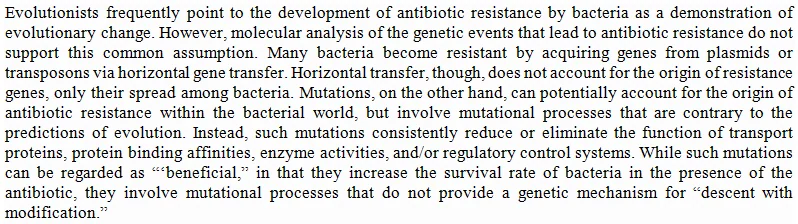
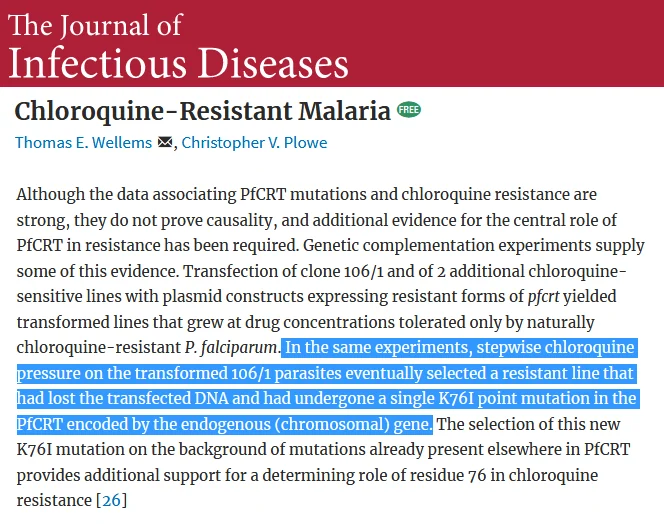
Anderson went on to demonstrate that some “fitness” cost is often associated with mutations, although reversion mutations may eventually recover most, if not all, of this cost in some bacteria. A biological cost occurs when there is a loss of pre-existing cellular systems or functions—but such loss of cellular activity cannot legitimately be presented as genetic evidence of evolution. Rather, it serves as evidence of devolution. In layman’s terms, antibiotic resistance can arise in different ways. For instance, bacteria may lose parts of their DNA that store information and code for certain traits. In other words, they may alter their structures so they continue functioning as before, but in a way that prevents the antibiotic from recognizing or affecting them. A well-known example is the malaria parasite, which developed antibiotic resistance through the loss of a portion of its DNA. When doctors stopped prescribing chloroquine, the newly resistant strains disappeared and the original strains reemerged. Unquestionably, this partial DNA loss is an instance of devolution rather than evolution.7
In short, antibiotic resistance exemplifies variation, not neo-Darwinian evolution.
Notes and References
- 1
Casey Luskin, “Specious Speciation: The Myth of Observed Large-Scale Evolutionary Change: A Response to Talk Origins’ “Observed Instances of Speciation” FAQ,” Center of Science and Culture, updated 9 Sep. 2013, https://www.discovery.org/m/2019/03/Casey-Luskin-Specious-Speciation.pdf.
- 2
Joseph Boxhorn, “Observed Instances of Speciation,” The Talk Origins Speciation Archive, last update: 1 Sep. 1995, http://www.talkorigins.org/faqs/faq-speciation.html.
- 3
Alan L. Gillen, The Genesis of Germs: The Origin of Diseases and the Coming Plagues, (Green Forest, U.S.: New Leaf Publishing Group, 2007), chapter 1: “Is Antibiotic Resistance Proof of Evolution?” section 4, available at: https://answersingenesis.org/natural-selection/antibiotic-resistance/is-antibiotic-resistance-proof-of-evolution/.
Microbes have acquired resistance to antibiotics in a number of ways. With some antibiotics (e.g., penicillin) resistance arises from the microbe’s ability to destroy the antibiotic before the antibiotic destroys the microbe. Resistance may occur in bacteria during the normal course of events, as happened with penicillinase-producing bacteria. Resistance can also arise from changes in the pathways of the microbial cell wall and membrane that restrict movement of the antibiotic into the cytoplasm. Alternatively, a microbe may alter the metabolic pathway on which an antibiotic normally acts and thereby bypasses the drug inhibition. Resistance may also develop when a bacterium changes the target of the antibiotic (e.g., tetracycline), such as by changing the structure of its ribosome. The most common mechanism of transfer is through the conjugative transfer of R plasmids. R plasmids frequently carry several resistance genes, each mediating resistance to a specific antibiotic. Thus, when a bacterium acquires R plasmid, it acquires resistance to several medications simultaneously. If a bacteria strain has multiple resistance factors, it is frequently known as a “superbug.” These superbugs are troublesome in many hospital and clinical settings.
- 4
Ibid.
There is “warfare” in the soil between bacteria and fungi and among bacteria…One of the most convincing studies that demonstrate that bacteria become resistant to antibiotics through “old” genes present in the past was published in 1988. In that study, individual bacteria from the intestines of explorers who had been frozen before the development of antibiotics were shown to already be resistant to several antibiotics that had not been developed until after the explorers were frozen. Thus, the genes that produced resistance were already there. Thus, it is very likely that kind of antibiotic resistance has been in nature for a long time.
- 5
Ed Struzik, “Ancient Bacteria Revived,” Sunday Herald, (Calgary, Alberta, Canada), 16 Sep.1990 as cited in ibid.
- 6
Kevin L. Anderson, “Is Bacterial Resistance to Antibiotics an Appropriate Example of Evolutionary Change?” Creation Research Society Quarterly, vol. 41, March 2005, available at: https://www.creationresearch.org/crsq-2005-volume-41-number-4_is-bacterial-resistance-to-antibiotics.
- 7
Thomas E. Wellems and Christopher V. Plowe, “Chloroquine-Resistant Malaria,” The Journal of Infectious Diseases, vol. 184, issue 6, 15 Sep. 2001, pp. 770–776. DOI: https://doi.org/10.1086/322858.