Is the coccyx a useless remnant of our evolutionary past? Are so-called “human tails” an evolutionary throwback?
The coccyx,1 commonly known as the tailbone, is perhaps the most frequently cited example of a so-called “useless” evolutionary vestige in humans. This oft-repeated claim dates back over a century to Charles Darwin, who pointed to the coccyx as a supposed vestigial structure indicating our descent from tailed ancestors. In The Descent of Man, Darwin wrote: “In certain rare and anomalous cases it [the coccyx] has been known, according to Isidore Geoffroy St.-Hilaire and others,39 to form a small external rudiment of a tail.”2 Proponents of this myth claim that the coccyx is a vestigial tail, a leftover from our alleged tailed, ape-like ancestors. Fortunately, although many in the medical field have been influenced by evolutionary speculation, they have generally refrained from surgically removing a normal coccyx. The human coccyx consists of four or five small vertebrae fused into a single bone at the lower end of the vertebral column. It is commonly referred to as the “tailbone” due to its superficial resemblance to a tail. As David Menton—a creation scientist and an exceptionally informative speaker, writer, and researcher at Answers in Genesis—pointed out, the coccyx does occupy the same relative position at the end of the vertebral column as a tail does in tailed primates. But then, where else would it be? The vertebral column is a linear structure that supports the head at one end and must terminate at the other. No matter where it ends, evolutionists will likely label it a vestigial tail.3 Evolutionists claim that the human coccyx serves no real purpose beyond reminding us of our evolutionary ancestry. However, the coccyx does, in fact, serve several important functions. Six muscles extend from the ring-like bones of the pelvic brim and attach to the coccyx, forming a bowl-shaped muscular structure known as the pelvic diaphragm:4

In fact, even human abnormalities entirely unrelated to the coccyx have been labeled by evolutionists as “human tails.” In the May 20, 1982 issue of The New England Journal of Medicine, physician-scientist Fred Ledley published a clinical case report titled “Evolution and the Human Tail.” The report described a baby born with a two-inch-long fleshy growth on its lower back that bore a superficial resemblance to a tail. Ledley strongly suggested that this growth—referred to as a caudal appendage—was essentially a “human tail,” even though he admitted that it exhibited virtually none of the defining biological features of a true tail.5 All true tails contain bones that are a posterior extension of the vertebral column. They also include muscles associated with those vertebrae, allowing for movement of the tail. Ledley acknowledged that there has never been a single documented case of an animal tail lacking these defining features—nor has there been a single instance of a human caudal appendage possessing them. In fact, the caudal appendage Ledley described was simply a fatty outgrowth of skin, and it was not even located in the correct position on the back to qualify as a tail. Nevertheless, he viewed this caudal appendage as compelling evidence for human evolution from ape-like ancestors. He stated:6

Indeed, only within the framework of evolution can such trivial data be extrapolated into supposedly profound and “inescapable” facts.
As noted earlier, Darwin was the first to propose that humans born with a so-called “vestigial” tail—a rare medical condition—represent an evolutionary remnant, pointing to our descent from a tailed ancestor. A 1985 paper published in the Journal of Neurosurgery explains that the classical Darwinian view of the “human tail” is itself a legacy of recapitulation theory:7

The author of this paper argued that “the true human tail is a benign condition not associated with any underlying [spinal] cord malformation.8 Carly Cassella—a senior science journalist at ScienceAlert—explained that this 1985 paper was, in fact, largely responsible for popularizing the myth that human tails are an evolutionary throwback:9

The Darwinian myth of the human “tail” persists—a true vestige—in the writings of Darwin’s modern advocates. Jerry A. Coyne, a biologist and prominent proponent of Darwinian evolution, echoed this claim in his book Why Evolution Is True, where he asserts that “tails appear to be true atavisms” and incorrectly states that these tails can resemble a normal “tail” with vertebrae.10 Physicist and Darwin advocate Karl Giberson expresses a similar view regarding human tails, claiming they result from the accidental activation of vestigial genes. He reiterated this myth during his 2014 debate with Stephen Meyer, director and senior fellow at the Center for Science and Culture at the Discovery Institute in Seattle.11 Writing for The Daily Beast about his debate with Meyer, Giberson remarked:12

Giberson thus articulated the standard Darwinian perspective on the human tail, making three key claims:
1.That “babies are born with perfectly formed, even functional tails”;
2.That such babies are “otherwise healthy”; and
3.That “the scientific explanation is that we inherited these instructions from our tailed ancestors, but the instructions for producing them have been shut off in our genomes.”
In response, Casey Luskin used Giberson’s remarks from the debate with Meyer as an opportunity to closely examine the classical evolutionary view of the human tail. He delved into the peer-reviewed scientific and medical literature on the topic and gained extensive insight. Luskin documented his findings in a series of articles published at Evolution News.13 At the conclusion of his series, Luskin presented the following findings based on his review of the scientific literature:
1.No babies are born with perfectly formed, fully functional tails.
2.Babies born with tails often have serious associated neurological defects.
3.While the exact causes of these tails remain debated, their consistent link with neurological abnormalities makes it most likely that they result from developmental irregularities or malformations.
Luskin contended that Giberson was mistaken on multiple fronts. Most notably, he emphasized that, according to the medical literature, there is not a single documented case of a human being born with what Giberson describes as a “perfectly formed, even functional tail.”14

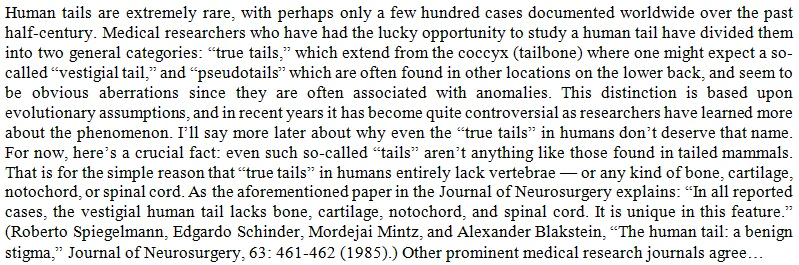
Luskin observed that this distinction is rooted in evolutionary assumptions and has become increasingly controversial in recent years as researchers have gained deeper insight into the phenomenon. He argued that even so-called “true tails” in humans are misnamed, as they bear no resemblance to the tails of other mammals—or any other animals for that matter—because they completely lack vertebrae, as well as any form of bone, cartilage, notochord, or spinal cord.15 As the aforementioned paper in the Journal of Neurosurgery explains:16

Luskin also cited other leading medical research journals that support the conclusions of the Journal of Neurosurgery:17
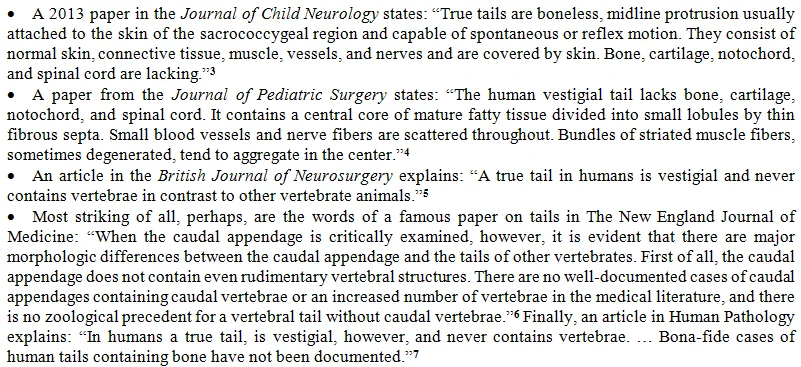
Clearly, these observations do not support the notion that humans can have “perfectly formed, or even functional tails.” As Luskin noted, it is hard to claim that any such structure is a “bona fide” (i.e., true) tail if it is not “bone-fied.” While “pseudotails” may occasionally contain bone, they do not contain vertebrae—as all true mammalian tails do. Moreover, they are not located at the base of the coccyx, where a true tail would be expected, but rather appear in various locations along the lower back and may even be offset from the spine. In addition, pseudotails are frequently associated with other abnormalities and are clearly deformities. Luskin cited multiple studies that have acknowledged this point:18
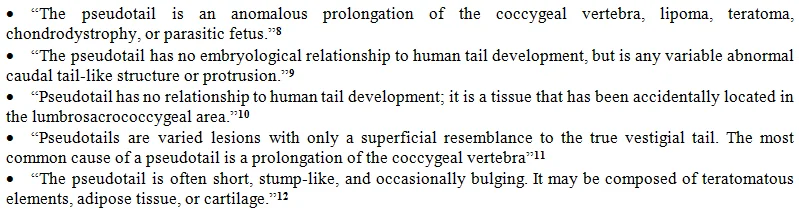
In other words, as Luskin explained, if a human has a bony tail, it is not a “true tail” but rather a “pseudotail,” typically associated with other abnormalities. Conversely, if it is considered a “true tail,” it lacks bone, cartilage, notochord, spinal cord—and, crucially, no human tail has ever been found to contain vertebrae.
Luskin evaluated Giberson’s claim that so-called human tails result from the accidental “turning on” of vestigial genes inherited from our tailed ancestors. He pointed out that Giberson’s pseudo-recapitulationist view—that humans born with tails have merely activated dormant genes lying unused in the genome, as if true tails represent a reversion to an earlier evolutionary form—echoes arguments he previously made in his book Saving Darwin, where he wrote: “Two-month-old embryos of chicken, pigs, fish, and humans look similar. They all have gills, webbed hands and feet, and tails. In a few weeks these formations disappear from the human embryo.”19 Luskin disagreed with Giberson, emphasizing that human embryos do not, in fact, develop gills.20 He also noted that the presence of webbed feet—a condition known as syndactyly—in embryos is not a vestige of amphibian ancestry, but rather a normal and purposeful stage in the development of hands and feet.21 As Luskin explained, the “webbed hands and feet” cited by Giberson are simply part of the normal developmental process of the human limbs: digits begin forming within a mass of tissue, and the tissue between them later recedes. This does not suggest that humans pass through an “amphibian” stage. Rather, it reflects a logical and efficient method of forming hands and feet. In some cases, babies are born with webbed feet due to a developmental defect. In any case, Luskin maintained that Giberson’s attempt to portray human tails as a regression to an earlier evolutionary state is contradicted by the actual developmental evidence surrounding so-called “true tails.”22 Luskin explained that during normal human embryogenesis, a “tail”-like structure emerges around the fourth or fifth week of development. However, this is not, as Giberson claims, the result of vestigial genes—normally “turned off”—being accidentally reactivated as part of a regression to some primitive ancestral state:23

Luskin pointed out that the appearance of a temporary tail during development is neither unusual nor unique; many structures emerge briefly and then regress as part of normal embryogenesis. He cited a significant 2001 paper published in Annals of Anatomy to support this observation.24 The authors of the paper acknowledged that “during normal human development, a number of transient structures form and subsequently regress completely.”25 They observed that “one of the most prominent structures that regress during development is the human tail.”26 They went on to explain that it is not uncommon for cells—or even entire macrostructures—to undergo programmed cell death during development: “In the process of development and in adult life, large numbers of cells are known to die in many different tissues. In some cases, whole regions or entire organs are eliminated.”27 Luskin observed that Giberson is perpetuating something of a Darwinian legend by claiming that the human tail results from ancient genes that fail to be “turned off.” According to Giberson, the tail is an unusual structure that forms abnormally when vestigial genes are unexpectedly activated. In reality, however, the tail is a normal feature of early human development, and babies are born with a tail only when this structure fails to be reabsorbed into the embryo during the typical course of embryogenesis.28 Another article in Pediatric Neurosurgery similarly states that “the true tail can be explained as a failure of complete regression of the nonvertebrate part of the tail at 8 weeks of pregnancy.”29 Hence, the occasional birth of human babies with tails does not indicate a relationship to animals with tails. On the contrary, the actual causes of so-called “true tails” have led some physicians to suspect that they are not signs of evolutionary regression, but rather the result of a developmental “disturbance.” This view is widely acknowledged within the medical community. The authors of a frequently cited paper in Pediatric Neurology state:30

The authors of another paper published in Advances in Orthopedics express the same conclusion.31 Luskin argued that a compelling piece of evidence supporting the view that even so-called “true tails” are developmental anomalies is their strong association with other deformities and medical conditions. He explored this point in a separate article, where he highlighted data that directly challenge the claim that the human tail is a “benign” structure appearing in “otherwise healthy” infants. The conclusion is clear: the presence of a human tail is typically indicative of an underlying developmental abnormality.32 Unfortunately, the evolutionary perspective initially led some doctors to view the so-called human tail as a benign structure that could be surgically removed without further concern or thorough examination. In another article, Luskin explored the medical harms that have resulted from this now thoroughly outdated notion—a legacy of Darwin that continues to be promoted today by proponents such as Giberson.33 Luskin concluded that the advancement of medical understanding came through moving beyond Darwinian thinking. One might ask: if both pseudotails and true tails are associated with many of the same developmental abnormalities, could this indicate a shared underlying cause? While the precise causes of this medical phenomenon—namely, why some humans are occasionally born with tails—are not yet fully understood, Luskin presented substantial evidence from the research literature suggesting that these structures are best and most reasonably interpreted not as evolutionary relics, but as developmental defects often accompanied by other abnormalities.34 He concluded his series of articles at Evolution News examining whether the human “tail” is an atavism—an evolutionary throwback that supports the case for evolution—with the following statement:35

Luskin demonstrated that each of the evolutionists’ claims regarding so-called human tails is unfounded. Interestingly, the aforementioned article by Carly Cassella at ScienceAlert has fully vindicated Luskin’s arguments on the subject.36 Essentially, Cassella’s well-written article titled “Some Babies Are Born with ‘Tails’, But Not for the Reason You Might Think” arrived at the same conclusions as Luskin. She began by observing that many people still believe human “tails” are evolutionary throwbacks—but this, she noted, is not what the medical evidence actually shows:37
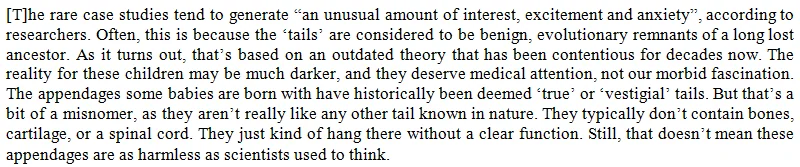
This is precisely what Luskin found in his review of the scientific literature, as he explained:38
Like Luskin, Cassella reported that even the so-called “true tails” are often linked to birth defects, indicating that they are not harmless evolutionary atavisms to be dismissed, but rather developmental abnormalities that warrant serious medical attention:39

Cassella went on to draw a conclusion strikingly similar to Luskin’s—namely, that so-called human tails are not harmless vestigial traits, but rather indicators of underlying developmental issues:40

The ScienceAlert article cited more recent literature that has emerged since Luskin published his review in 2014. Indeed, it is encouraging to see that Luskin’s conclusions regarding the human tail have stood the test of time. Thus, yet another evolutionary icon has been overturned by the weight of the evidence.
Notes and References
- 1
The term “coccyx” is derived from the Greek word kokkyx, meaning the beak of a cuckoo bird, due to the resemblance in shape when viewed from the side.
- 2
Charles Darwin, The Descent of Man, and Selection in Relation to Sex, (London, U.K.: John Murray, 1871), chapter 1, p. 29.
- 3
David Menton, “Chapter 24: Vestigial Organs—Evidence for Evolution?” in Ken Ham, The New Answers Book Vol. 3: Over 35 Questions on Evolution/Creation and the Bible, (Green Forest, U.S.: Master Books, 2010), available at: https://answersingenesis.org/human-body/vestigial-organs/vestigial-organs-evidence-for-evolution/.
- 4
Ibid.
- 5
F. D. Ledley, “Evolution and the Human Tail: A Case Report,” The New England Journal of Medicine, vol. 306, no. 20, 20 May 1982, pp. 1212–1215. DOI: https://doi.org/10.1056/NEJM198205203062006.
- 6
Ibid.
- 7
Roberto Spiegelmann et al., “The Human Tail: A Benign Stigma,” Journal of Neurosurgery, vol. 63, 1985, p. 461–462.
- 8
Ibid.
- 9
Carly Cassella, “Some Babies Are Born With 'Tails', But Not for the Reason You Might Think,” ScienceAlert, 25 June 2023, https://www.sciencealert.com/some-babies-are-born-with-tails-but-not-for-the-reason-you-might-think.
- 10
Jerry A. Coyne, Why Evolution Is True, (London, U.K.: Penguin Books, 2010), pp. 65–66.
- 11
“Should Christians Embrace Darwin?” YouTube, uploaded by Richmond Study Center, 24 Apr. 2014, https://www.youtube.com/watch?v=9sXsRa8vDpw.
- 12
Karl W. Giberson, “My Debate With an ‘Intelligent Design’ Theorist,” The Daily Beast, 21 Apr. 2014, https://www.thedailybeast.com/my-debate-with-an-intelligent-design-theorist/.
- 13
Casey Luskin, “Another Icon of Evolution: The Darwinian Myth of Human “Tails”“ Evolution News, 22 May 2014, https://www.discovery.org/a/23041/.
- 14
Casey Luskin, “Are Humans Ever Born with “Perfectly Formed” Tails?” Evolution News, 12 May 2014, https://evolutionnews.org/2014/05/are_humans_ever/.
- 15
Ibid.
- 16
Roberto Spiegelmann et al., “The Human Tail: A Benign Stigma,” Journal of Neurosurgery, vol. 63, 1985, p. 461–462.
- 17
Casey Luskin, “Are Humans Ever Born with “Perfectly Formed” Tails?” Evolution News, 12 May 2014, https://evolutionnews.org/2014/05/are_humans_ever/.
- 18
Casey Luskin, “Are Humans Ever Born with “Perfectly Formed” Tails?” Evolution News, 12 May 2014, https://evolutionnews.org/2014/05/are_humans_ever/.
- 19
Karl Giberson, Saving Darwin: How to Be a Christian and Believe in Evolution, (San Francisco, U.S.: HarperOne, 2009), p. 200.
- 20
Jonathan Wells, “Haeckel’s Embryos and Evolution: Setting the Record Straight,” The American Biology Teacher, vol. 61, issue 5, May 1999, pp. 345–349, http://www.discovery.org/f/629.
- 21
Steven Miller, “Webbed Toes,” Footvitals, 28 Jan. 2014, http://www.footvitals.com/toes/webbed-toes.html.
“The exact cause of webbed toes is still unknown. Some used to speculate that it was inherited, since family members often share the condition, but it is also common for only one member of a family to have webbed toes. Some studies show a pregnant woman’s nutritional intake during early gestation and smoking during pregnancy can also contribute to deformities such as webbed toes. Webbed toes are also associated with rare conditions such as: Down syndrome, Apert’s syndrome, Poland syndrome, Holt-Oram syndrome, Carpenter’s syndrome, Edward’s syndrome, Fetal hydantoin effect (using the medication hydantoin during pregnancy), Miller syndrome, Pfeiffer syndrome, Amniotic Band syndrome, also known as constriction band syndrome, Smith-Lemli-Opitz syndrome, Aarskog-Scott syndrome, Bardet-Beidl syndrome, Cornelia de Lange syndrome, Familial syndactyly, Timothy syndrome. Unfortunately, the list above is not complete. There are over 100 different syndromes that are associated with webbing of the digits.”
- 22
Casey Luskin, “Do Human “Tails” Represent the Simple “Turning On” of Genes Retained from Our Ancestors?” Evolution News, 13 May 2014, https://evolutionnews.org/2014/05/do_human_tails_/, footnote 14.
- 23
Ibid.
15 Daniel J. Donovan Robert C. Pedersen, “Human Tail with Noncontiguous Intraspinal Lipoma and Spinal Cord Tethering: Case Report and Embryologic Discussion,” Pediatric Neurosurgery, vol. 41, 2005, pp. 35–40
16 Good descriptions of this process can be found in: Chunquan Cai et al., “Surgical Treatment of a Patient with Human Tail and Multiple Abnormalities of the Spinal Cord and Column,” Advances in Orthopedics, 2011: 153797; Frank L. Lu et al., “The Human Tail,” Pediatric Neurology, vol. 19, no. 3, 1998; Daniel J. Donovan Robert C. Pedersen, “Human Tail with Noncontiguous Intraspinal Lipoma and Spinal Cord Tethering: Case Report and Embryologic Discussion,” Pediatric Neurosurgery, vol. 41, 2005, pp. 35–40; Anh H. Dao and Martin G. Netsky, “Human Tails and Pseudotails,” Human Pathology, vol. 15, issue 5, May 1984, pp. 449–453; D. Sapunar et al., “Morphological Diversity of Dying Cells During Regression of the Human Tail,” Annals of Anatomy, vol. 183, 2001, pp. 217–222.
- 24
D. Sapunar et al., “Morphological Diversity of Dying Cells during Regression of the Human Tail,” Annals of Anatomy, vol. 183, 2001, pp. 217–222, (emphases added).
- 25
Ibid.
- 26
Ibid.
- 27
Ibid.
- 28
Casey Luskin, “Do Human “Tails” Represent the Simple “Turning On” of Genes Retained from Our Ancestors?” Evolution News, 13 May 2014, https://evolutionnews.org/2014/05/do_human_tails_/.
- 29
Se-Hyuck Park et al., “Teratoma in Human Tail Lipoma,” Pediatric Neurosurgery, vol. 41, issue 3, May - June 2005, pp. 158–161. DOI: https://doi.org/10.1159/000085876.
- 30
Frank L. Lu et al., “The Human Tail,” Pediatric Neurology, vol. 19, issue 3, Sep. 1998, pp. 230–233, available at: https://www.pedneur.com/article/S0887-8994(98)00046-0/abstract.
- 31
Chunquan Cai et al., “Surgical Treatment of a Patient with Human Tail and Multiple Abnormalities of the Spinal Cord and Column,” Advances in Orthopedics, vol. 2011, 2011: 153797. DOI: https://doi.org/10.4061/2011/153797.
- 32
Casey Luskin, “Are Human Tails Mere “Vestigial” or “Benign” Structures Born to “Otherwise Healthy” Babies?” Evolution News, 16 May 2014, https://evolutionnews.org/2014/05/are_human_tails/.
- 33
Casey Luskin, “How the Darwinian View of Human “Tails” Leads to Harmful Medical Practices,” Evolution News, 19 May 2014, https://evolutionnews.org/2014/05/how_has_the_dar/.
- 34
Casey Luskin, ““Pseudotails” and “True Tails” Have Similar Causes, Suggesting Both Are Birth Defects, Not Vestigial Holdovers,” Evolution News, 20 May 2014, https://evolutionnews.org/2014/05/pseudotails_and/.
- 35
Casey Luskin, “Human Tails: Another Evolutionary Icon that Coyne, Giberson and Other Darwin Defenders Would Be Wise to Abandon,” Evolution News, 22 May 2014, https://evolutionnews.org/2014/05/human_tails_ano/.
- 36
Carly Cassella, “Some Babies Are Born With 'Tails', But Not for the Reason You Might Think,” ScienceAlert, 25 June 2023, https://www.sciencealert.com/some-babies-are-born-with-tails-but-not-for-the-reason-you-might-think.
- 37
Ibid.
- 38
Casey Luskin, “Are Humans Ever Born with “Perfectly Formed” Tails?” Evolution News, 12 May 2014, https://evolutionnews.org/2014/05/are_humans_ever/.
- 39
Carly Cassella, “Some Babies Are Born With 'Tails', But Not for the Reason You Might Think,” ScienceAlert, 25 June 2023, https://www.sciencealert.com/some-babies-are-born-with-tails-but-not-for-the-reason-you-might-think.
- 40
Ibid.