Why am I a Muslim?
Without a doubt, I am a Muslim by the grace, mercy, and favor of Allāh. However, the evidence that Islam is true is abundant and sufficient to convince any wise person who sincerely and impartially seeks the truth. The first evidence for the validity of Islam is the fiṭrah (divinely endowed innate disposition toward monotheism/Islam). That is, Man has an innate, divinely created disposition toward the recognition of Allāh and submission to Him. The message of Islam is in harmony with sound fiṭrah. Like every human being on earth, I am predisposed to believe that I have a God who is my Creator. Every human being inherently knows that they have a God—who is the All-Powerful King, who created them, made them accountable, and provides sustenance for them; the Arranger of all affairs, who manages and controls all of creation with order and balance; and the true Owner of all things—and that this God alone is worthy of worship.1 The Qurʾān emphasizes that the acceptance of God’s lordship is innate in human nature.2

The Qurʾān recounts the primordial covenant between human beings and Allāh as an actual event. It states that Allāh brought into existence all human beings whom He intended to create until the Day of Judgment. He endowed them with life, consciousness, and the faculty of speech so that they might bear witness to His lordship. He made clear to them that there is no god or lord besides Him. The Qurʾān affirms that this covenant will be used as evidence against human beings on the Day of Judgment: {And ˹remember˺ when your Lord brought forth from the loins of the children of Adam their descendants and had them testify regarding themselves. ˹Allāh asked,˺ “Am I not your Lord?” They replied, “Yes, You are! We testify.” ˹He cautioned,˺ “Now you have no right to say on Judgment Day, ‘We were not aware of this’} (Qurʾān 7:172). As-Suddī commented on this verse, saying:3

Islam confirms and conforms to the divinely endowed innate disposition toward monotheism that the Creator has instilled within all people. The Qurʾān refers to this human religious disposition as fiṭrat Allāh—the natural Way of Allāh: {so be steadfast in faith in all uprightness ˹O Prophet˺—the natural Way of Allāh which He has instilled in ˹all˺ people} (Qurʾān 30:30). Humans should be steadfast upon this innate disposition that none but One God is their Creator, Lord, and Deity. If they serve and worship others besides Him, then they will be acting against their nature. This topic has been explained by the Prophet (PBUH), who said that every child is born upon the fiṭrah: “No child is born except upon the fiṭrah, and then his parents make him Jewish, Christian, or Magian.”4 That is, every child is born with the innate belief in Allāh and the inclination to worship Him alone. If the child were left alone, they would grow up aware of Allāh in His oneness, but all children are affected by the pressures of their environment. Their parents try to make them follow their own religion, and the children are not strong enough in the early stages of life to resist or oppose their parents. The religion which the child follows at these stages is one of custom and upbringing. When the child becomes a mature adult and clear proofs of the falsehood of their religion are presented to them, they are then expected to follow the true religion grounded in knowledge and reason.
The innate impulse within human beings to seek God or what they perceive as a higher power—something they have done in one form or another throughout recorded history—is the result of the primordial covenant between them and Allah. Some scientists today argue that belief in God or a higher power is hardwired into our genes. American geneticist Dean Hamer states that the inclination toward religious faith is not accidental, but is due largely to our genes.5 The Qurʾān teaches that all humans have the recognition of Allāh imprinted on their souls as part of the very nature upon which they are created. It states that it is not right to corrupt or spoil this nature: {Let there be no change in this creation of Allāh. That is the Straight Way, but most people do not know} (Qurʾān 30:30). As all human beings are born with a natural disposition to believe in Allāh, the divine revelations brought by the Prophets simply awaken and reinforce that disposition already within them. In other words, human beings sense the existence of God through pure instinct, with or without the Prophets to guide them. Even polytheists, who believe in multiple gods, believe that there is a greater God above them all. Allāh says: {And if you ask them who created the heavens and the earth, they will definitely say, “Allāh!”} (Qurʾān 31:25). Allah also says: {If you ask them ˹O Prophet˺ who created them, they will certainly say, “Allāh!”} (Qurʾān 43:87). Allāh has created human beings only for His own service. This natural disposition of human beings cannot be altered however hard one may try. In other words, human beings cannot change their position as servants, and nothing other than Allāh can become their God in the real sense. Of course, human beings may make for themselves as many gods as they may please, but the fact remains that they are the servants of none but One God alone. That is, human beings, by their own folly and ignorance, may regard anyone or anything as possessing divine attributes and as having the power to decree their destiny. However, the fact of the matter is that no one and nothing other than Allāh possesses divine attributes or the power to decree the destiny of human beings. Anyone who denies the innate knowledge of Allāh, which is His gift to all human beings, would be lying to himself. Through this innate knowledge, Allāh has given all human beings an opportunity to know Him because such knowledge cannot be easily ignored or silenced. That is why it is so easy for human beings to infer and recognize the Truth—Allāh being the only true God who has no partners or rivals.
The existence of Allāh is an intuitive truth that no human being can fail to know and acknowledge. This is why belief in His existence is universal and necessary. It is also due to this intuitive knowledge that all people turn to Allāh during times of adversity. That is, when faced with calamities, human beings—even polytheists and atheists—instinctively cry out, “O God!” This occurs because the nature of human beings testifies to the existence of Allāh: {When you are touched with hardship at sea, you ˹totally˺ forget all ˹the gods˺ you ˹normally˺ invoke, except Him. But when He delivers you ˹safely˺ to shore, you turn away. Humankind is ever ungrateful} (Qurʾān 17:67). This is a proof of the fact that human beings’ primordial nature knows no lord other than Allāh. In the depths of their hearts, all human beings feel that Allāh alone possesses the real power to bring benefit and ward off harm. Had it not been so, they would never invoke Him at a time when they realize that no other helper could relieve their misfortune. It is a fact that life-and-death experiences prompt a reality check. Therefore, even people who are so obstinate in their atheism acknowledge the Divine Power in moments of grave danger, hence the adage, “there are no atheists in the trenches.” That is, men who never prayed before pray with all their hearts when they are on the battlefield. The playwright and religious writer Hannah More made a very pertinent statement:6

During his radio broadcast on February 7, 1954, U.S. President Dwight D. Eisenhower said:7


Hence, I am a Muslim—that is, my soul submits naturally to Allāh as my Creator and Lord—by fiṭrah (the divinely endowed innate disposition toward monotheism/Islam). In other words, Islam is the path of primordial human nature. Therefore, all of Islam’s teachings, whether in matters of belief or practice, are in harmony with sound human nature. We do not find anything in the teachings of Islam that contradicts sound human nature, whereas other religions and ideologies contain elements that are at odds with it. This is clear to anyone who reflects deeply. In short, every human is born with an inherent inclination toward monotheism/Islam, and any deviation from monotheism/Islam is undoubtedly a departure from sound human nature.
In addition to the evidence of the fiṭrah (the divinely endowed innate disposition toward monotheism/Islam), the proofs that Islam is true can hardly be enumerated. Among them are the following:
Rational evidence: knowledge of Allāh resides primarily in the heart, but it is reinforced by reason. The Qurʾān calls upon people of sound reasoning to examine the conclusive evidence for the truth of Islam. It addresses the questions most human beings eventually ask themselves about the nature of existence—Why am I here? Why is there something rather than nothing?—through a cosmological discourse. It reminds them that it was Allāh who created everything, and it invites them to reflect upon the nature of their existence and the universe. Is it really plausible, sensible, and intuitive that the universe appeared arbitrarily and for no reason? Our reason, intuition, and experience tell us that effects have causes.8

One of the examples of rational evidence for Allāh’s existence in the Qurʾān is the verses in which Allāh says: {Or were they created by nothing, or are they ˹their own˺ creators? Or did they create the heavens and the earth?} (Qurʾān 52:35–36). These verses present three possibilities:
1.Humans came into existence without any agent bringing them into existence: this is logically impossible, for “out of nothing, nothing comes.”9

Atheists deny God out of stubbornness, but they surely affirm within themselves that nothing exists except that it has an originator.
2.Humans created themselves and the universe: this too is logically impossible. The claim that a thing can bring itself into existence is self-contradictory because in every case where something comes into existence, its cause exists prior to it. Thus, for humans to have created themselves, they would have had to exist prior to their own existence—a contradiction of the axiom of causality.
3.Humans and the universe must have been created by Allāh: Since the first two propositions are impossible—nothing comes from nothing, and something cannot create itself without violating the axiom of causality—the only reasonable conclusion is that humans and the universe were caused—that is, created by something outside themselves and more powerful than themselves. The Qurʾān puts the question before the disbelievers: Are you your own creators? Or have you created this vast universe? This is such a powerful question that it shakes polytheism and atheism to their very roots. Islam teaches that Allāh is our Creator and that we should worship Him alone. If one admits that Allāh alone is their Creator, as well as the Creator of the universe, why would they reject the religion that teaches that Allāh alone is worthy of worship? Ibn Ḥajar al-ʿAsqalānī explains the meaning of these verses (Qurʾān 52:35–36) by quoting the scholar al-Khaṭṭābī:10

Scholars derive from these verses and others a logical line of reasoning, sometimes referred to as the cosmological argument, which concludes that Allāh, as the Uncaused Cause or First Cause, is the most reasonable answer to the existential question. İsmail Latif Hacınebioğlu summarizes the logic of this argument in the following steps:11

This line of reasoning finds validation in human intuition and experience and is acceptable to the mind. It sufficiently answers the question of why anything exists in the first place. Jubayr ibn Muṭʿim narrated: “I heard the Prophet (PBUH) reciting Chapter aṭ-Ṭūr during the maġrib (evening), prayer, and when he reached the verses: {Or were they created by nothing, or are they ˹their own˺ creators? Or did they create the heavens and the earth? In fact, they have no certainty. Or do they possess the treasuries of your Lord, or are they in control ˹of everything˺?} (52:35 –37) my heart was about to fly (when I realized the force of this argument)!”12 Jubayr embraced Islam because the argument in the verses is so compelling.
Those who deny the existence of the Creator argue that the universe has always existed in an endless series of causes, or an infinite regress, without the need for a first cause to set it in motion. This is an attempt to challenge the a priori premise that the universe has a definite beginning. However, this argument is counter-intuitive, as all things we experience in life had a beginning at some point. Moreover, modern physics and cosmology are broadly consistent with the cosmological argument’s premise that the universe had a beginning. According to the Big Bang theory, the universe began from a highly dense initial state somewhere between 12 and 14 billion years ago.13 Furthermore, even if, for the sake of argument, we accept the idea of an infinite regress despite the lack of scientific or intuitive evidence for it, this does not discount the need for a cause beyond time and space to produce and sustain it. Polymath and philosopher Gottfried Wilhelm Leibniz asserted that an infinite series must still have a sufficient reason for its existence. As Leibniz put it, since each part of the series depends on the preceding part, the sufficient reason for the series as a whole must lie outside it. He argued that this ultimate explanation must be a necessary being, which he identified with God:14

Likewise, physicist Don Page gives the example of an artist drawing a circle on a canvas: although the circle has no beginning or end, it still requires an external artist to draw it.15 The point is that, regardless of whether it is finite or infinite in nature, the universe must have had a Creator as the ultimate explanation of its existence.
The cosmological argument is strong in itself, but it is only one part of a much broader Qurʾānic discourse on the nature of existence. The Qurʾān complements it with an even more compelling teleological argument—that the world is designed. It persistently draws attention to signs in nature that demonstrate the grandeur, order, and design inherent in creation. It calls humans to reflect on all these signs as a means of recognizing purpose and attaining conviction. Allāh says: {Indeed, in the creation of the heavens and the earth and the alternation of the day and night there are signs for people of reason. ˹They are˺ those who remember Allāh while standing, sitting, and lying on their sides, and reflect on the creation of the heavens and the earth ˹and pray˺, “Our Lord! You have not created ˹all of˺ this without purpose. Glory be to You! Protect us from the torment of the Fire} (Qurʾān 3:190–191). It is natural and intuitive for us to recognize that the universe is teleological (i.e., it has purpose and design):16

Even Charles Darwin himself, who is often portrayed as a champion of atheistic philosophies, frequently employed the language of design and purpose in his scientific writings.17
Highlighting the signs of Allāh’s work in nature is a very powerful rational method for affirming the existence of the Creator. Allāh says: {We will show them Our signs in the universe and within themselves until it becomes clear to them that this ˹Quran˺ is the truth. Is it not enough that your Lord is a Witness over all things?} (Qurʾān 41:53). There are signs of Allāh in everything we see at every level:18

The Qurʾānic verses highlighting the powerful evidence contained in Allāh’s signs throughout the universe, and indicating that there is no God besides Allāh and no Lord like Him, are abundant. The Qurʾān establishes the idea that the universe was indeed designed by a single Creator, not by many different gods. The fact that the natural laws of the universe are deliberate, consistent, and unified in their purpose confirms this truth. Allāh says: {Had there been other gods besides Allāh in the heavens or the earth, both ˹realms˺ would have surely been corrupted. So Glorified is Allāh, Lord of the Throne, far above what they claim} (Qurʾān 21:22). All of the forces in the universe work together toward a common end: its creation and continued sustenance.19

The teleological argument is validated by science, which provides ample reason to believe in Allāh. Ironically, modern science implicitly depends on a monotheistic premise, namely, the assumption that uniform patterns exist within the fabric of the universe. Science would not advance at all without this premise. In fact, as science has advanced considerably, scientists have come to take for granted the consistency and universality of the laws of the universe.20 Paul Davies and many other physicists maintain that the laws of the universe require a plausible explanation. In their view, it is irrational—and unscientific—to assume that these laws came to be as they are for no reason:21

The fact that the universe is designed for life is the only reasonable conclusion that explains why things are as they are. Scientists have referred to this as the finely tuned universe or the anthropic principle. That is, the laws of the universe are configured with astonishing precision in order for the universe to exist and for life to thrive. Physicist and philosopher Robin Collins noted:22

Collins examined six compelling cases of fine-tuning embedded in the fabric of the universe:23

Each of these forces and phenomena is balanced in a way that produces the wondrous universe in which we live. Again, it is irrational to assume that all of these natural laws, with every miracle that they produce, appeared without cause or purpose. Upon examining the emerging evidence of fine-tuning, the legendary British philosophy professor Antony Flew, who wrote against theism for over fifty years, concluded that some intelligence beyond humanity must account for the origins of life and the complexity of the universe.24 Flew asserted that theism cannot be dismissed as wishful thinking or superstition. According to him, the real superstition is the ungrounded dogma that the universe is a purposeless accident. Allāh says: {And they argue, “There is nothing beyond our worldly life. We die; others are born. And nothing destroys us but ˹the passage of˺ time.” Yet they have no knowledge ˹in support˺ of this ˹claim˺. They only speculate} (Qurʾān 45:24).
Science provides ample reason to believe in God. For example, DNA points to the existence of God. As mentioned earlier, Antony Flew, who was a leading advocate of atheism for more than half a century, changed his mind and ultimately came to believe in God. Flew concluded that “super-intelligence is the only good explanation for the origin of life and the complexity of nature.”25The discoveries concerning DNA were central to his conclusion. Here is why:26

Dr. Francis Collins, the director of the Human Genome Project, which mapped the structure of human DNA, stated that one can “think of DNA as an instructional script, a software program, sitting in the nucleus of the cell.”27 Perry Marshall, an information specialist, commented on the implications of this, saying:28

Just as former atheist Antony Flew questioned the origin of the DNA script, ultimately concluding that its immense, code-like complexity implies an intelligent designer, everyone should ask himself who the author of this three-billion-letter script that informs and directs the cell’s processes is. Finding a complex working code inside the cell is comparable to finding a readable message written on a beach; both logically point to an intelligent source behind them. On June 26, 2000, President Bill Clinton congratulated the scientists who completed the first draft of the Human Genome Project, saying: 29

Dr. Francis Collins followed Clinton to the podium, stating,30

When looking at the DNA structure within the human body, we cannot escape the impression of incredibly intelligent design. Unquestionably, Allāh has designed DNA to instruct the cell. Thus, DNA is further evidence for Allāh, the designer of our bodies as well as the entire universe.
Hence, Islam inspires conviction by appealing to the heart, intuition, and experience of human beings. It also appeals to their reason, particularly their ability to reflect upon the teleology of existence. That is, the faculty of reason works in tandem with a sound heart to arrive at a state of certainty in faith. Modern scientific discoveries further reinforce this conviction. Again, humans are born in a state of natural purity and original goodness, which inclines them toward submission to Allāh and righteous actions. This inherent disposition toward virtue endows them with the ability to distinguish between right and wrong. Conscience is that inner voice that helps people judge the morality of their actions. It guides them to follow Allāh’s Law by doing good and avoiding evil. This innate moral sense is expressed in principles that no one can deny or be unaware of (e.g., murder is wrong; helping the needy is right). That is why, when good people are torn by the struggle between duty and desire—the conflict between altruism and self-interest—their inborn sense of morality requires them to do certain things regardless of their own preferences. The recognition of Allāh—a being to whom we are answerable—is inherent in the very idea of accountability. Hence, every human carries evidence of the existence of Allāh in the very constitution of his being as a moral agent. This sense of moral responsibility is absolutely universal, and so too is the knowledge of Allāh.
Someone might ask: Deists believe in the existence of a Creator, so what is the problem with deism? Deism suffers from grave theological difficulties that render it an unviable worldview worthy of rejection. Before proceeding to the critiques of deism, I would like to share a definition of deism offered by Bassam Zawadi—a Muslim author who holds a Master’s degree in Philosophy of Religion and Ethics from the University of Leeds and writes extensively on issues related to Islamic apologetics and modernist discourse within Islam.31

Deists reduce the role of God to the mere act of creation. That is, they affirm God but deny divine providence and intervention in the world. In other words, they adopt the “absentee God” doctrine, whereby God created the world and then abandoned it. The stance deists take toward revealed religion directly correlates with their view of God’s providence. That is, they deny God’s providence and therefore vehemently reject the notion of divine revelation. The dominant view among them is that religious beliefs can be acquired through reason alone. Hence, there is no need for God to communicate with humans through divine revelation, and any religious beliefs that cannot be acquired solely through reason must be rejected. Deists disagree over the moral character of God—some uphold Him as the ultimate good that all humans should aspire to emulate, while others strip Him of any virtuous moral traits. Deists also disagree over whether divine judgment after death will occur. In light of the above, there are no good reasons to think that deism is true, for it is incoherent in light of God’s wisdom and moral character, as well as inconsistent with the possibility and significance of divine revelation. I am mentioning these three critiques in general terms because I do not have room to discuss them in detail here. Zawadi presented these critiques in much greater detail. In the first critique, he demonstrated that deism does not make sense in light of God’s attribute of wisdom, since divine wisdom entails that action is taken only when there is an underlying purpose—something that is incongruent with the deistic denial of divine providence. In the second critique, Zawadi argued that God’s non-involvement in the world is discordant with affirming His attribute of goodness. He also criticized those deists who do not affirm God’s goodness by arguing that this leaves them with unappealing theological implications. In the third critique, Zawadi highlighted the importance of divine revelation in order to undermine the deistic claim that it is unnecessary or futile. He demonstrated that not only is revelation required, but it is also unfitting for a perfectly wise and good God not to communicate with humanity through revelation. Furthermore, Zawadi refuted two arguments in favor of deism. The first concerns whether miracles are possible, and he showed that miracles are not only logically possible but also plausible. The second is the argument from divine hiddenness, which he demonstrated rests on several highly disputable assumptions about how clearly God should be known to human beings.32
By definition, all deists believe in God, but not the God Muslims have in mind: the King, the All-Powerful, the Lord of the Worlds, the Creator of everything, the One who manages all affairs, the All-Wise, and the All-Knowing.33 The deistic God is said to have always existed but to have done nothing thereafter. In that sense, there is little practical difference between deists and atheists. Dutch philosopher Baruch Spinoza has often been regarded as a leading atheist of the Western tradition, yet he frequently used the word “God” (Deus) throughout his writings. However, he employed it in a sense distinct from traditional Judeo–Christian–Islamic monotheism. Spinoza’s most famous and controversial idea is that God is not the creator of the world, but that the world is part of God. He held that God is equivalent to the totality of natural laws, and not an individual entity or personal creator—God is necessarily identical with nature. This position is commonly identified as pantheism—the view that God is nature and nature is God—which conflicts with the teachings of the Abrahamic religions. In a similar vein, deism emphasizes natural theology—the idea that God’s existence is known through nature. The key point is that deists believe God created the universe and then left it to itself, whereas atheists do not believe in any god. Beyond this, there is little substantive difference. Both reject theistic commitments that include divine revelation, inerrant sacred texts, divine intervention, miracles, answered prayers, details of the afterlife, and a specific moral law, among other things. This is why the prominent atheist Richard Dawkins described pantheism as “sexed-up atheism” and deism as “watered-down theism.”34 Here is what Dawkins means by his characterization of deism as “watered-down theism.”35

Many deists are not satisfied with Dawkins’ characterization of deism as “watered-down theism.” They argue that they do not see how deism can be described as watered-down theism when they hold views that are identical to those of atheists, with one exception—namely, that they believe something other than chance initiated the universe. They maintain that beyond this point, there are no meaningful differences, since they do not pray to whatever they believe initiated the universe, nor do they adjust their behavior in order to please it. Again, deists believe in a Creator whose activity was confined to establishing the laws that govern the universe, after which He neither intervenes nor has any interest in human affairs. Deism renders God unnecessary and leads directly to atheism—the use of reason alone becomes a stepping stone to atheism.36

The deistic god is one that created the universe but plays no further part in it. Indeed, were such a god to exist, it would be indistinguishable from one that does not exist. Glorified and Highly Exalted is Allāh above what they claim! Deism is therefore both baseless and pointless. Deists do not uphold tawḥīd al-asmāʾ wa-ṣ-ṣifāt (the oneness of Allāh’s Names and Attributes), which is kufr (disbelief). That is, they do not affirm an Ever-Living, Self-Subsisting, All-Powerful Lord who has foreknowledge of all things and supreme control over everything. In other words, unlike theists in general, and Muslims in particular, deists do not believe that everything in the universe takes place according to the knowledge, will, and command of Allāh, and that divine justice and wisdom are the foundation of the entire act of creation. Rather, they ascribe the attributes of the Creator, Allāh, to nature or to created forces which are great but not self-sufficient or independent. Scholars unanimously agree that those who attribute Allāh’s names and attributes to nature are mulḥidūn (an Islamic religious term meaning deviants, atheists, or heretics). Hence, deists fall into the category of mulḥidūn described in the Noble Qurʾān. Allah says: {Allāh has the Most Beautiful Names. So call upon Him by them, and keep away from those who abuse His Names. They will be punished for what they used to do} (Qurʾān 7:180). The Arabic expression rendered “abuse His names” is yulḥidūna fī asmāʾihi, which means committing ilḥād (deviation) in relation to the Names of Allāh. This consists of choosing names that fall short of His majestic dignity and are inconsistent with the reverence due to Him—names that ascribe evil or deficiency to Allāh or reflect false notions about Him. Likewise, calling a creature by a name that befits Allāh alone is equally blasphemous. Hence, deists are atheists who blindly follow their deviant and erroneous conceptions of Allāh without knowledge: {In fact, the wrongdoers merely follow their desires with no knowledge} (Qurʾān 30:29). Did any deist witness Allāh create the universe and then “step back,” leaving it to run on its own according to natural laws, and leaving us on our own? Allāh says: {Did they witness their creation? Their statement will be recorded, and they will be questioned!} (Qurʾān 43:19). Deists have no evidence for their claim that God exists but does not intervene in the affairs of human beings or, more generally, in the workings of the universe. Allāh says: {Ask ˹them, O Prophet˺, “Do you have any knowledge that you can produce for us? Surely you follow nothing but ˹false˺ assumptions and you do nothing but lie”} (Qurʾān 6:148). Deists assume without evidence that Allāh left the universe to run on its own, and they dismiss without evidence the possibility that He runs it directly.37

The deistic argument that the universe runs on its own is flawed according to Muslim theologians and even some Western philosophers.38

Therefore, deists have no evidence for their position that the universe runs on its own. In fact, the deistic position is based more on an emotional reaction to the trauma of the oppressive and dogmatic Christian Church in premodern Europe than on a clear rational argument.39

Deists are mistaken because the universe is contingent and therefore completely dependent on Allāh. That is, no part of it is independent of Allāh, and thus Allāh runs it directly.40

Believe me, O deists and atheists, you are but arrogant and ungrateful sophists. You deceive yourselves when you deny the necessary knowledge within you that urges you to believe that you are servants of a Lord Who is the Omnipotent King, Who created you as well as everything, and Who has assigned you duties and made you accountable. To Him return your affairs and the affairs of all things. He governs everything according to His will. Nothing lies outside His control. You feel an inherent inclination to believe that this Lord alone is worthy of your worship and worthy of your submission to Him—obeying Him by doing all that He has commanded and abstaining from all that He has prohibited. These intuitions are embedded in your innate disposition, no matter how strongly you oppose them out of arrogance and ingratitude.41 The claim that nature exists because it caused itself to exist, or that it arose from nothing, is the most irrational myth. Unquestionably, nature is contingent. It derives its existence from Allāh, Who exists by His own nature and is accordingly eternal, depending on nothing else for His existence—whether a creator, place, time, or anything else. Allāh has made nature subservient to Man, yet both are deficient and utterly dependent on Him. He is the necessarily existent, the Self-sufficient, and the Everlasting, Who sustains everything. Why, then, do you, O disbeliever, oppose your innate disposition out of arrogance? Allāh has created you from a mere drop of fluid (sperm), and lo, you have become a brazen disputant. You, who have such a lowly origin, have become so vain that you do not hesitate to dispute even with your Creator. Human beings should not forget the lowliness of their origin while engaged in their rebellious arguments against their Creator. Indeed, if they remembered the various stages of their humiliating birth and growth, they would think many times before adopting a haughty and defiant attitude towards their Creator, their innate disposition, the Prophets, as well as the Resurrection and Reckoning. Nevertheless, atheists, deists, and pantheists are ego-inflated, arrogant people who refuse to submit to Allāh and obey His Messengers, yet they deeply revere nature.42

Human beings are necessarily deficient and weak, and they have an innate need to worship and surrender themselves to the Lord Who created them and decreed their life, sustenance, and death. But atheists, deists, and pantheists surrender themselves to matter. They worship the idol of nature and consider it the Creator and the Supreme Fashioner. Indeed, nature is the largest idol that has ever been set up as a rival to Allāh. While we believe that Allāh intervenes in the universe at every moment, deists claim that God created the universe and established a mechanical order by means of the natural laws. According to them, He intervenes in neither the workings of the universe nor the affairs of human beings. A natural consequence of this claim is that they attribute creativity to the natural laws. However, the natural laws are not creators. It is truly irrational and false to claim otherwise. Let us consider the following example in order to understand what the natural laws—which deists regard as possessing creative power—are within the magnificent and perfect order of the universe:43

Likewise, all the natural laws discovered by science are laws that originate from Allāh’s attribute of Will.44

What all this means is that the laws, which are wrongly called “natural laws” and are regarded as independent powers that exert influence in the existence and order of beings, are in reality nothing but rules and principles that originate from the Divine Will and Power. They possess no material existence and, as such, cannot be creators.
Do you, O deists, have any authority to support your claim that Allāh created the universe and us and then abandoned us? You founded your doctrine on mere conjecture: {You have no proof of this! Do you say about Allāh what you do not know?} (Qurʾān 10:68). Indeed, deism is a form of major kufr (disbelief) and an outright insult to the Creator, the Lord of the worlds. When deists refused to submit to Him, they were compelled to ascribe to nature attributes that belong to none but Him. In so doing, they aim but to negate His attributes, for they know that He does not create anything in vain, that He neither did nor will abandon creation out of negligence, and that He sustains all that exists at every moment. He is the One in Whose Hands lies authority over all things, and He is the All-Hearing, the All-Knowing.45 Deists believe that Allāh created us in vain and that we will not return to Him for reckoning, but Exalted is He above doing such a thing: {Did you then think that We had created you without purpose, and that you would never be returned to Us?” Exalted is Allāh, the True King! There is no god ˹worthy of worship˺ except Him, the Lord of the Honourable Throne} (Qurʾān 23:115–116). Neither the life nor the death of human beings is purposeless. Allah has created them to test them. Life is the period of the test, and death signifies that the time allotted for the test has come to an end: {˹He is the One˺ Who created death and life in order to test which of you is best in deeds} (Qurʾān 67:2). If deists were unbiased and open-minded, they would consider both the possibility that Allāh created the universe and then left it to run on its own and the possibility that He created the universe and has run it directly ever since. They should objectively examine the evidence for each possibility and then follow the evidence wherever it leads. The truth is that deism appeals to those addicted to sin, for the human self desires to live freely and however it wishes. In other words, this philosophy offers the prospect of a life devoted to the pursuit of worldly pleasures without accountability to the Creator or fear of reckoning.46

The misguided philosophy of deism is far removed from reason and truth. Again, deists present no evidence to support their claims; they simply believe whatever they wish to believe. This philosophy is the final refuge of those who are addicted to sin yet are compelled to acknowledge the existence of Allāh after witnessing the magnificent order of the universe. In other words, seeking relief and consolation, those who are addicted to illicit worldly pleasures say, “Allāh exists, but He cannot interfere with me and my life!”
The second reason why I am a Muslim concerns the attributes of Prophet Muḥammad (PBUH) and the essence of his message. The noble character of Prophet Muḥammad (PBUH) is one of the greatest proofs of the truthfulness of his Prophethood.47

The essence of Prophet Muḥammad (PBUH)’s message was to call people to devote all acts of worship to Allāh alone.48

The fact that Muḥammad ibn ʿAbd Allāh is Allāh’s Prophet and Messenger is supported by the fiṭrah (divinely endowed innate monotheistic disposition of human beings) and sound rational reflection. He is the Prophet who called to tawḥīd—affirming Allāh’s Oneness by describing Him as One and Unique, with no partner or peer in His essence and attributes. The need to worship Allāh is innate to human beings and indispensable to them. However, no religion has remained upon the worship of Allāh alone except Islam. Every other religion lacks complete and sincere submission to the Lord of the Worlds and contains some degree of polytheism, whether little or much. In other words, Islam is the only truly monotheistic religion in the world today. Indeed, there is no religion that sanctifies the Creator, affirms His Oneness and absolute transcendence above humanity, commands total submission to Him, calls to belief in all His Messengers and Prophets, and urges al-bāqīyāt aṣ-ṣāliḥāt (a Qurʾānic term referring to righteous deeds performed solely for Allāh’s sake, the reward of which endures in the Hereafter)like Islam. Indeed, Islam conforms to the nature of human beings. Therefore, it provides for and satisfies their true needs. No Book addresses the inherent disposition upon which Allāh created human beings like the Qurʾān. No Prophet had a greater recorded life history than Prophet Muḥammad (PBUH). No other Prophet was granted as much tamkīn (authority and empowerment) on earth as was granted to him (PBUH). No other Prophet was supported by as many miracles pointing to the truthfulness of his Prophethood as he was.49

No Prophet was foretold in the Scriptures of the former nations—thousands of years before his advent—as Prophet Muḥammad (PBUH) was. For instance, he (PBUH) was foretold in both the Hebrew Bible (Old Testament) and the Christian Bible (New Testament), which mention his name, his attributes, the location and time of his mission, as well as the message to be revealed through him.50 There are many clear prophecies concerning Prophet Muḥammad (PBUH) in the Bible even as it exists today, despite continuous attempts to erase or distort them. That is, the Jews and the Christians have corrupted their Scriptures, yet even with these corruptions they cannot conceal the truth. The following are a few Biblical prophecies concerning the advent of Prophet Muḥammad (PBUH):
Deuteronomy 18: This book of the Old Testament clearly foretells the coming of a Prophet who can be none other than Muḥammad (PBUH). Moses stated that Allāh revealed to him that a Prophet would be sent to the Israelites in the future:51

The Prophet prophesied here must possess the following three characteristics:
1) He must be like Moses.
2) He must come from the brethren of the Israelites.
3) God will put His words in his mouth, and he will proclaim whatever God commands him.
Let us examine these three characteristics in greater depth:
1) A Prophet like Moses: The prophecy in Deuteronomy 18 clearly states that the future Prophet will be similar to Moses (“a prophet like you”). Indeed, there were hardly any two Prophets more alike than Moses and Muḥammad (PBUH):
•Both were given a comprehensive law and way of life.
•Both confronted their enemies and were granted victory in miraculous ways.
•Both were accepted as Prophets and statesmen.
•Both migrated after conspiracies were devised to assassinate them.
Historians who have studied the lives of Prophet Muḥammad (PBUH) and Prophet Moses (PBUH) have observed the remarkable similarities between them. The late Reverend James L. Dow wrote regarding Moses: “The only man in history who can be compared even remotely to him is Mohammed.”52 Analogies between Moses (PBUH) and Jesus (PBUH) overlook not only the similarities mentioned above but also other crucial ones, including the natural birth, family life, and death shared by Moses (PBUH) and Muḥammad (PBUH), but not by Jesus (PBUH). Moreover, Jesus (PBUH) was regarded by some of his followers as the Son of God rather than exclusively as a Prophet of God, as Moses and Muḥammad (PBUH) were and as Muslims believe Jesus (PBUH) was.53 Thus, the prophecy in Deuteronomy 18:18–19 refers to Prophet Muḥammad (PBUH) and not to Jesus (PBUH) because Prophet Muḥammad (PBUH) more closely resembles Moses (PBUH) than Jesus (PBUH) does. Moreover, the Gospel of John indicates that the Jews were awaiting the fulfillment of three distinct prophecies: (1) the coming of the Messiah (Jesus Christ), (2) the coming of Elijah, and (3) the coming of the Prophet like Moses. This is evident from the three questions posed by the Jewish leaders to John the Baptist:54

John the Baptist denied being any of the three figures whom the Jewish leaders asked him about: (1) the Messiah (Jesus Christ), (2) Elijah, and (3) the Prophet. If you consult a Bible with cross-references,55 you will find in the marginal notes accompanying the words “the Prophet” in John 1:21 that they refer to the prophecy of Deuteronomy 18:1556 and 18:18.57 From this, we conclude that Jesus Christ (PBUH) is not the Prophet mentioned in Deuteronomy 18.
2) From the brothers of the Israelites: The prophecy states that the Prophet will come from the brothers of the Israelites (“from among their brothers”). Genesis 17:5 states that Abram (“exalted father”) was made Abraham (“father of many nations”).58 Genesis 21 relates that Abraham had two sons, Ishmael and Isaac. Ishmael became the forefather of the Arab nation, and Isaac became the forefather of the Jewish nation. The Prophet foretold in this passage was not to come from among the Jews themselves, but from among their brethren—the Ishmaelites. Muḥammad (PBUH), a descendant of Ishmael, is indeed this Prophet. Moreover, Isaiah 42:1–13 speaks of God’s Messenger, His “servant,” and His “chosen one,” who will bring forth a law.59
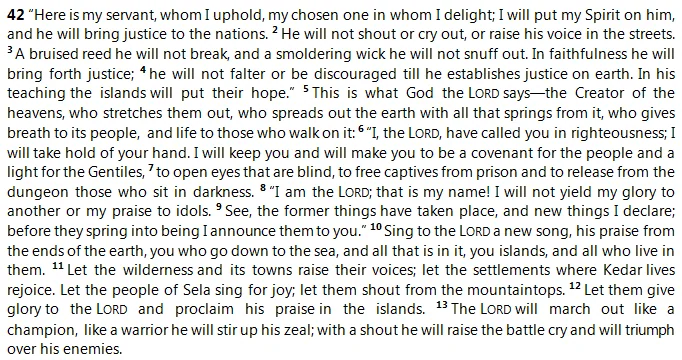
Verse 11 links the awaited one to the descendants of Kedar, and according to Genesis 25:13, Kedar was the second son of Ishmael and an ancestor of Prophet Muḥammad (PBUH).60
3) God will put His words in the mouth of this Prophet, and he will proclaim whatever God commands him: We are told in Deuteronomy 18 that this Prophet will serve as a mouthpiece for God and will faithfully convey all of His commands (“I will put my words in his mouth, and he will tell them everything I command.”). Allāh’s words—the Qurʾān—were indeed placed in the mouth of Prophet Muḥammad (PBUH). Allāh sent the angel Gabriel to teach him (PBUH) His exact words and commanded him to convey them to the people exactly as he heard them. The Qurʾān is therefore not the speech of Prophet Muḥammad (PBUH). It did not originate from his own thoughts but was conveyed to him by the angel Gabriel. During his lifetime (PBUH), and under his supervision, the Qurʾān—the words of Allāh—was memorized and written down by his Companions. This prophecy in Deuteronomy 18 also states that this Prophet will speak the words of God in His name. If you examine the Qurʾān, you will find that all of its chapters, except Chapter 9, begin with the phrase, “In the Name of Allāh, the Most Gracious, the Most Merciful.” Apart from this prophecy in Deuteronomy 18, another indication is that Isaiah 42:10–11 links the Prophet associated with Kedar to a new song (i.e., a scripture in a new language) to be sung to the Lord.61 This is stated even more clearly in the prophecy of Isaiah 28:11.62 Another related point is that the Qurʾān was revealed gradually over a period of twenty-three years. Isaiah 28:10 speaks of the same phenomenon.63 Finally, note that God says in the prophecy of Deuteronomy 18: “If anyone does not listen to my words that the prophet speaks in my name, I myself will call him to account” (Deuteronomy 18:19). This means that whoever believes in the Bible must believe in what this Prophet says, and this Prophet is Prophet Muḥammad (PBUH).
Deuteronomy 33:2:This additional prophecy in Deuteronomy makes it abundantly clear that the Gentile (non-Jewish) Prophet who resembles Moses, whom the world was awaiting, can be none other than Muḥammad (PBUH), the Arab Prophet sent to all of mankind. Deuteronomy 33:1–2 records a prophecy given by Moses, foretelling the emergence of “ten thousands of saints” and a “fiery law” from Arabia:64

This prophecy may be divided into two parts: (1) the mention of Sinai, Seir, and Paran, and (2) the emergence of ten thousand saints and a law. Let us examine each of these in detail.
1) The mention of Sinai, Seir, and Paran: “The Lord came from Sinai, and rose up from Seir unto them; he shined forth from mount Paran...” The three locations mentioned here are understood as references to the three Abrahamic religions: Judaism, Christianity, and Islam.65 Sinai is in Egypt, where Moses received a message from God, as indicated by the statement, “the Lord came from Sinai.” Seir is an allusion to Palestine, since Mount Seir was located within the ancient kingdom of Edom.66 This is affirmed by Old Testament commentators: “Seir is the mountain land of the Edomites to the east of Sinai.”67 Palestine is where Jesus appeared with a call to God: “[the Lord] rose up from Seir.” The question, then, is: which location is referred to in the final part of the verse, where God proclaimed, “he shined forth from mount Paran”? Biblical geographers differ regarding the exact location of Paran, but they are unanimous that it lies somewhere within Arabia. We read in Adam Clarke’s Commentary on the Bible:68

James Strong’s Hebrew Lexicon likewise identifies Paran as a desert of Arabia:69

Sebeos, a seventh-century Armenian bishop and historian, wrote while describing the Arab conquests of his time that the Arabs “assembled and came out from Paran.”70 Reverend T. K. Cheyne stated in Encyclopaedia Biblica: “Paran refers to the Arab tribal names, Farran or Faran.”71 The Bible states that Paran was the place where Ishmael dwelt,72 and Ishmael’s dwelling place was none other than Arabia. Moreover, the Dead Sea Scrolls—a collection of ancient Jewish manuscripts dating from the second century BCE that constitute the oldest surviving manuscript evidence for the Old Testament and also preserve various apocryphal writings—link Ishmael, his descendants, and Paran to Arabia:73

Hence, the Paran (or Pharan) of Ishmael was certainly located in the Arabian Peninsula. In fact, this location can be identified more precisely. Modern academic research supports the conclusion that Ishmael’s Paran was situated in al-Ḥijāz, a geographical region comprising much of the western part of present-day Saudi Arabia. Irfan Shahid—Professor Emeritus of Arabic and Islamic Literature at Georgetown University and one of the world’s foremost authorities on pre-Islamic Arabian history and geography—stated that there was a place called Pharan in al-Ḥijāz that belonged to the Sulaym tribe.74 Professor Haseeb Shehadeh—an Israeli scholar and professor—suggested in his translation of the Samaritan Torah that the wilderness of Paran is to be identified with the desert of Western Arabia, known today as al-Ḥijāz.75 Let us now turn to the second part of the prophecy.
2) The emergence of ten thousand saints and a law: “...he shined forth from mount Paran, and he came with ten thousands of saints: from his right hand went a fiery law for them” (Deuteronomy 33:2). The question is: who came from Arabia with ten thousand saints and a law? As discussed earlier, Paran is a reference to Western Arabia, specifically the region of al-Ḥijāz in present-day Saudi Arabia. This is precisely where Prophet Muḥammad (PBUH) was born—in the city of Makkah.76

Ibn ʿAbbās narrated:77

This is an exact fulfillment of the Biblical prophecy concerning the coming of ten thousand saints from Paran, which, as discussed earlier, refers to the region of al-Ḥijāz in Arabia. These saints were the ten thousand Muslims who accompanied Prophet Muḥammad (PBUH) during the conquest of Makkah and obeyed Allāh and His Messenger in all matters. Prophet Muḥammad (PBUH) did not arrive merely with an army; he also brought the Qurʾān, the law that Allāh revealed to him through the angel Gabriel.78

Another point worth highlighting about Deuteronomy 33:1–2 is that its chronology mirrors the order in which the Torah, the Gospel, and finally the Qurʾān were revealed:79

Notice the progression in the language used to describe these events: “The Lord came from Sinai, and rose up from Seir unto them; he shined forth from mount Paran…”:80

Hence, the Biblical prophecy in Deuteronomy 33:1–2 was fulfilled to the letter with the advent of Prophet Muḥammad (PBUH). There is no other figure in the history of mankind who emerged from Arabia with ten thousand saints and a law except him (PBUH). Incidentally, the 95th chapter of the Qurʾān, The Fig,81 bears a striking resemblance to Deuteronomy 33.82

The Assumption of Moses: There is another clear prophecy concerning Prophet Muḥammad (PBUH) in a book attributed to Moses (PBUH) known as The Assumption of Moses, also called The Testament of Moses (Hebrew: עליית משה), a first-century Jewish apocryphal work. It consists of a series of secret messages and instructions that Moses (PBUH) conveyed to Joshua son of Nun before entrusting him with leadership of the Israelites. It contains both prophecies and apocalyptic descriptions. The work is classified as a “testament,” meaning that it presents the final words of Moses (PBUH) before his death. Scholars generally believe that it was originally written in Hebrew or another Semitic language and later translated into Koine Greek. The surviving manuscript is incomplete, and the remainder of the text has been lost. R. H. Charles—an Irish Anglican theologian, biblical scholar, professor, and translator best known for his English translations of numerous ancient Jewish apocryphal and pseudepigraphal writings—edited, translated (from the surviving sixth-century Latin manuscript), and annotated this work.83 The text consists of twelve chapters. In Chapter 1, Moses (PBUH) appoints Joshua as his successor and entrusts to him a book to be preserved until the end of time. The most significant chapter, which appears to contain the work’s central theme, is Chapter 10.84

This chapter contains a prophecy concerning a Messenger (Latin: Nuntius) with a divine mission to establish God’s kingdom throughout all creation, punish the Gentiles, and destroy all their idols 1,750 years after the death of Moses (PBUH). Some of its passages are reproduced below, with the most significant lines highlighted in bold:
X. And then His kingdom will appear throughout all His creation,
And then Satan will be no more,
And sorrow will depart with him.
7. For the Most High will arise, the Eternal God alone,
And He will appear to punish the Gentiles,
And He will destroy all their idols.
11. And do thou, Joshua (the son of) Nun, keep these words and this book;
12. For from my death—(my) assumption—until His advent there will be CCL times.
13. And this is their course which they will pursue till they are consummated.
14. And I shall go to sleep with my fathers.
15. Wherefore, Joshua thou (son of) Nun, (be strong and) be of a good courage; (for) God hath chosen (thee) to be my successor in the same covenant.
It is stated at the outset of this chapter that God’s kingdom will be established throughout all His creation.

Obviously, “His kingdom” refers to the Law of God revealed through His Messenger. The Kingdom of God was never established throughout His creation by the Israelites.85

The predictions made by Moses (PBUH) in line 7 likewise apply to none but Prophet Muḥammad (PBUH):

It is true of Prophet Muḥammad (PBUH) alone that “He will appear to punish the Gentiles,” something the Jews were never able to accomplish. Likewise, it is true of him (PBUH) alone that “He will destroy all their idols.” Alfred Guillaume—a British Christian Arabist and scholar of the Hebrew Bible (Old Testament) and Islam—recorded in The Life of Muhammad:86

Sir William Muir also recorded the event in The Life of Moḥammad:87

As for the Israelites, far from “destroying all their [the Gentiles’] idols,” they themselves fell into idol worship on numerous occasions throughout their history, as the Bible repeatedly records. It is worth noting that the author of The Assumption of Moses, or a later redactor, appears to have inserted several lines concerning the Israelites that are so conspicuously unrelated to the surrounding context that any unbiased reader can readily see that they have little to do with the central theme and must be later interpolations. Nevertheless, they are reproduced below for reference:

In line 12, Moses (PBUH) told Joshua son of Nun:

The words “from my death—(my) assumption—until His advent” make it clear that all the events described in this chapter revolve around the person whose advent is being foretold. The key expression in line 12 is “CCL times.” R. H. Charles, the translator and editor of The Assumption of Moses, explained in a footnote:88

However, there is no mention of the coming of any Messiah in this chapter of The Assumption of Moses. Rather, it speaks of the establishment of the “kingdom of God.” Moreover, if the Messiah is taken to be Jesus Christ (PBUH), the chronology does not fit, for Jesus (PBUH) came approximately twelve centuries after Moses (PBUH), whereas he (PBUH) stated that 1,750 years would elapse between his death and the advent of the figure being foretold. Historically, it was only Prophet Muḥammad (PBUH) who appeared approximately CCL times after the death of Moses (PBUH). As noted above, according to the editor R. H. Charles, CCL times means 250 year-weeks, that is, 1,750 years. In Roman numerals, C represents one hundred, and thus CC equals two hundred, while L represents fifty. Therefore, CCL equals 250 (100 + 100 + 50). The original word translated here as “times” is understood by the editor to mean “year-weeks.” A year-week denotes a period of seven years, just as a week denotes a period of seven days. Consequently, 250 year-weeks amount to 1,750 years (250 × 7).89 To identify the exact figure who was to establish the foretold “kingdom of God,” we must first determine the point in world history that falls 1,750 years after the death of Moses (PBUH). Although the date of Moses’ (PBUH) death cannot be established with absolute certainty, scholars have made every effort to approximate it as closely as possible using the available historical evidence. The Oxford Bible Atlas states that the Exodus of the Israelites under Moses (PBUH) from Egypt most likely occurred during the reign of the Egyptian Pharaoh Rameses II of the Nineteenth Dynasty, who ruled from 1290 to 1224 BCE: “The oppression of Israel and the Exodus from Egypt took place most probably under Rameses II (1290–24).”90 American biblical scholars Bernhard W. Anderson and John Bright likewise assigned the same dates (1290–1224 BCE) to Rameses II.91 American Egyptologist John A. Wilson noted that Rameses II reigned from 1290 to 1224 BCE:92

Paul S. L. Johnson—an American scholar and pastor—asserted:93

The New Bible Atlas concludes on the basis of archaeological evidence that the Exodus took place around 1230/20 BC:94

The Pictorial Biblical Encyclopedia states:95

The New Jerusalem Bible notes:96

The New Jerusalem Bible lists the following entry in its Chronological Table: “1290–1224 Rameses II.”97 Kenneth A. Kitchen—a British biblical scholar, eminent Egyptologist, and ancient Near Eastern scholar—and Terence C. Mitchell—a British archaeologist, scholar, and curator who specialized in West Semitic languages and Near Eastern archaeology, and who also took an interest in biblical studies from an evangelical Christian perspective—assigned 1290–1224 BCE as the period of Ramesses II’s reign. They also proposed 1279–1213 BCE as an alternative chronology for the reign of Ramesses II.98 Hence, the authorities cited above date the reign of Ramesses II to 1290–1224 BCE. This chronology makes it clear that the advent of Prophet Muḥammad (PBUH) occurred exactly 1,750 years after the death of Moses (PBUH). Now, if this Pharaoh, Ramesses II (1290–1224 BCE), is—as is generally accepted by biblical scholars—the same Pharaoh during whose reign the Israelites departed from Egypt with Moses (PBUH), then he must have drowned in the sea while pursuing them. The Bible records this event in considerable detail.
Exodus 14:5–18:99

Exodus 14:21–23:100

Exodus 14:26–28:101

It is clear from the above passages that the Pharaoh who pursued the Israelites into the sea drowned and was not spared. Therefore, if the Exodus took place in 1224 BC, then that was also the year in which Pharaoh Rameses II drowned while pursuing the fleeing Israelites.102 The Israelites, together with Moses (PBUH), then wandered in the Sinai wilderness for forty years before entering the Promised Land of Canaan. Moses (PBUH) died at the end of this forty-year period before the Israelites entered the Promised Land under the leadership of Joshua son of Nun. This places the death of Moses (PBUH) in 1184 BC (1224 − 40 = 1184).103 The following passage from the Bible shows that the Israelites wandered in the Sinai wilderness for forty years after God pronounced this punishment upon them for their disobedience and before they entered the Promised Land of Canaan. Numbers 14:29–35 reads:104

The forty-year punishment of wandering in the wilderness did not begin immediately after the Israelites entered the Sinai wilderness.105

This means that Moses (PBUH) would have died approximately forty-four years after the death of Ramesses II, who drowned in 1224 BC. Accordingly, the year of Moses’ (PBUH) death would be 1180 BC (1224 − 44 = 1180). It follows that the interval between the death of Moses (PBUH) and the birth of Jesus Christ (PBUH) is approximately 1,180 years. It is almost universally accepted that Prophet Muḥammad (PBUH) was born in 570 CE.106 Geo. W. Gilmore stated:107

Michael H. Hart wrote:108

Hence, it can be seen that the interval between the death of Moses (PBUH) and the birth of Jesus (PBUH) is 1,180 years, while the interval between the birth of Jesus (PBUH) and the birth of Prophet Muḥammad (PBUH) is 570 years. Together, these periods total exactly 1,750 years. This demonstrates that only one prominent figure in history fulfills the prophecy of The Assumption of Moses: Prophet Muḥammad (PBUH), who came exactly 1,750 years after the death of Moses (PBUH). Therefore, honest and impartial people have no justifiable reason to deny the authenticity of his Prophethood (PBUH).
The Apocalypse of Abraham: Clear indications of Prophet Muḥammad (PBUH) are also found in the Apocalypse of Abraham, also known as the Testament of Abraham. This Jewish apocryphal work is generally regarded as part of the apocalyptic literature and is believed to have been composed in the first or second century CE. It can be divided into three parts:
Chapters 1–8: The first eight chapters serve as an introduction. They describe Abraham’s early life and his conversion from polytheism to monotheism.
Chapters 9–14: The next five chapters constitute the apocalyptic section, which begins with Abraham’s sacrifice to the Lord.
Chapters 15–32: The final section recounts Abraham’s ascent to heaven. It relates that Abraham and the angel Yahoel, borne by a dove, ascend to the heavens. Chapter 25 recounts Abraham’s vision of idolatry and the slaughter of boys. God explains that this vision concerns His Temple and His priesthood, against which His wrath is directed because of the descendants of Abraham.109

Abraham then saw another vision depicting people on the right, representing the Jewish world, and people on the left, representing the heathen world. He saw the heathen on the left plundering his descendants on the right, killing some and taking others captive. He also saw the heathen invade his descendants through four “entrances,” burn the Temple, and plunder all the holy things within it. The four “entrances” through which the heathen attack his descendants have been interpreted as referring to Israel’s captivity under the four oppressive world powers mentioned in the Book of Daniel: Babylon, Media, Greece, and Rome. Abraham is then told that the destruction of the Temple was a consequence of the idolatry committed by his descendants. The text also foretells the coming of men who would look after Abraham’s descendants.110

Abraham asked God whether what he had seen would be the fate of his descendants for a long time. God replied that He had ordained the age of ungodliness to rule among the nations and among Abraham’s descendants for “twelve years.” However, the editor R. H. Charles noted that the manuscript is probably corrupt at this point, with “hours” and “years” having been confused. He concluded that the text refers to twelve symbolic “hours,” each representing one hundred years, making a total of 1,200 years.111

God then told Abraham to look again at the vision. Abraham saw “a man” emerging from the left side of the heathen. He is worshipped by many heathens as well as by some of Abraham’s descendants (i.e., his followers include large numbers from both the Gentiles and the Jews). He is kissed by Azazel but insulted and beaten by other descendants of Abraham.112

Abraham asked about the identity of the man whom he had seen being insulted, beaten, and yet worshipped by many. God told him that the man was the “relief” (or, in other translations, “the mercy” or “liberation”) granted by the nations (the heathen) to his descendants in the twelfth hour of the age of ungodliness.113

The appearance of the figure described simply as “a man” is a central feature of Chapter 29. Abraham saw a vision of a man who was shamed, struck, and worshipped by the Gentiles, as well as by some of his descendants. The text states that God would send this man in the twelfth year of His final age. Again, as noted earlier, R. H. Charles argued that the manuscript mistakenly reads “year” instead of “hour,” the latter being the original reading, with the text itself equating one hour of the age with one hundred years.

The coming of the figure described as “a man” was foretold to occur following the destruction of the Temple. However, the Temple was destroyed twice: first in 586 BCE and again in 70 CE. Which destruction does the prophecy refer to? The answer is evident from the context. The prophecy also refers to the Israelites practicing idolatry in the Temple. According to the biblical record, they ceased practicing idolatry after the destruction of the First Temple. Consequently, the prophecy must refer to the First Temple, meaning that the foretold figure was to come twelve centuries after its destruction. Note the following passage from the aforementioned Chapter 25:114

To reiterate, the Temple was destroyed twice: first in the sixth century BCE, when Abraham’s descendants were practicing idolatry, and again in 70 CE, when it was destroyed by the Romans. The prophecy concerning the coming of “the man” in The Apocalypse of Abraham must therefore refer to the first destruction, since the book associates the destruction of the Temple with the idolatry of Abraham’s descendants, whereas they were no longer practicing idolatry by 70 CE. The First Temple was destroyed in the sixth century BCE. Twelve centuries later came the sixth century CE—the century in which Prophet Muḥammad (PBUH) was born (571 CE). The main point of contention in The Apocalypse of Abraham is the passage describing “the man” emerging from the left side of the heathen, who is shamed, struck, and worshipped by the Gentiles as well as by some of Abraham’s descendants. Most biblical scholars identify this man as Jesus of Nazareth yet regard the passage as a later Christian interpolation.115

Moreover, biblical scholars acknowledge that the description of this man as the “relief” (or, according to other translations, the “mercy” or “liberation”) granted by the heathen to Abraham’s descendants in the last days is difficult and obscure.116

In later Christian interpretation, the ambiguous figure described simply as “a man” is usually identified with the Antichrist, the “man of sin.” According to Jacob Licht, Professor of Biblical Studies at Tel Aviv University, the Apocalypse of Abraham is a Jewish work, although it does not represent mainstream rabbinic Judaism. Discussing the enigmatic passage about “the man,” Licht writes:117

In reality, however, this passage is an integral part of the work and allusively depicts Prophet Muḥammad (PBUH). Notwithstanding, there have been desperate attempts to conceal this fact by deliberately distorting New Testament traditions. In fact, the emergence of “the man” from among the heathen and from Abraham’s descendants—a feature that biblical scholars have regarded as curious and contradictory—is fully consistent with other biblical prophecies concerning Prophet Muḥammad (PBUH). These include the many statements of Jesus Christ (PBUH) indicating that God’s chosen one would not be a descendant of David (i.e., a Jew) and that the next Kingdom of God would be established through a nation other than the Jews. It is likewise consistent with the well-established course of human history. The important questions, therefore, are:
•Did Israel’s captivity and subjection to the four oppressive world powers really come to an end twelve centuries after the destruction of the First Temple?
•Did a man appear from among the heathen and from the descendants of Abraham, who was followed by large numbers of Gentiles while being opposed by many Jews, though some of them also followed him, and who became the “relief,” “mercy,” or “liberation” granted to the children of Israel, the descendants of Abraham, and all the nations of the earth?
•Do his followers bear a name chosen for them by the Creator?
Indeed, this was literally fulfilled in history. In 586 BCE, Nebuchadnezzar, king of Babylon, captured Jerusalem, destroyed the First Temple, burned the city, subjugated the Kingdom of Judah, and took many of its inhabitants into captivity. Prophet Muḥammad (PBUH), born in 571 CE, was commissioned by Allāh as a Prophet to all nations at the age of forty, approximately twelve centuries after the destruction of the First Temple and the beginning of Israel’s captivity and subjection to the four oppressive world powers as a consequence of idolatry. The age of ungodliness, which God ordained to rule among the nations and among the descendants of Abraham for twelve symbolic hours (i.e., twelve centuries), came to an end when the Muslims conquered the Blessed Land (Palestine) following the Battle of Yarmuk on 20 August 636 CE, approximately twelve centuries after the fall of Jerusalem in 586 BCE.118 Prophet Muḥammad (PBUH) is indeed Allāh’s mercy, relief, and liberation, raised up from among the Gentiles to those who proceed from Abraham, as this prophecy declares:119

The Qurʾān describes Prophet Muḥammad (PBUH) as one who removes the burdens and shackles that were upon the Israelites. The Israelites’ lives had been fettered by undue restrictions imposed on them through the legal hair-splitting of their jurists, the pietistic exaggerations of their rabbis, as well as the introduction of superstitions and self-contrived laws and regulations by their masses.120 The Qurʾān says that Prophet Muḥammad (PBUH), by relieving them of every unnecessary burden and releasing them from every unjustified restriction, effectively liberated them from the shackles that bound their lives.121 The prophecy also states that the followers of the “man’’ who is God’s chosen one will bear a name chosen for them by God: “and such as are called by me.’’122

Allāh has named the believers “Muslims’’ (i.e., those who submit) in the prior Scriptures and in the Qurʾān.123 By Allāh, adding the name “Muḥammad’’ to this prophecy would not make it any clearer. It is utterly strange that biblical scholars consider it curious that the Final Message was given to God’s chosen one from the children of Abraham (PBUH), but not from the children of Israel. The Israelites had been warned that the kingdom of God would be taken away from them and given to a people who would produce its fruit. Prophet John the Baptist (i.e., Yaḥyá ibn Zakariyyā) told Israel’s religious leaders that they had made a mistaken assumption about how God would deal with His people, Israel. They believed that God would not direct His wrath toward the Israelites, the children of Abraham. But John the Baptist rejected any Jewish claim to superiority or to possessing an inherent merit or worthiness simply by virtue of being Jewish. He even told them that God is able to raise up new children of Abraham:124

It is worth mentioning that the prophecy in The Apocalypse of Abraham is in complete agreement with the prophecies in the second, seventh, and ninth chapters of the Book of Daniel, as well as with the prophecy of the Apocalypse of Weeks in the Book of Enoch, regarding the timing of the appearance of God’s chosen one and his kingdom. Finally, the worship of “the man’’ by Azazel is a central feature of chapter 29, which says that “Azazel kissed his face.”125

This part, too, is considered strange by biblical scholars. Professor Hishām Ṭulbah, who has conducted an in-depth investigation of the prophecy in The Apocalypse of Abraham, holds that the word “Azazel” most probably refers to the wicked unbelieving jinn. He explains that, with the exception of Prophet Solomon (PBUH), it is not mentioned anywhere that any Prophet had followers from among the jinn except Prophet Muḥammad (PBUH). The Qurʾān contains an entire chapter relating this, in addition to mentioning it in two other places. Hence, the mention of Azazel’s worship of this man alludes to the fact that some of the jinn will believe in him and follow his religion. Ṭulbah further explains that it is narrated in the authentic books of Ḥadīth (Prophetic traditions), on the authority of Prophet Muḥammad (PBUH), that every human being has a constant companion from among the jinn who prompts or entices him toward evil, except for the Prophet (PBUH)’s accompanying jinn, who became a Muslim.126 This may thus provide an alternative explanation for the character of Azazel—that is, if it is not a Christian interpolation.127
The prophecies in Daniel 2 and Daniel 7: These are among the most explicit prophecies about Prophet Muḥammad (PBUH) in the Bible. Daniel (PBUH) was one of the Prophets of the Children of Israel. Like most of the other books of the Bible, the Book of Daniel is affected by the general problem of distortion or alteration, but it is distinguished by several unique characteristics:128

As for Daniel (PBUH) himself:129

The prophecy in Daniel 2: King Nebuchadnezzar had a dream that disturbed him. He summoned his magicians and fortune-tellers to interpret it, but none of them was able to do so. Daniel, however, implored God, and He revealed to him both the dream and its interpretation.130

Daniel (PBUH) went to King Nebuchadnezzar:131

Daniel (PBUH) recounted to King Nebuchadnezzar the dream that he had seen:132

Daniel (PBUH) interpreted the king’s dream:133

King Nebuchadnezzar’s dream has always been regarded as the most famous and accurate of all the visions in the Bible. It is wrong to differ over its meaning when Prophet Daniel (PBUH) himself interpreted it. Nonetheless, the Jews and Christians, driven by envy, sought to conceal its meaning and stirred up an unwarranted dispute after the truth had been made clear to them.134

This table presents the five kingdoms in Nebuchadnezzar’s vision, including those that preceded his for the sake of clarity:135

It was in an atmosphere of persecution and gloom that the Jews and Christians awaited the fifth kingdom with utmost patience. They knew with certainty that it would be established at the hand of the Prophet of the latter days, who bore the Seal of Prophethood between his shoulders, whom they called the “Prince of Peace,” and whom all the Prophets had heralded. They observed the signs of his advent until the day came when the learned emperor Heraclius announced that the kingdom of the circumcised had arrived, as related in the well-known and authentic ḥadīth (Prophetic tradition). ʿAbd Allāh ibn ʿAbbās narrated:136

Emperor Heraclius was certain of this and declared to Abū Sufyān, then the leader of the Arab pagans, that the kingdom of the Prophet of the latter days would reach the land beneath his feet, as affirmed in the aforementioned ḥadīth. ʿAbd Allāh ibn ʿAbbās narrated:137


Indeed, the divine fifth kingdom did arise and came to rule over the land where Heraclius stood, and he departed Syria saying, “Farewell, Syria—a parting after which we will never meet again.” It crushed the pagan kingdoms and came to rule over most of the known world with justice and peace. Under its banner, it united a great portion of the peoples of the world—the Arabs, Persians, Turks, Berbers, Africans, Indians, Tartars, and others. It was only at this point that the Jews and Christians began to dispute over Daniel’s clear vision. Allāh says: {It was not until this clear proof came to the People of the Book that they became divided ˹about his Prophethood˺} (Qurʾān 98:4). Some of them—and they were many—believed and were rightly guided, while others disbelieved and, in their disbelief, split into countless sects. Safar ibn ʿAbd ar-Raḥmān al-Ḥawālī, the prominent Islamic scholar, stated regarding the disputes among the People of the Book concerning the clear vision in the Book of Daniel:138

Incidentally, al-Ḥawālī devoted an entire chapter of his book The Day of Wrath to the vision in the Book of Daniel, in which he outlined the interpretations of the People of the Book, demonstrating how they contradict both the vision and reality.139
The prophecy in Daniel 7: Daniel himself had a vision in the first year of Belshazzar, king of Babylon (probably 553 BC), which was similar to Nebuchadnezzar’s vision of the statue and the rock. The statue’s four parts represent four successive world kingdoms, or empires. Daniel saw four great beasts coming up from the sea: the first was like a lion with the wings of an eagle; the second was like a bear with three ribs in its mouth; the third was like a leopard with four wings and four heads; and the fourth was a dreadful and powerful beast with teeth of iron, which devoured the other beasts and trampled their remains beneath its feet. This fourth beast had ten horns, and another little horn came up among them, before which three of the horns fell. Then eyes and a human mouth appeared on this horn, and it spoke words of blasphemy. The end of the little horn would be its destruction at the hand of the Ancient of Days, Lord of the Throne, Who is served by thousands upon thousands. The other beasts remain, but their dominion is taken away from them. The body of the fourth beast is burned with fire, but the blaspheming horn is left alive until a “Son of Man” (Aramaic: “Bar Nasha”) is taken up on the clouds and presented to the Ancient of Days, from whom he receives power, honour, and an everlasting kingdom.140
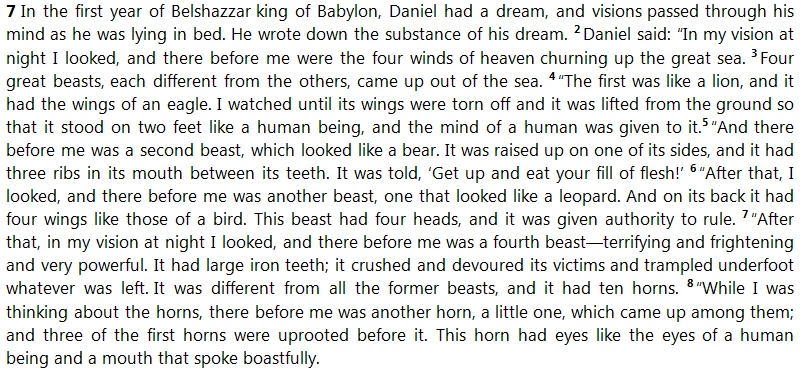

Greatly troubled, Prophet Daniel (PBUH) approached one of the angels standing by and implored him to interpret this wonderful vision. The angel interpreted it in such a manner that the whole mystery concealed within its figurative language was brought to light. According to the angel’s interpretation, the fourth beast is the fourth kingdom on earth, which is unlike all the other kingdoms and will conquer the whole earth, trampling it beneath its feet. The fourth kingdom’s ten horns are ten of its rulers who will arise, after whom another ruler will arise who will be different from his predecessors and will subdue three of them. This eleventh ruler will speak against the Most High and will attempt to change times and laws. He will wage war against the holy people, or the saints of the Most High, and prevail against them for a time, times, and half a time. This will continue until the Ancient of Days (i.e., the Eternal God) passes judgment in favor of His holy people, or saints, after which the eleventh ruler’s reign is destroyed and they possess the everlasting kingdom.141

Hence, Daniel prophesied the time of the advent of the promised Prophet, whose dominion will be an everlasting dominion, whose kingdom shall never be destroyed, and who will be served by all nations. Similar to the interpretation of Nebuchadnezzar’s dream, the first beast in Daniel’s vision represents Babylon, the second Medo-Persia, the third Greece, and the fourth Rome. The ten horns of the fourth beast represent the ten emperors of the Roman Empire who carried out the ten major persecutions. The eleventh horn refers to Constantine I, who overthrew three Roman emperors before him and persecuted those who rejected the Nicene Creed, which formally established the doctrine of the Trinity. He broke the first commandment of the Law, “The Lord our God is one Lord,” and changed the times by replacing the Sabbath with Sunday. The Muslims were the nation that crushed the Romans, drove them out of Palestine, Syria, and Egypt, and later conquered Constantinople, establishing it as the capital of Islam. Jerusalem was conquered by the Muslim armies under Caliph ʿUmar ibn al-Khaṭṭāb in 638 CE. Constantinople, the capital of the Byzantine Empire established by Constantine in 330 CE, was captured by the Ottoman Empire on 29 May 1453, marking the effective end of the last remnants of the Roman Empire, which had begun around 27 BC and endured for nearly 1,500 years. Having carefully examined the marvelous vision of Prophet Daniel (PBUH), Professor ʿAbd al-Aḥad Dāwūd—the former Reverend David Benjamin Keldani, a Roman Catholic priest of the Uniate-Chaldean sect who converted to Islam—observed:142

Professor ʿAbd al-Aḥad Dāwūd explained that the four beasts representing the four kingdoms that succeeded one another were the Powers of Darkness, which persecuted the Jews and the early Christians who were true believers in the One God. He also noted that these Powers were pagan and were allegorically described as ferocious brutes.143

He observed regarding the eleventh little horn:144

It is important to determine who the little horn (the eleventh king) is, for once its identity is definitively ascertained, the identity of the Bar Nasha will thereby be settled.145

Professor ʿAbd al-Aḥad Dāwūd has advanced the following arguments to show that the little horn is none other than Constantine the Great:
(a) He overcame his three rivals, became emperor, and put an end to the persecution of Christians:146

(b) All four beasts are represented in the vision as irrational brutes, but the little horn possessed human eyes and a mouth, which, in other words, is the description of a hideous monster endowed with reason and speech:147

(c) The Horn-Emperor speaks “big things” or “great words” (rōrbhān in the Chaldean tongue) against the Most High:148


(d) Not only does the “Little Horn,” which grew into a more formidable vision than the rest, speak impious words against the Most High, but it also wages war against the “Saints of the Most High” and vanquishes them (verse 25):149

(e) The “Talking Horn” is accused of having sought to change “the Law and the times”:150
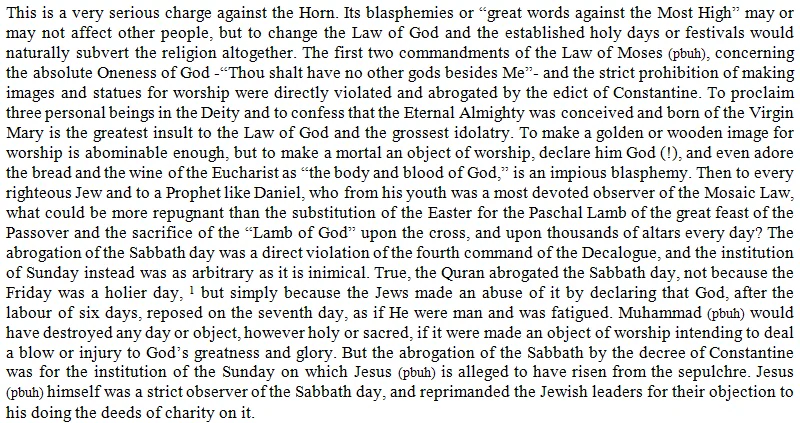
(f) The “Horn” was allowed to wage war against the Saints of the Most High for a period of about three and a half centuries; it only weakened them and made them languid but could not extinguish or completely root them out:151

Hence, Professor ʿAbd al-Aḥad Dāwūd demonstrated that the eleventh little horn—which had eyes and a mouth, uttered blasphemies against the Most High, fought against and overcame His holy people or saints, and changed the times and the Law—could be none other than Constantine the Great, who, in 325 CE, convened and presided over the First Council of Nicaea and subsequently promulgated an imperial rescript enforcing its decisions, thereby formalizing the Nicene Creed, affirming the doctrine of the Trinity, and condemning Arianism.
Now let us proceed to establish the identity of the glorious “Bar Nasha,” or the Son of Man—the next important figure in this wonderful vision—who was presented on the clouds before the Most High, to whom were given dominion, honour, and an everlasting kingdom, and who was commissioned to destroy and annihilate the terrible horn. Professor ʿAbd al-Aḥad Dāwūd noted that before determining who this Son of Man is, it is essential to take the following points and observations into consideration:152



Professor ʿAbd al-Aḥad Dāwūd has demonstrated that the “Bar Nasha”—the Son of Man—who was presented before the Ancient of Days (i.e., the Eternal God) and invested with the authority to destroy the monster was none other than Prophet Muḥammad (PBUH), whose very name literally means “the Praised and Illustrious.” He asserted that whatever other person one may try to invent in order to deprive the Messenger of Allāh of this unique glory and majesty bestowed upon him in the Divine Court, they will only make themselves ridiculous, for the following reasons:
•We know that neither Judaism nor Christianity has any particular name for its faith or its belief system:153


•The Son of Man, or Bar Nasha, is certainly Prophet Muḥammad (PBUH), for he came after Constantine and not before him, as Jesus (PBUH) or any other Prophet (PBUH) did:154

•It is equally futile to claim this celestial honour bestowed upon the Son of Man for Jesus Christ (PBUH):155

•There has never lived upon this earth a Prince-Prophet like Muḥammad (PBUH).156

It is no wonder, then, that on his Night Journey to Heaven, Prophet Muḥammad (PBUH) was received with the highest honours by Allah and invested with the power to eradicate idolatry and destroy the blasphemous horn from the lands given by the Almighty to him and his people as an everlasting heritage.157 Another remarkable feature of the vision of Daniel, according to Professor ʿAbd al-Aḥad Dāwūd, is that the sight of the Bar Nasha upon the clouds and his presentation before the Almighty corresponds to the Miʿrāj—the Night Journey of Prophet Muḥammad (PBUH):158

Professor ʿAbd al-Aḥad Dāwūd noted that, based on Daniel’s testimony, we as Muslims must acknowledge that Prophet Muḥammad (PBUH)’s journey was performed in bodily form—a thing that is by no means impossible for the Omnipotent:159

Professor ʿAbd al-Aḥad Dāwūd further stated that St. Paul also mentioned a vision he had seen of a man who had been taken up to the third heaven and then to Paradise, where he heard words and witnessed things that could not be described:160

Professor ʿAbd al-Aḥad Dāwūd concluded:161

In light of the above, there is no doubt that the fifth kingdom prophesied in chapters 2 and 7 of the Book of Daniel is Islam, whose foundation was laid by Prophet Muḥammad (PBUH) with Allāh’s permission and which later expanded across the world to defeat and consume the previous four kingdoms of idolatry, including the Roman Empire. In other words, if we look back at history, namely the succession of the five kingdoms foretold in Daniel 2 and 7, we clearly see the fulfillment of this prophecy in the coming of Islam and its expansion immediately after the Roman Empire, the fourth kingdom. Indeed, Prophet Muḥammad (PBUH) was granted such power and glory that within just a few short years Muslims, his followers, destroyed the beasts, including the Roman Empire in the East. And today, people from every nation and language group believe in him (PBUH) and thus follow and honour him.
Prophecy of Haggai 2: When the Children of Israel returned from the Babylonian captivity (around 537 BCE), God revealed to His Prophet Haggai:162

Prophet Haggai (PBUH) gave the glad tidings of the coming of “the desire of all nations” when the Israelites were rebuilding the House of the Lord in Jerusalem after it had been destroyed by the Babylonians. The phrase rendered as “the desire of all nations shall come” in the original Hebrew reads: וּבָאוּ חֶמְדַּת כָּל־הַגּוֹיִם (Ve yāvōʾū ḥemdat kol ha-gōyim), that is, “And the ḥemdâ (the most desired, beloved, coveted, praised) of all nations shall come here.”163

The original Hebrew word translated as “the desire” is חֶמְדָּה (ḥemdâ).164


The Hebrew word חֶמְדָּה (ḥemdâ) is derived from the root word חֶמֶד (ḥemeḏ).165

Clearly, the Hebrew word for “desire,” חֶמְדָּה (ḥemdâ) has the same root as the Arabic words Muḥammad and Aḥmad—the names of the final Messenger of Allāh (PBUH), meaning “Praised One” and “Most Praised,” respectively.166 They all derive from the ancient triliteral root Ḥ-M-D, also known as the “praise root.” Ḥ-M-D (Arabic: ح-م-د; Hebrew: ח-מ-ד) is the triconsonantal Semitic root of many Arabic and some Hebrew words, many of which are used as names. The basic meaning expressed by the root is “to praise” in Arabic and “to desire” in Hebrew. Moreover, the phrases “I will fill this house with glory” (Haggai 2:7) and “The glory of this latter house shall be greater than of the former” (Haggai 2:9) refer to al-Isrāʾ, that is, Prophet Muḥammad (PBUH)’s miraculous Night Journey from Makkah to Jerusalem about a year before his hijrah (migration) from Makkah to al-Madīnah: {Glory be to the One Who took His servant ˹Muḥammad˺ by night from the Sacred Mosque to the Farthest Mosque, whose surroundings We have blessed, so that We may show him some of Our signs} (Qurʾān 17:1). The Prophet (PBUH) was carried overnight on a noble steed called al-Burāq from the Sacred Mosque in Makkah to al-Masjid al-ʾAqṣá (the Farthest Mosque) in Jerusalem—at the site where the Jewish Temple once stood—where he met the earlier Prophets and led them in prayer. It was on that night that the “Temple” was filled with the glory of God as all the Prophets gathered there and prayed behind Prophet Muḥammad (PBUH). The Lord further said, “And in this place will I give peace” (Haggai 2:9). The original Hebrew word translated as “peace” is שָׁלוֹם (šālôm).167

The Hebrew word for “peace,” שָׁלוֹם (šālôm), is derived from the Hebrew root ש־ל־ם (Š-L-M), from which the verb שָׁלַם (šālam) is also derived.168


All scholars of the Semitic languages acknowledge that the Hebrew שָׁלוֹם (šālôm), the Syriac ܫܠܡܐ (šlama), and the Arabic salām and Islām all derive from the same Semitic root, Š-L-M (Shin-Lamedh-Mem),169 and convey the same essential meaning, namely “peace, submission, and resignation (to the will of God).” The words šālôm, šlama, and salām are cognate Semitic terms for “peace,” deriving from the Proto-Semitic šalām. Hence, the Hebrew text of Haggai 2:9 uses the word šālôm, which can also be understood as Islām, since salām (peace) and Islām are derived from the same root.170 For example, Allāh says: {O believers! Enter into silm (lit. peace, i.e., Islam) wholeheartedly and do not follow Satan’s footsteps} (Qurʾān 2:208). That is, Allāh commands mankind to submit wholeheartedly to His will by obeying all the rules and regulations of the Islamic religion. The former Rev. David Benjamin Keldani, who embraced Islam and adopted the name ʿAbd al-Aḥad Dāwūd—and who reached the highest academic and theological ranks, was fluent in both biblical languages, Greek and Hebrew, and was well versed in Arabic, Persian, and Turkish—believed that interpreting the word “peace” as “Islam” is also necessary in another passage of the Bible, namely Luke 2:14.171 The Book of Luke records that the angels praised God at the birth of Jesus (PBUH), saying: “Glory be to God in the highest heaven, and on earth peace to those on whom his favor rests.”172 Professor ʿAbd al-Aḥad Dāwūd asked which peace came to earth after the birth of Jesus (PBUH). In fact, wars and bloodshed continued unabated after his birth (PBUH). The Greek word for “peace” is εἰρήνη (eirēnē). The 1904 Nestle Greek New Testament reads: Δόξα ἐν ὑψίστοις Θεῷ καὶ ἐπὶ γῆς εἰρήνη ἐν ἀνθρώποις εὐδοκίας.173 That is, “Glory to God in the highest heaven, and on earth peace (eirēnē | εἰρήνη) to those on whom His favor rests.” Therefore, the correct Hebrew equivalent of the Greek word for “peace,” εἰρήνη (eirēnē), is šālôm, which corresponds to the Arabic Islām, just as salām does, since both derive from the triliteral root S-L-M (sīn-lām-mīm), which denotes peace. Professor ʿAbd al-Aḥad Dāwūd argued that if Christians insist on interpreting the word eirēnē simply as “peace,” then they make Jesus (PBUH) contradict himself, for he said:174

Based on this, Professor ʿAbd al-Aḥad Dāwūd believed that the “peacemakers” in Matthew 5:9 are the Muslims:175

That is, the accurate translation is “Blessed are the Muslims,” and not the imaginary peacemakers, who have never existed and never will exist on earth. Hence, the prophecy in Haggai 2:7–9 is not speaking about Jesus (PBUH) for two reasons. First, there is no connection between the words of the prophecy and his name. Second, there is no connection between its meaning and what is known about him (PBUH), namely that there was no lasting peace or stability in Jerusalem during his mission. Rather, he warned his followers to be on guard, for they would be arrested, tried, tortured, and killed because of their association with him, and he foretold the destruction of Jerusalem and the Temple:176

Moreover, Jesus (PBUH) was a Messenger sent to the Children of Israel, not to all nations. He presented himself as a shepherd to Israel:177

However, the expected Prophet was the desire of all nations and was not sent exclusively to the house of Jacob (i.e., the Children of Israel), as the Bible repeatedly describes Jesus (PBUH). The opponents of Islam argue that such a figure as the desire of all nations has never existed. That is, there has never been a Muḥammad who was accepted by all nations. Nonetheless, Prophet Muḥammad (PBUH) is truly the Messenger of Allāh sent to all mankind, whether all people follow him or not. Allāh says: {Say, ˹O Prophet,˺ “O humanity! I am Allāh’s Messenger to you all} (Qurʾān 7:158). Professor ʿAbd al-Aḥad Dāwūd wrote:178

Professor ʿAbd al-Aḥad Dāwūd explained the etymology of the two words:179

Professor ʿAbd al-Aḥad Dāwūd noted in his brief exposition of the prophecy of Haggai:180

Indeed, the following arguments advanced by Professor ʿAbd al-Aḥad Dāwūd are sufficient to convince every impartial observer that the person foretold in the two biblical passages mentioned above as coming suddenly to the Temple is Prophet Muḥammad (PBUH), and not Prophet Jesus (PBUH):181


Professor ʿAbd al-Aḥad Dāwūd concluded:182

Interestingly, even Western historians, archaeologists, and biblical lexicographers acknowledge that Prophet Muḥammad (PBUH) was prophesied by name in the Bible. The prominent historian William James Durant asserted: “His name, meaning ‘highly praised,’ lent itself well to certain biblical passages as predicting his advent.”183 Again, Prophet Muḥammad (PBUH) was explicitly foretold by name by Prophet Haggai (PBUH). There is no evading the plain text of Haggai 2:7–9 and its meaning, as recognized by John Parkhurst, an English academic, clergyman, and biblical lexicographer, one of the most unwilling yet competent witnesses, when he happened not to be warped by prejudice. Parkhurst stated: “From this root [ḤMD חמד] the pretended prophet Mohammed, or (according to our corrupt pronunciation) Mahomet, had his name.”184 Sir Godfrey Higgins—an archaeologist, Fellow of the Society of Antiquaries, and author—stated the following concerning the “desire of all nations” in Haggai 2:7:185


Now, the Jews and Christians should tell us: Who did Prophet Haggai (PBUH) prophesy, if not Prophet Muḥammad (PBUH)? Indeed, Prophet Muḥammad (PBUH) is not only described in the Bible but also identified by name. The etymological similarity between the names Aḥmad and ḥemdâ (Arabic and Hebrew, respectively) proves this truth beyond a shadow of a doubt.
There are many other clear and unmistakable prophecies concerning Prophet Muḥammad (PBUH) in the Bible:
The prophecy in Genesis 49:10:Prophet Muḥammad (PBUH) is the “Shiloh” foretold in Genesis 49:10. While on his deathbed, Prophet Jacob (PBUH) told his children:186

What this means is that the royal scepter and the office of Prophethood would remain in the tribe of Judah only until “Shiloh” (שִׁילֹה, šîlô) came. Shiloh can be neither Moses (PBUH), nor David (PBUH), nor Jesus (PBUH), for:
•Moses (PBUH) was the first organizer of the Twelve Tribes of Israel.
•David (PBUH) was the first king-Prophet from the tribe of Judah, and even after him there were Prophets and kings from that tribe, including his own son Solomon (PBUH).
•Jesus (PBUH) was also a descendant of Judah through his mother.187 Besides, he never held the royal scepter.
Hence, the “Shiloh” foretold by Prophet Jacob (PBUH) is none other than Allāh’s Messenger, Prophet Muḥammad (PBUH), for:
•He was an Ishmaelite, not a descendant of Judah.
•He did hold the royal scepter, as before his demise he became the effective ruler of Arabia.
•He brought a new Law (i.e., the Qurʾān) to replace the old and impractical Jewish Law.
This interpretation also fits Prophet Muḥammad (PBUH), for even before Prophethood he was known as “al-ʾAmīn,” which means essentially the same thing, namely “peaceful, tranquil, and trustworthy.” Professor ʿAbd al-Aḥad Dāwūd discussed the prophecy in Genesis 49:10 in greater detail. He wrote:188

Professor ʿAbd al-Aḥad Dāwūd noted that the text contains two unique words that occur nowhere else in the Old Testament.189


Professor ʿAbd al-Aḥad Dāwūd advanced the following arguments to show that this ancient prophecy, which both Jews and Christians regard as one of the foremost messianic prophecies, was practically and literally fulfilled in Prophet Muḥammad (PBUH).190

The second interpretation of the tetragram “Shilh” (i.e., the four-letter Hebrew form שילה), pronounced “Shiloh,” is equally important and likewise favors Prophet Muḥammad (PBUH):191
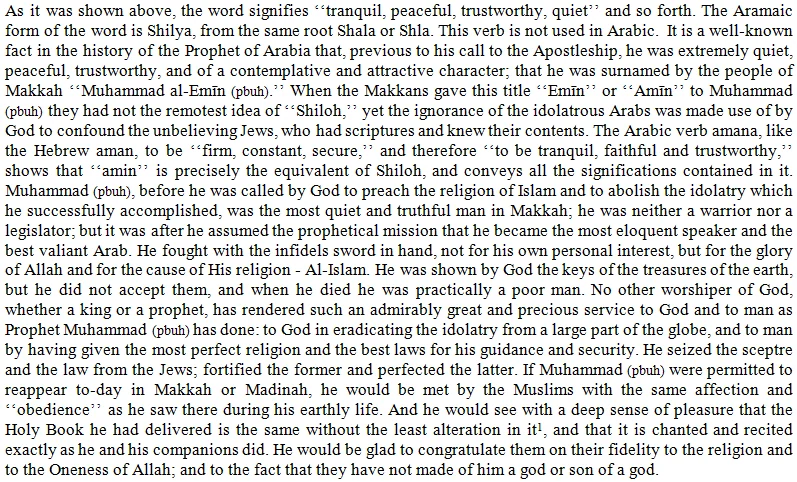
Professor ʿAbd al-Aḥad Dāwūd observed regarding the third interpretation of the name “Shiloh”:192

Professor ʿAbd al-Aḥad Dāwūd asserted that from whatever point of view we examine Jacob’s prophecy, we are compelled by its actual fulfillment in Prophet Muḥammad (PBUH) to admit that the Jews are vainly awaiting the coming of another Shiloh, and that the Christians obstinately persist in the mistaken belief that Jesus (PBUH) was the one intended by Shiloh. He further made several observations that deserve our serious consideration:193

Professor ʿAbd al-Aḥad Dāwūd concluded:194

The prophecy of Psalm 110:1: The Book of Psalms is one of the books of the Old Testament containing the history of Prophet David (PBUH), his exploits, and his prophetic writings. Psalm 110 is a messianic and prophetic psalm in which God gave David (PBUH) a vision of the future. In the opening verse of this psalm, Prophet David (PBUH) refers to Prophet Muḥammad (PBUH) as “my Lord”:195

Christians argue that this verse proves that Jesus Christ is God, reasoning that “if the first Lord is God, the second Lord must also be God.” Trinitarian commentators further argue that “my Lord” in this verse is another name for God and is therefore proof of the Messiah’s divinity. However, this interpretation is incorrect. In fact, if this verse refers to Jesus Christ, then it is one of the strongest proofs of his complete humanity. To understand why, we must first examine the use of the word “Lord” in this verse. The Hebrew text reads: “Yahweh said to ʾăḏōnî [translated ‘my lord’], ‘Sit at My right hand until I make your enemies a footstool for your feet.’” In all languages, words are derived from root words, and the meaning of an inflected form may differ significantly from that of its root. Psalm 110:1 illustrates this principle, as the root word meaning “lord” takes on a more specific sense in its inflected form. Understanding that distinction is essential to understanding the verse. The root of the word “lord” in Psalm 110:1 is אָדוֹן (ʾāḏôn), which means “lord” or “Lord” and can refer either to a human master or to God.196

When the root word אָדוֹן (ʾāḏôn) is inflected as אֲדֹנָי (ʾăḏōnāy), it refers to God.197

In stark contrast, when the root word אָדוֹן (ʾāḏôn) is inflected as אֲדֹנִי (ʾăḏōnî), it refers to a human or angelic lord.198 The -î ending is possessive in Hebrew and is therefore usually translated as “my.” Some examples will help illustrate this: אֵל (ʾĒl) is a name of God, so אֵלִי (ʾĒlî) means “my God.”199 Likewise, אָב (ʾāḇ) or אַבָּא (ʾabbāʾ) means “father,” so אֲבִי (ʾăḇî) means “my father.” The name אֲבִימֶלֶךְ (ʾĂḇîmeleḵ; Abimelech) is a compound of ʾăḇî (“my father”) and מֶלֶךְ (meleḵ, “king”), meaning “my father is king.”200 Similarly, ʾāḏôn means “lord,” and ʾăḏōnî means “my lord,” and this designation was never used of God. Instead, Hebrew uses ʾăḏōnāy for God. The point is that those who genuinely wish to undertake serious research into the biblical text must understand not only the root words but also their inflected forms and the impact those inflections have on the translation of the Bible. In this case, the term ʾăḏōnî is consistently used in the Bible to refer to human masters and lords, never to God. Many scholars recognize the distinction between ʾăḏōnî and ʾăḏōnāy and acknowledge the importance of that distinction. Sir Anthony Buzzard—a biblical scholar, Unitarian Christian theologian, author, and professor at Atlanta Bible College—and Charles F. Hunting—a retired pastor—write:201

The distinction between ʾāḏôn (the root word), ʾăḏōnî (“my lord”), used of human beings or angels, and ʾăḏōnāy (“the Lord” or “the Lord God”) is critical to understanding Psalm 110:1. The Dictionary of Old Testament Words by Aaron Pick distinguishes between ʾăḏōnāy and ʾăḏōnî, stating that ʾăḏōnî was “applied to man.”202 The three eminent Old Testament scholars—Francis Brown, Samuel R. Driver, and Charles Briggs—who spent more than twenty years researching, writing, and preparing The Brown–Driver–Briggs Hebrew and English Lexicon (commonly known as Brown–Driver–Briggs or BDB), which many consider the finest Hebrew lexicon of its kind, also distinguish between these words, stating that ʾăḏōnî “refers to human superiors.”203 The authors of the BDB lexicon point out that the following individuals were among those addressed as “lord.”204 The International Standard Bible Encyclopedia notes:205

Sadly, many biblical scholars have not paid close attention to the Hebrew text of Psalm 110:1 and therefore incorrectly claim that the second “lord” in the verse is the Hebrew word ʾăḏōnāy, meaning “God,” failing to recognize that ʾăḏōnāy is not the actual Hebrew word used in the verse. In light of the above explanation, the correct translation of Psalm 110:1 is: “The Lord (God) said to my lord…” Surely, this verse does not refer to Jesus (PBUH), for he was a son (a descendant) of David (PBUH),206 and he himself rejected the idea that the Messiah (the Deliverer), whom the Jews were expecting, was a son of David (PBUH).207


Therefore, our thesis that Prophet David (PBUH) calls Prophet Muḥammad (PBUH) “my lord” in Psalm 110:1 is supported by the testimony of Jesus Christ (PBUH). If this verse referred to Jesus (PBUH), David (PBUH) would have called him “my son,” for it would make no sense to call one’s son “my lord.” Evidently, this verse refers to Prophet Muḥammad (PBUH). The following points are worth considering:
•In the eyes of God and Man, the ʾāḏôn (the greatest Prophet) is the one who rendered unparalleled service to mankind by bringing it into the light of the One True God. If one compares the remarkable religious revolution brought about by the noble son of Ishmael with what all the thousands of Prophets achieved collectively, one will inevitably conclude that none but Muḥammad (PBUH) deserves the title of the ʾāḏôn—the lord, the master, the leader, and the commander.
•Jesus Christ (PBUH) said: “David himself, speaking by the Holy Spirit, declared: ‘The Lord said to my lord: “Sit at My right hand until I put your enemies under your feet.”’” (Mark 12:36). This mystery of “Sit at My right hand” is hidden from us, but we may safely assume that the honour of sitting at the right of the Throne of God was granted to Prophet Muḥammad (PBUH) during the famous Miʿrāj (i.e., the Night of Ascension to the Heavens). Professor ʿAbd al-Aḥad Dāwūd discussed the prophecy of Psalm 110:1 in greater depth. He wrote:208

Professor ʿAbd al-Aḥad Dāwūd noted that he had purposely written the original Hebrew words Yahwah and ʾĀḏōn in order to avoid any ambiguity or misunderstanding regarding the meaning they convey.209

Professor ʿAbd al-Aḥad Dāwūd observed:210

Professor ʿAbd al-Aḥad Dāwūd asserted the following concerning Jewish rabbis and Old Testament commentators:211

Professor ʿAbd al-Aḥad Dāwūd stated that the prophetic eye of Daniel (PBUH), which beheld in a remarkable vision the great “Barnasha (or Bar Nasha),” who was Prophet Muḥammad (PBUH), was undoubtedly the same prophetic eye as that of David (PBUH). That is, the same prophetic insight by which Daniel (PBUH) saw in a vision the great “Barnasha,” whom he identified as Prophet Muḥammad (PBUH), also enabled David (PBUH) to foresee Prophet Muḥammad (PBUH):212


Indeed, Psalm 110:1 shows Muslims who may not be well acquainted with the Jewish Scriptures how Christians have been misled by their priests and monks into adopting stupid and erroneous interpretations of the prophecies contained therein.
The prophecy of Isaiah 21:13–17:Isaiah 21:13–17 contains a very explicit and detailed prophecy about Prophet Muḥammad (PBUH):213

Verse 14—“The inhabitants of the land of Tema brought water to him that was thirsty.”—refers to the fact that, when Prophet Muḥammad (PBUH) was persecuted and faced many hardships in Makkah, and when his mission seemed to have failed, the people of al-Madīnah came to his rescue. The Makkan polytheists went so far as to impose an economic and social boycott on him and his clan, Banū Hāshim, confining them to a narrow mountain valley known as the Valley of Abū Ṭālib, where they suffered severe thirst and hunger. The people of al-Madīnah not only invited the Prophet (PBUH) and his Makkan followers to al-Madīnah, but also gave them refuge in their own homes, provided them with all the necessities of life, and furnished the new religion with a secure base from which to spread. Tema was a locality in Arabia that probably corresponds to the modern oasis of Taymāʾ, situated about 200 miles north of al-Madīnah and some 40 miles south of Dūmat al-Jandal (Dūmah), now known as al-Jawf.214 Moreover, the phrase “the land of Tema” encompasses the surrounding region, including al-Madīnah. Verse 15—“For they fled from the swords, from the drawn sword, and from the bent bow, and from the grievousness of war.”—refers to the fact that, when Prophet Muḥammad (PBUH) migrated to al-Madīnah, the Makkan polytheists had plotted to kill him while continuing to persecute the believers. Verse 16—“For thus hath the Lord said unto me, Within a year, according to the years of a hireling, and all the glory of Kedar shall fail.”—refers to the Battle of Badr, which took place about one year after the Prophet (PBUH)’s migration to al-Madīnah, when the small army of 313 Muslims defeated about 1,000 better-armed polytheists from the tribe of Quraysh, who were regarded as the most respected people among the Arabs, being descendants of Kedar, the son of Ishmael.215
The prophecy of Isaiah 29:12: Muḥammad (PBUH) is the unlearned Prophet heralded in Isaiah 29:12:216

At the age of forty, Muḥammad (PBUH) received his first revelation from Allāh through the angel Gabriel in the cave of Ḥirāʾ on Mount Paran (also known as Jabal an-Nūr, i.e., “Mountain of Light”), part of the as-Sarawāt mountain range in the al-Ḥijāz region of Saudi Arabia, just outside Makkah. There he used to seek solitude, reflect upon the evil deeds of his community, and worship Allāh for many nights before returning to his family. According to the Prophetic biographies, the angel Gabriel suddenly appeared before him (PBUH) and commanded him to read. He (PBUH) replied, “But I cannot read!” Gabriel embraced him tightly and then repeated the command. This happened three times. After the third embrace, Gabriel revealed to him the opening verses of chapter 96 of the Qurʾān: {Read, ˹O Prophet,˺ in the Name of your Lord Who created—created humans from a clinging clot. Read! And your Lord is the Most Generous, Who taught by the pen—taught humanity what they knew not} (Qurʾān 96:1–5). This was the exact fulfillment of the prophecy in the Book of Isaiah. The account in Isaiah 29:12 is also found in Ṣaḥīḥ al-Bukhārī, the most authentic collection of Ḥadīth (Prophetic traditions).217 The Noble Qurʾān also calls Prophet Muḥammad (PBUH) the unlettered Prophet: {˹They are˺ the ones who follow the Messenger, the unlettered Prophet, whose description they find in their Torah and the Gospel} (Qurʾān 7:157). Indisputably, Prophet Muḥammad (PBUH) was an unlettered man who had never known books or teachers and had never learned to read or write. The Qurʾān itself addresses him as follows: {You ˹O Prophet˺ could not read any writing ˹even˺ before this ˹revelation˺, nor could you write at all. Otherwise, the people of falsehood would have been suspicious} (Qurʾān 29:48). That is, if he (PBUH) had been literate, the disbelievers could have claimed that he was merely repeating what he had read in the earlier Scriptures and that the Qurʾān was not a new revelation sent down to him by Allāh. Hence, it was a great honour and miracle for the Prophet (PBUH) to be unlettered. He (PBUH) spent forty years of his life in this condition before the eyes of the people of Makkah. Then, at the age of forty, words began to flow from his mouth that were miraculous in their theme, meaning, and unsurpassed eloquence.
Hence, we have examined some prophecies in the Old Testament concerning the advent of Prophet Muḥammad (PBUH). We now turn to the New Testament to see whether it contains similar prophecies. As we shall demonstrate, Prophet Muḥammad (PBUH) was indeed foretold in the New Testament as well.
The prophecy of Matthew 3:11–12: The “mighty Prophet” foretold by Prophet John the Baptist (i.e., Yaḥyá ibn Zakariyyā) (PBUH) was none other than Prophet Muḥammad (PBUH). John the Baptist (PBUH) did not appear publicly until he was about thirty years old, when he began his mission of preaching repentance and baptizing repentant sinners with water. He baptized the penitent Jews in the waters of the Jordan River, declaring that his baptism with water was merely an outward sign of the purification of the heart through repentance. He proclaimed that another Prophet would come after him who would baptize with the Holy Spirit and fire, gather the wheat into his granary, and burn the chaff with unquenchable fire. He further proclaimed that this coming Prophet was mightier than himself in power and dignity, and that he (John the Baptist) was unworthy even to carry his sandals. John the Baptist (PBUH)—the great “Crier” in the wilderness—would repeatedly proclaim to the multitudes:218

Professor ʿAbd al-Aḥad Dāwūd noted:219

The preposition “after’’ in the phrase “that cometh after me’’ excludes Jesus (PBUH) from being the foretold Prophet because, according to the narratives of the four Evangelists, John the Baptist (PBUH) was a cousin and contemporary of Jesus (PBUH), being only about six months older than him. Certainly, Prophet Muḥammad (PBUH) came well after John the Baptist (PBUH). The statement “but he that cometh after me is mightier than I’’ also excludes Jesus (PBUH) from being the foretold Prophet. This is because, like John the Baptist (PBUH), he too was at the mercy of the unbelieving Jews and, according to Christian belief, suffered a violent and brutal death (crucifixion). Without a doubt, Prophet Muḥammad (PBUH) was mightier than both of them, as he eventually triumphed over all his enemies, subdued them, and successfully completed his Prophetic mission. As for the statement “he shall baptize you with the Holy Ghost, and with fire,’’ it is worth mentioning that baptism is the process of spiritual purification. According to this prophecy, the foretold Prophet was not to use water for this purpose. Indeed, Prophet Muḥammad (PBUH) purified his people with the Holy Qurʾān, the Word of Allāh, brought by the Holy Spirit (Archangel Gabriel). The statement, “Whose fan is in his hand, and he will throughly purge his flour, and gather his wheat into the garner; but he will burn up the chaff with unquenchable fire,’’ is very significant. The “fan’’ is the Qurʾān, for a fan is used to separate the grain from the chaff, and the Qurʾān, being al-Furqān (the Separator), separates right from wrong. Furthermore, the Old and New Testaments are full of statements that oppose and deny one another, and it is absolutely impossible to arrive at the truth—the true religion—from them unless they are read and examined from an Islamic and monotheistic point of view. Only then can the truth be separated from falsehood and the authentic distinguished from the spurious. That is, the spirit and faith of Islam alone can sift the Bible and cast away the chaff from its pages. One might argue that John the Baptist (PBUH) himself, upon seeing Jesus (PBUH), said:220

It is true that, upon seeing the noble Prophetic character of Jesus of Nazareth (PBUH), John the Baptist (PBUH) perhaps thought him to be that “mightier Prophet’’ of whom he spoke, but Jesus (PBUH) himself renounced the idea. This is evident from the fact that Jesus (PBUH) himself came to be baptized by John the Baptist (PBUH), and the latter hesitated, whereupon Jesus (PBUH) made the matter clear, and he himself was baptized:221

Professor ʿAbd al-Aḥad Dāwūd wrote:222

The fact that Jesus (PBUH) was baptized dispelled the notion, arising from John the Baptist (PBUH)’s confusion, that Jesus (PBUH) was that “mighty Prophet,’’ and thus righteousness was fulfilled. Besides, John the Baptist (PBUH) never became a disciple of Jesus (PBUH), even after coming to know him. This indeed removes all doubt, for if Jesus (PBUH) had been the foretold “mighty Prophet,’’ then John the Baptist (PBUH) would have become his disciple. Professor ʿAbd al-Aḥad Dāwūd wrote an in-depth article to determine the identity of the “mighty Prophet’’ foretold by John the Baptist (PBUH). He divided his article into two parts, namely:
A. The foretold Prophet was not Jesus Christ (PBUH).
B. The foretold Prophet was Prophet Muḥammad (PBUH).
Professor ʿAbd al-Aḥad Dāwūd asserted that everybody knows that the Christian Churches have always regarded John the Baptist (PBUH) as a subordinate of Jesus (PBUH) and as his herald. As he put it, all Christian commentators present Jesus (PBUH) as the object of John’s witness and prophecy, and the language of the Evangelists has been distorted by interpolators in that direction. However, the fraud or error cannot forever escape the searching eye of an impartial examiner and critic. Professor ʿAbd al-Aḥad Dāwūd offered ample proof that the Prophet foretold by John the Baptist (PBUH) was someone other than Jesus Christ (PBUH). As he put it, Jesus Christ (PBUH) could not be the object of John’s witness because:223


As Professor ʿAbd al-Aḥad Dāwūd stated, the Prophet foretold by John the Baptist (PBUH) was certainly Prophet Muḥammad (PBUH). There are two highly significant remarks made by Jesus Christ (PBUH) about John the Baptist (PBUH), but they are recorded in a mysterious way. The first remark concerning John the Baptist (PBUH) is the one in which he is presented to the world as the reincarnate Eliah (Elijah in the Old Testament):224

The other remark is shrouded in an even deeper mystery: “No man born of woman was ever greater than John the Baptist (PBUH),’’ says Jesus (PBUH), “but the least in the Kingdom of Heaven is greater than John.’’225


The Prophet foretold by John the Baptist (PBUH) could be none other than Prophet Muḥammad (PBUH) because:
1.According to the testimony of Jesus (PBUH), no man born of woman was ever greater than John the Baptist (PBUH). Yet the “least’’ in the Kingdom of Heaven is greater than John (PBUH).226


2. John the Baptist (PBUH) recognizes Prophet Muḥammad (PBUH) as mightier and superior to himself.227


3. Have you ever come across a sensible, judicious, and convincing interpretation of the phrase “The Coming Wrath’’ in any of the numerous commentaries on the Gospels?228

4. The Jews and the Christians have always charged Prophet Muḥammad (PBUH) with having established the religion of Islam by force, coercion, and the sword. This baseless charge is easily refuted. However, this is not to say that he (PBUH) never wielded the sword.229

Hence, Professor ʿAbd al-Aḥad Dāwūd advanced several logical, conclusive, and sound arguments in support of the Messenger of Allāh, Muḥammad (PBUH), being a superior and mightier Prophet than John the Baptist (PBUH). Indeed, each of the above arguments could easily be developed into a voluminous book. No doubt, these arguments will sound jarring to the fanatical ears of many a Christian, but, as Professor ʿAbd al-Aḥad Dāwūd put it, truth exalts itself and extols him who propagates it. As elaborated above, the truth to which John the Baptist (PBUH) bore witness concerns none other than Prophet Muḥammad (PBUH). Professor ʿAbd al-Aḥad Dāwūd asserted that the baptism of John the Baptist (PBUH) and Jesus (PBUH) is only a type of religious marking, “ṣibġah of Allāh.’’230Indeed, Islam is the indelible religious marking of Allāh, and no one marks better than Him: {[Our religion is] the ṣibġah (colouring) of Allāh. And whose ṣibġah is better than Allāh’s? And it is He Whom we worship} (Qurʾān 2:138). This verse describes Islam—the genuine and unabrogated religion—as the “ṣibġah’’ (i.e., colouring) of Allāh. The word “ṣibġah’’ has a deeper meaning. Just as a certain colour is clearly visible to the beholder, the signs of genuine and pure faith should shine through the face, movements, habits, and behaviour of a Muslim. In this sense, the verse calls upon Muslims to dye themselves with the colouring of Allāh, outwardly and inwardly, by offering unalloyed worship to Him alone, submitting themselves totally to His commandments, and gladly accepting His will.231 Professor ʿAbd al-Aḥad Dāwūd bemoaned:232

As Professor ʿAbd al-Aḥad Dāwūd asserted, the corruptions in the Gospels cannot conceal the truth that John the Baptist (PBUH) bore witness to two individuals:233

The principal point that constitutes the power and superiority of Prophet Muḥammad (PBUH), the Prince of the Apostles of Allāh, is the baptism with the Holy Spirit and with fire:234


The extreme importance of the two baptisms deserves very serious consideration, and the observations made by Professor ʿAbd al-Aḥad Dāwūd in his article should greatly interest both Muslims and non-Muslims.235

Professor ʿAbd al-Aḥad Dāwūd submitted the following observations regarding what baptism is and what it is not to the thoughtful and impartial judgment of readers:
(a) It is within our rights to agree or disagree with a doctrine, but nothing can justify our conduct if we deliberately distort and misrepresent a doctrine in order to prove our own theory about it:236

(b) Considering the classical meaning of the Greek “baptismos,’’ which means “tincture, dye, and immersion,’’ the corresponding word could be none other than the Arabic “ṣabaġa’’ (i.e., “to dye’’):237


(c) The Christian baptism, notwithstanding its grandiose definitions, is nothing more nor less than an aspersion with water or an immersion in it:238

(d) From the meager accounts in the Gospels, we cannot derive a clear definition of the true nature of the baptism practiced by John the Baptist (PBUH) and Jesus (PBUH):239

(e) According to the testimony of St. Mark (1:1–8), the baptism of John (PBUH) was for the “remission of sins”:240

(f) If the Gospels mean anything at all in their statements concerning baptism, they leave the impression that there was no difference between the two baptisms, except that they were administered in the name of one or the other of the two Prophets:241

Professor ʿAbd al-Aḥad Dāwūd noted that one of the few religious phenomena he had not been able to explain was this: How is it that the well-known Saba’ītes (Sabians), who were so predominant in the Arabian Peninsula and Mesopotamia, did not embrace Christianity if John the Baptist (PBUH) had really and openly declared Jesus (PBUH) to be the “mightier’’ Prophet than himself, and as the Messiah whose sandals he was not worthy to unloose?242

The Christian conception of the Holy Spirit is entirely different from the Islamic and Jewish conceptions:243


Now Professor ʿAbd al-Aḥad Dāwūd explains, according to his humble understanding, the spiritual and fiery baptism:244

Professor ʿAbd al-Aḥad Dāwūd developed these points a little further:245

St. John the Baptist (PBUH) ascribes this spiritual and fiery baptism to Muḥammad (PBUH), the Great Apostle of Allāh, not as a divine being, God, or the Son of God, but as a holy agent and an instrument through whom this divine baptismal sacrament was to be administered.246

These three effects of the “ṣibġat Allāh’’ (i.e., the colouring of Allāh) deserve serious consideration and study. Their exposition is necessarily brief.
1)The Holy Spirit, whether the Archangel Gabriel or another of the created superior spirits, sanctifies the spirit of a Muslim at birth or upon conversion, as the case may be, by the command of Allāh, and this sanctification means:247



2)The second sign of the spiritual baptism is enlightenment:248

3)The “ṣibġat Allāh’’ (i.e., the colouring of Allāh) is that divine baptism with fire which arms and equips the Muslim to become a bulwark against error and superstition, especially against idolatry in all its forms:249

In a word, the unquestionable conclusion is that the “mightier Prophet’’ foretold by John the Baptist (PBUH) in Matthew 3:11–12 is Prophet Muḥammad (PBUH).
The prophecies in chapters 14, 15, and 16 of the Gospel of John:The Qurʾān, the primary reference for Muslims as the last divine revelation that remains intact, says:{And ˹remember˺ when Jesus, son of Mary, said, “O children of Israel! I am truly Allāh’s messenger to you, confirming the Torah which came before me, and giving good news of a messenger after me whose name will be Aḥmad.” Yet when the Prophet came to them with clear proofs, they said, “This is pure magic”} (Qurʾān 61:6). This verse connects both the Old and the New Testaments within the same passage, as it states that Prophet Jesus (PBUH) told the Israelites that he came to confirm the Torah that came before him, as well as the prophecies that recur throughout it concerning a great Prophet to come. It is evident from this verse that Jesus (PBUH) heralded the advent of a Prophet who would come after him and even mentioned his name. The names Aḥmad and Muḥammad derive from the same Arabic root and are essentially the same name. This is further confirmed by a ḥadīth (tradition) in which Prophet Muḥammad (PBUH), when asked about his birth, said, “I am the answer to the supplication of my father Abraham and the glad tidings given by Jesus.’’250 That is, the advent of Prophet Muḥammad (PBUH) is the fulfillment of Abraham’s prayer for a Messenger to be raised among his descendants251 and of Allāh’s promise to Ishmael’s mother, Hagar, to make of Ishmael a great nation.252 It is also the fulfillment of the glad tidings of his advent given by Jesus (PBUH). In fact, the very word “Gospel’’ comes from the Greek word εὐαγγέλιον (euangélion) and simply means “good news’’ or “glad tidings.’’253 This shows that Prophet Jesus (PBUH) gave the good news of the coming of the universal and final Prophet to mankind. Indeed, he (PBUH) was the perfect prelude to the final Messenger.
One of the most important prophecies about Prophet Muḥammad (PBUH) in the New Testament appears in the Gospel of John, where Prophet Jesus (PBUH) spoke of the “Paraclete’’ who would come after him. The fourteenth, fifteenth, and sixteenth chapters of the Gospel of John contain descriptions of this Paraclete. Christians believe that the Paraclete whom Jesus (PBUH) mentioned is the Holy Spirit—the third person of the Trinity. In fact, however, the Paraclete (Latin: Consolator; Greek: Paráklētos) heralded by Jesus (PBUH) in chapters 14, 15, and 16 of the Gospel of John is none other than Prophet Muḥammad (PBUH). It is important to understand that the Greek word translated in different English versions of the Bible as “Comforter,’’ “Counselor,’’ “Advocate,’’ “Helper,’’ or “Teacher’’ (as found in John 14:16, 26; 15:26; and 16:7) is παράκλητος (romanized: Paráklētos). This is a distorted form of the original Koine Greek word περικλυτος (romanized: Periklytós), meaning “famed, illustrious, or praiseworthy,’’ which, in turn, is equivalent to the Arabic name Aḥmad—another name of Prophet Muḥammad (PBUH)—mentioned in the aforementioned Qurʾānic verse.254 Professor ʿAbd al-Aḥad Dāwūd compared the word “Aḥmad’’ in this Qurʾānic verse, which speaks of Jesus (PBUH)’s prophecy concerning Prophet Muḥammad (PBUH), with the word “Paraclete’’ in the Gospel of John (14:26, etc.) and drew a connection between them. As we shall see later, he proved that, from a linguistic and etymological point of view, “Paráklētos” does not mean Advocate, Consoler, or Comforter and is not the Holy Spirit. As he put it, for centuries the ignorant Latins and Europeans have written the name of Muḥammad (PBUH) as “Mahomet’’ and that of Moshe (PBUH) as “Moses.” Therefore, it is no wonder that some overzealous Christian monk or scribe should have written the true name, meaning “the Most Illustrious’’ or “the Praiseworthy,’’ in the corrupted form of Paráklētos, which means nothing at all except a standing shame to those who have for eighteen centuries understood it to signify an advocate or a consoler. It should be noted that even with the word “παράκλητος’’ (Paráklētos; in English, Paraclete), which all extant Greek manuscripts read and which is translated as “Comforter” or “Advocate”—and which, as we have said, is itself a distorted form of the original Koine Greek word περικλυτος (Periklytós)—this prophecy still refers to Prophet Muḥammad (PBUH), who is a mercy to all creation.
Now, let us shed some light on the verses in which the term “Paraclete” (Greek: παράκλητος; romanized: Paráklētos) occurs:
•In verse 16 of chapter 14 of the Gospel of John, Jesus (PBUH) said:255

It is quite significant that Jesus (PBUH) used the term “another” in heralding the Paraclete. If the Paraclete is the Holy Spirit, then it is not another, for according to the doctrine of the Trinity, the Son (Jesus), the Father, and the Holy Spirit are one and the same. The main point here is that when Jesus (PBUH) said “another,” he was speaking of someone different and independent, not someone who is part of the Trinity. The phrase “another Comforter’’ means a different one—an additional one—but one of the same kind and nature; that is, one who is subject to all the human conditions of hunger, thirst, fatigue, and the like. In short, the word “another” refutes the claim that the promised Comforter was the Holy Spirit and establishes that he was to be a man. Moreover, Jesus (PBUH) foretold that this “Comforter” would abide with people forever. One might ask: How can Prophet Muḥammad (PBUH) fulfill this prophecy when we all know that he died more than fourteen hundred years ago? The answer is quite simple. Obviously, no human being lives forever. Thus, when the Bible speaks of someone abiding forever, it does not necessarily mean that the person will remain on earth forever. Rather, it means that what was brought through that person will abide forever, such as the Law. Hence, this verse simply refers to the “Comforter” abiding forever through his teachings. Anyone familiar with Prophet Muḥammad (PBUH) knows that it is an indisputable fact that his teachings have been preserved without even an iota of corruption. Today, more than fourteen hundred years after his death, every word of the Qurʾān revealed to him remains intact in its original language, as though he were still with us reciting the Word of Allāh. Moreover, his ḥadīths (traditions) have also been faithfully preserved to this day. Hence, Prophet Muḥammad (PBUH) metaphorically abides with the believers forever through the divine revelation and the Law that he brought. In fact, this is also a biblical concept.256 This is one of the clearest pieces of evidence for the finality of Prophethood, for more than fourteen hundred years have passed, yet everything brought by Prophet Muḥammad (PBUH) remains preserved, and no one has come claiming a scripture that has, in any way, come close to what the Bible or the Qurʾān have achieved.
•In verse 26 of chapter 14 of the Gospel of John, Jesus (PBUH) said that the mission of the coming Paraclete was to remind people of the truth that he had preached:257

We shall address the phrase “the Comforter, which is the Holy Ghost’’ in greater detail shortly, as we examine whether the promised Comforter is indeed the Holy Spirit. Indeed, the statement “he shall teach you all things’’ applies to Prophet Muḥammad (PBUH), for his teachings encompass all spheres of life. That is, he (PBUH) enlightened mankind concerning every matter of human interest. The statement “and bring all things to your remembrance, whatsoever I have said unto you’’ refers to the fact that Prophet Muḥammad (PBUH), through his message, reminded mankind in general, and Christians in particular, of the true teachings of Jesus Christ (PBUH), namely the Islamic monotheism that he preached, as well as the importance of righteous deeds, among many other things.
•In verse 26 of chapter 15 of the Gospel of John, Jesus (PBUH) said:258

Jesus (PBUH) described the Paraclete as the Spirit of truth. It is true that all the Prophets are spirits of truth. However, this title befits Prophet Muḥammad (PBUH) more than any other Prophet, for he was known as aṣ-Ṣādiq (the Truthful) even before he declared his Prophethood. Indeed, his truthfulness is an undisputed historical fact, affirmed even by his staunchest enemies. The phrase “he shall testify of me’’ was fulfilled in Prophet Muḥammad (PBUH), for he testified concerning Jesus (PBUH) and refuted all the accusations that the Jews made against him and his mother. Prophet Muḥammad (PBUH) also testified—as Allāh revealed to him in the Qurʾān—that it was not Jesus (PBUH) who was crucified. Let us recall what happened when people believed that Jesus (PBUH) was the man who died on the cross. On the one hand, those who rejected him took this as proof that he was a false prophet, when in fact he was not. They referred to this verse in the Book of Deuteronomy:259

On the other hand, Christians who agreed with his enemies on the matter of the crucifixion, maintained that Jesus (PBUH) became accursed in order to atone for the sins of mankind, as stated in this verse from the Book of Galatians:260

However, the Qurʾān asserts that Jesus (PBUH) was neither crucified as a false prophet nor cursed. Rather, Allāh saved him.261 Moreover, the Qurʾān vindicates Jesus (PBUH) from what is attributed to him in the Bible:262


These verses claim that while he was on the cross and about to die, Jesus (PBUH) cried out, asking God why He had forsaken him. Yet history bears witness to people who were neither saints nor Prophets, and certainly not sons of God in any theological sense, who faced death for the sake of God without losing their trust in Him at the very last moment. This shows that it was not Jesus (PBUH) who uttered those words and expressed such distrust and impatience toward the Father while on the cross. Additionally, the Qurʾān makes it undeniably clear that the mother of Jesus (PBUH) was a respectable and truthful woman, and vindicates her against all the accusations concerning the conception and birth of Jesus (PBUH). Furthermore, the Qurʾān absolves Jesus (PBUH) of the many unbefitting attributes ascribed to him in the Bible, which most people, especially Christians, do not critically examine. One such example is the passage in the Gospel of John that portrays him as speaking with a certain harshness toward his own mother:263

In the Qurʾān, however, Jesus (PBUH) is quoted as saying: {[He has enjoined me] to be kind to my mother. He has not made me arrogant or defiant} (Qurʾān 19:32). This kindness, which is denied in the biblical passage, is unequivocally affirmed in the Qurʾān. Jesus (PBUH) is also portrayed in the Bible as using harsh language toward the scribes and Pharisees:264

Likewise, in the account of the Canaanite woman, Jesus (PBUH) is portrayed as calling the Gentiles (non-Jews) “dogs.”265

In short, the Qurʾān rejects the claim that Jesus (PBUH) ever made such harsh statements and never mentions him except with the utmost respect and reverence. It clearly recognizes Jesus (PBUH) as a great Prophet and vindicates both him and his mother from the false claims made against them. Hence, no one bore witness to Jesus (PBUH) and vindicated him more than Prophet Muḥammad (PBUH), who came after him.
•In verses 7 and 8 of chapter 16 of the Gospel of John, Jesus (PBUH) said:266

As is clear, Jesus (PBUH) asserted that his departure was a prerequisite for the coming of the Paraclete. In other words, the Paraclete would not come unless Jesus (PBUH) departed. The point is that Jesus (PBUH) spoke of the Paraclete as someone who would come after him, and there is no one who came after him who fits all the descriptions except Prophet Muḥammad (PBUH). The statement, “he will reprove the world of sin, and of righteousness, and of judgment,’’ means that the Paraclete would rebuke those who rejected Jesus (PBUH). Indeed, the Qurʾān does precisely this. The statement also indicates that, in exercising judgment, the Paraclete would prevail over his enemies and punish those who seek to prevent the truth from reaching mankind. Clearly, this describes a person—a Prophet—and not a spirit. Some Christians argue that the Paraclete was to be sent by Jesus (PBUH) after his departure from this world. Hence, they contend that the Muslim argument identifying Prophet Muḥammad (PBUH) as the Paraclete is invalid because Muslims maintain that Prophet Muḥammad (PBUH) was sent by Allāh, not by Jesus (PBUH). However, this, once again, is nothing but a perversion of the truth. The statement, “It is expedient for you that I go away: for if I go not away, the Comforter will not come unto you,’’ makes it abundantly clear that when Jesus (PBUH) said, “I will send him unto you,’’ he meant only that his departure would lead to the coming of the Paraclete. The interpretation that many Christians derive from this statement—that Jesus himself would send the Paraclete—is not consistent with the first part of the verse. Rather, the Paraclete was to be sent by God the Father in Heaven, as Jesus (PBUH) himself testified when he said:267

Indeed, Prophet Muḥammad (PBUH) was sent by Allāh, the Only True God.
•In verses 12–14 of chapter 16 of the Gospel of John, Jesus (PBUH) said:268

The idea that the Paraclete would guide the followers of Jesus (PBUH) into all truth and tell them of things to come is fully consistent with the mission of Prophet Muḥammad (PBUH) and with what the Qurʾān itself says about him. First of all, Allāh makes it clear that the Qurʾān is the most complete and perfect Scripture revealed by Him: {We have revealed to you the Book as an explanation of all things, a guide, a mercy, and good news for those who ˹fully˺ submit} (Qurʾān 16:89). In fact, one of the very last verses of the Qurʾān to be revealed states: {Today I have perfected your faith for you, completed My favour upon you, and chosen Islam as your way} (Qurʾān 5:3). This shows, both explicitly and conclusively, something that was not stated in any of the previous Scriptures, namely that the Qurʾān is the final revelation from Allāh and the completion of the message brought by all the Prophets. The statement “he will guide you into all truth” applies to Prophet Muḥammad (PBUH), for, as the last of Allāh’s Messengers, he was given a comprehensive and practical Law that provides a solution to every human problem. Moreover, Jesus (PBUH) told his disciples that the Paraclete would guide them into all truth, leaving no reason for them to differ among themselves. This does not apply to the Holy Spirit, for history bears witness that, from the Day of Pentecost to the present day, different Christian denominations have remained divided over fundamental doctrines, such as the nature of Jesus (PBUH).269 This demonstrates that no new truth or revelation was given to the disciples after Pentecost. The question, then, is this: If the promised Paraclete was the Holy Spirit, what new truth has it revealed to Christians over the past two thousand years? What solutions has it provided to the many problems facing the Christian world today? The answer is: Nothing. Hence, the Holy Spirit is not the Paraclete spoken of here. Rather, the truth was to come later. This applies to Prophet Muḥammad (PBUH), for it was only with the final divine revelation brought through him that the points of disagreement and confusion dividing the Christian community over the past two thousand years were clarified. Indeed, from the time of the Prophet (PBUH) to the present day, many Christians who have embraced Islam have found satisfying answers to the questions that had long perplexed them. Additionally, the fact that Jesus (PBUH) told his disciples that he had many things to say to them but that they could not yet bear them, and that when the Spirit of truth came, he would guide them into all truth, shows that the Paraclete was to bring additional divine guidance. In other words, he would bring a Law to complete the Old Law (the Old Testament), not to abolish or detract from it. This is further evidence that the Paraclete is not the Holy Spirit, as some Christian theologians claim, for after the day of Pentecost, Christians did not become more observant of the laws of the Old Testament. Rather, they ceased observing many of them, such as the Sabbath. Furthermore, the phrase “he shall not speak of himself” indicates that the Paraclete would receive instruction, knowledge, and revelation from another source—God. This closely parallels the Qurʾānic statement that Prophet Muḥammad (PBUH) did not speak from his own whims: {Nor does he speak of his own whims. It is only a revelation sent down ˹to him˺} (Qurʾān 53:3–4). This also shows that the Holy Spirit cannot be the Spirit of truth referred to here, for, according to Christian belief, the Holy Spirit is also a divine being—part of the Godhead—and thus must speak on His own authority and has no need to receive revelation from another source. This, in itself, refutes the claim that the Paraclete is the Holy Spirit and establishes that he is, instead, a human being. The statement “he will show you things to come” likewise applies to Prophet Muḥammad (PBUH), for he conveyed numerous prophecies in both the Qurʾān and the Ḥadīth (Prophetic traditions). The phrase “he shall glorify me” also applies to Prophet Muḥammad (PBUH). This may come as a surprise to many Christians, but the Qurʾān, in fact, glorifies Prophet Jesus (PBUH) more than the Gospels do—apart from the passages that Christians understand as affirming his divinity. In other words, with respect to his character and conduct, the Qurʾān presents Jesus (PBUH) in a more exalted light than does the New Testament. Indeed, it is an irrefutable fact that Prophet Muḥammad (PBUH) glorified Jesus (PBUH) more than all the Churches have been able to do. Globally, there are approximately 2 billion Muslims, all of whom love and revere Jesus (PBUH) and his mother solely on the authority of Prophet Muḥammad (PBUH).
Now, the most common interpretation, which has been upheld by the official Church for hundreds of years, is that the above prophecies about the Paraclete, sometimes referred to as the Spirit of Truth, refer to the Holy Spirit. It is commonly believed within the Christian community that everything Jesus (PBUH) said in chapters 14, 15, and 16 of the Gospel of John was fulfilled on the Day of Pentecost, as described in chapter 2 of the Book of Acts.270 That is, the Paraclete whom Christ had promised to his disciples came on the Day of Pentecost. It is claimed that on the tenth day after the Ascension of Christ into heaven, the Holy Spirit descended upon the disciples, whereupon they began speaking in different languages. Verses 12–13 of chapter 2 of the Book of Acts describe the disciples as appearing to be drunk, saying things that were unintelligible to one another. But St. Peter defended them and said that it was the Holy Spirit who enabled them to speak in different languages.271 However, the above prophecies are not speaking of a spirit but of a human being who would come after Jesus (PBUH). Someone might ask: How do we know with certainty that the Paraclete foretold by Jesus (PBUH) is a human being and not a spirit? In addition to the points discussed above, it is worth considering the following points as well:
•Jesus (PBUH) spoke of the Paraclete as someone who had not yet been sent by the Father and whom the world did not know. However, in both the Old and New Testaments, we see that the concept of the Holy Spirit was already known before Jesus (PBUH) came. That is, the Holy Spirit was known to the people, whereas Jesus (PBUH) insisted that the world did not know the Paraclete and that he had yet to be sent by the Father. As we have seen, John 16:7 plainly states that the Paraclete would come only after Jesus (PBUH)’s departure,272 but the Holy Spirit had already been sent on various occasions before and during the time of Jesus (PBUH)—in the womb of Elizabeth,273 in Zachariah,274 when Jesus (PBUH) was baptized,275 and even Jesus (PBUH)’s own disciples had received the Holy Spirit.276 Therefore, the Promised Paraclete in this prophecy is not the Holy Spirit but rather Prophet Muḥammad (PBUH).
•Jesus (PBUH) used the masculine demonstrative pronoun ἐκεῖνος (transliteration: ekeinos, i.e., “he”) to refer to the Paraclete—rather than the impersonal pronoun “it”—even though the Greek word for “spirit” (πνεῦμα, pneuma) is grammatically neuter, which is evidence that he is a person and a man.277


All Greek nouns and adjectives have grammatical gender and are either masculine, feminine, or neuter. The Greek word for “spirit” (πνεῦμα: pneuma) is grammatically neuter, and every word directly associated with it in ancient Greek texts, such as pronouns, articles, adjectives, and participles, is likewise grammatically neuter. Did the author of John’s Gospel break with grammatical convention and a use masculine pronoun for the Holy Spirit even though the Greek word for “spirit” (πνεῦμα: pneuma) is grammatically neuter rather than masculine? According to Christian theologians, John is the only biblical author to refer to the Holy Spirit as the Paraklētos (the Paraclete, i.e., Comforter, Advocate, or Counsellor), which is a grammatically masculine word, and any pronouns, articles, adjectives, and participles directly associated with it are likewise masculine. We see this principle of grammatical agreement demonstrated in John 16:13, in which Jesus (PBUH), speaking about the Paraclete—identified as the Spirit of truth— referred to him repeatedly using masculine pronouns.278

John 16:13 is remarkable for its repeated use of masculine pronouns in reference to the Paraclete, who is described as the Spirit of truth. This is significant because it reveals the nature of the Promised Paraclete. These pronouns indicate that the Paraclete must be a man and not a spirit. Prophet Muḥammad (PBUH) was indeed a human being—a man.
•It is also interesting to note the Greek verb used to describe the coming of this Paraclete. Whenever the Bible speaks of the Holy Spirit, it says that He came “upon” or “on” someone, but it never says that He came “unto” or “to” someone, as it does with the Paraclete. This is true throughout the Bible. Notice the following examples:279


When the Holy Spirit’s coming upon or on someone is described, the Greek preposition ἐπί (epi), meaning “upon,” “on,” or “over,” is always used, whereas the preposition used for the Paraclete is always πρός (pros), which denotes direction and means “towards,” “to,” or “unto.”280 The fact that the preposition ἐπί (epi) is never used for the Paraclete is proof that the Paraclete is not the Holy Spirit.
•The verbs associated with the Paraclete are also very significant, namely “speak” and “hear,” as recorded in John 16:13:281

The verb rendered “to hear” in English translations of the Bible is the Greek verb ἀκούω (akoúō), which means “to perceive sounds,” and the verb rendered “to speak” is the Greek verb λαλέω (laleō), which has the general meaning “to emit sounds” and the more specific meaning “to speak.”282

The Greek verb λαλέω (laleō) is very common in the Greek text of the Gospels, but it is never used with reference to the Holy Spirit. Therefore, it becomes evident that the communication proclaimed here has a material character. That is, it does not in any way consist of statements inspired through the agency of the Holy Spirit. The point is that the two Greek verbs ἀκούω (akoúō) and λαλέω (laleō) can only be applied to a being with organs of hearing and speech. In other words, it is impossible to apply them to the Holy Spirit, who is understood to inspire rather than to speak in the literal sense suggested by the Greek wording here.
•Historically speaking, not all early Christians subscribed to the view that the Paraclete is the Holy Spirit. Accordingly, throughout Christian history, many people claimed to be the Paraclete prophesied by Jesus (PBUH). If they believed that the Paraclete was a spirit, there would have been no point in doing so. In fact, Johann Lorenz Mosheim—a German Lutheran theologian and church historian—stated that figures such as Saint Augustine and Father Tertullian, at some point in their lives, followed individuals who claimed to be the Paraclete.283 This is proof that the Paraclete was regarded as a person who was to come, not as a spirit.
Someone might object: “But there are verses in the Gospel of John that refute the thesis that the Paraclete is a human being.” Indeed, in three of the verses in which the Paraclete is the main subject, John adds a phrase containing the neuter noun πνεῦμα (pneuma, “spirit”) to identify the Paraclete. It is this additional phrase that appears to have caused some confusion regarding the Paraclete’s identity. In John 14:26, the Paraclete is identified as the Holy Spirit, whom the Father will send in Jesus’s name:284

In John 15:26, the Paraclete is identified as the Spirit of truth, which proceeds from the Father:285

In John 16:13, the Paraclete is identified as the Spirit of truth:286

The identification of the Paraclete as the Spirit of truth has already been addressed. Aside from that, the statement that attracts our attention in the above verses is “the Comforter, which is the Holy Ghost.” Clearly, it does not take a biblical scholar of the highest caliber to recognize that the phrase “which is the Holy Ghost” is an interpolation. Considering John 14:26 alongside the other verses concerning the Paraclete reminds us of what Rev. John L. McKenzie—an American Catholic biblical scholar—stated in his Dictionary of the Bible. After describing the Paraclete as derived from the Gospel of John, Rev. McKenzie admitted that the items used to describe the Paraclete do not present an entirely coherent picture.287

That is, interpreting the Paraclete as a spirit is quite incoherent because some of the descriptions do not fit the nature of a spirit. This is evident from the various points discussed above. It is also interesting to note that the translators of the Revised Standard Version (RSV) of the Bible retained the expression “the Holy Ghost” but found it necessary to modify it. Specifically, they changed the phrase “Holy Ghost” to “Holy Spirit.”288

The original Greek word here is πνεῦμα (pneuma; Latin spiritus), which they preferred to translate as “Holy Spirit.”289

Even if, for the sake of argument, we accept the phrase “Holy Spirit” here, the case can still be made that Prophet Muḥammad (PBUH) is the Holy Spirit. This is because the author of the Gospel of John is also traditionally believed to have written several epistles that are part of the New Testament,290 and in one of those epistles he used the word “spirit” to refer to a Prophet. He wrote:291

Compare the original Greek word translated as “spirit” in 1 John 4:1 and John 14:26.292

It is the same πνεῦμα (pneuma). This supports the thesis that “spirit” and “Prophet” are synonymous in the writings of the same author. That is, in 1 John 4:1, the word “spirit” is used synonymously with “Prophet” in that a true spirit is a true Prophet and a false spirit is a false prophet. Hence, the correct translation of John 14:26 is: “But the Paraclete, which is the Holy Prophet, whom the Father will send in my name, he shall teach you all things, and bring all things to your remembrance, whatsoever I have said unto you.” On a related note, Christians may argue that the word “you” in the above prophecies—“he [the Comforter] may abide with you for ever” and “he [the Comforter] shall teach you all things”—is used by Jesus (PBUH) in addressing his disciples and therefore implies that the Paraclete would come to the disciples. That is, the Paraclete can refer only to the Holy Spirit and not to Prophet Muḥammad (PBUH). This argument is invalid and reflects a lack of scriptural knowledge. We have already discussed the prophecy in the Book of Deuteronomy concerning a Prophet like Moses,293 which is also mentioned in the Book of Acts:294

The words “you” and “your” are used here as well, yet the immediate audience of Moses (PBUH) undoubtedly lived some 1,300 years before St. Peter and his contemporaries. Nevertheless, every Christian acknowledges that this prophecy refers to Jesus (PBUH). Likewise, Jesus (PBUH) said:295

Again, if we take the word “you” here to refer to the immediate listeners of Jesus (PBUH), then we are accusing Jesus (PBUH) of having lied because he is saying that he, as the “Son of Man,” will come to them (i.e., his group of twelve hand-picked disciples) before they finish preaching in all the towns of Israel, yet this never happened. That is, Jesus (PBUH) did not return before the disciples had gone through all the towns of Israel. To conclude, the above arguments prove beyond a shadow of a doubt that everything Prophet Jesus (PBUH) said, as recorded in chapters 14, 15, and 16 of the Gospel of John, concerns Prophet Muḥammad (PBUH) and not the Holy Spirit.
Professor ʿAbd al-Aḥad Dāwūd wrote two in-depth articles in which he discussed the famous “Paraclete” of the Fourth Gospel (the Gospel of John). He examined the etymology and the true signification of what he regarded as the unclassical, or rather corrupt, form “Paraclete,” and exposed and refuted the erroneous Christian interpretation of the Paraclete. In his first article, he argued that the Paraclete is not—as the Christian Churches believe—the Holy Ghost, nor does the term mean “Comforter” or “Intercessor” at all. In his second article, he clearly showed that it is not “Paraclete” but “Periclyte” that precisely signifies “Aḥmad” in the sense of “the Most Illustrious, Praised, and Celebrated.” Professor ʿAbd al-Aḥad Dāwūd concluded that the Comforter—the Spirit of truth—spoken of by Jesus (PBUH) was none other than Prophet Muḥammad (PBUH):296

Professor ʿAbd al-Aḥad Dāwūd wrote:297


The Holy Spirit is described in the New Testament not as a person:298



This is what the early Church Fathers said about the Holy Spirit:299


The word “Paraclete” signifies neither “Consoler” nor “Advocate” and, in truth, is not a classical word at all:300

Before presenting the true Greek form of which “Paraklytos” is a corruption, Professor ʿAbd al-Aḥad Dāwūd corrected an error that the French scholar Ernest Renan had also made:301

Professor ʿAbd al-Aḥad Dāwūd asserted that “Periqlytos” means “Aḥmad” and that the Qurʾān declares that Jesus (PBUH) announced to the Children of Israel the coming of Aḥmad (PBUH):302

We have already seen that, as Professor ʿAbd al-Aḥad Dāwūd explained, the Periqlyte is not the Holy Spirit (i.e., whether understood as a divine person, Gabriel, or any other angel). We shall now see how Professor ʿAbd al-Aḥad Dāwūd proved that the Periqlyte could not be a consoler or an advocate between God and humanity.
1. The Periqlyte is neither the “Consoler” nor the “Intercessor”: Professor ʿAbd al-Aḥad Dāwūd fully demonstrated the material impossibility of discovering even the slightest signification of “consolation” or “intercession” in the word. He explained that Christ does not use Paraqalon (the Greek word that would correspond to “Counselor”) and that, even from a religious and moral point of view, the very idea of consolation or intercession is inadmissible.303


Hence, Professor ʿAbd al-Aḥad Dāwūd proved that the “Paraclete” of St. John’s Gospel neither means nor can mean “Consoler,” “Advocate,” or anything else, and that it is a corrupted form of Periqlytos. We shall now proceed to his discussion of the true signification of the word Periqlytos.
2. Periqlytos etymologically and literally means “the Most Illustrious, Renowned, and Praiseworthy.”304

Professor ʿAbd al-Aḥad Dāwūd noted that the only difficulty to be solved and overcome is discovering the original Semitic name used by Jesus Christ (PBUH) in either Hebrew or Aramaic:305


3. There is not the slightest doubt that by Periqlyte, Muḥammad, i.e., Aḥmad (PBUH), is intended:306

Professor ʿAbd al-Aḥad Dāwūd examined the distinguishing marks of the Periqlyte, which can be found only in Aḥmad, i.e., Muḥammad (PBUH):307


I encourage Christians to consider verses 15, 16, 21, and 23 of chapter 14 of the Gospel of John.308 In this chapter, Jesus (PBUH) repeated three times something to the effect of, “If you love me, keep my commandments,” showing that he was not merely informing them about the Paraclete—the Prophet who would come after him—but also calling on them to obey his commands. That is, when Jesus (PBUH) told them that this Paraclete would guide them into all truth, would testify about him, and would glorify him, he was calling on them to follow this Paraclete. In a word, Christians have a moral obligation to follow this Paraclete, namely, Prophet Muḥammad (PBUH), once they have realized that he is the one foretold by Prophet Jesus (PBUH). In light of the above, there can be no doubt that the coming of Prophet Muḥammad (PBUH) was heralded by earlier Prophets in their Scriptures. I strongly recommend Professor ʿAbd al-Aḥad Dāwūd’s Muḥammad in the Bible to anyone interested in learning more about the biblical prophecies concerning Prophet Muḥammad (PBUH).309
Prophet Muḥammad (PBUH) is the one heralded by the Prophets of his Lord thousands of years before his advent, and he is the one whom his Lord supported until he perfected the religion: {Today I have perfected your religion for you, and have completed My favor upon you, and have approved Islam as a religion for you} (Qurʾān 5:3). Allāh has made Islam an infallible, self-sufficient system of belief, conduct, and social order that provides answers to all the questions with which humanity is confronted. This system contains all the guidance necessary for human beings, either by laying down fundamental principles from which detailed rulings may be derived or by explicitly prescribing such rulings. Therefore, under no circumstances does a Muslim need to look to any external source for guidance. Despite their enmity toward Islam and their concerted efforts to refute it, atheists have not been able to identify a single passage in the Qurʾān or the authentic Prophetic Sunnah that contradicts a single firmly established scientific fact. How, except by virtue of being divine revelation, could the Qurʾān and the authentic Prophetic Sunnah be literally true regarding matters of which people had not the faintest inkling at the time they were revealed? For example, if the Qurʾān were not divine revelation, how could it contain a verse such as the one referring to the event commonly known as the Big Bang: {Do the disbelievers not realize that the heavens and the earth were ˹once˺ one mass, then We split them apart?} (Qurʾān 21:30). Indeed, the Qurʾān abounds with scientific facts that have been discovered only recently by modern science and that would have been impossible to know 1,400 years ago.
Prophet Muḥammad (PBUH) performed manifest miracles that prove his messengership. According to scholars, nearly one thousand of his miracles have been witnessed and transmitted to this day by such a large number of trustworthy people that it is inconceivable they could have conspired to fabricate them. The occurrence of these miracles, taken as a whole, is therefore certain. Even the most obstinate unbelievers did not deny the occurrence of Prophet Muḥammad (PBUH)’s miracles; rather, they dismissed them as sorcery in order to justify their disbelief and deceive their followers.310 Moreover, he (PBUH) foretold many events that later came to pass, both during his lifetime and after his death, exactly as he had foretold, as though he were reading the future from an open book. The many occasions on which he accurately foretold future events prove his Prophethood beyond doubt, for only one to whom Allāh had granted access to the unseen could have repeatedly foretold the future with such precision. In this paper, Shaykh Mohammad Elshinawy presents thirty of Prophet Muḥammad (PBUH)’s prophecies—all derived from Qurʾānic verses and authentic ḥadīths (Prophetic traditions)—and shows how every one of them was fulfilled with the utmost accuracy.311 Furthermore, the life history of Prophet Muḥammad (PBUH) is one of the greatest and most convincing testimonies to his Prophethood. It demonstrates conclusively that he is the greatest man ever to have walked the face of the earth. It is noteworthy that the polytheists of Makkah repeatedly appealed to Prophet Muḥammad (PBUH)’s worldly ambitions by offering him the leadership of Makkah, marriage to the most beautiful woman, and immense wealth. The only condition they imposed was that he stop scorning their intellect and denouncing their gods, religion, and forefathers—not that he cease calling people to Islam. These offers would have been tempting to anyone seeking worldly gain, yet Prophet Muḥammad (PBUH) rejected them all. With complete sincerity and unwavering resolve, he (PBUH) said to his uncle Abū Ṭālib: “I swear by Allāh, O uncle, that if they place the sun in my right hand and the moon in my left hand in return for my abandoning this matter (calling people to Islam), I will never desist until either Allāh grants it victory or I perish defending it.”312 Prophet Muḥammad (PBUH) was the chosen recipient and Messenger of the Word of Allāh through divine revelation. Allāh told him: {And follow what is revealed to you, and be patient until Allāh passes His judgment. For He is the Best of Judges} (Qurʾān 10:109). Prophet Muḥammad (PBUH) and his small group of followers not only endured persecution for thirteen years, but the unbelievers also tried several times to kill him (PBUH). They did so because they sought to nip the Islamic faith in the bud by putting an end to his life, but Allāh protected His Messenger from being murdered and preserved His Message from alteration. Throughout his mission, Prophet Muḥammad (PBUH) remained patient and steadfast upon the Truth, and never did he turn his back on his Message. In just twenty-three years, he accomplished his prophetic mission and transformed the world around him in a historically unparalleled way. Before his death, he (PBUH) restored the original unaltered monotheistic faith of Adam, Noah, Abraham, Moses, Jesus, and all the other Prophets, peace be upon them all. That is, he (PBUH) revived and propagated the forgotten message of Islam. He (PBUH) not only showed the People of the Book (i.e., Jews and Christians) how to return to the straight path, but also provided a model for the rest of humanity to emulate. Within the short span of his mission, he (PBUH) founded an Islamic nation that triumphed over the kingdoms of the earth, as foretold by the earlier Prophets. He (PBUH) brought the pre-Islamic Arabs out of the darkness of ignorance into the light of Islam. Indeed, humanity owes an eternal debt of gratitude to Prophet Muḥammad (PBUH) for the immense guidance, knowledge, and hope he left for all generations to come. Clearly, his limitless revolution began in the very place where he (PBUH) commenced his divine mission. Thomas Carlyle—a Scottish historian and philosopher—described the extraordinary transformation that Prophet Muḥammad (PBUH) brought about in Arab society:313

Prophet Muḥammad (PBUH) not only transformed Arabia, but he also brought about a revolution in human society. It is no exaggeration to say that he is the most successful reformer, and that the reforms he (PBUH) introduced changed the course of human history forever. Indeed, anyone familiar with the condition of the world when Prophet Muḥammad (PBUH) began his divine mission cannot but appreciate how beautifully and effectively he (PBUH) fulfilled it. It is no wonder that even non-Muslim scholars attest to this fact. John Hopkins Denison—an American historian and author—presented a picture of the world at the time when Prophet Muḥammad (PBUH) appeared, stating that the civilizations nurtured by ancient religions were disintegrating, but he (PBUH) appeared on the scene to steer the course of history out of crisis:314

Similarly, Pringle Kennedy—a British barrister and author—remarked:315

Robert Briffault—a French surgeon and social anthropologist—stated:316

Briffaultfurther stated: 317

There are overwhelmingly convincing proofs of Muḥammad (PBUH)’s Prophethood. First of all, his noble character (PBUH) proves the veracity of his Prophethood. It is noteworthy that, from early childhood, Prophet Muḥammad (PBUH) was known for his virtues and lofty conduct in that he was far removed from the prevalent vices of the day, such as idolatry, dishonesty, drinking, and gambling, which were the hallmarks of Makkan society. When it comes to his impeccable truthfulness, there is no room for debate, for Prophet Muḥammad (PBUH) was so renowned for his truthfulness that his people officially nicknamed him aṣ-Ṣādiq (the Truthful) and al-ʾAmīn (the Trustworthy). Indeed, his moral purity from an early age was indicative of his future greatness, for how could the Makkan people have believed in him if they had seen him prostrating before man-made idols and indulging in vices like any other Arab of the time? That is, in the case of Prophet Muḥammad (PBUH), divine providence was at work from the very beginning, preparing and educating the young Muḥammad (PBUH), and ultimately presenting him as a Messenger of Allāh and a model for all of humanity to emulate. Moreover, the fact that he (PBUH) foretold several events with complete confidence and in precise detail is another proof of his Prophethood. That is, such precise knowledge of the future cannot be ascribed to Muḥammad (PBUH) as a man living in the dark ages of Arabia. Rather, the only reasonable explanation for it is that it was revealed to him by Allāh—the All-Knowing Lord and Master of the Universe, the past, the present, and the future.318 Additionally, the message of Islam brought by him (PBUH) is essentially the same message that was preached by all the Prophets from Adam (PBUH) onward. Furthermore, the Qurʾān is Prophet Muḥammad (PBUH)’s greatest and everlasting miracle. In a nutshell, there is a multitude of proofs surrounding Muḥammad (PBUH)’s Prophethood, namely: the ethical and historical necessity of the coming of the final Prophet; the distinct and vivid prophecies of the previous Prophets concerning his advent; his noble character; the brilliance of his message; the fruits of his teachings; the prophecies he made that have been fulfilled; and his miracles, especially the miracle of the Qurʾān. Together, they clearly lead to one certain conclusion: Muḥammad (PBUH) was indeed Allāh’s final Messenger to mankind.319 Indeed, any reasonable person who examines the abundant and comprehensive rational proofs of his Prophethood with an unbiased mind cannot but accept it. We have previously mentioned a very interesting historical report that shows how Heraclius, the Eastern Roman Emperor—a wise, discerning, and learned leader—approached the subject of the proofs of Muḥammad (PBUH)’s Prophethood.320 Intrigued by the letter sent to him by Prophet Muḥammad (PBUH) inviting him to Islam, Heraclius wanted to know more about the one who had sent it and whether he was truly Allāh’s Messenger. At that time, a caravan of Makkan traders was in Jerusalem, and abū Sufyān ibn Ḥarb, then one of the most ferocious enemies of Prophet Muḥammad (PBUH), was its leader. Heraclius ordered the members of the caravan to be brought before his court. After Abū Sufyān embraced Islam, he related the entire incident to ʿAbd Allāh ibn ʿAbbās, describing how Heraclius evaluated the evidence for Muḥammad (PBUH)’s Prophethood. In short, when Heraclius considered every aspect of the Prophet (PBUH)’s life—including his lineage, character, message, motivations, influence on his people, and accomplishments—he became convinced that he (PBUH) was indeed Allāh’s Messenger.
Let us shed some light on the Qurʾān—the greatest miracle of all time. It is worth recalling that every Prophet was given miracles suited to the people and circumstances of his time, which proved his Prophethood:321

The Qurʾān’s Arabic is the pinnacle of eloquence and clarity. When the Makkan pagans—the most eloquent and fluent Arabs of the Prophet (PBUH)’s time—alleged that the Qurʾān was the work of a human being, Allāh immediately challenged them by offering a falsification test, namely to produce a Qurʾān of comparable merit.322 Later, Allāh reiterated the challenge and made the falsification test easier by challenging them to produce just ten chapters like the Qurʾān.323 Allāh further simplified the falsification test by challenging them to produce only a single chapter like the Qurʾān.324 Finally, Allāh put forward the easiest falsification test of all, namely to produce a chapter that merely bears a vague resemblance to the Qurʾān.325 In the verse that sets forth this final challenge, Allāh does not say mithlihi (i.e., exactly similar), as in the previous challenges, but rather min mithlihi (i.e., somewhat similar). Now, the shortest chapter in the Qurʾān (Chapter 108) contains only three verses, consisting of just ten words.

Nonetheless, the Arab pagans failed to meet even the easy challenge of producing a chapter that merely bears a vague resemblance to the Qurʾān. Therefore, they had no grounds for claiming that Prophet Muḥammad (PBUH) was its author, and they realized that mobilizing their military forces against him (PBUH) was far easier than taking up the challenge of producing its counterpart, or even a single chapter of comparable caliber. Muḥammad ʿAbd Allāh Drāz— one of the Muslim world’s most erudite scholars of the twentieth century—wrote:326

In fact, those who tried their very best to take up the challenge of producing anything that could rival the Qurʾān miserably failed. Some of the verses they produced have been preserved in historical works to demonstrate that they became a laughing stock because they were absurd, lacked a rhythm comparable to that of the Qurʾān, dealt with trivial subjects, and contained no wisdom. The bottom line is that the Arabs of the time of revelation, who possessed the highest linguistic abilities and the finest literary achievements, were unable to produce even a single verse that matched the Qurʾān in eloquence, beauty, wise legislation, true information, and accurate prophecies. Muḥammad ʿAbd Allāh Drāz wrote regarding the inimitable character of the Qurʾān:327

Without a doubt, the Qurʾān, with its rich, noble, and eloquent language, is the finest work of Arabic literature on the face of the earth. The incentive to imitate it was at its greatest during the time of its revelation, when literary skills had reached their peak more than at any other time, yet not a single successful attempt was made. To this day, no one has ever dared to claim that they have been able to compose words that equal or even approach its order, eloquence, and beauty. Indeed, the challenge that has remained unanswered for the past fourteen centuries shall forever remain unanswered. Al-ʾĀlūssī [may Allāh have mercy on him] said: “To this day, none of them has uttered a word or produced a single descriptive sentence [that matches the Qurʾānic style]. Everyone has shown their inability to live up to it [the eloquence and beauty of the Qurʾān] at all times, and this will remain so until Allāh inherits the earth and whoever is on it, and He is the Best of Inheritors. It is as if Muḥammad (PBUH) exists among us in every age, and [divine] revelation has not ceased among us because the evidence of his Prophethood continually reminds people of the truth of his Prophethood in every land, in the hours of the night and at both ends of the day.”328 Muḥammad ʿAbd Allāh Drāz commented on the fact that Prophet Muḥammad (PBUH) openly proclaimed the inimitability of the Qurʾān and mankind’s inability to meet the challenge of producing even a single chapter like it, including the Arabs of his own time, who were the most eloquent masters of Arabic rhetoric, saying:329

The Qurʾān’s miraculous literary and linguistic inimitability lies at the heart of its claim to a divine origin.330 In addition to that, Allāh asserted that the Qurʾān does not contain a single contradiction, thereby presenting another falsification test that anyone in the world can undertake.331 Today, if anyone wants to prove that the Qurʾān is not the Word of Allāh, all they have to do is point out a single contradiction in it. Many disbelievers have attempted to point out alleged contradictions in the Qurʾān, but all their claims have ultimately rested on taking verses out of context, mistranslation, or misquotation. It should be understood that if a Qurʾān scholar who is not well versed in the field of science is asked about an alleged scientific error in the Qurʾān, he may not be in a position to clarify the matter. However, this does not indicate that the Qurʾān contains a scientific error and is therefore not the Word of Allāh. Rather, such questions should be directed only to someone who is both well versed in the relevant scientific field and a Qurʾān scholar. Similarly, if someone wishes to inquire about what appears to be a grammatical error in the Qurʾān, they should consult an expert in Arabic grammar. If a lay Muslim is unable to clarify the alleged grammatical error in the Qurʾān, that does not prove that it contains grammatical errors and is therefore not the Word of Allāh. In a nutshell, if anyone still has any doubt about the Qurʾān, let them rise to the challenge of pointing out any genuine contradictions or errors in it. Indeed, the Qurʾān should be sufficient for every sincere seeker of the truth, and there is no need for any other miracles after it. That is, given the nature of the Qurʾān, people of later generations have no excuse for rejecting Islam.
The disbelievers of Makkah were well aware of the impressive nature of the Qurʾān. They were certain that anyone who heard such a matchless discourse would inevitably be captivated by it. Therefore, they resolved neither to listen to it themselves nor to let anyone else hear it. One of the schemes they devised to frustrate the Prophet (PBUH)’s mission of preaching the message of Islam was that whenever he (PBUH) began reciting the Qurʾān, they would create noise, clap their hands, hurl taunts, and raise all kinds of objections in order to drown out his voice: {The disbelievers advised ˹one another˺, “Do not listen to this Qurʾān but drown it out so that you may prevail”} (Qurʾān 41:26). Indeed, the Qurʾān abounds with wondrous secrets. It is an eternal source of divine guidance and brings peace to the soul. It is related that after the Battle of Badr, Jubayr ibn Muṭʿim came to al-Madīnah to negotiate the release of the Quraysh prisoners of war on behalf of the people of Makkah. At that time, the Prophet (PBUH) was leading the evening prayer and reciting Chapter aṭ-Ṭūr. Muṭʿim himself reported: “I heard the Prophet (PBUH) reciting Chapter aṭ-Ṭūr during the maġrib (evening), prayer, and when he reached the verses: {Or were they created by nothing, or are they ˹their own˺ creators? Or did they create the heavens and the earth? In fact, they have no certainty. Or do they possess the treasuries of your Lord, or are they in control ˹of everything˺?} (52:35 –37) my heart was about to fly (when I realized the force of this argument)!”332 The main reason Jubayr later embraced Islam was that Islam had taken root in his heart upon hearing these very verses that day. ʿĀʾishah, the wife of the Prophet (PBUH), narrated: “…Abū Bakr decided to build a mosque in the courtyard of his house. There he would pray and recite the Qurʾān. The women and children of the polytheists would gather around him, amazed by what they saw and watching him intently. Abū Bakr was a man who wept frequently and could not restrain his tears whenever he recited the Qurʾān. This alarmed the leading polytheists of Quraysh, so they sent for Ibn ad-Daġinah, and he came to them. They said, ‘We granted Abū Bakr protection under your guarantee on the condition that he worship his Lord only in his house. But he has gone beyond that. He has built a mosque in the courtyard of his house and now performs his prayers and recites the Qurʾān there publicly. We fear that he may influence our women and our children, so restrain him…’”333 Likewise, the delegations from the various Arab tribes who came to Makkah for the pilgrimage agreed that they would neither listen to the Qurʾān themselves nor allow their families to hear it, as they believed this was the only way to remain firm and steadfast upon their disbelief.
The Qurʾān is miraculous in many ways, namely in its eloquence and beauty, its powerful style, its method of teaching, its true prophecies, its legislation, which is suitable for all generations, as well as the scientific facts it mentions concerning the human body and the universe. However, the arrangement of its verses is the miracle that transcends all other miracles. In essence, the unique circumstances surrounding the revelation of the Qurʾān make its coherence—the feature that gives a piece of writing intelligibility—strong evidence of its divine origin. Indeed, the Qurʾān is a truly unique book in terms of its composition, and comparing its structure to that of other texts is like comparing night and day, for the following reasons:
•One of the wonders of the Qurʾān—and its wonders are countless—lies in the fact that it was revealed piecemeal over a period of twenty-three years according to events and circumstances. To understand the significance of the Qurʾān being revealed in this manner, one should consider the typical way in which most books are written, namely by following a pattern of beginning, middle, and end. Contrary to what most people would assume, and unlike most books, the Qurʾān was not revealed chronologically, beginning with its first chapter and ending with its last. That is, chapter 1 was not followed by chapters 2, 3, 4, and so on, as conventional books are written. Rather, chapter 96, for instance, was followed by chapter 68, which was then followed by chapter 73, and so on.
•Moreover, to the surprise of many, unlike conventional texts, the 6,236 verses that make up the Qurʾān were not revealed in sequential order. In fact, several Qurʾānic chapters that are quite large, containing hundreds of verses, were not revealed all at once, but rather over the course of many years, with the revelation of their verses interspersed with the revelation of verses from other chapters. Obviously, this makes achieving a coherent structure extremely difficult.
•The Qurʾān was originally delivered to its first audience through recitation in the form of speech. Clearly, coherence is more difficult to achieve in oral rather than written communication.
•Conventional texts usually undergo several stages of editing, making it much easier to achieve a coherent structure. In stark contrast, the Qurʾān did not undergo any editorial process, for Prophet Muḥammad (PBUH) would assign the position of the newly revealed verses as soon as they were revealed to him. That is, the spontaneous revelation was immediately followed by the placement of those verses within the Qurʾān, and once placed, they remained fixed, with no opportunity for later editing. The Prophet (PBUH) used to instruct the scribes where to place the verses and chapters in the Qurʾān according to the instructions conveyed to him by the angel Gabriel (PBUH), who would descend to him and say, “Place such-and-such verse in such-and-such place.” This explains why the chapter that was revealed first ultimately came to occupy the 96th position. In addition, the Qurʾān did not have the opportunity to undergo an editorial process because many verses were revealed on the spot in response to unexpected questions and challenges brought forward to the Prophet (PBUH) by both believers and non-believers. That is, believers would come to him (PBUH) and ask him about a particular matter, or his enemies would challenge him, and the responses, in the form of revelation, would immediately descend upon him (PBUH), addressing the specific situation he was facing. The point is that many verses are linked to questions and events that occurred unexpectedly. The question is: how could the Prophet (PBUH) have planned the verses ahead of time when the questions and events were not under his control? The bottom line is that, whenever new verses were revealed—which, again, were tied to external questions and events that were outside the Prophet (PBUH)’s control—he would not go away and review what had previously been revealed to determine where to place them in order to maintain a coherent structure.
In light of the above facts, one would expect the structure of the Qurʾān to be disjointed and jumbled, since it would be difficult to plan an orderly structure in advance when verses were being revealed in such a seemingly random fashion. Nevertheless, against all odds, what we find is that the Qurʾān possesses remarkable cohesion and coherence. That is, although its 114 chapters were revealed gradually—sometimes an entire chapter would be revealed concerning a particular issue or situation, and at other times a number of verses from a particular chapter would be revealed on one topic, followed by a number of verses on another topic, either from the same chapter or from another—their verses are all arranged with remarkable precision. Indisputably, this precision in the arrangement of all the verses and chapters of the Qurʾān, together with the extraordinary ways in which they connect to one another in terms of theme and meaning, is astonishing when we consider the timing and circumstances of their revelation, as well as the fact that they were arranged according to specific Prophetic instructions.
To better understand the miraculous nature of the Qurʾān in this regard, consider the example of constructing a house. Obviously, in order to build a well-constructed house, an experienced builder approaches the task in an organized manner. First, he waits until all the materials—bricks, cement, wood, nails, and so on—have been supplied. He then examines all the materials at his disposal, assessing their quantities, sizes, and shapes in order to determine how they will best fit together. Once he has a complete picture of the constituent parts of the house, he draws up a design plan. That is, he cannot draw up a design plan before the materials have been supplied and assessed because the plan depends on the materials available. Indeed, anyone who follows such an approach stands a good chance of building a well-constructed house. On the other hand, consider an inexperienced person who goes about building a house in a disorganized manner. That is, instead of waiting until he receives all the materials and then drawing up a design plan, he decides to build a house without complete knowledge of its constituent parts, constructing it piecemeal as and when he receives the individual materials. What are the chances that such a disorganized person will build a house as well constructed as that of an organized builder? Such a person would most likely end up with a poorly constructed house that is liable to collapse at any time. This is because, unlike the organized approach, in which each part is placed in its best possible position, he instead places each part arbitrarily, depending on the order in which it is received. The crux of the matter is that it is impossible for this disorganized, inexperienced person to end up with the same beautiful, well-constructed house as an organized, experienced builder would construct. Nevertheless, this is exactly what we find in the structure of the Qurʾān. In a manner of speaking, Prophet Muḥammad (PBUH) was the builder, and the Qurʾān is the house that he began to build from the moment its first bricks were given to him. The verses of the Qurʾān are the bricks of his construction, and its chapters are the rooms. Clearly, he (PBUH) could never have had a design plan in place for the Qurʾān because, as stated earlier, the revelation of many of its verses depended on events and challenges that were beyond his control throughout his twenty-three years of Prophethood.
According to Muḥammad ʿAbd Allāh Drāz, the way in which the different parts of the Qurʾān are joined together to establish the unity of its chapters—a process that should have made its chapters appear particularly disjointed—constitutes one of its most remarkable features. Indeed, it places the Qurʾān in a class apart from all human literary styles, ancient and modern, precisely because its final arrangement was made far in advance. Drāz discussed this point at length with remarkable eloquence:334


Drāz asserted that Prophet Muḥammad (PBUH) indeed did the impossible, namely planning the whole before receiving the parts:335


Drāz stated that the arrangement of the Qurʾān, as it was revealed in separate verses, passages, and chapters over a period of twenty-three years, points to its Author:336


Regarding the Qurʾān’s perfect unity of the whole and its parts, Drāz observed:337


Drāz noted that the following is how we should look at the Qurʾān if we wish to appreciate the order of arrangement that each chapter follows: by paying close attention to both the details and the whole in the Qurʾānic picture:338


Drāz has pointed out the wrong way to look for harmony in the Qurʾān:339


Drāz devoted the eleventh and final chapter of his book to the study of the longest chapter of the Qurʾān, namely al-Baqarah (The Cow), as an example of the perfect unity of Qurʾānic chapters. He delved into its semantic design, demonstrating that it forms a complete whole consisting of an introduction, four main purposes, and a conclusion, as follows:340

Drāz discussed how this chapter addresses each of its purposes throughout its 286 verses, some of which are very long.341 Indeed, Drāz’s study of this chapter makes it easy for any reader to discern its unity despite its length and to realize how its verses converge to complete its overall picture:342

The example drawn from this one chapter can serve as a model for studying all Qurʾānic chapters for anyone who wishes to do so. The crux of the matter is that each chapter of the Qurʾān possesses an organic unity. In other words, there is an inherent logic that runs through each chapter and unifies its various components. This may not be immediately obvious to the uninitiated, but those who are well versed in the Qurʾān recognize it. That is, many lay people find the Qurʾān daunting and even perplexing because the titles of its chapters do not appear to reflect their subject matter, the order of its verses and chapters does not seem to follow a fixed pattern, and the arrangement of topics within individual chapters, especially the longer ones, does not appear systematic, as there is often a blend of stories, polemics, anecdotes, and straightforward instruction. Nonetheless, each chapter has its own unique, coherent, and integral character, defined by a central subject or by a theme consisting of interrelated topics that together form the body of its subject matter. Hence, once the central subject or theme is identified, the pieces of the jigsaw come together, revealing how the rest of the chapter falls into line with, or relates to, that theme. Drāz said in this connection:343


To sum up, the remarkably harmonious and coherent structure that the Qurʾān exhibits is the miracle that transcends all miracles, given that its 6,236 verses were not revealed sequentially but in seemingly random pieces over a span of twenty-three years. If a book were to be composed by a human being in such a manner, its structure would undoubtedly be disjointed and disordered. Moreover, whenever new verses were revealed, they were immediately placed in their respective positions within their chapters, and once placed, those positions were fixed, with no opportunity for later modification or rearrangement. Prophet Muḥammad (PBUH) could never have devised such an intricate plan, especially since many of the verses were tied to particular historical events, and he could not predict the events that would occasion their revelation. Such an arrangement would have had to be planned in advance, but this was impossible because those events were beyond his control. Hence, it must be concluded that the author of the Qurʾān knew the future, and knowledge of the future is an attribute that belongs to Allāh alone. This is conclusive evidence that the Qurʾān is of divine origin—the literal Word of Allāh, as the Qurʾān itself asserts.344 Given the unique course that the Qurʾān’s revelation and compilation followed, coherence would be the last thing one would expect in such a book. Nonetheless, the Qurʾān exhibits a unique, sophisticated, and coherent structure. Hence, anyone who impartially reflects on how the Qurʾān was revealed and compiled will be convinced that it is not even remotely possible for a human being to produce such a degree of complexity, sophistication, and coherence in a work of oral literature that was produced piecemeal over the course of twenty-three years and then arranged in a non-chronological order. Therefore, the Qurʾān is indeed an independent proof that Prophet Muḥammad (PBUH) received revelation from Allāh.
In addition to the greatest miracle given to Prophet Muḥammad (PBUH)—the Qurʾān—he (PBUH) was, throughout his life, granted physical miracles numbering over a thousand, all of which are impossible for any human being to perform without divine intervention.345 These miracles were witnessed by hundreds, and in some cases thousands, of his contemporaries. The reports of these miracles have reached us through a reliable method of transmission unmatched in world history.346

The miracles of the Prophet (PBUH) were transmitted by his Companions, who were the best of the Muslim nation and, indeed, of all nations. The Companions are not in need of anyone among creation to testify to their righteousness, for Allāh, who knew what was within their hearts, has already done so.347 They were the most truthful of people, and they knew that attributing lies to the Prophet (PBUH) is a grave sin, for he (PBUH) sternly warned: “Whoever deliberately lies about me, let him take his seat in the Hellfire”348 Some of the miracles of the Prophet (PBUH) were reported by dozens of his Companions. How could all of them have conspired to fabricate reports of these miracles? Let us now discuss some of the physical miracles of Prophet Muḥammad (PBUH).
One of the well-attested miracles of Prophet Muḥammad (PBUH) is the miracle of the tree trunk weeping out of longing for him (PBUH). In al-Madīnah, he (PBUH) used to deliver sermons while leaning against the trunk of a date palm, but when the number of worshippers increased, someone suggested that a pulpit be built so that he (PBUH) could use it to deliver his sermons. When the pulpit was built, he (PBUH) abandoned the trunk. It was then heard weeping, and the Prophet (PBUH) went to it and comforted it with his hand. The Companion Jābir ibn ʿAbd Allāh gave an eyewitness account of what happened.349
More than ten Companions of the Prophet (PBUH) reported hearing the weeping of the tree trunk, including Anas ibn Mālik, Jābir ibn ʿAbd Allāh, ʿAbd Allāh ibn ʿAbbās, ʿAbd Allāh ibn ʿUmar, Ubayy ibn Kaʿb, Abū Saʿīd, Sahl ibn Saʿd, ʿĀʾishah bint Abī Bakr, and Umm Salamah. Their testimonies have been transmitted through the generations with unbroken chains of reliable narrators. In other words, they are mutawātir (mass-narrated, multiple-chained) reports, as stated by Ḥadīth (Prophetic traditions) masters such as as-Suyūṭī.350 The reports of this incident have been graded authentic by al-Bukhārī, at-Tirmiḏī, Ibn Ḥibbān, Ibn Khuzaymah, al-Bayhaqī, and others. Al-Qāḍī ʿIyāḍ and Ibn Kathīr stated that the reports are so numerous and of such strength that there can be no doubt the incident occurred.351 After transmitting numerous reports of this incident through several Companions, al-Bayhaqī said that the incident of the weeping tree trunk is known on such a mass scale that it is unnecessary to cite specific reports on the subject:352

Al-Qāḍī ʿIyāḍ stated:353

Ibn Kathīr said of the ḥadīth:354

Undoubtedly, this incident is among the greatest proofs of Muḥammad’s (PBUH) Prophethood.
Moreover, the Prophet (PBUH) manifested miracles connected with water, namely the flowing of water from between his fingers. On more than one occasion, when people were in dire need of water, they were saved through his blessing (PBUH). For example, in 6 A.H., the Prophet (PBUH) and his Companions journeyed to Makkah with the intention of performing ʿumrah. During the long journey through the desert, they ran out of water, and only the Prophet (PBUH) was left with a vessel containing enough water for him to perform ablution for prayer. He placed his hand in the vessel, and water began gushing forth from between his fingers like springs. Jābir ibn ʿAbd Allāh witnessed this miracle, which is recorded in authentic Ḥadīth collections such as Ṣaḥīḥ al-Bukhārī and Ṣaḥīḥ Muslim.355
Jābir reported this miracle on behalf of the one thousand five hundred people who witnessed it. That is, one Companion related the incident, and the others did not contradict him. Their silence indicates their confirmation, for in that era of truth and truthfulness, if the Companions had witnessed even the slightest lie, they would have exposed it. Hence, all one thousand five hundred eyewitnesses may effectively be regarded as reporters of this miracle through their tacit approval because human nature inclines one to expose something as a lie if it is indeed a lie, especially in light of the aforementioned Prophetic tradition.356 Miracles concerning water were also reported by various Companions of the Prophet (PBUH), while the other eyewitnesses tacitly confirmed those reports.357 Thus, each of these incidents carries the certainty of at-tawātur al-maʿnawī (consensus in meaning).
Other miracles of the Prophet (PBUH) relate to his bringing about an increase in food. On more than one occasion, he (PBUH) blessed food either by praying over it or by touching it so that all present could eat their fill. These miracles occurred when the Muslims were afflicted by food shortage. They were witnessed by large crowds and, therefore, were authentically reported by many truthful and trustworthy people from among those present through various chains of transmission—sometimes as many as sixteen.358 In other words, they have the certainty of at-tawātur al-maʿnawī and, hence, cannot be denied. Al-Bukhārī alone recorded the Prophet (PBUH)’s miracles relating to the increase of food, which have the certainty of at-tawātur al-maʿnawī, in five places in his Ṣaḥīḥ (authentic collection of Prophetic traditions).359
Furthermore, Prophet Muḥammad (PBUH) foretold many events that later came to pass, including many that would occur to his community after his death. These events occurred exactly as he (PBUH) foretold, which is not consistent with someone who is a liar. The following are some examples:
•He (PBUH) foretold the Companions about the windstorm during the Battle of Tabūk. After they arrived at Tabūk, the Prophet (PBUH) informed them that a violent windstorm would occur that night and instructed them not to stand up (i.e., leave their shelters), lest they be harmed by the wind. He also instructed those with camels to tie them securely so that they would not break loose, be carried away by the wind, and come to harm. Indeed, a violent windstorm swept through the area that night, and a man who stood up was carried away by the wind until it threw him near the mountain of Ṭayy.360
•He informed his Companions of the death of an-Najāshī (the Negus) even though the king had died far away in Abyssinia rather than in al-Madīnah. Abū Hurayrah said that the Prophet (PBUH) informed the people of the Negus’s death on the very day he died, led them out to the place of prayer, arranged them in rows, and proclaimed, “Allāhu Akbar” (“Allah is the Greatest”) four times (i.e., he (PBUH) performed the funeral prayer in absentia for the deceased king together with his Companions).361
•He (PBUH) foretold that ʿUmar ibn al-Khaṭṭāb, ʿAlī ibn abī Ṭālib, ʿUthmān ibn ʿAffān, Ṭalḥah ibn ʿUbayd Allāh, and az-Zubayr ibn al-ʿAwwām [may Allah be pleased with them all] would die as martyrs. Abū Hurayrah reported that the Messenger of Allah (PBUH) was on [Mount] Ḥirāʾ, and with him were Abū Bakr, ʿUmar, ʿUthmān, ʿAlī, Ṭalḥah, and az-Zubayr. The mountain shook, whereupon the Messenger of Allah (PBUH) said, “Be still, for upon you are none but a Prophet, a ṣiddīq, and a martyr.”362 Clearly, he (PBUH) declared himself to be a Prophet, bestowed the honorific title aṣ-Ṣiddīq (The Testifier of Truth) upon his closest Companion, Abū Bakr [may Allah be pleased with him],363 and foretold that the other Companions would die as martyrs, which indeed came to pass.
•He (PBUH) foretold the Mongol invasion.364 He stated that the Hour will not be established until the Muslims fight the non-Arab Khūz and Kirmān. He described them as having red faces (indicating the effect of the cold on their bodies), flat noses, small eyes, faces like leather-covered shields (indicating the broadness and roundness of their faces), and as wearing shoes made of hair. Indeed, about six hundred years after the Prophet (PBUH)’s death, the Mongols invaded the Muslim lands and massacred millions of people. This was a major event in Islamic history. The Mongols were a non-Arab people with the very physical features foretold by the Prophet (PBUH). They wore durable leather boots known as gutal, and during the bitter winter they pulled large, insulating fur overshoes called degtii over their regular footwear for extra warmth.
•He (PBUH) foretold competition in the construction of tall buildings.365 It is interesting to note the level of detail in this prophecy: a specific people were identified, namely barefoot, unclothed, destitute herders. According to Islamic scholarship, this is an obvious reference to the Bedouin Arabs.366 If Muḥammad (PBUH) were a liar, he could easily have played it safe by using more general language that would have been flexible enough to apply to anyone in the world, such as, “That you see competition in the construction of tall buildings.” Instead, he specifically identified the people who would engage in this competition. Today, the Arabs who were once impoverished herders of camels and sheep are competing to build the tallest skyscrapers. Burj Khalīfah in Dubai is the world’s tallest completed building, standing at 828 meters.367 Shortly after it was completed, a rival royal family in Saudi Arabia announced plans to build an even taller one—the Jaddah Tower (formerly known as Kingdom Tower)—which is planned to reach approximately 1,000 meters. Thus, they are literally competing with one another over who can build the tallest building.368 Remarkably, until only 50 or 60 years ago, much of the population of the Arabian Peninsula had scarcely any permanent homes. In fact, many were still Bedouins living in tents. However, the discovery of oil in the twentieth century transformed the region. Had oil not been discovered, the region would likely have remained the barren desert it was at the time of the Prophet (PBUH). If this prophecy were merely guesswork on the part of the Prophet (PBUH), the discovery of oil would represent an extraordinary stroke of luck. Moreover, if he (PBUH) had merely been guessing, it would have made more sense for him to relate this prophecy to the superpowers of his time—the Romans and the Persians—who, unlike the Arabs, already had a tradition of constructing grand buildings and palaces.369
•He (PBUH) prophesied tunnels in Makkah and that the city’s buildings would surpass the tops of its mountains: “When you see tunnels built in Makkah and you see its buildings taller than its mountains, know that the matter is close at hand (i.e., the Day of Judgment is near).”370 Today, anyone who visits the city—or even looks at pictures online—can see buildings that surpass some of the mountains of Makkah. The Arabic word translated as “tunnels” in this narration specifically refers to tunnels through which water flows. This may refer to Makkah’s sewer system, which was built hundreds of years after the Prophet (PBUH)’s death.
There are many prophecies found in the authentic narrations attributed to the Prophet (PBUH). A few have been presented here to illustrate a conceptual point: accurate foretelling of the future is evidence of a Prophet’s truthfulness.
Supplications answered immediately are also strong evidence of Muḥammad (PBUH)’s Prophethood. There are about 150 ḥadīths (Prophetic traditions) reporting incidents in which the Prophet (PBUH) supplicated his Lord, and his supplications were answered immediately before the eyes of those present.371 The following are some examples:
•The mother of Abū Hurayrah, a close Companion of Prophet Muḥammad (PBUH), used to speak ill of Islam and its Prophet. One day, Abū Hurayrah came to the Prophet (PBUH) weeping and asked him to pray for his mother’s guidance. The Prophet (PBUH) supplicated Allah, and when Abū Hurayrah returned home, he found his mother ready to accept Islam. She testified that there is no deity worthy of worship except Allah and that Muḥammad (PBUH) is His Messenger in the presence of her son and embraced Islam.372
•The people were struck by famine during the time of Prophet Muḥammad (PBUH). While he (PBUH) was delivering the Friday sermon, a man stood up and said, “O Messenger of Allah, our wealth has been destroyed and our children are starving. Supplicate Allah for us.” The Prophet (PBUH) raised his hands in prayer. The Companions present testified that as soon as he (PBUH) lowered his hands after supplicating, clouds began to gather like mountains, and by the time he stepped down from the pulpit, rain was dripping from his beard. It continued to rain throughout the entire week until the following Friday. Then the same man or a different man stood up and said, “O Messenger of Allah, our buildings have been destroyed and our property has been flooded. Supplicate Allah for us.” The Prophet (PBUH) again raised his hands and prayed, “O Allah, let it rain around us, but not upon us.” The Companions present testified that the clouds moved in the direction to which he (PBUH) pointed so that al-Madīnah was surrounded by clouds while none remained over it.373
•Jābir ibn ʿAbd Allāh testified that on one occasion the camel he was riding had become exhausted and could hardly walk because it had been used to carry water. The Prophet (PBUH) asked him what was wrong with his camel. When he (PBUH) learned how exhausted it was, he (PBUH) prayed for it, and from that time onward it always outpaced the other camels. The Prophet (PBUH) later asked Jābir how he found his camel, and Jābir replied that it was well because the Prophet (PBUH)’s blessing had reached it.374
Another miracle that Allāh performed through Prophet Muḥammad (PBUH) occurred when the Makkans demanded that he (PBUH) show them a miracle to prove his truthfulness. Allāh split the moon into two halves and then rejoined them. This event is recorded in the Qurʾān: {The Hour has drawn near and the moon was split ˹in two˺} (Qurʾān 54:1). Prophet Muḥammad (PBUH) used to recite Chapter al-Qamar (The Moon), which mentions this miracle, before the large congregations gathered for the weekly Friday prayer and during the biannual ʿĪd prayers held on ʿĪd al-Fiṭr (the Festival of Breaking the Fast) and ʿĪd al-ʾAḍḥá (the Festival of Sacrifice).375 Had the splitting of the moon never occurred, Muslims themselves would have doubted their religion, and many would have abandoned it. The Makkan polytheists would have said, “Your Prophet is a liar, for we never saw the moon split!” Instead, the believers grew stronger in their faith, and the only explanation the Makkan polytheists could offer was, “Same old magic!” as recorded in the Qurʾān.376 The splitting of the moon is confirmed through eyewitness testimonies from many Companions, including Anas ibn Mālik, ʿAlī ibn abī Ṭālib, Ḥuḏayfah ibn al-Yamān, ʿAbd Allāh ibn Masʿūd, ʿAbd Allāh ibn ʿAbbās, ʿAbd Allāh ibn ʿUmar, ʿAbd Allāh ibn ʿAmr ibn al-ʿĀṣ, and Jubayr ibn Muṭʿim [may Allāh be pleased with them all]. These testimonies were transmitted through unbroken chains of so many reliable narrators that it is impossible for them to be false. They are therefore mutawātir reports.377 A skeptic might ask, “Is there any independent historical evidence to suggest that the moon was ever split? After all, people around the world should have seen this remarkable event and recorded it.” The answer to this question is twofold.378 Firstly, people around the world could not all have seen it, since it would have been daytime, late night, or early morning in many parts of the world. Consider the following to get some idea of the corresponding times around the world for 9:00 p.m. in Makkah.379 Additionally, it is unlikely that large numbers of people in nearby lands would have been observing the moon at that exact moment, since they had no particular reason to do so. Furthermore, even if someone had seen it, it does not necessarily follow that others would have believed him or preserved a written record of it, especially since many civilizations at that time did not preserve their own history in writing.380 Secondly, there is, in fact, an independent and remarkable historical corroboration of the event from an Indian king of that time. King Chakrawati Farmas of Malabar, also known as Cheraman Perumal of Kodungallur, was a Chera king who ruled over present-day central and northern Kerala.381 Kerala is an Indian state stretching for 580 kilometers along the Malabar Coast on the southwestern side of the Indian peninsula.382 The Malabari king is recorded to have seen the moon split. The incident is documented in a manuscript preserved at the India Office Library in London under reference number Arabic 2807, folios 152–173.383 A group of Muslim merchants passing through Malabar on their way to China spoke to the king about how Allāh had supported the Arab Prophet with the miracle of the splitting of the moon. The astonished king said that he too had witnessed it with his own eyes. He appointed his son as his deputy and set out for Arabia to meet the Prophet (PBUH) in person. The Malabari king met him (PBUH), bore the two testimonies of faith, learned the basics of Islam, but passed away on his journey home and was buried in the port city of Ẓafār in Yemen.384 The delegation, which is said to have been led by the Muslim Mālik ibn Dīnār, continued to Kodungallur, the Chera capital, where they built India’s first and oldest mosque in 629 CE, which still stands today. Cheraman Juma Masjid is named after India’s first Muslim revert, King Chakrawati Farmas of Malabar.


When news of this Indian king’s conversion to Islam reached Kerala, many of its people accepted Islam. The people of Lakshadweep and the Mappilas (also known as Moplas) of the Calicut region of Kerala traditionally trace their origins to those early reverts. The fact that the Indian king witnessed the splitting of the moon and met Prophet Muḥammad (PBUH) is also reported in classical Islamic sources. Ibn Kathīr, the renowned Muslim historian, mentioned that the splitting of the moon was reported in parts of India.385 Moreover, the books of Ḥadīth (Prophetic traditions) record the arrival of the Indian king and his meeting with the Prophet (PBUH). Abū Saʿīd al-Khudrī, a Companion of the Prophet (PBUH), narrated: “The Indian king presented the Prophet with a jar of ginger. The Companions ate from it piece by piece, and I also took a piece.”386 The Indian king was therefore regarded as a ṣaḥābī (Companion: a person who met the Prophet (PBUH) and died as a Muslim), and his name was included in the major biographical works documenting the Prophet (PBUH)’s Companions.387 The bottom line is that there is indeed independent historical evidence suggesting that the moon did split. On a final note, another question often raised by skeptics is: Why is it that no trace of the splitting has been found on the moon up to now despite the tremendous advances in science? In fact, recent scientific research on newly discovered cliffs distributed across the lunar crust suggests that the moon did split into two halves and was then rejoined in its recent geological past. A recently published study using images from NASA’s Lunar Reconnaissance Orbiter spacecraft reveals tantalizing hints that the moon has slightly shrunk during its recent geological history.388 The research, led by Dr. Tom Watters of the Smithsonian National Air and Space Museum, involved examining thousands of lunar images for specific fault structures called “lobate scarps.”

Dr. Watters stated:389

The next step in this research will be to determine the age of the lobate scarps more accurately in order to assess how geologically active the moon might still be today. Dr. Watters noted:390

As Muslims, we have reason to believe that these scarps are 1,400 years old.
Additionally, Prophet Muḥammad (PBUH) said that Allāh created Adam on Friday. In other words, human beings were the last kind of creation.391 Indeed, researchers have found that the first plants began colonizing the land around 470 million years ago, and soon afterward the first land animals emerged. Fossil and DNA evidence suggests that modern Homo sapiens appeared much later—around 300,000 years ago. Ethan Siegel, an astrophysicist, author, and science communicator, asserted:392

Thus, humans are indeed the last species to arise on Earth. How did the Prophet (PBUH) know this? This brings to mind the concept of the Cosmic Calendar, popularized by the highly influential 20th-century scientist Carl Sagan. The Cosmic Calendar is a method of visualizing the chronology of the universe by compressing its currently estimated age of 13.8 billion years into a single calendar year, making it easier to grasp for educational and popular science purposes. In this visualization, modern humans appear only during the last hour of the last day of the year—at approximately 11:52 p.m. on December 31. The following is a graphical representation of the Cosmic Calendar, showing the months of the year, the days of December, the final minute, and the final second.393

The Qurʾān is filled with statements describing how Allāh created the universe. What is most remarkable is that these statements are in perfect agreement with modern scientific discoveries. For instance, fourteen centuries ago, the noble Companions deduced from the following verse that the moon, which is now devoid of light, had once been luminous like the sun before Allāh extinguished its light: {We made the day and the night as two signs. Then We obliterated the sign of the night while We made the sign of the day illuminating} (Qurʾān 17:12). Ibn Jurayj reported that Mujāhid said: “The sun is the sign of the day, and the moon is the sign of the night.”394 Al-ʾĀlūsī recorded in his exegesis that ʿAbd Allāh ibn ʿAbbās [may Allāh be pleased with him] said: “The moon used to shine as the sun shines. The moon is the sign of the night, and the sun is the sign of the day. ‘Then We obliterated the sign of the night’ refers to the darkness in the moon.”395 Ibn al-Kawwāʾ asked ʿAlī ibn abī Ṭālib about the darkness visible on the moon. He replied, “It is the trace of the erasure.”396 Indeed, Qurʾān 17:12 alludes to the moon’s fiery youth. Scientists have only recently discovered that the moon passed through an intensely hot early stage, with magma oceans covering much of its surface and lava erupting through its crust.

Thanks to NASA’s Lunar Reconnaissance Orbiter, we now have a better understanding of the moon’s history. On March 14, 2012, NASA released a video titled Evolution of the Moon, which depicts the moon’s fiery past. The video explains why the moon did not always look as it does today. According to the video, the moon likely formed from debris produced by a collision between the Earth and a Mars-sized object about 4.5 billion years ago, and was initially a giant ball of magma. As the magma cooled, the moon’s crust gradually formed.397 The point is that scientists today believe that, early in its history, the moon was molten, with “fire fountains” erupting from its surface. Apollo astronauts discovered tiny beads of volcanic glass on the moon that provide evidence of this early stage in its history. The moon then cooled and became the quiet, cratered world we know today. NASA Chief Scientist Jim Green discussed the moon’s volcanic past and what scientists have learned from the Apollo lunar samples—rocks, soil, and beads of volcanic glass brought back to Earth by Apollo astronauts between 1969 and 1972—with Deputy Chief Scientist Dave Draper.398 Hence, once again, modern science testifies to the truthfulness of Prophet Muḥammad (PBUH).
To conclude, Prophet Muḥammad (PBUH) was granted many manifest miracles demonstrating his veracity, and they are well known. It is not possible to enumerate them all because of their vast number, but I have mentioned some examples. These miracles have reached us through sound routes of transmission and possess the certainty of tawātur (consensus) in meaning. As previously stated, these miracles were reported by many Companions of the Prophet (PBUH). The scholars of the Tābiʿūn (Successors), whose numbers reached into the thousands, then took up the reports of the Companions and transmitted them to those who came after them. Great scholars like al-Bukhārī and Muslim collected and recorded the authentic miracle reports and transmitted them to future generations in the most reliable manner. Thus, the reports of the miracles of the Prophet (PBUH) have come down to us through successive generations of trustworthy transmitters.
What I find most amazing is that the senior Companions accepted Islam before witnessing any of these miracles because of the Prophet (PBUH)’s integrity. In doing so, they adopted a rational approach, for truthfulness is the cornerstone of Prophethood. It could not be otherwise, for if a Prophet were to lie, the religion he was sent to convey would be undermined. That is, all it takes is one lie to call his divine mission into question. Thus, Allāh declared: {Had the Messenger made up something in Our Name, We would have certainly seized him by his right hand, then severed his aorta, and none of you could have shielded him ˹from Us˺!} (Qurʾān 69:44–47). No lies, whether explicit or implicit, were ever uttered by Prophet Muḥammad (PBUH), either before or during his Prophethood. The reasons for affirming this are abundant. As stated earlier, Prophet Muḥammad (PBUH) was known for his truthfulness even before his appointment to Prophethood. The Makkans unanimously acknowledged that he (PBUH) was truthful, which is why they called him the Trustworthy One and the Truthful. Even after he proclaimed his Prophethood, his enemies did not accuse him of lying.399 After the Treaty of al-Ḥudaybiyyah (6 A.H.), the Prophet (PBUH) sent letters to the rulers of neighboring lands. As previously mentioned, the Byzantine ruler Heraclius received one of these letters in the Levant while a Makkan trade caravan led by Abū Sufyān was in the vicinity of Damascus. Heraclius summoned him, and a lengthy conversation took place between them. Heraclius asked Abū Sufyān a series of questions about Prophet Muḥammad (PBUH)’s lineage, character, and other matters relating to his claim to Prophethood. One of the questions he asked was whether they had ever heard the Prophet (PBUH) tell a lie, to which Abū Sufyān, who was at that time one of the fiercest enemies of Islam, replied, “No, never.” Heraclius was struck by Abū Sufyān’s answers and acknowledged Muḥammad (PBUH)’s Prophethood:400

Indeed, Heraclius was right, for why would someone who had never told a lie, even in jest, suddenly begin to lie, especially against Allāh, at the age of forty? Hence, even the idolaters of Makkah could neither deny nor dispute the truthfulness, trustworthiness, and good character for which Prophet Muḥammad (PBUH) was known among them from his youth. Abū Sufyān was not the only one among Prophet Muḥammad (PBUH)’s contemporaneous enemies to testify to his truthfulness. Abū Jahl, who was an even fiercer enemy of Prophet Muḥammad (PBUH), likewise testified to his truthfulness:401

This is another testimony from Abū Jahl when al-ʾAkhnas ibn Shurayq met him on the day of the Battle of Badr and withdrew with him for a private conversation:402

Thus, the Makkan polytheists rejected what Prophet Muḥammad (PBUH) brought, even though they knew deep down that he (PBUH) was truthful. In other words, they did not believe in him because of their own personal interests and desires. The testimony of Prophet Muḥammad (PBUH)’s enemies to his truthfulness carries great weight. It constitutes a conclusive acknowledgement and a clear proof of the truthfulness of his claim to Prophethood. That is why Allāh rebuked the Makkan polytheists in this verse: {…or ˹because˺ they failed to recognize their Messenger, and so they denied him?} (Qurʾān 23:69).403

The senior Companions were wise and rational in accepting the Prophethood of Muḥammad (PBUH) on the basis of his truthfulness, for truthfulness is the cornerstone of Prophethood. Again, the Prophet (PBUH) never lied or broke a promise before claiming to be Allāh’s Messenger. It is therefore inconceivable that he (PBUH) would suddenly lie against Allāh at the age of forty. Hence, truthfulness is sufficient proof of the validity of Prophethood. Someone who claims to be a Prophet is either the most truthful of people because no one can be more truthful than a Messenger of Allāh, or the most dishonest of people because he claims to have received divine revelation when nothing has been revealed to him. Only the most ignorant of people would fail to distinguish between the most truthful and the most dishonest person.404 Further evidence of Prophet Muḥammad (PBUH)’s veracity is provided by the fact that a liar usually lies for some worldly gain, yet Prophet Muḥammad (PBUH) endured tremendous hardship for the sake of his message. He (PBUH) unequivocally rejected the wealth and power offered to him in exchange for ceasing to proclaim it. Indeed, he (PBUH) remained unwavering in his call to the oneness of Allāh. Montgomery Watt—the late Emeritus Professor of Arabic and Islamic Studies at the University of Edinburgh—discussed this point in his Muhammad at Mecca. Watt argued that describing Prophet Muḥammad (PBUH) as an impostor is irrational:405

In short, Prophet Muḥammad (PBUH)’s truthfulness, noble character, and the impact he has had on the world provide compelling evidence that he is the final Messenger of Allāh.
The third reason why I am a Muslim is simply that Islam is the only valid and acceptable religion in the sight of Allāh. Apart from Islam, there remains nothing but atheism, nihilism, and a multitude of polytheistic religions. The Prophet (PBUH) said:406

Thus, any Jew or Christian who receives the message of Prophet Muḥammad (PBUH) and dies without believing in him will be among those who abide in Hell for eternity. If this is the case for the Jews and Christians, who were given divine scriptures, then it applies even more so to the followers of other religions, who were not. In other words, everyone is required to accept Islam and obey its Messenger: {Whoever seeks a religion other than Islam, it will never be accepted from them, and in the Hereafter they will be among the losers} (Qurʾān 3:85). Indeed, Islam remains unique, for unlike any other religion, it is not merely a set of beliefs to which one adheres, but a complete way of life. That is, it provides guidance for every sphere of life. Simplicity, rationality, and practicality are among its distinguishing features.407 The answer to the question, “Why Islam and not Judaism, Christianity, or any other religion?” is quite simple. Islam is the message of the final Prophet sent to all of mankind. Every previous Prophet of Allāh was followed by another Prophet who brought a new Divine Law that abrogated the one before it. However, the Prophethood of Muḥammad (PBUH) is final, and no Prophet will come after him. Since human societies change over time, Islam represents the final version of Allāh’s commandments, applicable to all of humankind until the Last Day. In other words, Islam is the only true universal religion that provides sound guidance for all times and all places, as the following verses confirm. Allah says: {He is the One Who has sent His Messenger with ˹right˺ guidance and the religion of truth, making it prevail over all others. And sufficient is Allāh as a Witness} (Qurʾān 48:28). Allah also says: {Say, “I ask no reward of you for this ˹Qurʾān˺—it is a reminder to the whole world”} (Qurʾān 6:90). The teachings of Islam have been preserved in their original form. The Qurʾān—the revealed Word of Allāh—has remained unchanged for the past fourteen hundred years. It is indeed the Living Scripture. Detailed accounts of the life of the Prophet (PBUH) have likewise been faithfully preserved. His sayings and actions have been transmitted to us with unparalleled authenticity in the works of Ḥadīth (Prophetic traditions) and Sīrah (Prophetic biography). Thus, Allāh’s guidance has been preserved without corruption of any kind. In short, these are some of the unique features of Islam that demonstrate that it is the religion of today and the religion of tomorrow. These features have appealed to millions of people in the past, appeal to millions in the present, and will no doubt continue to appeal to even more people in the future. When George Bernard Shaw’s cruise ship stopped in Bombay in January 1933, a correspondent for The Light—a weekly Islamic journal published in Lahore—asked him to elaborate on his prediction in his play Getting Married regarding the Islamization of Europe within a hundred years. Shaw said:408
To succinctly answer the question posed at the outset of this section, I chose to be a Muslim because Islam is perfectly compatible with the innate disposition that Allāh has instilled in mankind, as well as with reason. We should constantly ask Allāh to keep us firm upon the straight path: {˹They say,˺ “Our Lord! Do not let our hearts deviate after you have guided us. Grant us Your mercy. You are indeed the Giver ˹of all bounties˺} (Qurʾān 3:8). O Turner of the hearts, keep our hearts firm upon Your religion. Āmīn.
Notes and References
- 1
Abū al-Fidāʾ ibn Masʿūd, Miʿyār an-Naẓar ʿInda Ahl as-Sunnah wa-l-ʾAthar, (Al-Jīzah, Egypt: Sharikat ar-Rawḍah li-n-Nashr wa-t-Tawzīʿ, 2020), vol. 1, p. 96.
- 2
Justin Parrott, “The Case for Allah’s Existence in the Qurʾān and Sunnah,” Yaqeen Institute, 27 Feb. 2017, https://yaqeeninstitute.org/read/paper/the-case-for-allahs-existence-in-the-quran-and-sunnah.
- 3
Abū Jaʿfar Muḥammad ibn Jarīr aṭ-Ṭabarī, Jāmiʿ al-Bayān fī Tafsīr al-Qurʾān, (Bayrūt, Lebanon: Muʾassassat ar-Risālah, 2000), vol. 10, p. 561, verse 7:172.
- 4
Agreed upon ḥadīth, Muḥammad al-Bukhārī, Ṣaḥīḥ al-Bukhārī, (Cairo, Egypt: Dār as-Salām. 1999), book: 82, ḥadīth: 6, available at: https://sunnah.com/bukhari:6599; Muslim ibn al-Ḥajjāj, Ṣaḥīḥ Muslim, (Bayrūt, Lebanon: Dār al-Kutub ʿIlmiyyah, 2020), book: 46, ḥadīth: 37, available at: https://sunnah.com/muslim:2658e.
- 5
Dean Hamer, The God Gene: How Faith is Hardwired into Our Genes, (New York, U.S.: Doubleday, 2004), p. 6.
- 6
Hannah More, An Essay on the Character and Practical Writings of Saint Paul, (London, U.K.: Thomas Cadell and William Davies, 1815), vol. 2, chapter 19, p. 232.
- 7
Gerhard Peters and John T. Woolley, “Dwight D. Eisenhower: Remarks Broadcast as Part of the American Legion “Back to God” Program,” The American Presidency Project, accessed 30 Sep. 2023, https://www.presidency.ucsb.edu/node/233190.
- 8
Justin Parrott, “The Case for Allah’s Existence in the Qurʾān and Sunnah,” Yaqeen Institute, 27 Feb. 2017, https://yaqeeninstitute.org/read/paper/the-case-for-allahs-existence-in-the-quran-and-sunnah.
- 9
Mike Licona, “Out of Nothing, Nothing Comes,” bethinking, accessed 1 Oct. 2024, https://www.bethinking.org/is-there-a-creator/ex-nihilo-nihil-fit-out-of-nothing-nothing-comes.
- 10
Aḥmad ibn Ḥajar al-ʿAsqalānī, Fatḥ al-Bārī Sharḥ al-Bukhārī, (Bayrūt, Lebanon: Dār al-Maʿrifah, 1959), vol. 8, p. 603.
- 11
Ismail Latif Hacınebioğlu, Does God Exist? Logical Foundations of the Cosmological Argument, (Istanbul, Turkey: Insan Yayinlari, 2008), p. 188.
- 12
Muḥammad al-Bukhārī, Ṣaḥīḥ al-Bukhārī, (Cairo, Egypt: Dār as-Salām. 1999), book: 65, ḥadīth: 375, available at: https://sunnah.com/bukhari:4854.
- 13
“Big Bang Cosmology,” National Aeronautics and Space Administration (NASA), accessed 23 Dec. 2022, https://map.gsfc.nasa.gov/universe/bb_theory.html.
- 14
Gottfried Wilhelm Leibniz, Philosophical Essays, trans. Roger Ariew and Daniel Garber, (Indianapolis, U.S.: Hackett Publishing Company, 1989), pp. 149–150.
- 15
Dean L. Overman, A Case for the Existence of God, (Lanham, U.S.: Rowman & Littlefield, 2009), p. 40.
- 16
Justin Parrott, “The Case for Allah’s Existence in the Qurʾān and Sunnah,” Yaqeen Institute, 27 Feb. 2017, https://yaqeeninstitute.org/read/paper/the-case-for-allahs-existence-in-the-quran-and-sunnah.
- 17
Michael Hanby, No God, No Science? Theology, Cosmology, Biology, (Malden, U.S.: Wiley-Blackwell, 2013), p. 212.
- 18
Justin Parrott, “The Case for Allah’s Existence in the Qurʾān and Sunnah,” Yaqeen Institute, 27 Feb. 2017, https://yaqeeninstitute.org/read/paper/the-case-for-allahs-existence-in-the-quran-and-sunnah.
- 19
Ibid.
- 20
Ibid.
- 21
Dean L. Overman, A Case for the Existence of God, (Lanham, U.S.: Rowman & Littlefield Publishers, 2009), p. 42.
- 22
Michael J. Murray, Reason for the Hope Within, (Grand Rapids, U.S.: W.B. Eerdmans, 1999), p. 49.
- 23
Neil A. Manson, God and Design: The Teleological Argument and Modern Science, (London, U.K.: Routledge, 2003), pp. 179–190.
- 24
William Jay Wood, God, (Durham, U.K.: Acumen Publishing Limited, 2011), p. 29.
- 25
The Associated Press, “There is a God, Leading Atheist Concludes,” NBC News, 10 Dec. 2004, https://www.nbcnews.com/id/wbna6688917.
- 26
“DNA Says God is Real,” Every Student.com, accessed 12 Feb. 2023, https://www.everystudent.com/wires/is-god-real.html.
- 27
Francis S. Collins, The Language of God, (New York, U.S.: Free Press, 2006), p.102.
- 28
As quoted in “DNA Says God is Real,” Every Student.com, accessed 12 Feb. 2023, https://www.everystudent.com/wires/is-god-real.html.
- 29
Francis S. Collins, The Language of God, (New York, U.S.: Free Press, 2006), p. 2.
- 30
Ibid., p. 3.
- 31
Bassam Zawadi, “A Critique of Deism,” Muslim Matters, 25 May 2022, https://muslimmatters.org/2022/05/25/deism-critique/.
- 32
Ibid.
- 33
Abū al-Fidāʾ ibn Masʿūd, Miʿyār an-Naẓar ʿInda Ahl as-Sunnah wa-l-ʾAthar, (Al-Jīzah, Egypt: Sharikat ar-Rawḍah li-n-Nashr wa-t-Tawzīʿ, 2020), vol. 1, pp. 32–33.
- 34
Richard Dawkins, The God Delusion, (Richmond, U.S.: Black Swan, 2007), p. 19.
- 35
Pandeism Fish, “Is Pandeism ‘Sexed up’ and ‘Watered down’?” Everything2, 12 Dec. 2012, https://www.everything2.com/title/Is+Pandeism+%2522sexed+up%2522+and+%2522watered+down%2522%253F.
- 36
“Deism,” All About Philosophy, accessed 24 Nov. 2022, https://www.allaboutphilosophy.org/deism.htm.
- 37
Hamza Karamali, “How Do We Know that God Intervenes in the Running of the Universe?” Basira Education, accessed 25 Nov. 2022, https://www.basiraeducation.org/blog/how-do-we-know-that-god-intervenes-in-the-running-of-the-universe.
- 38
Ibid.
- 39
Ibid.
- 40
Ibid.
- 41
Abū al-Fidāʾ ibn Masʿūd, Miʿyār an-Naẓar ʿInda Ahl as-Sunnah wa-l-ʾAthar, (Al-Jīzah, Egypt: Sharikat ar-Rawḍah li-n-Nashr wa-t-Tawzīʿ, 2020), vol. 1, p. 96.
- 42
Paul Harrison, “Scientific Pantheism: Reverence of Nature and Cosmos,” World Pantheism, accessed 2 Oct. 2023, https://www.pantheism.net/paul/.
- 43
Mustafa Topöz, “Answers to the Claims of Deism,” The Pen Magazine, 19 Nov. 2018, https://thepenmagazine.net/answers-to-the-claims-of-deism/.
- 44
Ibid.
- 45
Abū al-Fidāʾ ibn Masʿūd, Miʿyār an-Naẓar ʿInda Ahl as-Sunnah wa-l-ʾAthar, (Al-Jīzah, Egypt: Sharikat ar-Rawḍah li-n-Nashr wa-t-Tawzīʿ, 2020), vol. 1, p. 152.
- 46
Mustafa Topöz, “Answers to the Claims of Deism,” The Pen Magazine, 19 Nov. 2018, https://thepenmagazine.net/answers-to-the-claims-of-deism/.
- 47
“What is the Evidence that Islam is True?” Islam Question & Answer, 21 Apr. 2016, https://islamqa.info/en/answers/175339/what-is-the-evidence-that-islam-is-true#qualities-and-attributes-of-prophet-muhammad.
- 48
Ibid.
- 49
Ibid.
- 50
{“˹They are˺ the ones who follow the Messenger, the unlettered Prophet, whose description they find in their Torah and the Gospel. He commands them to do good and forbids them from evil, permits for them what is lawful and forbids to them what is impure, and relieves them from their burdens and the shackles that bound them} (Qurʾān 7:157); {And ˹remember˺ when Jesus, son of Mary, said, “O children of Israel! I am truly Allāh’s messenger to you, confirming the Torah which came before me, and giving good news of a messenger after me whose name will be Aḥmad”} (Qurʾān 61:6).
- 51
“Deuteronomy 18:18-19, Christian Standard Bible,” Bible Gateway, accessed 10 Jul. 2024, https://www.biblegateway.com/passage/?search=Deuteronomy+18%3A18-19&version=CSB.
- 52
James L. Dow, Collins Gem Dictionary of the Bible, “Moses,” (Glasgow, U.K.: Collins, 1964), p. 403.
- 53
I. A. Ibrahim, A Brief Illustrated Guide to Understanding Islam, (Houston, U.S.: Darussalam, 1997), chapter 1: Some Evidence for the Truth of Islam—(3) Biblical Prophecies on the Advent of Muhammad, the Prophet of Islam, available at: https://www.islam-guide.com/.
- 54
“John 1:19-21, New International Version,” Bible Gateway, accessed 10 Jul. 2024, https://www.biblegateway.com/passage/?search=John%201%3A19-21&version=NIV.
- 55
See the marginal notes in Kenneth L. Barker and Donald W. Burdick, The NIV Study Bible: New International Version, (Grand Rapids, U.S.: Zondervan,1995), on verse 1:21, p. 1594.
- 56
“Deuteronomy 18:18-15, Christian Standard Bible,” Bible Gateway, accessed 10 Jul. 2024, https://www.biblegateway.com/passage/?search=Deuteronomy+18%3A15&version=CSB.
“The LORD your God will raise up for you a prophet like me from among your own brothers. You must listen to him.’”
- 57
“Deuteronomy 18:18-18, Christian Standard Bible,” Bible Gateway, accessed 10 Jul. 2024, https://www.biblegateway.com/passage/?search=Deuteronomy+18%3A18&version=CSB.
“I will raise up for them a prophet like you from among their brothers; I will put my words in his mouth, and he will tell them everything I command him.”
- 58
“Genesis 17:5, New International Version,” Bible Gateway, accessed 10 Jul. 2024, https://www.biblegateway.com/passage/?search=Genesis+17%3A5&version=NIV.
“No longer will you be called Abram; your name will be Abraham, for I have made you a father of many nations.”
- 59
“Isaiah 42:1-13, New International Version,” Bible Gateway, accessed 10 Jul. 2024, https://www.biblegateway.com/passage/?search=Isaiah+42%3A1-13&version=NIV.
- 60
“Genesis 25:13-15, New International Version,” Bible Gateway, accessed 10 Jul. 2024, https://www.biblegateway.com/passage/?search=Genesis%2025%3A13-15&version=NIV
“13 These are the names of the sons of Ishmael, listed in the order of their birth: Nebaioth the firstborn of Ishmael, Kedar, Adbeel, Mibsam, 14 Mishma, Dumah, Massa, 15 Hadad, Tema, Jetur, Naphish and Kedemah.”
- 61
“Isaiah 42:10-11, New International Version,” Bible Gateway, accessed 10 Jul. 2024, https://www.biblegateway.com/passage/?search=Isaiah+42%3A10-11&version=NIV.
“10 Sing to the LORD a new song, his praise from the ends of the earth, you who go down to the sea, and all that is in it, you islands, and all who live in them. 11 Let the desert and its towns raise their voices; let the settlements where Kedar lives rejoice. Let the people of Sela sing for joy; let them shout from the mountaintops.”
- 62
“Isaiah 28:11, King James Version,” Bible Gateway, accessed 10 Jul. 2024, https://www.biblegateway.com/passage/?search=Isaiah%2028%3A11&version=KJV.
“11 …and another tongue He will speak to this people.”
- 63
“Isaiah 28:10, New International Version,” Bible Gateway, accessed 10 Jul. 2024, https://www.biblegateway.com/passage/?search=Isaiah%2028%3A10&version=NIV.
“10 For it is: Do this, do that, a rule for this, a rule for that; a little here, a little there.”
- 64
“Deuteronomy 33:1-2, King James Version,” Bible Gateway, accessed 10 Jul. 2024, https://www.biblegateway.com/passage/?search=Deuteronomy+33%3A1-2&version=KJV.
- 65
“How Deuteronomy Foretells the Coming of Muḥammad (PBUH),” Many Prophets One Message, 31 March 2017, https://www.manyprophetsonemessage.com/2017/03/31/how-deuteronomy-foretells-the-coming-of-muhammad-%EF%B7%BA/.
- 66
The ancient kingdom of Edom was an Iron Age kingdom located primarily in the mountainous regions of present-day southern Jordan and Palestine. Mount Seir lay within this territory.
- 67
C. F. Keil and F. Delitzsch, Keil and Delitzsch Commentary on the Old Testament, (Grand Rapids, U.S.: William B. Eerdmans Publishing Company, 1991), p. 497.
- 68
“Genesis 21: Clarke’s Commentary,” Bible Hub, accessed 3 Oct. 2023, https://biblehub.com/commentaries/clarke/genesis/21.htm.
- 69
“H6290 פּארן – Strong’s Hebrew Lexicon Number,” Study Bible, accessed 3 Oct. 2023, https://studybible.info/strongs/H6290.
- 70
The Armenian History Attributed to Sebeos, trans. Robert W. Thomson and James Howard-Johnston, (Liverpool, U.K.: Liverpool University Press, 1999), chap. 30, pp. 95–97.
- 71
T. K. Cheyne and J. Sutherland Black, Encyclopaedia Biblica: A Critical Dictionary of the Literary, Political and Religious History, the Archaeology, Geography, and Natural History of the Bible, (London, U.K.: Adam and Charles Black, 1903), p. 3583.
- 72
“Genesis 21:21, King James Version,” Bible Gateway, accessed 10 Jul. 2024, https://www.biblegateway.com/passage/?search=Genesis+21%3A21&version=KJV.
“And he (Ishmael) dwelt in the wilderness of Paran: and his mother took him a wife out of the land of Egypt.”
- 73
“Dead Sea Scrolls: The Book of Jubilees, chapter 20, verses 12–13,” available at: https://www.yahwehswordarchives.org/book_of_jubilees/book_of_jubilees_chapter_20.htm.
- 74
Irfan Shahid, Byzantium and the Arabs in the Fourth Century, (Washington, U.S.: Dumbarton Oaks Research Library and Collection, 1984), p. 325.
- 75
Haseeb Shehadeh, The Arabic Translation of the Samaritan Pentateuch, (Jerusalem, Occupied Palestine: Israel Academy of Sciences and Humanities, 1989), p. 90.
- 76
“How Deuteronomy Foretells the Coming of Muḥammad (PBUH),” Many Prophets One Message, 31 March 2017, https://www.manyprophetsonemessage.com/2017/03/31/how-deuteronomy-foretells-the-coming-of-muhammad-%EF%B7%BA/.
- 77
Muḥammad al-Bukhārī, Ṣaḥīḥ al-Bukhārī, (Cairo, Egypt: Dār as-Salām. 1999), book: 64, ḥadīth: 310, available at: https://sunnah.com/bukhari:4276.
- 78
“How Deuteronomy Foretells the Coming of Muḥammad (PBUH),” Many Prophets One Message, 31 March 2017, https://www.manyprophetsonemessage.com/2017/03/31/how-deuteronomy-foretells-the-coming-of-muhammad-%EF%B7%BA/.
- 79
“Deuteronomy 33:1-2, King James Version,” Bible Gateway, accessed 10 Jul. 2024, https://www.biblegateway.com/passage/?search=Deuteronomy+33%3A1-2&version=KJV.
- 80
“How Deuteronomy Foretells the Coming of Muḥammad (PBUH),” Many Prophets One Message, 31 March 2017, https://www.manyprophetsonemessage.com/2017/03/31/how-deuteronomy-foretells-the-coming-of-muhammad-%EF%B7%BA/.
- 81
{By the fig and the olive ˹of Jerusalem˺, and Mount Sinai, and this secure city ˹of Mecca˺! Indeed, We created humans in the best form. But We will reduce them to the lowest of the low ˹in Hell˺, except those who believe and do good—they will have a never-ending reward. Now, what makes you deny the ˹final˺ Judgment? Is Allāh not the most just of all judges?} (Qurʾān 95:1–8).
- 82
“How Deuteronomy Foretells the Coming of Muḥammad (PBUH),” Many Prophets One Message, 31 March 2017, https://www.manyprophetsonemessage.com/2017/03/31/how-deuteronomy-foretells-the-coming-of-muhammad-%EF%B7%BA/.
- 83
R. H. Charles, The Assumption of Moses: English Translation, (London, U.K.: Adam and Charles Black, 1897), pp. 3–51, available at: https://ia601306.us.archive.org/22/items/assumptionofmose00unknuoft/assumptionofmose00unknuoft.pdf.
- 84
Ibid., pp. 38–45.
- 85
Abdus Sattar Ghauri, “A Clear-Cut Prophecy Regarding Prophet Muḥammad (PBUH) in Assumption of Moses,” Ghamidi, 02 Feb. 2016, footnote 19, https://www.ghamidi.tv/articles/a-clearcut-prophecy-regarding-prophet-muhammad-pbah-in-assumption-of-moses-185.
- 86
Alfred Guillaume, The Life of Muhammad: A Translation of Isḥāq’s Sīrat Rasūl Allāh, (Oxford, U.K.: Oxford University Press, 1997), p. 552.
- 87
William Muir, The Life of Moḥammad, (Edinburgh, U.K.: John Grant 31 George IV Bridge, 1923), p. 408, available at: https://ia804706.us.archive.org/10/items/lifeofmohammadfr00muir/lifeofmohammadfr00muir.pdf.
- 88
R. H. Charles, The Assumption of Moses: English Translation, (London, U.K.: Adam and Charles Black, 1897), p. 44, footnote 12, available at: https://ia601306.us.archive.org/22/items/assumptionofmose00unknuoft/assumptionofmose00unknuoft.pdf.
- 89
Abdus Sattar Ghauri, “A Clear-Cut Prophecy Regarding Prophet Muḥammad (PBUH) in ‘Assumption of Moses’,” Ghamidi, 02 Feb. 2016, footnote 19, https://www.ghamidi.tv/articles/a-clearcut-prophecy-regarding-prophet-muhammad-pbah-in-assumption-of-moses-185.
- 90
Herbert G. May, Oxford Bible Atlas, (New York, U.S.: Oxford University Press, 1984), p. 16.
- 91
Bernhard W. Anderson, Understanding the Old Testament, (Englewood Cliffs, U.S.: Prentice-Hall, Inc., 1975), in the Comprehensive Chronological Chart, p. 602; John Bright, A History of Israel, (London, U.K.: S.C.M. Press Ltd., 1967), Chronological Charts, p. 465.
- 92
George Arthur Buttrick, The Interpreter’s Dictionary of the Bible, (New York, U.S.: Abingdon Press, 1962), vol. 4, p. 11.
- 93
Johnson Paul, A History of the Jews, (New York, U.S.: Harper Perennial, 1988), 25f.
- 94
John J. Bimson et al., New Bible Atlas, (Leicester, U.K.: Inter-Varsity Press, 1985), p. 38.
- 95
Cornfeld Gaalyahu, Pictorial Biblical Encyclopedia, (New York, U.S.: The Macmillan Company, 1964), p. 301.
- 96
Alexander Jones, The New Jerusalem Bible, (Mumbai, India: Bombay Saint Paul Society, 1993), p. 81.
- 97
The New Jerusalem Bible: Pocket Edition, ed. Henry Wansbrough, (London, U.K.: Darton, Longman & Todd, 1990), p.1450.
- 98
K. A. Kitchen and T. C. Mitchell, “Chronology of the Old Testament” in J. D. Douglas, New Bible Dictionary, (Leicester, U.K.: Inter-Varsity Press, 1982), p. 195.
- 99
“Exodus 14:5–18, New International Version,” Bible Gateway, accessed 10 Jul. 2024, https://www.biblegateway.com/passage/?search=Exodus+14%3A5-18%2C&version=NIV.
- 100
“Exodus 14:21–23, New International Version,” Bible Gateway, accessed 10 Jul. 2024, https://www.biblegateway.com/passage/?search=Exodus+14%3A21-23%2C&version=NIV.
- 101
“Exodus 14:26–28, New International Version,” Bible Gateway, accessed 10 Jul. 2024, https://www.biblegateway.com/passage/?search=Exodus+14%3A26-28%2C&version=NIV.
- 102
Abdus Sattar Ghauri, “A Clear-Cut Prophecy Regarding Prophet Muḥammad (PBUH) in ‘Assumption of Moses’,” Ghamidi, 02 Feb. 2016, https://www.ghamidi.tv/articles/a-clearcut-prophecy-regarding-prophet-muhammad-pbah-in-assumption-of-moses-185.
- 103
Ibid.
- 104
“Numbers 14:29–35, New International Version,” Bible Gateway, accessed 10 Jul. 2024, https://www.biblegateway.com/passage/?search=Numbers+14%3A29-35&version=NIV.
- 105
Abdus Sattar Ghauri, “A Clear-Cut Prophecy Regarding Prophet Muḥammad (PBUH) in ‘Assumption of Moses’,” Ghamidi, 02 Feb. 2016, https://www.ghamidi.tv/articles/a-clearcut-prophecy-regarding-prophet-muhammad-pbah-in-assumption-of-moses-185.
- 106
Ibid.
- 107
Geo. W. Gilmore, “Mohammed, Mohammedanism” in Samuel Jackson Macauley, The New Schaff-Herzog Encyclopedia of Religious Knowledge, (New York, U.S.: Funk & Wagnalls Company, 1910), p. 436.
- 108
Michael H. Hart, The 100: A Ranking of the Most Influential Persons in History, (New York, U.S.: Hart Publishing Company, 1978), p. 34.
- 109
G. H. Box and J. I. Landsman, The Apocalypse of Abraham: Edited, with a Translation from the Slavonic Text and Notes, (London, U.K.: Society for Promoting Christian Knowledge, 1918), chapter XXV., pp. 72–73, available at: https://archive.org/details/apocalypseofabra00boxg/page/n7/mode/2up?view=theater.
- 110
Ibid., chapter XXVII., pp. 74–76.
- 111
Ibid., chapters XXIX., p. 77, footnote 3 and 4.
There is probably something wrong in the text; “hours” and “years” seem to be confused. Perhaps the question originally ran somewhat as follows: How much time is there (in) the hours of the age? Read hours for years. We may compare 4 Ezra xiv. 11 (“For the world-age is divided into twelve parts”), and the cloud and water vision in Ap. Bar. liii. f., where a similar division appears. If “years” be kept, each year will probably stand for a generation (reckoned at 100 years?); cf. 4 Ezra x. 45 (3000 years = 30 generations).
Ibid., chapters XXVIII. – XXIX., pp. 76–78.
- 112
Ibid., chapter XXIX, p. 78.
- 113
Ibid., chapter XXIX, p. 78–82.
- 114
Ibid., chapter XXV., p. 72.
- 115
Ibid., chapter XXIX., p. 78, footnote 3.
- 116
Ibid., chapter XXIX., p. 79, footnote 2.
- 117
Jacob Licht, “Abraham, Apocalypse of,” Encyclopaedia Judaica, 18 Oct. 2023, https://www.encyclopedia.com/religion/encyclopedias-almanacs-transcripts-and-maps/abraham-apocalypse.
- 118
The Battle of Yarmuk was a major military confrontation between the Byzantine Empire and the Muslim forces of the Rightly Guided Caliphate. It consisted of a series of engagements fought over six days in August 636 near the Yarmuk River in the southern Levant (near what are now the borders of Syria, Jordan, and Palestine). The battle ended in a decisive Muslim victory, marking the beginning of the end of Byzantine rule in the Levant.
- 119
G. H. Box and J. I. Landsman, The Apocalypse of Abraham: Edited, with a Translation from the Slavonic Text and Notes, (London, U.K.: Society for Promoting Christian Knowledge, 1918), chapter XXIX., pp. 78–79, available at: https://archive.org/details/apocalypseofabra00boxg/page/78/mode/2up?view=theater.
- 120
Sayyid Abū al-Aʿlá al-Mawdūdī, Towards Understanding the Qurʾān (English version of Tafhīm al-Qurʾān), trans. and edit. Zafar Isḥāq ʾAnṣārī, (Markfield, U.K.: The Islamic foundation, 1988), Chapter al-ʾAʿrāf (Qurʾān 7:157), footnote 115, available at: https://www.islamicstudies.info/tafheem.php?sura=7&verse=157&to=157.
- 121
{“˹They are˺ the ones who follow the Messenger, the unlettered Prophet, whose description they find in their Torah and the Gospel. He commands them to do good and forbids them from evil, permits for them what is lawful and forbids to them what is impure, and relieves them from their burdens and the shackles that bound them. ˹Only˺ those who believe in him, honour and support him, and follow the light sent down to him will be successful”} (Qurʾān 7:157); {We have sent you ˹O Prophet˺ only as a mercy for the whole world} (Qurʾān 21:107).
- 122
G. H. Box and J. I. Landsman, The Apocalypse of Abraham: Edited, with a Translation from the Slavonic Text and Notes, (London, U.K.: Society for Promoting Christian Knowledge, 1918), chapter XXIX., p. 79, available at: https://archive.org/details/apocalypseofabra00boxg/page/78/mode/2up?view=theater.
- 123
{Strive for ˹the cause of˺ Allāh in the way He deserves, for ˹it is˺ He ˹Who˺ has chosen you, and laid upon you no hardship in the religion—the way of your forefather Abraham. ˹It is Allāh˺ Who named you ‘the ones who submit’ ˹in the˺ earlier ˹Scriptures˺ and in this ˹Qurʾān˺, so that the Messenger may be a witness over you, and that you may be witnesses over humanity} (Qurʾān 22:78).
- 124
“Matthew 3:9, New International Version,” Bible Gateway, accessed 10 Jul. 2024, https://www.biblegateway.com/passage/?search=Matthew%203%3A9&version=NIV.
- 125
G. H. Box and J. I. Landsman, The Apocalypse of Abraham: Edited, with a Translation from the Slavonic Text and Notes, (London, U.K.: Society for Promoting Christian Knowledge, 1918), chapter XXIX., p. 78, available at: https://archive.org/details/apocalypseofabra00boxg/page/78/mode/2up?view=theater.
- 126
Muslim ibn al-Ḥajjāj, Ṣaḥīḥ Muslim, (Bayrūt, Lebanon: Dār al-Kutub ʿIlmiyyah, 2020), book: 52, ḥadīth: 62, available at: https://sunnah.com/muslim:2814a.
ʿAbd Allāh ibn Masʿūd reported: The Messenger of Allāh (PBUH) said: “There is none among you except that a companion from the jinn has been assigned to him.” They asked, “Even you, O Messenger of Allāh?” He replied, “Even me, except that Allāh has helped me against him, and he has become a Muslim, so he commands me only to do good.”
- 127
Hishām Muḥammad Ṭulbah, “The Prophecy in the Apocalypse of Abraham,” Mawqiʿ Iʿjāz al-Qurʾān wa-s-Sunnah, Dec. 2019, https://quran-m.com/?p=1785.
- 128
Safar ibn ʿAbd ar-Raḥmān al-Ḥawālī, The Day of Wrath, (Birmingham, U.K.: Maktabah Booksellers and Publishers, 2000), p. 53, available at: https://kalamullah.com/Books/Day_of_Wrath.pdf.
- 129
Ibid.
- 130
“Daniel 2:1–19, New International Version,” Bible Gateway, accessed 10 Jul. 2024, https://www.biblegateway.com/passage/?search=Daniel%202&version=NIV.
- 131
“Daniel 2:24–26, New International Version,” Bible Gateway, accessed 10 Jul. 2024, https://www.biblegateway.com/passage/?search=Daniel%202&version=NIV.
- 132
“Daniel 2:27–35, New International Version,” Bible Gateway, accessed 10 Jul. 2024, https://www.biblegateway.com/passage/?search=Daniel%202&version=NIV.
- 133
“Daniel 2:36–49, New International Version,” Bible Gateway, accessed 10 Jul. 2024, https://www.biblegateway.com/passage/?search=Daniel%202&version=NIV.
- 134
Safar ibn ʿAbd ar-Raḥmān al-Ḥawālī, The Day of Wrath, (Birmingham, U.K.: Maktabah Booksellers and Publishers, 2000), pp. 56–57, available at: https://kalamullah.com/Books/Day_of_Wrath.pdf.
- 135
---., The Day of Wrath, “The Prophecy of Daniel,” available at: Islambasics.com, accessed 25 Oct. 2023, https://islambasics.com/chapter/the-prophecy-of-daniel/.
- 136
Muḥammad al-Bukhārī, Ṣaḥīḥ al-Bukhārī, (Cairo, Egypt: Dār as-Salām. 1999), book: 1, ḥadīth: 7, available at: https://sunnah.com/bukhari:7.
- 137
Ibid.
- 138
Safar ibn ʿAbd ar-Raḥmān al-Ḥawālī, The Day of Wrath, (Birmingham, U.K.: Maktabah Booksellers and Publishers, 2000), p. 60, available at: https://kalamullah.com/Books/Day_of_Wrath.pdf.
- 139
Ibid., pp. 60–70.
- 140
“Daniel 7:1–4 New International Version,” Bible Gateway, accessed 10 Jul. 2024, https://www.biblegateway.com/passage/?search=Daniel7&version=NIV.
- 141
“Daniel 7:15–28, New International Version,” Bible Gateway, accessed 10 Jul. 2024, https://www.biblegateway.com/passage/?search=Daniel7&version=NIV.
- 142
David Benjamin Keldani, Muḥammad in the Bible, (ad-Dammām, Saudi Arabia: Esbah Publishing House, 2012), p. 73, available at: http://www.minbible.com/Books/English/English_F/Main.html.
- 143
Ibid., pp. 74–76.
- 144
Ibid., p. 76.
- 145
Ibid., p. 77.
- 146
Ibid.
- 147
Ibid., p. 78.
- 148
Ibid., pp. 78–80.
- 149
Ibid., pp. 80–81.
- 150
Ibid., pp. 81–83.
- 151
Ibid., p. 83.
- 152
Ibid., pp. 85–87.
- 153
Ibid., pp. 87–89.
- 154
Ibid., pp. 89–90.
- 155
Ibid., pp. 90–91.
- 156
Ibid., p. 91.
- 157
Ibid.
- 158
Ibid., pp. 92–93.
- 159
Ibid., p. 93.
- 160
Ibid., pp. 93–95.
- 161
Ibid., p. 95.
- 162
“Haggai 2:7–9, King James Version,” Bible Gateway, accessed 27 Oct. 2023, https://www.biblegateway.com/passage/?search=Haggai+2%3A7-9&version=KJV.
- 163
“Haggai Chapter 2 חַגַּי,” Mechon Mamre, accessed 27 Oct. 2023, https://mechon-mamre.org/p/pt/pt2202.htm.
- 164
“Lexicon :: Strong’s H2532 - ḥemdâ,” Blue Letter Bible, accessed 27 Oct. 2023, https://www.blueletterbible.org/lexicon/h2532/nasb20/wlc/0-1/; “חֶמְדָּה Translation: Hebrew to English,” Do it in Hebrew, accessed 27 Oct. 2023, https://doitinhebrew.com/Translate/default.aspx?kb=IL+Hebrew+Phonetic&l1=iw&l2=en&txt.
- 165
“Lexicon :: Strong’s H2531 - ḥemeḏ,” Blue Letter Bible, accessed 27 Oct. 2023, https://www.blueletterbible.org/lexicon/h2531/nasb20/wlc/0-1/.
- 166
Muslim ibn al-Ḥajjāj, Ṣaḥīḥ Muslim, (Bayrūt, Lebanon: Dār al-Kutub ʿIlmiyyah, 2020), book: 43, ḥadīth: 164, available at: https://sunnah.com/muslim:2354b.
Narrated from Muḥammad ibn Jubayr ibn Muṭʿim, from his father, that the Messenger of Allāh (PBUH) said: “I have several names: I am Muḥammad, I am Aḥmad...”
- 167
“Haggai Chapter 2 חַגַּי,” Mechon Mamre, accessed 27 Oct. 2023, https://mechon-mamre.org/p/pt/pt2202.htm.
- 168
“Lexicon :: Strong’s H7965 – šālôm,” Blue Letter Bible, accessed 27 Oct. 2023, https://www.blueletterbible.org/lexicon/h7965/kjv/wlc/0-1/; “Lexicon :: Strong’s H7999 – šālam,” Blue Letter Bible, accessed 27 Oct. 2023, https://www.blueletterbible.org/lexicon/h7999/kjv/wlc/0-1/.
- 169
“Š-L-M,” Wikipedia: The Free Encyclopedia, last edited 28 Sep. 2023, https://en.wikipedia.org/wiki/%C5%A0-L-M#cite_ref-6.
A triconsonantal root of many Semitic words (many of which are used as names) whose meaning translates to “whole, safe, intact, unharmed, to go free, without blemish,” and derived from this are meanings of “to be safe, secure, at peace,” hence “well-being, health” and passively “to be secured, pacified, submitted.”
- 170
Munqiḏ ibn Maḥmūd as-Saqqār, The Promised Prophet of the Bible, (ar-Riyāḍ, Saudi Arabia: Islam House, 2019), p. 101, available at: https://islamhouse.com/en/books/178683/.
- 171
Ibid., pp. 101–102.
- 172
“Luke 2:14 New International Version,” Bible Gateway, accessed 27 Oct. 2023, https://www.biblegateway.com/passage/?search=Luke+2%3A14&version=NIV.
- 173
“Luke 2:14, Nestle Greek New Testament 1904,” Bible Hub, https://biblehub.com/nestle/luke/2.htm.
- 174
“Luke 12:49-51 New International Version,” Bible Gateway, accessed 27 Oct. 2023, https://www.biblegateway.com/passage/?search=Luke+12%3A49-51&version=NIV; “Matthew 10:34 New International Version,” Bible Gateway, accessed 27 Oct. 2023, https://www.biblegateway.com/passage/?search=Matthew+10%3A34&version=NIV.
- 175
“Matthew 5:9, New International Version,” Bible Gateway, accessed 27 Oct. 2023, https://www.biblegateway.com/passage/?search=Matthew+5%3A9&version=NIV.
- 176
“Mark 13:1-2, New International Version,” Bible Gateway, accessed 27 Oct. 2023, https://www.biblegateway.com/passage/?search=Mark+13%3A1-2&version=NIV.
- 177
“Matthew 15:24 New International Version,” Bible Gateway, accessed 27 Oct. 2023, https://www.biblegateway.com/passage/?search=Matthew+15%3A24&version=NIV.
- 178
David Benjamin Keldani, Muḥammad in the Bible, (ad-Dammām, Saudi Arabia: Esbah Publishing House, 2012), pp. 34–35, available at: http://www.minbible.com/Books/English/English_F/Main.html.
- 179
Ibid., pp. 35–36.
- 180
Ibid., pp. 36–37.
- 181
Ibid., pp. 37–39.
- 182
Ibid., p. 39.
- 183
William James Durant, The Story of Civilization,(New York, U.S.: Simon and Schuster, 1950), Volume IV: The Age of Faith, p. 162.
- 184
John Parkhurst, Hebrew and English Lexicon, Without Points: In which the Hebrew and Chaldee Words of the Old Testament are Explained in their Leading and Derived Senses, (London, U.K.: G. G. J. and J. Robinson, 1792), p. 243, available at: https://books.google.dz/books?hl=fr&id=Md5BAQAAMAAJ&q=pretended#v=snippet&q=pretended&f=false.
- 185
Godfrey Higgins, Anacalypsis, An Attempt to Draw Aside the Veil of the Saitic Isis; Or, An Inquiry into the Origin of Languages, Nations, And Religions, (London, U.K.: Longman, Rees, Orme, Brown, Green, and Longman, 1836), p. 679–680, available at: https://books.google.dz/books?redir_esc=y&hl=fr&id=-sNBAAAAcAAJ&q=Haggai#v=onepage&q&f=false.
- 186
“Genesis 49:10 King James Version,” Bible Gateway, accessed 10 Jul. 2024, https://www.biblegateway.com/passage/?search=Genesis+49%3A10&version=KJV.
- 187
“Matthew 1:1-2 New International Version,” Bible Gateway, accessed 10 Jul. 2024, https://www.biblegateway.com/passage/?search=Matthew+1%3A1-2&version=NIV.
“1 1This is the genealogyof Jesus the Messiahthe son of David, the son of Abraham: 2 Abraham was the father of Isaac, Isaac the father of Jacob, Jacob the father of Judah and his brothers.”
- 188
David Benjamin Keldani, Muḥammad in the Bible, (ad-Dammām, Saudi Arabia: Esbah Publishing House, 2012), pp. 63–65, available at: http://www.minbible.com/Books/English/English_F/Main.html.
- 189
Ibid., pp. 65–66.
- 190
Ibid., pp. 67–69.
- 191
Ibid., pp. 69–70.
- 192
Ibid., pp. 70–71.
- 193
Ibid., pp. 71–72.
- 194
Ibid., p. 72.
- 195
“Psalm 110:1 King James Version,” Bible Gateway, accessed 10 Jul. 2024, https://www.biblegateway.com/passage/?search=psalm+110%3A1&version=KJV.
- 196
“Lexicon :: Strong's H113 - 'āḏôn,” Blue Letter Bible, accessed 10 Jul. 2024, https://www.blueletterbible.org/lexicon/h113/kjv/wlc/0-1/.
- 197
“Lexicon :: Strong's H136 - 'ăḏōnāy,” Blue Letter Bible, accessed 10 Jul. 2024, https://www.blueletterbible.org/lexicon/h136/kjv/wlc/0-1/.
- 198
“Lexicon :: Strong's H113 - 'āḏôn,” Blue Letter Bible, accessed 10 Jul. 2024, https://www.blueletterbible.org/lexicon/h113/kjv/wlc/0-1/.
- 199
“Matthew 27:46 King James Version,” Bible Gateway, accessed 10 Jul. 2024, https://www.biblegateway.com/passage/?search=Matt+27%3A46&version=KJV.
“46 And about the ninth hour Jesus cried with a loud voice, saying, Eli, Eli, lama sabachthani? that is to say, My God, my God, why hast thou forsaken me?”
- 200
“Judges 8:31 King James Version,” Bible Gateway, accessed 10 Jul. 2024, https://www.biblegateway.com/passage/?search=Judg.+8%3A31&version=KJV.
“31 And his concubine that was in Shechem, she also bare him a son, whose name he called Abimelech.”
- 201
Sir Anthony Buzzard and Charles F. Hunting, The Doctrine of the Trinity: Christianity’s Self-Inflicted Wound, (Lanham, U.S.: International Scholars Publications, 1998), pp. 49–50.
- 202
Aaron Pick, Dictionary of Old Testament Words for English Readers, (Grand Rapids, U.S.: Kregel Publications, 1977), p. 247.
- 203
Francis Brown et al. A Hebrew and English Lexicon of the Old Testament, (Oxford, U.K.: Clarendon Press, 1906), pp. 10–11.
- 204
Ibid.
A master (Exod. 21:5), a husband (Gen. 18:12), a prophet (1 Kings 18:7, 13; 2 Kings 2:19; 4:16, 28; 6:5; 8:5), a prince (Gen. 23:6, 11, 15; 42:10; 43:20; 44:18; 47:18; Judg. 4:18), a king (1 Sam. 22:12 and elsewhere), a father (Gen. 31:35), Moses (Exod. 32:22; Num. 11:28; 12:11; 32:25, 27; 36:2), a priest (1 Sam. 1:15, 26), theophanic angels (Josh. 5:14; Judg. 6:13), a captain (2 Sam. 11:11), and as a general form of respectful address recognizing superiority (Gen. 24:18; Ruth 2:13) (Brown et al. 10–11).
- 205
Geoffrey W. Bromiley, The International Standard Bible Encyclopedia. (Grand Rapids: U.S.: William B. Eerdmans Publishing Company, 1986), s.v. “Lord.”
- 206
“Matthew 1:1, New King James Version,” Bible Gateway, accessed 10 Jul. 2024, https://www.biblegateway.com/passage/?search=Matthew+1%3A1&version=NKJV.
“1 The book of the genealogy of Jesus Christ, the Son of David, the Son of Abraham.”
- 207
“Matthew 22:41-46 New International Version,” Bible Gateway, accessed 10 Jul. 2024, https://www.biblegateway.com/passage/?search=Matthew+22%3A41-46&version=NIV; “Mark 12:35-37 New International Version,” Bible Gateway, accessed 10 Jul. 2024, https://www.biblegateway.com/passage/?search=Mark+12%3A35-37&version=NIV; “Luke 20:41-44, New International Version,” Bible Gateway, accessed 10 Jul. 2024, https://www.biblegateway.com/passage/?search=Luke+20%3A41-44&version=NIV.
- 208
David Benjamin Keldani, Muḥammad in the Bible, (ad-Dammām, Saudi Arabia: Esbah Publishing House, 2012), p. 101, available at: http://www.minbible.com/Books/English/English_F/Main.html.
- 209
Ibid., p. 102.
- 210
Ibid., p. 102–103.
- 211
Ibid., p. 103–104.
- 212
Ibid., p. 104–106.
- 213
“Isaiah 21:13-17, King James Version,” Bible Gateway, accessed 10 Jul. 2024, https://www.biblegateway.com/passage/?search=Isaiah+21%3A13-17&version=KJV.
- 214
Charles M. Doughty, Travels in Arabia Deserta, (New York, U.S.: Dover Publications, 1980), vol. I, p. 285.
- 215
“Genesis 25:13, King James Version,” Bible Gateway, accessed 10 Jul. 2024, https://www.biblegateway.com/passage/?search=Genesis+25%3A13&version=KJV.
“13 And these are the names of the sons of Ishmael, by their names, according to their generations: the firstborn of Ishmael, Nebaioth; and Kedar, and Adbeel, and Mibsam…”
- 216
“Isaiah 29:12, King James Version,” Bible Gateway, accessed 10 Jul. 2024, https://www.biblegateway.com/passage/?search=Isaiah+29%3A12&version=KJV.
- 217
Muḥammad al-Bukhārī, Ṣaḥīḥ al-Bukhārī, (Cairo, Egypt: Dār as-Salām. 1999), book: 65, ḥadīth: 475, available at: https://sunnah.com/bukhari:4953.
ʿĀʾishah, the wife of the Prophet (PBUH), said: “The first thing with which the Messenger of Allāh (PBUH) was initiated was true visions during sleep. He would never see a dream except that it came to pass as clearly as the break of dawn. Then solitude was made beloved to him, and he would withdraw to the Cave of Ḥirāʾ, where he would engage in taḥannuth—he (the narrator) said, taḥannuth means worship—for a number of consecutive nights before returning to his family. He would take provisions for this purpose, then return to Khadījah to take another similar provision. This continued until the Truth suddenly came to him while he was in the Cave of Ḥirāʾ. Then the angel came to him and said, ‘Read.’ The Messenger of Allāh (PBUH) said: ‘I am not one who can read.’ He said: ‘Then he seized me and pressed me tightly until I was utterly exhausted. Then he released me and said, ‘Read.’ I replied, ‘I am not one who can read.’ Then he seized me a second time and pressed me tightly until I was utterly exhausted. Then he released me and said, ‘Read.’ I replied, ‘I am not one who can read.’ Then he seized me a third time and pressed me tightly until I was utterly exhausted. Then he released me and said: {Read, ˹O Prophet,˺ in the Name of your Lord Who created—created humans from a clinging clot. Read! And your Lord is the Most Generous, Who taught by the pen} up to His statement: {He taught humanity what they knew not} (Qurʾān 96:1–5)…”
- 218
“Matthew 3:11-12, King James Version,” Bible Gateway, accessed 10 Jul. 2024, https://www.biblegateway.com/passage/?search=Matthew+3%3A11-12&version=KJV.
- 219
David Benjamin Keldani, Muḥammad in the Bible, (ad-Dammām, Saudi Arabia: Esbah Publishing House, 2012), p. 171, available at: http://www.minbible.com/Books/English/English_F/Main.html.
- 220
“John 1:30, King James Version,” Bible Gateway, accessed 10 Jul. 2024, https://www.biblegateway.com/passage/?search=John+1%3A30&version=KJV.
- 221
“Matthew 3:13-15, New International Version,” Bible Gateway, accessed 10 Jul. 2024, https://www.biblegateway.com/passage/?search=Mathew+3%3A13-15&version=NIV.
- 222
David Benjamin Keldani, Muḥammad in the Bible, (ad-Dammām, Saudi Arabia: Esbah Publishing House, 2012), pp. 166–67, available at: http://www.minbible.com/Books/English/English_F/Main.html.
- 223
David Benjamin Keldani, Muḥammad in the Bible, (ad-Dammām, Saudi Arabia: Esbah Publishing House, 2012), pp. 172–177, available at: http://www.minbible.com/Books/English/English_F/Main.html.
- 224
Ibid., pp. 178–79.
- 225
Ibid., pp. 179–80.
- 226
Ibid., p. 181–82.
- 227
Ibid., p. 183–84.
- 228
Ibid., p. 184–86.
- 229
Ibid., p. 186–87.
- 230
Ibid., p. 188.
- 231
Muḥammad Shafīʿ ibn Muḥammad Yāsīn ʿUsmānī Deobandī, Maʿārif-ul-Qurʾān: A Comprehensive Commentary of the Holy Qurʾān, trans. Muḥammad Hasan Askari and Muhammad Shamīm, (Karachi, Pakistan: Maktaba-e-Darul-ʿUloom, 2010), chapter al-Baqarah (Qurʾān 2:138), p. 357, available at: https://islamicstudies.info/quran/maarif/maarif.php?sura=2&verse=135.
- 232
David Benjamin Keldani, Muḥammad in the Bible, (ad-Dammām, Saudi Arabia: Esbah Publishing House, 2012), p. 188, available at: http://www.minbible.com/Books/English/English_F/Main.html.
- 233
Ibid., p. 189.
- 234
Ibid., p. 189–91.
- 235
Ibid., p. 191.
- 236
Ibid., p. 191–92.
- 237
Ibid., p. 192–95.
- 238
Ibid., p. 195.
- 239
Ibid., p. 195–96.
- 240
Ibid., p. 197–98.
- 241
Ibid., p. 198–99.
- 242
Ibid., p. 201–202.
- 243
Ibid., p. 202–204.
- 244
Ibid., p. 205–206.
- 245
Ibid., p. 206–207.
- 246
Ibid., p. 207–208.
- 247
Ibid., p. 208–210.
- 248
Ibid., p. 210–211.
- 249
Ibid., p. 211.
- 250
ʿImād ad-Dīn abū al-Fidāʾ Ismāʿīl ibn ʿUmar ibn Kathīr, al-Bidāyah wa-n-Nihāyah, (Bayrūt, Lebanon: Dār al-Kutub al-ʿIlmiyyah, 2001), vol. 2, p. 256.
- 251
{And ˹remember˺ when Abraham raised the foundation of the House with Ishmael, ˹both praying,˺ “Our Lord! Accept ˹this˺ from us. You are indeed the All-Hearing, All-Knowing. Our Lord! Make us both ˹fully˺ submit to You and from our descendants a nation that will submit to You. Show us our rituals, and turn to us in grace. You are truly the Accepter of Repentance, Most Merciful. Our Lord! Raise from among them a messenger who will recite to them Your revelations, teach them the Book and wisdom, and purify them. Indeed, You ˹alone˺ are the Almighty, All-Wise”} (Qurʾān 2:127–129).
- 252
“Genesis 21:18, King James Version,” Bible Gateway, accessed 10 Jul. 2024, https://www.biblegateway.com/passage/?search=Genesis+21%3A18&version=KJV.
18 Arise, lift up the lad, and hold him in thine hand; for I will make him a great nation.
- 253
“Lexicon :: Strong’s G2098 – euangelion,” Blue Letter Bible, accessed 10 Jul. 2024, https://www.blueletterbible.org/lexicon/g2098/kjv/tr/0-1/.
- 254
{And ˹remember˺ when Jesus, son of Mary, said, “O children of Israel! I am truly Allāh’s messenger to you, confirming the Torah which came before me, and giving good news of a messenger after me whose name will be Aḥmad.” Yet when the Prophet came to them with clear proofs, they said, “This is pure magic”} (Qurʾān 61:6).
- 255
“John 14:16, King James Version,” Bible Gateway, accessed 10 Jul. 2024, https://www.biblegateway.com/passage/?search=John+14%3A16&version=KJV.
- 256
“Luke 16:31, King James Version,” Bible Gateway, accessed 10 Jul. 2024, https://www.biblegateway.com/passage/?search=Luke+16%3A31&version=KJV.
“31 And he said unto him, if they hear not Moses and the prophets, neither will they be persuaded, though one rose from the dead.”
- 257
“John 14:26, King James Version,” Bible Gateway, accessed 10 Jul. 2024, https://www.biblegateway.com/passage/?search=John+14%3A26&version=KJV.
- 258
“John 15:26, King James Version,” Bible Gateway, accessed 10 Jul. 2024, https://www.biblegateway.com/passage/?search=John+15%3A26&version=KJV.
- 259
“Deuteronomy 13:5, King James Version,” Bible Gateway, accessed 10 Jul. 2024, https://www.biblegateway.com/passage/?search=Deut.+13%3A5&version=KJV.
- 260
“Galatians 3:13, King James Version,” Bible Gateway, accessed 10 Jul. 2024, https://www.biblegateway.com/passage/?search=Galatians+3%3A13&version=KJV.
- 261
Allāh says: {and for boasting, “We killed the Messiah, Jesus, son of Mary, the messenger of Allāh.” But they neither killed nor crucified him—it was only made to appear so. Even those who argue for this ˹crucifixion˺ are in doubt. They have no knowledge whatsoever—only making assumptions. They certainly did not kill him. Rather, Allāh raised him up to Himself. And Allāh is Almighty, All-Wise} (Qurʾān 4:157).
- 262
“Matthew 27:46, King James Version,” Bible Gateway, accessed 10 Jul. 2024, https://www.biblegateway.com/passage/?search=Matt.+27%3A46&version=KJV; “Mark 15:34, King James Version,” Bible Gateway, accessed 10 Jul. 2024, https://www.biblegateway.com/passage/?search=Mark+15%3A34&version=KJV.
- 263
“John 2:3-4, King James Version,” Bible Gateway, accessed 10 Jul. 2024, https://www.biblegateway.com/passage/?search=John+2%3A3-4&version=KJV.
- 264
“Matthew 23:13-33, King James Version,” Bible Gateway, accessed 10 Jul. 2024, https://www.biblegateway.com/passage/?search=Matthew+23%3A13-33&version=KJV.
- 265
“Matthew 15:22-28, King James Version,” Bible Gateway, accessed 10 Jul. 2024, https://www.biblegateway.com/passage/?search=Matthew+15%3A22-28&version=KJV.
- 266
“John 16:7-8, King James Version,” Bible Gateway, accessed 10 Jul. 2024, https://www.biblegateway.com/passage/?search=John+16%3A7-8&version=KJV.
- 267
“John 14:16, King James Version,” Bible Gateway, accessed 10 Jul. 2024, https://www.biblegateway.com/passage/?search=John+14%3A16&version=KJV.
- 268
“John 16:13-14, King James Version,” Bible Gateway, accessed 10 Jul. 2024, https://www.biblegateway.com/passage/?search=John+16%3A12-13&version=KJV.
- 269
Christians believe that the Holy Spirit descended upon the disciples ten days after Jesus ascended into heaven as tongues of fire, granting them the miraculous gift of speaking in other languages to boldly preach the message of Christ.
- 270
“Acts 2:1-13, New International Version,” Bible Gateway, accessed 10 Jul. 2024, https://www.biblegateway.com/passage/?search=Acts%202%3A1-12&version=NIV.
The Holy Spirit Comes at Pentecost
2 When the day of Pentecost came, they were all together in one place. 2 Suddenly a sound like the blowing of a violent wind came from heaven and filled the whole house where they were sitting. 3 They saw what seemed to be tongues of fire that separated and came to rest on each of them. 4 All of them were filled with the Holy Spirit and began to speak in other tongues as the Spirit enabled them. 5 Now there were staying in Jerusalem God-fearing Jews from every nation under heaven. 6 When they heard this sound, a crowd came together in bewilderment, because each one heard their own language being spoken. 7 Utterly amazed, they asked: “Aren’t all these who are speaking Galileans? 8 Then how is it that each of us hears them in our native language? 9 Parthians, Medes and Elamites; residents of Mesopotamia, Judea and Cappadocia, Pontus and Asia,10 Phrygia and Pamphylia, Egypt and the parts of Libya near Cyrene; visitors from Rome 11 (both Jews and converts to Judaism); Cretans and Arabs—we hear them declaring the wonders of God in our own tongues!” 12 Amazed and perplexed, they asked one another, “What does this mean?” 13 Some, however, made fun of them and said, “They have had too much wine.”
- 271
“Acts 2:14-18, New International Version,” Bible Gateway, accessed 10 Jul. 2024, https://www.biblegateway.com/passage/?search=Acts%202&version=NIV: “14 Then Peter stood up with the Eleven, raised his voice and addressed the crowd: “Fellow Jews and all of you who live in Jerusalem, let me explain this to you; listen carefully to what I say. 15 These people are not drunk, as you suppose. It’s only nine in the morning! 16 No, this is what was spoken by the prophet Joel: 17 “In the last days, God says, I will pour out my Spirit on all people. Your sons and daughters will prophesy, your young men will see visions, your old men will dream dreams. 18 Even on my servants, both men and women, I will pour out my Spirit in those days, and they will prophesy…”
- 272
“John 16:7, King James Version,” Bible Gateway, accessed 10 Jul. 2024, https://www.biblegateway.com/passage/?search=John+16%3A7+&version=KJV: “7 Nevertheless I tell you the truth; It is expedient for you that I go away: for if I go not away, the Comforter will not come unto you; but if I depart, I will send him unto you.”
- 273
“Luke 1:15, New International Version,” Bible Gateway, accessed 10 Jul. 2024, https://www.biblegateway.com/passage/?search=Luke+1%3A15+&version=NIV: “…for he will be great in the sight of the Lord. He is never to take wine or other fermented drink, and he will be filled with the Holy Spirit even before he is born.”
“Luke 1:41, New International Version,” Bible Gateway, accessed 10 Jul. 2024, https://www.biblegateway.com/passage/?search=Luke+1%3A41&version=NIV: “When Elizabeth heard Mary’s greeting, the baby leaped in her womb, and Elizabeth was filled with the Holy Spirit.”
- 274
“Luke 1:67, New International Version,” Bible Gateway, accessed 10 Jul. 2024, https://www.biblegateway.com/passage/?search=Luke+1%3A67&version=NIV: “His father Zechariah was filled with the Holy Spirit and prophesied.”
- 275
“Luke 3:22, New International Version,” Bible Gateway, accessed 10 Jul. 2024, https://www.biblegateway.com/passage/?search=Luke+3%3A22&version=NIV: “… and the Holy Spirit descended on him in bodily form like a dove. And a voice came from heaven: “You are my Son, whom I love; with you I am well pleased.”
- 276
“John 20:21-22, New International Version,” Bible Gateway, accessed 10 Jul. 2024, https://www.biblegateway.com/passage/?search=John+20%3A21-22&version=NIV: “21 Again Jesus said, “Peace be with you! As the Father has sent me, I am sending you.” 22 And with that he breathed on them and said, “Receive the Holy Spirit.”
- 277
“John 14 Tischendorf 8th Edition,” Bible Hub, accessed 10 Jul. 2024, https://biblehub.com/t8/john/14.htm; “John 14:26, King James Version,” Bible Gateway, accessed 10 Jul. 2024, https://www.biblegateway.com/passage/?search=John+14%3A26&version=KJV.
- 278
“John 16:13, King James Version,” Bible Gateway, accessed 10 Jul. 2024, https://www.biblegateway.com/passage/?search=John+16%3A13+&version=KJV.
- 279
“Matthew 3:16, King James Version,” Bible Gateway, accessed 10 Jul. 2024, https://www.biblegateway.com/passage/?search=Matthew+3%3A16&version=KJV; “Matthew 12:18, New International Version,” Bible Gateway, accessed 10 Jul. 2024, https://www.biblegateway.com/passage/?search=Matthew+12%3A18&version=NIV; “John 16:7, King James Version,” Bible Gateway, accessed 10 Jul. 2024, https://www.biblegateway.com/passage/?search=John+16%3A7&version=KJV; “John 15:26, King James Version,” Bible Gateway, accessed 10 Jul. 2024, https://www.biblegateway.com/passage/?search=John+15%3A26&version=KJV.
- 280
“Lexicon :: Strong’s G1909 – epi,” Blue Letter Bible, accessed 10 Jul. 2024, https://www.blueletterbible.org/lexicon/g1909/kjv/tr/0-1/; “Lexicon :: Strong’s G4314 – pros,” Blue Letter Bible, accessed 10 Jul. 2024, https://www.blueletterbible.org/lexicon/g4314/kjv/tr/0-1/.
- 281
“John 16:13, King James Version,” Bible Gateway, accessed 10 Jul. 2024, https://www.biblegateway.com/passage/?search=John+16%3A13+&version=KJV.
- 282
“John 16 Tischendorf 8th Edition,” Bible Hub, accessed 10 Jul. 2024, https://biblehub.com/t8/john/16.htm.
- 283
Johann Lorenz Mosheim, Institutes of Ecclesiastical History, Ancient and Modern, trans. James Murdock, (London, U.K.: W. Tegg, 1867).
- 284
“John 14:26, King James Version,” Bible Gateway, accessed 10 Jul. 2024, https://www.biblegateway.com/passage/?search=John+14%3A26&version=KJV.
- 285
“John 15:26, King James Version,” Bible Gateway, accessed 10 Jul. 2024, https://www.biblegateway.com/passage/?search=John+15%3A26&version=KJV.
- 286
“John 16:13, King James Version,” Bible Gateway, accessed 10 Jul. 2024, https://www.biblegateway.com/passage/?search=John+16%3A13&version=KJV.
- 287
John L. McKenzie, Dictionary of the Bible, (New York, U.S.: Simon and Schuster, 1995), pp. 636–637.
- 288
“John 14:26, Revised Standard Version,” Bible Gateway, accessed 10 Jul. 2024, https://www.biblegateway.com/passage/?search=John+14%3A26&version=RSV.
- 289
“John 14:26 Tischendorf 8th Edition,” Bible Hub, accessed 10 Jul. 2024, https://biblehub.com/t8/john/14.htm.
- 290
Wikipedia Contributors, “John the Apostle,” Wikipedia: The Free Encyclopedia, last edited 1 Jul. 2026, https://en.wikipedia.org/wiki/John_the_Apostle.
John the Apostle is traditionally held to be the author of the Gospel of John, and many Christian denominations believe that he authored several other books of the New Testament (the three Johannine epistles and the Book of Revelation, together with the Gospel of John, are called the Johannine works), depending on whether he is distinguished from, or identified with, John the Evangelist, John the Elder, and John of Patmos. The authorship of the Johannine works has traditionally been attributed to John the Apostle. While many modern scholars continue to affirm traditional authorship, most have concluded that he wrote none of them. Regardless of whether or not John the Apostle wrote any of the Johannine works, most scholars agree that all three epistles were written by the same author and that the epistles did not have the same author as the Book of Revelation, although there is widespread disagreement among scholars as to whether the author of the epistles was different from that of the gospel.
- 291
“1 John 4:1, New King James Version,” Bible Gateway, accessed 10 Jul. 2024, https://www.biblegateway.com/passage/?search=1+John+4%3A1&version=NKJV.
- 292
“1 John 4 Tischendorf 8th Edition,” Bible Hub, accessed 10 Jul. 2024, https://biblehub.com/t8/1_john/4.htm; “John 14:26 Tischendorf 8th Edition,” Bible Hub, accessed 10 Jul. 2024, https://biblehub.com/t8/john/14.htm.
- 293
“Deuteronomy 18, Christian Standard Bible,” Bible Gateway, accessed 10 Jul. 2024, https://www.biblegateway.com/passage/?search=Deuteronomy%2018&version=CSB.
“15 The Lord your God will raise up for you a prophet like me from among your own brothers. You must listen to him.”
“18 I will raise up for them a prophet like you from among their brothers. I will put my words in his mouth, and he will tell them everything I command him.”
- 294
“Acts 3:22, King James Version,” Bible Gateway, accessed 10 Jul. 2024, https://www.biblegateway.com/passage/?search=Acts+3%3A22&version=KJV.
- 295
“Matthew 10:23, King James Version,” Bible Gateway, accessed 10 Jul. 2024, https://www.biblegateway.com/passage/?search=Matthew+10%3A23&version=KJV.
- 296
David Benjamin Keldani, Muḥammad in the Bible, (ad-Dammām, Saudi Arabia: Esbah Publishing House, 2012), p. 12, available at: http://www.minbible.com/Books/English/English_F/Main.html.
- 297
Ibid., pp. 213–214.
- 298
Ibid., pp. 217–221.
- 299
Ibid., pp. 222–223.
- 300
Ibid., pp. 223–224.
- 301
Ibid., pp. 224–225.
- 302
Ibid., pp. 226–227.
- 303
Ibid., pp. 227–230.
- 304
Ibid., p. 230.
- 305
Ibid., pp. 230–233.
- 306
Ibid., p. 233.
- 307
Ibid., pp. 233–238.
- 308
“John 14, King James Version,” Bible Gateway, accessed 10 Jul. 2024, https://www.biblegateway.com/passage/?search=John+14&version=KJV.
“15 If ye love me, keep my commandments. 16 And I will pray the Father, and he shall give you another Comforter, that he may abide with you for ever;”
“21 He that hath my commandments, and keepeth them, he it is that loveth me: and he that loveth me shall be loved of my Father, and I will love him, and will manifest myself to him.”
“23 Jesus answered and said unto him, if a man love me, he will keep my words: and my Father will love him, and we will come unto him, and make our abode with him.”
- 309
David Benjamin Keldani, Muḥammad in the Bible, (ad-Dammām, Saudi Arabia: Esbah Publishing House, 2012), available at: http://www.minbible.com/Books/English/English_F/Main.html.
- 310
“The Miracles of the Prophet Muhammad (PBUH),” The Pen Magazine, 17 Mai 2013, https://thepenmagazine.net/the-miracles-of-the-prophet-muhammad-pbuh/.
- 311
Mohammad Elshinawy, “The Prophecies of Prophet Muḥammad (PBUH): Proofs of Prophethood Series,” Yaqeen Institute, 9 Apr. 2018, https://yaqeeninstitute.org/read/paper/the-prophecies-of-prophet-muhammad.
- 312
ʿAbd al-Malik ibn Hishām, as-Sīrah an-Nabawiyyah, (Bayrūt, Lebanon: Dār al-Jīl, 1900), vol. 1, pp. 265–266.
- 313
Thomas Carlyle, On Heroes, Hero-Worship, and the Heroic in History, (New York, U.S.: Longmans, Green, and Co, 1906), p. 75, available at: https://archive.org/details/thomascarlyleson00carl/page/74/mode/2up.
- 314
John Hopkins Denison, Emotion as the Basis of Civilization, (New York, U.S.: Charles Scribner’s Sons, 1928), pp. 265–269.
- 315
Pringle Kennedy, Arabian Society at the Time of Muhammad, (Esplanade, India: Thacker, Spink & Company, 1926), pp. 8–10, 18–19, 20–21, available at: https://archive.org/details/in.ernet.dli.2015.80448/page/n7/mode/2up.
- 316
Robert Briffault, The Making of Humanity, (London, U.K.: George Allen & Unwin, 1919), p.190–191, available at: https://archive.org/details/makingofhumanity00brifrich/page/n9/mode/2up.
- 317
Ibid., p. 222.
- 318
Mohammad Elshinawy, “The Prophecies of Prophet Muḥammad (PBUH): Proofs of Prophethood Series,” Yaqeen Institute, 9 Apr. 2018, https://yaqeeninstitute.org/read/paper/the-prophecies-of-prophet-muhammad.
- 319
In both the Old Testament and the New Testament, as well as in the ancient religious writings of Hindus, Buddhists, and Zoroastrians, which, although not preserved in their original form because, according to their own scholars, they have undergone many changes, still not only describe the characteristics of the final Prophet but also mention his name.
- 320
Muḥammad al-Bukhārī, Ṣaḥīḥ al-Bukhārī, (Cairo, Egypt: Dār as-Salām. 1999), book: 1, ḥadīth: 7, available at: https://sunnah.com/bukhari:7.
- 321
“The Biggest and Eternal Miracle is the Qur’an,” Questions on Islam, accessed 28 Nov. 2023, https://questionsonislam.com/article/biggest-and-eternal-miracle-quran.
- 322
{Say, ˹O Prophet,˺ “If ˹all˺ humans and jinn were to come together to produce the equivalent of this Qurʾān, they could not produce its equal, no matter how they supported each other”} (Qurʾān 17:88); {Or do they say, “He made this ˹Qurʾān˺ up!”? In fact, they have no faith. Let them then produce something like it, if what they say is true!} (Qurʾān 52:33–34).
- 323
{Or do they say, “He has fabricated this ˹Qurʾān˺!”? Say, ˹O Prophet,˺ “Produce ten fabricated sūrahs like it and seek help from whoever you can—other than Allāh—if what you say is true!”} (Qurʾān 11:13).
- 324
{Or do they claim, “He made it up!”? Tell them ˹O Prophet˺, “Produce one sūrah like it then, and seek help from whoever you can—other than Allāh—if what you say is true!”} (Qurʾān 10:38).
- 325
{And if you are in doubt about what We have revealed to Our servant, then produce a sūrah somewhat like it and call your helpers other than Allāh, if what you say is true. But if you are unable to do so—and you will never be able to do so—then fear the Fire fuelled with people and stones, which is prepared for the disbelievers} (Qurʾān 2:23–24).
- 326
Muḥammad ʿAbd Allāh Drāz, The Qurʾān: an Eternal Challenge (original Arabic title: An-Nabaʾ al-ʿAẓīm), trans. and edit. Adil Salahi, (ar-Riyāḍ, Saudi Arabia: Osoul Global Center, 2019), pp. 112–113, available at: https://alnaba.ws/lang/en/index.html.
- 327
Muḥammad ʿAbd Allāh Drāz, Introduction to the Qurʾān, trans. Ayeshah Abdel-Haleem, (London, U.K.: I. B. Tauris, 2000), p. 91.
- 328
Maḥmūd Shukrī al-ʾĀlūssī, “ad-Dalāʾil al-ʿAqliyyah ʿala Khatm ar-Rissālah al-Muḥammadiyyah,” ed. Ḥussīn Aḥmad ʿAlī an-Najdī, Majallat al-Ḥikmah, issue 32, Muḥarram 1427, p. 427.
- 329
Muḥammad ʿAbd Allāh Drāz, The Qurʾān: an Eternal Challenge (original Arabic title: An-Nabaʾ al-ʿAẓīm), trans. and edit. Adil Salahi, (ar-Riyāḍ, Saudi Arabia: Osoul Global Center, 2019), pp. 64–65, available at: https://alnaba.ws/lang/en/index.html.
- 330
Hamza Andreas Tzortzis, ‘“Produce One Chapter Like it”: The Miraculous Inimitability of the Qur’ān’s Shortest Chapter,” Sapience Institute, 1 Feb. 2022, https://sapienceinstitute.org/produce-one-chapter-like-it/.
- 331
{Do they not then reflect on the Qurʾān? Had it been from anyone other than Allāh, they would have certainly found in it many inconsistencies} (Qurʾān 4:82).
- 332
Muḥammad al-Bukhārī, Ṣaḥīḥ al-Bukhārī, (Cairo, Egypt: Dār as-Salām. 1999), book: 65, ḥadīth: 375, available at: https://sunnah.com/bukhari:4854.
- 333
Ibid., book: 63, ḥadīth: 130, available at: https://sunnah.com/bukhari:3905.
- 334
Muḥammad ʿAbd Allāh Drāz, The Qurʾān: An Eternal Challenge (original Arabic title: an-Nabaʾ al-ʿAẓīm), trans. and edit. Adil Salahi, (ar-Riyāḍ, Saudi Arabia: Osoul Global Center, 2019), pp. 183–186, available at: https://alnaba.ws/lang/en/index.html.
- 335
Ibid., pp. 186–188.
- 336
Ibid., pp. 188–191.
- 337
Ibid., pp. 191–194.
- 338
Ibid., pp. 195–198.
- 339
Ibid., pp. 198–201.
- 340
Ibid., p. 203.
- 341
Ibid., pp. 204–251.
- 342
Ibid., pp. 251–252.
- 343
Muḥammad ʿAbd Allāh Drāz, Introduction to the Qurʾān, trans. Ayeshah Abdel-Haleem, (London, U.K.: I. B. Tauris, 2000), pp.91–96.
- 344
{Your fellow man is neither misguided nor astray. Nor does he speak of his own whims. It is only a revelation sent down ˹to him˺. He has been taught by one ˹angel˺ of mighty power} (Qurʾān 53:2–5).
- 345
Abū Bakr Aḥmad ibn Ḥusayn al-Bayhaqī, al-Madkhal ilá as-Sunan al-Kubrá, (Bayrūt, Lebanon: Dār al-Kutub al-ʿIlmiyyah, 2010).
- 346
Site Admin, “The Miracles of Muḥammad,” Ask A Muslim, 06 June 2020, https://www.ask-a-muslim.com/en/the-miracles-of-muhammad/.
- 347
Abū Bakr Muḥammad ibn ʿAbd Allāh ibn al-ʿArabī, al-ʿAwāṣim mina al-Qawāṣim, (Bayrūt, Lebanon: Dār al-Kutub al-ʿIlmiyyah, 2002), p. 34.
- 348
Muḥammad al-Bukhārī, Ṣaḥīḥ al-Bukhārī, (Cairo, Egypt: Dār as-Salām. 1999), book: 23, ḥadīth: 49, available at: https://sunnah.com/bukhari:1291.
- 349
Yaḥyá ibn Sharaf an- Nawawī, Riyāḍ aṣ-Ṣaliḥīn, book: 18, ḥadīth: 24, https://sunnah.com/riyadussalihin:1831.
Jābir [may Allāh be pleased with him] narrated: “There was a tree trunk against which the Prophet (PBUH) used to stand while delivering the sermon. When the pulpit was set up, we heard the trunk make a sound like the crying of a she-camel about to give birth, until the Prophet (PBUH) came down and placed his hand upon it, whereupon it became quiet.” In another narration: “When Friday came and the Prophet (PBUH) sat upon the pulpit, the date palm by which he used to deliver the sermon cried out until it nearly split apart.” In yet another narration: “It cried like a child, so the Prophet (PBUH) came down, took hold of it, and embraced it, and it began to sob like a child being comforted until it became calm. He then said, ‘It wept because it missed what it used to hear of the remembrance of Allah.’”
- 350
Jalāl ad-Dīn as-Suyūṭī, al-ʾAzhār al-Mutanāthirah fī al-ʾAḥādīth al-Mutawātirah, (Bayrūt, Lebanon: al-Maktab al-Islāmī, 1985), p. 267; ʿAbd ar-Raḥmān al-Kattānī, Naẓm al-Mutanāthir min al-Ḥadīth al-Mutawātir, (Bayrūt, Lebanon: Dār al-Kutub al-ʿIlmiyyah, 1987), p. 209; ʿImād ad-Dīn abū al-Fidāʾ Ismāʿīl ibn ʿUmar ibn Kathīr, ash-Shamāʾil an Nabawiyyah, (Damascus, Syria: Dār Ibn Kathīr, 2020), p. 239.
- 351
Zameel Mufti, “Ḥadīths on the Crying Tree Trunk,” Ahlus Sunnah Forum, 18 Jan. 2018, https://ahlussunnah.boards.net/thread/747/ad-ths-crying-tree-trunk.
- 352
Abū Bakr Aḥmad ibn Ḥusayn al-Bayhaqī, Dalāʾil al-Nubuwwah, (Bayrūt, Lebanon: Dār al-Kutub al-ʿIlmiyyah, 1988), vol. 2, p. 563.
- 353
Al-Qāḍī ʿIyāḍ ibn Mūsá, ash-Shifāʾ bi-Taʿrīf Ḥuqūq al-Muṣṭafá, (Bayrūt, Lebanon: Dār al-Kitāb al-ʿArabī, 1984), p. 369.
- 354
ʿImād ad-Dīn abū al-Fidāʾ Ismāʿīl ibn ʿUmar ibn Kathīr, al-Bidāyah wa-n-Nihāyah, (Bayrūt, Lebanon: Dār al-Kutub al-ʿIlmiyyah, 2001), vol. 6, p. 186.
- 355
Muḥammad al-Bukhārī, Ṣaḥīḥ al-Bukhārī, (Cairo, Egypt: Dār as-Salām. 1999), book: 61, ḥadīth: 85, available at: https://sunnah.com/bukhari:3576.
Sālim ibn abī al-Jaʿd narrated from Jābir ibn ʿAbd Allāh [may Allah be pleased with them both], who said: “The people became thirsty on the day of al-Ḥudaybiyyah, and the Prophet (PBUH) had before him a small vessel of water from which he performed ablution. The people hurried towards him, and he said, ‘What is the matter with you?’ They replied, ‘We have no water with which to perform ablution or to drink except what is before you.’ So he placed his hand into the vessel, and the water began gushing forth from between his fingers like springs. We then drank and performed ablution.” I [Sālim] asked, “How many of you were there?” He [Jābir] replied, “Had we been one hundred thousand, it would have been enough for us, but we were one thousand five hundred.”
- 356
Muḥammad al-Bukhārī, Ṣaḥīḥ al-Bukhārī, (Cairo, Egypt: Dār as-Salām. 1999), book: 23, ḥadīth: 49, available at: https://sunnah.com/bukhari:1291.
“Whoever deliberately lies about me, let him take his seat in the Hellfire”
- 357
“Miracles Concerning Water,” Questions on Islam, accessed 08 Dec. 2022, https://questionsonislam.com/article/miracles-concerning-water.
- 358
“The Miracles Concerning the Increase in Food and Drink,” Questions on Islam, accessed 08 Dec. 2022, https://questionsonislam.com/article/miracles-concerning-increase-food-and-drink.
- 359
Muḥammad al-Bukhārī, Ṣaḥīḥ al-Bukhārī, (Cairo, Egypt: Dār as-Salām. 1999), book: 34, ḥadīth: 79, available at: https://sunnah.com/bukhari:2127.
---., book: 51, ḥadīth: 50, available at: https://sunnah.com/bukhari:2618.
---., book: 61, ḥadīth: 87, available: https://sunnah.com/bukhari:3578.
---., book: 64, ḥadīth: 145, available at: https://sunnah.com/bukhari:4101.
---., book: 81, ḥadīth: 41, available at: https://sunnah.com/bukhari:6452.
- 360
---., book: 24, ḥadīth: 82, available at: https://sunnah.com/bukhari:1481.
Abū Ḥumayd as-Sāʿidī narrated: “We accompanied the Prophet (PBUH) on the Tabūk expedition...When we arrived at Tabūk, he said, ‘Indeed, a violent wind will blow tonight, so let no one stand up, and whoever has a camel should tie it securely.’ So, we tied our camels securely, and a violent wind blew. A man stood up, and the wind carried him away until it threw him near the mountain of Ṭayy.”
- 361
---., book: 23, ḥadīth: 88, available at: https://sunnah.com/bukhari:1333.
- 362
Muslim ibn al-Ḥajjāj, Ṣaḥīḥ Muslim, (Bayrūt, Lebanon: Dār al-Kutub ʿIlmiyyah, 2020), book: 44, ḥadīth: 77, available at: https://sunnah.com/muslim:2417a.
- 363
The Prophet (PBUH) conferred upon Abū Bakr the title aṣ-Ṣiddīq (The Testifier of Truth) because he affirmed the Prophet (PBUH)’s truthfulness in all matters—most notably when he believed, without hesitation or doubt, in the miraculous night journey and heavenly ascension.
- 364
Muḥammad al-Bukhārī, Ṣaḥīḥ al-Bukhārī, (Cairo, Egypt: Dār as-Salām. 1999), book: 61, ḥadīth: 97, available at: https://sunnah.com/bukhari:3590.
Abū Hurayrah narrated that the Prophet (PBUH) said: “The Hour will not be established until you fight the Khūz and the Kirmān among the non-Arabs: They are red-faced, flat-nosed, and small-eyed. Their faces are like leather-covered shields, and their shoes are made of hair.”
- 365
Abū ʿAbd ar-Raḥmān an-Nasāʾī, Sunan an-Nasāʾī, (Aleppo, Syria: Maktab al-Maṭbūʿāt al-Islāmiyyah, 1986), book: 47, ḥadīth: 6, available at: https://sunnah.com/nasai:4990.
ʿAbd Allāh ibn ʿUmar narrated that ʿUmar ibn al-Khaṭṭāb said: “One day, while we were with the Messenger of Allah (PBUH), a man appeared before us whose clothes were exceedingly white and whose hair was exceedingly black. There were no signs of travel upon him, yet none of us knew him. He came and sat before the Messenger of Allah (PBUH), placing his knees against his knees and his hands upon his thighs. ...Then he said, ‘Tell me about the Hour.’ He (PBUH) replied, ‘The one being questioned knows no more about it than the questioner.’ He said, ‘Then tell me about its signs.’ He (PBUH) replied, ‘… and that you will see the barefoot, unclothed, destitute herders of sheep competing in the construction of tall buildings.’ ʿUmar said: ‘Three [days] passed, then the Messenger of Allah (PBUH) said to me, ‘O ʿUmar, do you know who the questioner was?’ I replied, ‘Allah and His Messenger know best.’ He (PBUH) said, ‘It was [angel] Gabriel (PBUH). He came to teach you your religion.’”
- 366
Jamaal al-Din M. Zarabozo, Commentary of the Forty Hadith of An-Nawawi, (London, U.K.: Al-Basheer Publications and Translations, 1999), vol. 1, p. 270.
- 367
“Burj Khalifa,” Facts & figures, accessed 7 Jan. 2024, http://www.burjkhalifa.ae/en/the-tower/factsandfigures.aspx.
- 368
Daisy Carrington, “Saudi Arabia to Build World’s Tallest Tower, Reaching 1 Kilometer into the Sky,” CNN, 18 Apr. 2014, http://edition.cnn.com/2014/04/17/world/meast/saudi-arabia-to-build-tallest-building-ever/.
- 369
Abu Zakariya, The Eternal Challenge: A Journey through the Miraculous Qur’an, (London, U.K.: One Reason, 2015), pp. 69–70.
- 370
ʿAbd Allāh ibn Muḥammad ibn abī Shaybah, al-Muṣannaf, (Jaddah, Saudi Arabia: Dār al-Qiblah, 2006), ḥadīth: 14306.
- 371
These ḥadīths were collected by Saʿīd ibn ʿAbd al-Qādir Bāshanfar in his book Dalāʾil an-Nubuwwah, (Bayrut, Lebanon: Dār Ibn Ḥazm, 2003).
- 372
Muslim ibn al-Ḥajjāj, Ṣaḥīḥ Muslim, (Bayrūt, Lebanon: Dār al-Kutub ʿIlmiyyah, 2020), book: 44, ḥadīth: 226, available at: https://sunnah.com/muslim:2491.
Abū Hurayrah narrated: “I used to invite my mother to Islam while she was still a polytheist. One day I invited her again, and she said about the Messenger of Allah (PBUH) things that I disliked. So, I went to the Messenger of Allah (PBUH) weeping and said, ‘O Messenger of Allah, I have been inviting my mother to Islam, but she refuses. Today I invited her again, and she said about you things that I disliked. So, supplicate to Allah to guide the mother of Abū Hurayrah.’ The Messenger of Allah (PBUH) said, ‘O Allah, guide the mother of Abū Hurayrah.’ I left rejoicing at the supplication of the Prophet of Allah (PBUH). When I reached [my home] and came to the door, I found it closed. My mother heard the sound of my footsteps and said, ‘Stay where you are, O Abū Hurayrah.’ Then I heard the splashing of water. She bathed, put on her garment, and hurriedly covered herself with her headscarf. She then opened the door and said, ‘O Abū Hurayrah, I bear witness that there is no deity worthy of worship except Allah, and I bear witness that Muḥammad is His servant and His Messenger.’ I then returned to the Messenger of Allah (PBUH), weeping with joy, and said, ‘O Messenger of Allah, rejoice! Allah has answered your supplication and guided the mother of Abū Hurayrah.’ Thereupon, he praised Allah, extolled Him, and spoke words of goodness.”
- 373
Muḥammad al-Bukhārī, Ṣaḥīḥ al-Bukhārī, (Cairo, Egypt: Dār as-Salām. 1999), book: 15, ḥadīth: 28, available at: https://sunnah.com/bukhari:1033.
Anas ibn Mālik narrated: “The people were afflicted with a year of drought during the time of the Messenger of Allah (PBUH). While the Messenger of Allah (PBUH) was delivering the Friday sermon from the pulpit, a Bedouin stood up and said, ‘O Messenger of Allah, our wealth has perished and our families are starving. So, supplicate Allah to send us rain.’ The Messenger of Allah (PBUH) then raised his hands, and there was not a single cloud in the sky. Suddenly, clouds rose like mountains. He had not yet stepped down from the pulpit before I saw rain pouring from his beard. It rained that day, the following day, the day after that, and the next, continuing until the following Friday. Then that same Bedouin—or another man—stood up and said, ‘O Messenger of Allah, the buildings have collapsed and our wealth has been flooded. So, supplicate Allah for us.’ The Messenger of Allah (PBUH) raised his hands and said, ‘O Allah, let it rain around us and not upon us.’ Thereafter, whenever he pointed with his hand toward any part of the sky, the clouds parted in that direction until al-Madīnah became like an opening surrounded by clouds. The valley of Qanāt flowed for a month. Thereafter, no one came from any direction except that he spoke of the abundant rainfall.”
- 374
Muslim ibn al-Ḥajjāj, Ṣaḥīḥ Muslim, (Bayrūt, Lebanon: Dār al-Kutub ʿIlmiyyah, 2020), book: 22, ḥadīth: 139, available at: https://sunnah.com/muslim:715o.
Jābir ibn ʿAbd Allāh narrated: “I went on a military expedition with the Messenger of Allah (PBUH). He caught up with me while I was riding a camel used for carrying water that had become exhausted and could scarcely move. He (PBUH) asked me, ‘What is the matter with your camel?’ I replied, ‘It is unwell.’ Thereupon, the Messenger of Allah (PBUH) dropped back, prodded it, and supplicated for it. Thereafter, it always walked ahead of the other camels. He (PBUH) then asked me, ‘How do you find your camel?’ I replied, ‘It is well. Your blessing has reached it.’”
- 375
Muslim ibn al-Ḥajjāj, Ṣaḥīḥ Muslim, (Bayrūt, Lebanon: Dār al-Kutub ʿIlmiyyah, 2020), book: 8, ḥadīth: 14, available at: https://sunnah.com/muslim:891a: ʿUmar ibn al-Khaṭṭāb asked abū Wāqid al-Laythī, “What did the Messenger of Allah (PBUH) recite during the ʿĪd al-ʾAḍḥá and ʿĪd al-Fiṭr prayers?” He replied, “He used to recite in them: {Qāf. By the glorious Qurʾān!} (Qurʾān 50:1) and {The Hour has drawn near and the moon was split ˹in two˺} (Qurʾān 54:1).
- 376
{The Hour has drawn near and the moon was split ˹in two˺. Yet, whenever they see a sign, they turn away, saying, “Same old magic!” They rejected ˹the truth˺ and followed their own desires—and every matter will be settled} (Qurʾān 54:1–3).
- 377
Muslim ibn al-Ḥajjāj, Ṣaḥīḥ Muslim, (Bayrūt, Lebanon: Dār al-Kutub ʿIlmiyyah, 2020), book: 52, ḥadīth: 28, available at: https://sunnah.com/muslim:2800b:ʿAbd Allāh ibn Masʿūd narrated: “While we were with the Messenger of Allah (PBUH) at Miná, the moon split into two halves. One half was behind the mountain, and the other was on this side of it. Thereupon, the Messenger of Allah (PBUH) said to us, ‘Bear witness.’”
---., book: 52, ḥadīth: 34, available at: https://sunnah.com/muslim:2803: ʿAbd Allāh ibn ʿAbbās narrated: “The moon split during the lifetime of the Messenger of Allah (PBUH).”
Muḥammad at-Tirmiḏī, Jāmiʿ at-Tirmiḏī, (Cairo, Egypt: Dār at-Taʾṣīl, 2016), book: 47, ḥadīth: 341, available at: https://sunnah.com/muslim:2803: Jubayr ibn Muṭʿim narrated: “The moon split during the time of the Prophet (PBUH) until it became two separate parts, one over this mountain and the other over that mountain. They said, ‘Muḥammad has bewitched us.’ But some of them said, ‘Even if he has bewitched us, he cannot bewitch all the people.’”
- 378
Site Admin, “The Miracles of Muḥammad,” Ask A Muslim, 06 June 2020, https://www.ask-a-muslim.com/en/the-miracles-of-muhammad/.
- 379
Ibid.: Makkah (9:00 pm), India (11:30 pm), Perth (2:00 am), Reykjavik (6:00 pm), Washington D.C. (2:00 pm), Rio de Janeiro (3:00 pm), Tokyo (3:00 am), Beijing (2:00 am).
- 380
Ibid.
- 381
Kodungallur was the capital of the kings of Kerala, and between 622 and 628 CE (1–7 AH), its ruler was the renowned scholar Cheraman Perumal. In those days, “Cheraman Perumal” was the title borne by the highest-ranking ruler of Kerala.
- 382
William A. Noble, “Kerala,” Encyclopedia Britannica, 4 Jan. 2024, https://www.britannica.com/place/Kerala.
- 383
Site Admin, “The Miracles of Muḥammad,” Ask A Muslim, 06 June 2020, https://www.ask-a-muslim.com/en/the-miracles-of-muhammad/.
It is quoted in the book Muḥammad Rasulullah by Muḥammad Ḥamīd Allāh: “There is a very old tradition in Malabar, South-West Coast of India, that Chakrawati Farmas, one of their kings, had observed the splitting of the moon, the celebrated miracle of the Holy Prophet at Mecca, and learning on inquiry that there was a prediction of the coming of a Messenger of God from Arabia, he appointed his son as regent and set out to meet him. He embraced Islam at the hand of the Prophet, and when returning home, at the direction of the Prophet, died at the port of Zafar, Yemen, where the tomb of the “Indian king” was piously visited for many centuries.”
- 384
The Editors of Encyclopaedia Britannica, “Ẓafār,” Encyclopedia Britannica, 5 Jan. 2022, https://www.britannica.com/place/Zafar.
Ẓafār, ancient Arabian site located southwest of Yarīm in southern Yemen. It was the capital of the Himyarites, a tribe that ruled much of southern Arabia from about 115 BCE to about 525 CE. Up until the Persian conquest (c. 575 CE), Ẓafār was one of the most important and celebrated towns in southern Arabia—a fact attested to not only by Arab geographers and historians but also by Greek and Roman authors. After the extinction of the Ḥimyar kingdom and the rise of Islam, Ẓafār gradually fell into decay.
- 385
ʿImād ad-Dīn abū al-Fidāʾ Ismāʿīl ibn ʿUmar ibn Kathīr, al-Bidāyah wa-n-Nihāyah, (Bayrūt: Dār al-Kutub al-ʿIlmiyyah, 2001), vol. 3, p. 130 as cited in Site Admin, “The Miracles of Muḥammad,” Ask A Muslim, 06 June 2020, https://www.ask-a-muslim.com/en/the-miracles-of-muhammad/.
- 386
Abū ʿAbd Allāh Muḥammad ibn ʿAbd Allāh al-Ḥākim an-Naysābūrī, al-Mustadrak ʿalá aṣ-Ṣaḥīḥayn, (Bayrūt, Lebanon: Dār al-Kutub al-ʿIlmiyyah, 1990), vol 4, p. 150, as cited in Site Admin, “The Miracles of Muḥammad,” Ask A Muslim, 06 June 2020, https://www.ask-a-muslim.com/en/the-miracles-of-muhammad/.
“I have not memorized any other report stating the Prophet ate ginger.”
- 387
Aḥmad ibn Ḥajar al-ʿAsqalānī, al-Iṣābah fī Tamyīz aṣ-Ṣaḥābah, (Bayrūt, Lebanon: Dār Iḥyāʾ at-Turāth al-ʿArabī, 1980), vol. 3, p. 279; Shams ad-Dīn aḏ-Ḏahabī, Mīzān al-Iʿtidāl, (Bayrūt, Lebanon: Dār al-Maʿrifah, 1963), vol. 3, p. 10 under the name “Sarbanak,” the name with which the Arabs knew him, as cited in Site Admin, “The Miracles of Muḥammad,” Ask A Muslim, 06 June 2020, https://www.ask-a-muslim.com/en/the-miracles-of-muhammad/.
- 388
“NASA | LRO Reveals Incredible Shrinking Moon,” YouTube, uploaded by NASA Goddard, 19 Aug. 2010, https://www.youtube.com/watch?v=pHW0aOBYiMk&feature=youtu.be.
- 389
Ibid., [0:25–0:44].
- 390
Ibid., [1:05–1:38].
- 391
Muslim ibn al-Ḥajjāj, Ṣaḥīḥ Muslim, (Bayrūt, Lebanon: Dār al-Kutub ʿIlmiyyah, 2020), book: 52, ḥadīth: 10, available at: https://sunnah.com/muslim:2789.
Abū Hurayrah [may Allāh be pleased with him] narrated: The Messenger of Allāh (PBUH) took me by the hand and said, “… and [He] created Adam (PBUH) after ʿaṣr (the afternoon) on Friday, as the last of creation, in the last hour of Friday, between ʿaṣr and the night.”
- 392
Ethan Siegel, “What was it Like when the First Humans Arose on Earth?” Forbes, 15 May 2019, https://www.forbes.com/sites/startswithabang/2019/05/15/what-was-it-like-when-the-first-humans-arose-on-earth/?sh=261d230e6997.
- 393
Wikipedia Contributors, “Cosmic Calendar,” Wikipedia: The Free Encyclopedia, last edited 18 May 2026, https://en.wikipedia.org/wiki/Cosmic_Calendar.
- 394
ʿImād ad-Dīn abū al-Fidāʾ Ismāʿīl ibn ʿUmar ibn Kathīr, Tafsīr Ibn Kathīr (Abridged), trans. and abr. by a group of scholars under the supervision of shaykh Ṣafiyy ar-Raḥmān al-Mubārakfūrī, (ar-Riyāḍ, Saudi Arabia: Darussalam Publications, 2003), interpretation of Qurʾān 17:12, available at: https://quran.com/17:12/tafsirs/en-tafisr-ibn-kathir.
- 395
Maḥmūd Shukrī al-ʾĀlūssī, Ruḥ al-Maʿānī fī Tafsīr al-Qurʾān al-ʿAẓīm wa-s-Sabʿ al-Mathānī, (Bayrūt, Lebanon: Dār al-Kutub al-ʿIlmiyyah, 1994), vol. 15, p. 26, interpretation of (Qurʾān 17:12).
- 396
Al-Ḥusayn ibn Masʿūd al-Baġawī, Maʿālim at-Tanzīl fī Tafsīr al-Qurʾān, ed. Muḥammad ʿAbd Allāh an-Nimr et al., (ar-Riyāḍ, Saudi Arabia: Dār Ṭayyibah, 1997), vol. 5, p. 91, interpretation of Qurʾān 17:12.
- 397
“Evolution of the Moon,” NASA Goddard Media Studios, 14 March 2012, https://svs.gsfc.nasa.gov/cgi-bin/details.cgi?aid=10930.
- 398
Gary Daines, “Gravity Assist: Fire Fountains on the Moon, with Dave Draper,” NASA, 12 Sep. 2019, https://www.nasa.gov/mediacast/gravity-assist-fire-fountains-on-the-moon-with-dave-draper.
- 399
Muslim ibn al-Ḥajjāj, Ṣaḥīḥ Muslim, (Bayrūt, Lebanon: Dār al-Kutub ʿIlmiyyah, 2020), book: 1, ḥadīth: 414, available at: https://sunnah.com/muslim:208a.
Ibn ʿAbbās reported: When this verse was revealed, {And warn ˹all, starting with˺ your closest relatives} (Qurʾān 26:214) … the Messenger of Allāh (PBUH) went out until he ascended Mount aṣ-Ṣafā and called out, “O people, to arms!” The people said, “Who is it that is calling out?” They replied, “Muḥammad.” So, they gathered around him. He then called, “O Banū so-and-so! O Banū so-and-so! O Banū so-and-so! O Banū ʿAbd Manāf! O Banū ʿAbd al-Muṭṭalib!” When they had gathered around him, he said, “Tell me, if I were to inform you that horsemen would emerge from the foot of this mountain, would you believe me?” They replied, “We have never known you to lie.” He said, “Then indeed I am a warner to you before the coming of a severe punishment.”
- 400
Muḥammad al-Bukhārī, Ṣaḥīḥ al-Bukhārī, (Cairo, Egypt: Dār as-Salām. 1999), book: 56, ḥadīth: 153, available at: https://sunnah.com/bukhari:2940.
- 401
Ibn Qayyim al-Jawziyyah, Hidāyat al-Ḥayārá fī Ajwibat al-Yahūd wa-n-Naṣārá, (Jaddah, Saudi Arabia: Dār al-Qalam, 1996), vol. 1, p. 246.
- 402
Ibid.
- 403
Sayyid abū al-Aʿlá al-Mawdūdī, Towards Understanding the Qurʾān (English version of Tafhīm al-Qurʾān), trans. and edit. Zafar Isḥāq ʾAnṣārī, (Markfield, U.K.: The Islamic foundation, 1988), Chapter al-Muʾminūn (Qurʾān 23:69), footnote 66, available at: https://www.islamicstudies.info/tafheem.php?sura=23&verse=62&to=77.
- 404
Aḥmad ibn ʿAbd al-Ḥalīm ibn Taymiyyah, Thubūt an-Nubuwāt ʿAqlan wa-Naqlan, (Cairo, Egypt: Dār Ibn al-Jawzī, 2006), p. 573 and p. 318.
- 405
William Montgomery Watt, Muhammad at Mecca, (Oxford, U.K.: Oxford University Press, 1953), p. 52, available at: https://archive.org/details/WattMuhammadAtMecca/page/n65/mode/2up.
- 406
Muslim ibn al-Ḥajjāj, Ṣaḥīḥ Muslim, (Bayrūt, Lebanon: Dār al-Kutub ʿIlmiyyah, 2020), book: 1, ḥadīth: 292, available at: https://sunnah.com/muslim:153.
- 407
“Unique Features of Islam,” Islam Online, accessed 11 Dec. 2022, https://fiqh.islamonline.net/en/unique-features-of-islam/.
- 408
“Bernard Shaw’s Latest on Islam: Muhammad, the Saviour of Humanity,” The Light, vol. XII, no. 4 & 5, 24 Jan. 1933.