Are there other prophecies concerning Prophet Muḥammad (PBUH) in the Biblical Apocrypha?
The Apocryphon of James contains a description of the Companions of the Prophet (PBUH) that closely resembles the one found in the Qurʾān. Allāh says: {And their parable in the Gospel is that of a seed that sprouts its ˹tiny˺ branches, making it strong. Then it becomes thick, standing firmly on its stem, to the delight of the planters} (Qurʾān 48:29). The Companions of Allāh’s Messenger (PBUH) are likened to a seed. When a seed is sown, it grows gradually: at first, it is very weak, like a thin needle, then it develops small branches that grow larger and stronger, until it matures into a robust, upright plant. Similarly, the Companions of the Prophet (PBUH) were very few initially; at one point, there were only three Muslims besides the Prophet (PBUH)—Khadījah, Abū Bakr, and ʿAlī. Over time, the Muslim community steadily increased in number and strength so that by the farewell pilgrimage, the noble Companions numbered approximately 150,000. Thus, the Companions are like a planted seed that grows shoots and becomes strong and upright. The point is that, though initially few and weak, they gradually grew stronger and supported Allāh’s Messenger (PBUH) until he successfully delivered his message to all of mankind. Likewise, the Apocryphon of James provides a somewhat similar description of the followers of the kingdom of the next Prophet: 1
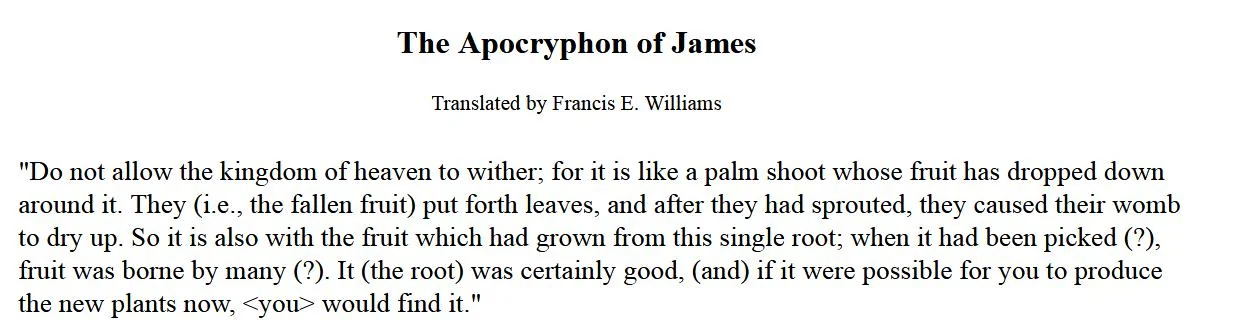
The description of the followers in the Apocryphon of James essentially parallels the Qurʾānic portrayal of the Companions’ growth. In both accounts, what begins as a small, seemingly weak group gradually grows, multiplies, and ultimately becomes strong and fruitful. In the Qurʾān, the Companions are likened to a seed that sprouts tiny branches, develops steadily, and finally stands firm and robust, reflecting both their numerical growth and spiritual strength. Similarly, the Apocryphon of James presents the followers as a palm shoot whose fallen fruit puts forth leaves and, over time, causes the root to bear many fruits. This imagery emphasizes that even a single source—a lone root or initial group—can give rise to numerous, flourishing plants, mirroring the way the early, few believers expanded into a large and resilient community. While the Apocryphon’s botanical metaphor is more detailed, describing the shedding of fruit, sprouting of leaves, and the root’s continuing productivity, the underlying principle is the same: small beginnings can lead to great and enduring results, and initial weakness does not preclude ultimate strength and widespread influence.
In short, this is only one of the many prophecies concerning Prophet Muḥammad (PBUH) found in both the canonical and non-canonical Scriptures of the People of the Book. Unfortunately, most Jews and Christians remain unaware of these prophecies, and even many Muslims lack proper knowledge of them. Nevertheless, these prophecies provide compelling evidence for the truth of Islam and can certainly reassure sincere truth seekers in the West, whether they are Jewish, Christian, or atheist. The Qurʾān itself reveals some of the prophecies that attest to the authenticity of Muḥammad (PBUH)’s Prophethood and of Islam—prophecies that the People of the Book had concealed. Allāh says: {O People of the Book! Now Our Messenger has come to you, revealing much of what you have hidden of the Scriptures} (Qurʾān 5:15). Thus, Allāh disclosed what the People of the Book had concealed in order to strengthen the cause of the true religion.
Notes and References
- 1
The Apocryphon of James, trans. Francis E. Williams, The Nag Hammadi Library, Gnostic Society Library, http://gnosis.org/naghamm/jam.html.