Does the Qurʾān originate from Syriac sources?
Strange as it may sound, some orientalists have claimed that the history of Islam and Muslims is potentially fabricated. Consequently, they have advanced theories regarding the origins of Islam. Essentially, they asserted that the Qurʾān was a compilation drawn from Judeo-Christian and Zoroastrian traditions. Notably, Reverend Alphonse Mingana even sought to instruct Muslims on the transmission of their Scripture, extending his analysis down to the Arabic alphabet. Mingana contended that the Qurʾān bears strong traces of Syriac influence. According to him, Prophet Muḥammad—the “author” of the Qurʾān—integrated numerous Syriac loanwords into Arabic and thereby brought about the linguistic revolution of what is now called the Qurʾān.1 Mingana catalogued the alleged “Syriac” vocabulary in the Qurʾān and argued that the widespread presence of Syriac Christianity played a significant role in the origins of Islam. Strikingly, he claimed complete ignorance regarding the origins of the Arabic language and the existence of an Arabic alphabet at the advent of Islam. He even asserted that the written language in Makkah and al-Madīnah “must have been” either Syriac or Hebrew:2

It is worth noting that orientalists often regard Arabic sources on Islam as inherently unreliable, while granting non-Islamic sources and speculative interpretations an undue aura of credibility. Mingana was no exception. Regarding the Arabic vowels, he relied on Aramaic writers and his own conjectures, dismissing the authority of Arab authors. He stated:3

He further asserted that:4

Christoph Luxenberg has revisited Mingana’s work and offered a new interpretation.5 Luxenberg closely followed in the footsteps of Mingana, asserting that syro-aramäische (Syro-Aramaic) was the principal written language prior to the emergence of Arabic literature.6 Accordingly, he contended that the origins of literary Arabic and the Qurʾān must be traced to Aramaic-speaking Christian communities. He further claimed that Makkah was not an Arab settlement, but rather an Aramaic colony whose inhabitants spoke Aramaic-Arabic Mischsprache (i.e., an Aramaic-Arabic mixed language).7 Luxenberg argued that the early Muslim scholars, writing approximately a century and a half after the Prophet (PBUH), were under the mistaken impression that the Qurʾān was composed in classical Arabic. Consequently, according to Luxenberg, it is unsurprising that they did not fully comprehend what they were reading.8 In this regard, Luxenberg made a radical departure from Mingana and all other scholars. Building on such assumptions, he embarked on a quest to reconstruct the “real” Qurʾānic text using his own graphic and linguistic methods. After asserting that the early Arabic documents lacked diacritical marks and vowel signs (i.e., the dots and vowel indicators used in the Arabic script), he took the liberty of altering diacritics and modifying vowels at will. As will be demonstrated below, the claims of both Mingana and Luxenberg concerning the Arabic script are incorrect.
To begin with, the claim that Arabic did not exist as a written language at the time of the Qurʾān’s composition, and that, between the 4th and 7th centuries, Aramaic served not only as the written language but also as the lingua franca of Western Asia, is entirely unfounded. In fact, pre-Islamic and early post-Islamic Arabic inscriptions provide clear evidence of the history of Arabic as a written language. These inscriptions illustrate the progressive development of the Arabic script and demonstrate that it possessed a well-established alphabet prior to the advent of Islam. The following are a few examples of pre-Islamic and Early Hijrah period Arabic inscriptions:
The Raqush Inscription (Jaussen-Savignac 17): It is recognized as the earliest dated pre-Islamic Arabic inscription, dating to 267 CE. Notably, scholars such as John F. Healey, a leading authority on Semitic epigraphy, and G. Rex Smith, a prominent historian of early Arabic and Islamic studies, have emphasized its significance, identifying it as the earliest known Arabic document.9 The salient feature of this inscription is the presence of diacritical points on the letters ḏāl (ذ), shayn (ش), and zāy (ز), although those on shayn (ش) and zāy (ز) are applied inconsistently. The Arabic definite article ʾl- appears twice: once in the place name ʾl-ḥjrw (line 4) and once before the common noun ʾl-qbrw (line 7). Additionally, a brief summary in Thamudic script appears vertically to the right of the main text, though our focus here remains on the early Arabic inscription.10

Jabal Ramm Inscription: It is a fourth-century pre-Islamic Arabic inscription, currently regarded as the second oldest so far discovered in the Arabic alphabet after the Raqush inscription. The salient feature of this inscription is the presence of diacritical points on the letters yāʾ (ي), jīm (ج), and nūn (ن) (see line 2).11


James A. Bellamy, Professor Emeritus of Arabic Literature at the University of Michigan, observes that the grammar of this inscription is straightforward Classical Arabic, further noting that its language is closer to modern Arabic than Shakespeare’s English is to modern English.12 Hence, the use of Classical Arabic in the Jabal Ramm inscription highlights the remarkable stability of the Arabic language, showing that its grammar and vocabulary remained largely consistent over many centuries.13
Umm al-Jimāl Inscription: Enno Littmann—a German Orientalist and Semitist known for his work on inscriptions and Semitic languages—assigns this pre-Islamic Arabic inscription to the 6th century CE, whereas James A. Bellamy suggests a 5th-century date.14 According to Bellamy, its grammar is straightforward Classical Arabic, and its language is closer to modern Arabic than Shakespeare’s English is to modern English.15 This use of Classical Arabic underscores the remarkable conservatism of the language, indicating that its grammar and vocabulary remained largely stable and consistent over many centuries.16

The Zebed Inscription: It is a pre-Islamic trilingual inscription in Greek, Syriac, and Arabic, dated to 512 CE. It is engraved on a lintel above the entrance to the martyrion of St. Serge. The Arabic portion does not translate the Greek text; rather, it lists six names, not all of which appear in the Greek version. This inscription is the earliest known to mention الاله (“the God”). The Arabic text is located at the bottom, and Figures (b) and (c) provide clearer views of this section.17

The Jabal Usays Inscription: This pre-Islamic Arabic inscription dates to 528 CE. Notably, it is the only known pre-Islamic Arabic inscription containing historical content, rather than merely recording names or phrases.18

The Ḥarrān Inscription: This pre-Islamic Arabic inscription, dated to 568 CE, is a Greek–Arabic bilingual text engraved on the martyrium of St. John in Ḥarrān, near Damascus, Syria.19 Figure (a) presents the complete text of the inscription, while Figure (b) displays only the Arabic portion.20

Early Hijrah Period Inscriptions near al-Madīnah: These inscriptions, found on Mount Salʿ near al-Madīnah, are dated to approximately 4 AH (c. 625 CE). This dating is primarily attributed to Dr. Muhammad Hamidullah—a renowned Indian-French Islamic scholar and historian, specializing in early Islamic documents and Arabic epigraphy, whose research remains highly influential in the study of early Islamic inscriptions—who inferred it by analyzing internal evidence within the inscriptions themselves, such as the names and genealogies mentioned, their historical context, and the style and content of the inscriptions.21 By cross-referencing these internal clues with early Islamic history, Hamidullah inferred that the inscriptions were likely created shortly after Prophet Muhammad’s (PBUH) migration to al-Madīnah. In his seminal article, he labeled the Mount Salʿ rock inscriptions as “Inscription A,” “Inscription B,” and “Inscription C,” a system widely recognized in epigraphic scholarship that provides a clear way to reference each distinct inscription.22 Inscription A refers to the four-line Arabic text on the vertical (perpendicular) face of the Mount Salʿ rock, written in an early monumental (proto-Kufic) hand and serving as the principal piece of this small group. Inscriptions B and C are shorter texts located nearby on the same site. The following image displays Inscription A, as documented and interpreted by Hamidullah.23

According to Hamidullah, the text of Inscription A reads as follows:24

The following image depicts Inscription B, located on the left side of the same rock, comprising a double inscription executed in at least two distinct handwritings.25

The right-hand portion of this double inscription, written in an elegant Qurʾānic style, has suffered considerable damage due to the disintegration of the rock surface. Dr. Hamidullah was able to decipher it only partially, as follows:26

According to Hamidullah, the left-hand section of this double inscription, consisting of a large inscription of approximately twenty lines, contains numerous signatures, many of which have been effaced by natural erosion. A portion of the right-hand section appears to have crossed over this inscription, indicating that the two parts were not made at the same time. Hamidullah emphasizes that his reading of this first inscription is necessarily incomplete and tentative. His deciphered text is as follows:27


While Inscriptions A and B occupy prominent positions on the main rocky surface of Mount Salʿ—A situated on the perpendicular face to the right and B comprising a double inscription on the left—several feet below this surface lie additional inscriptions. These supplementary carvings, collectively designated as Inscription C, appear to have been added over time and display considerable variation in size, style, and execution. Hamidullah’s tentative readings of these inscriptions are presented below:28


In his study of early Arabic epigraphy, Adolf Grohmann—an Austrian Orientalist renowned for his expertise in Semitic philology, Egyptology, and Islamic archaeology, whose scholarship significantly advanced the fields of Arabic papyrology and epigraphy and continues to shape the study of early Islamic documents and inscriptions—offered a detailed analysis of the script on the Early Hijrah Period inscriptions from Mount Salʿ near al-Madīnah, particularly those designated A, B, and C by Hamidullah. Grohmann compared the monumental script of these inscriptions with that of early Kufic Qurʾānic manuscripts, noting that the resemblance is “very striking.”29 Grohmann’s observation that the script of these inscriptions closely mirrors that of early Qurʾānic manuscripts further affirms that the Qurʾān was recorded and transmitted in an established and sophisticated script from the very outset, thereby refuting the theory of a post-Islamic invention of Arabic writing. Indeed, all the foregoing inscriptions provide ample evidence of a well-developed Arabic script and are sufficient to refute the speculative claims of Mingana and Luxenberg. The existence of these early inscriptions directly challenges the long-standing Orientalist claim that the Arabic script either did not exist or was too rudimentary to be used prior to or during the earliest period of Islam. Commenting on the inscriptions from Jabal Ramm, Umm al-Jimāl, and Ḥarrān, Bellamy stated:30

Mingana’s arguments have also been refuted by Nabia Abbott—an eminent historian and papyrologist whose pioneering research on early Islamic manuscripts remains foundational—who cited as evidence PERF No. 558, the earliest known Arabic papyrus originating from Egypt, dated 22 AH (643 CE).31 Abbott referenced PERF No. 558 in her 1939 seminal work, The Rise of the North Arabic Script and Its Kur’ānic Development. In this study, she examined the state of Arabic writing during the early Islamic period, citing PERF No. 558 as a key example. She observed that the papyrus, dated 22 AH (643 CE), was written in a well-developed manuscript hand, demonstrating a significant level of sophistication in the Arabic script at that time. Abbott’s analysis also highlighted the use of diacritical dots on letters, a feature uncommon in earlier inscriptions, indicating an advanced stage in the development of Arabic orthography. Furthermore, she discussed the bilingual nature of PERF No. 558—containing both Arabic and Greek—and emphasized that the papyrus was found in Egypt, where Greek and Coptic were the principal written languages. She argued that the use of the Arabic script in such a context reflected the language’s early sophistication and administrative deployment. In conclusion, Abbott’s examination of PERF No. 558 demonstrates the early sophistication of the Arabic script, its practical use in administrative contexts, and its integration alongside other contemporary written languages. Taken together, these findings support her argument against the notion that Arabic was primitive at the advent of Islam. In fact, the script was not only fully developed by the early Islamic period, but it was also utilized for both religious and administrative purposes within just a few decades of the Hijrah. Presented below is a photo of PERF No. 558, a primary witness to the early use of the Arabic script.32

This is the scholarly transcription of PERF No. 558, providing an accurate rendering of the original text.33

Presented below is the translation of PERF No. 558, with the Arabic text rendered in italics for ease of distinction.34

In a nutshell, PERF No. 558 is a well-documented papyrus from the early Islamic period, produced during the administration following the Muslim conquest of Egypt. It is essentially a tax receipt or fiscal record issued under the governorship of ʿAmr ibn al-ʿĀṣ. The document records the delivery of provisions—namely, sheep for slaughter—for troops, reflecting the fiscal policies of the nascent caliphate. As Abbott pointed out, at this stage Greek remained the dominant administrative language, with Arabic appearing alongside it, signaling the gradual transition toward Arabic as the official language of governance. The significance of PERF No. 558 lies in its status as one of the earliest securely dated Arabic papyri, illustrating the early formalization of the Arabic script and its use in administrative contexts. Of particular interest in this document is the term Magarites, written in Greek, which is understood to correspond to the Arabic Muhājirūn (The Emigrants: the early followers of Prophet Muḥammad (PBUH) who left Makkah for al-Madīnah to flee persecution, safeguard their faith, and support the nascent Muslim community). This identification is significant as it reflects the integration of early Islamic terminology into the existing Byzantine administrative framework, highlighting the evolving socio-political identity of the early Muslim community within the conquered territories. As noted by Abbott, PERF No. 558 exhibits extensive use of diacritical marks in the Arabic script, with dots clearly visible on the letters jīm (ج), khāʾ (خ), ḏāl (ذ), zāy (ز), shīn (ش), and nūn (ن).35 In Abbott’s words, if Mingana’s claim—that Arabic was indeed so primitive in its homeland at the advent of Islam—were true, it would be difficult to account for its practical adoption in Egypt within such a short period, and that too in a well-developed cursive script. She asserted:36

Luxenberg has claimed on the basis of pre-Islamic Arabic inscriptions that the cursive syro-aramäische script (Syro-Aramaic) served as a model for the Arabic script.37 Curiously, he drew on Grohmann’s seminal Arabische Paläographie to substantiate his argument, despite the fact that Grohmann was among the earliest and most decisive voices rejecting the hypothesis of a Syriac origin for the Arabic script.38 This is a striking contradiction because Grohmann, in Arabische Paläographie, clearly traced the early Arabic script back to the Nabataean branch of Aramaic, not Syriac—a position that has remained foundational in modern epigraphy.39 He explicitly rejected the Syriac-origin theory, which had been proposed by some 19th-century Orientalists but had lost ground long before Luxenberg. Hence, the fact that Luxenberg cited Grohmann to bolster a supposed connection between Arabic and Syro-Aramaic is indeed problematic. James F. Healey—one of the leading scholars of Semitic epigraphy—has extensively documented the affiliation between the Nabataean script and the early Arabic script. Healey stated:40

Similar conclusions regarding the Nabataean origins of the early Arabic script have been reached by Nabia Abbott, Kees Versteegh, and Beatrice Gruendler.41 Hence, Luxenberg’s claim that the early cursive Arabic script originated from the syro-aramäische script is entirely incorrect, for it in fact derives from the Nabataean script. Likewise, the claim advanced by several orientalists that the diacritical and vowel marks in the Arabic script were borrowed from Syriac is equally unfounded. Before examining this issue of alleged borrowing, it is worth noting that:42

Ernest John Revell—an eminent Semitist and authority on the history of Arabic orthography—was among the earliest scholars to reject the claim that Arabs borrowed numerous dots from Syriac:43

It is difficult to accept the notion that the Arabs borrowed their numerous dots from Syriac, given that the Syriac alphabet employs diacritical dots for only two characters—ܕ (dolath) and ܪ (rish)—whereas the Arabic alphabet contains fifteen dotted letters: bāʾ (ب), tāʾ (ت), thāʾ (ث), jīm (ج), khāʾ (خ), ḏāl (ذ), zāy (ز), shīn (ش), ḍād (ض), ẓāʾ (ظ), ġayn (غ), fāʾ (ف), qāf (ق), nūn (ن), tāʾ marbūṭah (ة).44 Moreover, clear pre-Islamic evidence attests to the use of diacritical dots:45
▪ The Raqush inscription (267 CE) contains diacritical points on the letters ḏāl (ذ), shīn (ش), and zāy (ز).46

▪ The Jabal Ramm inscription (4th century CE) contains diacritical points on the letters jīm (ج), yāʾ (ي), and nūn (ن).47

▪ A curious inscription from Sakakah (Northern Saudi Arabia) contains diacritical points on the letters bāʾ (ب), tāʾ (ت), and nūn (ن).48

Moreover, ample evidence demonstrates that diacritical dots were already in use at the time of the advent of Islam.49
▪ The earliest dated papyrus, PERF No. 558 (22 AH / 643 CE), exhibits numerous diacritical dots on the letters jīm (ج), khāʾ (خ), ḏāl (ذ), zāy (ز), shīn (ش), and nūn (ن).50


▪ P. Mich. 6714—a bilingual papyrus (22–54 AH / 642–674 CE)—also exhibits diacritical dots on the letters zāy (ز), qāf (ق), and nūn (ن).51


There are also instances of diacritical dots in early Islamic inscriptions:
▪ An inscription at Wādī as-Sabīl (46 AH / 666 CE) shows a diacritical dot below bāʾ (ب):52

▪ An inscription near aṭ-Ṭāʾif on a dam built by Caliph Muʿāwiyah (58 AH / 677 CE) shows the use of diacritical dots on the letters yāʾ (ي), bāʾ (ب), nūn (ن), thāʾ (ث), khāʾ (خ), fāʾ (ف), and tāʾ (ت). This establishes beyond doubt that by the sixth decade of the Hijrah, certain Arabic letters were already marked with diacritical dots.53


Indeed, poorly informed “scholars,” such as Luxenberg, cannot trouble discerning Muslims. All of the aforementioned materials were published well before Luxenberg’s book, yet he asserted that the Islamic tradition is unable to specify when the diacritical points were finally “fixed,” claiming instead that one must rely on the general statement that this process took more than three hundred years.54 In fact, the inscriptions and papyri predating ʿUthmān’s muṣḥaf (codex) demonstrate that ten of the fifteen dotted letters already employed the same dot patterns used today. Unsurprisingly, Beatrice Gruendler—a specialist in the Arabic script—observed, based on examples from inscriptions, papyri, and coins of the early Islamic period:55

As previously noted, the origins of the Arabic script and its diacritical dots are unrelated to Luxenberg’s syro-aramäische (Syro-Aramaic) script. Accordingly, it is hardly surprising that the diacritics may have been transmitted from the Nabataean script to Arabic. James F. Healey remarked: “... we may suspect that the concept of diacritics came to the Arabs with the Nabataean script...’’56 Nabia Abbott long ago surmised, based on her study of early Islamic coins and the aforementioned papyrus PERF No. 558, that the diacritical dots originated in pre-Islamic times.57 It is thus evident that Luxenberg is mistaken regarding both the origin of the Arabic script and the diacritical dots that distinguish letters sharing the same skeleton. As we shall soon elaborate, he and Mingana were likewise incorrect in claiming that the Arabic vowel signs were borrowed from the Syriac script.
As previously noted, Mingana asserted that the origin of the Arabic vowels remains obscure in the historical record. He dismissed the testimony of Arab scholars, regarding their views as insufficiently authoritative to merit citation. 58 On this basis, he advanced his own hypothesis: that the Arabic vowel signs were derived from those of the Syriac script. To support this claim, he highlighted the similarity between the names and sounds of corresponding vowels in both languages, noting that the Arabic fatḥah corresponds in both designation and phonetic value to the Syriac p̄tāḥā or phtâha (Aramaic ptāḥā), which literally means “opening.” Mingana considered this parallel strong evidence that the Arabic system of vowelization was modeled after its Syriac counterpart.59 Jacob of Edessa (d. 708 CE) is often credited as the first to introduce vowel notation in Western Syriac.60 Benjamin Davidson—an eminent 19th-century Hebraist and Semitic philologist, best known for his authoritative Analytical Hebrew and Chaldee Lexicon, a standard reference on the structure and vowel notation of Semitic languages—affirmed this view, attributing to Jacob of Edessa the invention of the system of vowelization.61

Jacob of Edessa’s pioneering efforts marked the beginning of a gradual process in Syriac. Systematic vowel naming did not emerge until centuries later: in Eastern Syria, Elias bar Sinaya (c. 11th century CE) appears to have been the first to assign names to the vowels, while in Western Syria, the five Greek-derived vowel names surface only after 839 CE, as evidenced by dated manuscripts.62 The earliest explicit use of these names occurs much later, in the 13th-century writings of Bar Hebraeus [d. 1286 CE]. Scholars generally assume that Bar Hebraeus adopted terminology partly introduced earlier by Jacob of Edessa, since the surviving Syriac sources on the origins of orthography and grammar were composed much later. By contrast, the development of a system of vowel signs in Arabic occurred far earlier. According to Ibn an-Nadīm (d. 385 AH / 995 CE)—a distinguished 10th-century bibliographer and the author of al-Fihrist, an influential encyclopedic catalogue that documented Arabic literature, sciences, religious studies, and the broader intellectual heritage of the Islamic world—this system was devised by abū al-ʾAswad ad-Duʾalī (d. 69 AH / 688 CE), an early Arabic grammarian and close associate of the fourth caliph, ʿAlī ibn abī Ṭālib. As Ibn an-Nadīm recorded, ad-Duʾalī introduced this system only decades after the advent of Islam—a pioneering innovation that gave Arabic a functional orthography at a time when Syriac was still developing its own system. Ibn an-Nadīm stated:63

However, it is the original Arabic quotation detailing the dotting that is of particular interest here. Abū ʿAmr ad-Dānī, a distinguished muqriʾ (Qurʾānic reader) and muḥaddith (traditionist) of Al-Andalus (medieval Muslim Spain), stated:64

This demonstrates that the dot notation for the three vowels and the tanwīn (nunation) were introduced by abū al-ʾAswad ad-Duʾalī and that the names of the vowels (fatḥah, ḍammah, and kasrah) correspond to their articulation. This first work of Arabic grammar by ad-Duʾalī thus represented an effort to describe the structure of the language and to provide an accurate rendering of the phonetic values of the short vowels. Some Qurʾānic manuscripts from the first and second centuries of the Hijrah (7th–8th centuries CE) preserve ad-Duʾalī’s scheme of vowelling:
Codex Topkapı Sarayı Medina 1a: housed at the Topkapı Sarayı Museum in Istanbul:65

Kodex Wetzstein II 1913: housed at the Staatsbibliothek in Berlin:66

Many more Qurʾānic manuscripts from the first and second centuries of the Hijrah also preserve abū al-ʾAswad ad-Duʾalī’s scheme of vowelling.67 Mingana’s claim that the Arabic vowels were derived from those of Syriac is therefore untenable. Moreover, as previously noted, the term p̄tāḥā (or phtâha) did not enter Syriac phraseology (the system of vowel terminology) until around the middle of the ninth century—more than 150 years after the death of ad-Duʾalī. Specifically, in Western Syriac, the Greek-derived vowel names—including phtâha—appeared only after 839 CE, while in Eastern Syriac, systematic vowel naming emerged even later, with Elias bar Sinaya (c. 11th century CE) apparently being the first to assign names to the vowels. This chronology underscores that Mingana’s reliance on phtâha, a single Syriac vowel, to argue that the Arabs borrowed their vowels from Syriac is misleading, since there are no corresponding terms for ḍammah and kasrah—the names for the other Arabic vowels—in the Syriac vowel system, and the Arabic vowel names—fatḥah, ḍammah, and kasrah—had already been established by ad-Duʾalī in the seventh century, long before vowel names were introduced in the Syriac tradition in the middle of the ninth century.
Let us now consider the case of Luxenberg, who introduced another dimension to the discussion of vowel signs. He argued that the Arabic system for representing the short vowels a, u, and i with points was borrowed from the earlier syro-aramäische (Syro-Aramaic) vocalization system, and that the addition of dots for the short vowels at various positions was introduced during the reign of ʿAbd al-Malik ibn Marwān (r. 685–705 CE).68 This claim is untenable and does not withstand critical examination. In the case of Syriac, the period from the third century to the early seventh century CE—i.e., until the advent of Islam—was marked by an almost exclusive use of the diacritical point. Signs denoting the vowels /e/ and /a/ began to appear only toward the end of this period; before this development, no specific signs were employed for the various vowels.69 In Syriac, a point was placed either above or below a letter for two main purposes: (a) to show whether the letters y, w, ’, and h were used as vowels or consonants, and (b) to distinguish between homographs—words spelled the same but with different meanings.70

Like Mingana, Luxenberg overlooked the fact that the needs of Arabic vocalization differed fundamentally from those of Syriac.71

As Shelomo Morag—a leading Semitic linguist and expert in Hebrew and Aramaic—explained, Syriac, unlike Arabic, had to develop additional methods to distinguish vowel notation from consonantal notation.72 It is therefore unsurprising that the system of Arabic vowel notation developed along a completely different path.73

Unsurprisingly, abū al-ʾAswad ad-Duʾalī adopted a dotting scheme fundamentally different from that of Syriac. His system was extremely minimal, marking only the short vowels (/a/, /i/, and /u/) and the nunation (/an/, /in/, /un/). Understandably, he deliberately did not address the long vowels (/ā/, /ī/, and /ū/), as these were already represented by the consonantal script. In contrast, Syriac vocalization systems were far more elaborate, indicating not only short vowels but also long and mid vowels such as /e/ and /o/. For instance, the East Syriac system, in its most complete form, provides signs for /a/, /ā/, /e/, /ē/, /i/, /o/, and /u/, while the West Syriac system includes /a/, /å/, /e/, /i/, and /u/. Thus, Syriac vocalization systems offered a wider range of vowel signs and were phonetically more detailed compared to ad-Duʾalī’s system, which remained highly economical and was tailored to the inherent phonological and orthographic structure of Arabic, in which the long vowels were already represented in the consonantal script. In addition to asserting that the representation of the short vowels a, u, and i with dots in the Arabic script was modeled on the earlier syro-aramäische (Syro-Aramaic) vocalization system, Luxenberg raised another issue regarding the sabʿat aḥruf (authorized dialectal modes of recitation) of the Qurʾān. He began by citing two ḥadīths (Prophetic traditions) that address differences in recitation among the Companions and their resolution by the Prophet (PBUH), both of which relate to the revelation of the Qurʾān in the sabʿat aḥruf.74 Luxenberg interpreted this as evidence of the indeterminate (i.e., ambiguous or open to multiple readings) nature of the Qurʾān’s early consonantal text. He further contended that these reports are later constructions (i.e., narratives formulated after the fact rather than contemporaneous accounts), reflecting only a faint recollection (a distant and incomplete memory) of the inherent indeterminacy (the lack of fixed vowel signs and diacritical marks) of the early Arabic script and, consequently, the reading of the Qurʾānic text—an issue that later scholars explained through the concept of sabʿat aḥruf (authorized dialectal modes of recitation). In addition, drawing on his heuristic methodology (interpretive and discovery-oriented, i.e., a trial-and-error approach to reconstructing meaning), Luxenberg argued that the sabʿat aḥruf permitted by the Prophet (PBUH) are related to the seven vowel signs of the Syriac script, a system developed by Jacob of Edessa (d. 708 CE). He also cited a tradition transmitted by aṭ-Ṭabarī (d. 310 AH / 923 CE), which mentions the khamsat aḥruf (five authorized dialectal modes of recitation)—a reference that Luxenberg linked to the five vowel signs employed by the Western Syriac tradition.75 However, while Luxenberg interpreted these five recitation modes as corresponding to the five Syriac vowel signs, traditional Islamic scholarship does not support any connection between the Arabic recitation variants and Syriac vowels. The core issue here concerns the dating of the tradition regarding the revelation of the Qurʾān in the sabʿat aḥruf, which, in turn, indicates whether the ḥadīth is early or late. By examining the isnād (chain of transmission) bundle of the ḥadīth narrated by ʾUbayy ibn Kaʿb, as cited by Luxenberg, we can draw informed conclusions about the origins of this tradition. The full text of the ḥadīth reads:76

By plotting the isnād bundles of ʾUbayy’s ḥadīth as recorded in the well-known collections of Ḥadīth, along with its variants—whether as slightly shorter texts or with minor changes in wording—using digital Ḥadīth software, The Ḥadīth Encyclopedia (Mawsūʾat al-Ḥadīth ash-Sharīf), produced by Sakhr Software, the authors of the Islamic Awareness website concluded that the ḥadīths concerning the revelation of the Qurʾān in the sabʿat aḥruf were already in circulation during the first Islamic century, prior to the death of ʾUrwah ibn az-Zubayr (d. 94 AH / 712 CE).77 Comparing this dating with the findings of Luxenberg’s heuristic methodology—which suggest that the sabʿat aḥruf are connected to the seven vowel signs of Syriac, the writing system developed by Jacob of Edessa (d. 708 CE)—shows that linking the sabʿat aḥruf of the Qurʾān to the seven vowels of Syriac is clearly erroneous. Indeed, the Qurʾān’s recitation in seven modes is in no way connected to the seven vowels of Syriac. Moreover, Jacob of Edessa’s vowel system never gained acceptance among the West Syriacs and remained unused until Bar Hebraeus (d. 1286 CE).78

Clearly, when considering the full spectrum of evidence, we cannot plausibly claim that a vowel system that had not even gained acceptance in West Syria during Jacob of Edessa’s time could have influenced the tradition of the Qurʾān’s revelation in the sabʿat aḥruf. It should also be noted that abū al-ʾAswad ad-Duʾalī’s system was transmitted by early Arabic grammarians and reciters, including Yaḥyá ibn Yaʿmar (d. 90 AH / 708 CE), Naṣr ibn ʿĀṣim al-Laythī (d. 100 AH / 718 CE), and Maymūn al-ʾAqran.79 The pioneering linguist and lexicographer al-Khalīl ibn Aḥmad al-Farāhīdī (d. 170 AH / 786 CE)—renowned for founding Arabic prosody and compiling the first comprehensive dictionary of the Arabic language—eventually refined ad-Duʾalī’s system by replacing the dot notation with distinct letter-based signs for the three short vowels: a small ʾalif (ا) for /a/ (fatḥah), a small wāw (و) for /u/ (ḍammah), and a portion of the yāʾ (ي)—essentially, a small stroke or miniature version of the letter—for /i/ (kasrah). Al-Farāhīdī also modified the sign of shaddah, using a small sīn (س). His system quickly gained widespread adoption, and as Versteegh observes: “With al-[K]halil’s reform, the system of Arabic orthography was almost completed and, apart from a very few additional signs, it has remained essentially the same ever since.’’80 Conversely, as noted earlier, the standardization of the vocalization system in Western and Eastern Syria proceeded more slowly than that of Arabic. In short, the arguments of both Mingana and Luxenberg regarding the Syriac origins of Arabic vowels rest on pure speculation, as they both assume that the Syriac vocalization system was fully established before the Arabs could have adopted it. The primary difference between them lies in their treatment of sources: Mingana dismissed the opinions of Arab authors as unreliable, whereas Luxenberg readily accepted the testimony of an Arab author to support his hypothesis of Syriac influence.81 Nevertheless, the claims of both scholars are demonstrably incorrect. Unsurprisingly, since the diacritical marks were already fixed by the first half of the first century of the Hijrah and abū al-ʾAswad ad-Duʾalī devised the vowel marks shortly thereafter (d. 69 AH / 688 CE), Muslims were already using dotted manuscripts toward the end of that century. Abū ʿAmr ad-Dānī recorded two reports that illuminate this development (i.e., provide evidence for the early adoption and use of Arabic vowel marks). The first report states:82

The second report states:83

It should be noted that each center of Qurʾānic learning and scholarship initially followed slightly different conventions.84 However, by the end of the first century of the Hijrah, the Baṣran system had become so widely adopted that even scholars in al-Madīnah followed it.85 Expectedly, some Qurʾānic manuscripts from the first and second centuries of the Hijrah preserve evidence of abū al-ʾAswad ad-Duʾalī’s vowel-marking scheme. The uneven application of diacritical dots and vowel signs—ranging from fully marked texts to those omitting even the dots—demonstrates that ad-Duʾalī’s system was already in use, albeit inconsistently, shortly after its invention. This provides clear proof of the early development of Arabic vowel notation and refutes claims that it was borrowed from Syriac. Funnily enough, Luxenberg—the author who boastfully titled his book Die syro-aramäische Lesart des Koran: Ein Beitrag zur Entschlüsselung der Koransprache (The Syro-Aramaic Reading of the Qur'an: A Contribution to the Deciphering of Qur'anic Language)—did not choose a cover design that lives up to the grandeur suggested by the title.

Luxenberg’s title page—drawn from a first-century Qurʾānic manuscript, MS. Arabe 328a, housed at the Bibliothèque Nationale in Paris, written in the ḥijāzī script with no vowel marks and only rare diacritical points—directly undermines his thesis, as it demonstrates that early Qurʾānic texts were transmitted without a full vowel system, contradicting his claim that Arabic vowel notation was borrowed from Syriac. The authors of the Islamic Awareness website provide a detailed elaboration of this fact.86

Luxenberg’s claim of an unstable Qurʾānic text during the first two centuries of the Hijrah is untenable for several reasons:87

Now that the arguments of Mingana and Luxenberg have been refuted, let us turn to the evidence showing that the Qurʾān bears no Syriac imprints. Luxenberg advanced the thesis that the Qurʾān was written in a hybrid Arabic-Syriac language (Syriac being a dialect of Aramaic)88 and drew upon Christian Syriac writings, citing examples from the Qurʾān in support of this claim. However, his argument is essentially circular: in order to substantiate his overarching thesis that the Qurʾān is an Arabic-Syriac text influenced by Christian Syriac sources, he disregarded evidence that contradicted his narrative. Consequently, he made assertions that conflict with well-established facts, including:
1.The syro-aramäische (Syro-Aramaic) script served as a model for the Arabic script.
2.The Arabic system of vocalization (i.e., vowelization, marking short vowels in the script) was based on the earlier syro-aramäische vocalization system.
3.Makkah was not an Arab settlement but an Aramaic colony, and its residents spoke aramäische-arabische Mischsprache (an Aramaic-Arabic mixed language).
4.Just before the advent of Islam, Aramaic was not only the language of written communication but also the lingua franca of that area of Western Asia.
In fact, contrary to Luxenberg’s sweeping claims, Arabic was already well established and widespread in the Middle East before Islam, as demonstrated by substantial epigraphic evidence. The following figure illustrates the geographical distribution of pre-Islamic Syriac, Nabataean, and Arabic inscriptions. Each colored dot marks a site where inscriptions of the respective script were found, regardless of their number. For example, in Petra (Nabataean) and Edessa (Syriac), along with their surrounding regions, hundreds of inscriptions have been uncovered, though each location is represented by only a single colored dot in the figure. This distribution makes it clear that Arabic was not a marginal or peripheral language, as Luxenberg suggested, but rather an integral part of the linguistic landscape of the region prior to Islam.89

The geographical spread of pre-Islamic Arabic inscriptions extends from Zebed, located in the Syriac-speaking heartland of the north, down to Madāʾin Ṣāliḥ (the ancient Nabataean site in present-day northwestern Saudi Arabia) in the south, and from abū Darag in Egypt in the west to Sakakah in Saudi Arabia in the east. Luxenberg claimed that the Qurʾān was partially composed in Syro-Aramaic or Syriac. However, the majority of pre-Islamic Syriac inscriptions are concentrated in the Edessa region of modern southern Turkey—far removed from the Ḥijāz region, particularly Makkah. As Jean-Baptiste Chabot— a distinguished French Orientalist and Syriacist renowned for his critical editions and translations of Syriac texts, making him one of the foremost authorities on Semitic epigraphy and early Christian literature—observed:90

Contrary to Luxenberg’s assertion, Aramaic was no longer as pervasive by the late sixth century CE, having been largely supplanted by Greek as the primary lingua franca across much of the Middle East.91 Alexander the Great introduced Greek language and culture to the Near East (i.e., Western Asia), establishing Hellenism in both urban and rural areas in a manner that proved irreversible. By the advent of Islam, Greek had already emerged as the predominant language across much of Western Asia. As Glen W. Bowersock—a distinguished historian and scholar of the ancient Mediterranean and Near Eastern (i.e., Western Asian) worlds—observed:92

When surveying the sources, particularly the Greek inscriptions, this becomes immediately apparent. As Professor Robert Hoyland, a historian specializing in the history of the late antique and early Islamic Near East, noted, approximately 90% of inscriptions from the sixth-century Near East are in Greek. Luxenberg, in contrast, argued that the Qurʾān was partly composed in Syro-Aramaic or Syriac; however, this language was predominantly spoken in the Edessa region, in what is now southern Turkey—considerably distant from the Ḥijāz and, in particular, from Makkah. The figure below, slightly modified with some additional information by the authors of the Islamic Awareness website, illustrates the geographical distribution of Aramaic and the Aramaeans, the Semitic people who spoke Aramaic and its dialects, including Syriac.93

The shaded areas in this figure indicate, very approximately, the regions where Aramaic was used during its period of flourishing, from around 900 BCE to the Arab conquest, and where the Aramaeans—that is, the speakers of Aramaic and its dialects, including Syriac—are known with reasonable certainty to have settled during this time.94 The evidence is provided by external references to the Aramaeans and by their distinctive names and religion.95

A comparison of the aforementioned figures shows that most Syriac speakers—that is, the Aramaeans—were concentrated between the Euphrates and Tigris rivers and to the west of the Euphrates, spanning what is now the frontier between Turkey and Syria. Although these figures were drawn from different sources, they correspond closely, thereby providing corroborative evidence.96 The Nabataean inscriptions are geographically the closest to the Arabic inscriptions, and this proximity renders Luxenberg’s hypothesis of a syro-aramäische (Syrio-Aramaic) reading of the Qurʾān untenable. In fact, the Nabataeans were Arabs who spoke a non-Aramaic northern Arabic dialect closely related to Classical Arabic. Healey has argued that the Nabataeans were far more likely to have been Arabs than Aramaeans, emphasizing that linguistic evidence from Nabataean Aramaic indicates they primarily spoke a form of Arabic while using Aramaic for formal purposes, particularly in inscriptions. He further identified the Nabataeans as one of several Arab groups speaking early northern Arabic dialects.97 Nabataean Aramaic functioned effectively as a Schriftsprache—that is, the language of inscriptions. The early Arabic inscriptions, however, were written in the Nabataean Aramaic script while representing the Arabic language, as in the following examples:
The ‘En ‘Avdat inscription (c. 125 CE): The inscription contains six lines, the first four in Aramaic and the final two in Arabic. It is the earliest known example of Arabic written in the Nabataean script, predating the famous Namārah inscription of 328 CE by roughly two centuries. This inscription is written in Old Arabic, with the Arabic definite article ʾl- appearing as ʾl-mwtw (line 5).98 According to J. A. Bellamy, the Arabic portion consists of verses of poetry, showing that Arabic poetry was already being composed around the turn of the first and second centuries, in a form closely resembling the poetic style familiar four centuries later. The Arabic section contains three hemistichs (half-lines of verse) in aṭ-ṭawīl, the most commonly used of the classical meters.99

The Namārah Inscription (328 CE): This inscription is unique in several respects. It is among the earliest inscriptions discovered in the classical Arabic language, although many Arabic personal names and isolated words appear in other Nabataean inscriptions. Its use of classical Arabic demonstrates the conservatism of the language (i.e., its preservation of older linguistic forms and resistance to change). As noted earlier, it is one of only two Arabic inscriptions written in the Nabataean script.100

The Raqush inscription (267 CE): As noted earlier, this is the earliest known dated Arabic text, though it still preserves Aramaic archaisms (i.e., older linguistic features borrowed from Aramaic).101

The archaisms in the Raqush inscription demonstrate that early Arabic writing remained under strong Aramaic influence, which suggests that while Aramaic played a lingering role in script and vocabulary, it was no longer the dominant lingua franca by the time of Islam. This also indicates that Arabs were familiar with Aramaic—a familiarity clearly reflected in the Nabataean dialect of Aramaic, which was used by the Nabataeans, an Arab people. Unlike other Aramaic dialects, Nabataean is distinguished by its Arabic coloring (i.e., traces of Arabic vocabulary and structure)—or more precisely, influence from an Arabian language closely related to what later became Classical Arabic.102 This linguistic blending highlights a transitional stage between Aramaic and Arabic—moving from Aramaic, through Nabataean (an Aramaic dialect infused with Arabic elements), to what later became Classical Arabic—underscoring that Arabic evolved gradually from earlier Semitic traditions rather than appearing abruptly. Healey noted that some other early, though undated, Nabataean inscriptions may actually be in Arabic, and that some of the thousands of Nabataean graffiti (short informal rock inscriptions) could reasonably be identified as Arabic.103 In a nutshell, Aramaic itself played a significant role in the Ḥijāz as early as the fifth or fourth centuries BCE, as shown by a stela from Taymāʾ in northern Saudi Arabia inscribed in Aramaic.104 It is therefore unsurprising that the Ḥijāzī dialect of Arabic contained many Aramaic words; however, this does not make it a mixed language. Indeed, much—if not all—of the socio-historical context surrounding the origins of Islam can be understood by considering the Nabataean milieu (i.e., the cultural and linguistic environment of the Nabataeans).105

Now, let us turn our attention to Syriac in the early Islamic centuries. Mingana and Luxenberg argued that Syriac grammar and vocabulary should be used to interpret the Qurʾān, claiming that Syriac provided the literary models from which Prophet Muḥammad (PBUH) drew. Their argument rests on the assumption that Syriac predated Arabic and was therefore already stabilized in terms of orthography, lexicography, and grammar. Mingana stated:106

The Qurʾān does exhibit certain stylistic features that are not found in pre-Islamic poetry. However, the claim that these features differ from the Classical Arabic of eighth-century Arabia is problematic. In fact, Luxenberg’s notion of an aramäische-arabische Mischsprache (a mixed Aramaic–Arabic language) is a poorly defined concept, which has allowed him to argue that the standard rules of neither Arabic nor Aramaic apply to specific passages of the Qurʾān. In other words, this notion provided him with a pretext to make conjectural interpretations of particular passages, even when such interpretations would otherwise be dismissed as ungrammatical.107

It can be concluded that Classical Arabic has its origins even before the second century CE and had remained fixed prior to the advent of Islam. Moreover, the fact that one language predates another does not automatically imply that its orthography, lexicography, and grammar were fully established before the other unless there is solid evidence to support this claim. As we shall see, this applies to Syriac. In fact, as noted by William Wright—an eminent 19th-century scholar of Semitic languages and author of widely used works on Arabic and Syriac grammar—in his Fragments of the Turras mamlla nahraya, or Syriac Grammar of Jacob of Edessa, the first systematic treatment of Syriac orthography and grammar was undertaken by Jacob of Edessa (d. 708 CE), whose work is known only through a brief mention by Bar Hebraeus and a few fragments discovered in Oxford and London. The following discussion is drawn from The Diacritical Point and the Accents in Syriac—by Judah B. Segal, an expert in Semitic linguistics and a leading authority on Syriac phonology and orthography.108

Jacob of Edessa—an influential 7th- to 8th-century Syriac scholar and grammarian—stated:109

In his well-known letter to George of Sarug—an early Syriac bishop and prolific writer—Jacob of Edessa rebuked the copyists of his time for their ignorance and carelessness:110

Jacob of Edessa even remarked:111

Indeed, Jacob of Edessa’s correspondences provide ample evidence of the poor state of Syriac orthography after the advent of Islam, not to mention the incorrect pronunciation and understanding of the language. Mingana and Luxenberg assumed that the Syriac script was scriptio plena (i.e., a writing system in which both consonants and vowels are represented by characters) during Jacob’s time and after the advent of Islam. In fact, however, it was clearly scriptio defectiva (i.e., a writing system in which only consonants are denoted). Moreover, the Aramaeans were often unable to read and write their own language correctly even after the advent of Islam. This raises a critical question in relation to the claims of Mingana and Luxenberg: if the Syriac texts produced by these Aramaeans were written or understood so inconsistently, how can we be certain that what was allegedly recorded—texts that Mingana and Luxenberg argue were later adapted into Arabic and ultimately became the “Qurʾān’’—actually reflected the Aramaeans’ intended meaning? Regarding the earliest stages of Syriac grammar, scholarly information is scarce. Most of what is known about the terminology of the early Syriac grammarians, such as Jacob of Edessa, is reported by later writers, including Bar Hebraeus (d. 1286 CE), and it is likely that their terminology reflects Arabic influence rather than genuinely indigenous development. As stated by C. H. M. Versteegh—an esteemed Dutch scholar of Semitic languages and a leading authority on Arabic linguistic history:112

Hence, the assumptions of Mingana and Luxenberg regarding Syriac orthographical and grammatical influences on Arabic are without foundation. With respect to Syriac lexicography, its foundations were established by Ḥunayn ibn Isḥāq (d. 873 CE), who compiled the first proper Syriac dictionary organized according to the alphabetical order.113 At the end of the ninth century, Zacharias of Merv supplemented Ḥunayn ibn Isḥāq’s dictionary by adding additional entries, but his work was confused in its structure, lacking clear organization. Ḥunayn’s pupil, Ishoʿ Bar ʿAli, later compiled a new dictionary based on his teacher’s work, which is now available in print.114 In this dictionary, Syriac words are followed by their Arabic equivalents or definitions, with additional Syriac explanations provided occasionally. Later, Bar Bahlul (10th century) compiled the most comprehensive and renowned Syriac dictionary.115 It can be described as a kind of encyclopedia and functions as a Syriac–Arabic lexicon, with both Syriac and Arabic used to explain the meaning of a word. As in much of Arabic lexicography, and in many Arabic dictionaries, the compiler cites recognized authorities to support the meanings and usage of the words included.116 Consequently, the theses of Mingana and Luxenberg are unfounded, as they rest on the mistaken assumption that the Aramaeans were highly advanced in their lexicography while the Arabs struggled to understand their own language, particularly the Qurʾān. In fact, the first Syriac dictionary appeared long after the compilation of the first Arabic dictionary by al-Khalīl ibn Aḥmad al-Farāhīdī, namely Kitāb al-ʿAyn—the earliest known Arabic dictionary and one of the first dictionaries of any language. The following figure presents a chronological chart of Arabic lexicography according to the dictionary arrangements used.117

By the time Ḥunayn ibn Isḥāq compiled the first proper Syriac dictionary, there was already significant lexicographical activity among the Arabs. Even more notably, the Syriac dictionaries of Ishoʿ Bar ʿAli and Bar Bahlul employed Arabic to provide equivalents and definitions, as illustrated in the following figure.118


In this figure, (a) represents the lexicon of Ishoʿ Bar ʿAli, showing the meanings of Syriac words in Arabic, while (b) represents the lexicon of Bar Bahlul, showing the meanings of Syriac words in both Arabic and Syriac. Although the use of Syriac declined in the Middle East with the rise of Islam, the Syriac lexicographers continued to use Arabic to clarify the meanings of words in their dictionaries. This undermines Luxenberg’s implicit assumption regarding the superiority of Syriac lexicography. The fact that both Ishoʿ Bar ʿAli and Bar Bahlul made extensive use of Arabic to clarify Syriac words suggests that, by the time Ḥunayn ibn Isḥāq compiled his dictionary, Arabic lexicography was already well developed and considerably more sophisticated than its Syriac counterpart. As John Haywood—an established scholar of Semitic languages and Arabic lexicography—observed:119

Oddly enough, to support his theory of a Syro-Aramaic reading of the Qurʾān, Luxenberg relied on the lexicons of Payne Smith and Carl Brockelmann—the former a 19th-century scholar known for his comprehensive Thesaurus Syriacus, and the latter a leading authority on Semitic lexicography and author of the influential Lexicon Syriacum—which in turn are primarily based on the lexicons of Ishoʿ Bar ʿAli and Bar Bahlul, compiled by the latter two more than 250 years after the advent of Islam and approximately 100 years after the production of the first Arabic lexicon.120 Interestingly, the celebrated pioneers in the study of the Syriac language and literature in the second half of the nineteenth century—such as William Wright, an eminent British scholar of Semitic languages and Arabic grammar, and Ernest Renan, a distinguished French historian and expert on Semitic studies—expressed the candid opinion that the culture of the Syriac-speaking communities was mediocre. Wright, referring to Renan’s De Philosophia Peripatetica apud Syrus, wrote: “As Renan said long ago, the characteristic of the Syrians is a certain mediocrity. They shone neither in war, nor in the arts, nor in science.”121
Indeed, the enemies of Islam are prepared to devise any theory to lend plausibility to their views regarding the Qurʾān and Islam, regardless of how strongly such claims contradict the entirety of well-established evidence. In this respect, Luxenberg is no exception with his thesis asserting that the Qurʾān originated from Syriac Christianity.122

This is precisely what Robert Hoyland—an eminent historian of early Islam and author of several authoritative works on the subject—has recently emphasized. While addressing the corpus of documentary evidence for early Islam123 and noting its near-complete absence in the work of Christoph Luxenberg and others, Hoyland stated:124

Federico Corriente—an eminent linguist and one of the foremost authorities on Arabic dialectology and Semitic philology—has likewise reached similar conclusions:125

In a nutshell, the theses of Mingana and Luxenberg regarding the origins of various aspects of the Arabic script are patently false. Let us recapitulate the essential points:
•The Arabic script originated from the Nabataean script, as opposed to Luxenberg’s syro-aramäische (Syro-Aramaic) script.
•The diacritical marks in Arabic were already known before the advent of Islam and most likely derived from the Nabataean script.
•The vowel marks in Arabic were first introduced by abū al-ʾAswad ad-Duʾalī. The claim that they originated from Syriac is highly implausible because the orthographic needs of Syriac differed significantly from those of Arabic, and the terminology for vocalization in the Syriac script is attested only in the works of later authors such as Bar Hebraeus, showing clear influence from Arabic orthography.
•The claim that the seven aḥruf (authorized dialectal modes of recitation) of the Qurʾān represent the seven vowel signs of Syriac is scarcely credible, as the analysis of isnād bundles shows that the tradition of the Qurʾān being revealed in seven aḥruf was already known in the first century of the Hijrah, and these can in no way represent the Syriac vocalization of Jacob of Edessa.
•The Qurʾān was paleographically a fixed text in the first century of the Hijrah, as evidenced by manuscripts such as MS. Arabe 328a and MS. Or. 2165, as well as by the qirāʾāt (Qurʾānic readings) preserved in these manuscripts
•Examination of the geographical distribution of inscriptional evidence reveals that the bulk of the pre-Islamic inscriptions of Syriac—the language Luxenberg claims partially underlies the Qurʾān—are confined to the Edessa region in modern southern Turkey, far from the Ḥijāz region, particularly Makkah.
•Nabataean inscriptions are geographically the closest to pre-Islamic Arabic inscriptions.
•Much of the socio-historical context of Islam’s origins can be explained by considering the Nabataean milieu. This milieu effectively accounts for the origins of the Arabic script, the introduction of diacritical marks, and the pre-Islamic existence of Classical Arabic.
•The Arabic script’s proximity to the Nabataean script makes Luxenberg’s hypothesis of a syro-aramäische reading of the Qurʾān untenable. A Syro-Aramaic milieu cannot account for the origins of the Arabic script, its system of diacritical marks, the emergence of Classical Arabic, or the socio-historical context of Islam’s rise.
•There are other valid explanations for the presence of Aramaic words in the Qurʾān, namely that the Nabataeans—Arabs who wrote in the Nabataean Aramaic script—were familiar with Aramaic. Evidence such as the Raqush inscription (267 CE), the earliest dated Arabic text containing Aramaic archaisms, and a stela from Taymāʾ in northern Saudi Arabia inscribed in Aramaic suggests that Aramaic held great importance in the Ḥijāz as early as the fifth or fourth centuries BCE. Thus, it is entirely natural that the Ḥijāzī dialect of Arabic contained a significant number of Aramaic words, but this does not make Arabic a mixed language.
•To support his hypothesis of an alleged Syro-Aramaic reading of the Qurʾān, Luxenberg lamented the late origins of Islamic literature,126 yet failed to recognize that the Syriac sources he relied upon to substantiate his claim are even later than the Islamic sources. In fact, he is unfamiliar with the origins of both Arabic and Syriac source materials. Further examples are noted below.127
•Luxenberg not only lacked understanding of the development of Syriac and Arabic orthographies, grammars, and lexicographies, but he also made no attempt to anchor his arguments in any credible historical context.128

In a word, Luxenberg and Mingana have proposed extravagant ideas regarding the origins of the Qurʾān, as their theses are devoid of any engagement with existing early documents such as manuscripts, inscriptions, coins, and papyri. Yet, none of the words of the Qurʾān struck the Makkan Arabs—the immediate audience of Revelation after Prophet Muḥammad (PBUH)—as anything beyond the Arabic of their practical, everyday lives.
It is worth noting that Arabia is the cradle of the Semitic race. Karl Brockelmann—a distinguished German Orientalist and Semiticist, author of Geschichte der arabischen Litteratur (History of Arabic Literature), a cornerstone in the study of Arabic literary history, and Lexicon Syriacum, a critical resource for Syriac lexicography, who devoted considerable effort to studying and balancing the Semitic and Arabic languages—stated: “The Arabian Peninsula is the location fit to be the cradle of the first Semites.”129 Archibald Henry Sayce—a pioneering British Assyriologist and linguist, author of several foundational works on Semitic languages, and holder of the Chair of Assyriology at the University of Oxford from 1891 to 1919—expressed a view of the same nature when he commented on the home of Semitic-speaking peoples: “The Semitic traditions all point to Arabia as the original home of the race. It is the only part of the world which has remained exclusively Semite.’’130 Aloys Sprenger, one of the most prominent Orientalists of the nineteenth century, similarly remarked: “all Semites are according to my conviction successive layers of Arabs.’’131 Likewise, after a detailed discussion of the religious, linguistic, and historico-geographical relations among the various Semitic nations, Eberhard Schrader—a German Orientalist chiefly renowned for his contributions to Assyriology—concluded that Arabia is the homeland of these peoples.132 Michael Jan de Goeje—a Dutch Orientalist specializing in Arabia and Islam—also clearly expressed his support for the view that Central Arabia is the homeland of the Semitic race as a whole.133 William Wright—a renowned English Orientalist, Syriac and Arabic scholar, and Professor of Arabic at the University of Cambridge—wrote:134

Wright asserted that he aligns himself with Eberhard Schrader and Michael Jan de Goeje in regarding the speech of the Arabs as the closest approximation we have to the primitive Semitic tongue.135

Hugo Winckler—one of the foremost Semitic linguists, a specialist in Assyriology, and, in the words of James A. Craig, a distinguished Semiticist and professor of Oriental Languages at the University of Michigan, naturally endowed for the constructive work of the historiographer—was another scholar who proposed an Arabian Peninsula origin for the Semites.136

Hugo Winckler and Leone Caetani—an Italian historian, Orientalist, and scholar of Islamic and Middle Eastern history—advocated the Winckler–Caetani theory, which holds that Arabia was originally a land of great fertility and the first home of the Semitic peoples.137 Winckler and Caetani held that Arabia, over the millennia, underwent a process of gradual desiccation, marked by the depletion of wealth and waterways and the expansion of the desert at the expense of cultivable land. Consequently, the declining productivity of the peninsula, coupled with an increase in population, led to a series of overpopulation crises and, in turn, a recurring cycle of invasions of neighboring regions by the Semitic peoples of the peninsula. It was these crises that propelled the Assyrians, the Aramaeans, the Canaanites—including the Phoenicians and Hebrews—and, ultimately, the Arabs themselves into the Fertile Crescent.138 Interestingly, satellite imagery has revealed that a network of ancient rivers once flowed through the sands of the Arabian Desert, leading scientists to conclude that the region experienced wetter periods in the past.139

These images served as the starting point for a major, ground-breaking research project led by the University of Oxford.140 Project leader Professor Michael Petraglia, Co-Director of the Centre for Asian Archaeology at Oxford University’s School of Archaeology, stated:141

Petraglia noted that the Arabian landmass contains an interior with numerous paleorivers and paleolakes. The figure below shows the Pleistocene fossil localities and key sites for paleoenvironmental reconstruction, with the black lines representing major paleorivers and key locations for paleoenvironmental reconstruction, with the black lines representing major paleorivers.142

As a starting point for the research project led by Professor Petraglia, the team analyzed satellite imagery that revealed a network of ancient rivers and lakebeds in the Arabian Peninsula. Based on this photographic evidence, the researchers selected excavation sites near these ancient water sources, as such locations were likely gathering points for animals and early humans. Among their discoveries was a giant tusk in the Arabian Desert, one of the first finds at the site since excavations began in 2013. The researchers noted that this find is highly significant, indicating that, to sustain the life of large fauna (animals), today’s arid terrain was considerably wetter and greener in the past.143

Professor Petraglia stated:144

The Palaeodeserts Project has identified up to 10,000 palaeolakes in Saudi Arabia using satellite imagery.145 The findings of this project are consistent with—and reminiscent of—the ḥadīth of the Prophet (PBUH) reported in Ṣaḥīḥ Muslim: “The Hour will not be established until wealth becomes abundant and overflows, so much so that a man takes zakāt (obligatory charity) from his property and cannot find anyone to accept it, and until the land of Arabia returns to being meadows and rivers.’’146 The second part of this ḥadīth makes it clear that Arabia was once a lush, green land, full of trees and rivers. There is, again, no doubt that the Arabian Peninsula was the original homeland of the Semites or their historical cradle before Islam. As Jehoshua M. Grintz—a distinguished scholar specializing in biblical ethnology and the history of ancient Israel, author of Studies in Early Biblical Ethnology and History—noted: “The Arabs, who preserved the most ancient linguistic forms, are thus the purest specimens of the Semitic race, and Arabia the cradle of the entire Semitic.’’147 Interestingly, the Arabic language has not undergone any noticeable changes, and therefore one cannot define an early or late stage for it. It remains essentially the same today as it was when it first appeared. Ernest Renan—a French Orientalist and Semitic scholar, expert in Semitic languages and civilizations, historian of religion, and philologist—asserted:“One of the most astonishing events in human history is the spread of the Arabic language. Indeed, Arabic was once unknown, but then suddenly it emerged as a complete and perfect language. This language has neither childhood nor old age. It has surpassed its sister languages (counterparts) in the richness of its vocabulary, the precision of its terms, and the accuracy of its constructions and grammatical structures.”148
Let us return to the claims advanced by Christoph Luxenberg. Motivated largely by a Christian apologetic agenda and anti-Islamic sentiments, Luxenberg argued that Syro-Aramaic, rather than Arabic, was the original language of the Qurʾān. Accordingly, he maintained that the proper methodology to decode the Qurʾānic text is to examine whether Arabic expressions have homonymous roots in Syriac or Aramaic with different meanings that might provide a better understanding of the passages. He even suggested translating Arabic phrases of the Qurʾān into Syriac and consulting Syriac literature for expressions that might have been rendered literally into Arabic. Luxenberg further claimed that, at the time of the Qurʾān’s initial compilation, Arabic was a defective script, capable of representing only consonants, with several consonants sharing the same basic shape or skeleton. According to him, it was only about a century after this compilation that diacritical dots were added to distinguish consonants, yet he alleged that the scribes frequently erred in placing these dots. Therefore, he proposed experimenting with alternative placements of the diacritics—later added to the rasm (the earliest consonantal text)—arguing that a different placement could yield a Syriac word that better suited the passage. Clearly, Luxenberg’s claims are both nonsensical and indicative of his ignorance on the one hand, and intellectual dishonesty on the other. One cannot help but question whether he unconsciously or deliberately overlooks the fact that every letter of the Qurʾān was orally transmitted via tawātur (uninterrupted mass transmission) exactly as it was revealed to the Prophet (PBUH). This oral transmission relied on ḥifẓ (memorization), with the Prophet (PBUH) himself being the first to commit each revelation to memory upon receiving it from the angel Gabriel.149 He (PBUH) then recited the revelation and instructed his Companions to memorize it. Numerous ḥadīths recount the various measures the Prophet (PBUH) took to ensure that the Qurʾān was preserved in the memory of his Companions. The following ḥadīth is perhaps the clearest: The Prophet (PBUH) said, “The best among you (Muslims) are those who learn the Qurʾān and teach it.”150 It is therefore certain that the Qurʾān was memorized by the Companions of the Prophet (PBUH) during his lifetime. This tradition continued among the Companions after the Prophet’s death, and later among the Tābiʿūn (Successors) and all subsequent generations of Muslims up to the present day. Consequently, the Qurʾān has been preserved in both oral and written form in a manner unmatched by any other book in human history, with each mode of transmission serving as a check on the authenticity of the other. Nevertheless, oral transmission—through precise articulation and rigorous memorization—remained the primary method. This oral tradition began with the Prophet (PBUH) instructing his Companions to learn and transmit the verses exactly as they were revealed. Every ḥāfiẓ (memorizer) of the Qurʾān has committed the identical text to memory. Thus, we have a continuous chain of over 1,400 years of Muslims who learned the same Qurʾān from their teachers and taught it to their students—a chain extending directly back to the Prophet (PBUH). This is why, to this day, any copy of the Qurʾān can be read with full confidence that it is the same sacred text taught by the Prophet (PBUH) himself. Did Luxenberg truly never hear of the Qurʾān ḥifẓ ijāzah (license), to obtain which a student must memorize the entire Qurʾān with tajwīd (rules of Qurʾānic recitation) and recite it by heart to a qualified teacher before being authorized to teach it?151 And is he really unaware of the linguistic evidence showing that Arabic is the mother of all ancient Semitic languages?152 Dr. Solehah Yaacob, Professor in the Department of Arabic Language and Literature at the International Islamic University of Malaysia (IIUM), asserts that many linguists hold that Arabic had assumed its classical form not shortly before the seventh century C.E., but already in ancient times, and should therefore be regarded as the principal stem from which all other Semitic languages subsequently evolved.153 The Qurʾān was revealed bi-lisān ʿarabīyy mubīn—that is, in the pure, manifest, and eloquent tongue, or language, of the Arabs.154 This indicates that other tongues were spoken in Arabia that were not as eloquent—corrupted or less refined dialects. Yet the similarities among them are remarkable. Linguists recognize that all these dialects ultimately trace back to a single, older origin. That is, Aramaic, Syriac, Old Yemeni, Hebrew, and other Semitic languages are all derived from what is called the Mother Tongue—Arabic. Unquestionably, Arabic is the best-preserved model of the Semitic languages. Classical Arabic, in particular, retains several archaic features attributed to Proto-Semitic that have otherwise been lost in many living and dead Semitic languages. The reconstruction of Proto-Semitic was originally based primarily on Arabic, whose phonology and morphology—especially in its classical form—remain highly conservative (i.e., resistant to change), preserving as contrastive (i.e., distinct) 28 out of the 29 reconstructed consonantal phonemes.155 However, while 28 out of the 29 Proto-Semitic consonants are preserved as distinct sounds in Arabic, various mergers of the original consonants have occurred in the other Semitic languages. Thus, Akkadian, the earliest-attested Semitic language, has only 18 consonants, whereas Hebrew, Aramaic, and Syriac have 22 letters.
The laryngeal sounds ḥ (ح) and ḫ/kh (خ): Both are preserved as distinct only in Arabic:156


The laryngeal ʿ (ʿayn, ع): In Abyssinian, there is no distinction between ʿ (ع) and ġ (ghayn, غ); in Amharic, both have merged into ʾ (hamzah, ء):157

In Hebrew and Aramaic, the two sounds—ʿ (ʿayn, ع) and ġ (ghayn, غ)—have merged into a single consonant:158

In Assyrian, ʿ (ʿayn, ع) becomes either ʾ (hamzah, ء) or ḫ/kh (خ):159

Velar ġ (غ): The sounds ʿ (ʿayn, ع) and ġ (ghayn, غ) are distinguished only in the Arabic script.160


Interdental consonants: Arabic preserves all the original interdental and emphatic distinctions of Proto-Semitic, rather than merging them into other sounds.161 It maintains distinct phonemes for the voiceless interdental ṯ (ث), the voiced interdental ð/ḏ (ذ), and the emphatic sounds ṣ́/ẓ (ظ) and ḍ (ض), whereas most other Semitic languages either lost these sounds or merged them with others. For example, Akkadian eliminated interdentals entirely, turning ṯ, ð/ḏ, ẓ, and ḍ into sibilants (š, z) or stops (ṣ). Similarly, Syriac changed ṯ into t and ð/ḏ into d, thereby losing their original fricative quality. Ethiopic shows comparable changes, with ṯ becoming s and ð/ḏ becoming z. The following table, adapted from the Arabic translation of Sabatino Moscati’s An Introduction to the Comparative Grammar of the Semitic Languages: Phonology and Morphology, presents the reflexes of Proto-Semitic interdental sounds in the daughter languages—Akkadian, Ugaritic, Hebrew, Syriac, Arabic, Old South Arabian, and Ethiopic—thereby illustrating their correspondences. Moscati, a distinguished Semiticist with extensive expertise in ancient languages, provided this analysis based on his deep scholarly knowledge of the field. This table supports the fact that Arabic is the most conservative Semitic language, as it preserves the richest inventory of Proto-Semitic phonemes, particularly the interdentals (ṯ, ð/ḏ) and emphatics (ẓ, ḍ). It reinforces the idea that, in terms of phonology, Arabic is closer to Proto-Semitic than its sister languages.162

In short, this comparative table illustrates the exceptional phonological conservatism of Arabic within the Semitic family. Unlike Akkadian, Syriac, and other related languages that eliminated or merged several Proto-Semitic interdental and emphatic sounds, Arabic has preserved these sounds in their original, distinct forms.163
The following discussion examines selected Proto-Semitic reconstructions and traces how their characteristic interdental and emphatic sounds evolved across different Semitic languages. While these sounds were often neutralized (merged with other sounds) or completely lost in most branches, Arabic stands out as the only Semitic language that preserves the full set, making it an invaluable key to understanding the original phonetic system of Proto-Semitic. This remarkable preservation is one of the main reasons Arabic is regarded as the most conservative Semitic language in terms of phonology. The following examples illustrate the changes that the interdental and emphatic consonants of Proto-Semitic underwent across Semitic languages:
•The Proto-Semitic word for “bull” is reconstructed as ṯawr-, in which the sound ṯ (the voiceless interdental) was originally present. In Arabic, it appears asثَوْر (thawr), preserving the original interdental ṯ. In Ugaritic, the word is written 𐎘𐎗 (ṯr or ṯōru), likewise retaining the interdental sound. In contrast, Biblical Hebrew uses שׁוֹר (šōr), where the original ṯ has shifted to š (shīn), a sibilant fricative. Akkadian also replaces ṯ with š, giving the form šūrum. Syriac shows a different pattern: the word appears as ܬܵܘܪܵܐ (tawra), where ṯ has merged into t, a stop consonant. These correspondences demonstrate that while Arabic and Ugaritic maintained the interdental sound, other Semitic languages either turned it into a sibilant (Hebrew and Akkadian) or a stop (Syriac), losing the original fricative quality.
•The Proto-Semitic word for “wolf” is reconstructed as ḏiʾb-, in which the sound ḏ (the voiced interdental) was originally present. Arabic preserves this form as ذِئْب (ḏiʾb), keeping the original interdental sound. In Akkadian, it appears as zībum, where the interdental ḏ shifted to a sibilant sound (z). Biblical Hebrew has זְאֵב (zeʾev), showing the same change to z. In Classical Syriac, the form isܕܺܐܒܳܐ (dēvā / dēḇā), where the interdental ḏ changed to a stop (d). An unambiguous Ugaritic form is not securely attested in standard references and is therefore omitted.
•The Proto-Semitic word for “shadow” is reconstructed as ẓill-, in which the emphatic interdental ẓāʾ (ẓ) was originally present. In Arabic, it appears as ظِلّ (ẓill), preserving the original interdental ẓ. In Ugaritic, the same root occurs as 𐎑𐎍 (ẓl), also maintaining the interdental. In Akkadian, it became 𒄑𒈪 (ṣillum), with ẓ shifting to an emphatic sibilant ṣ. In Hebrew, it appears as צֵל (ṣel), reflecting the same change. In Syriac, it became ܛܠܠܐ (ṭillālā), where ẓ shifted to the emphatic stop ṭ. This shows how Arabic and Ugaritic uniquely preserved the original interdental, while others replaced it with emphatic consonants.
•The Proto-Semitic word for “earth” is reconstructed as ʾarṣ̣-, in which the emphatic interdental ḍ (or ṣ̣) was originally present. In Arabic, it appears as أرض (ʾarḍ), preserving the emphatic lateral ḍād. In Abyssinian (Geʿez), it is ʾarḍ (አርድ), also retaining ḍād. In Akkadian, it occurs as 𒂍𒍣𒋾 (erṣetu), where ḍ shifted to ṣ. In Ugaritic, it appears as 𐎛𐎗𐎕 (ʾarṣ), reflecting the same change. In Hebrew, the word is אֶרֶץ (ʾereṣ), again showing the substitution of ṣ. In Syriac, it became ܐܪܥܐ (ʾarʿā), where the emphatic was replaced by ʿayn.
In summary, Arabic is the only Semitic language that has fully preserved all the original interdental and emphatic consonants of Proto-Semitic—namely thāʾ (ث), ḏāl (ذ), ẓāʾ (ظ), and ḍād (ض).164
Dentals: Arabic has preserved all three Proto-Semitic dentals—tāʾ (ت), dāl (د), and ṭāʾ (ط). By contrast, Akkadian generally does not distinguish between tāʾ (ت) and ṭāʾ (ط), merging them in most contexts. In Aramaic and Syriac, the emphatic ṭāʾ (ط) is often realized as dāl (د) or occasionally as tāʾ (ت), depending on the dialect and historical period.165
Nasal, lateral, and rolled dentals (coronal consonants): Arabic has preserved all three Proto-Semitic dentals—nūn (ن), lām (ل), and rāʾ (ر)—as fully distinct sounds. By contrast, in Phoenician, nūn (ن) sometimes shifts to lām (ل), as in bn (‘son of’) appearing as bl. In Aramaic, nūn (ن) may be realized as rāʾ (ر), and thus bn becomes br. In some Ethiopian Semitic languages (Abyssinian), lām (ل) can shift to nūn (ن); for example, silsilah (i.e., chain) appears as sinsil.166
Throat letters: Arabic has preserved all Proto-Semitic throat letters—khāʾ (خ), ġayn (غ), ḥāʾ (ح), ʿayn (ع), hāʾ (هـ), and hamzah (ʾ ء)—as fully distinct sounds.167 By contrast, in Syriac and Hebrew, khāʾ (خ) is generally realized as ḥāʾ (ح); for example, Arabic akh (أخ, brother) appears as ʾaḥā (أحا) in Syriac and ʾāḥ (آح) in Hebrew. Ġayn (غ) is preserved in Ugaritic but merges with ʿayn (ع) in Aramaic, Syriac, Hebrew, and some Ethiopian Semitic languages, while in Akkadian and Assyrian it becomes hamzah (ʾ ء); for instance, Arabic ġarb (غرب, west) appears as ʿarb (عرب) in Syriac, Hebrew, and Abyssinian, and Ġazzah (غَزَّة, Gaza) appears as ʿAzzah (עזה) in the Hebrew Bible.168 Similarly, ḥāʾ (ح), ʿayn (ع), and hāʾ (هـ) are replaced by hamzah (ʾ ء) in Aramaic, Syriac, and Hebrew; for example, Arabic ʿaṣā (عصا, stick) becomes ʾaʿā (أعا) in Syriac. In Akkadian and some Syriac dialects, the throat letters are largely lost and also realized as hamzah (ʾ ء); for instance, Arabic ḥimār (حمار, donkey) is pronounced mārā (مارا) in Syriac.
All of the above, concerning the phonological continuity—or lack thereof—between Proto-Semitic and later Semitic languages, including Arabic, shows that the latter not only preserved the inventory (i.e., full set) of Proto-Semitic consonants but also retained subtle articulatory distinctions lost in other languages, establishing it as the most conservative and authentic representative of the Semitic phonological system.
Indeed, Arabic is the only language whose sounds encompass the entire phonatory system. It has seventeen points of articulation, some of which are entirely absent in other languages, both Semitic and non-Semitic. In addition to preserving the distinctiveness of 28 out of the 29 original Proto-Semitic consonantal phonemes, Arabic has retained other fundamental features of Proto-Semitic that most other Semitic languages have lost, including the following:
Preservation of the inflections and case endings (inflection/declension system): Arabic is the language of iʿrāb—the system of grammatical endings that indicate a word’s role in a sentence, such as subject, object, or possession, by slightly altering its ending. Classical Arabic preserves the full Proto-Semitic case system: rafʾ (nominative, marking the subject, indicated by ḍammah or its substitutes), jarr (genitive, marking possession or relationship, indicated by kasrah or its substitutes), and naṣb (accusative, marking the object, indicated by fatḥah or its substitutes).169 By contrast, Aramaic, Syriac, and Hebrew largely lost their original system of declensions, preserving only residual traces. For instance, the final -el in the Hebrew word for Babel (בָּבֶל, Bāḇel) reflects remnants of the older Proto-Semitic case endings, such as the accusative, which Hebrew ultimately abandoned. This ending is not a complete case marker but rather a vestige of the earlier system, serving as evidence of the historical loss of case inflection in Hebrew. Similarly, Aramaic and Syriac preserve traces of these old endings in certain adverbs. For example, Aramaic has תַּחֲתָא (taḥathā, under) and בָּרָא (bārā, outside), while Syriac has ܬܚܝܬ (taḥīt, under) and ܠܒܪܝܐ (labrayyā, outside). In some forms, such as taḥathā and bārā, the final vowel reflects an older case ending—originally accusative or locative (marking an object or a place)—though in others, like taḥīt, the vowel has dropped. These remnants trace back to ancient case endings once used for nouns, which later disappeared from most Semitic languages.170 Arabic has also preserved most Proto-Semitic inflectional forms of nouns and pronouns, including asmāʾ al-ishārah (demonstrative pronouns) and al-asmāʾ al-mawṣūlah (relative pronouns). Does Christoph Luxenberg not realize that Arabic alone preserves a fully productive system of iʿrāb—a system absent in all other Semitic tongues and found elsewhere only in a much-reduced form, as in modern German?171
Preservation of wāw (و) in wāw-initial roots: Arabic preserves the original wāw (و) sound in words that began with w- in Proto-Semitic, while most other Central Semitic languages changed this initial w into a y for phonological simplification—that is, to make pronunciation easier. For instance, Arabic has walad (boy), while Hebrew uses yeled and Aramaic has yelūdā. Similarly, Arabic waḥid (one) comes from the same root as Hebrew eḥad and Aramaic ḥad, though Hebrew and Aramaic dropped the initial w. Likewise, the Proto-Semitic root wawada (he promised) appears in Arabic as waʿada (وَعَدَ), but in Hebrew as yaʿad (יָעַד) and in Aramaic as yaʿed. The preservation of this original feature in Arabic highlights its conservative character compared to its sister languages.
Retention of sound masculine and feminine plural forms: Arabic is the only Semitic language that has fully and productively preserved the Proto-Semitic system of sound plurals—namely jamʿ muḏakkar sālim (sound masculine plural) and jamʿ muʾannath sālim (sound feminine plural). For example, the word muslim (Muslim) forms its regular masculine plural as muslimūn (مسلمون, Muslim men) and its regular feminine plural as Muslimāt (مسلمات, Muslim women). In these cases, the stem of the word remains intact while a suffix is added (-ūn for the masculine and -āt for the feminine), in contrast to broken plurals, where internal vowel changes modify the stem, as in kitāb (book) becoming kutub (books). These sound plural patterns are direct continuations of Proto-Semitic morphology. By contrast, the rest of the Semitic languages have either lost this system entirely or retained it only in a few fossilized forms. For instance, Hebrew uses the plural markers -im and -ot without preserving the full declensional structure, and Aramaic largely eliminated these endings altogether.
Retention of jamʿ at-taksīr (broken plural): Among the Semitic languages, the system of broken plurals—known in Arabic as jamʿ at-taksīr—is fully preserved only in Arabic and, to a limited extent, in Geʿez (Classical Ethiopic). In Arabic, this system modifies the internal structure of the singular form rather than simply adding a suffix. For example, the singular rajul (رجل, man) becomes rijāl (رجال, men). This type of internal vowel alternation is inherited from Proto-Semitic, which scholars reconstruct as having similar patterns. By contrast, other Semitic languages such as Hebrew and Aramaic largely abandoned this system, replacing it with regular suffixation. For instance, in Biblical Hebrew, the plural of sefer (סֵפֶר, book) is sfarim (סְפָרִים, books), and the plural of ish (אִישׁ, man) is anashim (אֲנָשִׁים, men)—showing a move toward regularized endings rather than maintaining the extensive internal vowel alternations seen in Arabic. Similarly, Syriac and later Aramaic dialects primarily employ suffixal plurals rather than broken plural patterns. Thus, Arabic is unique among the living Semitic languages in fully preserving and systematizing the broken plural mechanism, making it a highly distinctive morphological feature of the language.
Retention of the muthanná (dual) inflection: The muthanná (dual), which denotes precisely two units of the same kind, whether masculine or feminine, is fully preserved only in Arabic and Ugaritic. In Classical Arabic, the dual is formed by adding the suffix -ān(i) (nominative) or -ayn(i) (accusative/genitive) to the singular noun, e.g., امرأتان (imraʾatān, two women) andرَجُلانِ (rajulān, two men). Ugaritic similarly retains the dual, though less productively, typically marked by -m, as in ydm (yad-m, two hands). In contrast, the dual does not exist at all in Geʿez (Classical Abyssinian), where only singular and plural forms occur. In Biblical Hebrew, the dual’s use is minimal and largely restricted to natural pairs or certain objects, such as יָדַיִם (yādayim, two hands) and רַגְלַיִם (raglayim, two feet), and is not productive beyond these lexicalized forms. In Aramaic, the dual disappeared entirely as a productive category, with plural forms replacing it. Syriac shows only residual traces of the dual, surviving in two numerals: ܬܪܬܶܝܢ (treyn, two) and ܡܳܬܰܝܢ (mātayn, two hundred).
Retention of a large amount of vocabulary lost or unrecorded in other Semitic languages: A distinctive feature of the Semitic languages is the formation of words by combining a consonantal “root,” typically triliteral, with a “pattern” of vowels and, sometimes, affixes before or after the root. The root conveys the core semantic field, while the pattern narrows the meaning and provides grammatical information. Arabic has fully preserved this system of ishtiqāq (derivation) and word formation from roots with taṣrīf (inflection) and wazn (pattern)—that is, pattern-and-root inflectional morphology. Indisputably, Arabic is the richest of the Semitic languages in terms of awzān (patterns), and nearly every root allows all forms of inflection. It has retained all the Proto-Semitic derivational forms and their respective meanings, such as ism al-fāʿil (the name of the doer) and ism al-mafʿūl (the name of the object of an action). Is Luxenberg not aware that Syriac lacks this morphological richness and cannot match the depth and productivity of Arabic?As noted earlier, Arabic possesses more letters than its sister Semitic languages, making it the richest in terms of word roots. It has by far the largest repertoire of primitive triliteral roots, with approximately 12,000 roots, whereas Syriac and Hebrew have around 3,000 roots each. Furthermore, each root in Arabic can generate dozens of derivatives, while in the other Semitic languages, most roots yield at most two derivatives. Consequently, Arabic has the largest lexicon among the Semitic languages. Remarkably, Arabic is also extraordinarily rich in synonyms, each carrying subtle shades of meaning. For instance, hundreds of names describe the lion in Arabic literature and lore, with each term highlighting a particular detail of the lion’s type, age, appearance, or temperament, including al-layth, al-hazbar, aḍ-ḍirġām, al-bahnas, al-ʿabbās, al-hamham, al-bayhas, as-sabʿ, and al-ḥaydarah, among others. By contrast, Hebrew, for example, has only six names for the lion. Similarly, the renowned linguist and philologist ʿAbd al-Malik ibn Qurayb al-Aṣmaʿī famously said, “I know seventy words for a rock!”172 Another renowned literary scholar and poet, abū al-ʿAlāʾ al-Maʿarrī, is reported to have said: “The dog is the one who does not know seventy names for the dog.”173 One might assume that such claims are exaggerations by Arabs, but this is by no means the case. Scholars have compiled works cataloguing all the synonyms of particular words in Arabic. For instance, the famous lexicographer Muḥammad ibn Yaʿqūb al-Fayrūzābādī, in his Kitāb al-Jāmiʿ fī al-ʿAsal, listed seventy synonyms for “honey.” Al-Ḥusayn ibn Aḥmad ibn Khālawayh, recognized as one of the foremost authorities on Arabic grammar and lexicography in the 10th century CE, was the first to assert that Arabic has five hundred words for “lion,” supporting this claim with an authoritative list included as a chapter in his best-known work, Not in the Speech of the Arabs. An English translation of Ibn Khālawayh’s list of lion names is available for reference.174 Ibn Khālawayh also authored a work listing 200 names for the snake. Murtaḍá az-Zubaydī reports that Arabic has 400 names for the lion, 300 for the sword, 255 for the camel, 170 for water, and 70 for rain, with each term carrying a specific usage and nuance.175 In short, Modern Standard Arabic preserves all the core features of classical Proto-Semitic. Strikingly, other Semitic languages, such as Syriac and Hebrew, contain many “rigid” words—words that appear as fixed forms carrying meaning without a clear root structure in their lexicon. By contrast, Arabic preserves the underlying triliteral or quadriliteral roots corresponding to these so-called fixed forms in Syriac and Hebrew, along with their full range of derivatives, allowing the meanings systematically linked to the root to be fully expressed. For example, the Hebrew word שָׁלוֹם (shalom, peace) and the Syriac ܫܠܡܐ (shlama, peace) derive from the Arabic root س-ل-م (s-l-m), which forms a broad family of related words, such as سَلَام (salām, peace) and أَسْلَمَ (aslama, to submit [to Allah]). Similarly, the Hebrew מֶלֶך ְ (melekh, king) and Syriac ܡܠܟܐ (malkā, king) reflect the Arabic root م-ل-ك (m-l-k), yielding words like مَلِك (malik, king) and مُلْك (mulk, sovereignty, dominion). Another example is Hebrew כָּתַב (katav, he wrote) and Syriac ܟܬܒ (kthav, he wrote), which correspond to the Arabic root ك-ت-ب (k-t-b), generating a rich set of words such as كَتَبَ (kataba, he wrote), كِتَاب (kitāb, book), and مَكْتَب (maktab, office). Understanding the Arabic root and its derivatives illuminates the semantic connections that are opaque in Hebrew or Syriac, demonstrating that Arabic often serves as the key to reconstructing the origins and meanings of words in other Semitic languages.176 Ironically, the Arabic words allegedly borrowed from Syriac have no roots in that language. These roots exist only in Arabic, and speakers of Syriac appear to have borrowed them at some point in the development of their own language. How, then, could the Qurʾān have borrowed these words from Syriac if Syriac speakers themselves can explain them etymologically only on the basis of Arabic?
We will now examine two examples from the so-called “academic research,” which, according to the critics of Islam, contains “bombshells” capable of producing a “new interpretation of the Qurʾān.” This research was conducted by Luxenberg, who is celebrated by them as offering “the most far-reaching scholarly commentary on the Qurʾān’s genesis, taking this infant discipline far into uncharted and highly controversial territory.”177

Luxenberg argued that the word قرآن (Qurʾān) derives from the Syriac noun ܩܪܝܢܐ (qeryānā), meaning “lectionary” or “reading/recitation,” and cited this as evidence for his hypothesis that the Qurʾān was originally a Syriac lectionary. In Arabic grammar, however, the word Qurʾān is a maṣdar (verbal noun) derived from the verb قرأ (qaraʾa, to read or to recite), which serves as its root. Its morphological pattern, فُعْلان (fuʿlān), conveys a sense of intensity, diligence, or devotion in performing the action. For instance, the verb غفر (ġafara, to forgive) has a maṣdar, غفران (ġufrān), which expresses an excessive or diligent act of forgiveness. In the same way, Qurʾān signifies diligent reading or recitation. Within the Qurʾān itself, the word is used in its general sense of “reading” or “recitation,” as seen in 75:18, which adds the accusative suffix ىه (-hu, 3rd person masculine singular possessive).

Transliteration: fa iḏā qaraʾnāhu fa-ttabiʿ qurʾānahu.
The term Qurʾān is also employed in a self-referential sense—that is, to denote the revelation itself—within the text, as in 12:2:

Transliteration: innā anzalnāhu Qurʾānan ʿarabiyyan laʿallakum taʿqilūn.
In fact, the morphological pattern fuʿlān does not exist in the Syriac language at all. Furthermore, the root from which the word Qurʾān is derived—قرأ (qaraʾa)—is an authentic Arabic root that does not occur in Syriac with the same meaning. Evidence of its pre-Islamic usage appears in the poetry of ʿAmr ibn Kulthūm, a renowned pre-Islamic poet whose ode is among the seven that comprise al-Muʿallaqāt (The Hanging Odes). In this poem, he employs the phrase لم تقرأ (lam taqraʾ), the negative form of the verb qaraʾa, meaning “did not read”:178

Transliteration: ḏirāʿay ʿayṭalin ʾadmāʾa bikrin … hijāni al-lawni lam taqraʾ janiynā
The Syriac root ܩ-ܪ-ܐ (q-r-ʾ) carries the meaning of “crowing” (specifically, cockcrowing), rather than the sense of “reading” or “reciting” found in Arabic.179

The German Orientalist Theodor Nöldeke—a leading authority on Semitic philology—despite his well-documented prejudice against Islam, admitted that the Syriac noun ܩܪܝܢܐ (qeryānā), from which Luxenberg claimed the word “Qurʾān” was borrowed, “did not exist in Old Syriac,” the early stage of the language spoken before and during the lifetime of the Prophet (PBUH).180 Rather, it is a later development, primarily within Christian Syriac usage. This admission fundamentally undermines Luxenberg’s hypothesis, for linguistic borrowing presupposes that the source term existed in the donor language prior to its adoption.Since qeryānā emerged only as a later Christian liturgical term, it did not exist at the time of the Qurʾān’s revelation and therefore could not have influenced or given rise to the Arabic word Qurʾān. In short, its development postdates the Qurʾān’s revelation, rendering the borrowing hypothesis chronologically impossible.
Another Qurʾānic term that Luxenberg alleged to have been borrowed from Syriac is ḥawāyā (حوايا), which appears in verse 6:147:

Transliteration: Wa-ʿalá alladīna hādū ḥarramnā kulla ḏī ẓufrin wa-mina al-baqari wa-l-ġanami ḥarramnā ʿalayhim shuḥūmahumā illā mā ḥamalat ẓuhūruhumā awi al-ḥawāyā aw mā ikhtalaṭa bi-ʿaẓmin. Ḏālika jazaynāhum bibaġyihim wa-innā laṣādiqūn.
Luxenberg claimed that the Qurʾānic term ḥawāyā (حوايا) derives from the Syriac term gwāyē, meaning “entrails” or “intestines,” suggesting that the verse reflects a liturgical or dietary context borrowed from Syriac Christian usage. His argument relies primarily on the perceived formal resemblance between the two terms, based on selective consonant–vowel correspondences rather than a genuine phonetic match. Nevertheless, this similarity is superficial and limited, as the words do not correspond exactly in sound or form. Such a selective resemblance does not constitute sufficient evidence of borrowing, as similarities in consonants and vowels may arise by coincidence or through convergent patterns (i.e., independent development of similar sounds or structures), without necessarily reflecting a historical connection. In reality, the word ḥawāyā is well attested in early Arabic with the meaning “internal organs” or “viscera,” making it an authentic Arabic term rather than a loanword. Notwithstanding, Luxenberg treated it as potentially borrowed from Syriac, following his broader approach to what he considered obscure Qurʾānic terms. Yet any native speaker proficient in Arabic recognizes that ḥawāyā is an authentic Arabic word derived from the verb ḥawá (حوى) in the past tense and yaḥwī (يَحْوِي) in the non-past tense, from the root ḥ-w-y (ح و ى), which denotes “to contain,” “to hold within,” or “to bring together.” For instance, the word ḥāwiyah is used to describe a vehicle carrying luggage. According to Muʿjam Maqāyīs al-Luġah by Aḥmad ibn Fāris, ḥawá is indeed rooted in this triliteral form, meaning “to bring together.” Furthermore, al-ḥawiyyah is the singular form of ḥawāyā, referring to the intestines or entrails. Luxenberg’s claim, therefore, reflects a fundamental misunderstanding of Arabic morphology and lexicon.181

Furthermore, the Qurʾānic context in which ḥawāyā appears addresses dietary prohibitions within a distinctly Islamic legal framework, not a Christian liturgical one. Verse 6:146 refers to what Allah prohibited for the Jews, not Muslims, yet the Qurʾān presents these prohibitions within its own legal and theological discourse, framing them as historical divine legislation with moral and theological purposes rather than ritualistic or symbolic aims. By contrast, a Christian liturgical context associates similar terms with ritual readings in worship and symbolic meanings—i.e., words used in church services for ceremonial or spiritual interpretation instead of everyday legal rules—rather than with legal dietary regulations. In the Qurʾān, even when discussing Jewish laws, these rules are presented as part of a Prophetic legal tradition, demonstrating continuity, divine wisdom, and normative guidance rather than elements of church ritual or symbolic interpretation. The tone is legal-historical, not liturgical. Thus, the phrase “a distinctly Islamic legal framework” emphasizes that the verse situates these rules within the Qurʾān’s discourse of divine law and Prophetic guidance. This contextual analysis shows that, although the verse containing ḥawāyā refers to prohibitions for the Jews, it does so entirely within the Qurʾān’s own legal-historical framework of divine legislation—distinct from a Christian liturgical context focused on ritual readings and symbolic worship. Therefore, the presence of ḥawāyā in the Qurʾān reflects native Arabic vocabulary and conceptual structures, and Luxenberg’s argument fails on contextual grounds.
In his analyses, Luxenberg often engaged with and built upon earlier scholarship, such as that of Arthur Jeffery, who preceded him by several decades and is widely recognized for his pioneering work on Qurʾānic vocabulary and Semitic languages, particularly regarding “possible Syriac sources for Qurʾānic terms.” While Jeffery focused on tracing etymological borrowings from Syriac into Arabic, Luxenberg extended this approach by proposing reconstructions of Syriac forms to account for so-called “obscure” Qurʾānic vocabulary, sometimes following Jeffery’s methodology but occasionally introducing speculative elements not attested in historical sources. The screenshot below is taken from Jeffery’s The Foreign Vocabulary of the Qur’ān, where he listed Qurʾānic words alleged to have foreign, especially Syriac, origins. In this instance, the entry concerns the Qurʾānic word ḥawāyā (plural of ḥawīyah), which appears in Chapter al-Anʿām (6:146) and which Luxenberg, following earlier scholars such as Nöldeke, connected to a Syriac root gwayā/gawwāyā meaning “innards” or “viscera.” Jeffery argued that ḥawāyā, usually glossed as “entrails” or “internal organs,” is not a native Arabic word but a loanword from the Syriac root gwayā/gawwāyā, citing evidence from Syriac lexica and earlier discussions to show how the form entered Arabic through Christian or Jewish usage.182
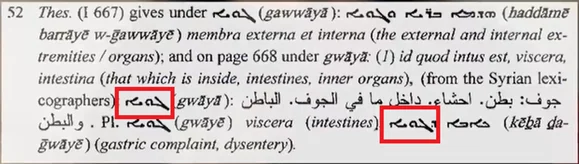
Luxenberg’s methodology mirrored Jeffery’s approach, which sought Syriac sources for Qurʾānic words, and rested on the assumption that so-called “obscure” Qurʾānic terms may reflect Syriac lexis and context. However, the reconstruction of a hypothetical Syriac form gawwāyā is methodologically flawed and historically unsound, for standard Syriac lexica attest the singular gwāyā (“inner part” or “interior”) and the plural gwāyē, but do not register the consonant doubling of w arbitrarily introduced in gawwāyā. This doubling, which is unattested in classical Syriac sources, appears only in certain scholarly reconstructions—most clearly by Jeffery and Luxenberg, and sometimes associated with Nöldeke’s school of thought—likely as an attempt to create phonetic or semantic proximity to Arabic ḥawāyā. In this way, a superficial resemblance is manufactured, suggesting a borrowing that never occurred. In short, while both ḥawāyā and gwāyā share long vowels and the consonant w, the doubled consonant is absent from both the attested Syriac forms (gwāyā/gwāyē) and the Arabic. Its inclusion reflects an effort to enhance visual or phonetic similarity rather than historical reality, since no evidence attests to such a form.183 This practice is methodologically questionable, lacking foundation in Syriac morphology, lexicography, or historical phonetics. In other words, the speculative reconstruction represents an unsound attempt to force an etymological link rather than a conclusion grounded in historical linguistics, and it is unnecessary for understanding ḥawāyā, which is authentically Arabic and firmly attested. The term derives from the root ḥ–w–y (ح و ى), meaning “to contain” or “to hold within,” and both its morphology and usage accord with Arabic linguistic patterns, as corroborated by classical authorities such as Ibn Fāris in Maqāyīs al-Luġah. In short, while Luxenberg’s approach emphasizes potential Syriac influences, in this case no borrowing need be posited, since ḥawāyā is an internally coherent and historically attested Arabic term, and his reconstruction of a corresponding Syriac form remains speculative rather than linguistically necessary. His proposal, therefore, reflects a conjectural hypothesis rather than a substantiated borrowing. Moreover, Ḥassān Bar Bahlul’s dictionary shows that ܓܘ (gw) means “inside,” which further illustrates the unwarranted nature of Luxenberg’s reconstruction.184

The same Syriac word is attested in Matthew 23:26,185 where it clearly carries the meaning “inside.’’186

Now, which reading of verse 6:146 is more accurate and meaningful: the standard classical Arabic reading{For those who are Jewish, We forbade every animal with undivided hoofs and the fat of oxen and sheep except what is joined to their backs or intestines (ḥawāyā) or mixed with bone…}—or Luxenberg’s Syriac-based rereading—{we prohibited to them their fat, except what adheres to their backs or the inside (gwāyē)’’? Had Luxenberg been fully versed in Arabic, he would have recognized that ḥawāyā refers to the innermost parts of an animal, namely its intestines or internal organs, as the verse clearly indicates. Interestingly, whereas Syriac gwāyē (the plural of gāwāyā) functions as a fixed lexical form without productive root-based morphology, Arabic ḥawāyā transparently derives from the authentic root ḥ–w–y, preserving its semantic clarity.187 Remarkably, Luxenberg frequently adjusted the meanings of Syriac words to force alignment with Qurʾānic terms he alleged were borrowed from them. Yet, any careful reader who considers the “new readings’’ of the numerous passages discussed in his book will find that they offer no greater clarity than the straightforward classical Arabic interpretation of the traditional text. Such reinterpretations derive their appeal chiefly from novelty—or, more precisely, from their outright perversity—rather than from any genuine contribution to understanding the Qurʾān or the historical development of Islam. The two examples discussed above illustrate, in a manner accessible to the general reader, the kind of reasoning employed by Luxenberg and those who adopt his approach. Ultimately, Luxenberg exemplifies a strain of Orientalist scholarship motivated less by objective inquiry than by a predisposition to discredit Islam.
As previously noted, Luxenberg’s claims stand in sharp contradiction to both traditional Muslim scholarship and the prevailing views of Western academia. His thesis, which diverges markedly from established scholarly consensus, was met with broad skepticism in reviews. Angelika Neuwirth, a leading German scholar of Islam, described his proposition—that the Qurʾān consists of translations and paraphrases of original Syriac texts once recited in church services as part of a lectionary—as “an extremely pretentious hypothesis which is unfortunately relying on rather modest foundations.’’188 Neuwirth observed that Luxenberg disregards prior scholarship on the Qurʾān and instead “limits himself to a very mechanistic, positivist linguistic method without caring for theoretical considerations developed in modern linguistics.”189 François de Blois—who has published extensively on Semitic and Iranian languages and on the history of religions in the pre-modern Near East, and serves as a teaching fellow in Aramaic and Middle Iranian languages at the School of Oriental and African Studies (SOAS), University of London, the world’s leading institution for the study of Asia, Africa, and the Middle East—asserted that Luxenberg is not German but a Lebanese Christian. De Blois regarded Luxenberg as a dilettante whose Syro-Aramaic readings “do not actually make better sense” than the standard classical Arabic interpretation. He further noted that Luxenberg’s theory is not original but rather an adaptation of earlier works by James A. Bellamy and Günter Lüling, without acknowledging them in his bibliography—an omission that “poses questions about [his] scholarly integrity.” According to De Blois, Luxenberg possesses articulate knowledge of dialectal Arabic, a passable “though flawed” command of classical Arabic, and only a basic, “very shaky” grasp of Syriac. De Blois ultimately concluded that there is no reason for German academics to conceal their identity.190

Walid Saleh, Associate Professor of Islamic Studies at the University of Toronto, described Luxenberg’s method as: “so idiosyncratic, so inconsistent, that it is simply impossible to keep his line of argument straight.’’191 Saleh summed up his assessment of Luxenberg’s method as follows:192

Saleh further observed that Luxenberg failed to follow the very rules he himself had set forth.193 Richard Kroes, a Dutch archaeologist, described Luxenberg as “unaware of much of the other literature on the subject’’ and noted that “quite a few of his theories are doubtful and motivated too much by a Christian apologetic agenda.’’194 Patricia Crone, professor of Islamic history at the Institute for Advanced Study in Princeton, referred to Luxenberg’s work as “open to so many scholarly objections … [and marked by] notable amateurism.”195
In an effort to cast doubt on the Qurʾān and undermine its authority, the opponents of Islam such as Luxenberg have advanced arguments that scholars widely regard as flawed. These attempts stem from a deep unease with the undeniable reality that Islam continues to win hearts and minds across the West. The Qurʾān, as a divine revelation, endures—preserved in the memory of Muslims, recited ceaselessly in prayer and worship, and vibrantly alive in every generation. By contrast, the Syriac language on which Luxenberg built his hypothesis has long since fallen into extinction, surviving only as an artifact of history, confined to manuscripts and museum shelves rather than sustained as a living tradition within a community.196 In essence, the presence of what some Orientalists have termed “foreign words” in the Qurʾān is entirely natural, given that it was revealed in the language of its immediate audience—the Arabs. Over centuries of cultural interaction, particularly through trade, Arabic had absorbed numerous loanwords from non-Arabic sources. These terms had long been naturalized, fully integrated into the lexicon, and regarded as part of al-lisān al-ʿarabiyy al-mubīn (the pure, manifest Arabic tongue, i.e., the standard literary Arabic of pre-Islamic Arabia)well before the Qurʾān’s revelation, and their inclusion does not compromise the language’s purity. Moreover, Arabic and Syriac, alongside other Semitic languages, share a substantial number of cognates due to their common linguistic ancestry. As a result, Prophet Muḥammad (PBUH)’s audience understood his message without ambiguity, since the terms he employed were already firmly established within their linguistic repertoire. De Lacy Evans O’Leary, a British Orientalist and lecturer at the University of Bristol who authored several works on the early history of the Arabs and Copts, maintained that classical Arabic should serve as the foundation for Semitic philology, given its relatively isolated development, which protected it from significant contamination by non-Semitic languages. In O’Leary’s view, it remained free from the more radical alterations that affected Assyrian and Hebrew.197

The Arabic language possesses remarkable depth and versatility, and its influence on Syriac has been particularly profound, as evidenced by the substantial number of lexemes borrowed from Arabic. This observation is not based on Arabic’s status as the language of the Qurʾān, but, as previously noted, is affirmed by numerous prominent linguists. Luxenberg’s peculiar assertion—that many Qurʾānic words cannot be explained etymologically within Arabic but become intelligible when traced to Syro-Aramaic roots—stands in stark contrast to the extensive corpus of pre-Islamic poetry, which remains a crucial resource for understanding and interpreting the Qurʾān. This corpus includes the renowned al-Muʿallaqāt (The Hanging Odes), seven celebrated compositions studied throughout the Arab world. As for Luxenberg—the anonymous “scholar’’ writing under a pseudonym, claiming affiliation with an unnamed “leading German university’’ (so much for academic credibility!), whose knowledge of Syriac extended little beyond dictionary consultation, who lacked sufficient command of Classical Arabic, and who demonstrated no real grasp of the methodology of comparative Semitic linguistics—he cannot be considered a pioneer or a visionary. His work amounts to dilettantism masquerading as scholarship, lacking the rigor and originality required for a path-breaking academic contribution. Unquestionably, the Qurʾān is the revelation granted to Prophet Muḥammad (PBUH), not a product of Syriac Christianity. Perhaps it is most appropriate to conclude with a quotation from the Syriac bishop Iqlīmīs Yūsuf Dāwud al-Mawṣilī, who stated: “Know that the Syriac language is one of the languages known as Semitic, that is, those spoken by the descendants of Shem [one of the three sons of Prophet Noah (PBUH)]. The most prominent of the Semitic languages are Arabic, Hebrew, Syriac, Ethiopic, and Phoenician. We have mentioned Arabic first among the Semitic languages because, by the acknowledgment of all scholars, it is the noblest, the oldest, and the richest of the Semitic languages. Its mastery is indispensable for anyone who wishes to attain a sound understanding of the other Semitic languages, especially Syriac.198

Notes and References
- 1
Alphonse Mingana, “Syriac Influences on the Style of the Kur'ān,” Bulletin of the John Rylands Library Manchester, vol. II, 1927, pp. 77–98 and ---. “An Ancient Syriac Translation of the Kur'ān Exhibiting New Verses and Variants,” Bulletin of the John Rylands Library Manchester, vol. IX, 1925, pp. 188–235 as cited in “From Alphonse Mingana to Christoph Luxenberg: Arabic Script & the Alleged Syriac Origins of the Qur'an,” Islamic Awareness, last modified 3 May 2007, https://www.islamic-awareness.org/quran/text/mss/vowel.
- 2
---., “The Transmission of the Qur'an,” Journal of the Manchester Egyptian and Oriental Society, 1916, pp. 44–45 as cited in “From Alphonse Mingana to Christoph Luxenberg: Arabic Script & the Alleged Syriac Origins of the Qur'an,” Islamic Awareness, last modified 3 May 2007, https://www.islamic-awareness.org/quran/text/mss/vowel.
- 3
Alphonse Mingana and A. S. Lewis, Leaves from Three Ancient Qur'âns Possibly Pre-‘Othmânic with a List of their Variants, (Cambridge, U.K.: Cambridge University Press, 1914), p. xxxi, available at: https://archive.org/details/LeavesFromThreeAncientQurans/mode/2up.
- 4
Ibid., p. xxx.
- 5
Christoph Luxenberg, Die syro-aramäische Lesart des Koran: Ein Beitrag zur Entschlüsselung der Koransprache, (Berlin, Germany: Das Arabische Book, 2000) as cited in “From Alphonse Mingana to Christoph Luxenberg: Arabic Script & the Alleged Syriac Origins of the Qur'an,” Islamic Awareness, last modified 3 May 2007, https://www.islamic-awareness.org/quran/text/mss/vowel.
- 6
Luxenberg uses the term syro-aramäische to emphasize that the script influencing early Arabic writing was not merely Syriac in the narrow sense, but part of the broader Syro-Aramaic continuum—a family of scripts used across the Near East before and during the emergence of Islam. By employing this compound term, he signals that the linguistic and scriptural tradition influencing Arabic was deeply rooted in Aramaic, though specifically in its Syriac branch, which dominated Christian liturgical and literary culture. In this view, the early Arabic script is framed as a derivative or adaptation of a Syro-Aramaic cursive model, rather than as an entirely independent system at the advent of Islam. This terminology aligns with his thesis in Die syro-aramäische Lesart des Koran, where he argues that the Qurʾān preserves linguistic and interpretive layers from this Syro-Aramaic milieu—supporting his broader claim of an Aramaic substrate underlying Qurʾānic language and script.
- 7
Christoph Luxenberg, Die syro-aramäische Lesart des Koran: Ein Beitrag zur Entschlüsselung der Koransprache, (Berlin, Germany: Das Arabische Book, 2000) p. 299 as cited in “From Alphonse Mingana to Christoph Luxenberg: Arabic Script & the Alleged Syriac Origins of the Qur'an,” Islamic Awareness, last modified 3 May 2007, https://www.islamic-awareness.org/quran/text/mss/vowel.
- 8
Ibid., p. 302.
- 9
John F. Healey & G. R. Smith, “Jaussen-Savignac 17 - The Earliest Dated Arabic Document (A.D. 267),” Atlal (The Journal of Saudi Arabian Archaeology), vol. 12, 1989, pp. 77–84, for picture see Pl. 46 as cited in “From Alphonse Mingana to Christoph Luxenberg: Arabic Script & the Alleged Syriac Origins of the Qur'an,” Islamic Awareness, last modified 3 May 2007, https://www.islamic-awareness.org/quran/text/mss/vowel.
- 10
“Raqush Inscription (Jaussen-Savignac 17): The Earliest Dated Pre-Islamic Arabic Inscription (267 CE),” Islamic Awareness, last modified 6 March 2005, https://www.islamic-awareness.org/history/islam/inscriptions/raqush.
- 11
“Jabal Ramm Inscription: A Fourth Century Pre-Islamic Arabic Inscription,” Islamic Awareness, last modified 16 March 2005, https://www.islamic-awareness.org/history/islam/inscriptions/jramm.
- 12
James A. Bellamy, “Two Pre-Islamic Arabic Inscriptions Revised: Jabal Ramm and Umm al-Jimāl,” Journal of the American Oriental Society, vol. 108, 1988, pp. 369–372 as cited in “From Alphonse Mingana to Christoph Luxenberg: Arabic Script & the Alleged Syriac Origins of the Qur'an,” Islamic Awareness, last modified 3 May 2007, https://www.islamic-awareness.org/quran/text/mss/vowel.
- 13
“Jabal Ramm Inscription: A Fourth Century Pre-Islamic Arabic Inscription,” Islamic Awareness, last modified 16 March 2005, https://www.islamic-awareness.org/history/islam/inscriptions/jramm.
- 14
“A Pre-Islamic Arabic Inscription at Umm al-Jimāl,” Islamic Awareness, last modified 16 March 2005, https://www.islamic-awareness.org/history/islam/inscriptions/jimal.
- 15
James A. Bellamy, “Two Pre-Islamic Arabic Inscriptions Revised: Jabal Ramm and Umm al-Jimāl,” Journal of the American Oriental Society, vol. 108, 1988, pp. 369–372 as cited in “From Alphonse Mingana to Christoph Luxenberg: Arabic Script & the Alleged Syriac Origins of the Qur'an,” Islamic Awareness, last modified 3 May 2007, https://www.islamic-awareness.org/quran/text/mss/vowel.
- 16
“A Pre-Islamic Arabic Inscription at Umm al-Jimāl,” Islamic Awareness, last modified 16 March 2005, https://www.islamic-awareness.org/history/islam/inscriptions/jimal.
- 17
“Zebed Inscription: A Pre-Islamic Trilingual Inscription in Greek, Syriac & Arabic from 512 CE,” Islamic Awareness, last modified 13 Nov. 2017, https://www.islamic-awareness.org/history/islam/inscriptions/zebed.
- 18
“Jabal Usays Inscription: A Pre-Islamic Arabic Inscription from 528 CE,” Islamic Awareness, last modified 17 March 2005, https://www.islamic-awareness.org/history/islam/inscriptions/usays.
- 19
Paul Schroeder, “Epigraphisches aus Syrien,” Zeitschrift der Deutschen Morgenländischen Gesellschaft, 1884, pp. 530–534 and Pl. I as cited in “From Alphonse Mingana to Christoph Luxenberg: Arabic Script & the Alleged Syriac Origins of the Qur'an,” Islamic Awareness, last modified 3 May 2007, https://www.islamic-awareness.org/quran/text/mss/vowel.
- 20
“Harran Inscription: A Pre-Islamic Arabic Inscription from 568 CE,” Islamic Awareness, last modified 29 Jan. 2008, https://www.islamic-awareness.org/history/islam/inscriptions/harran.
- 21
Muhammad Hamidullah, “Some Arabic Inscriptions of Medinah of the Early Years of Hijrah,” Islamic Culture, October 1939, vol. XIII, number 4, pp. 427–439, available at: https://www.mdhamidullah.files.wordpress.com/2020/02/arabic-inscriptions-in-medinah.1939.pdf.
The internal evidence examined by Dr. Hamidullah included the names and genealogies mentioned in the inscriptions, which correspond to known historical figures from the early Hijrah period; the historical context, such as references to events, tribes, or circumstances that align with what is known of the early Muslim community around 625 CE; and stylistic and linguistic features, including the form of the letters, phrasing, and composition of the messages, which reflect early 7th-century Arabian epigraphy rather than later periods.
- 22
Ibid.
- 23
Ibid.
- 24
Ibid., p. 434, PL. 8.
- 25
Ibid., PL. 9.
- 26
Ibid., PL. 9.
- 27
Ibid., p. 435.
- 28
Ibid., p. 437–438.
- 29
Adolf Grohmann, “The Problem of Dating Early Qur'ans,” Der Islam, vol. 33, issue 3, 1 Jan. 1958, p. 221 as cited in “From Alphonse Mingana to Christoph Luxenberg: Arabic Script & the Alleged Syriac Origins of the Qur'an,” Islamic Awareness, last modified 3 May 2007, https://www.islamic-awareness.org/quran/text/mss/vowel.
- 30
James A. Bellamy, “The Arabic Alphabet” in Wayne M. Senner, The Origins of Writing, (Lincoln, U.S.: University of Nebraska Press, 1989), p. 99 As cited in “From Alphonse Mingana to Christoph Luxenberg: Arabic Script & the Alleged Syriac Origins of the Qur'an,” Islamic Awareness, last modified 3 May 2007, https://www.islamic-awareness.org/quran/text/mss/vowel.
- 31
Nabia Abbott, The Rise of the North Arabic Script and its Kur'anic Development, with a Full Description of the Kur'an Manuscripts in the Oriental Institute, (Chicago, U.S.: University of Chicago Press, 1939), p. 48 as cited in “From Alphonse Mingana to Christoph Luxenberg: Arabic Script & the Alleged Syriac Origins of the Qur'an,” Islamic Awareness, last modified 3 May 2007, https://www.islamic-awareness.org/quran/text/mss/vowel.
- 32
“PERF No. 558 - One of the Earliest Bilingual Papyrus from 22 AH / 643 CE,” Islamic Awareness, last modified 3 May 2014, https://www.islamic-awareness.org/history/islam/papyri/perf558.
- 33
Ibid.
- 34
Ibid.
- 35
Ibid.
- 36
Nabia Abbott, The Rise of the North Arabic Script and its Kur'anic Development, with a Full Description of the Kur'an Manuscripts in the Oriental Institute, (Chicago, U.S.: University of Chicago Press, 1939), p. 48 as cited in “From Alphonse Mingana to Christoph Luxenberg: Arabic Script & the Alleged Syriac Origins of the Qur'an,” Islamic Awareness, last modified 3 May 2007, https://www.islamic-awareness.org/quran/text/mss/vowel.
- 37
Christoph Luxenberg, Die syro-aramäische Lesart des Koran: Ein Beitrag zur Entschlüsselung der Koransprache, (Berlin, Germany: Das Arabische Book, 2000), p. 15 as cited in “From Alphonse Mingana to Christoph Luxenberg: Arabic Script & the Alleged Syriac Origins of the Qur'an,” Islamic Awareness, last modified 3 May 2007, https://www.islamic-awareness.org/quran/text/mss/vowel.
- 38
Adolf Grohmann, Arabische Paläographie II: Das Schriftwesen; Die Lapidarschrift, Österreichische Akademie der Wissenschaften Philosophisch - Historische Klasse: Denkschriften, bd. 94, abh. 2, (Vienna, Austria: Hermann Böhlaus Nachf, 1971), p. 13 and pp. 17–21 as cited in “From Alphonse Mingana to Christoph Luxenberg: Arabic Script & the Alleged Syriac Origins of the Qur'an,” Islamic Awareness, last modified 3 May 2007, https://www.islamic-awareness.org/quran/text/mss/vowel.
- 39
Aramaic is an overarching language continuum comprising several dialectal branches. Among these are Nabataean Aramaic—the script used by the Nabataeans, which evolved into the early Arabic script—and Syriac Aramaic—the script and dialect associated with Syriac Christian communities. It should be noted, however, that Aramaic was not a two-branch system; other branches also existed (e.g., Palmyrene, Hatran, Jewish Aramaic, and Mandaic).
- 40
John F. Healey, “Nabataean to Arabic: Calligraphy and Script Development among the Pre-Islamic Arabs,” Manuscripts of the Middle East, vol. V, 1990–1991, p. 44 as cited in “From Alphonse Mingana to Christoph Luxenberg: Arabic Script & the Alleged Syriac Origins of the Qur'an,” Islamic Awareness, last modified 3 May 2007, https://www.islamic-awareness.org/quran/text/mss/vowel.
- 41
Nabia Abbott, The Rise of the North Arabic Script and its Kur'anic Development, with a Full Description of the Kur'an Manuscripts in the Oriental Institute, (Chicago, U.S.: University of Chicago Press, 1939), p. 9 as cited in “From Alphonse Mingana to Christoph Luxenberg: Arabic Script & the Alleged Syriac Origins of the Qur'an,” Islamic Awareness, last modified 3 May 2007, https://www.islamic-awareness.org/quran/text/mss/vowel; Kees Versteegh, The Arabic Language, (Edinburgh, U.K.: Edinburgh University Press, 1997), p. 33 as cited in “From Alphonse Mingana to Christoph Luxenberg: Arabic Script & the Alleged Syriac Origins of the Qur'an,” Islamic Awareness, last modified 3 May 2007, https://www.islamic-awareness.org/quran/text/mss/vowel; Beatrice Gruendler, “Arabic Script” in Jane Dammen McAuliffe, Encyclopaedia of the Qur'an, (Leiden, the Netherlands: Brill, 2001), vol. 1, p. 138 as cited in “From Alphonse Mingana to Christoph Luxenberg: Arabic Script & the Alleged Syriac Origins of the Qur'an,” Islamic Awareness, last modified 3 May 2007, https://www.islamic-awareness.org/quran/text/mss/vowel.
- 42
“From Alphonse Mingana to Christoph Luxenberg: Arabic Script & the Alleged Syriac Origins of the Qur'an,” Islamic Awareness, last modified 3 May 2007, https://www.islamic-awareness.org/quran/text/mss/vowel.html.
- 43
Ernest John Revell, “The Diacritical Dots and the Development of Arabic Alphabet,” Journal of Semitic Studies, vol. xx, no. 2, 1975, p. 184 as cited in ibid.
- 44
This figure (15) excludes yāʾ (ي), which acquired its two dots only in later orthographic stages. Moreover, some scholars debate whether tāʾ marbūṭah (ة) should be considered a separate letter, as it is a contextual variant of tāʾ (ت). Including it raises the count to fifteen; excluding it reduces it to fourteen.
- 45
“From Alphonse Mingana to Christoph Luxenberg: Arabic Script & the Alleged Syriac Origins of the Qur'an,” Islamic Awareness, last modified 3May 2007, https://www.islamic-awareness.org/quran/text/mss/vowel.html.
- 46
“Raqush Inscription (Jaussen-Savignac 17): The Earliest Dated Pre-Islamic Arabic Inscription (267 CE),” Islamic Awareness, last modified 6 March 2005, https://www.islamic-awareness.org/history/islam/inscriptions/raqush.
- 47
“Jabal Ramm Inscription: A Fourth Century Pre-Islamic Arabic Inscription,” Islamic Awareness, last modified 16 March 2005, https://www.islamic-awareness.org/history/islam/inscriptions/jramm.
- 48
“A Peculiar Inscription Containing Arabic & Nabataean Characters at Sakakah, Saudi Arabia,” Islamic Awareness, last modified 5 March 2005, https://www.islamic-awareness.org/history/islam/inscriptions/sakaka.
- 49
“From Alphonse Mingana to Christoph Luxenberg: Arabic Script & the Alleged Syriac Origins of the Qur'an,” Islamic Awareness, last modified 3May 2007, https://www.islamic-awareness.org/quran/text/mss/vowel.html.
- 50
“PERF No. 558 - One of the Earliest Bilingual Papyrus from 22 AH / 643 CE,” Islamic Awareness, last modified 3 May 2014, https://www.islamic-awareness.org/history/islam/papyri/perf558.
- 51
“P. Mich. 6714 - A Bilingual Papyrus From 22-54 AH / 643-674 CE,” Islamic Awareness, last modified 18 Dec. 2005, https://www.islamic-awareness.org/history/islam/papyri/pmich.
- 52
“Arabic Graffito from Wādī Sabil, 46 AH / 666 CE,” Islamic Awareness, last modified 17 March 2005, https://www.islamic-awareness.org/history/islam/inscriptions/sabil.
- 53
“Inscription on the Dam Built by Caliph Muʿāwiya, 58 AH / 678 CE,” Islamic Awareness, last modified 20 March 2008, https://www.islamic-awareness.org/history/islam/inscriptions/muwinsc1.
- 54
Christoph Luxenberg, Die syro-aramäische Lesart des Koran: Ein Beitrag zur Entschlüsselung der Koransprache, (Berlin, Germany: Das Arabische Book, 2000), p. 19 as cited in “From Alphonse Mingana to Christoph Luxenberg: Arabic Script & the Alleged Syriac Origins of the Qur'an,” Islamic Awareness, last modified 3 May 2007, https://www.islamic-awareness.org/quran/text/mss/vowel.
- 55
Beatrice Gruendler, The Development of the Arabic Scripts: From the Nabatean Era to the First Islamic Century According to the Dated Texts, (Leiden, the Netherlands: Brill, 1993), p. 127 as cited in “From Alphonse Mingana to Christoph Luxenberg: Arabic Script & the Alleged Syriac Origins of the Qur'an,” Islamic Awareness, last modified 3 May 2007, https://www.islamic-awareness.org/quran/text/mss/vowel.
- 56
John F. Healey, “Nabataean to Arabic: Calligraphy and Script Development Among the Pre-Islamic Arabs”, Manuscripts of the Middle East, 1990–1991, p. 45 as cited in “From Alphonse Mingana to Christoph Luxenberg: Arabic Script & the Alleged Syriac Origins of the Qur'an,” Islamic Awareness, last modified 3 May 2007, https://www.islamic-awareness.org/quran/text/mss/vowel.
- 57
Nabia Abbott, The Rise of the North Arabic Script and its Kur'anic Development, with a Full Description of the Kur'an Manuscripts in the Oriental Institute, (Chicago, U.S.: University of Chicago Press, 1939), p. 38 as cited in “From Alphonse Mingana to Christoph Luxenberg: Arabic Script & the Alleged Syriac Origins of the Qur'an,” Islamic Awareness, last modified 3 May 2007, https://www.islamic-awareness.org/quran/text/mss/vowel.
- 58
This tendency to disregard the authority of Arab scholars was not unique to Mingana but rather emblematic of early Orientalist scholarship, particularly among philologists. Many 19th- and early 20th-century European philologists operated under the assumption that native Arabic sources were methodologically inferior and historically unreliable. The prevailing belief held that medieval Arab grammarians and lexicographers were prescriptive and steeped in later theoretical constructs, rendering their testimony of little value for reconstructing the earliest stages of the Arabic language. Consequently, Orientalists privileged epigraphic evidence and comparative Semitic data—particularly Syriac and Aramaic—over the testimony of Muslim scholars, whom they often dismissed as biased or uncritical. This structural bias underpinned Mingana’s treatment of the vowel signs, wherein he traced their origin to Syriac (and, by extension, Aramaic) while neglecting native explanations preserved within the Arabic philological tradition.
- 59
Alphonse Mingana and A. S. Lewis, Leaves from Three Ancient Qur'âns Possibly Pre-‘Othmânic with a List of their Variants, (Cambridge, U.K.: Cambridge University Press, 1914), p. xxxi and p. xxx as cited in “From Alphonse Mingana to Christoph Luxenberg: Arabic Script & the Alleged Syriac Origins of the Qur'an,” Islamic Awareness, last modified 3 May 2007, https://www.islamic-awareness.org/quran/text/mss/vowel.
- 60
Syriac comprises two principal dialect traditions: Western Syriac (used by the West Syriac Church) and Eastern Syriac (used by the East Syriac Church, e.g., the Nestorians). Their vocalization systems developed independently. Jacob of Edessa’s innovations pertain specifically to Western Syriac manuscripts, while Eastern Syriac later introduced a distinct system with different signs and placement. Scholars specify “Western Syriac” to avoid overgeneralization.
- 61
Benjamin Davidson, Syriac Reading Lessons: Consisting of Copious Extracts from the Peschito Version of the Old and New Testaments and the Crusade of Richard I from the Chronicles of Bar Hebraeus, (London, U.K.: Samuel Bagster & Sons, 1851), p. iii as cited in “From Alphonse Mingana to Christoph Luxenberg: Arabic Script & the Alleged Syriac Origins of the Qur'an,” Islamic Awareness, last modified 3 May 2007, https://www.islamic-awareness.org/quran/text/mss/vowel.
- 62
Judah B. Segal, The Diacritical Point and the Accents in Syriac, (London, U.K.: Oxford University Press, 1953) as cited in “From Alphonse Mingana to Christoph Luxenberg: Arabic Script & the Alleged Syriac Origins of the Qur'an,” Islamic Awareness, last modified 3 May 2007, https://www.islamic-awareness.org/quran/text/mss/vowel.
For the naming of vowels in Eastern Syria see p. 33. For the discussion on the Greek vowels see pp. 44–47: Theophilus of Edessa [d. 785 CE] was supposed to have invented the Greek vowels. However, there is difference of opinion among the Syriac grammarians on this issue. Also see Shelomo Morag, The Vocalization Systems of Arabic, Hebrew, and Aramaic: Their Phonetic and Phonemic Principles, (Berlin, Germany: De Gruyter Mouton, 1972), p. 49, footnote 16 as cited in “From Alphonse Mingana to Christoph Luxenberg: Arabic Script & the Alleged Syriac Origins of the Qur'an,” Islamic Awareness, last modified 3May 2007, https://www.islamic-awareness.org/quran/text/mss/vowel.html, footnote 36.
- 63
Bayard Dodge, The Fihrist of Al-Nadim: The Tenth Century Survey of Muslim Culture, (New York, U.S. & London, U.K.: Columbia University Press, 1970), vol. I, pp. 87–88 as cited in “From Alphonse Mingana to Christoph Luxenberg: Arabic Script & the Alleged Syriac Origins of the Qur'an,” Islamic Awareness, last modified 3 May 2007, https://www.islamic-awareness.org/quran/text/mss/vowel.
- 64
Abū ʿAmr ʿUthmān ibn Saʿīd ad-Dānī, al-Muḥkam fī Naqṭ al-Maṣāḥif, (Damascus, Syria: Dār al-Fikr, 1986), pp. 6–7 and Kees Versteegh, The Arabic Language, (Edinburgh, U.K.: Edinburgh University Press, 1997), p. 56 as cited in “From Alphonse Mingana to Christoph Luxenberg: Arabic Script & the Alleged Syriac Origins of the Qur'an,” Islamic Awareness, last modified 3 May 2007, https://www.islamic-awareness.org/quran/text/mss/vowel.
- 65
“Codex Topkapı Sarayı Medina 1a - A Qurʾān Located at Topkapı Sarayı Museum, Istanbul, from 1st/ 2nd Century Hijra,” Islamic Awareness, last updated 8 Aug. 2021, https://www.islamic-awareness.org/quran/text/mss/medina1a.html.
- 66
“Kodex Wetzstein II 1913 - A Qur'ān Located at Staatsbibliothek, Berlin, from 1st / 2nd Century Hijra,” Islamic Awareness, last updated 13 Apr. 2020, https://www.islamic-awareness.org/quran/text/mss/wetzstein1.html.
- 67
“The Qur'anic Manuscripts,” Islamic Awareness, accessed 19 Apr. 2023, https://www.islamic-awareness.org/quran/text/mss/index.html#1/2.
- 68
Christoph Luxenberg, Die syro-aramäische Lesart des Koran: Ein Beitrag zur Entschlüsselung der Koransprache, (Berlin, Germany: Das Arabische Book, 2000), p. 16 as cited in “From Alphonse Mingana to Christoph Luxenberg: Arabic Script & the Alleged Syriac Origins of the Qur'an,” Islamic Awareness, last modified 3 May 2007, https://www.islamic-awareness.org/quran/text/mss/vowel.
- 69
Judah B. Segal, The Diacritical Point and the Accents in Syriac, (Oxford, U.K.: Oxford University Press, 1953), p. 22 and Shelomo Morag, The Vocalization Systems of Arabic, Hebrew, and Aramaic: Their Phonetic and Phonemic Principles, (Berlin, Germany: De Gruyter Mouton, 1972), p. 46 as cited in “From Alphonse Mingana to Christoph Luxenberg: Arabic Script & the Alleged Syriac Origins of the Qur'an,” Islamic Awareness, last modified 3 May 2007, https://www.islamic-awareness.org/quran/text/mss/vowel.
- 70
“From Alphonse Mingana to Christoph Luxenberg: Arabic Script & the Alleged Syriac Origins of the Qur'an,” Islamic Awareness, last modified 3May 2007, https://www.islamic-awareness.org/quran/text/mss/vowel.html.
- 71
Ibid.
- 72
Shelomo Morag, The Vocalization Systems of Arabic, Hebrew, and Aramaic: Their Phonetic and Phonemic Principles, (Berlin, Germany: De Gruyter Mouton, 1972), pp. 13–14 and also p. 20 as cited in “From Alphonse Mingana to Christoph Luxenberg: Arabic Script & the Alleged Syriac Origins of the Qur'an,” Islamic Awareness, last modified 3 May 2007, https://www.islamic-awareness.org/quran/text/mss/vowel
- 73
Ibid., p. 15.
- 74
Christoph Luxenberg, Die syro-aramäische Lesart des Koran: Ein Beitrag zur Entschlüsselung der Koransprache, (Berlin, Germany: Das Arabische Book, 2000), pp. 20–25 as cited in “From Alphonse Mingana to Christoph Luxenberg: Arabic Script & the Alleged Syriac Origins of the Qur'an,” Islamic Awareness, last modified 3 May 2007, https://www.islamic-awareness.org/quran/text/mss/vowel.
- 75
Ibid., pp. 23–24.
- 76
Muḥammad ibn ʿAbd Allāh al-Khaṭīb at-Tibrīzī, Mishkāt al-Maṣābiḥ, (Bayrūt, Lebanon: al-Maktab al-Islāmī. 1979), book: 8, ḥadīth: 103, available at: https://sunnah.com/mishkat:2213.
- 77
“From Alphonse Mingana to Christoph Luxenberg: Arabic Script & the Alleged Syriac Origins of the Qur'an,” Islamic Awareness, last modified 3 May 2007, https://www.islamic-awareness.org/quran/text/mss/vowel.html.
- 78
Judah B. Segal, The Diacritical Point and the Accents in Syriac, (London, U.K.: Oxford University Press, 1953), p. 44 as cited in “From Alphonse Mingana to Christoph Luxenberg: Arabic Script & the Alleged Syriac Origins of the Qur'an,” Islamic Awareness, last modified 3 May 2007, https://www.islamic-awareness.org/quran/text/mss/vowel.
- 79
Yaḥyá ibn Yaʿmar and Naṣr ibn ʿĀṣim are primarily recorded as Qurʾān reciters, while Maymūn al-ʾAqran contributed as a transmitter of the vocalization system, likely combining grammatical and recitation expertise.
- 80
Kees Versteegh, The Arabic Language, (Edinburgh, Scotland: Edinburgh University Press, 1997), p. 57 as cited in “From Alphonse Mingana to Christoph Luxenberg: Arabic Script & the Alleged Syriac Origins of the Qur'an,” Islamic Awareness, last modified 3 May 2007, https://www.islamic-awareness.org/quran/text/mss/vowel
- 81
Luxenberg cited aṭ-Ṭabarī specifically regarding the khamsat aḥruf—the five modes of Qurʾānic recitation. These are sometimes referred to as the “five readings” within the Western Syriac framework that he used to propose a connection between the Arabic recitation variants and Syriac vowel signs. Accordingly, the report from aṭ-Ṭabarī that Luxenberg references pertains only to the five modes of Qurʾānic recitation, not the full seven. It should be emphasized, however, that this represents Luxenberg’s interpretation; traditional Islamic scholarship does not associate the aḥruf with Syriac vowels.
- 82
Abū ʿAmrū ʿUthmān ibn Saʿīd ad-Dānī, al-Muqniʿ fī Rasm Maṣāḥif al-ʾAmṣār maʿa Kitāb an-Naqṭ, (Cairo, Egypt: Maktabat al-Kulliyāt al-ʾAzhariyyah, 1978), p. 129 as cited in “From Alphonse Mingana to Christoph Luxenberg: Arabic Script & the Alleged Syriac Origins of the Qur'an,” Islamic Awareness, last modified 3 May 2007, https://www.islamic-awareness.org/quran/text/mss/vowel.
- 83
---., al-Muḥkam fī Naqṭ al-Maṣāḥif, (Damascus, Syria: Dār al-Fikr, 1986), p. 13 as cited in “From Alphonse Mingana to Christoph Luxenberg: Arabic Script & the Alleged Syriac Origins of the Qur'an,” Islamic Awareness, last modified 3 May 2007, https://www.islamic-awareness.org/quran/text/mss/vowel.
- 84
In early Islamic history, places like al-Baṣrah, al-Kūfah, and Madīnah were recognized as major centers of Qurʾānic learning, Islamic scholarship, and linguistic study. They were not “schools” in the modern sense but hubs where scholars, grammarians, and Qurʾānic reciters gathered, transmitted knowledge, and developed conventions like the vowel notation.
- 85
Abū ʿAmrū ʿUthmān ibn Saʿīd ad-Dānī, al-Muḥkam fī Naqṭ al-Maṣāḥif, (Damascus, Syria: Dār al-Fikr, 1986), p. 7 as cited in “From Alphonse Mingana to Christoph Luxenberg: Arabic Script & the Alleged Syriac Origins of the Qur'an,” Islamic Awareness, last modified 3 May 2007, https://www.islamic-awareness.org/quran/text/mss/vowel.
- 86
“From Alphonse Mingana to Christoph Luxenberg: Arabic Script & the Alleged Syriac Origins of the Qur'an,” Islamic Awareness, last modified 3 May 2007, https://www.islamic-awareness.org/quran/text/mss/vowel.html.
- 87
Ibid.
- 88
Luxenberg usually uses syro-aramäisch (Syro-Aramaic), which blends both terms. Syriac is the Christian Aramaic dialect in question, and Luxenberg’s usage highlights this connection.
- 89
“From Alphonse Mingana to Christoph Luxenberg: Arabic Script & the Alleged Syriac Origins of the Qur'an,” Islamic Awareness, last modified 3 May 2007, https://www.islamic-awareness.org/quran/text/mss/vowel.html.
- 90
As cited in “From Alphonse Mingana to Christoph Luxenberg: Arabic Script & the Alleged Syriac Origins of the Qur'an,” Islamic Awareness, last modified 3 May 2007, https://www.islamic-awareness.org/quran/text/mss/vowel.
- 91
Averil Cameron, The Mediterranean World in Late Antiquity AD 395-600, (London, U.K.: Routledge: 1993), pp. 182–185; Glen W. Bowersock, Hellenism in Late Antiquity, (Cambridge, U.K.: Cambridge University Press, 1990), Chapter III, pp. 29–40; Fergus Millar, The Roman Near East: 31 BC - AD 337, (Cambridge, U.S.: Harvard University Press, 1993) as cited in ibid.
- 92
Glen W. Bowersock, Hellenism in Late Antiquity, (Cambridge, U.K.: Cambridge University Press, 1990), p. 29 and p. 40 as cited in “From Alphonse Mingana to Christoph Luxenberg: Arabic Script & the Alleged Syriac Origins of the Qur'an,” Islamic Awareness, last modified 3 May 2007, https://www.islamic-awareness.org/quran/text/mss/vowel.
- 93
John F. Healey, “Were the Nabataeans Arabs?” Aram, vol. 1, no. 1, 1989, p. 44 as cited in “From Alphonse Mingana to Christoph Luxenberg: Arabic Script & the Alleged Syriac Origins of the Qur'an,” Islamic Awareness, last modified 3 May 2007, https://www.islamic-awareness.org/quran/text/mss/vowel.
- 94
Ibid.
- 95
“From Alphonse Mingana to Christoph Luxenberg: Arabic Script & the Alleged Syriac Origins of the Qur'an,” Islamic Awareness, last modified 3May 2007, https://www.islamic-awareness.org/quran/text/mss/vowel.html.
- 96
Ibid.
- 97
John F. Healey, “Were the Nabataeans Arabs?” Aram, vol. 1, no. 1, 1989 as cited in ibid.
- 98
“A First/Second Century Arabic Inscription of ʿEn ʿAvdat,” Islamic Awareness, last modified 31 May 2005, https://www.islamic-awareness.org/history/islam/inscriptions/avdat.
- 99
J. A. Bellamy, “Arabic Verses from the First/Second Century: The Inscription of ʿEn ʿAvdat,” Journal of Semitic Studies, vol. 35, 1990, pp. 73–79 as cited in ibid.
- 100
“Namarah Inscription: The Second Oldest Dated Pre-Islamic Arabic Inscription (328 CE),” Islamic Awareness, last modified 5 May 2005, https://www.islamic-awareness.org/history/islam/inscriptions/namarah.
- 101
“Raqush Inscription (Jaussen-Savignac 17): The Earliest Dated Pre-Islamic Arabic Inscription (267 CE),” Islamic Awareness, last modified 6 March 2005, https://www.islamic-awareness.org/history/islam/inscriptions/raqush.
- 102
John F. Healey, “Lexical Loans in Early Syriac: A Comparison with Nabataean Aramaic,” Studi Epigrafici E Linguistici Sul Vicino Oriente Antico, vol. 12, 1995, p. 78 as cited in “From Alphonse Mingana to Christoph Luxenberg: Arabic Script & the Alleged Syriac Origins of the Qur'an,” Islamic Awareness, last modified 3 May 2007, https://www.islamic-awareness.org/quran/text/mss/vowel.
- 103
Ibid.
- 104
John C. L. Gibson, Textbook of Syrian Semitic Inscriptions: Volume 2: Aramaic Inscriptions, including inscriptions in the Dialect of Zenjirli, (Oxford, U.K.: The Clarendon Press, 1975), pp. 148–151, no. 30, Plate IX; John F. Healey, “Were the Nabataeans Arabs?” Aram, vol. 1, 1989, p. 43; J. F. Healey & H. Bin Seray, “Aramaic in the Gulf: Towards A Corpus,” Aram, vol. 11–12, 1999–2000, pp. 1–14 for Aramaic inscriptions in Kuwait, Saudi Arabia, Bahrain, Qatar and the United Arab Emirates, as cited in “From Alphonse Mingana to Christoph Luxenberg: Arabic Script & the Alleged Syriac Origins of the Qur'an,” Islamic Awareness, last modified 3 May 2007, https://www.islamic-awareness.org/quran/text/mss/vowel.
The Achaemenids used Aramaic as the lingua franca of administration and trade not only in the West (Palestine, North Arabia, Egypt, and Anatolia) but also in the East (in Iran). It is therefore not in the least surprising to find Aramaic in use during and after the Achaemenid period in those areas of the Gulf which were affected by Persian and Parthian political commercial links.
Access the information about the Achaemenids and a map showing the area ruled by them here: “Map of the Achaemenid Empire,” Livius.org, last modified on 21 Jan. 2014, https://www.livius.org/pictures/a/maps/the-persian-empire/.
It will be clear why Aramaic inscriptions appear in the aforementioned Gulf states.
- 105
“From Alphonse Mingana to Christoph Luxenberg: Arabic Script & the Alleged Syriac Origins of the Qur'an,” Islamic Awareness, last modified 3May 2007, https://www.islamic-awareness.org/quran/text/mss/vowel.html.
- 106
Alphonse Mingana, “Syriac Influences on the Style of the Kur'an,” Bulletin of the John Rylands Library Manchester, vol. II, 1927, p. 78 as cited in “From Alphonse Mingana to Christoph Luxenberg: Arabic Script & the Alleged Syriac Origins of the Qur'an,” Islamic Awareness, last modified 3 May 2007, https://www.islamic-awareness.org/quran/text/mss/vowel.
- 107
“From Alphonse Mingana to Christoph Luxenberg: Arabic Script & the Alleged Syriac Origins of the Qur'an,” Islamic Awareness, last modified 3May 2007, https://www.islamic-awareness.org/quran/text/mss/vowel.html.
- 108
Judah B. Segal, The Diacritical Point and the Accents in Syriac, (London, U.K.: Oxford University Press, 1953), p. 4 as cited in “From Alphonse Mingana to Christoph Luxenberg: Arabic Script & the Alleged Syriac Origins of the Qur'an,” Islamic Awareness, last modified 3 May 2007, https://www.islamic-awareness.org/quran/text/mss/vowel.
- 109
See ibid, p. 2 for translation; see original text in William Wright, Fragments of the Turras mamlla nahraya or Syriac Grammar of Jacob of Edessa, (London, U.K.: Gilbert & Rivington, 1871), p. ܒ as cited in “From Alphonse Mingana to Christoph Luxenberg: Arabic Script & the Alleged Syriac Origins of the Qur'an,” Islamic Awareness, last modified 3 May 2007, https://www.islamic-awareness.org/quran/text/mss/vowel.
- 110
George Phillips, A Letter by Mār Jacob, Bishop of Edessa on Syriac Orthography, (London & Edinburgh, U.K.: William And Norgate, 1869), pp. 4–10; for Syriac text see William Wright, Fragments of the Turras mamlla nahraya or Syriac Grammar of Jacob of Edessa, (London, U.K.: Gilbert & Rivington, 1871), p. ܛ as cited in “From Alphonse Mingana to Christoph Luxenberg: Arabic Script & the Alleged Syriac Origins of the Qur'an,” Islamic Awareness, last modified 3 May 2007, https://www.islamic-awareness.org/quran/text/mss/vowel.
- 111
Judah B. Segal, The Diacritical Point and the Accents in Syriac, (London, U.K.: Oxford University Press, 1953), pp. 41–42 as cited in “From Alphonse Mingana to Christoph Luxenberg: Arabic Script & the Alleged Syriac Origins of the Qur'an,” Islamic Awareness, last modified 3 May 2007, https://www.islamic-awareness.org/quran/text/mss/vowel.
- 112
C. H. M. Versteegh, Arabic Grammar and Qur'ānic Exegesis in Early Islam, (Leiden, the Netherlands: Brill, 1993), p. 28 as cited in “From Alphonse Mingana to Christoph Luxenberg: Arabic Script & the Alleged Syriac Origins of the Qur'an,” Islamic Awareness, last modified 3 May 2007, https://www.islamic-awareness.org/quran/text/mss/vowel.
- 113
William Wright, A Short History of Syriac Literature, (London, U.K.: Adam & Charles Black, 1894), p. 211 as cited in “From Alphonse Mingana to Christoph Luxenberg: Arabic Script & the Alleged Syriac Origins of the Qur'an,” Islamic Awareness, last modified 3 May 2007, https://www.islamic-awareness.org/quran/text/mss/vowel.
- 114
Richard James Horatio Gottheil, The Syriac-Arabic Glosses [of] Bar ‘Alī (Īshō‘), (Rome, Italy: Tipografia della R. Accademia Nazionale dei Lincei, 1910–1928) as cited in “From Alphonse Mingana to Christoph Luxenberg: Arabic Script & the Alleged Syriac Origins of the Qur'an,” Islamic Awareness, last modified 3 May 2007, https://www.islamic-awareness.org/quran/text/mss/vowel.
- 115
Rubens Duval, Lexicon Syriacum auctore Hassano bar Bahlule: voces Syriacas Græcasque cum glossis Syriacis et Arabicis complectens, (Paris, France: e Reipublicæ typographæo, 1888–1901) as cited in “From Alphonse Mingana to Christoph Luxenberg: Arabic Script & the Alleged Syriac Origins of the Qur'an,” Islamic Awareness, last modified 3 May 2007, https://www.islamic-awareness.org/quran/text/mss/vowel.
- 116
In this context, “authorities” refers to scholars, grammarians, or other recognized experts whose opinions, definitions, or examples are cited in the dictionary. Citing authorities demonstrates that the entries are based on established scholarly knowledge rather than the compiler’s personal judgment.
- 117
John A. Haywood, Arabic Lexicography: Its History, and its Place in General History of Lexicography, (Leiden, the Netherlands: E. J. Brill, 1965), see the chart facing p. 132 as cited in “From Alphonse Mingana to Christoph Luxenberg: Arabic Script & the Alleged Syriac Origins of the Qur'an,” Islamic Awareness, last modified 3 May 2007, https://www.islamic-awareness.org/quran/text/mss/vowel.
- 118
Richard James Horatio Gottheil, The Syriac-Arabic Glosses [of] Bar ‘Alī (Īshō‘), (Rome, Italy: Tipografia della R. Accademia nazionale dei Lincei, 1910–1928), p. 9; Rubens Duval, Lexicon Syriacum auctore Hassano bar Bahlule: voces Syriacas Græcasque cum glossis Syriacis et Arabicis complectens, (Paris, France: e Reipublicæ typographæo, 1888–1901), vol. 1, p. 11 as cited in “From Alphonse Mingana to Christoph Luxenberg: Arabic Script & the Alleged Syriac Origins of the Qur'an,” Islamic Awareness, last modified 3 May 2007, https://www.islamic-awareness.org/quran/text/mss/vowel.
- 119
John A. Haywood, Arabic Lexicography: Its History, and its Place in General History of Lexicography, (Leiden, the Netherlands: E. J. Brill, 1965), p. 122 as cited in “From Alphonse Mingana to Christoph Luxenberg: Arabic Script & the Alleged Syriac Origins of the Qur'an,” Islamic Awareness, last modified 3 May 2007, https://www.islamic-awareness.org/quran/text/mss/vowel.
- 120
For Luxenberg’s use of these lexicons see Die syro-aramäische Lesart des Koran: Ein Beitrag zur Entschlüsselung der Koransprache, (Berlin, Germany: Das Arabische Book, 2000), p. 8 as cited in “From Alphonse Mingana to Christoph Luxenberg: Arabic Script & the Alleged Syriac Origins of the Qur'an,” Islamic Awareness, last modified 3 May 2007, https://www.islamic-awareness.org/quran/text/mss/vowel.
- 121
William Wright, A Short History of Syriac Literature, (London, U.K.: Adam & Charles Black, 1894), pp. 1–2 as cited in “From Alphonse Mingana to Christoph Luxenberg: Arabic Script & the Alleged Syriac Origins of the Qur'an,” Islamic Awareness, last modified 3 May 2007, https://www.islamic-awareness.org/quran/text/mss/vowel.
- 122
“From Alphonse Mingana to Christoph Luxenberg: Arabic Script & the Alleged Syriac Origins of the Qur'an,” Islamic Awareness, last modified 3 May 2007, https://www.islamic-awareness.org/quran/text/mss/vowel.html.
- 123
“Dated Muslim Texts from 1-72 AH / 622-691 CE: Documentary Evidence For Early Islam,” Islamic Awareness, last modified 14 Jul. 2022, https://www.islamic-awareness.org/history/islam/inscriptions/earlyislam.
- 124
Robert Hoyland, “New Documentary Texts and the Early Islamic State,” Bulletin of the School of Oriental and African Studies, vol. 69, no. 3, 2006, pp. 410–411 as cited in “From Alphonse Mingana to Christoph Luxenberg: Arabic Script & the Alleged Syriac Origins of the Qur'an,” Islamic Awareness, last modified 3 May 2007, https://www.islamic-awareness.org/quran/text/mss/vowel.
- 125
Federico Corriente, “On a Proposal for a “Syro-Aramaic” Reading of the Qurʾān,” Collectanea Christiana Orientalia, vol. I, 2003, pp. 309–310 as cited in “From Alphonse Mingana to Christoph Luxenberg: Arabic Script & the Alleged Syriac Origins of the Qur'an,” Islamic Awareness, last modified 3 May 2007, https://www.islamic-awareness.org/quran/text/mss/vowel.
- 126
Jusfiq Hadjar, “An interview with "Christoph Luxenberg" by Alfred Hackensberger,” The Mail Archive, 14 Apr. 2005, https://www.mail-archive.com/proletar@yahoogroups.com/msg06993.html.
According to Islamic tradition, the Koran dates back to the 7th century, while the first examples of Arabic literature in the full sense of the phrase are found only two centuries later, at the time of the ´Biography of the Prophet´; that is, of the life of Mohammed as written by Ibn Hisham, who died in 828. We may thus establish that post-Koranic Arabic literature developed by degrees, in the period following the work of al-Khalil bin Ahmad, who died in 786, the founder of Arabic lexicography (Kitab al-Ayn), and of Sibawwayh, who died in 796, to whom the grammar of classical Arabic is due. Now, if we assume that the composition of the Koran was brought to an end in the year of the Prophet Mohammed´s death, in 632, we find before us an interval of 150 years, during which there is no trace of Arabic literature worthy of note.
- 127
“From Alphonse Mingana to Christoph Luxenberg: Arabic Script & the Alleged Syriac Origins of the Qur'an,” Islamic Awareness, last modified 3 May 2007, https://www.islamic-awareness.org/quran/text/mss/vowel.html.
The earliest Arabic literature that comes to us is in the form of hadith collections. An example is the Sahifah of Hammam bin Munabbih, [d. 110 AH /719 CE], a Yemenite follower and a disciple of the companion Abu Hurrayrah, [d. 58 AH / 677 CE], from whom Hammam wrote this Sahifah, which comprises 138 hadith and is believed to have been written around the mid-first AH/seventh century. This is available as a printed edition. The hadith collections of Ibn Jurayj [d. 150 AH] and Ma‘mar b. Rashad [d. 153 AH], many of them transmitted by ‘Abd al-Razzaq in his Musannaf, are also available in print. Motzki has traced the material in the Musannaf of ‘Abd al-Razzaq to the first century of hijra.
- 128
Ibid.
- 129
Karl Brockelmann, Grundriss der vergleichenden Grammatik der semitischen Sprachen (Outline of the Comparative Grammar of the Semitic Languages — Fiqh al-Luġāt as-Sāmiyyah), trans. Ramaḍān ʿAbd at-Tawāb, (Cairo, Egypt: Dār al-Fajr, 1905), p. 12.
- 130
Archibald Henry Sayce, An Assyrian Grammar for Comparative Purposes, (London, U.K.: Trübner & Co.,1872), p. 13.
- 131
Aloys Sprenger, Die alte Geographie Arabiens als Grundlage der Entwicklungsgeschichte des Semitismus, (Bern, Switzerland: Commissionsverlag Von Huber & Como, 1875), p. 293.
- 132
Eberhard Schrader, “Die Abstammung der Chaldäer und die Ursitze der Semiten,” Zeitschrift der Deutschen Morgenländischen Gesellschaft, vol. XXVII, 1873, pp. 397–424.
- 133
Michael Jan de Goeje, Het vaderland der Semietische volken, (Leiden, the Netherlands: Brill, 1882).
- 134
Wright William, Lectures on the Comparative Grammar of the Semitic Languages, (Cambridge, U.K.: Cambridge the University Press, 1890), p. 8, available at: https://archive.org/details/lecturesoncompar00wrig/page/8/mode/2up.
- 135
Ibid., p. 9.
- 136
Hugo Winckler, The History of Babylonia and Assyria, (London, U.K.: Hodder & Stoughton, 1907), pp. 19-22, available at: https://archive.org/details/TheHistoryOfBabyloniaAndAssyria/mode/2up.
- 137
“Winckler–Caetani Theory,” Wikipedia: The Free Encyclopedia, last edited 4 Jan. 2023, https://en.wikipedia.org/wiki/Winckler%E2%80%93Caetani_theory.
- 138
Tori Lee, “The Fertile Crescent, Explained,” UChicago News, 10 Nov. 2022, https://goo.su/6AQAZWS.
The “Fertile Crescent,” a term coined by University of Chicago Egyptologist James Henry Breasted, refers to a crescent-shaped region in Western Asia. Formed by the Tigris and Euphrates rivers and the Mediterranean Sea, this region gave rise to some of the world’s earliest civilizations.
- 139
“Ancient Network of Rivers and Lakes Found in Arabian Desert,” University of Oxford, 30 Apr. 2012, https://www.ox.ac.uk/news/2012-04-30-ancient-network-rivers-and-lakes-found-arabian-desert.
- 140
The Palaeodeserts Project was a five-year programme (March 2012–2016) funded by the European Research Council. The project team included experts in archaeology, environmental studies, remote sensing, palaeontology, animal genetics, and rock art studies. The research was conducted in collaboration with the Saudi Commission for Tourism and Antiquities (SCTA) and with universities and institutions across the Arabian Peninsula, the United Kingdom, and Europe.
- 141
“Ancient Network of Rivers and Lakes Found in Arabian Desert,” University of Oxford, 30 Apr. 2012, https://www.ox.ac.uk/news/2012-04-30-ancient-network-rivers-and-lakes-found-arabian-desert.
- 142
Michael Petraglia and Huw Groucutt, “The Prehistory of the Arabian Peninsula: Deserts, Dispersals, and Demography,” Evolutionary Anthropology, vol. 21, issue 3, May/June 2012, pp. 113–125. DOI: https://doi.org/10.1002/evan.21308.
- 143
“Tusk Suggests Greener, Wetter Arabian Desert in the Past,” University of Oxford, 3 Apr. 2014, https://www.ox.ac.uk/news/2014-04-03-tusk-suggests-greener-wetter-arabian-desert-past-0.
- 144
Ibid.
- 145
“Early Human Footprints in Saudi Arabia,” The Past, 20 Dec. 2020, https://the-past.com/news/early-human-footprints-in-saudi-arabia/.
- 146
Muslim ibn al-Ḥajjāj, Ṣaḥīḥ Muslim, (Bayrūt, Lebanon: Dār al-Kutub ʿIlmiyyah, 2020), book: 12, ḥadīth: 76, available at: https://sunnah.com/muslim:157c.
- 147
Jehoshua M. Grintz, “On the Original Home of the Semites,” Journal of Near Eastern Studies, vol. 21, no. 3, 1962, pp. 186–206. DOI: https://doi.org/10.1086/371692.
- 148
Ḥasan Ẓāẓā, as-Sāmiyyūn wa-Luġātuhum (Semites and their Languages), (Istanbul, Turkey: ad-Dār ash-Shāmiyyah, 1990), p. 135.
Ernest Renan’s statement in French: “La chose la plus étrange qui est arrivée dans l’histoire humaine concerne la diffusion de la langue arabe. En effet, la langue arabe était inconnue, et soudainement, elle a connu une expansion pleine et complète. Cette langue n’a ni enfance, ni vieillesse. Elle a dépassé ses sœurs par la richesse de son vocabulaire, par la précision de ses termes et par la justesse de son système de construction et sa structuration.”
- 149
{Do not rush your tongue trying to memorize ˹a revelation of˺ the Qurʾān. It is certainly upon Us to ˹make you˺ memorize and recite it} (Qurʾān 75:15–16).
- 150
Muḥammad al-Bukhārī, Ṣaḥīḥ al-Bukhārī, (Cairo, Egypt: Dār as-Salām. 1999), book: 66, ḥadīth: 49, available at: https://sunnah.com/bukhari:5027.
- 151
The ijāzah is the certification granted to a Muslim for mastery in the recitation and memorization of the Qurʾān. It involves reciting the entire Qurʾān to a qualified teacher who themselves received the Qurʾān in the same manner from their teacher, and so on, tracing back through an unbroken chain. The ijāzah thus serves as a testimony from an authorized shaykh that the student has memorized and recited the entire Qurʾān with tajwīd (rules of Qurʾānic recitation), precision, and proper differentiation between similar verses, and is now qualified to recite and teach it.
- 152
Solehah Yaacob, “Arabic Language as the Foundation of Semitic Languages,” Arab World English Journal,vol. 5, no. 3, Sep. 2014, pp. 278–290, available at: https://awej.org/arabic-language-as-the-foundation-of-semitic-languages/.
- 153
Ḥāzim ʿAlī Kamāl ad-Dīn, al-Ḥarakah aṭ-Ṭawīlah fī al-Luġāt as-Sāmiyyah, (Cairo, Egypt: Maktabat al-ʾĀdāb, 2007), pp. 41–44; ---. al-Imālah fī al-Luġāt as-Sāmiyyah, (Cairo, Egypt: Maktabat al-ʾĀdāb, 2007), pp. 27–36.
- 154
{This is certainly a revelation from the Lord of all worlds, which the trustworthy spirit ˹Gabriel˺ brought down into your heart ˹O Prophet˺—so that you may be one of the warners—in a clear Arabic tongue} (Qurʾān 26:192–195).
- 155
Kees Versteegh, The Arabic Language, (Edinburgh, U.K.: Edinburgh University Press, 1997), p. 13.
- 156
De Lacy O'Leary, Comparative Grammar of the Semitic Languages, (London, U.K.: Kegan Paul, Trench, Trübner & Co.; New York, U.S.: E. P. Dutton and Co., 1923), pp. 43–45, available at: https://archive.org/details/comparativegramm00oleauoft/comparativegramm00oleauoft/mode/2up.
- 157
Ibid., pp. 46–47.
- 158
Ibid.
- 159
Ibid.
- 160
Ibid., pp. 48–49.
- 161
Emphatic sounds are pronounced with a constricted pharynx, giving them a heavier, ‘thicker’ quality.”
- 162
Sabatino Mascati et al., An Introduction to the Comparative Grammar of the Semitic Languages: Phonology and Morphology, trans. Mahdī al-Makhzumī and ʾAbd al-Jabbār al-Maṭlabī, (Bayrūt, Lebanon: ʿĀlam al-Kutub, 1993), p. 80.
- 163
Although Arabic preserved these consonants as distinct phonemes, their phonetic realizations have shifted slightly from their Proto-Semitic originals. For example, the emphatic sounds—such as ẓ and ḍ—are reconstructed in Proto-Semitic as emphatic interdentals (commonly transcribed as ṣ́ and ḍ̣ or ẓ and ḍ), contrasting with plain interdentals. In Arabic, however, these sounds have undergone a positional shift toward pharyngealization and dental or alveolar articulation, while maintaining their emphatic quality without merging with other categories.
- 164
Al-ʾAmīr Bahāʾ, Tafsīr al-Qurʾān bi-s-Siryāniyyah, (Cairo, Egypt: Dār al-Kutub al-Maṣriyyah, 2017), pp. 44–45.
- 165
Ibid., p. 45.
- 166
Ibid., pp. 45–46.
- 167
Ibid., pp. 46–47.
- 168
Deuteronomy 2:23; 1 Kings 4:24; Jeremiah 25:20.
- 169
Sabatino Mascati et al., An Introduction to the Comparative Grammar of the Semitic Languages: Phonology and Morphology, trans. Mahdī al-Makhzūmī and ʾAbd al-Jabbār al-Maṭlabī, (Bayrūt, Lebanon: ʿĀlam al-Kutub, 1993), p. 162.
- 170
Al-ʾAmīr Bahāʾ, Tafsīr al-Qurʾān bi-s-Siryāniyyah, (Cairo, Egypt: Dār al-Kutub al-Maṣriyyah, 2017), p. 47.
- 171
Jawdat Maḥmūd aṭ-Ṭaḥlāwī, Tārīkh al-Luġāt as-Sāmiyyah, (Cairo, Egypt: Maṭbaʾat aṭ-Ṭalabah, 1932), p. 34.
- 172
Aḥmad ibn Muṣṭafá al-Labābīdī, al-La ṭāʾif fī al-Luġah, (Cairo, Egypt: Dār al-Faḍilah, 2006), p. 13.
- 173
Ibid.
Abū al-ʿAlāʾ al-Maʿarrī, who was blind, once entered a scholarly gathering and accidentally stepped on someone’s foot. Unaware of al-Maʿarrī’s identity, the person exclaimed, “Who is this dog who did not see me?” Offended, al-Maʿarrī replied, “The dog is the one who does not know seventy names for the dog.”
- 174
Ḥusayn ibn Aḥmad ibn Khālawayh, Names of the Lion, trans. David Larsen, (Seattle, U.S.: Wave Books, 2017).
- 175
Muḥammad ʿAbd ash-Shāfī al-Qūṣī, ʿAbqariyyat al-Luġah al-ʿArabiyyah, (Rabat, Morocco: Publications of Islamic World Educational, Scientific and Cultural Organization (ICESCO), 2016).
- 176
Al-ʾAmīr Bahāʾ, Tafsīr al-Qurʾān bi-s-Siryāniyyah, (Cairo, Egypt: Dār al-Kutub al-Maṣriyyah, 2017), p. 49.
- 177
Stefan Theil, “Challenging the Qur'an,” Newsweek, 27 Jul. 2003, https://www.newsweek.com/challenging-quran-139447.
- 178
Al-Muʿallaqāt: poems traditionally believed to have been suspended on the walls of the Kaʿbah as exemplars of the finest literary achievement in the pre-Islamic era.
- 179
Rubens Duval, Lexicon Syriacum auctore Hassano bar Bahlule: voces Syriacas Græcasque cum glossis Syriacis et Arabicis complectens, (Paris, France: e Reipublicæ typographæo, 1888–1901), vol 2, p. 1832; Richard James Horatio Gottheil, The Syriac-Arabic Glosses [of] Bar ‘Alī (Īshō‘), (Rome, Italy: Tipografia della R. Accademia nazionale dei Lincei, 1910–1928), vol. 2, p. 362.
- 180
Theodor Nöldeke, The History of the Qurʾān, trans. Wolfgang Behn, (Leiden, the Netherlands: Brill, 2013), p. 27.
- 181
Aḥmad ibn Fāris al-Qazwīnī, Muʿjam Maqāyīs al-Luġah, (Bayrūt, Lebanon: Dār al-Jīl, 1991).
- 182
Arthur Jeffery’s The Foreign Vocabulary of the Qurʾān (Leiden, the Netherlands: Brill, 1938).
- 183
The similarity that scholars sought lay not in the doubled consonant itself but in the overall consonant–vowel pattern and semantic sense. Arabic ḥawāyā follows the structure ḥ–w–ā–y–ā, marked by long vowels and the consonant w, while Syriac gwāyā—or the reconstructed gawwāyā—shows a comparable sequence, particularly the presence of w and long vowels. The doubling of w in the reconstruction artificially heightens this resemblance for visual or phonetic effect, though it lacks historical attestation. In this way, the perceived similarity was manufactured by emphasizing shared consonants and long vowels, even though the doubling itself has no correspondence in Arabic ḥawāyā. This speculative method effectively “stretched” the Syriac form to approximate the Arabic, creating an illusion of borrowing rather than reflecting linguistic reality.
- 184
Rubens Duval, Lexicon Syriacum auctore Hassano bar Bahlule: voces Syriacas Græcasque cum glossis Syriacis et Arabicis complectens, (Paris, France: e Reipublicæ typographæo, 1888–1901), vol 1, p. 458.
- 185
“Matthew 23:26, New International Version,” Bible Gateway, accessed 1 May 2023, https://www.biblegateway.com/passage/?search=Matthew%2023%3A26&version=NIV.
- 186
Al-ʾAmīr Bahāʾ, Tafsīr al-Qurʾān bi-s-Siryāniyyah, (Cairo, Egypt: Dār al-Kutub al-Maṣriyyah, 2017).
- 187
The Syriac term gwāyē (plural of gāwāyā) is morphologically unproductive, functioning as a lexical fossil (i.e., a frozen form) that no longer actively reflects its underlying root. Although it may ultimately derive from g-w-y, such forms in Syriac often became opaque and were treated as fixed nouns rather than members of a productive root family. By contrast, the Arabic ḥawāyā clearly derives from the root ḥ-w-y, which remains both productive and semantically transparent (‘to contain, encompass’ → ‘innermost parts, contents’). Thus, whereas ḥawāyā exemplifies a living Arabic pattern, gwāyē persists as a fixed form lacking overt root transparency.
- 188
Angelika Neuwirth, “Qurʾān and History—A Disputed Relationship. Some Reflections on Qurʾānic History and History in the Qurʾān,” Journal of Qurʾānic Studies, vol. v, issue 1, 2003, pp. 1–18. DOI: https://doi.org/10.3366/JQS.2003.5.1.1.
- 189
Ibid.
- 190
François de Blois, “Review of Die syro-aramäische Lesart des Koran. Ein Beitrag zur Entschlüsselung der Koransprache / ﻗﺮﺍﺀﺓ ﺳﺮﻳﺎﻧﻴﺔ ﺁﺭﺍﻣﻴﺔ ﻟﻠﻘﺮﺁﻥ,” Journal of Qur'anic Studies, vol. 5, issue 1, 2003, pp. 92–97, JSTOR, accessed 2 May 2023, http://www.jstor.org/stable/25728097.
- 191
Walid Saleh, “The Etymological Fallacy and Quranic Studies: Muhammad, Paradise, and Late Antiquity” in Angelika Neuwirth, The Qur’an in Context, (Leiden, the Netherlands: Brill, 2011), pp. 649–698, available at: https://safarmer.com/Indo-Eurasian/Walid_Saleh.pdf, quote page: 51.
- 192
Ibid., pp. 55-56.
- 193
Ibid., p. 47.
- 194
Richard Kroes, “Missionary, Dilettante or Visionary? A Review of Ch. Luxenberg, Die Syro-Aramäische Lesart des Qur'an,” Livius, last modified on 12 October 2020, https://www.livius.org/articles/misc/luxenberg-thesis/.
- 195
Patricia Crone, “What Do we Actually Know about Mohammed?” Open Democracy, 10 June 2008, https://www.opendemocracy.net/en/mohammed_3866jsp/.
- 196
Al-ʾAmīr Bahāʾ, Tafsīr al-Qurʾān bi-s-Siryāniyyah, (Cairo, Egypt: Dār al-Kutub al-Maṣriyyah, 2017).
- 197
De Lacy O'Leary, Comparative Grammar of the Semitic Languages, (London, U.K: Kegan Paul, Trench, Trübner & Co.; New York, U.S.: E. P. Dutton and Co., 1923), pp. 16–18, available at: https://archive.org/details/comparativegramm00oleauoft/comparativegramm00oleauoft/mode/2up.
- 198
Iqlīmīs Yūsuf Dāwud al-Mawṣilī, al-Lumʿah ash-shahiyyah fī Fahm Naḥw as-Siryāniyyah, (al-Mawṣil, Iraq: Dayr al-ʾĀbāʾ ad-Dūskiyyīn, 1879), p. 8.