Did Prophet Muḥammad (PBUH) establish Islam by extensively drawing upon rabbinical Judaism?
The opponents of Islam, masquerading as scholars, have advanced the unfounded claim that Prophet Muḥammad (PBUH) copied the Jewish Scriptures. According to them, Islam originated with the Prophet (PBUH) who supposedly established it by borrowing heavily from rabbinical Judaism. However, anyone acquainted with the historical context of the Torah and the Jewish presence during the Prophet’s time will recognize the claim as utterly baseless. To begin with, during the Prophet (PBUH)’s time, the Jewish tribes were primarily settled in and around al-Madīnah, while he (PBUH) had been receiving and sharing the Qurʾān in Makkah for thirteen years before migrating with his followers to al-Madīnah to escape persecution. Thus, Makkah lacked any significant source of biblical material. Moreover, the allegation that the Prophet (PBUH) copied the Jewish Scriptures was never made, even at the height of the Jewish tribes’ hostility towards the Prophet (PBUH) in al-Madīnah, despite their repeated attempts to slander him and to suppress Islam. Furthermore, the Qurʾān itself exposes the distortions introduced by Christians and Jews to the original messages of Moses and Jesus (peace be upon them). The following examples illustrate Qurʾānic corrections to these biblical distortions:
1)The claim that Abraham was a Jew.1
2)The notion that God became weary from creating the universe.2
3)The idea that Ezra is the son of God or that Jesus is the son of God.3
4)The concept of the Trinity.4
5)The practice of sanctifying the Church or the saints.5
6)The accusation that Solomon committed blasphemy.6
7)The confusion regarding the first qiblah (direction of prayer).7
8)The rules regarding forbidden foods.8
Now, the opponents of Islam claim that the Qurʾān is merely a copy of the Bible. But the question arises: could a copy ever correct the claimed original? Undeniably, there are similarities between the Qurʾān and the Bible, yet this does not imply that Prophet Muḥammad (PBUH) plagiarized from the latter. Rather, it indicates that both originate from the same source—the one and only God—and that the Qurʾān presents corrections to messages that had been corrupted over time by the Jews and Christians. Historically and logically, it is impossible to assert that the Prophet (PBUH) copied the Qurʾān from Jewish Scriptures, for a hallmark of his Prophethood was his illiteracy. The argument that he (PBUH) learned and preached from earlier Scriptures therefore collapses entirely, for he could not have borrowed from them, much less altered them. The Qurʾān explicitly states that he (PBUH) was unlettered, a fact never denied by his contemporaries; had it been otherwise, his enemies would surely have exposed him. Even those who rejected the Qurʾān acknowledged its unmatched eloquence, distinct from the speech of Muḥammad, a man they knew intimately. Moreover, his adversaries closely monitored him, yet never produced evidence of secret meetings with followers of other faiths. In short, had the Prophet (PBUH) possessed direct access to Jewish Scriptures, his opponents—who left no opportunity to discredit him—would certainly have accused him of quoting from them; the fact that no such claim was ever substantiated is itself a testimony to the divine origin of his message. The following facts about the Hebrew Bible further demonstrate that the claim that Prophet Muḥammad (PBUH) borrowed from it is entirely baseless and constitutes nothing more than a conspiracy to defame him and Islam:
•Historically, Ezra, who lived during the late fifth and early fourth centuries BCE, is generally credited with compiling the books of the Old Testament (the Hebrew Bible, also known as the Torah or the Pentateuch) to the extent that they had been completed in his time, while also incorporating his own writings.
•There was no Arabic translation of the Bible during the lifetime of Prophet Muḥammad (PBUH). The earliest Arabic version of the Old Testament was produced by R. Saʿadiah ben Yosef Gaon (Arabic: Saʿīd bin Yūsuf al-Fayyūmī) around 900 CE, more than 250 years after the Prophet’s death. The oldest Arabic version of the New Testament was later published by Erpenius in 1616 CE, approximately 1000 years after his death. Thus, in the time of the Prophet (PBUH), the Bible was accessible only in Syriac, Greek, or Hebrew.
•The Hebrew Bible remained primarily a written text from the time of its compilation by Ezra. That is, unlike the Qurʾān, it was not meticulously preserved and transmitted through continuous oral recitation and rigorous memorization across successive generations of the Jewish community.
•Like Arabic, a distinctive feature of the Hebrew language, both historically and in its contemporary form, is that it is ordinarily written without most vowels. For more than a thousand years, only the consonants were written, while the vowels necessary for proper pronunciation had to be supplied by the reader. Consequently, the consonantal Hebrew Bible posed the problem of allowing multiple possible pronunciations and, by extension, potentially different meanings. By contrast, in the case of the Qurʾān, knowledge of the correct pronunciation and meaning was preserved and transmitted from generation to generation alongside the written text. The Qurʾān was conveyed through tawātur (unbroken, consistent, mass oral and written transmission) such that it was never lost or confined to a limited group of individuals in any generation. In other words, Muslims safeguarded their Scripture both in memory and in the muṣḥaf (written codex). Conversely, the original Hebrew biblical text, consisting solely of consonants without diacritical marks, was neither memorized nor orally transmitted across successive generations.
•When the Romans destroyed the Second Jewish Temple in 70 CE, countless manuscripts of the Hebrew Bible (the Tanakh) were lost, and Biblical Hebrew—the spoken language of the Jews for over a thousand years—began to decline. It effectively became extinct 65 years later, in 135 CE, following the failure of the Bar Kokhba Revolt, when the Roman emperor Hadrian expelled, enslaved, or killed most of the remaining Jews of Judea, who were the last native Hebrew speakers. The Jews who remained in Judea continued to employ Hebrew in the study of the Torah, but only as a written language. Thus, the Hebrew in which the Jewish Bible (the Old Testament) had originally been composed died out, and Aramaic replaced it as the spoken vernacular of the Jewish people.
•Hebrew remained a dead language for roughly 1,400 years, preserved solely in written form. As a result, biblical Hebrew became ambiguous, and the majority of Jews no longer knew how to read or understand it. Since the original text lacked vowels, diacritical marks, and punctuation, it allowed considerable scope for interpretive errors, and with the decline of biblical Hebrew, the Jewish Scriptures became virtually inaccessible to the broader public.
•Over the centuries, successive generations of Jewish scholars sought to reproduce and standardize the original text of the Hebrew Bible but were unable to do so, as this required consensus on the vocalization (i.e., vowelization) of a language that was, in essence, purely consonantal.
The Masoretic Text—the traditional Hebrew text of the Jewish Bible supplied with diacritical marks to facilitate correct pronunciation—was developed as a solution to this problem, which had been building within the Jewish community for centuries. Indeed, it took Jewish scholars a long time to reproduce the original text of the Hebrew Old Testament. The Masoretic tradition began around the 7th century CE and was completed in the 10th century through the work of the Masoretes in Talmudic academies based primarily in Tiberias, Jerusalem, and Babylonia under the Rāshidūn, Umayyad, and Abbasid Caliphates. Thus, the Masoretic Text represented the culmination of several centuries of effort and was completed relatively late. For the most part, it was brought to a close by ʾAhārôn ben Mōšeh ben ʾĀšēr and Mōše ben Dāwīḏ ben Nap̄tālī, the leading Masoretes of their time.
As is evident from the foregoing, it was during the cultural flourishing under the Islamic Abbasid Caliphate that Jewish scholars, known as the Masoretes, developed a system of vowel markings and diacritics that definitively established the pronunciation and, consequently, the meaning of the vowel-less Hebrew Old Testament. In fact, the Masoretes drew upon Arabic word roots to interpret obscure Hebrew terms and adopted from Arabic the method of tashkīl (i.e., the system of short vowel signs and diacritics added to the consonantal script to indicate full pronunciation).9 Jonah ibn Janah (born abū al-Walīd Marwān ibn Janāḥ, c. 990–c. 1055) was a Jewish rabbi and Hebrew grammarian in al-Andalus (Islamic Spain), renowned for his expertise in Arabic grammar and literature. Towards the end of his life, he authored his magnum opus (most important work), Kitāb at-Tanqīḥ (The Book of Minute Research), known in Hebrew as Sefer HaDikduk.10 The book is divided into two sections: Kitāb al-Lumaʿ (Book of Variegated Flower-Beds), or Sefer HaRikmah, which focuses on Hebrew grammar, and Kitāb al-Uṣūl (Book of Roots), or Sefer HaShorashim, a dictionary of Classical Hebrew words organized by root.11Kitāb al-Lumaʿ was the first comprehensive Hebrew grammar ever produced.12 During Ibn Janāḥ’s time, works on Arabic grammar and Qurʾānic exegesis exerted a significant influence on Hebrew grammarians.13 In his work, Ibn Janāḥ drew upon the Arabic grammatical writings of Sibawayh, al-Mubarrad, and others, both citing them and incorporating material directly from their texts.14 His book Kitāb al-Lumaʿ comprised 54 chapters, modeled on the organizational structure of Arabic grammars.15 By drawing on the similarities between the two Semitic languages, Ibn Janāḥ adapted existing rules and theories of Arabic and applied them to Hebrew.16 These introductions enabled the Bible to be examined according to criteria similar to those employed by Qurʾānic scholars of the period.17Ibn Janāḥ’s reliance on the methods and systems of Arab grammarians is evident in nearly every chapter of his comprehensive grammar and dictionary, Kitāb at-Tanqīḥ.18 Zion Zohar, Professor of Sephardic Studies, describes Kitāb al-Tanqīḥ as “the most influential Hebrew grammar for centuries” and as an example of “where medieval Judeo-Arabic literary culture reached its apogee.”19 Indeed, as will be further elaborated, Arabic served as a valuable guiding resource for both early and modern Hebrew grammarians and lexicographers.
Undeniably, the example set by Arabic literary and linguistic studies was a decisive factor in the development of the medieval Hebrew tradition. Nearly all Jewish scholars cited the same motivation for composing their grammars: the desire to compensate for the loss of Hebrew in the centuries following the Jewish exile from their homeland. Saʿadia ben Joseph (Arabic: Saʿīd ibn Yūsuf al-Fayyūmī, d. 942), head of the Talmud Academy of Sura in Iraq and regarded as the father of Hebrew linguistics, was the first to introduce this theme. In the introduction to his poetic dictionary Egron, al-Fayyūmī identified the loss of Hebrew in the Diaspora as the primary motive for creating a Hebrew grammar. In doing so, he adopted an Islamic conceptual framework, borrowing the Muslims’ rationale for developing the art of grammar: Arabic grammarians of the Abbasid period consistently framed “linguistic development” in terms of degeneration, viewing the gradual shift from Classical to so-called Middle Arabic as the corruption of pure Arabic by the languages of newly conquered peoples across the vast Muslim empire. Accordingly, al-Fayyūmī formulated a Jewish counter-theory, similarly attributing linguistic decline to territorial dispersion and contact with other languages. He wrote that, for centuries, the Jews had been living in exile, which had caused them to abandon their Holy Tongue and speak the languages of foreign peoples.20 He thus argued that the only way to safeguard the Hebrew heritage from certain oblivion was to collect its roots and study their meanings. When he published an Arabic version of the Egron, he connected his efforts to preserve the eloquence of Hebrew with the Muslim endeavor to preserve the eloquence of Arabic:21

Hence, al-Fayyūmī professed his intention to preserve the “eloquence” and grammar of the Hebrew language in his work. By directly comparing his efforts to those of the “children of Ishmael” (i.e., the Muslims) in preserving their language, the similarity of intention in producing linguistic works becomes apparent. Al-Fayyūmī’s Jewish contemporaries adopted his argumentation without exception, allowing an originally Arabic linguistic framework to shape the history of Hebrew linguistics for centuries. His linguistic works are considered foundational in the study of Hebrew: Sefer HaEgron, composed in Hebrew and addressing grammar, style, and poetics, is regarded as the first Hebrew dictionary, and Kitāb Faṣīḥ Luġat al-ʿIbrāniyyīn, written in Arabic, is the earliest-known systematic Hebrew grammar. Al-Fayyūmī’s principal work, however, is Kitāb al-ʾAmanāt wa-l-Iʿtiqādāt (The Book of Beliefs and Opinions), preserved in the Hebrew translation Emūnōt we Dē’ōt. This text presents an exposition of the Jewish religion guided by philosophical principles in the manner of kalām (Islamic scholastic theology). Like Islamic kalām, al-Fayyūmī’s book begins at a universal level and progressively addresses more specific issues of Jewish faith and ethics. It also shares many stylistic features with Islamic kalām, including dialectical argumentation, such as the formula “As for those who assert …, to them I say …”. Consequently, Jewish kalām texts, including those by al-Fayyūmī, are “so closely akin to Muslim kalām that, at first sight, only the prooftexts appear to be different.”22 However, the influence of kalām extended beyond methodology and style. In The Philosophy of Hebrew Scripture, philosopher and Bible scholar Yoram Hazony demonstrates that the Torah contains a form of epistemology, albeit a primitive one, focused on principles such as “look at evidence.” For the first time, Jewish thinkers were prompted to critically examine the foundations of their knowledge and beliefs, and their conclusions closely mirrored those found in Islamic thought: sense perception, reason, and authentic tradition.23 Moreover, al-Fayyūmī was among the most prominent exegetes of the Old Testament.24 He was a contemporary of Imām Ibn Jārīr aṭ-Ṭabarī and was strongly influenced by his exegetical methodology, namely at-tafsīr bi-l-maʾthūr (lit. “received tafsīr,” i.e., Qurʾānic exegesis based on the traditions of the Prophet PBUH, his Companions, and the immediate Successors of the Companions). Al-Fayyūmī applied aṭ-Ṭabarī’s methodology in his interpretation of the Five Books of Moses (the Pentateuch).25 Even more strikingly, al-Fayyūmī began the introductions to his commentaries in the Islamic manner, opening with praise of Allāh and blessings upon His Messengers.26 Al-Fayyūmī produced an Arabic translation of the Old Testament that became the standard version for Arabic-speaking Jews. He was therefore a significant figure in Jewish history, as his use of Arabic for Jewish scholarship rendered the Torah accessible to Jews throughout the medieval world, both in his own time and for centuries thereafter.27 He was also the first to write exclusively in Arabic and is regarded as the founder of Judeo-Arabic literature. In light of these contributions, he has been ranked as the greatest writer of post-biblical Judaism after Philo and was “instrumental in ensuring the language and culture of Mohammedan [i.e., Muslim] Arabs contributed a lasting influence over the history of Judaism.’’28 Put succinctly, al-Fayyūmī was profoundly influenced by Islam and Arabic, including lexicography, grammar, fiqh (systematic jurisprudence), tafsīr (Arabic Bible translation and rationalistic commentary), kalām, and even poetry—he was, for instance, the mentor of Dunash ibn Labrat and praised his innovation of composing Hebrew verse in Arabic metre. Consequently, during the cultural flourishing of the classical period of Islamic civilization, Hebrew scholars adopted significant grammatical and philological concepts from their Arabic counterparts, and numerous terms relating to secular and philosophical matters were borrowed from Arabic into Hebrew. On a related note, some scholars who argue that Judaism influenced Islam cite Isrāʾīlīyāt—a body of explanatory traditions drawn from Jewish midrashic and exegetical sources, used to supplement Qurʾānic references to Biblical stories. However, as Rabbi Mark L. Solomon observes, certain Jewish legends may instead derive from Qurʾānic narratives, as in the story of Moses and the servant of God (later known as al-Khiḍr in Muslim tradition, Qurʾān 18:65–82), which appears in an eleventh-century collection of Judeo-Arabic tales by Nissim of Kairouan (990–1062) as a legend of Elijah and Rabbi Joshua ben Levi.29
Furthermore, in more recent times, Arabic influenced Modern Hebrew (MH) through several successive phases. During the process of its revival, Hebrew urgently required new words and patterns, and its neighboring, rich, and vibrant language—Arabic—provided a ready source of linguistic resources. The first layer of Arabic loanwords entered Modern Hebrew through the efforts of Elīʿezer Ben-Yehūdāh (1858–1922), the father of Modern Hebrew, who advocated a strong reliance on Arabic in the revival process. Ben-Yehūdāh argued that a fellow Semitic language, rather than European languages, should fill Modern Hebrew’s lacunae (i.e., gaps in vocabulary), viewing Arabic as a source of missing roots and new words for Hebrew.30 Ben-Yehūdāh based his argument on the contention that Arabic had preserved the character of proto-Semitic. When compiling a modern dictionary of Hebrew, he found that the language contained no more than two thousand word roots. He therefore invented—or, more accurately, derived, drawing upon Arabic—the remaining roots he required. However, the influence of Arabic on Hebrew was not limited to the lexical level. In other words, Hebrew borrowings from Arabic occurred not only in vocabulary but also extended to syntax and morphology.31 Similarly, in earlier centuries, Arabic grammatical concepts influenced medieval Hebrew. For example, the idea of the root (shōresh in Hebrew)—the basic form from which words are derived—and the paʿal system of verb conjugation, which organizes verbs according to specific patterns of tense and structure, were adopted from Arabic into Hebrew grammar.32 In short, the influence of Arabic on pre-modern Hebrew—particularly medieval Hebrew—as well as on modern Hebrew, is well documented.
Hence, Prophet Muḥammad (PBUH) did not, as alleged by critics of Islam, borrow from Judaism; rather, the influence flowed in the opposite direction. In fact, Islam has impacted Judaism even in areas related to ʿibādāt (acts of ritual worship). The following are a few examples of Jewish assimilation of Islamic practices in ritual matters:
Ritual foot washing before prayer: The Mishneh Torah—an all-encompassing guide to Jewish law—mandates washing the hands before prayer but, unlike in Islam, imposes no obligation to wash the face or feet. In the Torah itself, priests are instructed to wash their hands and feet only before entering the Tent of Meeting.33 Notably, there is no mention of ritual foot washing before prayer anywhere in the Hebrew Bible. This practice appears in later Jewish texts, such as the Halakhot Gedolot, a halakhic code from the Geonic period that provides a systematic and comprehensive summary of all Talmudic laws.34 Since this ritual is absent from earlier Jewish sources but exists in Islamic practice, it is evident that Jews adopted it from Muslims. Even Rabbi and leader of Orthodox Judaism Azriel Hildesheimer, upon encountering the instruction on ritual foot washing in the Halakhot Gedolot, acknowledged that it was foreign to traditional Judaism.35
Ġusl al-janābah (full ablution of the body after sexual intercourse or ejaculation): Jews appear to have adopted this practice from Muslims, as it became a widespread custom among Jews in Spain and the region of Iraq for any healthy individual who experienced a seminal emission to bathe the entire body before praying. This practice, however, is not obligatory according to the Halakhah (the comprehensive body of Jewish law and tradition).
Sujūd (Islamic prostration): Jews appear to have adopted the practice of sujūd (Islamic prostration) during prayers. Originally, Jewish prayer did not include this form; in traditional Judaism, prostration involves lowering the entire body to the ground while spreading out the hands and feet.

Sujūd (prostration) is a central element of the five daily obligatory prayers performed by Muslims. The posture involves placing the forehead, nose, both hands, knees, and all toes firmly on the ground simultaneously.

Jews adopted the Islamic manner of prostration in their prayers.

The practice of Islamic-style prostration sparked a notable dispute between Karaites and Rabbanites. Karaism, a Jewish movement that originated in Baġdād in the eighth century, rejects rabbinism and Talmudic authority, recognizing only the Hebrew Scriptures as divinely inspired law. In contrast, Rabbanites adhere to the Talmud and the traditions of the rabbis. Like other aspects of Karaite literature and practice, their liturgy and mode of prayer reflect both conflict with rabbinic Judaism and traces of acculturation to Islam. For example, unlike Rabbanites but similar to Muslims, Karaites perform regular prostrations.36 Indeed, Karaism emerged from the Jewish experience under medieval Islam. A key feature of Karaite methodology is its emphasis on the midrashic approach, which derives law directly from the texts through largely literal interpretation. This resembles the method employed by Muslim jurists in uṣūl al-fiqh (the foundational sources and principles of Islamic law, along with the discipline that explains how these sources relate to specific legal rulings, fiqh).37
The appellation of the Qurʾān: Some medieval Jewish writers in Islamic lands (i.e., Islamic Spain, Iraq, and other Muslim-ruled regions) referred to the Torah as the “Qurʾān,” adopting the Arabic term for “recitation” to highlight its textual and recited nature, in parallel with the Islamic concept.38
Facing a designated direction during all prayers: Jewish law traditionally requires Jews to face the Temple in Jerusalem only during the Amidah (the “Standing Prayer”), with no obligation to orient oneself during seated prayers.39 The practice of consistently facing a designated direction in all prayers—analogous to the Muslim practice of facing the qiblah (i.e., the Kaʿbah)—was initially adopted by Jews from Muslim prayer practices and later formally established within Jewish law by Rabbis Ibrāhīm al-Maymūnī and Ibrāhīm al-Ḥassīd.
Head-covering for women outside prayer: The Torah instructs women to cover their heads during prayer or other sacred acts, not in public. The widespread custom of covering the head outside of prayer among Jews developed during the medieval period, particularly in communities living under Islamic rule, where it was influenced by Muslim norms. Rabbi Isaac Luria (16th-century Kabbalist) observed that this public head-covering practice is not mandated in the Hebrew Scriptures.40
According to Islamic Influences on Jewish Worship, a book written in Hebrew with an appendix of passages in Judeo-Arabic drawn from Kifāyat al-ʿĀbidīn (The Compendium for the Servants of God) by Abraham, the son of Maimonides:41

It should be noted, however, that the influence of Islamic law on Jewish law was not confined to ritual matters alone but extended to broader areas of muʿāmalāt (social and commercial interactions). Gideon Libson, Professor Emeritus of Jewish and Islamic Law as well as Comparative Jewish–Islamic Law at the Hebrew University of Jerusalem, explains that during the Geonic period (8th–11th centuries), Jewish communities in the East were significantly shaped by the surrounding Islamic legal environment. As a minority living under Muslim rule, Jews were influenced by the prevailing legal culture in multiple ways: legal theory, methods of inference, linguistic terminology, and literary forms. The writings of leading Jewish legal authorities reflect these influences, while ordinary Jews also absorbed certain practices from their environment that echoed Islamic law. According to Libson, the geonim were well acquainted with Islam and its legal system, which frequently provided the backdrop to their own rulings.42 This context helps explain a number of innovative halakhic rulings of the period, as well as the assimilation of Muslim legal norms into Jewish legal literature—sometimes openly, through recognized custom, and at other times discreetly, without explicit acknowledgment.43
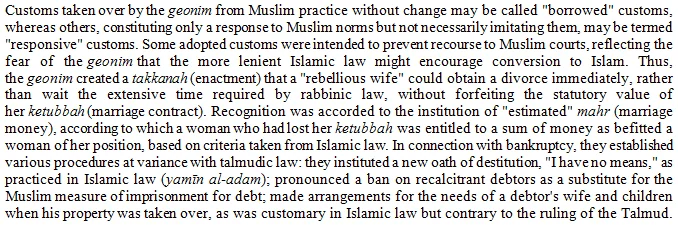
Numerous examples of Muslim influence can be found in the field of commercial law:44

The institution of the “anonymous ban’’ serves as an example of a “responsive custom’’:45

Without a doubt, Islamic law made its way into geonic Halakhah. Libson asserts that a careful study of Muslim legal literature reveals its influence in monographs (specialized scholarly works devoted to a single subject) written by the geonim on practical legal topics—such as abutters’ rights and suretyship, which receive only limited attention in the Talmud—as well as on family law and matters of personal status.46

Similar connections can be seen in R. Samuel ben Ḥofni’s treatise on suretyship and hiring (Kitāb aḍ-Ḍamān wa-l-Kafālah), much of whose content—along with its overall structure and chapter divisions—draws from parallel Muslim legal literature or from the prevailing practices of the surrounding society.47
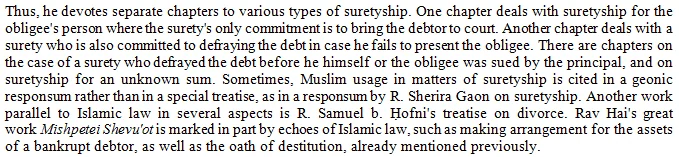
Libson observes that connections with Islamic law may also be found in the field of uṣūl al-fiqh (the foundational principles of Islamic jurisprudence), particularly in the writings of R. Saadiah Gaon (Saʿīd ibn Yūsuf al-Fayyūmī) and R. Samuel ben Ḥofni.48
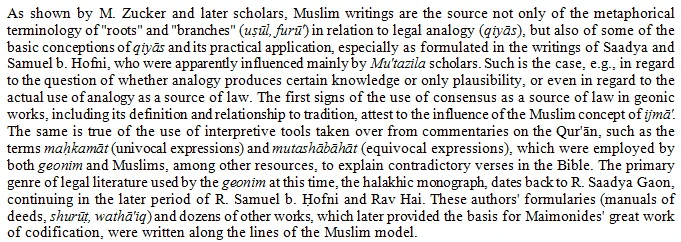
Libson further notes that even after the geonic period, though less frequently, traces of Muslim influence can still be found. For example, elements of Islamic legal thought appear in the works of R. Joseph ibn Migash and R. Isaac al-Fāsī, both of whom employed concepts drawn from the Muslim intellectual world, such as jawhar and ʿaraḍ (substance and accident), in discussions of obligations related to tangibles (physical property) and intangibles (non-physical rights or benefits). At times, al-Fāsī also incorporated Islamic legal terms—such as naẓar, dalīl, and istidlāl—into his Talmudic discourse.49 Maimonides shows Islamic influence more frequently in his choice of wording, in legal formulas, in methods of interpretation—such as tāʾwīl (allegorical interpretation), ẓāhir (the outward or literal meaning), and bāṭin (the inner or hidden meaning)—as well as in actual laws and legal institutions.50

Libson highlights that familiarity with Islamic law is also evident in the writings of Abraham ben Maimon (the son of Maimonides), where its influence can at times be discerned.51

Libson notes that Abraham ben Maimon was influenced by Islamic practice in certain synagogue procedures, including ablution, prostration, and seating arrangements. He further observes that later Spanish rabbinical authorities—such as R. Asher ben Jehiel, R. Solomon ben Adret, R. Simeon ben Ẓemaḥ Duran, and R. Solomon ben Simeon Duran—also display isolated instances of the influence of Islamic law:52
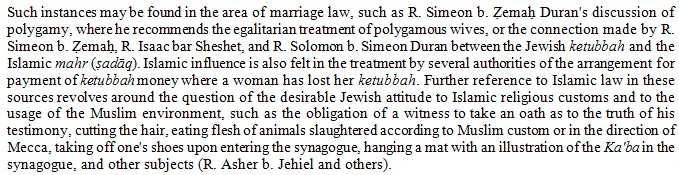
In short, the geonim drew upon works written in Arabic by the fuqahāʾ (experts in Islamic jurisprudence) and adopted their legal terminology, using it as a contemporary framework for legal composition. Indeed, the flourishing legal literature of the geonic period was, in Libson’s words, made possible by Muslim legal writings—which the geonim adopted as models for composing halakhic monographs—and by the Muslim authorities, who granted their non-Muslim protected subjects (ḏimmīs), including the Jews, a measure of legal autonomy, thereby spurring the development of an extensive halakhic literature in a contemporary legal form.
In summary, the influence of Islam on Judaism is undeniable, whereas the reverse claim—that Islam was influenced by Judaism—is unfounded, for Islam by its very nature cannot be shaped by any prior religion. Islam does not leave room for adopting the traditions or practices of earlier Messengers and Prophets, and it strongly condemns innovations introduced in the name of religion as misguidance. As the Prophet (PBUH) said: “The best of speech is the Book of Allah, and the best of guidance is the guidance of Muḥammad, and the worst of matters are those newly invented, and every innovation is misguidance...”53 Hence, one of Islam’s most remarkable features is its firm rejection of innovations in religion. The Prophet (PBUH) said: “Whoever introduces into our matter (religion) that which does not belong to it, it will be rejected.”54 This ḥadīth, according to scholars, is considered one of the pillars of Islam, for the remarkable principle of rejecting religious innovation ensures that the core teachings and practices of Islam remain unchanged and preserved, just as they were during the time of the Prophet Muhammad (PBUH), maintaining the authenticity and purity of the religion. Throughout the centuries, Muslim scholars have diligently worked to maintain Islam in its original, perfected form from the first century of Hijrah, eliminating any innovations or deviations. The Messenger of Allāh (PBUH) said: “This knowledge will be carried by the trustworthy of every successive generation, refuting the corruption of extremists, the distortions of falsifiers, and the misinterpretations of the ignorant.”55 Indeed, Islam is a perfect and complete religion, destined to remain intact throughout the ages. While there are some similarities between the Qurʾān and the Bible, such resemblances do not imply borrowing. Rather, they reflect a common source—the Creator of mankind—and the continuity of His fundamental message of monotheism. Only naïve or poorly informed Muslims—those unaware of the historical context and nature of the Torah, and, more importantly, unfamiliar with the unique and inimitable Qurʾān—might accept the mistaken claim that Prophet Muḥammad (PBUH) created Islam by copying Judaism. For even a casual but impartial comparison makes clear the stark difference between the fallible, human-authored texts of the Bible and the flawless, divinely preserved Qurʾān.
Notes and References
- 1
{Do you claim that Abraham, Ishmael, Isaac, Jacob, and his descendants were all Jews or Christians?” Say, “Who is more knowledgeable: you or Allāh?” Who does more wrong than those who hide the testimony they received from Allāh? And Allāh is never unaware of what you do} (Qurʾān 2:140); {O People of the Book! Why do you argue about Abraham, while the Torah and the Gospel were not revealed until long after him? Do you not understand?} (Qurʾān 3:65).
- 2
{Indeed, We created the heavens and the earth and everything in between in six Days, and We were not ˹even˺ touched with fatigue} (Qurʾān 50:38).
- 3
{The Jews say, “Ezra is the son of Allāh,” while the Christians say, “The Messiah is the son of Allāh.” Such are their baseless assertions, only parroting the words of earlier disbelievers. May Allāh condemn them! How can they be deluded ˹from the truth˺?} (Qurʾān 9:30); {Indeed, those who say, “Allāh is the Messiah, son of Mary,” have fallen into disbelief. Say, ˹O Prophet,˺ “Who has the power to prevent Allāh if He chose to destroy the Messiah, son of Mary, his mother, and everyone in the world all together?” To Allāh ˹alone˺ belongs the kingdom of the heavens and the earth and everything in between. He creates whatever He wills. And Allāh is Most Capable of everything} (Qurʾān 5:17).
- 4
{Those who say, “Allāh is the Messiah, son of Mary,” have certainly fallen into disbelief. The Messiah ˹himself˺ said, “O Children of Israel! Worship Allāh—my Lord and your Lord.” Whoever associates others with Allāh ˹in worship˺ will surely be forbidden Paradise by Allāh. Their home will be the Fire. And the wrongdoers will have no helpers. Those who say, “Allāh is one in a Trinity,” have certainly fallen into disbelief. There is only One God. If they do not stop saying this, those who disbelieve among them will be afflicted with a painful punishment} (Qurʾān 5:72–73).
- 5
{Say, ˹O Prophet,˺ “O People of the Book! Let us come to common terms: that we will worship none but Allāh, associate none with Him, nor take one another as lords instead of Allāh.” But if they turn away, then say, “Bear witness that we have submitted ˹to Allāh alone˺”} (Qurʾān 3:64).
- 6
{They ˹instead˺ followed the magic promoted by the devils during the reign of Solomon. Never did Solomon disbelieve, rather the devils disbelieved. They taught magic to the people, along with what had been revealed to the two angels, Hārūt and Mārūt, in Babylon. The two angels never taught anyone without saying, “We are only a test ˹for you˺, so do not abandon ˹your˺ faith.” Yet people learned ˹magic˺ that caused a rift ˹even˺ between husband and wife; although their magic could not harm anyone except by Allāh’s Will. They learned what harmed them and did not benefit them—although they already knew that whoever buys into magic would have no share in the Hereafter. Miserable indeed was the price for which they sold their souls, if only they knew!} (Qurʾān 2:102).
- 7
{Surely the first House ˹of worship˺ established for humanity is the one at Bakkah—a blessed sanctuary and a guide for ˹all˺ people} (Qurʾān 3:96).
- 8
{All food was lawful for the children of Israel, except what Israel made unlawful for himself before the Torah was revealed. Say, ˹O Prophet,˺ “Bring the Torah and read it, if your claims are true”} (Qurʾān 3:93).
- 9
Al-ʾAmīr Bahāʾ, Tafsīr al-Qurʾān bi-s-Siryāniyyah, (Cairo, Egypt: Dār al-Kutub al-Maṣriyyah, 2017), p. 133.
- 10
José Martínez-Delgado, “Ibn Janāḥ, Jonah (Abū ʾl-Walīd Marwān)” in Norman A. Stillman et al., Encyclopedia of Jews in the Islamic World, vol. 2, D–I, (Leiden, Netherlands; Boston, U.S.: Brill, 2010), p. 501.
- 11
Shimeon Brisman, A History and Guide to Judaic Dictionaries and Concordances, part 1, (Cincinnati, U.S.: Hebrew Union College Press, 2000), p. 12.
- 12
Ibid.
- 13
José Martínez-Delgado, “Ibn Janāḥ, Jonah (Abū ʾl-Walīd Marwān)” in Norman A. Stillman et al., Encyclopedia of Jews in the Islamic World, vol. 2, D–I, (Leiden, Netherlands; Boston, U.S.: Brill, 2010), p. 501.
- 14
Dan Becker, “Linguistic Rules and Definitions in Ibn Janāḥ's “Kitāb Al-Lumaʿ (Sefer Ha-Riqmah)” Copied from the Arab Grammarians,” The Jewish Quarterly Review, vol. 86, issue 3, 1996, p. 277. DOI: https://doi.org/10.2307/1454908.
- 15
José Martínez-Delgado, “Ibn Janāḥ, Jonah (Abū ʾl-Walīd Marwān)” in Norman A. Stillman et al., Encyclopedia of Jews in the Islamic World, vol. 2, D–I, (Leiden and Boston: Brill, 2010), pp. 501–502
- 16
Ibid.
- 17
Ibid.
- 18
Eliyahu Ashtor, The Jews of Moslem Spain, (Philadelphia, U.S.: Jewish Publication Society, 1984), vol. III, p. 27.
- 19
Zion Zohar, Sephardic and Mizrahi Jewry: from the Golden Age of Spain to the Modern Age, (New York, U.S.: New York University Press, 2005), p. 46.
- 20
Saʿadia ben Joseph, Kitāb Uṣūl ash-Shiʿr al-ʿIbranī, (Jerusalem, Occupied Palestine: ha-Aḳademyah la-lashon ha-ʻIvrit, 1969).
- 21
Nehemiah Allony, The Egron: The Book of the Principles of Hebrew Poetry by Rav Sa’adyah Gaon [Sefer ha’egron: kitab usul al-shi˓r al-˓ibranime’et rav sa’adyah gaon] (Jerusalem, Occupied Palestine: The Academy of the Hebrew Language, 1969), pp.156-9 as cited in Dodie Lee Weinberg, “Saadia Gaon and Medieval Arabic and Hebrew Language Study in Baghdad,” 3 March 2022, p. 9, https://s29068.pcdn.co/wp-content/uploads/weinberg-dodie-lee-mph-paper.pdf.
- 22
Saadia Gaon, The Book of Beliefs and Opinions, trans. Samuel Rosenblatt, (New Haven, U.S.: Yale University Press, 1948).
- 23
Nleo Giosuè Palmer, “How Medieval Islam Influenced Modern Judaism,” The Jerusalem Post, 7 March 2016, https://www.jpost.com/blogs/the-thousand-year-view/how-medieval-islam-influenced-modern-judaism-447071.
- 24
Irene E. Zwiep, “The Hebrew Linguistic Tradition of the Middle Ages,” Histoire Épistémologie Langage, vol. 18, issue 1, 1996, pp. 41–61, DOI: https://doi.org/10.3406/hel.1996.2448.
- 25
ʿAbd ar-Razzāk Aḥmad Qindīl, al-ʾAthar al-Islāmī fī al-Fikr ad-Dīnī al-Yahūdī, (Damascus, Syria: Dār al-Fikr, 1987), p. 426.
- 26
Ibid., p. 436.
- 27
Jewish Treats, “Rav Saadia Gaon,” NJOP, 27 May 2022, https://njop.org/rav-saadia-gaon-2/.
- 28
“Jewish Commentators — Their Lives and Works: Saadia ben Joseph,” Etz Hayim, last updated 20 Jan. 2021, https://www.etz-hayim.com/commentators/commentator.php?id=saadia-ben-joseph.
- 29
Mark L. Solomon, “The Influence of Islam on Judaism,” p. 1, accessed 27 Apr. 2023, https://www.ed.ac.uk/sites/default/files/atoms/files//influence_of_islam_on_judaism.pdf.
- 30
Haseeb Shehadeh, “The Influence of Arabic on Modern Hebrew” in Christian-Bernard et al., Études sémitiques et samaritaines offertes à Jean Margain, (Paris, France: Zèbre, 1998), pp. 61–62.
- 31
Ibid., p. 58.
- 32
Ibid., p. 59.
- 33
Another name for the Jewish tabernacle, built as a place of worship for the people of Israel during their forty-year journey through the wilderness after leaving Egypt.
- 34
Berakhot 14:2.
- 35
R. Simeon Kayyara and R. Ezriel, Halachoth Gedoloth: nach dem Texte der Handschrift der Vaticana (הלכות גדולות: על פי כתב יד רומי), (Berlin, Germany: דפוס צבי הירש איטצקאווסקי, 1888), p. 35.
- 36
Wieder Naphtali, Islamic Influences on the Jewish Worship, (Oxford, U.K.: East and West Library, 1947), trans. Muhammad Salem al-Jarḥ, (Cairo, Egypt: Markaz ad-Dirāssāt ash-Sharqiyyah, 2001), p. 60.
- 37
Imran Ahsan Niazi, “The Karaites: Influence of Islamic Law on Jewish Law,” Islamic Studies, vol. 32, no. 2, 1993, pp. 137–47, JSTOR, accessed 27 Apr. 2023, http://www.jstor.org/stable/20840118.
- 38
Jonah ibn Janaḥ (born abū al-Walīd Marwān ibn Janāḥ), Kitāb al-Lumaʿ, trans. and ed. Mūlāy al-Māmūn al-Marīnī, (Marrakech, Morocco: Muʾassassat ʾĀfāq li-d-Dirāssāt wa-n-Nashr wa-l-Ittiṣāl, 2022), in the introduction.
- 39
Wieder Naphtali, Islamic Influences on the Jewish Worship, (Oxford, U.K.: East and West Library, 1947), trans. Muḥammad Sālim al-Jarḥ, (Cairo, Egypt: Markaz ad-Dirāssāt ash-Sharqiyyah, 2001), p. 80.
- 40
Alī ibn Muṣṭafá aṭ-Ṭanṭāwī, al-Bawākīr, (Jaddah, Saudi Arabia: Dār al-Manārah, 2009), p. 782.
- 41
Arthur Stanley Tritton, “Islamic Influences on the Jewish Worship. By N. Wieder. Pp. 102. Oxford: East and West Library, 1947. 12s. 6d,” Journal of the Royal Asiatic Society, vol. 80, no. 1–2, 1948, pp. 94–94. DOI: https://doi.org/10.1017/S0035869X00101984.
- 42
Geonim (sing. Gaon): The formal title given to the heads of the great Talmudic academies of Sura and Pumbedita in Babylonia. From the late 6th century until the mid-11th century, the Geonim were regarded by Jews throughout the diaspora as the highest religious and legal authorities. After the close of the geonic era, the title gaon was also applied to the heads of academies in Baghdad, Damascus, and Egypt, and in later usage it became an honorific designation for any rabbi or scholar of exceptional Torah knowledge.
- 43
“Jewish and Islamic Law: A Comparative Review,” Encyclopaedia Judaica, updated 21 Feb. 2024, https://www.encyclopedia.com/religion/encyclopedias-almanacs-transcripts-and-maps/jewish-and-islamic-law-comparative-review.
- 44
Ibid.
- 45
Ibid.
- 46
Ibid.
- 47
Ibid.
- 48
Ibid.
- 49
Ibid.
- 50
Ibid.
- 51
Ibid.
- 52
Ibid.
- 53
Abū ʿAbd ar-Raḥmān an-Nasāʾī, Sunan an-Nasāʾī, (Aleppo, Syria: Maktab al-Maṭbūʿāt al-Islāmiyyah, 1986), book: 19, ḥadīth: 23, available at: https://sunnah.com/nasai:1578.
- 54
Agreed upon ḥadīth, Muḥammad al-Bukhārī, Ṣaḥīḥ al-Bukhārī, (Cairo, Egypt: Dār as-Salām. 1999), book: 53, ḥadīth: 7, available at: https://sunnah.com/bukhari:2697; Muslim ibn al-Ḥajjāj, Ṣaḥīḥ Muslim, (Bayrūt, Lebanon: Dār al-Kutub ʿIlmiyyah, 2020), book: 30, ḥadīth: 23, available at: https://sunnah.com/muslim:1718a.
- 55
Narrated by Aḥmad ibn Ḥanbal with a ṣaḥīḥ sanad (an authentic chain of transmission) in ʿAlī ibn al-Ḥasan ibn ʿAsākir, Tārīkh Dimashq, (Bayrūt, Lebanon: Dār al-Kutub al-ʿIlmiyyah, 2012), vol. 7, p. 39.