Why did Prophet Muḥammad (PBUH) marry multiple women?
The enemies of Islam often accuse Prophet Muḥammad (PBUH) of practicing and promoting unjust treatment of women, labeling him “a self-indulgent libertine’’ and “a repelling womanizer.’’ However, the many biographies written about him (PBUH) and the well-authenticated accounts of his sayings and actions make it clear that he (PBUH) led an exceptionally disciplined life, founded on chastity and self-restraint from the very beginning, and that his marriages were among the many responsibilities he bore as Allāh’s final Messenger. It is recorded that even before he was called to his Prophetic mission, the Prophet (PBUH) enjoyed a reputation for perfect purity, modesty, and integrity, never once entering the brothels that were common in Makkah during his youth. Indeed, his avoidance of immoral behavior is remarkable not only because of the cultural environment in which he (PBUH) lived but also given the harsh climate of Makkah at the time and the fact that he was still young—factors that would most probably have led others into vice. As is well known, the Prophet (PBUH) acquired enemies as soon as he was called to Prophethood. These enemies did not hesitate to spread false accusations against him, yet not once did any of them dare to fabricate something that no one would have found believable, such as what the contemporary enemies of Islam accuse him of—namely, being an unbridled libertine and a womanizer. Rather, they were compelled to acknowledge that they could not find a single flaw in his moral character. As a matter of fact, the Sharīʿah that he (PBUH) brought included stringent measures to uphold morality, such as prescribing severe punishments for fornicators and adulterers, commanding believers to lower their gaze from non-maḥrams (i.e., individuals with whom marriage is permissible, as opposed to maḥrams, with whom marriage is forbidden), and prohibiting seclusion as well as even a handshake with non-maḥrams. The Prophet (PBUH) himself did not even shake hands with women who were outside his permissible circle, despite the fact that pledges of allegiance were traditionally made both verbally and through a handshake. ʿĀʾishah [may Allāh be pleased with her] narrated: “By Allah, his hand never touched the hand of any woman during the pledge of allegiance; he would take their pledge only by oral declaration.”1
The following facts reveal the absurdity, baselessness, and vileness of the charges laid against the Prophet (PBUH) by Islam’s enemies:
•The Prophet (PBUH) first married at the age of twenty-five. Although in the prime of his life, he married Khadījah, a woman significantly his senior (fifteen years older) who had children from two previous marriages.
•From age 25 to 50, he remained faithful to only one wife, Khadījah. She passed away when he was fifty, and he continued to love her deeply until his death, often speaking of their life together with great nostalgia.
•Between the ages of 50 and 60, he married his other wives for a variety of noble reasons, while mourning Khadījah’s loss and caring for his daughters.
•Around the age of 60, Allāh revealed a verse forbidding him from marrying any more women, and he did not take any additional wives until his death at the age of 63.2
It is indeed preposterous to suggest that the Prophet (PBUH) suddenly became lustful at the age of fifty—an age when sexual desire and interest in marriage are generally diminished in most men, especially considering that he was largely away from home, occupied with his numerous duties as a Prophet, while constantly traveling and dealing with hostile enemies. Therefore, the allegation that his marriages after this age were motivated by licentiousness or self-indulgence is as vile and indecent as it is utterly false. The truth of the matter is that the Prophet (PBUH) married women who were not haphazardly “acquired” for carnal reasons, as his detractors claim, but were carefully selected. Let us examine the biographies of the Prophet (PBUH)’s wives in the order of their marriages, so as to shed light on the circumstances and noble motives behind each of the Prophet (PBUH)’s marriages:
Khadījah: She was the first of the Prophet (PBUH)’s wives. She had been married twice before to two Arab noblemen, each of whom had children with her and left her widowed. She rejected all proposals from the many Qurayshi men who sought her hand in marriage. Her interest in the Prophet (PBUH) was sparked by what she heard from her servant Maysarah about his exemplary conduct in managing her trade and the substantial profits he earned while leading a caravan on a business journey to the Levant. She sent an intermediary to him to express her interest indirectly. At the time of their marriage, she was forty years old and he (PBUH) was twenty-five. He loved her deeply and did not marry any other woman during her lifetime. They lived together in profound harmony for twenty-five years. Even after her death, he (PBUH) never forgot her, frequently speaking of her virtues and merits.
Sawdah: The first woman the Prophet (PBUH) married following the death of the noble Khadījah was a sixty-nine-year-old widow. Sawdah and her husband were among the earliest reverts to Islam and had been forced to flee to Abyssinia to escape the persecution of the Quraysh idolaters. When her husband passed away while in refuge, Sawdah was left in complete destitution. Accordingly, the Prophet (PBUH) married her as a means of providing care and support.
ʿĀʾishah: She was the only virgin the Prophet (PBUH) married and the daughter of Abū Bakr, his closest friend and devoted supporter. By marrying her, the Prophet (PBUH) conferred the highest honour on a man who had shared with him both the trials and triumphs of his mission. ʿĀʾishah also possessed the intelligence and temperament to carry forward the Prophetic mission, being remarkably wise and capable. She became one of the Prophet’s foremost disciples, and her marriage served as the means through which she was prepared to teach and guide the entire Muslim ummah (nation). Her life and services to Islam after her marriage demonstrate her worthiness as the Prophet’s wife: she became a leading authority on Ḥadīth, an excellent commentator on the Qurʾān, and a knowledgeable expert in Islamic law. Thanks to her young, intelligent, and receptive mind, she preserved the knowledge she gained during seven years of marriage for forty-seven years after the Prophet (PBUH)’s passing, teaching thousands of Muslims their religion as she had learned it directly from him. This enduring legacy is surely why the Prophet (PBUH) was told in his dream that he would marry her.3
Ḥafṣah: She was the daughter of ʿUmar ibn al-Khaṭṭāb, the second Caliph of Islam. She had lost her husband, who died from wounds sustained in battle in the cause of Allāh, and remained without a husband for some time. Like Abū Bakr, ʿUmar also desired the honour and blessing of being close to the Prophet (PBUH) in this world and the Hereafter. Accordingly, the Prophet (PBUH) married Ḥafṣah to protect and support the daughter of his faithful companion.
Zaynab bint Khuzaymah: She was also a widow when the Prophet (PBUH) married her. Before this, she had been married to his paternal cousin, ʿAbd Allāh ibn Jaḥsh, who was martyred at the Battle of Uḥud, leaving her without support. The Prophet (PBUH), renowned for his exemplary kindness toward his near relatives, personally proposed marriage to Zaynab, and upon her consent, married her. Their union, however, was short-lived, as she passed away a few months later.
Umm Salamah: She was first married to her cousin. The couple had embraced Islam in its earliest days and migrated to Abyssinia to escape the persecution of the Quraysh. After returning from Abyssinia, they, along with their four children, migrated to al-Madīnah. Her husband took part in many battles and was severely wounded at the Battle of Uḥud, from which he later died. Abū Bakr and ʿUmar, aware of Umm Salamah’s hardship as a widow with children and no means of support, proposed marriage to her, but she declined, believing that no one could be better than her late husband. After some time, the Prophet (PBUH) offered to marry her, and she accepted. Like ʿĀʾishah, Umm Salamah was intelligent and quick in comprehension, possessing the qualities and abilities to serve as a teacher and guide for the Muslim ummah. Thus, when the Prophet (PBUH) married her, a new student—one to whom the entire Muslim ummah would remain grateful—was welcomed into the school of Prophetic knowledge and guidance. Indeed, the fact that the Prophet (PBUH), who was then approaching the age of sixty, married a widow with several children, assuming all the responsibilities and burdens that entailed, stands as clear proof of the boundless depth of his compassion and humanity.
Zaynab bint Jaḥsh: She was a lady of noble birth and a close relative of the Prophet (PBUH). When he (PBUH) sought her hand on behalf of Zayd, she and her family were initially reluctant, as they had hoped she would marry the Prophet (PBUH) himself. However, out of love and deference to the Prophet (PBUH) and his authority, they consented when they realized it was his wish that Zaynab marry Zayd. Thus, the marriage took place. Zayd had been a slave belonging to Khadījah, who gave him to the Prophet (PBUH) at the time of her marriage to him. The Prophet (PBUH) immediately freed Zayd and soon afterward adopted him as his son. He (PBUH) encouraged the marriage between Zayd and Zaynab to establish the principle of equality among Muslims and to abolish the deep-rooted Arab prejudice against a slave or freedman marrying a free-born woman. In doing so, the Prophet (PBUH) began this difficult reform with his own relatives. However, the marriage brought happiness to neither Zaynab nor Zayd. Though both deeply loved and obeyed the Prophet (PBUH), their marriage proved unsustainable due to mutual incompatibility. Zayd, unable to endure the situation, expressed his desire to divorce several times, but the Prophet (PBUH) urged him to remain with Zaynab and to persevere with patience. Eventually, the Prophet (PBUH) received divine revelation declaring his own marriage to Zaynab as a bond already decreed by Allāh: {We gave her to you in marriage} (Qurʾān 33:37).4 Indeed, this command was among the severest trials the Prophet (PBUH) faced, for he was ordered to do something contrary to the deeply rooted traditions of his people—a cultural taboo—yet he fulfilled it solely for the sake of Allāh, as He had commanded. ʿĀʾishah later said, “If the Messenger of Allāh (PBUH) were to conceal anything [that had been revealed to him], he would have concealed this [verse].”5 Divine wisdom decreed that Zaynab, a distinguished and noble woman, should be joined to the household of the Prophet (PBUH) so as to provide her with knowledge and prepare her for the task of guiding and enlightening the Muslims. In the jāhiliyyah (the period of ignorance before Islam), an adopted son was regarded as a biological son, and an adopted son’s wife was thus considered as a biological son’s wife. The pagan taboo against marrying the former wives of adopted sons was deeply entrenched. Hence, the Prophet (PBUH)’s marriage to Zaynab was commanded by Allāh to abolish this custom. The Qurʾān clarified that the former wives of biological sons are included among the women to whom marriage is permanently forbidden for a man, but this prohibition does not extend to the former wives of adopted sons, with whom there is no real consanguinity (i.e., who are not related by blood). In other words, the Qurʾān affirmed that only blood relationships determine marriage prohibitions, rescuing the Arabs from their mistaken belief based on custom rather than reality. Indeed, the breaking of this taboo had to be accomplished through the Prophet’s own example in order to provide an authoritative precedent for future generations of Muslims. This acceptance of the divine decree by the Prophet (PBUH), in defiance of the entrenched custom of his people forbidding the marriage to former wives of adopted sons is yet another demonstration of the depth of his faith.
Juwayriyah bint al-Ḥārith: She was the daughter of al-Ḥārith, the chief of the defeated Banū al-Muṣṭaliq tribe. Like other members of her family, she was held captive by the Muslims, along with the rest of her tribe, during an expedition in which the Muslims sought to suppress a perceived rebellion. When the spoils were divided, she fell to the lot of a man from among the ʾAnṣār, who agreed to set her free for a certain sum.6 Juwayriyah, deeply troubled by her captivity and the misfortunes of her people, went to the Prophet (PBUH) to plead for his assistance in paying the ransom for her freedom. In his sublime wisdom, the Prophet (PBUH) understood her suffering and knew how to resolve her plight. He therefore agreed to pay her ransom, set her free, and offered to marry her. Juwayriyah gladly accepted this offer. Indeed, her marriage to the Prophet (PBUH) was blessed, for her people—who had been enslaved—regained their freedom when the Muslims realized that the Banū al-Muṣṭaliq were now connected to the Prophet (PBUH) by ties of marriage.7 Moreover, historical accounts suggest that the majority of her tribe, recognizing the honor bestowed upon her, also embraced Islam. Thus, the marriage of the Prophet (PBUH) to one woman brought many of her people into Islam. In short, through his compassionate wisdom and generosity, the Prophet (PBUH) transformed what had been an occasion of enmity and distress into one of friendship and joy.
Umm Ḥabībah: She was the daughter of abū Sufyān, who for a long time had been among the staunchest enemies of Islam. She was one of the earliest reverts to Islam and had migrated to Abyssinia to escape persecution by the idolaters. While there, her husband converted to Christianity, and since she remained a Muslim, she separated from him. He died shortly afterward, leaving her alone and heartbroken in refuge. At that time, the Companions of the Prophet (PBUH) were few in number and possessed little material wealth to support themselves, let alone others. Thus, Umm Ḥabībah remained alone among people of a different race and faith, burdened by her husband’s apostasy and death. When the Prophet (PBUH) learned of her plight, he sent her a marriage proposal through the king of Abyssinia (Negus)—an action both noble and generous. In this way, Allāh recompensed Umm Ḥabībah for all that she had lost and sacrificed in the path of Islam. She joined the household of the Prophet (PBUH) as his wife and student, and contributed greatly to the moral and spiritual life of the Muslim community. Many learned from her and, in turn, transmitted that knowledge to later generations. Moreover, through this marriage, the powerful family of abū Sufyān became connected to the Prophet (PBUH), which helped soften their stance toward Islam and eventually led many of them to embrace the faith. In fact, this union had a far-reaching influence on the Umayyads, who later ruled the Muslim world for nearly a century. Indeed, the tribe whose members had once been among the fiercest opponents of the Prophet’s mission produced some of Islam’s most devoted, valiant fighters in the path of Allāh, as well as able governors and administrators in the early period.
Ṣafiyyah bint Ḥuyayy ibn Akhṭab: She was the daughter of Ḥuyayy ibn Akhṭab, one of the chieftains of the Jewish tribe of Khaybar. A question often raised by the opponents of Islam is: How did the Prophet (PBUH) marry Ṣafiyyah after she had lost her father, brother, and husband at the hands of Muslims in the Battle of Khaybar, and had herself become a captive? From her earliest years, Ṣafiyyah saw her family and relatives determined in opposition to the Prophet (PBUH). Her father had persuaded the Banū Qurayẓah to break their treaty with him (PBUH). Naturally, such experiences could have nurtured deep indignation against the Muslims in her heart. However, three days before the Prophet (PBUH) arrived at Khaybar, she had seen in a dream a brilliant moon emerging from al-Madīnah, moving toward Khaybar, and falling into her lap. She later said: “When I was captured, I began to hope that my dream would come true.” When she was brought before the Prophet (PBUH) as a captive, he generously set her free and offered her a choice: she could remain a Jew and return to her people, or embrace Islam and become his wife. He said to her: “Among the Jews, your father did not cease in his enmity toward me until Allāh destroyed him.” She replied: “O Allāh’s Messenger! Indeed, Allāh says in His Book, ‘No soul burdened with sin will bear the burden of another.’” The Prophet (PBUH) then said: “Make your choice. If you choose Islam, I will select you for myself; if you choose Judaism, I will set you free and send you to your people.” She said: “O Allāh’s Messenger! Indeed, I had longed for Islam and testified to your truth even before you extended this invitation to me when I came to you. I have no guardian among the Jews—neither father nor brother—and I prefer Islam over disbelief. Allāh and His Messenger are dearer to me than returning to my people.”8 As a result of this marriage, the attitude of many Jews toward the Prophet (PBUH) changed, as they came to see and know him closely.
Maymūnah bint al-Ḥārith: She was the last wife of the Prophet (PBUH). Her family was closely connected to his: one of her sisters was married to al-ʿAbbās and was the mother of ʿAbd Allāh ibn ʿAbbās, the Prophet’s nephew, while her other sister was married to the Prophet’s uncle, Ḥamzah. She was also the half-sister of Zaynab bint Khuzaymah, another wife of the Prophet (PBUH). Towards the latter part of her life, Maymūnah had long desired to marry the Prophet (PBUH). She confided in her sister about this, who in turn spoke to her husband, al-ʿAbbās. The circumstances of her marriage are unique. The Prophet (PBUH) had seen a dream in which he was circumambulating the Kaʿbah. In 628 A.D., he (PBUH) set out with hundreds of his Companions to perform ʿumrah and camped outside Makkah at al-Ḥudaybiyyah. The Quraysh did not permit them to enter and instead signed a peace treaty with the Prophet (PBUH) that contained several conditions—a pivotal agreement intended to end war and maintain regional peace. One condition required the Prophet (PBUH) and his Companions to return to al-Madīnah that year, with permission to perform ʿumrah the following year. During this journey, al-ʿAbbās approached the Prophet (PBUH) and mentioned that his wife’s sister, Maymūnah, was a widow and if it pleased the Prophet, he might marry her. The Prophet (PBUH) accepted, and the wedding ceremony took place thereafter. Maymūnah belonged to a tribe that had been hostile toward the Muslims, and her marriage to the Prophet (PBUH) served to reduce tensions between her tribe and the Muslim community. She was a woman of great knowledge, known to have transmitted many of the Prophetic narrations to the Muslims, and on numerous occasions, she explained their intricacies. Scholars agree that it was after the Prophet’s marriage to Maymūnah that Allāh revealed the verse making it unlawful for him (PBUH) to marry additional women.
It is evident from the foregoing that the Prophet (PBUH)’s marriages were in no way motivated by self-indulgence or lust, for, with the exception of ʿĀʾishah, all his wives were widows or divorcees, and all his marriages after Khadījah were contracted when he was already advanced in age. In fact, by welcoming widows and divorcees into his household and ensuring their dignified sustenance in the absence of other means of support, the Prophet (PBUH) was continuing a practice he had followed since his youth: befriending the friendless, supporting the unsupported, and protecting the unprotected. In other words, in the circumstances faced by these helpless, vulnerable women, there was no more gracious way to address their needs. Therefore, one of the purposes of the Prophet (PBUH)’s marriages was to teach Muslim men to extend their compassion not only to young and beautiful women but, more importantly, to weak and destitute women—widows with orphans, divorcees, and the elderly. Hence, the Prophet (PBUH)—unfailingly just and kind to all his wives, regardless of their age (young or old) or previous marital status (never married, widows, or divorcees), and never showing the slightest discrimination among them—provided a lasting and practical model for Muslim men. Moreover, some of the marriages of the Prophet (PBUH) were intended to train certain uniquely gifted and exceptionally capable women to serve the cause of Islam. Indeed, the wives of the Prophet (PBUH) transmitted Islam to succeeding generations of Muslims as a living legacy, for they carefully preserved the minutest details of the public and private life of a man who was the very embodiment of the Qurʾān. In doing so, they became sources of immense wisdom, gained through their intimate companionship with such a noble and exemplary figure. Allah says: {˹Always˺ remember what is recited in your homes of Allāh’s revelations and ˹Prophetic˺ wisdom} (Qurʾān 33:34). Indeed, the Prophetic teachings, traditions and practices preserved in the keen minds of the Prophet (PBUH)’s wives and Companions constitute a “daily life manual” for Muslims to follow until the end of time. The authentic collections of Prophetic traditions attribute more than three thousand of these traditions to his wives alone. Additionally, the marriages of the Prophet (PBUH) helped strengthen the bonds within the emerging Muslim community. Through these marriages, the Prophet (PBUH) honored with marital ties the men who would become the first leaders of the Muslim nation after him. His closest Companions—two were the fathers of his wives (ʿĀʾishah, daughter of Abū Bakr, and Ḥafṣah, daughter of ʿUmar), and the other two married his daughters (ʿUthmān married Ruqayyah and later Zaynab, and ʿAlī married Fāṭimah)—later became the four Caliphs who led and guided the Muslim community during the critical period following his death. Furthermore, another reason for some of the Prophet (PBUH)’s marriages was to console and honor tribespeople who were enraged (actively hostile to the Muslims) or estranged (defeated and somewhat alienated as captives), thereby fostering a measure of connection and peaceful relations with former enemies, even if full friendship or complete harmony was not immediately achieved. Hence, the multiple marriages of the Prophet (PBUH) were far from acts of self-indulgence. Rather, they served the cause of Islam both during his lifetime and after his passing. M. F. Sahin—a contributor to The Fountain magazine, a bi-monthly publication exploring the intersection of religion, philosophy, science, and social issues from a faith-inspired perspective—offered a thoughtful response to the frequently asked question of how the Prophet (PBUH)’s plurality of marriages aligns with his role as a Prophet.9
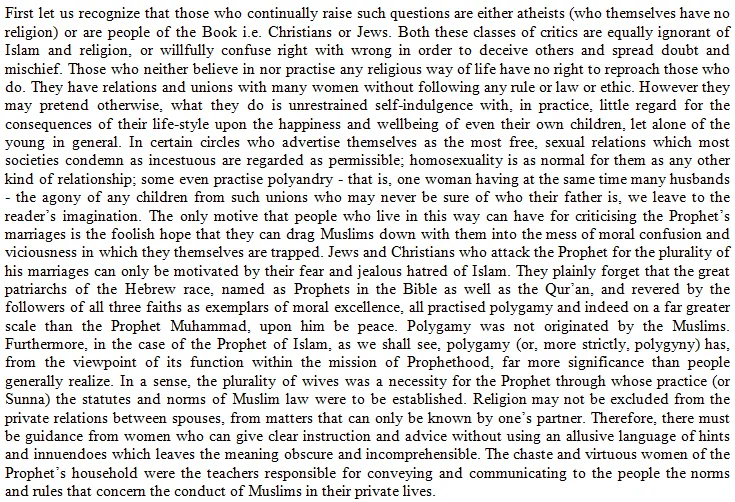
Sahin further explained that some of the Prophet (PBUH)’s marriages were contracted for specific purposes related to his wives:10

In a nutshell, there were various reasons behind the Prophet (PBUH)’s multiple marriages, but even in the private nature of some of these reasons, they all related to his role as the leader of the nascent Muslim community, guiding the Muslims toward the norms and values of Islam. Hence, the allegation that the Prophet (PBUH) was a sensualist or a man driven by lust is both false and disgraceful, for if there were any truth to it, he could not have lived the exemplary life we know. In short, Muḥammad the man—who needed a loving wife, children, and a stable home—married Khadījah and remained with her for twenty-five years until her death, whereas Muḥammad the Prophet married other women for reasons tied to his duty to convey the Divine Message to the world.
Notes and References
- 1
Agreed upon ḥadīth, Muḥammad al-Bukhārī, Ṣaḥīḥ al-Bukhārī, (Cairo, Egypt: Dār as-Salām. 1999), book: 54, ḥadīth: 2, available at: https://sunnah.com/bukhari:2713; Muslim ibn al-Ḥajjāj, Ṣaḥīḥ Muslim, (Bayrūt, Lebanon: Dār al-Kutub ʿIlmiyyah, 2020), book: 33, ḥadīth: 130, available at: https://sunnah.com/muslim:1866a.
- 2
{It is not lawful for you ˹O Prophet˺ to marry more women after this, nor can you replace any of your present wives with another, even if her beauty may attract you—except those ˹bondwomen˺ in your possession. And Allāh is ever Watchful over all things} (Qurʾān 33:52).
- 3
Muslim ibn al-Ḥajjāj, Ṣaḥīḥ Muslim, (Bayrūt, Lebanon: Dār al-Kutub ʿIlmiyyah, 2020), book: 44, ḥadīth: 113, available at: https://sunnah.com/muslim:2438a.
ʿĀʾishah narrated that the Messenger of Allāh (PBUH) said, “I was shown you in a dream for three nights. An angel brought you to me in a silk garment, saying, ‘This is your wife.’ I would uncover your face, and lo, it was indeed you. So I said, ‘If this is from Allāh, He will carry it out.’”
- 4
{And ˹remember, O Prophet,˺ when you said to the one for whom Allāh has done a favour and you ˹too˺ have done a favour, “Keep your wife and fear Allāh,” while concealing within yourself what Allāh was going to reveal. And ˹so˺ you were considering the people, whereas Allāh was more worthy of your consideration. So when Zayd totally lost interest in ˹keeping˺ his wife, We gave her to you in marriage, so that there would be no blame on the believers for marrying the ex-wives of their adopted sons after their divorce. And Allāh’s command is totally binding} (Qurʾān 33:37).
- 5
Muḥammad al-Bukhārī, Ṣaḥīḥ al-Bukhārī, (Cairo, Egypt: Dār as-Salām. 1999), book: 97, ḥadīth: 48, available at: https://sunnah.com/bukhari:7420.
- 6
The ʾAnṣār (lit. the Helpers): the native inhabitants of al-Madīnah who welcomed Prophet Muḥammad (PBUH) and his followers—the Muhājirūn (li. the Emigrants)—into their homes and supported them after they migrated from Makkah to escape persecution by the Quraysh.
- 7
Abū Dāwūd as-Sijistānī, Sunan Abī Dāwūd, (Cairo, Egypt: Maktabat al-Maʿārif, 1998), book: 31, ḥadīth: 6, available at: https://sunnah.com/abudawud:3931.
- 8
Abū ʿAbd Allāh Muḥammad ibn Saʿd ibn Manīʿ al-Baṣrī al-Hāshimī, aṭ-Ṭabaqāt al-Kubrá (The Book of the Major Classes), (Bayrūt, Lebanon: Dār al-Kutub al-ʿIlmiyyah, 1990, vol. 8, p. 123.
- 9
M. F. Sahin, “The Reasons Behind the Several Marriages of the Prophet Muhammad, Upon Him Be Peace,” The Fountain, 1 Apr. 1993, https://fountainmagazine.com/1993/issue-2-april-june-1993/the-reasons-behind-the-several-marriages-of-the-prophet-muhammad-upon-him-be-peace.
- 10
Ibid.