Does Islam permit child marriage?
The enemies of Islam often portray Muslims as morally corrupt individuals who marry off young daughters to older men for financial gain. They direct virulent attacks at Prophet Muḥammad (PBUH), whom they falsely accuse of originating this reprehensible practice. However, such claims are entirely baseless, and it would be far more reasonable for their proponents to first examine the shortcomings in their own societies. In reality, while non-Muslim societies frequently set arbitrary minimum marriage ages, Islam requires that marital relations only occur when both parties meet the conditions of biological and psychological maturity. Consequently, Islam protects pre-pubescent children from harm and mitigates the social problems that can arise when individuals are prevented from fulfilling their biological and emotional needs safely and honorably due to an excessively high minimum marriage age. Far from supporting pedophilia or child abuse, Islamic law stipulates that those entering marriage must have reached puberty, possess the necessary cognitive and emotional development to understand their marital rights and responsibilities, and be capable of exercising them. To understand the distinction between puberty and the age of marriage, it should be noted that in Islamic legal terminology, a bāliġ(ah) refers to a person who has reached bulūġ (puberty) and become accountable for their actions, thereby deserving reward or punishment. For a girl, bulūġ is attained upon the onset of menstruation or upon reaching a specific age, which varies between 9 and 13 according to different schools of Islamic jurisprudence. For a boy, bulūġ is attained at the time of his first nocturnal emission (a sexual dream resulting in ejaculation) or upon reaching 15 lunar years. All traditional schools of Islamic jurisprudence considered that once a girl menstruates, she attains sexual maturity and may be married. At the same time, however, they maintain that to acquire full legal capacity and enter contracts, a person must, in addition to bulūġ, attain rushd—the intellectual maturity required to manage one’s property and affairs—which some scholars regard as a prerequisite for a girl’s marriage. This ruling is derived through qiyās (analogical reasoning), with reference to the Qurʾānic verse instructing guardians of orphans to withhold the latter’s inheritance until they reach a marriageable age and possess sound judgment to manage their own property: {Test ˹the competence of˺ the orphans until they reach a marriageable age. Then if you feel they are capable of sound judgment, return their wealth to them} (Qurʾān 4:6). According to this verse, there is a connection between reaching marriageable age and attaining rushd (intellectual maturity). Before reaching rushd, boys and girls are legally considered minors, lacking the capacity to enter contracts or manage their property and affairs. In other words, bulūġ (physical maturity for procreation) alone does not confer the legal capacity to marry. Therefore, fitness for marriage corresponds to the legal capacity to exercise sound judgment. Islam thus stipulates that marriage may only occur between individuals who have matured both physically and intellectually. It distinguishes between reaching puberty and attaining full maturity, at which point a person is capable of understanding marital responsibilities and managing their commitments. The basic requirement in Sharīʿah is that those entering marriage must have not only reached puberty but also possess the intellectual and emotional maturity to recognize and fulfill their marital rights and obligations. Consequently, the appropriate age for marriage is determined by a person’s physical and mental development, with individual maturity serving as the key criterion. Islam prescribes the age of physical maturity because those who have not reached puberty are incapable of exercising informed choice in sexual matters, including expressing personal preference and attraction toward a potential spouse. At the same time, it leaves the age of mental maturity flexible, allowing individuals and their parents to decide, as maturity varies depending on lifestyle, environment, socialization, and other factors. In stark contrast to Islam, modern Western age restrictions on marriage are not grounded in evidence but are often arbitrary, bearing little relation to the biological and social development of the individuals they are intended to safeguard.
Now let us compare the conditions of marriage in Islam with the marriageable age in secular Western systems and consider which approach better safeguards both girls and society at large. One of the Islamic legal requirements for the validity of marriage is the principle expressed in the ḥadīth: “There should be neither harming nor reciprocating harm.”1 This ḥadīth embodies a foundational maxim of Islamic law—that the Sharīʿah neither permits causing harm nor sanctions the return of harm. Accordingly, Islam obligates Muslims to protect themselves and those under their care from any practice that results in harm. In the context of marriage, it is impermissible to marry off any girl for whom marriage would be harmful, regardless of her age. For instance, if a twenty-year-old girl would be harmed by marriage, then marrying her off would still be prohibited. Furthermore, a girl’s consent is an essential condition for a valid marriage contract: once she receives a proposal, the decision to accept or reject it ultimately rests with her, and her guardian has no authority to compel her into a marriage against her will. The Prophet (PBUH) said: “A virgin is not to be married off except after her permission is sought.’’2 That is, a pre-arranged marriage may be annulled if the girl so wishes. A young woman came to the Prophet (PBUH) and said, ‘My father has married me off to his nephew in order to elevate his own status through me.’ The Prophet (PBUH) gave her the authority to decide. She then said, ‘I approve of what my father has done, but I wanted women to know that fathers have no say in the matter.’”3 Hence, a guardian does not have absolute authority to give away his daughter in marriage, and forced marriages are strictly forbidden in Islam, as marriage is fundamentally a contract between two consenting parties. This principle is not a product of modern civil legislation, but rather a divine law that has been in place for over 1,400 years. Since Islam grants women the right to consent to marriage, and the contract is invalid without their consent, it follows that a girl must reach an age at which she is capable of consultation so that her permission can be sought. Clearly, minor girls cannot be expected to possess the necessary experience or intellectual maturity to make an informed choice of husband. At the same time, the guardian’s consent remains essential and indispensable for the validity of the marriage contract. This authority is grounded in the assumption that the guardian acts in the girl’s best interests and is best positioned to ensure her well-being. Accordingly, he will arrange her marriage to a suitable partner at the appropriate age. Additionally, public announcement is obligatory for the validity of the marriage contract under Islamic law. Society has a stake in marriage in the sense that people must know the couple is married, preventing suspicion of an illicit relationship. In other words, Islam requires that marriages be made public so that the marital bond remains clearly distinguished from immoral or unregulated relationships such as fornication and secret affairs. Part of the wisdom behind this obligation is that when marriages are openly announced, men are more likely to help the girls under their guardianship find suitable spouses. Put differently, publicity reduces the likelihood of unsuitable matches and encourages unions that are compatible and stable. It is clear from the foregoing requirements that the avoidance of harm and compatibility are central principles in Islamic marriage. To be direct, Islam does not prescribe a fixed minimum age for marriage; rather, it requires the presence of rushd (maturity). Thus, the appropriate age of marriage for girls is determined by their intellectual and psychological readiness, not by an arbitrary number. It is entirely possible for a girl of fourteen to possess the maturity needed to shoulder the responsibilities of marital and family life, while a woman of thirty may still lack such maturity. Accordingly, setting a universal marriageable age is a trivial matter compared to the substantive requirements laid down by Islamic law—requirements intended to ensure that girls are able to build successful marriages that provide them with economic stability, social dignity, security, and psychological well-being. Undoubtedly, imposing a minimum legal marriage age for girls and invalidating marriages below it serves neither the interests of girls as individuals nor those of society as a whole. It is also noteworthy that in the modern world, children are reaching maturity earlier than previous generations. This is due to improved nutrition, increased interaction between the sexes, expanded educational opportunities, and heightened awareness driven by mass media. Given these developments, raising the legal age of marriage is difficult to justify. In fact, preventing young people—who are physically and mentally ready for married life and experiencing strong sexual urges—from marrying deprives them of a lawful and healthy outlet for their natural impulses, and thereby contributes to the spread of promiscuity and moral corruption in society.
Many traditional Muslim jurists maintained that a father may arrange a marriage for his minor daughter, while others opposed this view. Those jurists who allowed the practice set two conditions. Firstly, they held that only fathers may act as guardians in contracting marriages for their minor daughters; no other guardians are permitted to do so. Ash-Shāfiʿī [may Allāh have mercy on him] stated: “If a guardian other than the father contracts a marriage for a minor girl, the marriage would be void. They (i.e., the girl and her purported husband) do not inherit from each other [in such a case], and there is no divorce on the girl. The ruling for it (i.e., arranged marriage) is the same as that for an-nikāḥ al-fāsid (an invalid marriage lacking one of the conditions for validity) in all of its matters, and neither divorce nor inheritance follow from it.”4 Secondly, Islam does not permit the consummation of child marriages. In other words, the marriage contract alone does not make it permissible to consummate a marriage with a minor girl; rather, the husband must wait until she becomes physically, sexually, and mentally readyfor marriage. This naturally raises the question: why is child marriage permissible if its consummation is not allowed? The permissibility is based on achieving clear and genuine benefits. If the marriage of a minor girl serves a real and tangible interest for her, then her guardian may arrange the marriage; however, if no such interest exists, he has no right to do so while she is still a minor, and must instead wait until she can choose for herself and give consent. Arranging a marriage for a minor girl may be relevant in times of severe hardship and widespread fitnah (trials, tribulations, sedition, and temptation), such as during war or social turmoil. It may also be permissible in cases of extreme poverty when a father cannot adequately provide for his daughter, or when he suffers from a terminal illness and fears that she will be left without support or protection after his death. Additionally, if an exceptionally virtuous and suitable suitor appears and the father believes that his daughter should not miss the opportunity to marry someone who is best for her welfare in this life and the next, arranging the marriage may be justified. Other jurists, however, maintained that neither the father nor any guardian is permitted to arrange a marriage for a minor girl at all. Among them was Shaykh ʿUthaymīn, who said: “The fundamental rule is that this is not permissible, as the Prophet (PBUH) said: ‘A virgin is not to be married off except after her permission is sought.’” Shaykh Ibn ʿUthaymīn also narrated the view of Ibn Shubrumah [may Allāh have mercy on him], one of the well-known jurists, who stated: “It is not permissible to arrange a marriage for a minor girl who has not reached the age of puberty, because if we say that it is subject to her consent, her consent does not count (because she is too young to make such decisions), and when she does reach the age of puberty we believe that she should not be forced into a marriage.” Shaykh Ibn ʿUthaymīn added: “This view is the correct one—that the father should not arrange a marriage for his daughter until she reaches the age of puberty, and when she reaches the age of puberty he should not arrange a marriage unless she gives her consent.”5 As noted earlier, there is no specific and definitive provision in the Qurʾān regarding the age of marriage, but there are relevant non-definitive verses that classical jurists relied upon in formulating their various jurisprudential views on the matter. Allāh says: {Test ˹the competence of˺ the orphans until they reach a marriageable age. Then if you feel they are capable of sound judgment, return their wealth to them} (Qurʾān 4:6). This verse indicates that attaining maturity and sound judgment are necessary preconditions for possessing the personal capacity to marry. It is recorded that Abū Bakr and ʿUmar [may Allāh be pleased with them both] sought the hand of Fāṭimah, the daughter of the Prophet (PBUH), in marriage, and he (PBUH) responded: “She is young.”6 Hence, Islam did not stipulate a fixed minimum age for marriage; rather, it required physical and psychological maturity as well as social maturity (the ability to manage responsibilities, household affairs, and social obligations—essentially being ready for adult roles in family and social life) as prerequisites for the parties to validly solemnize the marital contract.
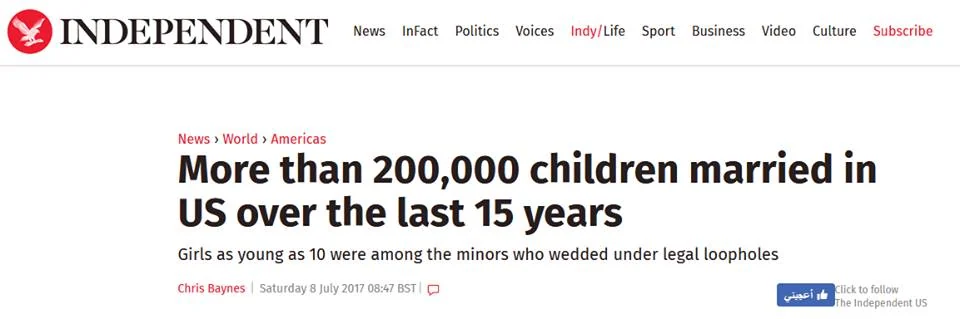
Indeed, the hypocrisy of Islam’s opponents is evident: while they single out Islam in their criticisms, they remain silent regarding non-Muslims who marry prepubescent girls and never accuse them of pedophilia. In other words, they selectively publicize only what suits their narrative. For example, they conveniently ignore data showing that, according to Unchained At Last—a survivor-led nonprofit organization dedicated to ending forced and child marriage in the United States—and Frontline, an investigative documentary program distributed by the Public Broadcasting Service (PBS), at least 207,468 children, some as young as ten, were married in the United States between 2000 and 2015. The actual number is likely much higher, as ten states provided no or incomplete statistics.7
Donna Pollard—the founder of Survivors’ Corner, an organization advocating for survivors of domestic violence, sexual assault, abuse, and exploitation—told CBSN that child marriage is extremely prevalent in the United States.8

The question arises: why is the charge of pedophilia absent from discussions when children are married in the United States today, the vast majority being girls marrying adult men? Similarly, the critics of Islam deliberately ignore the fact that, since 1907, New Hampshire law permitted girls as young as 13 and boys as young as 14 to marry under certain conditions, typically requiring parental and court consent.9

In March 2017, the New Hampshire House rejected a bill that would have raised the minimum legal age of marriage to 18, from the then-current minimums of 14 for males and 13 for females.10

The New Hampshire law was not amended until 2018, and even then the minimum age of marriage was raised only to 16; that is, minors were still legally allowed to marry.11

It was only on January 1, 2025, that a new law (Senate Bill 359) went into effect, raising the minimum age for a valid marriage to 18 for all persons.12 Remarkably, as of July 2025, about 34 U.S. states—most states—continue to allow marriage under the age of 18 under certain exceptions, such as parental consent, judicial approval, pregnancy, or emancipation (a minor legally granted adult rights by a court).13 In some states, there is no statutory minimum age for marriage, meaning that judges or clerks may approve marriage licenses for minors under 18—sometimes even for very young children.14 California reportedly has no minimum age for marriage, provided parental consent and judicial approval are obtained.15 Several states, including Mississippi, New Mexico, and Oklahoma, are among those that have no clear minimum age limit or set very low age thresholds under certain exceptions.16 The bottom line is that, as of 2025, a significant portion of U.S. states legally permit marriages involving minors under certain conditions. What is even more remarkable is that U.S. marriage laws do not require a minor to have reached puberty before marriage or consummation. That is, while they generally set a minimum legal age (sometimes with exceptions), they do not mandate physical, sexual, or psychological maturity. In other words, they focus on parental consent, and/or judicial approval, not biological development. Hence, a prepubescent girl could legally be married in some U.S. states if the legal requirements (age exceptions, parental consent, judicial approval, etc.) are met, regardless of whether she has reached puberty. Will the enemies of Islam level accusations of pedophilia at American adult men who marry minor girls today, some of whom may not even have reached puberty, or are their attacks limited solely to Islam and Muslims? By the same modern standards they apply when judging the practices of seventh-century Arabia, should children not be significantly older and more mature before being allowed to consent to marriage? If so, why do they not subject American marriage laws to the same scrutiny, given that these laws do not stipulate—as Islam does—that puberty is a prerequisite for the consummation of marriage? Additionally, the enemies of Islam have voiced no concerns regarding heinous practices that exist around the world today. For instance, pre-marital sex is legal in many non-Muslim countries, most of which set the minimum age for sexual consent at 14—significantly younger than the age of 18 that secularists in Muslim countries often advocate as the minimum marriageable age—though exceptions exist. Angola and the Philippines, for example, set the age of consent at 12, the lowest in the world.17

The age of consent is 14 in several European countries, including Austria, Italy, Serbia, Germany, and Portugal.18

Likewise, most countries in South America set the age of consent at 14, including Paraguay, Peru, Brazil, Bolivia, and Ecuador.19

Similarly, the age of consent is also 14 in mainland China.20

In 2008, the Tackling Violent Crime Act raised the legal age of sexual consent in Canada from 14 to 16, marking the first increase since 1892.21

Hence, non-Muslim jurisdictions allow children to engage in fornication and set the age of consent at 14—and even 12 in some countries—while atheists and secularists in our Muslim countries seek to prohibit pure and chaste marriage even years beyond these ages. Oddly enough, Western girls are deemed by secular jurisdictions to be legally competent to consent to fornication at the ages mentioned above, whereas atheists and secularists in Muslim countries want to raise the marriageable age for our daughters beyond 18. They want Muslim girls to spend years in failed romantic relationships, committing sins, before attaining a pure and chaste marriage. Indeed, those who follow their lusts wish that the believers would take the horrendous path of deviance instead of Allah’s Path: {and it is Allāh’s Will to turn to you in grace, but those who follow their desires wish to see you deviate entirely ˹from Allāh’s Way˺} (Qurʾān 4:27). The emotions and sexual desires of many young Muslim girls are being strongly stirred by Korean drama series and pop groups—especially BTS—as well as by Turkish drama series. They enter emotional relationships and indulge in sin as a way of releasing that emotional and sexual tension, and, unfortunately, they often end up being emotionally and sexually exploited. Parents are exhausted by the struggle to earn a living and often too overwhelmed to notice the emotional and sexual urges their daughters are experiencing, while the advocates of atheism are calling for raising the legal marriage age for girls. Indeed, if their efforts succeed, they will only deepen the cruel absurdity of the current situation, for if girls are not allowed to get married before the age of 18 or 20, and are left to struggle with their internal feelings, desires, and impulses for the same reason, they become highly susceptible to emotional and psychological problems (such as anxiety, mood swings, and depression), as well as social problems (including illicit unsafe sexual activity, addiction, and delinquency).
Indeed, the position of atheists, raising the shubhah (specious argument) of child marriage in Islam, is utterly bizarre. They once again forget that within their materialistic worldview, there is no logical basis for objective morality or ultimate meaning and purpose. If naturalistic atheism is true, then atheists have no grounds for declaring anything morally right or wrong. Consequently, they cannot explain why the legal minimum age for marriage (18 years) is objectively good, or why child marriage—or even rape—is objectively wrong. All they can do is simply assume these things to be so. The following real example reveals the core of atheists’ dilemma. Some years ago, Ted Bundy—an American serial killer who confessed to over thirty murders—was interviewed about his gruesome activities. Consider the frightening words he addressed to one of his victims:22

This is not to suggest that atheists in general are like Ted Bundy, but the question we pose to them is simple: on what moral grounds can they respond to Bundy’s actions? Indeed, the options available to atheists are limited. If, as they maintain, morality has nothing to do with God, then what does it depend on?23

It is truly astonishing that atheists promote an ideology that allows every act of indecency and provides no objective grounds to condemn any crime, on the pretext that Islam, from their perspective, permits child marriage. As we have stated, if naturalism is true, and humans are merely the product of nature, blind evolution, and genetic determinism, how can genuine moral concerns arise? Indeed, the atheistic worldview offers no foundation for the origin of morality, leaving atheists suspended in a moral grey zone—where there is no absolute standard to judge right from wrong. If they accept the objectivity of morality, they implicitly acknowledge an external standard and source, which is tantamount to accepting God; if they deny an external standard, morality becomes subjective, dependent on human opinion, with potentially disastrous consequences. For example, atheism provides no inherent condemnation of rape, nor any moral basis for a society to prevent or deter it. In an interview with Justin Brierley—the Christian host of the popular radio show and podcast Unbelievable—Richard Dawkins admitted that his reason for why rape is wrong is as arbitrary as the fact that humans evolved to have five fingers rather than six.24 This is where atheism leads! In essence, atheistic evolution not only devalues human life, but also undermines many of the most important areas of human interaction. Sexuality is one domain of human behavior that has been profoundly distorted by the erroneous ideas of evolution and atheism. As atheist Aldous Huxley wrote:25

If one follows Huxley’s argument—assuming that the world was not created by God and that human existence has no ultimate meaning—then one could, in principle, engage in sexual activity with whomever, whenever, and however they choose. In this view, evolutionary atheism grants sexual deviance a blank check, allowing each “naked ape” to act according to their personal impulses. There are numerous examples in which atheists have used evolution to explain and even defend sordid sexual behaviors, including rape, homosexuality, pedophilia, and adultery. Consider the example of rape. Several years ago, operating under the assumptions of naturalistic evolution and aware of the ethical implications, Randy Thornhill (an evolutionary biologist at the University of New Mexico) and Craig T. Palmer (an evolutionary anthropologist at the University of Colorado) co-authored the book A Natural History of Rape: Biological Bases of Sexual Coercion, in which they made the inflammatory claim that, biologically speaking, rape is not a pathology but a natural outcome of Man’s evolutionary imperative to reproduce.26 In other words, rape, under certain circumstances, evolved as a genetically advantageous behavioral adaptation—a strategy for maximizing reproductive success. Simply put, some men may resort to coercion to fulfill the reproductive imperative if roses, chocolate, and candy do not succeed. Thornhill and Palmer stated:27

They concluded that all men are violent, rapacious predators who will act accordingly whenever the necessary environmental conditions arise—conditions that, unsurprisingly, appear at least occasionally in all societies studied to date. Although the authors emphasized that they are neither justifying nor endorsing rape and are merely presenting what they regard as biological facts, their evolutionary premise implies that any trait persisting in a population must offer some survival advantage; otherwise, natural selection would have eliminated it. By this logic, they were compelled to identify some positive function even in the crime of rape. Thus, although Thornhill and Palmer personally reject rape and wish to see it eliminated, their application of naturalistic evolutionary reasoning led them to conclude that, at the deepest level, there is nothing ultimately wrong with it. In essence, by comparing humans with animal species, they framed rape as a natural male strategy for circumventing the selection process:28

Human rape, they argue, arises from men’s evolved mechanisms for securing a larger number of mates in environments where females exercise mate choice.29 Thornhill and Palmer went on to state that:30

Hence, Thornhill and Palmer have even advanced ostensibly “scientific” explanations for why men rape women, proposing, for instance, that exposure to certain heavy metals such as lead may “disrupt psychological adaptations of impulse control,” thereby contributing to a “higher rate of criminality.”31 They asserted that “lead may account for certain cases of rape, just as mutations may.”32 Therefore, rape may simply occur when a male of a species is exposed to excessive amounts of certain heavy metals, such as lead, or when certain mutations are present. Likewise, Sam Harris added:33

Similarly, Joann Rodgers remarked:34

Rodgers further remarked:35

The flaw in this line of reasoning is that it contradicts everything we understand about moral decision-making. Furthermore, it transforms a vicious, morally reprehensible act into something that could occasionally result from mutations or other biological factors, thereby absolving the perpetrator of responsibility. Indeed, such so-called “scientific” explanations for immoral behavior are absolutely abominable. Essentially, Thornhill, Palmer, Harris, and Rodgers have effectively shown that, from the standpoint of naturalistic evolution, no human action can be considered ultimately wrong. Rather, every action is viewed as morally equivalent—that is, neither inherently right nor wrong—since all behavior is understood as a by-product of evolutionary processes. In fact, Darwin himself remarked:36

Hence, if a man follows his impulse to rape a woman, atheists cannot claim it is inherently wrong, because once all behavioral tendencies are reduced to inexorable genetic mechanisms, humans are no more responsible for their actions than an ATM is when it fails to dispense the money one tries to withdraw. Ethics cannot be derived from mechanics, and the obvious evolutionary default then becomes simply “might makes right.” In short, the assumption of naturalistic evolution carries grave ethical implications. As noted above, atheists have no objective grounds to declare rape absolutely and morally wrong; when they do condemn it, it is crucial to recognize that they are merely expressing personal preferences framed as morality borrowed from the theistic worldview.
Indeed, sexual perversion and promiscuity are a direct and logical implication of atheistic evolution. Moreover, sexual laxity is one of the primary aims of the atheistic community. For example, in his God Is Not Great: How Religion Poisons Everything, Christopher Hitchens repeatedly argued that biblical sexual purity and monogamous fidelity are not only undesirable but actually destructive. Among his four irreducible objections to religious faith, he included that faith “is both the result and cause of dangerous sexual repression.”37 Hitchens stated: “Clearly, the human species is designed to experiment with sex.”38 He concluded his book with a plea to abolish all religions so that no sexual restrictions would impede unregulated sexual experimentation:39

It is abundantly clear from Hitchens’ writings that one of his main purposes for rejecting God is to allow himself—and those who embrace his atheistic views—to “experiment” sexually like evolved animals, free from any restraints of conscience. Hitchens is certainly not alone in his desire to see atheism drive human sexuality into an unregulated realm of experimental promiscuity. Militant atheist Sam Harris has likewise attempted to explain to Christians that sexuality is totally unrelated to morality:40

Harris went on to remark that “any God who could concern Himself with something as trivial as gay marriage…is not as inscrutable as all that.”41 Other atheists have carried the banner of sexual anarchy into areas such as pornography. David Mills, for instance, extrapolated from his atheistic philosophy that pornography is both harmless and morally neutral:42

Mills brazenly asserted that “senseless religious moralizing” is responsible for pornography ever being stigmatized as immoral:43

No doubt, this assertion is demonstrably false, for numerous studies show that, among other deleterious effects, viewing pornography “can lead to anti-social behavior,” “desensitizes people to rape as a criminal offense,” and “leads men and women to experience conflict, suffering, and sexual dissatisfaction.”44 According to one study of rapists, half of those surveyed “used pornography to arouse themselves immediately prior to seeking out a victim.”45 Moreover, heavy exposure to pornography “encourages a desire for increasingly deviant materials which involve violence, like sadomasochism and rape.”46 Hence, atheists such as Mills, Hitchens, Harris, and many of their peers are striving to strip away all moral “regulations” from human sexuality. Evidently, atheism justifies sexual conduct of any kind, and those atheists who understand this point are demanding the abolition of all societal regulations on sex. Joann Rodgers appropriately summarized this point:47

According to atheistic Darwinism, the universe and human beings have no ultimate purpose, and there is no rational basis for claiming that human beings possess a dignity superior to anything else in nature, for evolution has no direction or purpose—it simply happens. As Chet Raymo stated:48

Therefore, we are simply one among many species that have evolved with differing survival strategies. If we believe otherwise, it is only because we resemble the gnat that, according to Friedrich Nietzsche, “floats through the air… imagines itself the flying centre of the world.”49 Likewise, Francis Fukuyama asserted: “Today everybody talks about human dignity, but there is no consensus as to why people possess it… In the end, why does humanity have more dignity than any part of the natural world, from the most humble rock to the most distant star? Why should insects, bacteria, intestinal parasites, and HIV viruses not have rights equal to those of human beings?”50

Similarly, in 1995, Stephen Hawking declared on the TV show Reality on the Rocks: Beyond Our Ken that:51

The point is that, from the atheistic perspective, there is nothing unique or special about human beings that grants them inherent worth and dignity. Theists, by contrast, believe that humans possess dignity because they are created by God in a special category, with a hierarchy over animals that are made to serve their interests. In other words, human beings’ transcendent worth and value derive solely from God; they do not originate in the material world. Consequently, atheists cannot claim that we are unique among creatures. From the atheistic outlook on humans and life, what renders rape, murder, genocide, and other heinous crimes against humanity wrong? Indeed, according to naturalistic evolution, all crimes are either mere biological malfunctions caused by mutations or biological, evolutionary by-products passed down to humans from some mammalian precursor. Hence, atheism undermines all moral absolutes, and everything becomes, in principle, permissible if God does not exist, as John Paul Sartre aptly commented: “Everything is indeed permitted if God does not exist, and man is in consequence forlorn, for he cannot find anything to depend upon either within or outside himself.”52 Arthur Allen Leff—a professor of law at Yale Law School, best known for a series of articles examining whether normative law or morality exists—asserted that there is no way, using logic, to prove that any particular act, no matter how horrible, is normatively wrong. In other words, one can never demonstrate to another person that a particular set of behaviors is right or that a different set is wrong. Leff stated:53

Indeed, a philosophy or society that eradicates the concept of God severs its capacity to make moral judgments and forfeits the ability to eliminate actions such as rape, theft, murder, or any other immoral vice. Consequently, atheists who identify as humanists, who speak of moral values and human dignity, and who make moral decisions, are dishonest about the implications of their worldview. This is because they inherently recognize that humans are honoured above all creatures, that they are accountable, and that some actions are objectively wrong. In other words, God instilled morality in all humans, and their awareness of certain actions as inherently wrong and others as inherently right is a God-given gift.54 Hence, modern atheists live in a conflict between the philosophical and psychological realities of their atheism and their innate disposition to love and prefer goodness, and to hate evil and strive to avert it. When they attempt to be moral, they, in truth, draw their standards from the theistic worldview. In short, atheism degrades humanity and inevitably leads to moral decay in society because it destroys objective moral values. Atheists have no foundation for making absolute moral statements, for according to their worldview, material reality is all that exists and there is no spiritual dimension whatsoever. Yet there exists an innate, universal moral compass shared by all humans, the basis upon which courts were established and penal laws formulated. In conclusion, atheists have no basis to question child marriage, rape, murder, or any other immoral vice or reprehensible crime, for objective morality is impossible without belief in God—without God, ethical judgments and condemnation of evil become impossible. In other words, our sense of ultimate value cannot be accounted for under atheism: no God means no value. Hence, religion is not an intellectual luxury but an innate and indispensable necessity for humans to possess inherent dignity, recognize value, and make absolute ethical judgments. Ibn Taymiyyah said: “This whole world is cursed, and so is everything in it, except for that upon which the sun of the Message (the divine religion) shines. Man’s need for this Message is greater than his need for anything else.”55 Najīb Maḥfūẓ, the most outstanding Egyptian novelist of the modern era who spent a long period of his life in skepticism, said: “It is Allāh alone who gives values their meaning. It is Allāh alone who gives existence its meaning. Without Him, existence is meaningless, and values are meaningless. And the alternative to belief in Him is absurdity and meaninglessness.”56 Indeed, humans inherently need Allāh and cannot dispense with religion. How can atheists criticize religion on the basis of a shubhah (specious argument) regarding a matter—such as child marriage—when they cannot even condemn it based on their own worldview? Fundamentally, by arguing for a belief in or knowledge of morality without providing a justification for it, atheists conflate moral epistemology (moral knowledge) with moral ontology (the foundational existence of morality). Lacking any grounding for their moral positions, their moral views amount to nothing more than subjective opinions.
Let us return to our initial question concerning child marriage in Islam. It is important to understand that marriage in Islam is an ethical safeguard and a social responsibility. Accordingly, like every other responsibility in Islam, it is encouraged only for those who are capable of fulfilling its duties. As explained earlier, Islam did not set a fixed age for marriage; rather, it established a more sensible criterion of physical, mental, and sexual readiness for both males and females. According to the Qurʾān, reaching maturity is the appropriate stage for marriage. However, it is not appropriate to fix a specific age, since individuals do not attain maturity at the same time, and circumstances may sometimes arise in which marrying off a minor girl before the commonly prescribed age is in her interest. Ultimately, an individual’s personal level of maturity and readiness is what determines the proper age for marriage, regardless of whether one has reached the legal marriage age or not. Thus, the ideal time for a Muslim girl to marry is only when she is physically, intellectually, and emotionally prepared to fulfill the marriage responsibilities that Islam places upon her. It is worth noting that although Islam does not provide a definite marriage age for either men or women, it recommends considering marriage at a young age, as marriage protects from sin during youth. However, early marriage does not imply that the spouses may be immature or irresponsible. Dr. Muḥammad Saʿīd Ḥawwā, professor of Sharīʿah at the University of Muʾtah in Jordan, states:57

In addition to an individual’s maturity, marriage also depends on the norms of the society in which one resides. Indeed, jurists who interpret the Sharīʿah and its application across different times and places established long ago that ʿurf (culture and customs) carries significant weight. Hence, it is unwise to ignore geographical and regional conditions and norms, just as it is unwise to neglect the needs of contemporary youth, for such negligence may lead to numerous problems. I will conclude my response to the child-marriage shubhah (specious argument) with an interesting fact: it is highly significant that secular Western countries have the highest rape rates in the world. These are the statistics for the year 2020.58

As we have explained, the philosophy underlying the theory of naturalistic evolution fails to provide a foundation for ethics, and the denial of a divine, ultimate standard of morality leaves atheists in hopeless confusion about how actions such as rape should be viewed. Those among them who are honest with the implications of their theory may say that they “do not like” rape or that they “think” it is best that rape be eradicated, yet they have no grounds on which to claim that it is absolutely, morally wrong. In stark contrast, the concept of God is the only rational basis for an ultimate moral standard. Indeed, every person and society that embraces the notion that God does not exist becomes corrupt—atheism inevitably leads to moral corruption. Numerous academic studies have demonstrated that communities with high numbers of religious adherents have lower crime rates, and other studies have likewise found that more religious individuals are less likely to be involved in criminal behavior. This is because religion provides believers with a set of moral values that makes them less likely to engage in crime. Again, while the philosophy of naturalistic evolution cannot provide a foundation for ethics, the concept of God offers the perfect rationale on which to base moral determinations. In simple terms, there is a God who sees both the evil and good deeds of humans and will call every human to account for their actions.59 Rape, among other crimes, is a sinful, morally reprehensible offense against both humanity and God, committed by individuals who have chosen to ignore and violate His moral standard.
Notes and References
- 1
Yaḥyá ibn Scharaf an-Nawawī, al-ʾArbaʿūn an-Nawawiyyah, (Cairo, Egypt: Dār as-Salām, 2007), ḥadīth:32, available at: https://sunnah.com/nawawi40:32.
- 2
Muḥammad al-Bukhārī, Ṣaḥīḥ al-Bukhārī, (Cairo, Egypt: Dār as-Salām. 1999), book: 67, ḥadīth: 72, available at: https://sunnah.com/bukhari:5136.
- 3
Abū ʿAbd Allāh ibn Mājah, Sunan Ibn Mājah, (Cairo, Egypt: Dār at-Taʾṣīl. 2014), book: 9, ḥadīth: 30, available at: https://sunnah.com/ibnmajah:1874.
- 4
Abū ʿAbd Allāh ash-Shāfiʿī, Kitāb al-Umm, (Bayrūt, Lebanon: Dār al-Maʿrifah, 1990), vol. 5, p. 18.
- 5
Muḥammad ibn Ṣāliḥ ʿUthaymīn, ash-Sharḥ al-Mumtiʿ, (ad-Dammām, Saudi Arabia: Dār Ibn al-Jawzī, 2002), vol. 12, pp. 57–59.
- 6
Muḥammad ibn Ḥibbān, Ṣaḥīḥ Ibn Ḥibbān, (Bayrūt, Lebanon: Muʾassassat ar-Risālah, 1988), ḥadīth: 6948.
- 7
Chris Baynes, “More than 200,000 Children Married in US over the Last 15 Years,” Independent, 28 Aug. 2018, https://www.independent.co.uk/news/world/americas/200-000-children-married-us-15-years-child-marriage-child-brides-new-jersey-chris-christie-a7830266.html.
- 8
Nicole Brown Chau, “Child marriage is "extremely prevalent" in U.S.: "The cycle perpetuates across generations",” CBS News, 30 June 2020, https://www.cbsnews.com/news/child-marriage-united-states-donna-pollard/.
- 9
“2010 New Hampshire Statutes TITLE XLIII DOMESTIC RELATIONS CHAPTER 457 MARRIAGES Section 457:4 Marriageable,” Justia US Law, accessed 15 June 2023, https://law.justia.com/codes/new-hampshire/2010/titlexliii/chapter457/section457-4/.
- 10
“Minimum Age of Marriage in N.H. Remains 13 For Women, 14 For Men,” New Hampshire Public Radio, 10 March 2017, https://www.nhpr.org/politics/2017-03-10/minimum-age-of-marriage-in-n-h-remains-13-for-women-14-for-men.
- 11
Ethan Dewitt, “House Passes Bill to Raise Minimum Marriage Age to 18, Sending It to Governor,” New Hampshire Bulletin, 2 May 2024, https://newhampshirebulletin.com/2024/05/02/house-passes-bill-to-raise-minimum-marriage-age-to-18-sending-it-to-governor/.
- 12
“New Hampshire Senate Bill 359,” LegiScan, accessed 30 Nov. 2025, https://legiscan.com/NH/text/SB359/id/2864563.
- 13
Wikipedia Contributors, “Child Marriage in the United States,” Wikipedia: The Free Encyclopedia, last edited 18 Nov. 2025, https://en.wikipedia.org/wiki/Child_marriage_in_the_United_States.
- 14
Madeleine Roberts, “Legal Marriage Age,” MOST Policy Initiative, 21 Jan. 2025, https://mostpolicyinitiative.org/science-note/legal-marriage-age/.
- 15
“U.S. Child Marriage Laws: Individual State Legislation,” Freedom United, updated March 2025 https://www.freedomunited.org/u-s-child-mariage-laws-individual-state-legislation/.
- 16
“What Are the Minimum Marriage Ages in Each US State in 2025?” Factually, 25 Oct. 2025, https://factually.co/fact-checks/society/us-state-minimum-marriage-ages-2025-510486?utm.
- 17
“Age of Consent by Country 2023,” World Population Review, accessed 17 June 2023, https://worldpopulationreview.com/country-rankings/age-of-consent-by-country.
- 18
Ibid.
- 19
Ibid.
- 20
Ibid.
- 21
Ibid.
- 22
A statement by Ted Bundy, paraphrased and rewritten by Harry V. Jaffa, Homosexuality and the National Law, (Claremont, U.S.: Claremont Institute of the Study of Statesmanship and Political Philosophy, 1990), pp. 3–4 as cited in Chad Meister, “Atheists and the Quest for Objective Morality,” The Christian Research Institute, updated on: 26 Aug. 2022, https://www.equip.org/articles/atheists-and-the-quest-for-objective-morality/.
- 23
Chad Meister, “Atheists and the Quest for Objective Morality,” The Christian Research Institute, updated on: 26 Aug. 2022, https://www.equip.org/articles/atheists-and-the-quest-for-objective-morality/.
- 24
“Richard Dawkins Interviewed by Justin Brierley,” YouTube, uploaded by キリストは主である, 21 Aug. 2013, https://www.youtube.com/watch?v=NZ6t7Lqrdvc&t=360s, [5:59-6:13].
- 25
Aldous Huxley, Ends and Means, (London, U.K.: Chatto & Windus, 1937), pp. 270, 273.
- 26
Randy Thornhill and Craig Palmar, A Natural History of Rape, (Cambridge, U.S.: MIT Press, 2000).
- 27
Ibid.
- 28
Ibid., p. 53.
- 29
Ibid., p. 190.
- 30
Ibid., p. 55.
- 31
Ibid., p. 58.
- 32
Ibid.
- 33
Sam Harris, Letter to a Christian Nation, (New York, U.S.: Alfred A. Knopf, 2006), pp. 90–91.
- 34
Joann Rodgers, Sex: A Natural History, (New York, U.S.: Henry Holt, 2001), p. 412.
- 35
Ibid., p. 11.
- 36
Charles Darwin, The Autobiography of Charles Darwin, (New York, U.S.: W.W. Norton, 1958), p. 94.
- 37
Christopher Hitchens, God is Not Great: How Religion Poisons Everything, (New York, U.S.: Twelve Books, 2007), p. 4.
- 38
Ibid., p. 54.
- 39
Ibid., p. 283.
- 40
Sam Harris, Letter to a Christian Nation, (New York, U.S.: Alfred A. Knopf, 2006), p. 26.
- 41
Ibid., p. 55.
- 42
David Mills, Atheist Universe, (Berkeley, U.S.: Ulysses Press, 2006), p. 197.
- 43
Ibid., p. 198.
- 44
Jay Rogers, “The Documented Effects of Pornography,” The Forerunner, vol. X, no. VI, Sep. 1990, https://www.forerunner.com/forerunner/X0388_Effects_of_Pornograp.
- 45
Ibid.
- 46
Ibid.
- 47
Joann Rodgers, Sex: A Natural History, (New York, U.S.: Henry Holt, 2001), pp. 40–41.
- 48
Raymo Chet, Skeptics and True Believers, (New York, U.S.: Walker Books, 1998), p. 222.
- 49
Friedrich Nietzsche, On Truth and Lie in an Extra-Moral Sense, trans. A. K. M. Adam, (Oxford, U.K.: Quadriga, 2019), pp. 1–2, available at: https://archive.org/details/NietzscheOnTruthAndLie/page/n1/mode/2up.
In some remote corner of the universe which opens out and twinkles in innumerable solar systems, there was once a star upon which clever animals invented knowledge. It was the most arrogant and untruthful minute in world history; but it was only a minute. After Nature had drawn several breaths, it chilled the star, and the clever animals had to die. One could invent such a fable and still not have illustrated sufficiently how miserable, how insubstantial and ephemeral, how pointless and arbitrary the human intellect appears next to Nature. There were eternities in which it did not exist; when it is all over with again, nothing will have happened. Because there is no further mission which leads beyond human life for any intellect. Rather, it is human, and only its owner and producer so pathetically takes it as if the world rotates around it. If, however, we and the gnat could understand one another, we would perceive that even the gnat floats through the air with the same pathos and imagines itself the flying centre of the world. Nothing in Nature is so reprehensible and small that it will not, through a little puff of that power of knowledge, immediately swell up like a balloon; and as every porter wants to have his admirers, so the most vain human being—the philosopher—supposes that he sees the eyes of the universe telescopically directed at his behaviour and thoughts from all sides.
- 50
Francis Fukuyama, The End of History and the Last Man, (New York, U.S.: The Free Press, 1992), pp. 296–298, (emphasis added), available at: https://archive.org/details/TheEndOfHistoryAndTheLastMan/page/n1/mode/2up.
- 51
As quoted in Raymond Tallis, “You Chemical Scum, You,” Philosophy Now, accessed 10 Oct. 2025, https://philosophynow.org/issues/89/You_Chemical_Scum_You.
- 52
Jean Paul Sartre, “Existentialism and Humanism,” in Leonard M. Marsak, French Philosophers from Descartes to Sartre, (New York, U.S.: Meridian, 1961), p. 485.
- 53
Arthur Allen Leff, “Economic Analysis of Law: Some Realism about Nominalism,” Virginia Law Review, vol. 60, no. 3, 1974, pp. 451–82, JSTOR, https://doi.org/10.2307/1072437.
- 54
{And by the soul and ˹the One˺ Who fashioned it, then with ˹the knowledge of˺ right and wrong inspired it!} (Qurʾān 91:7–8).
- 55
Aḥmad ibn ʿAbd al-Ḥalīm ibn Taymiyyah, Majmūʿ al-Fatāwá, (al-Madīnah al-Munawwarah, Saudi Arabia: King Fahd Complex for the Printing of the Noble Qurʾān, 2004), vol. 19, p. 101.
- 56
Najīb Maḥfūẓ, My Country Egypt, (Cairo, Egypt: Dār ash-Shurūq, 1997), p. 63.
- 57
“Islam’s Stand on Early Marriages,” Islam Online, accessed 19 June 2023, https://fiqh.islamonline.net/en/islams-stand-on-early-marriages/.
- 58
Ejaz Khan, “Top 10 Countries with the Highest Rape Crime in the World,” Wonders List, accessed 19 June 2023, https://www.wonderslist.com/10-countries-highest-rape-crime/.
- 59
{Tell ˹them, O Prophet˺, “Do as you will. Your deeds will be observed by Allāh, His Messenger, and the believers. And you will be returned to the Knower of the seen and unseen, then He will inform you of what you used to do”} (Qurʾān 9:105).