Conclusion
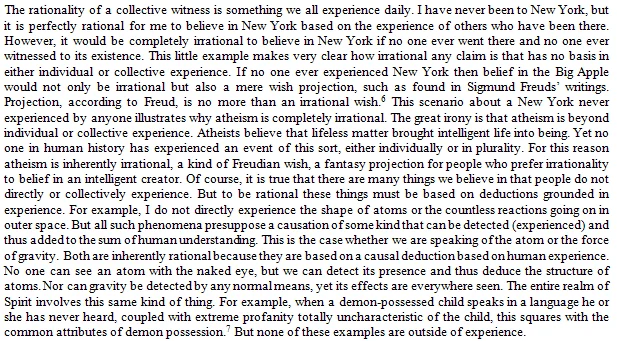
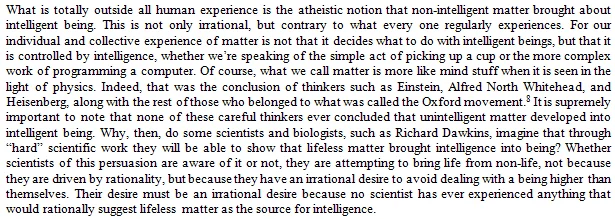
Atheism is a peculiar position. Atheists habitually declare that atheism is based on facts and reason, whereas belief in Allāh is based solely on faith and is therefore the enemy of reason. In fact, however, atheism is itself always the product of an irrational, blind faith. Experience is the one essential ingredient that any claim truly grounded in reason must contain, yet it is entirely absent from atheism, thus making it inherently irrational. To use Ron Galloway’s words, a New York that no one has ever experienced and a universe in which non-intelligence brings intelligence into being are bedfellows:1
Hence, atheism is not based on reasoned arguments. Rather, atheists go against the axioms of reason. For instance, they go against the axiom of causality—the proposition that everything in the universe has a cause and is therefore an effect of that cause. In their search to understand the basic building blocks of existence, scientists are encountering ever greater complexity and precision rather than ever greater simplicity. This naturally leads rationally thinking human beings to seek the intelligence behind such complexity. This is why, as previously mentioned, Anthony Flew, one of the West’s most influential atheists, ultimately acknowledged the irrationality of atheism and the rationality of belief in a higher being. As Flew conceded, the complexity of the laws and processes of the universe requires a Lawgiver. Moreover, atheists reject the self-evident truth that we live in a perfect universe. Indeed, if the universe were not perfect, it could not exist for a single moment. Doubtlessly, Allāh is Perfect, and a Perfect Cause must produce a perfect effect. That is, the greatness of the universe is clear evidence of the existence of the Self-Sufficient Creator, who is in need of none, but of Whom all are in need: {Allāh—the Sustainer ˹needed by all˺} (Qurʾān 112:2). Furthermore, atheists put forward many irrational notions, such as the notion that good and evil are merely fictional. Statements such as “there is no such thing as right or wrong” directly contradict humanity’s collective experience. Try as we might, human beings cannot dismiss from their laws, their courts, or their individual lives the reality of good and evil, right and wrong. These must have been embedded in our understanding by an Intelligent Designer—Allāh. This is the only possible explanation for why atheists often cry out against injustice. Indeed, they cannot refrain from pontificating about right and wrong, even while denying the existence of both. Indubitably, this obvious irrationality stems from their initial irrationality in believing that lifeless matter could bring intelligence into being.
Unfortunately, atheists fail to acknowledge that atheism is based on blind faith. Indeed, they cannot maintain their faith in atheism unless they turn a blind eye to logic. Additionally, they turn a blind eye to the innumerable proofs of Muḥammad’s Prophethood, which also expose the weakness of their reasoning. Nevertheless, atheists insist that their atheism is the product of rational thinking. To explain that evidence and logic—rather than supernatural belief and dogma—underpin their thinking, they argue that they do not believe in God but in science instead. However, simply believing in evidence-based scientific research does not mean that their minds work in the same way. Atheists like to claim that people believe in God without evidence, but again, although they present themselves as believers in reason, they have no rational foundation to support their atheism, which is nothing more than an arbitrary, irrational, and groundless blind faith dressed up as reason. That is, atheists maintain that the most reasonable conclusions are those with the strongest evidential support, and they argue that the case for concluding that there is no God is highly compelling, whereas the evidence for God’s existence is too weak. However, rather than making judgments based on scientific reason, atheists are merely wishful thinkers. Nonetheless, they insist that religion is nothing but wishful thinking. They like to blame believers in God for believing in what they describe as “a sugar daddy in the sky who is going to make everything okay one day.” They mock their belief in the afterlife and heaven by saying, “Theists imagine that if they hold on tight for a few years here, they will just go upstairs for the big party when they die.” Inarguably, this facile, childish, and superstitious view of God and religion does not represent true faith, least of all Islamic faith. Faced with the near-universal human belief in an afterlife, atheists look away. Likewise, when faced with the possibility that there may indeed be a final judgment in which they will be held accountable for their deeds, they wholeheartedly deny that such a thing will happen. Time and again, they say, “There is no God. There is no heaven. There is no hell. When we die, we simply cease to exist.” Ironically, this is a profound form of wishful thinking because, if atheists’ wish comes true, they can live as they please and never have to pay the fare—they get a free ride, so to speak. Therefore, it is atheists who truly believe there will be “pie in the sky” when they die, except that their version of it is a happy oblivion. They are simply going to sleep and never wake up. In fact, this is merely their version of the “eternal rest” they accuse believers of wishing for. The possibility of Hell and eternal torment is certainly frightening. Virtually every culture and religion throughout the world, across the ages, has believed in Hell and the possibility of ending up there. Hence, atheists’ thinking is not only more wishful but also dangerously wishful. In a nutshell, atheists portray themselves as rational, sensible, careful, and scientific, but given the possibility that there may indeed be a Heaven, Hell, and final judgment, it is the believers who are, in fact, the sensible ones, simply playing their cards right and staking their lives on a common-sense wager.
It is a well-established fact that belief in God is the default setting for human beings. That is, human beings are naturally predisposed, or wired, to believe in God. Researchers have found that a lack of belief in God is often a reaction rooted more in emotional experiences than in intellectual reasons. That is, many atheists reject God as a result of disappointment, anger, or mistrust directed toward a God they once believed existed, or because they came to conceive of God as cruel or punishing. In other words, such atheists stopped believing in God because something tragic happened in their lives and, in their view, God did not answer an important prayer or rescue them from the consequences of a bad decision. Many others abandon their belief in God as a result of negative experiences with so-called religious people and institutions. That is, they may have been hurt by a religious institution (e.g., the Church) or turned off by “hypocritical” believers. For example, many victims of clergy sexual abuse report lower levels of belief in God. The effects of perceived victimization at the hands of religion may also extend to the societal level. Hence, some atheists spend considerable time and energy combating what they perceive to be the negative influence of religious teachings on society. In a word, most atheists are ruled by their emotions, not reason. Incidentally, leading figures of the New Atheist movement, such as Richard Dawkins and Daniel Dennett, make sweeping statements devoid of historical accuracy, claiming that the European Enlightenment was the formative period during which humanity outgrew belief in God, which is certainly not the case.2
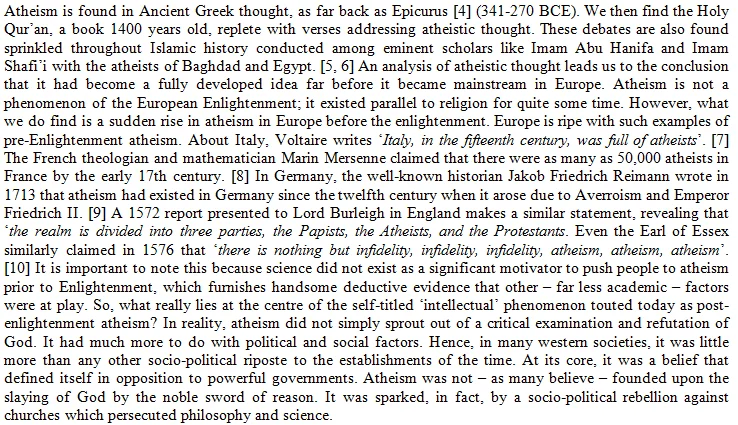
Despite the fact that history is overwhelmingly replete with historians’ testimonies to the contrary, atheists like to claim that atheism emerged from the evolution of scientific thought, whereas, in fact, it began as a concept almost devoid of scientific thought and evolved in opposition to Christian thought. That is, it was a reaction to the actions of Christian churches and, by extension, the policies of the governments under which they operated. It was also an indirect result of Christian skepticism toward science during the Age of Enlightenment. Nick Spencer—Senior Fellow at Theos, the UK’s leading think tank on religion and public life; a Fellow of the International Society for Science and Religion, the leading international society of scholars working at the intersection of science and religion; and a Visiting Research Fellow at the Faiths and Civil Society Unit, Goldsmiths, University of London—wrote:3

Hence, atheists cannot predicate their rejection of God solely on a process of scientific and philosophical enlightenment, for historians have found that much of the atheism of the Age of Enlightenment was a declaration of political frustration. Examples such as France, where “A rigidly authoritarian Catholic ancient regime…created deep wells of moral indignation on which atheists could draw,” stand front and center.4 The bottom line is that atheism was not founded on the concept of reason challenging belief in God. Rather, it was sparked by a rejection of man-made institutions that claimed to be holy. All in all, the history of European atheism is rooted in the actions of groups seeking to dissent from Christian nations—whether Russian Orthodoxy, Catholicism, or Anglican Christianity—in order to secure power, not to reject the Creator of the universe. Therefore, atheists who claim otherwise must forsake their own history in the process, and many conveniently do. Again, the foundation of atheism is not reason but blind faith and unreasonable assumptions, to which atheists give priority over the religious texts. This is what leads them to reject the Lord of the Worlds, His Prophets, His Books, and the Last Day. Atheism is thus the most bizarre position one can adopt. Muḥammad al-Ġazālī [may Allāh have mercy on him], one of the most influential Islamic scholars of the twentieth century, was right when he said that we can imagine a mule building the pyramids, but we cannot imagine what atheists assume when they deny Allāh.
Bearing witness to the existence of Allāh—the Creator, the Provider, the All-Powerful, and the Sole Sovereign King over all that exists—and submitting to Him does not require lengthy discussion, for it does not take many words to speak the truth. Rather, this self-evident truth is at the heart of humanity’s innate disposition. I have elaborated on this subject in this book only as part of a humble endeavor to help cleanse hearts that have become attached to the filth of atheism, and I hope that I have succeeded in doing so. There is no religion on the face of the earth that upholds perfect faith in Allāh and total submission to Him except Islam. Servitude to Allāh is the inescapable state of human existence, and true human greatness lies in embracing it. Hence, although atheists are proud of their achievements, wealth, and social status, they are inwardly disturbed by a growing sense of loss because they fail to embrace their servitude to Allāh. Indeed, atheists’ denial of their servitude to Allāh is tantamount to denying their innate nature, for servitude is the most universal and enduring of all human attributes. We are all born with it, live with it, and will die with it. In short, servitude is the pinnacle of the human experience, the most sublime state to which human beings can aspire, and the summit at which they discover their truest essence. In other words, human beings reach the highest stage of their personal development when they perfect their servitude to Allāh.
Again, human beings are hardwired for religion—born to be servants of Allāh. Therefore, they either choose to believe in and worship their Creator, or they spend their lives trying to come up with justifications for their rejection of Him. In other words, Allāh is the true, lifelong preoccupation of every human being, whether they realize it or not. The proof of this is that even those who declare themselves atheists remain preoccupied with Allāh. They devote so much of their time and energy to denying Him, going to great lengths to justify their position. Atheists may present a thousand arguments to persuade others that they are sincerely convinced of their atheistic creed. However, their own conscience is never unaware of why they persist in it or what, in reality, prevents them from admitting its falsehood. Therefore, when they stand before Allāh in the Hereafter, they will know full well what crime they have committed: {In fact, people will testify against their own souls, despite the excuses they come up with} (Qurʾān 75:14–15). Verily, belief in Allāh is the position most befitting you, O weak human being, for not a single breath leaves your chest except that you are in need of the One Who enables you to take the next, and your heart does not beat once except that you are in need of the One Who grants you the next heartbeat. Indeed, you have an inherent and indispensable need for your Creator.5 The condition of being in absolute and incessant need of Allāh is one of the fundamental states of servitude to Him. Ibn al-Qayyim described it as the very reality and crux of servitude.6 Humans should never labor under the delusion that refusing to acknowledge Allāh as God would somehow diminish Him, or that He would incur any loss if they refused to worship Him. Allāh stands in need of no one. Rather, it is human beings who stand in need of Him. They cannot remain alive for a single moment unless He keeps them alive and provides them with the means by which they live and function in this world. Hence, when we are commanded to worship Allāh, it is not because He stands in need of our worship, but because our success in this world and the Hereafter depends upon it. Anyone who refuses to worship their Lord does not harm Him in the least; rather, they harm only themselves. Allāh says: {O humanity! It is you who stand in need of Allāh, but Allāh ˹alone˺ is the Self-Sufficient, Self-Praiseworthy} (Qurʾān 35:15). The Arabic verse mentions two of Allāh’s Beautiful Names: al-Ġaniyy and al-Ḥamīd:7
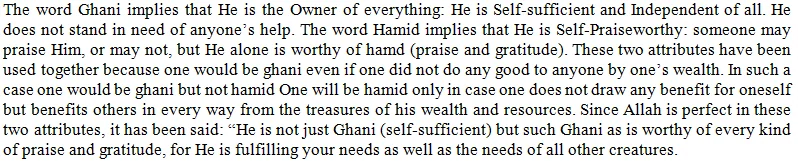
The servants’ incessant need for Allāh requires them to strip their hearts of all whims and desires, to turn to their Lord with the fullness of their being, to humble themselves before Him, to submit to His commands and prohibitions, and to devote their hearts to loving and obeying Him. They can cultivate this sense of neediness—the secret of the heart’s vitality and the foundation of its devotion to its Lord—through two things: realizing the might and power of the Creator and realizing the weakness and incapacity of creation.8
True servants of Allāh feel a continual need for Him in every circumstance. Every believer should strive to cultivate this sense of need for Allāh, for it encourages steadfast adherence to piety and obedience. Allāh loves to see His servants, who have been addressed with His Message, remain true servants whose faith grows as they remain steadfast upon the path of piety and obedience through every trial they face in life. That is, faith is not static; rather, it increases and decreases. From the moment a person embraces Islam until their death, they continue, at every stage of life, to face tests in which they must decide whether they are willing to sacrifice everything dear to their hearts—their wealth, desires, time, comfort, interests, and, if need be, even their life—for the sake of following the divine religion. If, in every such test, the believer chooses the path of sacrifice for Allāh’s sake, their faith increases. If, however, the believer turns away, their faith decreases until the point may come when the initial faith with which they embraced Islam is in danger of being lost altogether. Indeed, those who are too arrogant to become servants of their Creator reject the only One deserving of worship and instead become slaves of this worldly life. Thus, they fail to fulfill the ultimate purpose of all creation—submission to Allāh.
Notes and References
- 1
Ron Galloway, “Why Atheism is Inherently Irrational,” Faith Beyond Belief, 25 Apr. 2019, https://www.faithbeyondbelief.ca/blog/2019/4/25/why-atheism-is-inherently-irrational.
- 2
Tariq Mahmood, “Atheism: A Lesser-Known History,” The Review of Religions, 26 March 2021, https://www.reviewofreligions.org/29756/atheism-a-lesser-known-history/.
- 3
Nick Spencer, Atheists: The Origin of the Species, (London, U.K.: Bloomsbury Continuum, 2014), p. 15 and p. 18.
- 4
Ibid., p. 23.
- 5
Abū al-Fidāʾ ibn Masʿūd, Miʿyār an-Naẓar ʿInda ʾAhl as-Sunnah wa-l-ʾAthar, (Al-Jīzah, Egypt: Sharikat ar-Rawḍah li-n-Nashr wa-t-Tawzīʿ, 2020), vol. 1, p.174.
- 6
Ibn Qayyim al-Jawziyyah, Madārij as-Sālikīn, (Bayrūt: Dār al-Kitāb al-ʿArabī, 1996), vol. 2, p. 439.
- 7
Sayyid Abū al-Aʿlá al-Mawdūdī, Towards Understanding the Qurʾān (English version of Tafhīm al-Qurʾān), trans. and edit. Zafar Isḥāq ʾAnṣārī, (Markfield, U.K.: The Islamic foundation, 1988), Chapter Fāṭir (Qurʾān 35:15), footnote 37, available at: https://www.islamicstudies.info/tafheem.php?sura=35&verse=15&to=18.
- 8
Farid Haibatan, “The Indispensable Need for Allah: Our Basis for Servitude,” Islam21C.com, 19 Nov. 2009, https://www.islam21c.com/spirituality/246-the-indispensable-need-for-allah-our-basis-for-servitude/.