What are the manifestations of submission to Allāh? In other words, how can you know whether you are truly submitting to Allāh?
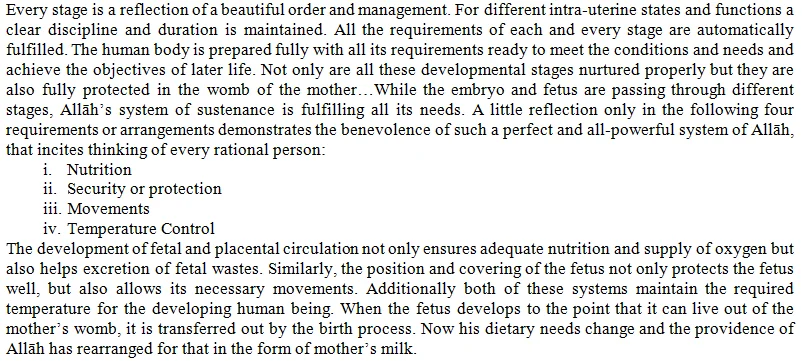
The essence of worship is servitude to Allāh, which is a state of complete submission and humility toward Him. True worshippers of Allāh submit to their Creator and Master out of love for Him. That is, one cannot truly worship Allāh while submitting to Him with hatred. To submit completely to the will of Allāh is to surrender to His Lordship and obey Him as an obedient servant obeys a wise master. A servant should obey Allāh in such a way that they neither think about any matter nor perform any act without first thinking of Him before, during, and after it. This requires constant remembrance of Allāh and His commands, leaving no room for disobedience. Allāh says: {Whoever fully submits themselves to Allāh and is a good-doer, they have certainly grasped the firmest hand-hold} (Qurʾān 31:22). We surrender to Allah because He is our Sustainer and the One who bestows immense favors upon us. There are countless signs and manifestations of Allāh’s providence and benevolence at every stage of human development, beginning in the womb, when the fetus has neither power nor strength except through Allāh. As Muhammad Tahir-ul-Qadri—a contemporary Islamic scholar—put it:1
Sustaining all creation is among the manifestations of Allāh’s Lordship. Allāh alone is the Creator of everything and the sole Provider of sustenance: {There is no moving creature on earth whose provision is not guaranteed by Allāh} (Qurʾān 11:6). Allāh creates every kind of sustenance and, out of His favor, makes it accessible to all His creatures. That is, He provides every creature with the means to obtain its sustenance. For example, plants cannot move because they are rooted in the ground. Nevertheless, they produce their own food through the process of photosynthesis. Their roots absorb water and minerals from the soil, while their leaves take in a gas called carbon dioxide (CO₂) from the air. Using energy from sunlight, they convert these into food. Indeed, Allāh created the heavens and the earth and all that is between them according to laws that govern their very existence—in due measure and with remarkable balance. Hence, all creation is subservient to Him and remains in constant need of Him, for He did not bring it into existence in mere play and then leave it to itself.
The entire universe is in a state of complete submission to the will of Allāh. In this sense, it can be said that every part of the universe follows the religion of Islam. In the Qurʾān, Allāh asks whether people would choose a religion other than His (Islam), even though they are part of a universe characterized by submission to Him (i.e., Islam): {Do they desire a religion other than Allāh’s—knowing that all those in the heavens and the earth submit to His Will, willingly or unwillingly, and to Him they will ˹all˺ be returned?} (Qurʾān 3:83). The sole reason human beings were sent into this world is to be tested: will they submit to Allāh as the rest of creation does, or will they turn away from Him in arrogance? Submission to Allāh is a state of existence characterized by complete self-surrender to His will. This is the fundamental principle that characterizes the entire universe. Indeed, everything in the universe is in submission to Allāh, whether by choice or by force. Unlike the rest of creation, human beings submit to Allāh willingly, having the freedom and ability to obey Allāh or reject and even rebel against Him. By contrast, the rest of creation submits to Allāh unwillingly, having chosen to remain Allāh’s powerless servants. Unlike human beings, they did not ask for the freedom to disobey Allāh and thereby incur His punishment. Allāh says: {Indeed, We offered the trust to the heavens and the earth and the mountains, but they ˹all˺ declined to bear it, being fearful of it. But humanity assumed it, ˹for˺ they are truly wrongful ˹to themselves˺ and ignorant ˹of the consequences˺} (Qurʾān 33:72). The “trust” mentioned in this verse refers to the immense responsibility of free will and moral accountability. It is the freedom to choose between obedience and disobedience, together with the intellect required to make that choice. The heavens, the earth, and the mountains represent creations that instinctively and naturally submit to Allāh’s will without hesitation. They refused to bear this trust out of fear of the accountability it entails. By contrast, humankind willingly accepted this immense responsibility, making our choice to obey carry great spiritual weight because we also have the ability to disobey. The verse concludes by describing humanity as “wrongful [to themselves]” and “ignorant [of the consequences]” because of the immense responsibility we assumed. If we use our freedom rightly, we attain Allāh’s mercy, but if we misuse it, we face His punishment. In short, every creature submits to Allāh, the Omnipotent and the Most Bountiful, either willingly or unwillingly. None can challenge or resist His dominion over the universe. Allāh states that everything in the heavens and on the earth is His obedient servant.2 So, you too should submit to Allāh and obey Him. Do not let stones, mountains, insects, and animals be better than you in the sight of Allāh. If you submit to Allāh, you will be the best of His creation because, unlike the rest of creation, you will submit to Him willingly. But if you choose not to submit to Allāh, then stones, mountains, insects, and animals will be better than you in the sight of Allāh, for they all submit to Him, albeit unwillingly. They cannot prevent what He decrees for them, nor can they act against His will, or resist His dominion. Do not be the only ungrateful and rebellious being in a universe that has remained in submission to Allāh since its creation.
The manifestations of submission to Allāh, Exalted is He, are four:
Serving Allah in every aspect of one’s life, whether big or small: This is the first manifestation of submission to Allāh. One should not limit worship to the rituals that Allāh has prescribed at specific times—such as prayer, fasting, and pilgrimage—and regard only those times as worship while treating the rest of life as “outside worship.” Rather, one should realize that one’s entire life is an act of worship, and that these rituals are occasions to renew one’s spiritual strength so as to fulfill all the other acts of worship required of them. True submission to Allāh is comprehensive and encompasses every aspect of a Muslim’s life. That is, to attain the lofty status of being a truly submissive servant of Allāh, a Muslim should remember their Lord in whatever they do, in every sphere of life, and continually ask themselves whether they are in a situation that pleases their Lord or incurs His anger. Allāh says: {Say, “Surely my prayer, my sacrifice, my life, and my death are all for Allāh—Lord of all worlds. He has no partner. So I am commanded, and so I am the first to submit”} (Qurʾān 6:162–163). That is, every deed we perform should be done with the desire to attain Allāh’s pleasure and draw nearer to Him. Thus, when we strive in the land seeking provision, we are worshipping Allāh because He has commanded us to do so, as He says: {He is the One Who smoothed out the earth for you, so move about in its regions and eat from His provisions} (Qurʾān 67:15). When we obey our parents, we do so in obedience to Allāh, as He says: {For your Lord has decreed that you worship none but Him. And honour your parents...} (Qurʾān 17:23). When we seek knowledge, we do so to benefit others for the sake of Allāh alone because Islam makes seeking knowledge a religious obligation upon every Muslim. The Prophet (PBUH) said: “Seeking knowledge is an obligation upon every Muslim.”3 Whoever leaves behind beneficial knowledge will continue to receive reward as long as people benefit from it. The Prophet (PBUH) said: “When a person dies, their deeds come to an end except for three: ongoing charity, beneficial knowledge, and a righteous child who prays for them.”4 Likewise, when we sleep, we do so to regain our strength for the worship of Allāh. Muʿāḏ ibn Jabal [may Allāh be pleased with him] said: “…I seek reward for my sleep just as I seek reward for praying qiyām (a voluntary prayer offered during the night).”5 As Muslims, we are not content unless even our pleasure in eating, drinking, and marital intimacy is counted on the scale of our good deeds, as the Prophet (PBUH) said: “…and in the intimacy of one of you there is ṣadaqah (reward).” They (the Companions) said: “O Messenger of Allāh, does one of us satisfy their sexual desire and yet be rewarded for that?” He said: “Tell me, if they were to do it in a ḥarām (unlawful) way, would they not incur sin?” They said: “Yes.” He said: “Likewise, if they do it in a ḥalāl (lawful) way, they will receive a reward.”6 In short, we should turn even the most mundane tasks—working, studying, grocery shopping, and even being intimate with our spouses—into acts of worship. The greatness of Allāh and reverent fear of Him should be constantly present in our hearts in everything we do and say. We should remember Allāh both verbally and inwardly in every circumstance. This is how the Salaf (the first three generations of Muslims—the Companions, the Successors, and the Successors of the Successors) and the Tābiʿūn (those who followed them) understood worship. They were as their Lord described them: {˹They are˺ those who remember Allāh while standing, sitting, and lying on their sides} (Qurʾān 3:191). Hence, the first manifestation of submission to Allāh is maintaining a sense of servitude to Him in every action we take. Only then can we fulfil the purpose for which humankind was created, which the Qurʾān confines entirely to the worship of Allāh: {I did not create jinn and humans except to worship Me} (Qurʾān 51:56).
Adhering to what Allāh has commanded and refraining from what He has prohibited: This is the second manifestation of submission to Allāh. True submission entails complete surrender and obedience. It should characterize us at all times, whether at home or in public, governing our thoughts, feelings, and conduct. Again, submission is an all-encompassing state; it is not confined to acts of ritual worship. Allāh says: {O believers! Obey Allāh and His Messenger and do not turn away from him while you hear ˹his call˺} (Qurʾān 8:20). Allāh demands that humans submit their whole being to His will without reservation. That is, the believer’s beliefs, conduct, and interactions with others should all be completely governed by Islam, for Allāh does not accept dividing human life into separate compartments, some governed by the teachings of Islam and others exempt from them: {O believers! Enter into Islam wholeheartedly} (Qurʾān 2:208). Hence, a true Muslim, to the best of their ability, adheres to all of Allāh’s commandments and refrains from all of His prohibitions.
Surrendering wholeheartedly to all of Allāh’s legislation: This is the third manifestation of submission to Allāh. When we declare our submission to Allāh, we affirm that we worship Him alone without associating partners with Him and obey Him in every matter, whether related to belief, worship, or legislation, for all of these have been ordained by Him, Exalted is He. Many Muslims acknowledge this in principle. However, what many fail to realize is that judging and governing by what Allāh has revealed is one of the most fundamental manifestations of submission to Him: {It is only Allāh Who decides. He has commanded that you worship none but Him. That is the upright faith, but most people do not know} (Qurʾān 12:40). We should understand that Allāh has not granted anyone the authority to legislate—not even angels or Prophets. Indeed, our obedience to Prophet Muḥammad (PBUH) is not for his own sake; rather, we obey him because he faithfully conveyed the revelation of his Lord. Thus, by obeying him (PBUH), we are obeying Allāh. This is why Allāh describes those who do not judge by what He has revealed as disbelievers, wrongdoers, and rebellious sinners.7 These verses explicitly affirm the obligation of judging and governing by Allāh’s Law alone and never accepting any legislation that contradicts it. Whoever knowingly rejects this will inevitably fall into disbelief, transgression, and corruption. Rejecting Allāh’s Law in a seemingly minor matter is no less serious than rejecting it in major matters:8

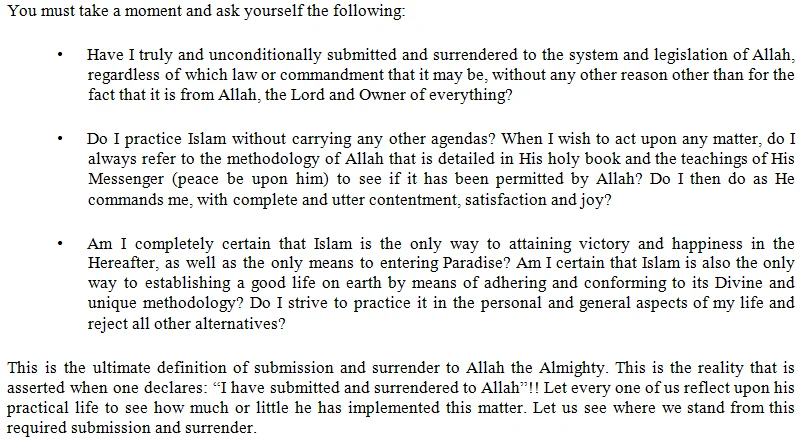
Therefore, claiming to have submitted to Allāh is devoid of truth if you do not understand the true meaning of the Islamic declaration of faith (“There is no god but Allāh, and Muḥammad is His Messenger”) and the obligations it entails. Such a claim also has no value if you do not examine your daily life to ensure that it conforms to this declaration.9
Allāh is the one and only Deity. He alone is the Creator and Owner of all things. He has no partner in creation, nor does anyone share His dominion: {The creation and the command belong to Him ˹alone˺. Blessed is Allāh—Lord of all worlds!} (Qurʾān 7:54). He is the Disposer of all affairs, the All-Knowing, and the All-Aware of His creation. Hence, it is only fitting that He alone has the exclusive right to legislate what is best for His creation:10

Allāh has ordained Islam as the way of life that He approves for humanity. Therefore, His servants are obligated to obey Him in all that He has decreed for them. A true Muslim embraces and implements every aspect of Islamic law and does not reject any part of it. For example, one should not reject the ḥudūd—the fixed penalties that Allāh has prescribed in accordance with His wisdom and as a mercy to His servants. We should never forget that the objective of legislating the ḥudūd is to establish justice and reform both individuals and communities. Moreover, the ḥudūd serve to reform offenders, for they are a means of expiation and purification. Furthermore, they uphold the rights of victims, bring an end to cycles of vengeance, and deter others from following the path of criminality. In short, the ḥudūd serve as both a means of moral instruction for society and a deterrent to potential offenders. After all, Allāh knows what is best for His creation. He says: {How could He not know His Own creation? For He ˹alone˺ is the Most Subtle, All-Aware} (Qurʾān 67:14). He also says: {Who could be a better judge than Allāh} (Qurʾān 5:50).
Allāh rebukes those who claim to believe in what He has revealed to His Messenger (PBUH), yet seek judgment from sources other than His Book and the Sunnah of His Messenger (PBUH): {Have you ˹O Prophet˺ not seen those who claim they believe in what has been revealed to you and what was revealed before you? They seek the judgment of false judges, which they were commanded to reject. And Satan ˹only˺ desires to lead them farther away} (Qurʾān 4:60). It was reported that this verse was revealed concerning a dispute between a man who professed to be a Muslim and a Jew. The Jew said, “Let us refer our dispute to Muḥammad for judgment.” However, the so-called Muslim said, “Let us refer it to Kaʿb ibn al-Ashraf (a Jew).” He did so because he feared that the Messenger (PBUH) would rule against him. Instead, he preferred to seek the judgment of Kaʿb, hoping for a ruling more favorable to him.11 The word Ṭāġūt, translated here as “false judges,” refers to any ruler or legal system that judges by other than what Allāh has revealed, rejecting His sovereignty and the supreme authority of His Book. This verse makes it clear that true faith requires rejecting the authority of Ṭāġūt. Attempting to submit to both Allāh and Ṭāġūt is therefore a form of hypocrisy. A true Muslim would never imitate the hypocrite described in this verse by turning away from the Qurʾān and the Sunnah in favour of false judgment that caters to personal desires. Rather, a believer’s desires are subservient to the Law of Allāh. Allāh sent the Messengers so that people would obey His commands as conveyed through them, rather than follow laws devised by others: {We only sent Messengers to be obeyed by Allāh’s Will} (Qurʾān 4:64). Mere acknowledgment of the Messengers is not enough; they were sent to be obeyed. Hence, Allāh states that no one attains true faith until they seek the judgment of Prophet Muḥammad (PBUH) in all their disputes, accept his decision without inner resistance, and submit wholeheartedly: {But no! By your Lord, they will never be ˹true believers until they accept you ˹O Prophet˺ as the judge in their disputes, and find no resistance within themselves against your decision and submit wholeheartedly} (Qurʾān 4:65). This command was not limited to Prophet Muḥammad (PBUH)’s lifetime. Rather, the divine legislation proclaimed through him (PBUH) remains binding until the Day of Judgment, and recognizing it as the final authority is one of the defining characteristics of true faith. Prophet Muḥammad (PBUH) expressed this principle in the following ḥadīth: “None of you [truly] believes until his desires are subservient to that which I have brought.”12
Submission to Allāh’s Predestination: It is the fourth manifestation of submission to Allah and one of the essential pillars of the Islamic faith. A Muslim must believe that no good or evil, benefit or harm, befalls anyone except by Allāh’s Will and Decree. Without this belief, one’s faith is incomplete. In other words, a believer must be certain that whatever befalls them could never have missed them, and whatever misses them could never have befallen them, for everything occurs according to Allāh’s Will and Decree, as He says: {Verily, We have created all things according to [Our] Predestination} (Qurʾān 54:49). Belief in Allāh’s Predestination stems from the certainty that none can overturn His Decree or reverse His decision: {Allāh decides—none can reverse His decision} (Qurʾān 13:41). The Prophet (PBUH) would often supplicate: “O Allāh! None can withhold what You give, and none can give what You withhold; and the greatness of the great will be of no avail to them against You.”13 Everything is predestined by Allāh, Who does nothing except with perfect wisdom. Once a person realizes this, they must believe in and submit to Allāh’s Predestination, both its good and its bad. If Allāh grants a Muslim abundant provision, a beautiful home, academic success, good health, or a righteous family, they should respond with gratitude. If they are afflicted with illness, poverty, fear, or distress, they should endure patiently and seek help from Allāh. This is the attitude of true believers who submit to their Lord. They recognize that everything—joy and sorrow, strength and weakness, wealth and poverty, health and sickness—is decreed by Allāh. They remain steadfast through the changing circumstances of worldly life, continually remembering Allāh, thanking Him for His blessings, turning to Him in humble submission, and seeking His relief from every hardship. This is beautifully expressed in the following ḥadīth of the Prophet (PBUH): “How wonderful is the case of a believer! Indeed, all of his affairs are good for him, and this applies to no one except the believer. If prosperity befalls him, he expresses gratitude, and that is good for him. If adversity befalls him, he endures it patiently, and that is good for him.”14 Allāh says: {We will certainly test you with a touch of fear and famine and loss of property, life, and crops. Give good news to those who patiently endure—who, when faced with a disaster, say, “Surely to Allāh we belong and to Him we will ˹all˺ return.” They are the ones who will receive Allāh’s blessings and mercy. And it is they who are ˹rightly˺ guided} (Qurʾān 2:155–157). Thus, believers express gratitude for every blessing that Allāh bestows upon them and respond to sickness, hardship, hunger, and every other affliction with submission and patience. They believe that both the good and the bad are from Allāh and depend upon Him in all their affairs. Consequently, they remain content in every circumstance, knowing that everything is under Allāh’s control and decree, as He says: {Say, “Nothing will ever befall us except what Allāh has destined for us} (Qurʾān 9:51). Allah further says: {No soul can ever die without Allāh’s Will at the destined time} (Qurʾān 3:145). Nothing in this universe can escape Allāh’s control. No matter how dark or difficult a situation may be, it remains subject to His Will: {Allāh’s Will always prevails, but most people do not know} (Qurʾān 12:21). Belief in Predestination enables the Muslim to face life’s challenges with contentment rather than anxiety. The heart finds true peace only through submission to Allāh, contentment with His decree, and acceptance of whatever He has ordained, knowing that nothing can occur except by His Will. As the Prophet (PBUH) said: “A servant [of Allāh] does not truly believe until he believes in Predestination, both its good and its bad, and knows that what befell him could not have missed him, and what missed him could not have befallen him.”15 This belief frees the believer from anxiety and despair. The Prophet (PBUH) said: “Among the causes of the son of Adam’s happiness is his contentment with what Allāh has decreed for him, and among the causes of his misery is his discontent with what Allāh has decreed for him.”16 Thus, when faced with the changing circumstances of life, the Muslim remains emotionally balanced, recognizing Allāh’s wisdom in every outcome, whether sweet or bitter: {No calamity ˹or blessing˺ occurs on earth or in yourselves without being ˹written˺ in a Record before We bring it into being. This is certainly easy for Allāh. ˹We let you know this˺ so that you neither grieve over what you have missed nor boast over what He has granted you. For Allāh does not like whoever is arrogant, boastful} (Qurʾān 57:22–23). In brief, those who submit to Allāh believe that the entire universe belongs to Him, and that nothing occurs within His dominion except by His Knowledge and Will. Not even a single atom moves except by His Permission. Whatever He wills comes to pass, and whatever He does not will never comes to pass. One of the Qurʾān’s most comprehensive verses on monotheism declares that Allāh has ordained everything with perfect measure: {He has created everything, ordaining it precisely} (Qurʾān 25:2). This means that Allāh not only created every single thing in the universe, but also determined every aspect of it—its form, size, characteristics, capabilities, limits, lifespan, and everything else pertaining to it. He then provided each creature with the means necessary to fulfil its appointed function. Every Muslim is therefore required to submit wholeheartedly to Allāh’s decrees, knowing that everything occurs according to His prior Knowledge and perfect Wisdom. Submission is the very foundation of Islam, for one who persistently disputes Allāh’s Decree has not truly submitted to Him.
To conclude, we should constantly remind ourselves that we are, above all, servants of Allāh. Servitude to Him lies at the very heart of our existence and is its very purpose. Nothing gives our lives greater meaning than the conviction that we ultimately belong to Allāh. We entered this world in a state of submission to Him, and we will leave it in that same natural state: {Surely to Allāh we belong and to Him we will ˹all˺ return} (Qurʾān 2:156). Indeed, we are born completely in thrall to Allāh, remain unavoidably His servants throughout our lives, and ultimately die in submission to His Will. The span of time and the sphere of choice within which we shape our lives are limited, and even within those limits, everything we do is bounded by finitude. Even those who fail to recognize this servitude will, at the moment of death, submit to Allāh’s Will, surrendering all resistance and leaving behind everything they once possessed and took pride in.17
Notes and References
- 1
Muhammad Tahir-ul-Qadri, Creation of Man (A Review of the Qurʾān & Modern Embryology), (Lahore, Pakistan: Minhaj-ul-Qurʾān Publications, 2001), p. 75–79, available at: https://www.minhajbooks.com/images-books/creation-man/creation-man_1.pdf.
- 2
{Do you not see that to Allāh bow down ˹in submission˺ all those in the heavens and all those on the earth, as well as the sun, the moon, the stars, the mountains, the trees, and ˹all˺ living beings, as well as many humans, while many are deserving of punishment. And whoever Allāh disgraces, none can honour. Surely Allāh does what He wills} (Qurʾān 22:18); {Whatever is in the heavens and whatever is on the earth glorifies Allāh. For He ˹alone˺ is the Almighty, All-Wise} (Qurʾān 61:1); {The seven heavens, the earth, and all those in them glorify Him. There is not a single thing that does not glorify His praises—but you ˹simply˺ cannot comprehend their glorification. He is indeed Most Forbearing, All-Forgiving} (Qurʾān 17:44).
- 3
Aḥmad ibn Ḥajar al-ʿAsqalānī, Mishkāt al-Maṣābiḥ, (Bayrūt, Lebanon: al-Maktab al-Islāmī. 1979), book: 2, ḥadīth: 20, available at: https://sunnah.com/mishkat:218.
- 4
Muslim ibn al-Ḥajjāj, Ṣaḥīḥ Muslim, (Bayrūt, Lebanon: Dār al-Kutub ʿIlmiyyah, 2020), book: 25, ḥadīth: 20, available at: https://sunnah.com/muslim:1631.
- 5
Muḥammad al-Bukhārī, Ṣaḥīḥ al-Bukhārī, (Cairo, Egypt: Dār as-Salām. 1999), book: 64, ḥadīth: 372, available at: https://sunnah.com/bukhari:4344.
- 6
Muslim ibn al-Ḥajjāj, Ṣaḥīḥ Muslim, (Bayrūt, Lebanon: Dār al-Kutub ʿIlmiyyah, 2020), book: 12, ḥadīth: 66, https://sunnah.com/muslim:1006.
- 7
{…And those who do not judge by what Allāh has revealed are ˹truly˺ the disbelievers. We ordained for them in the Torah, “A life for a life, an eye for an eye, a nose for a nose, an ear for an ear, a tooth for a tooth—and for wounds equal retaliation.” But whoever waives it charitably, it will be atonement for them. And those who do not judge by what Allāh has revealed are ˹truly˺ the wrongdoers. Then in the footsteps of the prophets, We sent Jesus, son of Mary, confirming the Torah revealed before him. And We gave him the Gospel containing guidance and light and confirming what was revealed in the Torah—a guide and a lesson to the God-fearing. So let the people of the Gospel judge by what Allāh has revealed in it. And those who do not judge by what Allāh has revealed are ˹truly˺ the rebellious} (Qurʾān 5:44–47).
- 8
“The Submission and Surrender to Allah,” The Proclaimers of the Truth, 02 Apr. 2017, https://www.sdahaqq.com/en/posts/108?title=The%20Submission%20and%20Surrender%20to%20Allah.
- 9
Ibid.
- 10
Ibid.
- 11
ʿImād ad-Dīn abū al-Fidāʾ Ismāʿīl ibn ʿUmar ibn Kathīr, Tafsīr Ibn Kathīr (Abridged), trans. and abr. by a group of scholars under the supervision of shaykh Ṣafiyy ar-Raḥmān al-Mubārakfūrī, (ar-Riyāḍ, Saudi Arabia: Darussalam Publications, 2003), interpretation of verse (Qurʾān 4:60), available at: https://quran.com/4:60/tafsirs/en-tafisr-ibn-kathir.
- 12
Abū Zakariyyā Yaḥyá ibn Sharaf an-Nawawī, al-ʾArbaʿūn an-Nawawiyyah, (Cairo, Egypt: Dār as-Salām, 2007), ḥadīth: 41, available at: https://sunnah.com/nawawi40:41.
- 13
Ibid., Riyāḍ aṣ-Ṣāliḥīn, (Bayrūt, Lebanon: Muʾassassat ar-Rissālah, 1998), book: 15, ḥadīth: 9, available at: https://sunnah.com/riyadussalihin:1416.
- 14
Muslim ibn al-Ḥajjāj, Ṣaḥīḥ Muslim, (Bayrūt, Lebanon: Dār al-Kutub al-ʿIlmiyyah, 2020), book: 55, ḥadīth: 82, https://sunnah.com/muslim:2999.
- 15
Muḥammad at-Tirmiḏī, Jāmiʿ at-Tirmiḏī, (Cairo, Egypt: Dār at-Taʾṣīl, 2016), book: 32, ḥadīth: 12, available at: https://sunnah.com/tirmidhi:2144.
- 16
Ibid., book: 32, ḥadīth: 19, available at: https://sunnah.com/tirmidhi:2151.
- 17
Muhammed Nafih Wafy, “Why Servitude to God is the Irreparable State of Human Existence,” The Muslim Vibe, 16 Sep. 2021, https://themuslimvibe.com/faith-islam/why-servitude-to-god-is-the-irreparable-state-of-human-existence.