What is the most effective and rapid treatment for al-waswās al-qahrī?
Before discussing the treatment of al-waswās al-qahrī, it is important to emphasize that prevention is better than cure. Avoiding exposure to the avenues of fitnah—particularly shubuhāt (specious arguments made against Islam)—can play a significant role in preventing this condition. This advice applies not only to Muslims who are unaffected by this mental health condition, but also to those currently suffering from it and those who may be genetically predisposed to developing it. A Muslim must be especially cautious of shubuhāt, as it is easy to become overwhelmed by them. When one persistently fixates on these doubts and begins to lean toward them, the heart starts to absorb them, and over time, one’s speech and actions come under their control. For this reason, it is not permissible for a Muslim to expose their heart to waves of doubt, as the heart will absorb them like a sponge, eventually becoming riddled with confusion and falling into skepticism. It is also worth remembering that individuals with OCD are particularly vulnerable to the need for absolute certainty. Therefore, it is of paramount importance for the Muslim to heed the divine command not to even sit with those who mock, deny, or distort Allāh’s revealed verses—so as to protect themselves from the snares of shubuhāt and the deceptive allure they carry: {He has already revealed to you in the Book that when you hear Allāh’s revelations being denied or ridiculed, then do not sit in that company unless they engage in a different topic, or else you will be like them} (Qurʾān 4:140). As mentioned earlier, there is a response to every shubhah (specious argument or doubt), for by Allāh’s grace, the Muslim scholars who are firmly grounded in knowledge have refuted every single doubt raised against Islam. Even so, why would a Muslim expose their heart to shubuhāt in the first place, only to later search for a cure? Why take the risk of falling into waswās before seeking protection from it? The fundamental principle is that it is not permissible to sit with those who raise shubuhāt about the religion of Allāh, for hearts are naturally weak and shubuhāt are seizing.
The best and most effective way to overcome all types of intrusive thoughts is to ignore them completely and not give them any attention. This is the remedy prescribed by the Prophet (PBUH), who said: “Satan comes to one of you and says, ‘Who created so-and-so? Who created so-and-so?’—until he says, ‘Who created your Lord?’ When he reaches that point, let him seek refuge with Allāh and desist from that (i.e., stop the cycle of intrusive thoughts).”1 Thought-stopping is a technique that has been used for over 50 years. Many practitioners of Cognitive Behavioural Therapy (CBT) continue to teach thought-stopping skills and recommend the practice.2

Thought-stopping is a cognitive behavioral technique designed to interrupt negative thinking patterns and redirect the mind toward something that alleviates distress. The theory behind why thought-stopping works is fairly straightforward: interrupting bothersome and unnecessary thoughts with a firm “stop” command or by introducing a positive thought serves as both a helpful reminder and an effective distraction. When the patient applies thought-stopping, they become more aware of harmful thought chains and learn to shift their attention away from damaging, repetitive patterns.3 Moreover, using the thought-stopping technique can give the patient a sense of control. When it is followed by positive and reassuring statements, the individual not only disrupts the negative thought pattern but also reinforces a sense of calm and reassurance. Just as unhealthy thought patterns can influence how a person feels and behaves, so too can healthy and constructive thoughts—only with far more beneficial outcomes.4 Thought-stopping can be effective when used as part of Exposure and Response Prevention (ERP) therapy, a form of cognitive-behavioral therapy that is considered the gold standard treatment for OCD. The aim of ERP is to help patients confront their identified fears while refraining from performing compulsions or engaging in escape behaviors—by either delaying gratification or, ideally, resisting it altogether. By breaking the conditioned cycle of obsession and compulsion, the patient gradually becomes desensitized to the previously feared stimulus, and over time, both the obsession and the strong urge to act on it begin to fade.5 ERP is compatible with the Islamic approach to treating al-waswās al-qahrī. In fact, one could argue that the Islamic guidance to ignore obsessive thoughts and resist compulsive urges may be seen as a layperson’s version of ERP.6

Two well-known Islamic fiqhī (jurisprudential) principles are: “Everything is to be treated as clean and pure unless it is proven with certainty to be impure,” and “Certainty is not overruled by doubt.” Based on these principles, sufferers of waswās should firmly ignore all doubts concerning purity and prayer, as such doubts are considered whispers from Satan, and they should resist the compulsion to repeat their ablution or prayers. Similarly, ERP therapy trains the patient to resist compulsions, which only provide temporary relief from anxiety, and instead teaches them to accept uncertainty—no matter how upsetting or distressing the thought, image, or urge may be. By resisting the compulsive response, the patient retrains their brain to recognize that they are not in real danger. The ultimate goal of ERP is to help individuals manage OCD effectively and experience lasting relief.
If a person suffering from al-waswās al-qahrī engages with intrusive thoughts—whether by trying to figure them out, counter them, or prove them wrong through internal arguments or conversations—they will only grow stronger, expand beyond their original limits, and become increasingly difficult to manage. Once this happens, the doors of doubt are hard to shut, and more doors begin to open, creating a continuous cycle. In other words, whoever takes intrusive thoughts seriously ends up stuck in them, confused, and uncertain even about what they once knew with clarity. Therefore, a Muslim afflicted with al-waswās al-qahrī should ignore all intrusive thoughts, avoid dwelling on them, and refrain from answering any questions they pose. They should not allow Satan to frighten them with thoughts of disbelief, misguidance, or hellfire, for such thoughts do not diminish their faith, nor will any of these feared outcomes ever come to pass. These thoughts are like frightening scenes on a television screen—they cannot harm the viewer, and once the screen is turned off, everything vanishes. For this reason, the waswās sufferer should stay engaged in activities that help distract the mind from intrusive thoughts. They should fill their time, thoughts, and heart with what is beneficial and uplifting, and keep the company of good people. It may be that these harmful thoughts arise from having too much free time or being alone. Remember: Satan does not approach a vessel that is full. In response to the question, “How do I get rid of intrusive thoughts?” on Quora—a crowdsourced question-and-answer platform—Sanskar Vyas, who describes himself as nearly having overcome OCD, wrote: “Intrusive thoughts are just thoughts.”7 Vyas went on to explain that when the mind is calm and undisturbed, intrusive thoughts are unlikely to surface. Just as still water remains clear and undistorted, a settled mind experiences clarity and peace. However, once the surface is stirred—by stress, anxiety, or overthinking—intrusive thoughts can begin to appear, much like ripples or waves disrupting the calm surface of the water. Vyas stated: “Imagine a bucket filled with water. Intrusive thoughts do not occur all the time. Now imagine these cases…”8
Case 1: In a calm and stable state—when the person is feeling completely fine, content, and free of intrusive thoughts. In this case, the mind resembles a bucket of perfectly still water. There is no disturbance, no mental noise; everything feels quiet and settled. It represents a moment of inner peace before any intrusive thought begins to surface.

Case 2: An intrusive thought suddenly appears. The person feels unsettled and reacts to it—they may try to suppress it or push it away. As a result, the once-still water in the bucket becomes disturbed, with ripples and agitation spreading across the surface. The mind is no longer calm, reflecting the emotional impact of reacting to the thought. This disturbance is a direct result of the person's response and the effort to suppress the intrusive thought, which only unsettles the mind further and intensifies the inner turmoil.

Case 3: The person tries even harder to get rid of the intrusive thought. They fight it, argue with it, and do everything they can to make it stop. Their goal is to stop thinking about it entirely—but they fall into the trap of the “white elephant” effect. This is the phenomenon where, in trying not to think about something—like a white elephant—the very effort to suppress the thought makes it even more persistent. Similarly, the more the person struggles against the intrusive thought, the more dominant it becomes. At this point, the water in the bucket is no longer just disturbed—it is highly agitated and chaotic, reflecting the intense mental and emotional unrest.

The water in this bucket represents the person’s mind. Their goal is to maintain the stillness of this water—to keep their mind calm and undisturbed. To achieve this, they must avoid the reactions described in Case 2 and Case 3: suppressing, fighting, or engaging with the intrusive thought. Instead, they need to simply ignore it, allowing the thought to pass without giving it power or attention. As Vyas put it: ”Imagine this water tap.’’9

Now, imagine the water flowing from this tap as intrusive thoughts. At first, the tap only drips slowly—just a single drop at a time, like this:

The person reacted to their intrusive thoughts and tried to suppress them—so now, the water flows from the tap in a steady stream, like this:

Sanskar Vyas concludes:10

It is worth mentioning that Vyas’s answer was upvoted by Natale Frisina (MD, Mental Health & Neuropsychology, NY Medical College, 1987). His testimony illustrates that ignoring intrusive thoughts is not only entirely possible but also genuinely effective. However, many waswās sufferers struggle with this because they do not fully understand what it means to completely ignore intrusive thoughts. Many complain that ignoring these thoughts is not easy, and even if they manage to do so for a few days, the thoughts eventually return. What such individuals need to understand is that intrusive thoughts are entirely normal—everyone experiences them. The difference is that individuals who are not affected by OCD usually think, “That was odd,” and immediately dismiss the thought and move on. In contrast, OCD sufferers tend to fixate on these thoughts, obsess over them, and blame or criticize themselves for having them, which only adds to their anxiety. Understanding that these intrusive thoughts are not things they actually want to act on—neither consciously nor unconsciously—can help sufferers release the shame and guilt attached to them. OCD sufferers need to grasp that disturbing thoughts do not reflect one’s desires or intentions; a person may think something over and over again, but that does not mean they want to do it. These thoughts become much easier to dismiss when the sufferer accepts that they are harmless and not worth attention. It is important to recognize that although one cannot always control when intrusive thoughts arise, they can control how they respond. In simple terms, the person should acknowledge the thought as intrusive, remind themselves that it is just a thought—not a command or a reflection of character—and understand that it holds no power over them unless they engage with it. They should not argue with the thought, try to analyze it, or attempt to push it out of their mind, as such reactions often backfire. In fact, the more someone tries to force intrusive thoughts away, the more persistent they tend to become. Engaging with intrusive thoughts—by trying to understand, judge, challenge, or suppress them—only gives them more space. The opposite of engagement is observation. When we observe our thoughts, we simply notice them as they arise and pass, without assigning meaning or reacting emotionally. Thus, the waswās sufferer should aim to observe intrusive thoughts calmly, letting them drift by like clouds in the sky, without panic, resistance, or interaction.
The OCD patient’s ability to distinguish between rational and irrational thoughts is critical in overcoming intrusive thoughts. Rational thoughts are based on facts and reality, while irrational thoughts are driven by fear, insecurity, and doubt. When a waswās sufferer is able to recognize that a particular thought is irrational, it becomes much easier to respond appropriately. For example, if someone is constantly plagued by the thought that they are not a Muslim—despite knowing this fear is baseless—they can learn to dismiss it without engagement. I encourage waswās sufferers to imagine intrusive thoughts as the ramblings of a mentally unstable person whispering nonsense into their ear—something completely irrational and undeserving of a response. If such a person were to shout random accusations at you in the street, you would not engage or take them seriously. Everything they say would go in one ear and out the other. Now imagine if you did respond, argued with them, or got visibly upset. It would only encourage them—and soon, others like them would join in. You would become the target of a crowd eager to provoke you. But if you ignored the first outburst completely—without giving it any reaction—the person would likely lose interest and leave you alone. A similar analogy is that of a silly child who mocks you every time you pass by. If you respond or try to reason with him, he will keep mocking you. But if you offer no reaction at all—no emotion, no attention—he will realize he has no power over you and eventually stop. Likewise, when the waswās sufferer takes intrusive thoughts seriously and seeks to resolve each one, even temporarily, the obsessions will only return and the OCD cycle will persist. It is common for sufferers to confuse intrusive thoughts with genuine shubuhāt (specious doubts about Allāh or Islam), telling themselves, “I just need to resolve this one doubt, and then I will ignore the rest.” But this is self-deception. The constant search for reassurance is itself part of the compulsion. While this reassurance may bring temporary relief, it ultimately strengthens the intrusive thoughts and fuels the cycle, leading to more doubts and obsessive thought loops. The only true remedy for al-waswās al-qahrī is to completely ignore intrusive thoughts the moment they appear—just as the Prophet (PBUH) instructed. Waswās sufferers must always remember: these thoughts are nothing but evil whispers from Satan. Allāh says:{And if an evil whisper from Shaytan tries to turn you away, then seek refuge in Allāh} (Qurʾān 41:36). As mentioned earlier, when some of the Companions came to the Prophet (PBUH) and said that they experienced thoughts too terrible to even speak aloud, he (PBUH) reassured them that such thoughts were a sign of pure faith. The very fact that the waswās sufferer views these intrusive thoughts as awful, feels fear and shame over them, and dares not utter or believe them, is itself a clear indication of true belief. This reaction reflects a heart that is firmly rooted in faith and free from doubt. Indeed, Satan whispers only to those sincere believers whom he has despaired of leading astray through direct means. As for the disbelievers who willingly follow him in chasing their whims and desires, he does not need to whisper—he plays with them openly and in countless ways. His attacks on such people go far beyond mere intrusive thoughts.11

When Satan resorts to whispering, waswās sufferers should recognize that he is at his weakest, using his least powerful weapon—and they should simply ignore him. If they pay attention to his whispers, they risk being defeated. Believers who listen to such whispers weaken their own ability to resist, much like a commander who, overcome by fear, focuses all his forces on the front and leaves his flanks exposed. Muslims experiencing intrusive thoughts must understand that dwelling on these thoughts only amplifies their vulnerabilities. In other words, these unwanted thoughts are strengthened by engaging with them, worrying about them, struggling to fight them off, or trying to reason them away.
The majority of waswās sufferers tend to ask variations of the same question. They describe their experience and then ask, “Is this an intrusive thought?” A common example is: “I reached a stage where the thoughts no longer bothered me, and then a new pattern emerged—‘If you are not bothered by these thoughts, then you must believe them.’ Is this still an intrusive thought? What should I do? What if I truly believe it or want it, which would be terrible?” It is essential for OCD sufferers to understand that intrusive thoughts are not defined by their content. Rather, they are identified by two defining features: first, they provoke distress; and second, they are persistent and “sticky” (i.e., difficult to dismiss). As Dr. Martin N. Seif12 explains:13
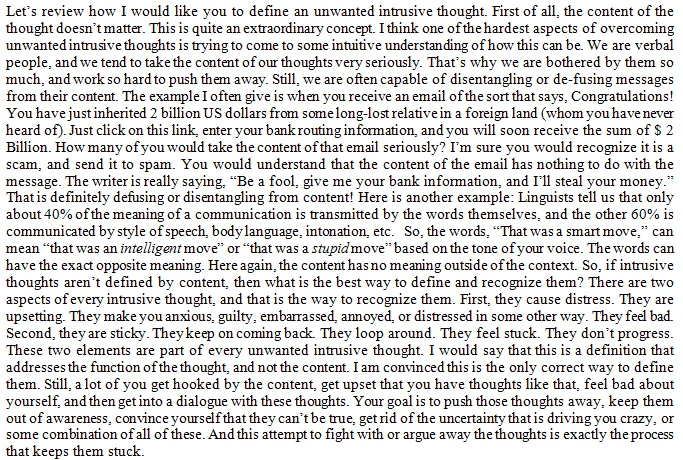
Intrusive thoughts often shift or morph into new forms of mental intrusions. While the OCD patient may initially recognize the original thoughts as intrusive and unwanted, over time, uncertainty may creep in, leaving them unsure whether the current thoughts still qualify as intrusive. It is important for patients to remember that the content of the thought is irrelevant. As long as a thought causes distress and remains persistent or “sticky,” it is considered intrusive and should be treated accordingly. Regardless of the thought’s content or the intensity of the urge for certainty, the patient must apply the non-engagement strategy.14
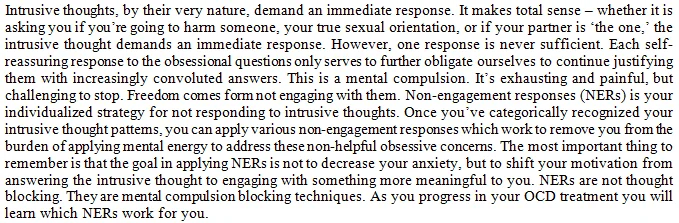
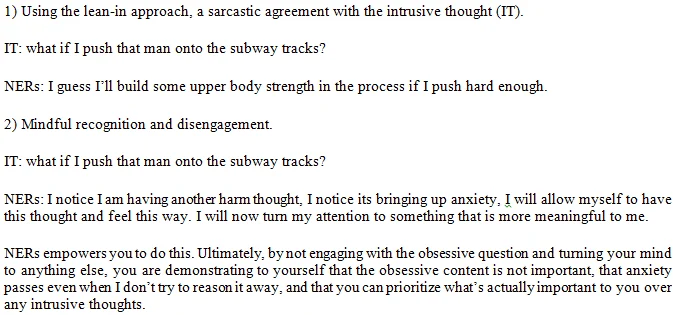
Here are two Non-Engagement Response (NER) strategies that may be helpful to try:15
Hence, when a patient’s intrusive thought shifts or morphs into a new form, they should address it in exactly the same way as the original thought. The patient must remain mindful that intrusive thoughts often change in content, and whatever thought provokes a heightened, sensitized reaction is likely to become the next “stuck” thought. It is therefore essential to treat each new intrusion using the same non-engagement approach. As Dr. Martin N. Seif observes:16
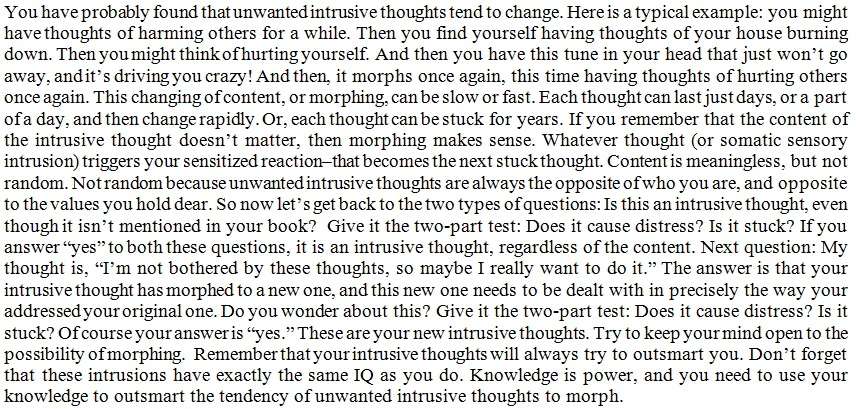
The fact that intrusive thoughts often morph and shift in theme—thereby tricking the sufferer into believing they are experiencing entirely new intrusive thoughts—is similar to how individuals with panic disorder believe they are having a heart attack during each panic episode. It is essential for the waswās sufferer to recognize that what truly matters is not the content of the thought, but rather the response to it—because thoughts, ultimately, are just thoughts. As such, the content itself is irrelevant; what matters are two key features: how the thought feels and how it behaves, as Dr. Seif explains:17

The patient can reliably identify unwanted intrusive thoughts by applying the two-step test described by Dr. Martin Seif: “Does it feel awful? Yes. Is it stuck? Yes. Therefore, this is an intrusion. It really is that simple.”18 Any thought—regardless of its specific content—that feels distressing and sticks (i.e., lingers in the mind) qualifies as an intrusive thought and should be dealt with accordingly. Consistently practicing non-engagement—regardless of the theme of the thought—is essential to breaking the cycle of obsession; it truly is the name of the game.
When waswās sufferers are encouraged to accept their blasphemous thoughts without judgment and without mental or physical distress, many express fear that doing so will lead to a loss of faith or khushūʿ (i.e., a state of submissiveness, humility, and yearning—marked by inner stillness and deep reverence born out of love and awe for Allāh’s greatness and majesty). It is important to clarify that acceptance, as a therapeutic strategy in OCD, does not mean accepting the content of the blasphemous thought itself, but rather accepting the presence of the thought without resistance or reaction. In other words, one can have inappropriate or disturbing thoughts without believing in them or being distressed by them. As with many disorders, a vital first step in effectively managing OCD is reaching a place of acceptance with the condition itself. Furthermore, some waswās sufferers who are currently doing well and free of symptoms fear a relapse—a return to their previous level of suffering. This fear, too, reflects a misunderstanding of the power and effectiveness of thought-stopping, acceptance, and non-engagement strategies. OCD sufferers must understand that relapses are normal and can be expected, but with the right mindset, recovery from a relapse can be quick and manageable. If the sufferer consistently applies the techniques correctly—by not engaging with the content of the intrusive thought, accepting its presence, avoiding mental or behavioral responses, and doing nothing in reaction—they will gain confidence and skill in managing future episodes. When triggered, the sufferer should maintain an “oh well” attitude and carry on with their normal routine, resisting the pull of OCD to spiral into fear or doubt. And if they do get pulled in, they should avoid self-blame and simply return to step one. In short, the sufferer should keep in mind that OCD may reappear in the form of a full-blown relapse (a complete return of symptoms), a partial relapse (a milder return of symptoms), or a temporary lapse (a brief intrusive thought, emotion, or doubt that does not lead to a relapse). But they should also remember that they have the tools to manage it. In fact, how a person responds to the initial return of symptoms often determines whether it remains a lapse or escalates into a relapse. With this understanding, the waswās sufferer can continue to live a fulfilling and joyful life.
Waswās sufferers often complain that intrusive thoughts have disrupted their khushūʿ (i.e., proper focus and reverence) during prayer. It is entirely normal for one’s khushūʿ to diminish due to waswās, as the repeated presence of intrusive thoughts can impair concentration and make it difficult to focus on any activity. The good news is that as soon as a person begins to completely ignore these thoughts, their khushūʿ will return, in shāʾa Allāh (lit. if God wills). Some sufferers wonder whether reading books that strengthen their faith and certainty will help them remain steadfast in their religion. Others frequently call imāms, seeking reassurance about irrational fears—often related to being neglectful in religious duties. However, as previously explained, seeking constant and unnecessary reassurance can become part of the compulsion cycle. From a psychological standpoint, reassurance-seeking is a common compulsive behavior in OCD, driven by the desire to eliminate the uncertainty at the core of the disorder. Unfortunately, this behavior tends to validate the intrusive thoughts. That is, every time a person seeks reassurance, it reinforces the false belief that the obsession may have some validity—after all, why would reassurance be needed if there were truly nothing to worry about? While excessive reassurance may offer temporary relief, in the long term it only serves to sustain and strengthen the OCD symptoms. The key issue is that failing to distinguish between whisperings (i.e., intrusive thoughts) and genuine destructive shubuhāt (doubts or specious arguments) can have serious consequences. As explained earlier, intrusive thoughts that cause cognitive dissonance—mental discomfort arising from conflicting beliefs or values—are, in fact, recognized by the sufferer as problematic. This very recognition of the intrusive thoughts as problematic is a sign of faith, as affirmed in the aforementioned Prophetic tradition.19

While it may seem that seeking answers is the best way to cure doubts, the Prophet (PBUH) advised a different approach when it comes to whisperings: to ignore them, not act upon them, and not speak of them. Abū Hurayrah [may Allāh be pleased with him] narrated that the Prophet (PBUH) said, “Allāh, the Mighty and Sublime, has forgiven my ummah (nation) for what is whispered to them or what enters their minds, so long as they do not act upon it or speak of it.”20 Indisputably, the best approach to obsessive thoughts is to do nothing—that is, to completely ignore them as meaningless mental chatter, no different from distant traffic noise. When an intrusive thought arises, the waswās sufferer should treat it as a non-event and continue their chosen activity as though there were no competing demand for their attention. They should stay grounded in the present moment, focus on their surroundings, and resume whatever they were doing before the thought appeared. This is the “keep calm and carry on” approach to managing OCD. By doing nothing, the sufferer refrains from engaging with the content of the thought and denies it power. As the intrusive thoughts begin to creep in, they should ask themselves: “Am I going to give in to this and try to control my anxiety?” It may help to imagine how they would respond if a mentally deranged person were saying the same things aloud—surely they would not read an entire library just to respond or gain certainty. That would only provoke more shouting instead of quieting the noise. Likewise, the waswās sufferer should not read books to increase certainty or eliminate obsessive thoughts. However, if they seek Islamic knowledge with a sincere and sound intention—to act upon it personally and to teach it to others for the sake of earning reward—then this is commendable and entirely appropriate. Similarly, one should not abandon acts of worship they are accustomed to out of fear that waswās might intensify. In short, the sufferer should neither do anything with the goal of eliminating waswās, nor avoid anything out of fear that it may worsen.
Again, thoughts do not matter—what truly matters is how a person responds to them. Those who are troubled by intrusive thoughts must learn to form a new relationship with these thoughts: one that recognizes their content as irrelevant and unimportant. A waswās sufferer can choose to treat OCD thoughts as insignificant. If the mind says, “Maybe you are not a Muslim,” the response can be, “Okay, cool, whatever,” followed by carrying on with the day. If the mind says, “You just made ablution, but it might not be valid,” the reply can be, “Maybe so, but doubt cannot override certainty,” and then simply move on. The key is to stop treating intrusive thoughts as if they are important—because they are not. OCD improves only when the sufferer treats all intrusive thoughts as if they are meaningless and responds with complete non-engagement. As Dr. Michael Stein, a licensed clinical psychologist with 14 years of experience specializing in anxiety disorders and OCD through Exposure Therapy and other evidence-based interventions, explains:21
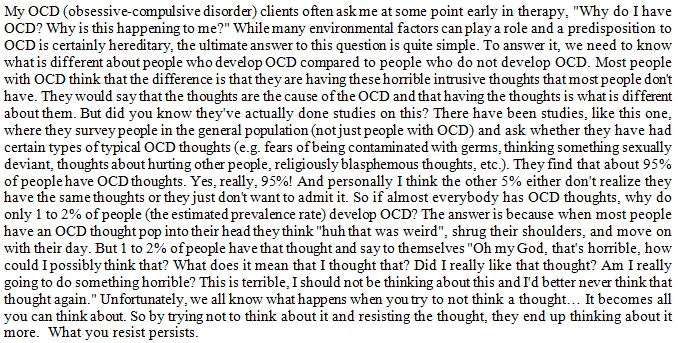
Dr. Stein further writes:22
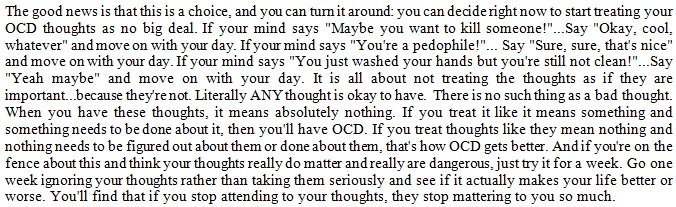
Hence, the waswās sufferer should avoid any response that might reinforce or feed the intrusive thoughts. By dwelling on these thoughts, they are signaling to their brain that the thoughts are unacceptable and that relief must be sought through internal debate or reassurance—trying to convince themselves that the thoughts do not reflect their true self or are irrational. While it is indeed true that the thoughts are not a reflection of their identity and are, in fact, irrational, the very act of fighting them inadvertently communicates to the brain that they pose a real threat. This reaction reinforces the influence of the intrusive thoughts by signaling to the brain that they pose a threat and warrant anxiety. In doing so, the sufferer effectively sets up a mental sentry, constantly on guard and ready to flag these thoughts as intolerable the moment they arise, thus perpetuating the cycle. Conversely, if the waswās sufferer were to stop fighting the intrusive thoughts and instead ignore them completely, the thoughts would begin to lose their grip. By refusing to engage with, analyze, or suppress the thoughts—and instead demonstrating an attitude of indifference—they signal to the brain that these thoughts are neither dangerous nor worthy of attention. Over time, the brain receives the message that there is no threat, and as a result, the intrusive thoughts begin to fade away.
It is important to remember that thoughts, like emotions, are temporary. The Anxiety and Depression Association of America (ADAA) recommends viewing such thoughts as clouds—just as they come, they eventually drift away. Thus, even if an intrusive thought feels never-ending and unbearable, the individual must understand that it will pass. They should avoid giving power to these thoughts, recognizing that they are invalid and rooted in fear and anxiety. Practicing patience, allowing the thought to be present, and continuing with whatever activity they were engaged in prior to the intrusion—while allowing the anxiety to coexist—will lead to the thought fading on its own. Obsessing over intrusive thoughts, on the other hand, only invites their return. Unfortunately, many waswās sufferers believe they are practicing acceptance and non-engagement techniques when, in reality, they are not—which explains their inability to break free from OCD. The only way to loosen OCD’s grip is for the waswās sufferer to truly allow themselves to be unbothered by these thoughts, to practice acceptance by refusing to ruminate on them, and to let them pass through without judgment—reminding themselves that such thoughts can only cause harm if given permission to do so. About ten years ago, I—the author of this book—was suffering from panic disorder, an anxiety condition characterized by recurring panic attacks. Medically speaking, a panic attack is not considered a distinct condition; rather, it refers to a misfiring of the body’s natural fight-or-flight response. In such moments, the body mistakenly perceives a threat where none exists. This results in a surge of intense physical and emotional symptoms, which may include a racing heartbeat, chest pain or discomfort, shortness of breath, a choking sensation, dizziness, gastrointestinal distress, trembling, hot flushes, chills, shaky limbs, and a profound fear of dying. Because these symptoms mimic serious physical conditions like heart attacks or strokes, they are deeply distressing. Each time I experienced a panic attack, the fear only worsened the symptoms, often extending the episode for hours and making them more frequent—until I decided to face them head-on. After being diagnosed with panic disorder, I resolved to confront the fear instead of running from it. I will never forget that night when, upon feeling a panic attack coming on, I entered a dark room alone and silently challenged it: “Come on, panic—give me your best shot.” As the symptoms peaked—sweating, palpitations, dizziness, nausea—I remained calm and smiling, telling myself over and over that this would pass and could not hurt me. And it did. After a few intense minutes, the symptoms subsided quickly. That night marked a turning point: I realized that overcoming panic did not require eliminating fear, but rather cultivating courage—the kind of courage that allows one to feel afraid and act anyway. Confronting the panic attack felt like standing in the jungle and running toward the lion’s roar. I used to have panic attacks every couple of days, but by Allāh’s grace and mercy, I have not had one in ten years. That night was the last one. And even if it returns, I know how to handle it. The experience was liberating—I no longer live under the threat of panic. I have learned how to respond. Crucially, I know that if the symptoms ever return, I will not be starting from scratch. I will not respond to panic with more panic. After all, constant worry about the next attack only feeds the fear and increases the likelihood of future episodes—a cycle of living “in fear of fear” that perpetuates the problem. The reason I have shared my experience of overcoming panic attacks is that both panic disorder and obsessive-compulsive disorder (OCD) are characterized by excessive fear and worry. When we feel anxious, the body instinctively activates the fight-or-flight response as a means of self-protection. While this response is beneficial when facing an actual threat, a panic attack occurs when the fight-or-flight system is triggered in the absence of real danger. Similarly, in OCD, the brain’s filtering system malfunctions, mistakenly flagging certain thoughts as threats. As a result, the person experiences intense anxiety without any genuine danger—a false-alarm response. It is crucial to recognize that feeling anxious does not necessarily indicate the presence of a threat. Many individuals instinctively resist panic attacks because they are deeply unpleasant; however, this resistance tends to prolong the episode by sending additional distress signals to the brain. Moreover, the overwhelming fear of experiencing another panic attack often leads to increased panic episodes, creating a vicious cycle that can escalate into panic disorder. In the same way, the obsessive-compulsive cycle is sustained by fear and anxiety. Compulsions serve as reactive attempts to neutralize obsessive thoughts, but they also reinforce the notion that these thoughts are dangerous. This response strengthens the obsession, thereby perpetuating the cycle of OCD.23
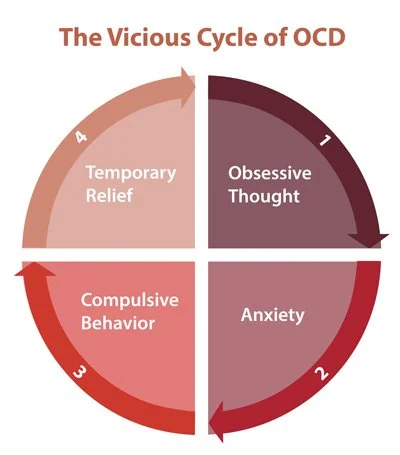
It may seem counterintuitive not to react to anxiety; however, responding to anxiety in the absence of real danger is ultimately counterproductive. In treating both panic attacks and obsessive-compulsive disorder (OCD), acceptance proves to be a highly effective strategy. A person experiencing a panic attack can practice acceptance by calmly reminding themselves—either internally or aloud—“This is just a panic attack. It cannot hurt me. The worst that will happen is that I will feel uncomfortable for a while, and then it will pass. I can handle this. I am safe.” The key is to trust the process and recognize that what is being experienced is a false-alarm feeling. Similarly, when an individual with OCD is confronted by an intrusive thought, they should not resist or attempt to suppress it. Instead, they should accept it for what it is: just a thought. Over time, this acceptance reduces the emotional charge associated with the thought and lessens the tendency to obsess over it. As previously explained, resistance to such thoughts and feelings is precisely what fuels the OCD cycle. When a patient resists a thought, they inadvertently communicate to their brain that the thought is dangerous and meaningful, even though in reality it is harmless and insignificant. Obsessions are essentially false alarms, and treating them as real only reinforces the brain’s maladaptive attempt to protect the individual. As a result, the brain continues to produce more of these false alarms. Despite its clinical effectiveness, acceptance can be challenging for many patients to implement. True acceptance involves allowing thoughts and feelings to be present without attempting to change, analyze, resist, or react to them. However, a common misconception deters many from embracing this approach: the mistaken belief that acceptance means believing the intrusive thoughts are true. This misunderstanding prevents sufferers from benefiting fully from this critical component of OCD treatment. Waswās sufferers must understand that acceptance refers to allowing thoughts and feelings to exist—not endorsing them as truth or letting them dictate behavior. Acceptance means saying, “This thought is present, and I will allow it to be here,” rather than, “This thought is true, and I must live by it.” For example, if the intrusive thought is “I am a kāfir (disbeliever),” an appropriate accepting response would be: “I am having the thought that I could be a disbeliever. That’s fine. I will let the thought be there while I continue with my day.” This is entirely different from saying, “I am a disbeliever, and I must accept it as truth.” Due to a lack of proper understanding, some waswās sufferers take extreme measures—such as performing ġusl (ritual purification) and repeating the shahādatayn (testimony of faith) daily—out of fear that intrusive thoughts have rendered them disbelievers.24 They justify this behavior as a precautionary measure. Can you imagine that?! Yet, such actions are not only contrary to the Prophet (PBUH)’s instruction to disregard these thoughts, and worse still, they exacerbate the problem, causing the intrusive thoughts to intensify. What they label as “precaution” is, in fact, a manifestation of waswasah. As Ibn al-Qayyim aptly states, “There are thousands of things which the people afflicted with waswasah take as a part of religion, cloaked in ‘precaution’, whereas, precaution is to be exercised in following the Sunnah.”25 Precaution is to follow the Sunnah in the best possible way and to avoid both negligence and exaggeration. Muslims who perform ġusl and pronounce the shahādatayn every day as a form of ‘precaution’ are, in reality, giving excessive attention to their intrusive thoughts—to the extent of believing them, reacting to them, and constantly seeking reassurance to relieve the doubts they bring. But why would one feel the need to perform ġusl and repeat the shahādatayn when the Sharīʿah has not even commanded them to make istiġfār (seeking forgiveness from Allāh) for such thoughts—given that they are not sinful in the first place?
I suggest that waswās sufferers visualize al-waswās al-qahī (religious OCD) as a troll lurking inside the head.

Trolls are individuals who deliberately post provocative or offensive messages online to attract attention, incite conflict, or upset others.

It is perfectly understandable to feel compelled to wage war on trolls—with your keyboard—but trolls thrive on others’ anger, frustration, and annoyance. Their goal is to provoke a reaction, and engaging with them only reinforces their behavior. Therefore, the most effective strategy for dealing with trolls is to deny them the reaction they seek. One of the most widely recognized strategies that emerged from online culture is the maxim: “Do not feed the trolls.”

When we reply to a troll on the internet—often with anger or visible offense—we give them precisely the attention they crave, which only intensifies their behavior. However, according to the conventional wisdom of the internet, the most effective way to deal with trolls is simple: do not feed them. That is, one should ignore them, refrain from reacting to them, and deny them the attention they seek—eventually, they tire themselves out. Obsessive-compulsive disorder (OCD) functions much the same way: it is like a troll in one’s mind, and every OCD sufferer would do well to abide by the classic internet adage: “Don’t feed the trolls,” for it truly holds. Being afraid of intrusive thoughts is like being afraid of a phantasm—something that only appears to exist. Suppose someone thinks they have caught a glimpse of a ghostly figure late at night while walking home. If fear overtakes them, they will be unable to continue walking; but if they acknowledge the fear and press on, they will soon discover that what they saw was nothing but a phantasm. A phantasm is an illusion—an apparition that seems real at first glance but quickly fades with time. Likewise, OCD preys on fears that have no basis in reality. It is driven by imagined consequences, however improbable they may be. For the OCD sufferer, a 0.01% risk can feel just as threatening as a 99.9% one. Indeed, fear distorts reality and nourishes the frightening, tormenting thoughts in the mind. Unfortunately, many OCD sufferers do not remain in the presence of their fears long enough to discover the truth—that even if they resist engaging in their compulsions, nothing terrible will happen.26
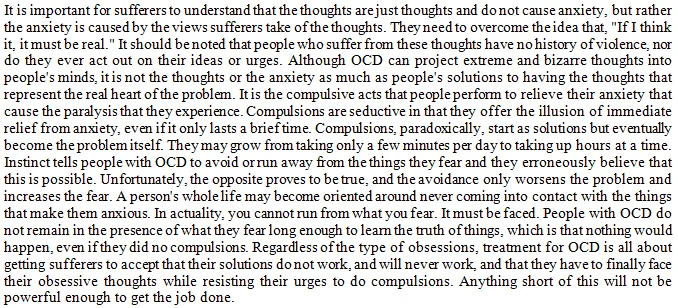
As long as the patient interprets intrusive thoughts as catastrophic and continues to believe such thoughts to be true, they will remain distressed and engage in avoidance and/or ritualistic behaviors (compulsions).27 It is only when they learn to accept the intrusions as just thoughts that they cease to be stuck on them, and the thoughts will no longer go round and round. The waswās sufferer should allow themselves to feel anxious while resisting the urge to engage in a compulsion. They may believe that the discomfort they are feeling will persist until they act on the compulsion, but if they endure it, the anxiety will fade. In short, OCD is a vicious cycle, and the patient can break it only by learning to tolerate anxiety without acting on compulsions. When the patient reaches the other side, they can laugh at OCD, as their anxiety will subside to the point where they no longer experience intense fears related to intrusive thoughts. That is, they will come to perceive that thoughts are fundamentally different from events in the real world: the content of an intrusive thought may be terrible, but it remains a product of the mind—it does not exist in reality.
Unfortunately, many people are truly tormented and debilitated by OCD, and unless they understand how it works, they cannot overcome it. There is a global increase in OCD rates, and in Muslim populations, al-waswās al-qahī has become increasingly prevalent in recent years for many reasons, including:
Internet accessibility: Many people turn to the internet for reassurance, but what distinguishes the average person using Google as a resource from someone with OCD is the excessive amount of time spent searching for answers and reassurance. OCD specialists regard Googling as a compulsion. Reassurance-seeking is a very common compulsion among OCD sufferers and can take the form of researching online or asking others for answers. A person with OCD may excessively use the internet to resolve intrusive doubts, and although reassurance-seeking offers temporary relief, it ultimately worsens the condition. Every time a person gives in to the urge to engage in a compulsion to alleviate anxiety, they reinforce the obsessive thoughts and make them return more forcefully. This dynamic applies equally to those suffering from al-waswās al-qahī: as soon as an intrusive thought arises, they rush to search for an answer online, thereby exacerbating their condition by continually feeding the intrusive thoughts. Such individuals fail to recognize that the questions raised by obsessive thoughts are not genuine inquiries and that there are no real answers to them. Therefore, they should simply agree with the thoughts without analyzing, questioning, or debating them.
The growing prevalence of specious arguments: The experience of doubt is a core vulnerability in the development of OCD symptoms. Indeed, OCD—often referred to as the “doubting disorder”—is closely linked to uncertainty. Therefore, Muslims should recognize the dangers posed by destructive doubts, remain cautious of them, and refrain from giving them any attention or consideration.
Boredom: Research has shown that individuals who frequently experience boredom are more susceptible to poor mental health, particularly conditions such as anxiety and depression. For individuals with OCD, insufficient stimulation—having too little to do—often leads to a spike in obsessive-compulsive symptoms. As Fletcher Wortmann aptly noted:“there is absolutely nothing more toxic to an obsessive-compulsive than boredom. Boredom is to obsession as an incubator is to an egg, or a compost bin is to rotten fruit: it adds heat and pressure and that accelerates the process exponentially. It is never pleasant to find your thoughts drifting to a horrible image or irresolvable problem—but when you have nothing else to distract you, when there is nothing to occupy your mind, such thoughts can quickly escalate from annoying to excruciating.’’28 In short, boredom is the worst adversary of individuals suffering from OCD.
Lack of religious knowledge: The younger generations of Muslims often have limited religious knowledge. Waswās can affect virtually any practicing Muslim, particularly those who lack sufficient understanding of Islam and matters pertaining to Islamic jurisprudence. In fact, many such Muslims deeply desire to worship correctly, to please Allāh, and to ensure their deeds are accepted, but they simply do not possess the necessary knowledge—especially in the area of jurisprudential rulings. Knowledge, in truth, is power when it comes to overcoming OCD. It is beneficial for the Muslim OCD sufferer to know, for example, that when performing wuḍūʾ (minor ablution), one should not wash any limb more than three times. Once wuḍūʾ is completed, one should neither rewash any limb nor repeat the entire wuḍūʾ. Likewise, when Satan suggests that ġusl (major ablution) was not performed properly, such whispers must be ignored. Similarly, when preparing to pray, no matter how persistent the Devil is in casting doubt on the prayer’s validity, these whispers must not be entertained. In a word, the sufferer should not doubt the validity of their acts of worship or repeat them—regardless of how compelling the whispers may seem. Once an act of worship is completed, there is no need to revisit or analyze it. Instead, they should move on with their day or evening, completely ignoring any associated intrusive thoughts, no matter how serious or frightening they sound. Furthermore, when Satan whispers that one has committed shirk (associating partners with Allāh), it must be dismissed entirely. The very fact that the sufferer detests these thoughts and that their heart recoils from them is a clear sign of faith. They will not be held accountable for such thoughts unless they act on them—and Satan may try to convince them that mere mind-wandering constitutes action, which is not the case. Even if such thoughts lingered in the mind, it does not mean they were acted upon. All devout Muslims experience random, bizarre, disturbing, and unwanted thoughts, but this does not mean they believe in them. When the sufferer begins to consistently ignore satanic whispers, Satan will not easily relent. He may attempt to make the sufferer feel that they no longer care about their worship or that they are indifferent toward committing shirk—but this too is just another one of his tactics to hinder the worshippers of Allāh. In short, with sound religious knowledge, the waswās sufferer becomes better equipped to combat evil whispers. Fundamental Islamic legal maxims—such as “certainty cannot be overruled by doubt”—empower the believer against Satan. Armed with this understanding, they will not give in to intrusive thoughts because they recognize them for what they are: Satan’s deceitful tricks designed to derail their worship. Though Satan may continue to bombard them with a relentless stream of repetitive thoughts, they should remember that OCD, as Kimberly Morrow puts it, OCD possesses a morphing ability—it tends to be “grabby,” transferring its content from one theme to another, like flipping through a mental rolodex of distressing scenarios.29 However, by consistently applying the strategies outlined earlier, the sufferer will, in shāʾa Allāh (if God wills), eventually overcome this affliction and rediscover joy in their worship of Allāh.
By the grace of Allāh, waswās sufferers are among those who are most humble before Him, who fear most for their religion, and who strive earnestly for perfection—an endless and impossible task. They should therefore channel these beautiful qualities into seeking sound religious knowledge and becoming callers who guide others to Allāh. They should view the waswās as a trial through which Allāh may elevate their ranks in both this world and the Hereafter—if they face it with patience, steadfastness in faith, and continued devotion in worship. In fact, Satan’s whisperings can even be seen as beneficial to the believer, for they keep the soul vigilant, push it to struggle against its lower self and Satan, and can become a path to higher spiritual refinement. I must reiterate: there is no cure for al-waswās al-qahī except the one prescribed by the Prophet (PBUH)—to completely ignore the intrusive thoughts and refrain from engaging or reacting to them. Arguing with them or trying to push them away is precisely what causes them to persist. This is the same principle behind the most effective treatment approach recommended by mental health professionals for OCD: Exposure and Response Prevention (ERP). Every waswās sufferer must remember that intrusive thoughts are harmless in themselves, and one should not become entangled in their content. Rather, one should use knowledge to outsmart their deceptive and morphing nature. Most importantly, while a person cannot prevent an obsessive thought from arising, they can choose not to respond with a compulsion. I urge every waswās sufferer to face their fears directly and allow obsessive thoughts to exist without trying to “fix” or “neutralize” them through compulsive acts. They must always move toward the anxiety—not away from it—because the only way to overcome fear is to face it. Indeed, one cannot run away from their own thoughts, and thus there is no alternative but to confront them. Recovery from al-waswās al-qahī depends on doing just that. Additionally, sufferers should continually seek refuge in Allāh and call upon Him for protection from Satan’s influence and mischief, including his intrusive whispers. For those who turn sincerely to Allāh, there is clear evidence that He will protect them and render Satan’s efforts ineffective. Allāh says: {And if an evil whisper from Shaytan tries to turn you away, then seek refuge in Allāh. Indeed, He ˹alone˺ is the All-Hearing, All-Knowing} (Qurʾān 41:36). And He says: {And say, “My Lord! I seek refuge in You from the whisperings of the devils. And I seek refuge in You, my Lord, that they ˹even˺ come near me”} (Qurʾān 23:97–98). ʿUthmān ibn abī al-ʿĀṣ (may Allāh be pleased with him) reported: He came to the Messenger of Allāh (PBUH) and said, “O Messenger of Allāh, Satan comes between me and my prayer and confuses my recitation of the Qur’ān.” The Prophet (PBUH) replied, “That is a devil called Khinzab. Thus, whenever you sense him, seek refuge in Allāh from him and spit lightly to your left three times.” ʿUthmān said, “I did that, and Allāh caused him to depart from me.”30 Last but not least, waswās sufferers should remind themselves of Allāh’s boundless Mercy, take comfort in it, rejoice, and praise their Lord—for indeed, as stated in the Qurʾān: {Surely Allāh is ever Merciful to you} (Qurʾān 4:29). I ask Allāh, the Mighty, the Lord of the Magnificent Throne, to heal our afflicted and to elevate our ranks in this worldly life and in the Hereafter.
Notes and References
- 1
Agreed upon ḥadīth, Muḥammad al-Bukhārī, Ṣaḥīḥ al-Bukhārī, (Cairo, Egypt: Dār as-Salām. 1999), book: 59, ḥadīth: 85, available at: https://sunnah.com/bukhari:3276; Muslim ibn al-Ḥajjāj, Ṣaḥīḥ Muslim, (Bayrūt, Lebanon: Dār al-Kutub ʿIlmiyyah, 2020), book: 1, ḥadīth: 250, available at: https://sunnah.com/muslim:134a.
- 2
“Thought Stopping,” Wikipedia: The Free Encyclopedia, last edited 28 Jan. 2023, https://en.wikipedia.org/wiki/Thought_stopping.
- 3
Antonia N. Kaczkurkin and Edna B. Foa, “Cognitive-Behavioral Therapy for Anxiety Disorders: An Update on the Empirical Evidence,” Dialogues in Clinal Neuroscience, vol. 17, issue 3, 1 Sep. 2015, pp. 337–346. DOI: https://doi.org/10.31887/DCNS.2015.17.3/akaczkurkin.
- 4
Claire Eagleson et al., “The Power of Positive Thinking: Pathological Worry is Reduced by Thought Replacement in Generalized Anxiety Disorder,” Behaviour Research and Therapy, vol. 78, March 2016, pp. 13–18. DOI: https://doi.org/10.1016/j.brat.2015.12.017.
- 5
Najwa Awad, “Clinicians, Imams, and the Whisperings of Satan,” Yaqeen institute, 19 Jul. 2017, https://yaqeeninstitute.org/read/paper/clinicians-imams-and-the-whisperings-of-satan.
- 6
Ibid.
- 7
Sanskar Vyas, “How Do I Get Rid of Intrusive Thoughts?” Quora, accessed 31 Jan. 2023, https://www.quora.com/How-do-I-get-rid-of-intrusive-thoughts/answer/Sanskar-Vyas, (italics and capitals in original).
- 8
Ibid.
- 9
Ibid.
- 10
Ibid.
- 11
Hikmet Isik, “How Should We React to the Evil Thoughts and Desires Whispered by Satan?” The Fountain, 1 Jan. 2004, http://www.fountainmagazine.com/2004/issue-45-january-march-2004/how-should-we-react-to-the-evil-thoughts-and-desires.
- 12
Dr. Martin N. Seif is a leading figure in the modern treatment of anxiety disorders. He is a founding member of the Anxiety and Depression Association of America, former Associate Director of the Anxiety and Phobia Treatment Center at White Plains Hospital Medical Center, and a board-certified specialist in Cognitive Behavioral Therapy through the American Board of Professional Psychology. He also serves as a faculty member at New York-Presbyterian Hospital.
- 13
Martin N. Seif, “Intrusive Thoughts Often Morph,” Martin N. Seif, Ph.D., accessed 1 Feb. 2023, https://drmartinseif.com/intrusive-thoughts-often-morph/.
- 14
Elliot Kaminetzky, “The Art of OCD Non-engagement Responses,” My OCD Care, 28 Dec. 2019, https://myocdcare.com/the-art-of-ocd-non-engagement-responses/.
- 15
Ibid.
- 16
Martin N. Seif, “Is This an Intrusive Thought?” Martin N. Seif, Ph.D., accessed 1 Feb. 2023, https://drmartinseif.com/is-this-an-intrusive-thought/.
- 17
Ibid. .
- 18
Ibid.
- 19
Fahad Tasleem, No Doubt: 10 Effective Strategies on How to Deal with Your & Other People’s Doubts, Strategy 3: Make the Distinction, (Texas, U.S.: Sapience Institute, n.d.), available at: PB Pressbooks, accessed 1 Feb. 2023, https://pressbooks.pub/nodoubt/.
- 20
Abū ʿAbd ar-Raḥmān an-Nasāʾī, Sunan an-Nasāʾī, (Aleppo, Syria: Maktab al-Maṭbūʿāt al-Islāmiyyah, 1986), book: 27, ḥadīth: 46, available at: https://sunnah.com/nasai:3434.
- 21
Michael Stein, “Why Do You Have OCD? Because What You Resist Persists,” Anxiety & Depression Association of America, 11 Oct. 2020, https://adaa.org/learn-from-us/from-the-experts/blog-posts/consumer/why-do-you-have-ocd-because-what-you-resist.
- 22
Ibid.
- 23
Melinda Smith et al., “Obsessive-Compulsive Disorder (OCD),” HelpGuide.org, accessed 15 Jan. 2024, https://www.helpguide.org/articles/anxiety/obssessive-compulsive-disorder-ocd.htm
Compulsions are behaviors or rituals that you feel driven to act out again and again. Usually, compulsions are performed in an attempt to make obsessions go away. For example, if you're afraid of contamination, you might develop elaborate cleaning rituals. However, the relief never lasts. In fact, the obsessive thoughts usually come back stronger. And the compulsive rituals and behaviors often end up causing anxiety themselves as they become more demanding and time-consuming. This is the vicious cycle of OCD.
- 24
In Islām, the “major ablution” that entails washing the entire body is known as ġusl. According to the predominant opinion of scholars, ġusl is mustaḥab (recommended) upon embracing Islām. Additionally, when a non-Muslim wishes to enter into the fold of Islām, they must recite the shahādatayn—the two testimonies of faith: “I bear witness that there is no deity but Allāh, and I bear witness that Muḥammad is the Messenger of Allāh.”
- 25
Ibn Qayyim al-Jawziyyah, ar-Rūḥ, (Bayrūt, Lebanon: Dār Ibn Ḥazm, 2010).
- 26
Fred Penzel, “How I Treat OCD Killer Thoughts: Treating Violent Obsessions,” International OCD Foundation, accessed 4 Feb. 2023, https://iocdf.org/expert-opinions/expert-opinion-violent-obsessions/.
- 27
Mantracare Author, “OCD Avoidance: Implications, and Treatment,” MantraCare, accessed 4 Feb. 2023, https://mantracare.org/ocd/ocd-treatment/ocd-avoidance/#Understanding_OCD_Avoidance.
OCD avoidance is when an individual with OCD deliberately avoids situations or objects that trigger their obsessions. This can be anything from avoiding touching doorknobs to avoiding social situations. For many people with OCD, avoidance is a way of managing their anxiety. It allows them to feel in control and safe from harm. However, avoidance can also have several negative consequences. Avoidance behaviors prevent people from exposure to the very things that will help them overcome their OCD.
•For example, someone who avoids touching doorknobs will never be able to desensitize themselves to the fear of germs. As a result, their OCD will likely continue to worsen.
•Again in, exposure and response prevention (ERP), which is one of the most effective treatments for OCD, relies on the individual being willing to face their fears. If someone is avoiding their triggers, they are not going to be able to do this.
- 28
Fletcher Wortmann, “With OCD—Waiting is the Hardest Part,” Psychology Today, 28 Oct. 2013, https://www.psychologytoday.com/us/blog/triggered/20131Book0/ocd-waiting-is-the-hardest-part.
- 29
Kimberly Morrow, “Helpful Ways to Manage OCD Relapse,” Anxiety Training, 15 Apr. 2017, https://anxietytraining.com/helpful-ways-manage-ocd-relapse/.
- 30
Muḥammad ibn ʿAbd Allāh al-Khaṭīb at-Tibrīzī, Mishkāt al-Maṣābīh, (Bayrūt, Lebanon: al-Maktab al-Islāmī. 1979), book: 1, ḥadīth: 71, available at: https://sunnah.com/mishkat:77.