Can shubuhāt (specious arguments and doubts) in and of themselves lead to riddah (apostasy—the abandonment of Islam by a Muslim)?
Suspicions, in and of themselves, do not lead to disbelief, no matter how magnified they may become in a Muslim’s mind. Without a doubt, such suspicions can cause confusion in those who fail to reflect on the religious texts, due to their lack of al-ʿilm ash-sharʿī (Islamic knowledge), and this confusion can result in the corruption of their thoughts and understanding. A person afflicted with shubuhāt may deviate—partially or entirely—from the path of the pious predecessors, and may also misunderstand the divine wisdom behind certain matters. Shubuhāt can even lead to a psychological crisis—an internal turmoil marked by confusion, anxiety, anger, guilt, and helplessness. They may also cause individuals to drift away from religion, leading them to neglect certain acts of obedience. However, when these doubts, stemming from ignorance, are accompanied by corrupt intentions and a desire to fulfill one’s own cravings, then arises the gravest of all fitan (trials) and the most dangerous of afflictions: the deviation caused by evil motives. In such individuals, the dominant force is their hawá (whims and desires), as Allāh describes them: {They follow nothing but ˹inherited˺ assumptions and whatever ˹their˺ souls desire, although ˹true˺ guidance has already come to them from their Lord} (Qurʾān 53:23). It is the following of desires that leads one astray from the path of Allāh, as He says: {“O David! We have surely made you an authority in the land, so judge between people with truth. And do not follow ˹your˺ desires or they will lead you astray from Allāh’s Way} (38:26). That is, the fundamental reason for rejecting the truth is the submission to one’s base desires. Allāh said to the Prophet (PBUH): {So if they fail to respond to you, then know that they only follow their desires} (Qurʾān 28:50). Allāh frequently mentions the word hawá (whims and desires) in the Qurʾān, condemning it to such a degree that He describes it as a deity taken in place of Him: {Have you seen ˹O Prophet˺ the one who has taken their own desires as their god? Will you then be a keeper over them?} (Qurʾān 25:43). Those who are enslaved to the desires of their own selves are like a ship without an anchor, drifting aimlessly in whatever direction their whims carry them. They heed no advice, no matter how sincere the well-wisher may be. Their minds remain constantly preoccupied with finding ways to fulfill their personal interests and desires by any means possible, and they continue to fabricate and present arguments to justify their unchecked freedom. They show no concern for what Allāh has declared lawful or unlawful, following only their whims and inclinations. In this sense, their desires become their god, even if they have never uttered such a claim with their tongues: {Have you seen ˹O Prophet˺ those who have taken their own desires as their god? ˹And so˺ Allāh left them to stray knowingly, sealed their hearing and hearts, and placed a cover on their sight. Who then can guide them after Allāh? Will you ˹all˺ not then be mindful?} (Qurʾān 45:23). These people worship their desires at all costs, to the extent that logic and reasoning have no impact on them. The root of their disbelief is not a flaw in the logic presented to them, but rather the veils of their personal desires, which act as a thick curtain over the eyes of their intellect, blocking the light of wisdom from entering.1

Hence, people reject divinely sent guidance not because of faith-related doubts or any deficiency in the evidence brought by the Prophet (PBUH), but because it is their whims—unsupported by any sound guidance—that lead them to disbelief and ultimately to their downfall. Certain desires can create such strong attachments in a person that they lose the ability to perceive clearly, becoming blind to the truth. This is because true understanding cannot emerge when the heart is emotionally entangled with falsehood. Such a condition is a grave affliction of the soul.
The believer will inevitably encounter doubts about Islam at some point in life. These doubts may stem from various sources—whether as whispers from Satan or as attacks from the enemies of Islam who seek to malign it by distorting facts, quoting scriptural texts out of context, citing weak or fabricated traditions from the Sunnah, or simply by inventing lies against it. It is essential for Muslims to seek knowledge from reliable sources. Experiencing such basic doubts is not blameworthy, as it is natural for people to desire further evidence to strengthen their conviction in divine revelation. These doubts can be dispelled through deeper learning about Islam and increased exposure to the signs of Allāh. When a sincere seeker of truth and salvation faces doubts—no matter how overwhelming they may seem due to their limited knowledge—they will not abandon dīn al-fiṭrah: Islam, the religion whose laws and teachings align perfectly with the human innate disposition to believe in and submit to the Creator. Islam is the only true religion of Allāh that speaks to the inborn awareness of monotheism present in every human being. Only truth can answer truth, and if one leaves Islam, there is no higher truth to which he can turn. What remains on earth is merely the shirkiyyāt (polytheistic beliefs and practices that contradict monotheism) of the ancients, the irrationality of atheism, and the monotheism of Islam. Humanity has no fourth option. An example that illustrates how disbelievers knowingly turn away from Allāh due to desires that oppose the truth revealed to them is the reaction of the pagans of Makkah during the time of the Prophet (PBUH), who said: “Why has not Muḥammad (PBUH) been given all the miracles that were given to the Prophet Moses (PBUH)?” Allah says: {But when the truth came to them from Us, they said, “If only he was given the like of what Moses had been given”} (Qurʾān 28:48). Allāh responded to their objection by stating that they had no right to make such a claim, for they had not believed in Moses (PBUH) either, nor had they followed his teachings: {Did they not deny what had been given to Moses earlier? They claimed, “Both ˹Scriptures˺ are works of magic, supporting each other!” Adding, “We truly deny both”} (Qurʾān 28:48). As a matter of fact, some of the Makkan pagans approached certain Jewish authorities to inquire about the message of Prophet Muḥammad (PBUH), and when they were informed that there were indeed references to him in the Torah, they promptly rejected both the Torah and the Qurʾān, dismissing them as mere works of magic. They even declared, “We shall never believe in this Qurʾān nor in any other Book that came before it.” Their statement is conveyed in the Qurʾān: {The disbelievers vow, “We will never believe in this Qurʾān, nor in those ˹Scriptures˺ before it”} (Qurʾān 34:31). Allāh instructed Prophet Muḥammad (PBUH) to say to them: “Then bring a Book from Allāh that offers better guidance than either of them—the Qurʾān and the Torah—and I will follow it, if you are truthful.” Allah says: {Say, ˹O Prophet,˺ “Bring then a scripture from Allāh which is a better guide than these two so I may follow it, if your claim is true”} (Qurʾān 28:49). That is, if you possess a divine Book that offers better guidance than the Qurʾān and the Torah, then present it—and I will follow it without hesitation, for I am bound to follow true guidance, as long as it is genuinely from Allāh. However, if a person rejects the Truth and cannot present any superior truth in its place, this clearly shows that they are rejecting it only because they are following the dictates of their base desires: {So if they fail to respond to you, then know that they only follow their desires. And who could be more astray than those who follow their desires with no guidance from Allāh? Surely Allāh does not guide the wrongdoing people} (Qurʾān 28:50).
Islam is the Truth—the only Truth—so how can anyone turn away from it? Islam affirms and aligns with the instinctive, inherent disposition with which Allāh has created all people. It is the innate impulse placed by the Creator within every human being that drives them to seek Him. In his autobiography, al-Ġazālī described this innate religious disposition, which he personally experienced, as a deep urge within people to “seek knowledge of the reality of things.”2 He describes this spiritual longing for truth as a ‘thirst’ that must be quenched—a void and emptiness in the heart, and an uneasiness with existence—that can only be eased and fulfilled by discovering the meaning and purpose of life.3 Everyone is born inclined to the simple, natural worship of one unique, powerful, and benevolent Creator. However, when this innate disposition and intuitive belief in one God become corrupted, logical arguments may be necessary to help a person return to their natural state. Ibn Taymiyyah said:4

Our intuitive beliefs—rooted in our natural disposition and shaped by experience—serve as a foundation and guide for the beliefs we acquire through reflection and conscious, rational deliberation.5 As for doubts in one’s faith, they are, as previously mentioned, a natural part of the human experience. It is entirely normal to question what we believe and why we believe it. In fact, Islam is better understood as informed knowledge rather than blind faith. Therefore, when doubts arise, we are equipped to address them. To begin with, the presence of doubt reflects a form of ignorance—one that can only be removed through knowledge. The more a Muslim educates themselves and strengthens their faith, the more resilient they become in resisting persistent doubts. Allāh provides us with a simple and clear method for dealing with such uncertainties: {“ask those who have knowledge ˹of the Scriptures˺ if you do not know”} (Qurʾān 21:7).The religion of Islam is so great and firmly established that no specious argument can withstand or refute it. Therefore, if someone experiences a doubt stemming from a particular misconception, they should consult knowledgeable scholars about it. It would be irrational to reject the Lord of the Worlds and His trustworthy Prophet (PBUH) merely because one cannot comprehend certain Islamic statements or the wisdom behind specific rulings due to their limited understanding. In such cases, one should reaffirm their faith by turning to the core foundations of Islam. If they truly believe that Allāh is All-Powerful and All-Wise, then the few matters they may find unclear or doubtful should not pose a serious problem.6
It is incumbent upon every believer to build a fortress around their faith to protect it from external threats that may give rise to doubts—namely, the whisperings of Satan and the attacks by the enemies of Islam who spread misconceptions about it. This fortress is constructed through proactive measures that prepare one to face these challenges—measures that prevent the doubts caused by Satan’s whispers and the assaults of disbelievers from evolving into the dangerous condition of compounded ignorance.7 A Muslim who has not prepared for such threats is in a vulnerable position, for as these attacks accumulate, they may begin to develop a distorted understanding of Islam—this is often the case with those who abandon the faith based on false assumptions. The first preventative measure is to acquire knowledge of Allāh by reflecting on His signs both in divine revelation and in creation. Shaykh Ibn ʿUthaymīn said:8

The Qurʾān and Sunnah are filled with signs from Allāh that clearly indicate their divine origin. Therefore, believers must maintain a close relationship with these two foundational sources, as knowledge of them is essential. Those who absorb their religion passively—through habit or cultural imitation, merely going through the motions like those around them—are especially vulnerable to doubts. A Muslim strengthens their faith by engaging regularly with the Qurʾān through consistent reading and reflection: {The ˹true˺ believers are only those whose hearts tremble at the remembrance of Allāh, whose faith increases when His revelations are recited to them} (Qurʾān 8:2). The Messenger of Allāh (PBUH) said: “Verily, this Qurʾān is a rope—one end is in the hand of Allāh and the other end is in your hands. Hold fast to it, for you will never be led astray or ruined ever again.”9The life of Prophet Muḥammad (PBUH) is also filled with signs and wonders that affirm he was truly a Messenger from Allāh, calling humanity to worship the Creator alone. Ibn Ḥazm said: “Were there no miracles other than his sīrah (life history), peace and blessings be upon him, it would be enough.”10 The certainty that the Muslim gains from divine revelation is reinforced by observing the signs of Allāh in creation, for the universe is also Allāh’s Book containing His signs, just like the Qurʾān. It is the habit of believers to read the book of nature with attentiveness, reflecting on the countless universal signs that point to the Creator’s design, wisdom, and power, and linking them directly to the signs found in divine revelation.11Reflection upon the creation leads us to clearly observe the signs of intentional design in the world, making it evident that creation is not a random, purposeless accident. Shaykh Ibn ʿUthaymīn said:12

It is natural and intuitive to recognize Allāh’s signs, and the powerful evidence they contain does not require any specialized philosophical training or knowledge to understand or believe in. In short, Allāh created the world so that He would be known. When a Bedouin—one of the nomadic tribespeople who were typically illiterate—was once asked about the existence of the Creator, he replied:13

The simplicity of the teleological argument was even captured in a succinct poem by ʿAbd Allāh ibn al-Muʿtazz:14
O wonder! How can the Deity be disobeyed,
Or by the denier be denied,
While in everything there is a sign
By which His Oneness stands testified.
And in every movement and stillness
There is forever evidence of Him.
After mentioning these anecdotes in his exegesis, Ibn Kathīr further commented:15

In a word, the first preventive measure is that the Muslim must fortify their faith with knowledge of Allāh, His Messenger (PBUH), His religion, and His creation. The second preventive measure a Muslim should take is striving to attain a positive religious experience and to taste the “sweetness of faith.” The spiritual contentment that the Prophet (PBUH) described as the “sweetness of faith”—a fruit of true religion meant to be tasted and experienced—complements and reinforces one’s knowledge of Allāh’s signs. It grounds the believer and strengthens their certainty in the truth of their faith. This inner experience is profoundly powerful, often more effective at deepening conviction and dispelling doubts than intellectual arguments alone. The Prophet (PBUH) said:16

The “light” of the knowledge of Allāh, which fills the spiritual void within the believer, is found both in divine guidance and in the deep sense of peace and contentment experienced through practicing Islam. Indeed, the greatest proof of Allāh’s existence and Lordship is discovered through the visceral experiences of the heart by which believers find comfort, inner peace, moral growth, and a deep sense of meaning in life—the spiritual fruits of true religion. Thus, the most effective way to strengthen faith is by tasting these spiritual fruits. Believers who witness the transformative effects of spiritual practice in their lives, day after day, reach a level of certainty and serenity that makes the idea of turning away from faith unthinkable. Al-Ġazālī said:17

The sweetness of faith is dependent upon three elements, each rooted in the personal experience of the believer. The first, as discussed above, is knowledge of Allāh and His Messenger (PBUH), which leads to loving them. The second is the love, fellowship, and brotherhood shared among Muslims:18

The third element is knowledge of evil in contrast to the goodness of Islam:19
In a nutshell, the preventative measures to be taken before encountering external attacks are: increasing our knowledge of Allāh, His Messenger (PBUH), and His creation; keeping the company of righteous believers; and cultivating awareness of the evils from which Islam protects us.
The case for Allāh’s existence, as presented in the Qurʾān and Sunnah, is clear, accessible, and grounded in logic and sound reasoning. Recognizing that there is a Creator and Sustainer of the universe does not require specialized training or philosophical expertise, as the evidence and arguments are available to all people, regardless of their educational background. However, the spiritual path demands sustained and patient effort—to seek the truth, to confront life’s most profound existential questions, and to dispel misleading doubts. Allāh is the Absolute Truth, and knowing Him is the highest and most noble form of knowledge. In fact, knowledge itself is not possible without Allāh, for He is the necessary foundation upon which any claim to knowledge rests. How can there be any doubt regarding Allāh’s Lordship and His exclusive right to be worshipped, when He alone is the Creator of all beings? The logical conclusion of this firmly established fact is that none but He is deserving of worship. Yet, despite most nations—past and present—acknowledging the existence of a Creator, they often fail to worship Him alone, turning instead to intermediaries. Allāh has recounted to us the debates that took place between the Messengers and the disbelievers of earlier communities when those disbelievers questioned the call to worship Allāh alone, without partners: {Their messengers asked ˹them˺, “Is there any doubt about Allāh, the Originator of the heavens and the earth?} (Qurʾān 14:10). The Messengers posed this question to those who rejected the message in order to highlight the absurdity of their position regarding Allāh. This is because the polytheists of every era believed in the existence of Allāh and acknowledged Him as the Creator of the heavens and the earth, yet they refused to accept that He alone was entitled to their worship. Allāh, in His characteristically wise and probing manner, posed a series of questions to the polytheists of Makkah—questions aimed at helping them recover their clarity and reason. Addressing the Prophet (PBUH), He said: {Ask ˹them, O Prophet˺, “Who provides for you from heaven and earth? Who owns ˹your˺ hearing and sight? Who brings forth the living from the dead and the dead from the living? And who conducts every affair?”} (Qurʾān 10:31). After that, Allāh stated that when these questions are posed to them, they will all respond by acknowledging that it is He who created all these things: {They will ˹surely˺ say, “Allāh”} (Qurʾān 10:31) Then, the Prophet (PBUH) was to ask them: {Say, “Will you not then fear ˹Him˺?} (Qurʾān 10:31). That is, when you yourselves acknowledge that it is Allāh alone who creates, sustains, and governs all things, why then do you not fear Him? And why would you devote yourselves to anyone besides Him in worship and obedience? Fear is what makes people take matters seriously. When the heart is devoid of fear, nothing prevents a person from embracing injustice. Such a person becomes arrogant—and arrogance prevents one from accepting the Truth. Allāh then declared that once the Truth has been made clear, there is nothing left to follow except falsehood and misguidance: {That is Allāh—your True Lord. So what is beyond the truth except falsehood? How can you then be turned away?”} (Qurʾān 10:32). That is, once it is established that Allāh is the only true and rightful object of worship, it becomes utterly senseless to abandon this truth and allow oneself to be diverted elsewhere. Islam affirms that Allāh is our true Provider, Owner, and Master—that He alone is our rightful Lord, and therefore solely deserving of our servitude and worship.
After the truth of Islam, there remains nothing but error. Anyone worshipped besides Allāh is false, for there is no God but Allāh, and He has no partners. What will someone do if they renounce Islam due to doubts arising from their lack of knowledge? Will they turn to polytheism, or will they embrace the irrationality of atheism? If such a person takes a sincere look at the world around them and reflects on the beliefs followed by polytheists and atheists, they will come to appreciate the immense blessing of Islam that Allāh has granted them. Atheists reject foundational, self-evident metaphysical first principles such as causality, sufficient reason, and non-contradiction. Many claim that the universe is its own explanation and, therefore, that a transcendent deity is unnecessary. Others go further, refusing to acknowledge that the existence of the cosmos requires any explanation at all. They assert that the cosmos is simply a “brute fact,” in no need of justification. Some deny the metaphysical principle that nothing can come from nothing, arguing instead that particles can appear and disappear out of nothing based on interpretations of quantum mechanics. A few even speculate that entire universes could emerge from a quantum vacuum. For instance, the atheist Kai Nielsen writes: “It is certainly very natural to reject the principle of sufficient reason and to say that it has not been established that there must be … an explanation for everything.”20 Dr. Dennis Bonnette, who served as a Full Professor of Philosophy at Niagara University in Lewiston until his retirement in 2003, comments on atheist Kai Nielsen’s position, saying:21
That is, the principles of sufficient reason and causality are, in fact, presupposed and necessarily employed by the very atheists who deny their validity and critique their use in arguments for Allāh’s existence. This renders the atheistic position logically invalid. Atheism lacks any ontological foundation and fails to offer adequate explanations for causality, material reality, and the fine-tuning of the universe. Even if atheists attempt to absolve themselves of the responsibility to explain these matters, the ontological gap remains—a glaring absence that is never resolved. In contrast, the truths conveyed in the Qurʾān are entirely rational and coherent. When given due attention, they are easily understood. Consider the force and clarity of reasoning in the following verses: {Or were they created by nothing, or are they ˹their own˺ creators? Or did they create the heavens and the earth? In fact, they have no firm belief ˹in Allāh˺} (Qurʾān 52:35–36). A sense of gratitude toward Allāh naturally develops in anyone who seriously reflects on their own creation and the intricate systems functioning throughout the natural world. This sense of gratitude is, in fact, the driving force behind the true godliness that is required of Man. Allāh calls upon humanity to consider how the food they take for granted is brought into existence—that is, to reflect on His favor and power as manifested in bringing forth vegetation from lifeless earth: {Let people then consider their food} (Qurʾān 80:24). Indeed, had Allāh not provided the means for it, it would not have been within human power to produce food on the earth by any means. Allāh also invites humanity to reflect upon their own selves and consider how they have been created: {Let people then consider what they were created from!} (Qurʾān 86:5). This verse draws attention to the weakness of the origin from which humans were created—namely, a mere drop of semen—and aims to guide them toward accepting the reality of the Hereafter, for the One who is capable of originating creation is likewise capable of bringing it forth again. In other words, both the initial creation and the resurrection are easy for Allāh. It is clearly evident that there is deliberate planning in the creation of both humankind and the universe, which strongly indicates that there must be a purpose behind this creation:22

Allāh invites humans to reflect upon His signs, which testify to His might and boundless power—signs that are present on earth and readily accessible, as they are closely tied to their lived experience, surrounding them as they reside and move about among them: {There are ˹countless˺ signs on earth for those with sure faith…} (Qurʾān 51:20). The signs refer to those evidences that affirm both the possibility and the necessity of the Hereafter.23
In the following verse, Allāh calls upon humans to reflect on their own bodies, for every single part bears witness to the boundless wisdom of Allāh: {…as there are within yourselves. Can you not see?} (Qurʾān 51: 21). The small human being embodies and reflects nearly all the divine signs dispersed throughout the vast universe. For this reason, humanity is often described as “the universe in miniature,” as all types of creation are represented within the human form. Anyone who reflects on the stages they have passed through—from the moment they began as a tiny drop within the safe and nurturing environment of a woman’s body—will perceive the power of Allāh as though seeing it with clarity.24
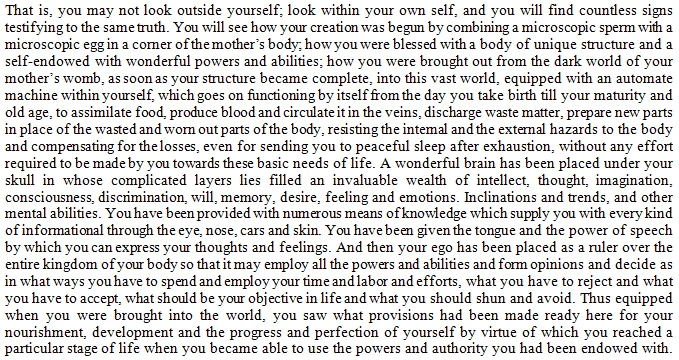
In order to make use of these powers, you were granted means upon the earth, provided with opportunities, and given the ability to control and utilize many things according to your will.25
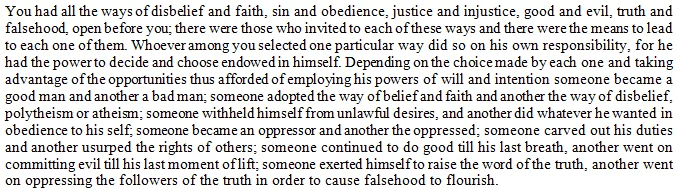
One does not need to be exceptionally intelligent to recognize that a Wise Creator is behind the existence of humanity, and only those who are utterly devoid of sense would deny His existence:26

Allāh not only created the world but also sustains and governs it. He cares for the universe and all who live within it, and without His constant care and management, the world would not endure for long. To illustrate, imagine visiting a factory where electronic devices are produced. You would see hundreds of workers carrying out various tasks, but there would be one person responsible for overseeing everything—the factory manager. This manager supervises the workers, ensures operations run smoothly, and sees that all targets are met. They handle major responsibilities such as screening, recruiting, and training new employees, maintaining machinery, and inspecting finished products to meet quality standards. They also tend to smaller details, like ensuring the cleanliness of the facility. In the same way, Allāh is the Manager of the universe—He is the One in charge and in control of everything, intricately involved in every aspect of the world and our individual lives. He governs the elements and the forces of nature. There is no such thing as “Mother Nature”; rather, there is a supreme God—Allāh—who rules over all of nature. Our belief in Allāh is fully justified and deeply meaningful, as it arises naturally from our fiṭrah (divinely endowed innate monotheistic disposition), just like our instinctive belief in the existence of good and evil, causality, numbers, truth, and being itself. To deny such a core pillar of the fiṭrah is to strip ourselves of a coherent way to interpret reality, leading—if pursued consistently—to radical skepticism and a collapse into endless doubt.
Moreover, studies conducted by scientists examining societies across the globe have revealed that, despite cultural and individual differences, all human beings possess an inherent sense of right and wrong. Every rational person recognizes that certain actions are innately good, while others are inherently evil. For instance, acts such as rape and child abuse are universally regarded as fundamentally wrong, whereas defending the innocent or feeding the poor are widely recognized as morally good. Even Antony Flew and Wallace Matson—two prominent atheistic philosophers of the 20th century—explicitly acknowledged the existence of objective morality during their debates with the theistic philosopher Thomas B. Warren in the 1970s.27 Atheist Michael Ruse admitted in his book Darwinism Defended that “[t]he man who says that it is morally acceptable to rape little children, is just as mistaken as the man who says that 2 + 2 = 5.”28 Recognition by atheists that certain actions are morally wrong raises an important question: How can an atheist logically describe anything as atrocious, deplorable, evil, or wicked?29

The moral argument for the existence of God exposes atheism as the self-contradictory and deeply flawed philosophy that it is:30

Reason dictates that objective good and evil can only exist if there is a real, objective reference point beyond the natural world. The only reasonable explanation for the existence of an objective moral law is the presence of a supernatural, moral Lawgiver. In other words, Allāh is the best—and indeed the only—explanation for the reality of objective moral truths. Objective morality is self-evident, as we intuitively recognize that some actions are inherently right while others are inherently wrong. These moral truths exist independently of individual preferences, beliefs, or opinions. As previously noted, even many atheists concede that genuine objective good and evil exist. However, only belief in Allāh can provide a coherent foundation for this reality, while atheism, by its very nature, cannot. Intellectual consistency requires rejecting any worldview that fails to account for what it claims. Atheists are thus left with two options: either they are being intellectually dishonest, or they fail to grasp that their worldview lacks the capacity to explain objective morality. Since every attempt to maintain both morality and atheism is simply an exercise in intellectual incoherence, one must choose: either maintain atheism and embrace amorality, or uphold morality and embrace theism.31

Again, the truth of Allāh is known instinctively, for He has placed this knowledge within every human heart. This is why we possess a natural inclination to turn to and appreciate Allāh in times of ease—thanking Him and glorifying Him for His countless blessings and generosity—because we inherently recognize Him as our Creator and true Provider. Likewise, we instinctively turn to Him in moments of hardship and danger. When someone is faced with a serious crisis, they begin to call upon Allāh with full sincerity. In such moments, all the man-made illusions are stripped away from the mind, and it becomes clear that human beings are entirely helpless, and that Allāh alone possesses true power. Undeniably, no human being truly believes, deep within their heart, that they are the child of nature (a being shaped entirely by natural forces, without divine purpose or origin), or that they are merely an animal. Some alleged Muslims leave Islam, claiming that it is incompatible with reason and science. However, it is atheists who, in fact, make the most irrational claims, such as:32
1.Everything came from nothing.
2.An explosion caused exquisite order.
3.Random chance produced precision.
4.Life emerged in nature from non-life.
5.A finely tuned universe came into being without a Designer.
6.Fish and frogs are the distant ancestors of human beings.
7.Intelligence ultimately arose from non-intelligence.
8.Human beings are either morally equal to a moose, or they somehow evolved a moral sense from amoral mice.
Islam, on the other hand, is entirely rational because, among other things:
1.Matter demands a Maker.
2.Life demands a Life-Giver.
3.Design demands a Designer.
4.Intelligence demands an Intelligent Creator.
5.Morality demands a Moral Lawgiver.
It is, without question, logical to believe in Allāh, as former atheist Antony Flew so eloquently concluded: “I must say again that the journey to my discovery of the Divine has thus far been a pilgrimage of reason. I have followed the argument where it has led me. And it has led me to accept the existence of a self-existent, immutable, immaterial, omnipotent, and omniscient Being.”33
Let us now turn to the question: Is it reasonable for someone to dismiss the mountain of irrefutable, compelling, and credible evidence attesting to Allāh’s existence simply because they encounter a misconception about Islam that they do not understand? No—by Allāh, shubuhāt (specious arguments and doubts) are in no way a valid justification for disbelief. A sincere seeker of truth who genuinely follows the evidence will logically arrive at the conclusion that Allāh exists. The real motive behind atheism and denial of the Lord of the Worlds is not rooted in intellectual objections, but in surrendering to personal whims—the desire to disbelieve. The so-called shubuhāt are merely excuses. As previously explained, the disbelievers' true object of worship is their own desires; they serve their whims, doing whatever satisfies them. In essence, they worship the greatest idol—the idol of the self. It must, however, be acknowledged that there are some disbelievers whose rejection of faith stems from a perceived conflict between scientific understanding and the religious doctrines of the faith into which they were born. These individuals often adopt an agnostic or atheistic stance by default, remaining open to truth while still seeking convincing answers. If such people encounter sound arguments, they are likely to embrace belief. In contrast, the true kuffār (disbelievers) are those who, despite being presented with clear and sufficient evidence, knowingly reject the truth for personal reasons. They are convinced of its reality but refuse to accept it because belief would disrupt their worldly comfort and desires. Their lives revolve around indulgence and amusement, material gain, and the pursuit of self-satisfaction, without concern for truth or accountability. They follow conjecture and chase unrestricted freedom. But when the shallow shubuhāt raised by atheists are placed alongside the countless and overwhelming proofs of Muḥammad’s (PBUH) prophethood—proofs that remove any doubt about his truthfulness as a Divine Messenger—the irrationality, absurdity, and hollowness of the atheistic position becomes painfully clear. How could any rational person turn away from a Divine Message that aligns perfectly with their innate disposition and fulfills their deepest existential and moral needs? Islam is the one Message we all need more than anything else. It explains the ultimate purpose of our existence, reveals the origin of our religious instinct and intuitive sense of morality, and provides a rational foundation for objective morals. In Islam, we believe that Allāh is a being of absolute perfection—All-Knowing, All-Powerful, and the very essence of goodness. One of His names is Al-Barr, the source of all goodness. When Allāh issues a moral command, it is rooted in His will, and His will is never in conflict with His nature. Thus, what Allāh commands is good, because He is good—and He alone defines what goodness truly is: {Say, “Surely Allāh never enjoins any indecency”} (Qurʾān 7:28). Furthermore, Islam teaches us the essence of servitude to Allāh and how to embody it. There is overwhelming evidence that Islam is the complete and perfect truth for all of humanity. Anyone who sincerely examines the Qurʾān and the authentic Sunnah will find abundant proof that Islam is a divinely revealed religion. Consider the numerous miracles performed by the Prophet Muḥammad (PBUH), by the permission of Allāh—miracles that could only be performed by the Prophets of Allāh. It is a consistent divine practice that Allāh grants supernatural signs to His Prophets as evidence of their truthfulness and as a means of establishing proof against their people. Alongside the greatest miracle granted to Prophet Muḥammad (PBUH)—the Qurʾān—he also performed many physical miracles that were witnessed by his contemporaries, including thousands of believers and skeptics. Verses of the Qurʾān were revealed referencing some of these supernatural events after they occurred. Had these miracles not taken place, the Prophet (PBUH)’s opponents would have eagerly seized the opportunity to expose him. Yet the growing strength of the believers’ faith, coupled with the silence of the disbelievers and their failure to deny these events, serves as implicit acknowledgment from both sides that the miracles occurred exactly as described in the Qurʾān. This should convince any fair-minded and objective seeker of truth that Muḥammad (PBUH) did indeed perform these great miracles by divine support, and that he was truthful when he declared, “I am Allāh’s Messenger.”
Any Muslim may find themselves in a situation where they encounter something about Islam they have never fully understood—perhaps they are suddenly asked a question and are unable to answer, or they come across a verse in the Qurʾān or a ḥadīth that seems unclear or confusing. In such moments, doubts may begin to creep in, which is entirely normal, but it is never a valid reason to abandon one’s faith. The Qurʾān and Sunnah should be viewed as interconnected data points; rarely is a single verse or narration enough to grasp the full depth of an issue, and often both are needed to understand the subject in its entirety. Therefore, if a verse or ḥadīth appears troubling, it may simply mean that another piece of information—another verse or narration—is missing from our current understanding. Removing doubt is the essential first step in benefiting from knowledge, and the Muslim can do this by turning to qualified scholars. Indeed, these scholars have already examined and debated the very questions that may trouble us, centuries ago. Thus, when a Muslim is faced with a difficult question, they can rest assured that answers exist—they just need to be sought out. Therefore, if something you read about Islam causes confusion, do not stop there; instead, look into the context and find the related verses and narrations that offer clarification. Doubt, again, is natural—but lingering in it without seeking answers is when it can become spiritually harmful. It must be emphasized that suspicions about Islam do not arise from contradictions in Allāh’s religion. In fact, the Qurʾān and Sunnah—Islam’s two foundational sources—contain precise, far-reaching statements that address a broad range of topics, lay down laws and moral codes, recount the histories of past nations, forecast future events, and contain scientific truths that were unknown at the time of revelation. And yet, despite the vastness and depth of this body of knowledge, it is free from any contradiction or inconsistency—a clear indication of Divine authorship. Over time, many critics have attempted to attack the Qurʾān and Sunnah by alleging contradictions, yet every such attempt has ended in failure. The root of most suspicions lies in the tendency to prioritize human reasoning (ʿaql) over divine revelation (naql). Strict rationalists argue that the intellect alone determines the moral value of actions, rejecting the idea that divine command is what grants moral status. They advocate the theory of at-taḥsīn wa-t-taqbīḥ al-ʿaqliyyayn (the knowledge of merits and demerits of things based on intellect), which assesses actions based solely on reason or perceived utility, and they deny the role of divine legislation in moral judgment. In cases of conflict, they side with rationality over revelation. Consequently, they dismiss anything that seems beyond the grasp of reason. Yet one of Islam’s most distinctive features is its balanced integration of ʿaql and naql—reason and revelation. While human intellect can identify good and evil, divine revelation is necessary to safeguard it from error, distortion, and falsehood. Intellect leads to revelation, but it cannot replace it. Instead, intellect must be used to understand revelation—not to judge its acceptability. As Mawlānā Shabbīr Aḥmad ʿUthmānī states in al-ʿAql wa-n-Naql, revelation does not contradict reason; rather, our intellects are limited and thus sometimes unable to grasp the truths found in revelation.34 In fact, the first being to prefer reason over revelation was the Devil himself, who refused to prostrate to Adam out of his belief that fire was superior to clay. His reliance on flawed reasoning led to his downfall—demonstrating the grave error of elevating intellect above divine command.35 One of the main characteristics of the disbelievers is the false pride and arrogance that they exhibit: {Verily, those who dispute about the Ayat of Allāh, without any authority having come to them, there is nothing else in their breasts except pride} (Qurʾān 40:56). That is, they attempt to refute the truth with falsehood and challenge sound evidence with dubious arguments, lacking any proof from Allāh—driven purely by their refusal to submit to the truth and the one who brings it. This false pride can stem from wealth, power, beauty, or fame, and often from possessing knowledge. For example, individuals who attain advanced academic degrees, such as a master’s or doctorate—particularly in science—may become excessively proud of their credentials, research papers, or discoveries. They may assume that they are more intelligent than those who do not grasp science or philosophy and begin to look down on others. This sense of superiority frequently leads them to show arrogance toward religion and toward God Himself. Sadly, this arrogance compels them to cling to their positions, even when overwhelming evidence proves them wrong. They convince themselves that they cannot be mistaken, and once they have publicly taken a stance, they refuse to retract it for fear of embarrassment. A related form of arrogance occurs when disbelievers observe that those of lesser education or lower social status believe in God, and they scornfully respond by assuming that if belief in God were truly valuable, they—as supposedly smarter and superior individuals—would have embraced it first. Allāh says: {The disbelievers say of the believers, “Had it been ˹something˺ good, they would not have beaten us to it.” Now since they reject its guidance, they will say, “˹This is˺ an ancient fabrication!”} (Qurʾān 46:11). The doctrine of monotheism and belief in the Hereafter to which the Prophet (PBUH) called humanity is entirely rational, and the signs throughout the universe testify to its truth and soundness. Allāh issued a stern warning and a grave threat to those who stubbornly oppose this message, especially those who distort the meanings of Qurʾānic passages and remove them from their proper context. Allāh makes it clear that the actions of those who introduce deviation into His verses are not hidden from Him, and they will not be able to escape the consequences of their deeds: {Indeed, those who abuse Our revelations are not hidden from Us. Who is better: the one who will be cast into the Fire or the one who will be secure on Judgment Day? Do whatever you want. He is certainly All-Seeing of what you do} (Qurʾān 41:40). This verse refers to a specific kind of denial known as ilḥād, which means to deviate or swerve from what is right and just. In the context of the Qurʾān, ilḥād refers to deliberately twisting or misinterpreting the meanings of Allāh’s words, taking them out of context, or introducing false interpretations to mislead oneself or others. It represents not just disbelief, but a willful and corrupt distortion of divine revelation—a serious form of denial that earns stern condemnation in the Qurʾānic discourse:36
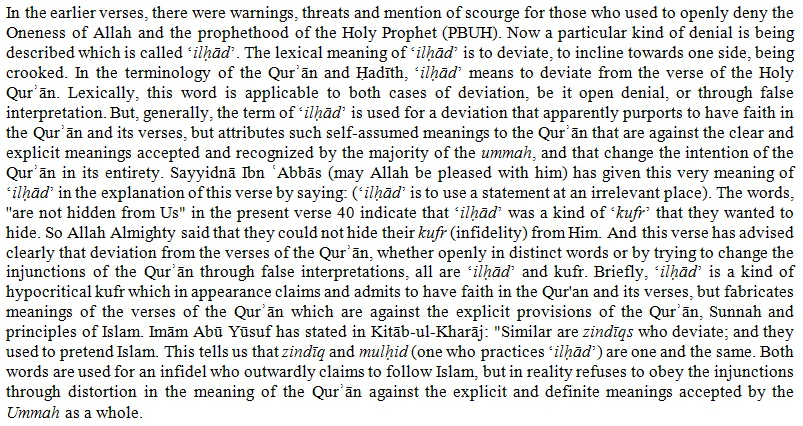
Hence, ilḥād in the revelations of Allāh refers to deliberately deviating from their clear and straightforward meaning—misinterpreting them in a way that leads both oneself and others astray. This was one of the tactics employed by the disbelievers of Makkah to undermine the message of the Qurʾān: they would listen to its verses, then isolate a verse from its context, distort another, or twist the meaning of a word or phrase. In doing so, they would raise all sorts of objections and falsely claim that the Prophet (PBUH) had said something he never actually said, thereby misleading the people and spreading doubt about the Divine message.37
Once again, shubuhāt (specious arguments and doubts) arise from prioritizing the dictates of reason over divine revelation—something that every apostate knows deep within their heart. In truth, apostates do not abandon Islam because of these doubts; rather, their apostasy stems from elevating their flawed and feeble intellect, along with their base desires, above the revealed guidance of their Lord. They may offer a thousand arguments in an attempt to convince others that they sincerely embraced atheism after leaving Islam, but their own conscience is never unaware of the true reason for their disbelief, nor of what truly prevents them from acknowledging its falsehood. That is why Allāh says that on the Day of Reckoning, man will bear witness against himself, despite the excuses he may offer: {In fact, people will testify against their own souls, despite the excuses they come up with} (Qurʾān 75:14–15). Allāh’s religion is perfect, and if apostates were to reflect upon His Book, they would find no discrepancy in its words or meanings: {Do they not then reflect on the Qurʾān? Had it been from anyone other than Allāh, they would have certainly found in it many inconsistencies} (Qurʾān 4:82). That is, a plain recitation that lacks deliberation and deep reflection may cause one to perceive contradictions that do not actually exist. In other words, atheists persistently raise baseless objections against the Qurʾān simply because they fail to ponder over it. Lay Muslims should study the Qurʾān under the guidance of scholars to safeguard themselves from falling into doubts and misunderstandings. If this is not possible, then they should take to the study of some authentic and reliable Qurʾānic exegesis, and if any doubt arises during such study, they must consult expert scholars rather than seek solutions based on personal opinion. It is important to note that the Qurʾān itself commands every human being to reflect upon its meanings. However, the depth of reflection will naturally differ according to one's level of knowledge and understanding. That is, no individual or group has a monopoly over the interpretation of the Qurʾān and Sunnah, but there are essential conditions and qualifications for undertaking such a task.38

Undoubtedly, the Qurʾān is free from all forms of inconsistency and contradiction, which stands as clear proof that it is the Word of Allāh.
The case for Allāh’s existence in the Qurʾān and Sunnah includes heart-based appeals rooted in intuition and mind-based appeals grounded in rational reflection. The evidence for the truth of Islam is thus decisive and firmly established—both intuitively and intellectually—and is further supported by the purpose, meaning, comfort, and guidance it brings to our lives. Specious arguments (shubuhāt; sing. shubhah)should not disturb a Muslim who thinks properly. Any doubt that unsettles the believer must be addressed with sound evidence. He should consult scholars or refer to authentic books and reliable websites, approaching the matter with sincerity and objectivity. Soon enough, he will recognize that Islam offers authentic, rational answers to every question and clear responses to every misconception. It is worth noting that the Salaf (the first three generations of Muslims—the Companions, the Successors, and the Successors of the Successors) were not preoccupied with countering every shubhah raised by Islam’s opponents, as many are today. Imagine if the Companions of the Prophet (PBUH) had abandoned the mission of spreading Islam to engage in endless debates with every arrogant sophist who rejected the Lord of the Worlds, or spent their time unraveling every legal detail to appease every self-styled philosopher! They neither had the time nor the need to address each and every fabrication and objection. Had that been their primary focus, would they have found the time to carry Islam’s message across the globe? One must remember that there is no end to the confusions and inconsistencies that disbelievers may fabricate about the Qurʾān and Islam. This is because the Qurʾān’s unique style can only be truly grasped with reason and sincerity. Therefore, we should not be surprised by the absurd interpretations and objections put forward by Islam’s critics. The believer is not obligated to refute every minor shubhah; rather, his duty is to convey the Qurʾān’s truths and miracles. And when truth is made manifest, falsehood inevitably vanishes. Once again, the key lies in sincerity—truth reveals itself only to those who earnestly seek it. Sophists, however, will never stop arguing, even if presented with every clear proof, for they are not concerned with truth. In fact, they are averse to it. Sophistry involves using arguments one does not even find convincing himself, treating debates as battles rather than as sincere efforts to uncover truth. Their goal is not to seek truth or understanding, but rather to ensure they leave the dialogue holding the very same views they entered with. As mentioned earlier, such people focus on what is ambiguous in Allāh’s religion and will never understand His Book properly, for they approach it with prejudice and ulterior motives.39

Allāh has presented all kinds of examples in the Qurʾān so that people may understand His Message, yet Man remains highly argumentative and persistently opposes the truth with falsehood: {We have surely set forth in this Qurʾān every ˹kind of˺ lesson for people, but humankind is the most argumentative of all beings} (Qurʾān 18:54). Indeed, Allāh has left no stone unturned in making the truth clear to mankind in the Qurʾān. He has employed every kind of argument, parable, and similitude, along with the most effective appeals to both the heart and the mind, expressed in the most eloquent language. Yet, some choose to counter clear and convincing arguments with empty objections. Such people will never submit to the law of the Lord of the Worlds. They will persist in raising baseless doubts—perhaps until the very end of the human trial, when the Day of Judgment arrives.
In sum, the shubuhāt (specious arguments and doubts) raised about Islam have never been—and will never be—a genuine problem for true believers, nor can they ever serve as a valid justification for disbelief or atheism. The efforts made by distinguished people of knowledge—Muslim scholars and preachers—to address these shubuhāt are simply intended to reassure sincere truth seekers, halt the spread of falsehood, and confront those who use such doubts to justify their misguidance. Apostasy from Islam, once again, is not rooted in shubuhāt; rather, it stems from an obstinate, arrogant, and morally corrupt way of thinking and living, as well as the failure to engage reason properly. A person who is primarily concerned with gratifying personal whims and desires inevitably becomes self-centered and selfish. Prioritizing one’s own inclinations leads to a rejection of religion, as it is seen as an obstacle to fulfilling those desires. The combination of arrogance and unrestrained desire, when left unchecked by any religious moral code, is a destructive force that drives many to reject religious teachings—and eventually, even the very notion of Allāh. This is because, for such individuals, life becomes more convenient without God, as they are no longer bound by the moral framework He has prescribed. Yet Allāh has sent His Messenger (peace be upon him) with the truth—the proclamation that there is no deity worthy of worship but Him—and He has established clear, definitive, and rational proofs in support of that truth. Those who knowingly reject Allāh despite inwardly recognizing His existence are, as Allāh describes them, nothing but liars: {In fact, We have brought them the truth, and they are certainly liars} (Qurʾān 23:90). They are liars because they know in their hearts that Allāh is the Owner and Sovereign of the universe, yet they claim that there is no life after death—a claim based on the false presumption that the All-Powerful Allāh cannot recreate what He created once before, which is a clear contradiction in itself. Thus, following one’s whims and desires leads to serious consequences. The following verses condemn human desires that are not aligned with divine guidance, and make it clear that such desires are the very reason people go astray. Allāh says: {And who could be more astray than those who follow their desires with no guidance from Allāh?} (Qurʾān 28:50). He also says: {And do not obey those whose hearts We have made heedless of Our remembrance, who follow ˹only˺ their desires and whose state is ˹total˺ loss. (Qurʾān 18:28). And He says: {And do not follow ˹your˺ desires or they will lead you astray from Allāh’s Way} (Qurʾān 38:26). Likewise, the Prophet (peace be upon him) said: “Indeed, among what I fear most for you are the seductive temptations related to your stomachs and private parts, and the misguidance of whims.”40 Following one’s whims is among the blameworthy traits that blind and obstruct their bearer from recognizing the truth and ultimately lead them to ruin, as the Prophet (peace be upon him) said: “Three deeds are destructive vices, three are salvific virtues, three are expiations, and three are causes for elevation in ranks. As for the destructive vices, they are: greed that is obeyed, whims that are followed, and a person being impressed with his own self...”41 Thus, the most important battle a Muslim must fight is the internal struggle to overcome his own evil inclinations (jihād an-nafs). The Prophet (PBUH) affirmed that the true mujāhid in the cause of Allāh is the one who strives against his own self, saying: “The best jihād is the striving of a man against his self and his hawá (base desires).”42 Indeed, the greatest calamity that can befall a Muslim is to become ensnared by misleading whims. Such a trial corrupts hearts and brings ruin to societies. Allāh commands us to restrain our sinful desires and submit them to His will, and whoever succeeds in doing so will be admitted into Paradise: {And as for those who were in awe of standing before their Lord and restrained themselves from ˹evil˺ desires, Paradise will certainly be ˹their˺ home} (Qurʾān79:40–41). Following one’s whims is perilous, for it obstructs the path to truth and opens the door for shubuhāt (specious arguments and doubts) to enter the heart. When whims and desires dominate, they lead to weakened faith, inner turmoil, and discontent with the Divine Decree. A Muslim must prioritize the struggle against his vain desires—striving to overcome his inner inclinations and seeking to please Allāh through acts of obedience while avoiding acts of disobedience. A person becomes vulnerable to shubuhāt during moments of sin, but when he repents and refrains from wrongdoing, those shubuhāt vanish on their own—glory be to Allāh. Moreover, following one’s whims weakens discernment to the extent that one can no longer distinguish between truth and falsehood, or good and evil. As previously discussed, part of following whims involves pursuing the unclear verses of the Qurʾān and distorting their meanings to suit personal desires, selectively seeking opinions that align with one’s inclinations, and following the slips of scholars while disregarding the consensus that aligns with the clear and established texts. As ʿAlī ibn abī Ṭālib [may Allāh be pleased with him] said: “Following one’s whims blocks the way of the truth.”43 Therefore, before embarking on a journey of learning to seek answers to the shubuhāt raised about Islam, one must first strive to restrain personal desires—for this is the essential first step and the most effective means of suppressing doubts. You must engage in the internal jihād against your whims to purify your soul. This entails battling greed for worldly pleasures, hypocrisy and insincerity, hatred and envy, arrogance and pride, vanity and narcissism, and other destructive traits that Satan exploits to lead human beings to ruin. Furthermore, you should be content with the law of your Lord, even when it contradicts your personal desires. That is, you should never place your desires above the will of your Lord—for while you may seek only worldly gain, Allāh desires for you the everlasting good of the Hereafter: {You ˹believers˺ settled with the fleeting gains of this world, while Allāh’s aim ˹for you˺ is the Hereafter} (Qurʾān 8:67). Neglect of the Hereafter stems from the desire for immediate reward in return for one’s efforts. That is, Man tends to disregard the Hereafter because its outcomes seem distant and far-off, while worldly life offers the allure of instant gratification, prompting him to hasten toward it: {But no! In fact, you love this fleeting world, and neglect the Hereafter} (Qurʾān 75:20–21). Since Man seeks to escape the moral restrictions that inevitably accompany belief in Allāh and the Hereafter, his selfish whims and motives drive him to deny both. He then attempts to justify this denial by constructing arguments that rationalize his stance. Those who reject belief in Allāh and the Hereafter are, in truth, narrow-minded and shortsighted, for they consider only the outcomes that manifest in this worldly life to be of consequence. They give no weight to the consequences that await in the Hereafter, and thus devote all their energy to securing whatever benefits and pleasures they can obtain here and now. In essence, they are only interested in immediate gains—a “cash bargain,” so to speak. This way of thinking leads them to a firm resolve not to acknowledge the existence of Allāh or the Hereafter, even though deep within, their conscience affirms the rational strength of the Qurʾān’s arguments and the weakness of their own counterclaims. If you adhere to what Allāh has commanded, restrain your desires, and submit to His will, most of your doubts will naturally fade away. Anyone who undertakes a sincere journey to discover the beauty and majesty of Islam will come to see that nothing on earth equals the power and perfection of this religion. The arguments presented by atheists—arguments they elevate above the sharʿī (Islamic legal) texts, i.e., divine revelation—are ultimately baseless, and in contrast, Allāh’s is the conclusive argument. That is, atheists possess no sound reasoning that can counter the Qurʾān’s intellectual dismantling of their false creed. Allāh, in His supreme wisdom, does nothing without purpose—whether in creation or legislation. He neither creates nor commands anything in vain. Those who understand that Allāh is the All-Wise, and that everything He wills carries meaning, benefit, and wisdom, are safeguarded from doubts, misguidance, and from questioning His Divine Will and Wisdom. Nevertheless, Muslims may experience occasional doubts, whether due to satanic whispers or the many lies and distortions about Islam spread through the internet, public discourse, or academia. Therefore, they must safeguard their faith with the preventative measures discussed earlier. Every Muslim must also recognize that the Qurʾān contains unequivocally clear verses, and the Sunnah contains decisively authentic, mass-transmitted reports that form the foundation of religious knowledge—and it is through these that all other texts are to be understood. Those who attack Islam typically rely on verses that are open to multiple interpretations, ignoring the clarity and context provided by the core texts.44 Muslims, therefore, must hold firmly to the decisive verses of the Qurʾān and the mass-transmitted reports of the Sunnah, fully aware that unbelievers—whether deliberately or out of ignorance—will misinterpret what is susceptible to misinterpretation, particularly by those unfamiliar with the Arabic language of the Qurʾān. In other words, every Muslim should become acquainted with the foundational principles of the religion and its clear proof-texts, and turn away from those who promote specious interpretations. Moreover, there is nothing blameworthy about lay Muslims experiencing doubts as a result of the attacks, lies, and distortions spread by non-Muslims. Since such doubts may unsettle the heart and cause distress, it becomes obligatory for the believer in such a situation to consult trustworthy scholars. Sincerely seeking guidance from reliable Muslim scholars and consulting their writings is the only effective remedy for doubts that arise from ignorance.
Notes and References
- 1
Maulana Wahiduddin Khan, Tazkirul Quran, (Noida, India: Goodword Books, 2012), Chapter al-Jāthiyah (Qurʾān 45:23), p. 1489–1490, footnote b, available at: https://archive.org/details/CPS-TQE/page/1490/mode/2up?view=theater.
- 2
Abū Ḥāmid al-Ġazālī, al-Munqiḏ mina aḍ-Ḍalāl (The Deliverance from Confusion), (Cairo, Egypt: Dār al-Kutub al-Ḥadīthah, 1972), p. 111.
- 3
Ibid., p. 182.
- 4
Aḥmad ibn ʿAbd al-Ḥalīm ibn Taymiyyah, Majmūʿ al-Fatāwá, (al-Madīnah al-Munawwarah, Saudi Arabia: King Fahd Complex for the Printing of the Noble Qurʾān, 2004), vol. 16, p. 328.
- 5
Justin L. Barrett, Cognitive Science, Religion, and Theology: From Human Minds to Divine Minds, (Conshohocken, U.S.: Templeton Press, 2011), p. 49.
- 6
Aisha Stacey, “Dealing with Doubts,” New Muslims eLearning Site, 14 Jan. 2013, https://www.newmuslims.com/lessons/175/dealing-with-doubts/.
- 7
Muḥammad ibn Ṣāliḥ ʿUthaymīn, Sharḥ Thalāthat al-Uṣūl, (ar-Riyāḍ, Saudi Arabia: Dār ath-Thurayyā, 2004), vol. 1, p. 18.
“Simple ignorance is to not comprehend something in its entirety. Compound ignorance is to comprehend something in a way that contradicts what it actually is.”
- 8
Ibid., vol. 1, p. 19.
- 9
Muḥammad ibn Ḥibbān, Ṣaḥīḥ Ibn Ḥibbān, (Bayrūt, Lebanon: Muʾassassat ar-Risālah, 1988), ḥadīth: 122.
- 10
Abū Muḥammad ʿAlī ibn Aḥmad ibn Saʿīd ibn Ḥazm al-ʾAndalusī, al-Faṣl fī al-Milal wa-l-ʾAhwāʾ wa-n-Niḥal, (Bayrūt, Lebanon: Dār al-Kutub al-ʿIlmiyyah, 2007), vol. 2, p. 73.
- 11
{Indeed, in the creation of the heavens and the earth and the alternation of the day and night there are signs for people of reason. ˹They are˺ those who remember Allāh while standing, sitting, and lying on their sides, and reflect on the creation of the heavens and the earth ˹and pray˺, “Our Lord! You have not created ˹all of˺ this without purpose. Glory be to You! Protect us from the torment of the Fire} (Qurʾān 3:190–191).
- 12
Muḥammad ibn Ṣāliḥ ʿUthaymīn, Sharḥ Thalāthat al-Uṣūl, (ar-Riyāḍ, Saudi Arabia: Dār ath-Thurayyā, 2004), vol. 1, p. 29.
- 13
Abū al-Fiḍāʾ ʿImād ad-Dīn Ismāʿīl ibn ʿUmar ibn Kathīr, Tafsīr al-Qurʾān al-ʿAẓīm,(ar-Riyāḍ, Saudi Arabia: Dār Ṭaybah, 1997), vol. 1, p. 106.
- 14
Ibid., p. 107.
- 15
Ibid.
- 16
Muḥammad al-Bukhārī, Ṣaḥīḥ al-Bukhārī, (Cairo, Egypt: Dār as-Salām. 1999), book: 2, ḥadīth: 9, available at: https://sunnah.com/bukhari:16.
- 17
Abū Ḥāmid al-Ġazālī, al-Munqiḏ min aḍ-Ḍalāl (The Deliverance from Confusion), (Cairo, Egypt: Dār al-Kutub al-Ḥadīthah, 1972), pp. 185–186.
- 18
Abu Amina Elias, “Dealing with Faith-Related Doubts in Islam,” Faith in Allah, 7 Oct. 2021, https://www.abuaminaelias.com/dealing-doubts-islam/.
- 19
Ibid.
- 20
Kai Nielsen, Reason and Practice: A Modern Introduction to Philosophy, (New York, U.S.: Harper and Row, 1971), p. 181.
- 21
Dennis Bonnette, “Are Metaphysical First Principles Universally True?” Strange Notions, accessed 6 Jan. 2023, https://strangenotions.com/are-metaphysical-first-principles-universally-true/.
- 22
Sayyid abū al-Aʿlá al-Mawdūdī, Towards Understanding the Qurʾān (English version of Tafhīm al-Qurʾān), trans. and edit. Zafar Isḥāq ʾAnṣārī, (Markfield, U.K.: The Islamic foundation, 1988), Chapter aṭ-Ṭāriq (Qurʾān 86:5), footnote 2, available at: https://www.islamicstudies.info/tafheem.php?sura=86&verse=1&to=17.
- 23
Ibid., Chapter aḏ-Ḏāriyāt (Qurʾān 51:20), footnote 18, available at: https://www.islamicstudies.info/tafheem.php?sura=51&verse=1&to=23.
- 24
Ibid., Chapter aḏ-Ḏāriyāt (Qurʾān 51:21), footnote 19, available at: https://www.islamicstudies.info/tafheem.php?sura=51&verse=1&to=23.
- 25
Ibid.
- 26
Ibid.
- 27
Antony Flew and Thomas B. Warren, The Warren-Flew Debate on the Existence of God, (Jonesboro, U.S.: National Christian Press, 1977); Thomas B. Warren and Wallace Matson, The Warren-Matson Debate on the Existence of God, (Jonesboro, U.S.: National Christian Press, 1978) .
- 28
Michael Ruse, Darwinism Defended, (London, U.K.: Addison-Wesley, 1982), p. 275.
- 29
Eric Lyons and Kyle Butt, “7 Reasons to Believe in God,” Apologetics Press, accessed 5 Jan. 2023, https://apologeticspress.org/7-reasons-to-believe-in-god-5045/.
- 30
Ibid.
- 31
Robert S. Smith, “The Amorality of Atheism,” Themelios, vol. 40, issue 3, accessed 7 Jan. 2023, https://www.thegospelcoalition.org/themelios/article/the-amorality-of-atheism/.
- 32
Eric Lyons and Kyle Butt, “7 Reasons to Believe in God,” Apologetics Press, accessed 5 Jan. 2023, https://apologeticspress.org/7-reasons-to-believe-in-god-5045/.
- 33
Antony Flew and Roy Varghese, There Is a God: How the World’s Most Notorious Atheist Changed His Mind, (New York, U.S.: Harper Collins, 2007), p. 155.
- 34
Siddiqa al-Farsiyyah, “Reason and Revelation [ʿAql & Naql],” Siblings of Ilm, 4 Sep. 2022, https://siblingsofilm.com/reason-and-revelation-aql-naql/.
The ʿaql is deficient due to the following main reasons:
1.ʿAql is dependent on the five senses and one’s thoughts. Thus, ʿaql being the intellectual strength cannot perform its role without the physical strength. If one cannot see, hear, feel, speak, or smell, then their ʿaql would be very defective and weak.
2.If following ʿaql was enough for existence, and for reaching tawḥīd (monotheism), then Allāh would not have sent naql. Allāh sending down revelation indicates that there are things that our intellects cannot reach without it.
3.Everyone’s intellect is not on the same calibre. Every society thinks differently. As time goes on, our reasonability changes whereas naql is forever and unchanging. So, it makes sense to base everything upon naql since it does not change, rather than ʿaql, which changes.
4.The first being who gave preference to ʿaql over naql was Iblīs, because it did not make sense to him that he has to prostrate to someone who is inferior. So, it was his ʿaql that resulted in his rejection.
- 35
Ibid.
- 36
Muḥammad Shafīʿ ibn Muḥammad Yāsīn ʿUsmānī Deobandī, Maʿārif-ul-Qurʾān: A Comprehensive Commentary of the Holy Qurʾān, trans. Muḥammad Hasan Askari and Muhammad Shamīm, (Karachi, Pakistan: Maktaba-e-Darul-ʿUloom, 2010), Chapter Fuṣṣilat (Qurʾān 41:40), pp. 657–658,available at: https://islamicstudies.info/quran/maarif/maarif.php?sura=41&verse=40.
- 37
Sayyid abū al-Aʿlá al-Mawdūdī, Towards Understanding the Qurʾān (English version of Tafhīm al-Qurʾān), trans. and edit. Zafar Isḥāq ʾAnṣārī, (Markfield, U.K.: The Islamic foundation, 1988), Chapter Fuṣṣilat (Qurʾān 41:40), footnote 49, available at: https://www.islamicstudies.info/tafheem.php?sura=41&verse=33&to=44.
- 38
Muḥammad Shafīʿ ibn Muḥammad Yāsīn ʿUsmānī Deobandī, Maʿārif-ul-Qurʾān: A Comprehensive Commentary of the Holy Qurʾān, trans. Muḥammad Hasan Askari and Muhammad Shamīm, (Karachi, Pakistan: Maktaba-e-Darul-ʿUloom, 2010), Chapter an-Nisāʾ (Qurʾān 4:82), pp. 515–517, available at: https://islamicstudies.info/quran/maarif/maarif.php?sura=4&verse=81.
- 39
Harun Yahya, How Do the Unwise Interpret the Qar'an? (New Delhi, India: Millat Book Center, 2001), pp. 12–13, available at: https://www.academia.edu/42051596/HOW_THE_UNWISE_INTERPRETE_THE_QURAN.
- 40
Muḥammad Nāṣir ad-Dīn al-ʾAlbānī, Ṣaḥīḥ at-Tarġīb wa-t-Tarhīb, (ar-Riyāḍ, Saudi Arabia: Maktabat al-Maʿārif, 2000), p. 52.
- 41
---., Ṣaḥīḥ al-Jāmiʿ aṣ-Ṣaġīr, (Bayrūt, Lebanon: al-Maktab al-Islāmī, 1988), ḥadīth: 3039.
- 42
Ibid., ḥadīth: 1099.
- 43
Aḥmad ibn Ḥanbal, az-Zuhd, (Cairo, Egypt: Dār Ibn Rajab, 2003), ḥadīth: 377.
- 44
Abu Amina Elias, “Dealing with Faith-Related Doubts in Islam,” Faith in Allah, 7 Oct. 2021, https://www.abuaminaelias.com/dealing-doubts-islam/.
For instance, they will claim some verses contradict “science” but such verses use figurative language and do not in any way conflict with what can be proven from rational methods. They will also claim some verses contradict “history” or “morality” as they impose the worst possible disingenuous interpretation upon them.