What are the underlying causes of this religious form of obsessive-compulsive disorder (OCD)?
Despite a wide range of theories and extensive research, scientists have not yet identified a definitive cause for why a person develops obsessive-compulsive disorder (OCD), including its religious variant, known in clinical literature as scrupulosity. Several theories have been proposed regarding the potential causes of OCD. Some suggest it arises from genetic and hereditary factors—that is, certain genes may predispose individuals to the disorder. Others point to chemical imbalances in the brain, particularly involving neurochemicals such as serotonin, dopamine, and glutamate, which are often found to be dysregulated in those with OCD. In particular, emerging research highlights the role of glutamate, a major excitatory neurotransmitter, whose dysregulation is thought to contribute significantly to the disorder’s neurobiological basis. In addition, major stressors or traumatic life events have been implicated as possible triggers in genetically vulnerable individuals. It is now widely believed that OCD results from a complex interplay of neurobiological, genetic, behavioral, cognitive, and environmental factors that converge in a particular individual at a specific point in time. The key point is that some people are more susceptible to developing OCD than others. With regard to its religious presentation—al-waswās al-qahrī—there is currently no evidence that stress alone causes the condition, but stressful experiences can trigger or exacerbate its onset. For example, a Muslim who exposes themselves to sudden, intense stress—such as by engaging with shubuhāt (specious doubts or arguments) through anti-Islamic content filled with provocative and inaccurate claims—may find that this experience triggers the onset of al-waswās al-qahrī. From an Islamic perspective, intrusive thoughts are understood to originate from Satan. While these thoughts occur internally, they are believed to be antagonistic in source and external in origin. A person experiencing waswasah (satanic whisperings) does not hear an external voice, but rather struggles with recurring, distressing thoughts that feel deeply unsettling—both emotionally and spiritually. The idea that Satan seeks to mislead humans has its roots in the story of creation shared across the Abrahamic traditions (the three monotheistic faiths: Judaism, Christianity, and Islam). In the Qurʾān, Satan is described as having whispered to Adam, urging him to approach the forbidden tree: {But Satan whispered to him, saying, “O Adam! Shall I show you the Tree of Immortality and a kingdom that does not fade away?”} (Qurʾān 20:120). Waswasah (satanic whispering) is the Devil’s tool for extinguishing the light of knowledge and guidance in a believer’s heart and trapping them in the darkness of doubt and confusion. It includes all the bad, unsettling thoughts that occur in a person’s mind. However, al-waswās al-qahrī differs from ordinary waswasah—those mild and occasional intrusive thoughts that are a normal part of human experience—because it refers to whisperings that are excessive, overwhelming, and far beyond the average person’s experience. For this reason, it is regarded as a mental health disorder. Satan exploits the biological predisposition to OCD that some individuals may be born with, relentlessly whispering corrupt thoughts in order to erode their yaqīn (certainty of faith) and disturb their tranquility of the nafs (self). These satanic whisperings generate an illusory feeling of uncertainty. A person suffering from al-waswās al-qahrī does not, in reality, lose their core conviction in the fundamentals of Islam, but experiences a false sense of doubt, which stems from the underlying disorder. Mental health specialists recognize doubt as a defining feature of OCD—so much so that the condition is often referred to as the “doubting disorder.” Doubt can overpower logic and override a person’s rational understanding. That is, individuals with OCD may intellectually recognize that their thoughts are irrational or unfounded, but the emotional intensity of doubt makes them question even what they were certain of only moments earlier. Muslims affected by al-waswās al-qahrī must understand that this is not a crisis of faith, but a manifestation of OCD. They should remember that Satan, by his very nature, holds no real power over human beings. His influence lies solely in whispering suggestions, and he can only exert control over a person to the extent that they allow him to. In other words, the keys are not in Satan’s hands, but in their own. This is why the Prophet (PBUH) said: “Allāh is Most Great, Allāh is Most Great, Allāh is Most Great. Praise be to Allāh Who has reduced the guile of the Devil to no more than waswasah (evil prompting).”1 Hence, the most Satan can do is give the person suffering from al-waswās al-qahrī an illusory sense of disbelief. There are three common types of al-waswās al-qahrī:
Waswās in ʿibādah (worship)2
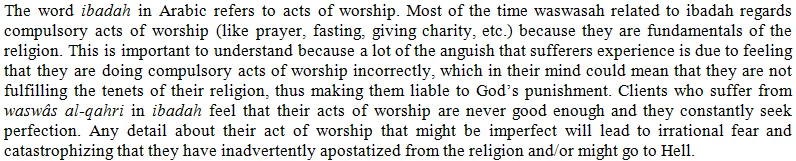
Waswās in ṭahārah (purification)3

Waswās in ʿaqīdah (belief)4
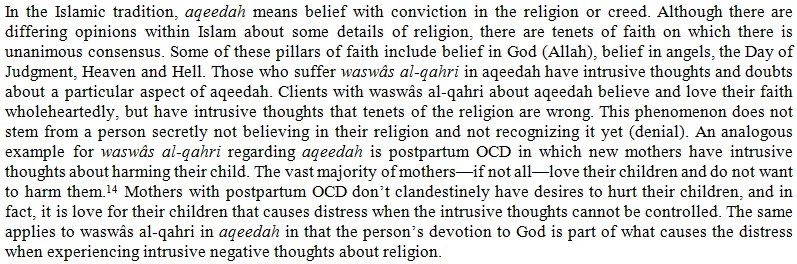
Obsessive-Compulsive Disorder (OCD) typically begins between the ages of 18 and 25, although it can develop at any stage from early childhood through adulthood. The disorder can last for days, months, or even years. Its symptoms may fluctuate—easing over time, worsening, or recurring unpredictably. Some individuals report that their OCD disappeared on its own, often expressing this with disbelief, saying things like, “I suffered from OCD for many years of my life, but now it’s hard to believe I ever had it, because it no longer affects me.” When it comes to the religious form of OCD, al-waswās al-qahrī, the onset is rarely sudden. Rather, its severity tends to increase gradually if left unaddressed. It often begins with a person becoming more careful and deliberate in their acts of worship, gradually progressing until practices that were once comforting and fulfilling become sources of significant hardship. In some cases, Muslims develop symptoms of al-waswās al-qahrī abruptly when they become religiously observant or start actively seeking Islamic knowledge. OCD has a tendency to attach itself to what matters most to a person, and for practicing Muslims, this often includes their beliefs and acts of worship—both mandatory and voluntary. For example, some experience intrusive blasphemous thoughts while praying or reciting the Qurʾān, seemingly out of nowhere. Others report a spike in symptoms during Ramaḍān. This close connection between waswās and iltizām (commitment to religious practice) can be traced to the fact that waswās is often driven by a deep-rooted desire for flawlessness (perfection): an overwhelming fear of sinning, making mistakes, failing, and difficulty tolerating even the slightest uncertainty regarding one’s faith or actions. It may be useful to point out here that perfectionism—namely, the unhealthy form of perfectionism—has been strongly linked to OCD.5 That is, individuals who feel an intense need for things to be “perfect,” “done right,” or who crave absolute certainty are more likely to develop and sustain OCD symptoms over time. Put simply, religious obsessions are rooted in the fear that one’s acts of worship are inadequate and must be repeated until they are performed perfectly. Much of the anguish experienced by those affected stems from the feeling that they are performing their religious duties incorrectly—an anxiety that, in their minds, may mean they are failing to uphold the core tenets of their faith and are thus liable to Allāh’s punishment. Intrusive blasphemous thoughts often reflect a deep fear of losing one’s belief and demonstrate just how dearly one holds that belief. However, this very sincerity is exploited and magnified by humanity’s parasitic enemy: Satan. The fear of not being a perfect Muslim—and the yearning for certainty that would relieve one of guilt and anxiety—tends to intensify the more one increases in obedience to Allāh or is exposed to shubuhāt (specious arguments against Islam). It is rational to conclude that only someone who trulypossesses the treasure of faith would fear its loss. For this reason, studies have shown a strong positive correlation between religiosity and the severity of OCD symptoms. In short, al-waswās al-qahrī thrives on the distress a Muslim feels when faced with intrusive negative thoughts about religion—distress that is, in part, rooted in their devotion to Allāh and amplified by anxiety-driven perfectionism.
Notes and References
- 1
Abū Dāwūd as-Sijistānī, Sunan Abī Dāwūd, (Cairo, Egypt: Maktabat al-Maʿārif, 1998), book: 43, ḥadīth: 340, available at: https://sunnah.com/abudawud:5112.
- 2
Najwa Awad, “Clinicians, Imams, and the Whisperings of Satan,” Yaqeen institute, 19 Jul. 2017, https://yaqeeninstitute.org/read/paper/clinicians-imams-and-the-whisperings-of-satan.
- 3
Ibid.
- 4
Ibid.
- 5
Owen Kelly, “Obsessive Compulsive Disorder (OCD) and Perfectionism,” Very Well Mind, updated on 14 Aug. 2020, https://www.verywellmind.com/ocd-and-perfectionism-2510483.
Maladaptive/unhealthy perfectionism has been associated with distress, low self-esteem, and symptoms of mental illness.This type of perfectionism is characterized by:
•Being heavily invested in the high expectations of others, such as parents or employers.
•Doubts about whether you are doing something correctly.
•Excessive preoccupation with control.
•Excessive preoccupation with past mistakes.
•Fears about making new mistakes.