What are the fruits of worshiping Allāh, Glorified and Exalted is He?
To begin with, it is important to note that Allāh has no need for worship and gains nothing from being worshipped. He does love for us to worship and obey Him, but not because He needs validation or servitude; rather, it is because He loves to see the benefits we derive from worshipping Him. Peace of heart, mind, and soul is one of the fruits of worshipping Allāh. Attaining inner peace and tranquility is a universal quest, yet it is very difficult because the world around us and the things that happen to us often leave us deeply troubled. Nonetheless, Allāh has revealed to us the way to attain the inner peace and tranquility that every human being seeks: {those who believe and whose hearts find comfort in the remembrance of Allāh. Surely in the remembrance of Allāh do hearts find comfort} (Qurʾān 13:28). That is, the only way for human beings to attain lasting inner peace and tranquility is by busying themselves with the remembrance of Allāh. Allāh told His Prophet (PBUH) that glorifying his Lord, praying, and worshipping Him are the means by which he would find comfort, strength, and courage to carry out the mission for which he had been sent in the face of abuse, derision, and obstacles: {We certainly know that your heart is truly distressed by what they say. So glorify the praises of your Lord and be one of those who ˹always˺ pray, and worship your Lord until the certainty comes to you} (Qurʾān 15:97:99). Therefore, two rakʿahs (units of Islamic prayer) performed with khushūʿ (deep humility and attentiveness) and contemplation can do for the human soul what hours of therapy sessions involving relaxation techniques for stress relief cannot. Allāh stated that those who turn away from what He revealed to His Messenger (PBUH), neglect it, and seek guidance from other than it are bound to live a miserable life: {But whoever turns away from My Reminder will certainly have a miserable life} (Qurʾān 20:124). The phrase “a miserable life” in this verse does not refer to a life of poverty. Rather, it means that even if a person is a millionaire, and even if they appear to live in comfort outwardly—wearing and eating whatever they like and living wherever they want—they will not experience true happiness, for they will be deprived of inner peace and have a constricted heart because of their misguidance. Such people are constantly racing after the material goals they set for themselves or that society places before them, and because they turn away from Allāh’s admonition, they often do so through unlawful means. Consequently, they suffer from the pangs of a guilty conscience and live in a state of uncertainty, confusion, agitation, and doubt. Worship provides a serenity and fulfillment that nothing else can provide. Shaykh Mohammad Elshinawy wrote:1
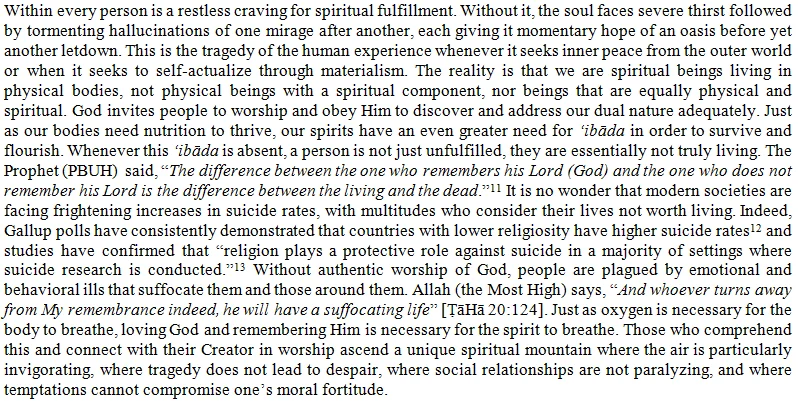
Moreover, the sense of security that comes from knowing there is someone to turn to in times of hardship is another fruit of worship. Additionally, worshipping Allāh liberates people from being enslaved to other people. It also liberates them from being subjugated to and shackled by their own harmful impulses and base desires. Islam makes people devoted servants of the one and only true Lord, Allāh, their Creator. The Prophet (PBUH) said: “Whoever makes the Hereafter their primary concern, Allāh will place their richness in their heart, bring their affairs together, and the world will come to them against its will. But whoever makes this world their primary concern, Allāh will place their poverty before their eyes, scatter their affairs, and they will receive nothing from this world except what has already been decreed for them.”2 Shaykh Mohammad Elshinawy wrote:3
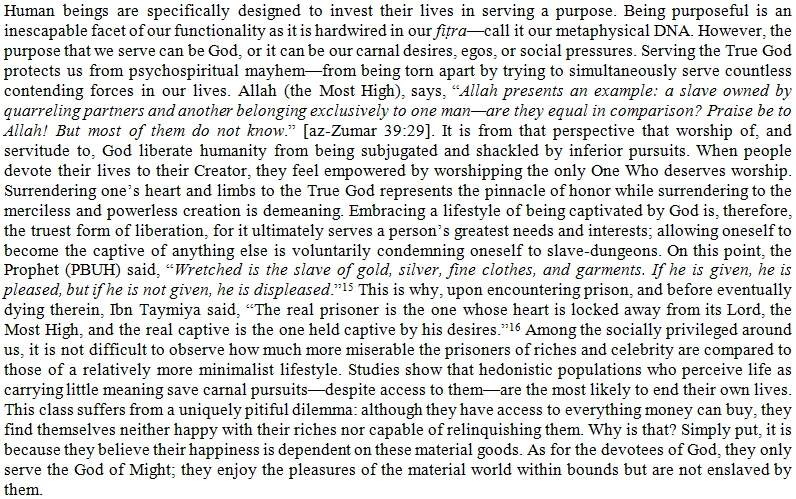
Furthermore, the worship of Allāh forms the foundation of morality. When a person sees themselves as a servant of Allāh and recognizes that moral principles come from Him, their values and conduct become more consistent. Finally, because the human heart is inherently unstable and prone to forgetfulness and agitation, worship renews faith. That is, the daily acts of worship cleanse the heart of its stains and keep it alive and illuminated. A Muslim who truly worships Allāh alone is blessed to understand the reality and purpose of the worldly life. They understand that Allāh’s sublime nature precludes the possibility of His ever acting without purpose, as He says: {We did not create the heavens and the earth and everything in between for sport. We only created them for a purpose, but most of these ˹pagans˺ do not know} (Qurʾān 44:38–39). Hence, the Muslim realizes that Allāh did not create us in vain; rather, the very purpose for which life and death were created is to test us: {˹He is the One˺ Who created death and life in order to test which of you is best in deeds} (Qurʾān 67:2). In short, worshipping Allāh is the primary reason for human existence.
Notes and References
- 1
Mohammad Elshinawy, “Why Does God Ask People to Worship Him?” Yaqeen Institute, 26 Dec. 2017, https://yaqeeninstitute.org/read/paper/why-does-god-ask-people-to-worship-him.
- 2
Muḥammad at-Tirmiḏī, Jāmiʿ at-Tirmiḏī, (Cairo, Egypt: Dār at-Taʾṣīl, 2016), book 37, ḥadīth: 51, available at: https://sunnah.com/tirmidhi:2465.
- 3
Mohammad Elshinawy, “Why Does God Ask People to Worship Him?” Yaqeen Institute, 26 Dec. 2017, https://yaqeeninstitute.org/read/paper/why-does-god-ask-people-to-worship-him.