If Allāh is not in need of our worship, then why does He command us to worship Him?
This is one of the common questions that atheists relentlessly repeat, but it is inherently problematic, as it rests on flawed assumptions. To begin with, the notion that the human mind can fully comprehend Allāh is itself erroneous, for not only is Allāh’s Essence beyond understanding, but even His attributes—such as His wisdom—are far beyond the limits of human cognition. In fact, we can never know everything there is to know about Allāh, nor can we grasp the full reality of even a single one of His attributes. Therefore, it is inappropriate for human beings to casually question Allāh’s wisdom in commanding worship, since passing judgment requires complete understanding—and as finite beings, we lack the capacity to fully grasp the nature and perfection of the Divine. We have neither direct access to Allāh nor any comparable reference point that could help our minds form a conceptual image of Him, as Allāh says: {there is nothing like Him} (Qurʾān 42:11). Therefore, the necessary antecedent for comprehending and critiquing Allāh does not exist. All that human beings can—and should—do is infer certain truths about the Creator and His attributes by reflecting on His signs in the universe and within themselves. Yet, the human mind is limited even in what it can grasp from these signs. Hence, people should refrain from attempting to fully comprehend what lies behind an impenetrable veil. In other words, they must recognize that there are veils between their intellect and the full essence of Allāh’s nature. In short, since the gap between Creator and creation, between the Infinite and the finite, will always exist, true intelligence lies in realizing the limits of one’s own intelligence. Moreover, if we carefully examine the wording of the atheists’ question about the Creator’s “need” for worship, we find that it rests on a flawed presupposition—that Allāh possesses human-like traits—an anthropomorphic assumption that forms another erroneous premise behind the question.1
The Qurʾān rejects anthropomorphic interpretations of Allāh, for such interpretations involve using the human being as the prism through which to understand the qualities of Allāh. For this reason, the early imāms of Islam understood the attributes of Allāh through greater analogy—that is, if human beings possess a praiseworthy trait that is also ascribed to Allāh, then a greater, more exalted form of that trait is understood of Allāh, one that is fully befitting His Uniqueness and Perfection.2

Therefore, the idea that Allāh commands worship in order to fulfill a need or compensate for some deficiency stems from anthropomorphizing the Divine. Those who adopt this notion project their own human experiences onto Allāh, assuming that all requests arise from a desire to fill a void, because in their dealings with people, this is often the case. However, it is entirely fallacious to attribute such motives to Allāh when we do not fully comprehend His Nature—especially when, as will be discussed in the next subsections, both revelation and reason affirm that He has no needs whatsoever. As a matter of fact, Allāh loving to be worshipped does not necessitate His need for worship, nor is any request—even among people—always prompted by the requester’s need.3
Indisputably, Allāh is not increased by people’s worship in the least. Rather, He loves that His servants worship Him because this worship is of benefit to them—an idea that will be discussed in detail in a subsequent section. Although atheists usually phrase their question pertaining to the wisdom behind Allāh asking His creation to worship Him along the lines of, “Why does Allāh ask humans to worship Him when He has no need for their worship?” or “What does He gain from humans worshipping Him?”, some may begin instead by asking, “What is the wisdom for which Allāh created us?” But the moment they are told that it is for worship, they immediately object: “If Allāh does not ask us to worship Him out of need or if He does not gain anything from us worshipping Him, then He asks to be worshipped pointlessly, without need.” Such a statement suggests that Allāh is imperfect, acting in ways devoid of wisdom or benefit. According to this line of reasoning, either Allāh created humans and commanded them to worship Him out of need—in which case there is a deficiency in His being—or He created them and commanded them to worship Him without need—in which case the act of creation and the request for worship are deemed pointless. In both scenarios, they argue, Allāh cannot be perfect, for He either acts out of need or acts without purpose. This argument hinges on equating “doing something or asking for something when one has no need for it or gains nothing from it” with “acting or asking pointlessly.” However, this is an erroneous conception, for anyone with a modicum of common sense knows that the antonym of “absurdity” or “futility” is not “need,” but rather “wisdom.” Evidently, a person may do something not because of any need they have for it, but because they have wisdom and a noble purpose behind it.4 It is therefore sheer nonsense to assume that it is pointless for someone to do something if they have no need for it or gain nothing from it. In point of fact, doing something does not necessarily indicate a need, for humans do not always expect something in return for everything they do. For example, a wealthy and reputable doctor may treat poor patients free of charge—not because he has any need or stands to gain personally, but simply out of compassion—and no rational person would consider such an act absurd; rather, it would be deemed admirable. Likewise, imagine a young man walking along a riverside who sees a child being swept away by the current; he jumps in without hesitation, rescues the child, revives him with first aid, and leaves before the parents even arrive to thank him. That he risked his life and sought nothing in return does not make his act pointless—it is, in fact, a heroic act of pure altruism. Like the doctor’s charity, this action does not stem from need, but that does not render it absurd. These examples show that not all human behavior is motivated by self-interest; some actions are undertaken solely to benefit others. Doing something without needing it is not equivalent to acting without wisdom or purpose. Logical necessity suggests that Allāh did not create human beings or command them to worship Him out of need, for He is the All-Wealthy and the Self-Sufficient, entirely independent of His creation. Rather, there is wisdom behind His act of creation and His command to worship Him. Without a doubt, Allāh has no need for our worship, and if all the people on earth were to become ungrateful to Him, it would not harm Him in the least. This undeniable truth is repeatedly affirmed in both the Qurʾān and the authentic Sunnah. Allāh says: {Moses added, “If you along with everyone on earth were to be ungrateful, then ˹know that˺ Allāh is indeed Self-Sufficient, Praiseworthy”} (Qurʾān 14:8). Allāh is entirely Independent and in no need of praise or gratitude, for He is inherently Praiseworthy and deserving of all praise. Thus, when He commands human beings to be grateful, it brings no benefit to Him. Rather, it is a manifestation of His boundless mercy directed toward their own wellbeing: {O humanity! It is you who stand in need of Allāh, but Allāh ˹alone˺ is the Self-Sufficient, Praiseworthy} (Qurʾān 35:15). The Qurʾān makes it absolutely clear that Allāh is free of all need for worship: {Then whoever chooses to be guided, it is only for their own good} (Qurʾān 27:92). On the authority of Abū Ḏarral- Ġifārī (may Allāh be pleased with him), from the Prophet (peace and blessings be upon him), from what he relates from his Lord, the Mighty and Majestic, that He said: “O My servants, you will never reach My harm so as to harm Me, nor will you ever reach My benefit so as to benefit Me. O My servants, were the first of you and the last of you, the human of you and the jinn of you, to be as pious as the most pious heart of any one among you, it would not increase My Kingdom in the least. O My servants, were the first of you and the last of you, the human of you and the jinn of you, to be as wicked as the most wicked heart of any one among you, it would not diminish My Kingdom in the least. O My servants, if all of you stood together in one place and each asked of Me, and I granted every single one what they requested, this would not decrease what I possess—no more than a needle dipped in the ocean diminishes it. O My servants, it is only your deeds that I record for you, and then I recompense you accordingly. Thus, whoever finds good, let them praise Allāh; and whoever finds otherwise, let them blame no one but themselves.”5 It is utterly illogical to presume that Allāh—Who brought human beings into existence from nothing—would need them or benefit from their actions, when they themselves have no power to benefit or protect even their own selves except by His Will. Allāh does not ask us to strive in His cause because He needs assistance in establishing or maintaining His Divinity. Rather, whatever righteous deeds we perform are not a favor to Allāh, but a means of benefiting our own selves: {And whoever strives ˹in Allāh’s cause˺, only does so for their own good. Surely Allāh is not in need of ˹any of˺ His creation} (Qurʾān 29:6). Indeed, Allāh gains nothing from our worship, nor does our neglect of it diminish Him in any way.
Allāh is a perfect Being, and therefore He is not deficient in goodness or perfection such that He would seek it through an action like creation. Rather, His actions are manifestations of His perfection—just as the sun shines by its very nature, not to gain anything. Allāh is neither a god who asks for worship out of need nor one who does so pointlessly without need, for His sublime nature rules out the possibility of Him ever acting without purpose. Indeed, the flawless design of creation points to a Creator who is purposeful and unmatched in wisdom. Allāh says: {We did not create the heavens and the earth and everything in between for sport. We only created them for a purpose, but most of these ˹pagans˺ do not know} (Qurʾān 44:38–39). And He says: {Did you then think that We had created you without purpose, and that you would never be returned to Us?” Exalted is Allāh, the True King! There is no god ˹worthy of worship˺ except Him, the Lord of the Honourable Throne} (Qurʾān 23:115–116). Hence, we should never allow the shubuhāt (specious arguments and doubts) of atheists—regarding the perceived lack of wisdom in Allāh’s actions and commands—to creep into our minds. One of the verses most frequently cited by those who insist that Allāh needs to be worshipped is: {I did not create jinn and humans except to worship Me} (Qurʾān 51:56). However, this verse in no way implies that Allāh’s Godhead would cease to function if humans and jinn did not worship Him, or that He would no longer be God if they turned away from His service. Interestingly, the very next verses explicitly negate any notion of Allāh’s need for this worship: {I seek no provision from them, nor do I need them to feed Me. Indeed, Allāh ˹alone˺ is the Supreme Provider—Lord of all Power, Ever Mighty} (Qurʾān 51:57–58). Allāh categorically affirms that He has no need for the worship of the jinn and humans. Rather, it is inherent in their very nature that they should serve Him.6

Allāh emphasizes in numerous passages throughout the Qurʾān that He gains nothing from being worshipped; rather, He is the Gracious Giver to both the righteous and the wicked alike. In other verses, Allāh makes it clear that the rejection of the disbelievers does not harm Him in the least, just as the faith of the believers does not benefit Him in any way. The claim that Allāh demands worship out of egotism is illogical and based on a flawed and anthropomorphic conception of the Divine:7
We ought not to be like those described in this verse: {rather, they have denied that which they encompass not in knowledge and whose interpretation has not yet come to them} (Qurʾān 10:39). That is, just because we do not perceive the divine wisdom behind something does not mean it is absent; it simply means we have not been made aware of it yet—just as a patient’s ignorance of a doctor’s reasoning behind a prescribed medication does not render the prescription irrational. One of Allāh’s greatest attributes is wisdom, and one of His most exalted names is the All-Wise. He creates and commands with immense wisdom and for noble, purposeful ends. It is not necessary for us to grasp every dimension of Divine Wisdom in order to affirm its reality. It suffices to know that Allāh has not created us in vain, but rather for the ultimate purpose of worshipping Him alone, without partners. Thus, obeying Allāh—even when the full scope of wisdom behind certain commands escapes us—is the most rational course of action, for His commands are rooted in infinite knowledge and perfect wisdom. Consider this analogy:8
Humans will never be able to fathom the totality of Allāh’s wisdom because their knowledge is fragmentary and finite. If we were capable of comprehending all of Allāh’s wisdom, it would imply that we are like Allāh or that He is like us—both of which are impossibilities. Therefore, the very absence of a fully comprehensible answer to the question of why Allāh created us to worship Him is itself a sign of the transcendence of His knowledge. Put simply, He created us to worship Him due to His eternal wisdom; we just cannot fully comprehend why. Thus, rather than asking the inherently flawed question “Why does Allāh ask for worship?” the more meaningful and relevant question is “Why do we need to worship Allāh?”
Worshipping Allāh is both necessary and beneficial. First and foremost, Allāh is worthy of worship by virtue of who He is—for He is, by definition, the One solely entitled to our worship. The Qurʾān repeatedly emphasizes that worship is a necessary truth stemming from His very existence: {‘It is truly I. I am Allāh! There is no god ˹worthy of worship˺ except Me. So worship Me ˹alone˺, and establish prayer for My remembrance} (Qurʾān 20:14). Indeed, worship is Allāh’s right, even if we were to receive no comfort or benefit in return, as Hamza Andreas Tzortzis aptly states:9
Allāh deserves to be worshipped because He created and also sustains everything. However, He was worthy of worship even before He created, and would remain so even if He had never created at all, for His sublime nature alone entitles Him to be the direction of our heart’s devotion. To borrow the words of Mohammad Elshinawy: Even if we had not received anything from Him, He would still deserve to be worshipped—how much more, then, when a torrential downpour of blessings reaches us from Him every moment of our lives?10

Indeed, Allāh provides us with innumerable favours—blessings so vast and constant that they cannot be counted or fully comprehended: {And He has granted you all that you asked Him for. If you tried to count Allāh’s blessings, you would never be able to number them} (Qurʾān 14:34). Thus, we should be eternally grateful to Allāh, for no matter how much we try, we could never truly thank Him enough for His countless blessings.11
Each moment of our existence is from Allāh alone; therefore, we must be thankful to Him and recognize that all gratitude—a central aspect of worship—belongs to Him alone.12
All gratitude is due to Allāh not merely for the gift of life, but because everything we use in our daily lives—and all the essential things we require to survive—come from Him alone.13

The Qurʾān repeatedly affirms that Allāh is the Creator and Sustainer of the entire cosmos and that He provides for us out of His bounty—an undeniable reality that stirs gratitude and awe in the heart of the listener or reader:
{He is the One Who created everything in the earth for you. Then He turned towards the heaven, forming it into seven heavens} (Qurʾān 2:29).
{Do they associate ˹with Allāh˺ those ˹idols˺ which cannot create anything, but are in fact created; which cannot help them, or even help themselves? And if you ˹idolaters˺ call upon them for guidance, they cannot respond to you. It is all the same whether you call them or remain silent. Those ˹idols˺ you invoke besides Allāh are created beings like yourselves. So call upon them and see if they will answer you, if your claims are true!} (Qurʾān 7:191–194).
{O humanity! Remember Allāh’s favours upon you. Is there any creator other than Allāh who provides for you from the heavens and the earth? There is no god ˹worthy of worship˺ except Him. How can you then be deluded ˹from the truth˺?} (Qurʾān 35:3).
Hence, Allāh is the only One worthy of worship because He alone has created human beings and all that is in the heavens and the earth, and He continually provides for their needs. Thus, the proper course for humans is to submit themselves entirely to Him and not associate any partner with Him: {O humanity! Worship your Lord, Who created you and those before you, so that you may become mindful ˹of Him˺} (Qurʾān 2:21). The choice of the particular Name Rabb, translated as “Lord,” from among the Beautiful Names of Allāh, is highly significant in this context. The word Rabb signifies that only Allāh is—or can ever be—worthy of worship, for He alone truly sustains and cares for all of creation, nurturing it in the most perfect and complete way.14
Allāh is not only the sole Creator but also the exclusive Commander and Governor. He expressed His Absolute Subduing Power as a universal principle, saying: {The creation and the command belong to Him ˹alone˺} (Qurʾān 7:54). That is, creation and command are exclusive to Allāh, for no one besides Him can bring even the most insignificant thing into existence, nor does anyone else have the right to subject others to their command. Allāh rules over the entire universe according to His sovereign will, and His grip over it is firm. Since human beings are but a small part of this universe, their role should align with that of all other things that are wholly subservient to Allāh’s overpowering will and function according to His command. In other words, they should devote themselves to the Creator’s plan just as the rest of the universe has submitted to that plan in full obedience—mirroring the universe’s involuntary conformity with Allāh’s will by choosing to conform voluntarily. In short, Allāh’s right over us, His slaves, is that we worship Him and associate nothing with Him, for He is the One who gives us life, sustains us, and provides for us in every way—our Lord who revealed the Scriptures and sent the Messengers to guide us.
Additionally, Allāh, the Exceedingly Benevolent, loves that His servants worship Him because this worship is of benefit to them and can result in their flourishing in a number of ways. First, only worship can fill the spiritual void in the heart of every human.15
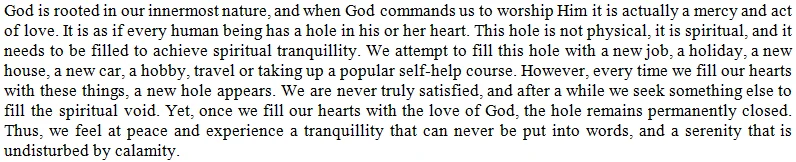
Indeed, worship grants the soul a sense of inner peace and fulfillment that nothing else can provide.16
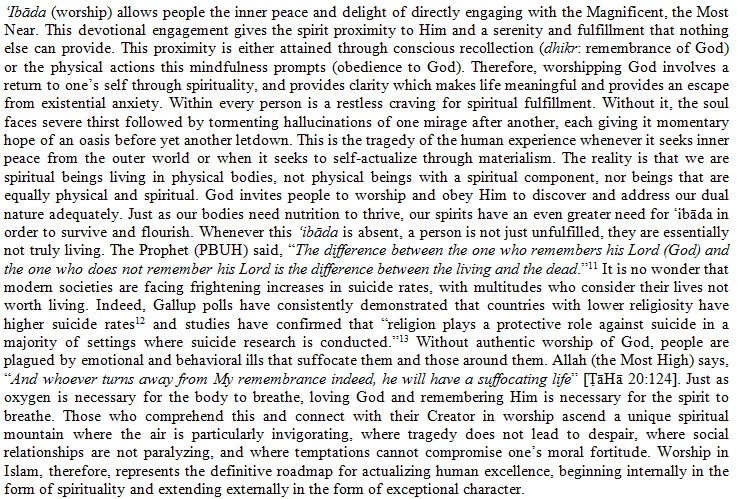
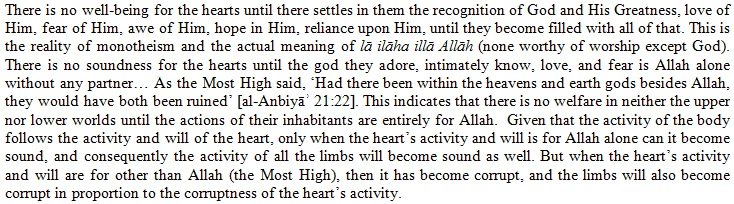
Without worship, humans are destined for psycho-spiritual ills. The great Ḥanbalī theologian Ibn Rajab said:17
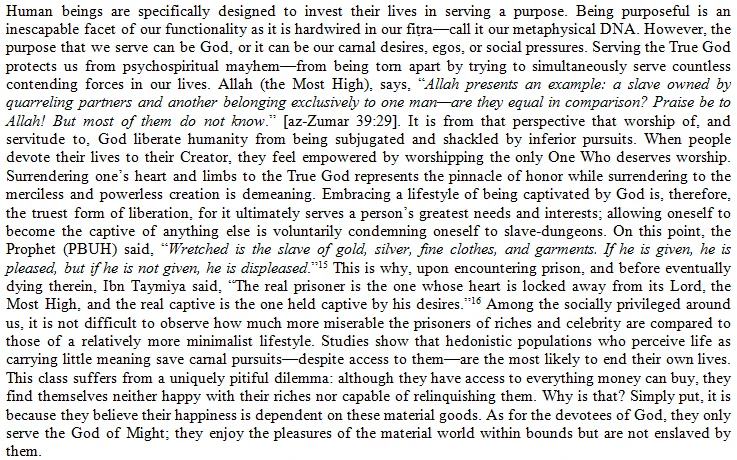
Moreover, worshipping Allāh is liberating. It is important to understand that humans are natural-born worshippers—in other words, worship is part of who they are, one of their innate tendencies just like their need to eat, drink, and breathe. Thus, those who do not worship Allāh will still end up worshipping other “gods”—idolizing certain ideologies, leaders, various forms of social pressure, norms, cultures (such as materialism), ephemeral things like possessions, and even their own egos and desires. From this perspective, they are enslaved to these things; that is, these things become their masters and their objects of worship. Hence, being a slave of Allāh is in fact being free, because worshipping Allāh alone liberates us from the shackles of other false gods, be they our own selves or the things we own or desire. In a word, worshipping the only One who truly deserves worship is the purest and truest form of liberation:18
Furthermore, worship provides the foundation for principled morality through a relationship with the Divine. It serves as a restraint against lewdness and iniquity and acts as a catalyst for goodness and virtue. Without worship, humans are bound to fall into behavioral dysfunctions. The Qurʾān indicates that among the profound functions of the daily prayers is their ability to deter evil and indecency: {Recite what has been revealed to you of the Book and establish prayer. Indeed, ˹genuine˺ prayer should deter ˹one˺ from indecency and wickedness} (Qurʾān 29:45). Likewise, fasting reduces one’s dependence on material things and strengthens spiritual resolve, enabling a person to control their desires—an essential foundation for God-consciousness and the key to higher realms of faith: {O believers! Fasting is prescribed for you—as it was for those before you—so perhaps you will become mindful ˹of Allāh˺} (Qurʾān 2:183). Similarly, giving charity serves to purify a person from greed and from earnings tainted by unethical means: {Take from their wealth ˹O Prophet˺ charity to purify and bless them...} (Qurʾān 9:103). When someone sees themselves as a servant of Allāh and recognizes that moral rules originate from Him alone—and that the only perception that truly matters is His—their moral behavior becomes principled and consistent. That is, the practicing Muslim’s self-image as a servant in Allāh’s kingdom remains vivid through regular worship, and so does their moral motivation. Conversely, those who behave morally to impress others or for a feel-good endorphin rush may abandon moral behavior when such external motivators are absent.
To summarize, Allāh is transcendent and absolutely free of any need. Thus, He does not need us to worship Him at all. He gains nothing from our worship, and our lack of it takes nothing away from Him, but He asks us to worship Him because—through His wisdom and mercy—He created us that way. That is, He made worship good and beneficial for us, from both a worldly and spiritual perspective. Indeed, no righteous life on earth and no success in this world or in the Hereafter are conceivable without worship. We are the ones in need of the Supreme, Self-Sufficient Creator. We need to worship Him for our own good. We need His blessings. We need His mercy. We need His Paradise. Hamza Tzortzis suggests a practical way of looking at the question “Why does Allāh ask for worship?” in the following illustration.19
If we do not worship Allāh alone, we will inevitably have many ‘masters’—each pulling us in different directions, each demanding something from us—leaving us in a state of inner turmoil, misery, and confusion. In contrast, worshipping Allāh alone liberates us from enslavement to the fleeting world and from submission to the carnal and egotistical tendencies of the human condition. The Poet of the East, Muhammad Iqbal, powerfully expressed this truth: “This one prostration [to God] which you deem too exacting liberates you from a thousand prostrations [to all others besides God].”20
Notes and References
- 1
Mohammad Elshinawy, “Why Does God Ask People to Worship Him?” Yaqeen Institute, 26 Dec. 2017, https://yaqeeninstitute.org/read/paper/why-does-god-ask-people-to-worship-him.
- 2
Ibid.
- 3
Ibid.
- 4
Sulṭān al-ʿUmayrī, Ẓāhirat Naqd ad-Dīn fī al-Falsafah al-Ḥadīthah, (Makkah al-Mukarramah, Saudi Arabia: Jāmiʿat Umm al-Qurá, 2015), (Ph.D. thesis).
- 5
Muslim ibn al-Ḥajjāj, Ṣaḥīḥ Muslim, (Bayrūt, Lebanon: Dār al-Kutub ʿIlmiyyah, 2020), book: 45, ḥadīth: 70, available at: https://sunnah.com/muslim:2577a.
- 6
Sayyid abū al-Aʿlá al-Mawdūdī, Towards Understanding the Qurʾān (English version of Tafhīm al-Qurʾān), trans. and edit. Zafar Isḥāq ʾAnṣārī, (Markfield, U.K.: The Islamic foundation, 1988), Chapter aḏ-Ḏāriyāt (Qurʾān 51:57), footnotes 54, available at: https://www.islamicstudies.info/tafheem.php?sura=51&verse=47&to=60.
- 7
Mohammad Elshinawy, “Why Does God Ask People to Worship Him?” Yaqeen Institute, 26 Dec. 2017, https://yaqeeninstitute.org/read/paper/why-does-god-ask-people-to-worship-him.
- 8
Hamza Andreas Tzortzis, “7 Reasons Why God is Worthy of Worship,” Hamza Andreas Tzortzis, accessed 27 Feb. 2023, https://www.hamzatzortzis.com/7-reasons-why-god-is-worthy-of-worship/.
- 9
Hamza Andreas Tzortzis, “7 Reasons Why God is Worthy of Worship,” Hamza Andreas Tzortzis, accessed 27 Feb. 2023, https://www.hamzatzortzis.com/7-reasons-why-god-is-worthy-of-worship/.
- 10
Mohammad Elshinawy, “Why Does God Ask People to Worship Him?” Yaqeen Institute, 26 Dec. 2017, https://yaqeeninstitute.org/read/paper/why-does-god-ask-people-to-worship-him.
- 11
Hamza Andreas Tzortzis, “7 Reasons Why God is Worthy of Worship,” Hamza Andreas Tzortzis, accessed 27 Feb. 2023, https://www.hamzatzortzis.com/7-reasons-why-god-is-worthy-of-worship/.
- 12
Ibid.
- 13
Ibid.
- 14
Muḥammad Shafīʿ ibn Muḥammad Yāsīn ʿUsmānī Deobandī, Maʿārif-ul-Qurʾān: A Comprehensive Commentary of the Holy Qurʾān, trans. Muḥammad Hasan Askari and Muhammad Shamīm, (Karachi, Pakistan: Maktaba-e-Darul-ʿUloom, 2010), Chapter al-Baqarah (Qurʾān 2:21-22), pp. 133–134, available at:https://islamicstudies.info/quran/maarif/maarif.php?sura=2&verse=21.
- 15
Hamza Andreas Tzortzis, “7 Reasons Why God is Worthy of Worship,” Hamza Andreas Tzortzis, accessed 27 Feb. 2023, https://www.hamzatzortzis.com/7-reasons-why-god-is-worthy-of-worship/.
- 16
Mohammad Elshinawy, “Why Does God Ask People to Worship Him?” Yaqeen Institute, 26 Dec. 2017, https://yaqeeninstitute.org/read/paper/why-does-god-ask-people-to-worship-him.
- 17
Ibn Rajab al-Ḥanbalī, Jāmiʿ al-ʿUlūm wa-l-Ḥikam, (Bayrūt, Lebanon: Muʾassasat ar-Risālah, 1997), vol. 1, pp. 211–212.
- 18
Mohammad Elshinawy, “Why Does God Ask People to Worship Him?” Yaqeen Institute, 26 Dec. 2017, https://yaqeeninstitute.org/read/paper/why-does-god-ask-people-to-worship-him.
- 19
Hamza Andreas Tzortzis, “Why Does God Need Our Worship? Why Did He Create Us to Worship Him?” Hamza Andreas Tzortzis, accessed 27 Feb. 2023, https://www.hamzatzortzis.com/does-god-need-our-worship-why-did-he-create-us-to-worship-him/.
- 20
As cited in Hassan Riffat, The Main Philosophical Idea in the Writings of Muhammad Iqbal (1877 - 1938),(Doctoral thesis, Durham University, 1968), available at Durham E-Theses Online: http://etheses.dur.ac.uk/7986/.