What is the best form of jihād: jihād with the hand and the sword, or jihād of calling to Allāh and defending His religion with evidence?
Ibn al-Qayyim [may Allāh have mercy on him] said: “The foundation on which religion is established is knowledge and jihād, and that is why jihād is of two types. The first is jihād with the hand and weapons, and many people participate in this type of jihād. The second is jihād with evidence and demonstration—this is the jihād of the elite among the followers of the Messengers, the jihād of the imāms (Muslim religious leaders). It is the best of the two forms of jihād due to the greatness of its benefit, the difficulty of its provisions (the physical and mental effort it requires), and the multitude of its opponents. Allāh says: {And if We had willed, We could have sent into every city a warner. So do not yield to the disbelievers, but strive diligently against them with this ˹Qurʾān˺} (Qurʾān 25:51–52).”1 Verse (Qurʾān 25:52), cited by Ibn al-Qayyim, is a Makkan verse revealed at a time when the command for jihād in the sense of fighting the disbelievers had not yet been issued by Allah. What is ordained in this verse is that the Prophet (PBUH) spread the message of the Qurʾān among the people at large. Undertaking the great jihād by means of the Qurʾān refers to a peaceful struggle to convey the Word of Allāh. That is to say, jihād of the tongue—the propagation of the Qurʾānic message among people and helping them to understand it—is the greatest form of jihād. Indeed, jihād through evidence and rational demonstration is the hardest form of jihād upon the hearts of the advocates of disbelief. They dread it even more than they dread large armies, for it exposes their falsehoods and refutes their specious arguments. Ibn Ḥazm [may Allāh have mercy on him] said: “Nothing provokes the disbelievers and the people of falsehood more than having their claims dismantled by compelling evidence. Large troops may be defeated, but a sound argument will always prevail. Indeed, it serves the cause of truth and upholds the religion more effectively than powerful weapons and large numbers of soldiers.”2 Likewise, Ibn Ḥajar [may Allāh have mercy on him] said: “Ibn Daqīq al-ʿĪd stated that qiyās (analogical reasoning) necessitates that jihād be the best of the acts of worship that serve as means, because jihād is a means of proclaiming and spreading the religion and of extinguishing and refuting disbelief.”3 The purpose served by jihād was the ultimate goal of the long line of Messengers and Prophets sent by Allāh—spreading Allāh’s message on Earth and guiding mankind to Him. The reward for jihād is immense, and in fact, no good deed equals it in reward. The Messenger of Allāh (PBUH) was asked, “What deed could be an equivalent of jihād in the way of Allāh?” He replied, “You do not have the strength to do that deed.” The narrator of the ḥadīth said that the question—“What deed could be an equivalent of jihād in the path of Allāh?”—was repeated two or three times, and each time the Prophet (PBUH) responded, “You do not have the strength to do it.” When the question was asked a third time, he (PBUH) said: “The one who engages in jihād in Allāh’s path is like the one who fasts and spends the night in prayer, constantly reciting Allāh’s verses and never slacking in fasting or prayer—until the mujāhid returns from jihād in the way of Allāh, the Exalted.”4 And in another narration, a man came to the Messenger of Allāh (PBUH) and said, And in another narration, a man came to the Messenger of Allāh (PBUH) and said, “Tell me of a deed that equals jihād in reward.” He replied, “I do not find such a deed.” Then he added, “Can you, while the Muslim fighter is on the battlefield, enter your mosque to pray without pause and fast without breaking your fast?” The man said, “But who can do that?”5 Becoming engrossed in worldly life and prioritizing personal interests over making financial sacrifices for the establishment of Allāh’s religion leads to ruin—both in this world and in the Hereafter. When Allāh granted Islam authority and strength, some of the Companions began to say that jihād was no longer necessary and that they could remain at home to tend to their wealth and property. In response, Allāh revealed a verse warning the believers not to cast themselves into destruction by their own doing through the abandonment of jihād: {Spend in the cause of Allāh and do not let your own hands throw you into destruction ˹by withholding˺} (Qurʾān 2:195). Abū Ayyūb al-ʾAnṣārī [may Allāh be pleased with him] said: “We understand this verse (2:195) best, for it was revealed about us—the Companions of the Messenger of Allāh who participated in jihād with him, aided him, and supported him. When Islam gained strength, we, the ʾAnṣār,6 gathered and said to one another: ‘Allāh has honored us by making us the Companions of His Prophet and by allowing us to support him until Islam became victorious and its followers increased. Previously, we had neglected our estates. Now that warfare has ceased, let us return to our property and improve it.’ Thereupon, this verse was revealed about us: {Spend in the cause of Allāh and do not let your own hands throw you into destruction ˹by withholding˺}. The ‘destruction’ refers to staying behind to manage our property, committing ourselves to its improvement, and abandoning jihād (i.e., spending in the cause of Allāh).”7 Hence, the Qurʾān enjoins us to regard the cause of Allāh as our own and to spend generously for the sake of the religion. If we fail to do so, we invite our own destruction—both in this world and in the next. Every Muslim should strive against the enemies of Islam on all possible fronts, using all available resources, in order to raise high the “Word of Allāh.” This includes jihād with the tongue, the pen, wealth, and every other means within one’s capacity. It is easy to take part in a project of daʿwah (inviting non-Muslims to Islam) by contributing time or money, according to one’s ability. One can carry out jihād by seeking religious knowledge to gain sufficient understanding in order to invite others to Islam effectively and confidently, or by learning a new language to call its speakers to Allāh. Acquiring video editing (montage) skills can also open up excellent daʿwah opportunities in today’s digital age. That is, one can engage in jihād by creating videos to promote understanding of Islam in this era of the Internet and social media, where people prefer watching over reading. Other ways to perform jihād include sponsoring a student of Islamic studies or someone learning a foreign language with the intention of calling people to Allāh. Indeed, whoever helps another to obey Allāh will receive a similar reward. For instance, if a person supports a knowledge seeker by purchasing books for them, securing them a residence, or providing a stipend, they will receive the same reward—without it diminishing the student’s reward in the slightest. The Prophet (PBUH) said that if someone equips a fighter with a riding animal, supplies, and weapons, he will receive the same reward as the fighter, because he aided him upon good: “Whoever equips a fighter in the cause of Allāh has indeed taken part in the fight himself.’’8 Doubtlessly, those who guide others to the right path will be rewarded both in this worldly life and in the Hereafter. During one of the most critical moments of the Battle of Khaybar, the Messenger of Allāh (PBUH) summoned ʿAlī ibn abī Ṭālib, handed him the standard (flag), and said to him: “Invite them to Islam and inform them of what Allāh has enjoined upon them. By Allāh, that Allāh guides a man through you is better for you than a herd of expensive red camels.”9 This shows that a believer who seeks the pleasure of Allāh will consider it an indispensable, great virtue and responsibility to strive not only for their own salvation but also for the salvation of humanity. Indeed, guiding a person is better than the entire world and all it contains, for the honor of being a means for someone’s guidance (embracing Islam) is an everlasting source of reward. Therefore, truly obedient believers are not content with having faith and performing good deeds themselves—they also invite others to do the same. The Qurʾān affirms that the best and most excellent speech a person can offer is to call others to the truth: {And whose words are better than someone who calls ˹others˺ to Allāh} (Qurʾān 41:33). Allāh exhorted the believers towards their real duty in this verse.10

Hence, the most beloved of all people on earth to Allāh are those who respond to His call and, in turn, call others to that which they themselves have responded. This includes all forms of inviting others to Allāh—whether through speech, writing, or any other means.
However, those who call to Islam must possess strong and solid knowledge of what they are inviting others to—that is, they should have a sound understanding of Islam and also be aware of why Islam is superior to any alternative paths. Their daʿwah must be grounded in insight, reason, and wisdom. Allāh has condemned those who argue and dispute without knowledge, just as the Jews and Christians did concerning Prophet Abraham (PBUH): {but why do you now argue about what you have no knowledge of?} (Qurʾān 3:66). It is not permissible for a person to engage in dispute over matters about which they have no knowledge.11 It is imperative that the dāʿī (the one who calls to Islam) conveys Allāh’s Message to Muslims struggling with doubts, to those who raise specious arguments against Islam, and to all sincere truth seekers with softness and gentleness, as a harsh attitude could repel and distance people from the truth. Indeed, Allāh told Prophet Muḥammad (PBUH) in the Qurʾān that had he been harsh and stern in delivering the Message to his Companions—who were the best people to ever live—they would have turned away from him: {It is out of Allāh’s mercy that you ˹O Prophet˺ have been lenient with them. Had you been cruel or hard-hearted, they would have certainly dispersed from you} (Qurʾān 3:159). Allāh also instructed Prophet Moses and his brother, Prophet Aaron, to convey the Message of Islam to Pharaoh with gentleness and softness—despite his reputation as the worst human being to ever live, who declared himself a god and killed babies and innocent people: {Go, both of you, to Pharaoh, for he has truly transgressed ˹all bounds˺. Speak to him gently, so perhaps he may be mindful ˹of Me˺ or fearful ˹of My punishment˺”} (Qurʾān 20:43–44). Al-Ġazālī [may Allāh have mercy on him] said: “Harshness and sternness provoke obstinacy and opposition and reinforce false beliefs.”12 Therefore, inviting people to Allāh requires wisdom, insight, patience, and forbearance—but it also requires prudence. For example, it is not wise for those calling to Islam to give free publicity to the people of shubuhāt (specious arguments and doubts) and the advocates of falsehood by responding to them publicly or debating them. In fact, some atheists gained fame solely because Muslim preachers replied to them. Thus, every dāʿī should be aware of this danger. Indubitably, it is inappropriate to debate the people of shubuhāt in front of the ʿawām (general public), as deviant ideas may settle in their hearts. That is, the hearts are weak, and the people of falsehood and shubuhāt might cast something into the hearts of the masses that causes them to doubt Islam and corrupts their faith. Why, then, expose people’s pure innate disposition to unnecessary harm? In the historical debate between Shaykh Muḥammad ʿAbduh and the secularist Faraḥ Anṭūn, Shaykh Muṣṭafá Ṣabrī observed that the responses and rebuttals of Shaykh Muḥammad ʿAbduh were more forceful than the assertions and allegations of Professor Faraḥ Anṭūn; nevertheless, he noted that the general public was swayed by Anṭūn’s arguments.13 Therefore, false ideas should not be discussed among those who are not concerned with them; rather, they should be addressed among those affected by them or among whom they are likely circulating. Debating this and that person and granting publicity to those who attack Islam is far too risky and brings more harm than benefit. Imām al-Lālakāʾī [may Allāh have mercy on him] said in this regard: “Nothing has harmed the Muslims more than debating the people of [religious] innovation. The Salaf (the first three generations of Muslims—the Companions, the Successors, and the Successors of the Successors) inflicted unmatched defeat and disgrace upon the people of innovation [by ignoring them and refusing to debate them]. They had no means of spreading their innovation until the arrogant ones came and opened a path for them, and their mission was made public and widespread through debates, and their shubuhāt (specious arguments and doubts) reached the ears of those who were not familiar with them, from both al-khāṣṣah (the distinguished elite, i.e., the scholars and students of religious knowledge) and al-ʿāmmah (the lay Muslims).”14 This must be clearly understood by every caller to Islam in our times, lest he be deceived into thinking that by publicly debating the enemies of Islam he is aiding the daʿwah and strengthening it, when in fact he is harming it, endangering people’s faith, and leading them into the snares of those promoting misguidance. Furthermore, only those shubuhāt (specious arguments and doubts) that are currently widespread among people should be addressed publicly; otherwise, “dead” shubuhāt (those no longer in circulation) should be left buried. Indeed, we should allow falsehood to die out through silence and give life to the truth by proclaiming it. Most importantly, the caller to Islam must make it clear to his audience that they must distance themselves from the avenues of fitnah (spiritual confusion and misguidance). That is, they must refrain from sitting with, mixing with, or listening to the people of misguidance and deviation, and from entertaining their false notions and specious arguments. In other words, the believers should not offer up their hearts to shubuhāt, for their hearts will become a lodging place for them, absorbing every shubhah (specious argument) they are exposed to. In fact, Allāh has warned the believers against keeping company with those who reject and mock His verses. He made it clear that those who claim Islam, yet enjoy the company of such blasphemers and tolerate their scoffing at Allāh and His verses, are no different from them: {He has already revealed to you in the Book that when you hear Allāh’s revelations being denied or ridiculed, then do not sit in that company unless they engage in a different topic, or else you will be like them} (Qurʾān 4:140). Abū Qilābah said: “Do not sit with the people of whims, nor dispute with them. For indeed, I fear they will plunge you into their misguidance, or confuse you concerning some of what you already know [to be the truth].”15 Bidʿah refers to any newly introduced religious matter that has no precedent and stands in opposition to the Qurʾān and the Sunnah. ʿAmr ibn Qays said: “It used to be said [in the past]: Do not sit with a person of deviation, lest your heart be led astray.”16 “Ibn ʿAbbās, may Allah be pleased with him, said: ‘Do not sit with the people of whims (deviant inclinations), for their company is a disease to the hearts.’”17 Al-Ḥasan [al-Baṣrī] and Muḥammad [ibn Sīrīn] said: “Do not sit with the people of whims (deviations), do not argue with them, and do not listen to them.”18 Muslim ibn Yasār said: “Do not allow a person of innovation to access your hearing, for he may pour into it something you will not be able to remove from your heart [afterward].”19 Ibn Qudāmah said: “The Salaf (the first three generations of Muslims—the Companions, the Successors, and the Successors of the Successors) used to forbid sitting with the people of innovation, looking into their books, and listening to their speech.”20 In all of these statements, we clearly see the position of the Salaf with respect to the people of innovation and shubuhāt (specious arguments and doubts). Therefore, even in our times, if one truly seeks to follow the path of the Salaf, one must not neglect this essential aspect of the uṣūl (fundamentals) of the religion. It is among the fundamental principles of Islam that we do not sit with, debate with, or attend the conferences and gatherings of those who promote innovations [in religion] and shubuhāt. This is because repeated exposure to false ideas and shubuhāt gradually gives rise to distorted perceptions, and eventually allows those doubts to take root in the heart. Many individuals who ignored the warnings of the Salaf made the grave mistake of associating with the people of deviation and misguidance, under the pretext that they would guide them back to the truth. They assumed they could bring them out of their deviation and misguidance—yet in the end, they themselves became confused, overwhelmed, and uncertain, and were ultimately drawn into the fold of the people of misguidance and deviation. Indeed, what led Ibn ar-Rāwandī to become a mulḥid (a heretic or atheist—someone who deviates from Islamic creed in serious matters) if not his willingness to lend an attentive ear? Imām aḏ-Ḏahabī [may Allāh have mercy on him] stated in his biography: “He was constantly in the company of heretics, and when reproached for this, he would say that he only wanted to learn about their claims—until he eventually rejected all religion and became an atheist.”21 We have witnessed this occur time and time again: many individuals end up renouncing religion because they fail to observe the divine directive to avoid any company that promotes disbelief and shubuhāt (specious arguments and doubts), lack adequate religious knowledge, and become overwhelmed by their own whims and desires. Under no circumstances should a Muslim expose their religion—the most precious possession they have—to such peril. Indeed, a wise Muslim does not knowingly take himself to the doorsteps of evil by keeping evil companionship. Without doubt, there is an answer to every shubhah (specious argument) raised against Islam, but how can one guarantee that they will find the answer before their heart deviates and the shubhah settles within it? In reality, when a Muslim exposes themselves to doubtful matters, they place their faith in a very dangerous position. Just as a scuba diver who plunges into the depths unequipped is unlikely to make it safely back to the surface, the heart of the Muslim who lacks sound Islamic knowledge will, like a sponge, absorb all manner of deviant ideas and shubuhāt, and will not be able to repel them. What may begin as mere curiosity—a casual browsing session, reading a book, or sitting with people of deviation—may soon give rise to shubuhāt that take root in the mind, especially if one does not possess the necessary tools of knowledge to counter them. What is it that plants the seeds of misguidance in the hearts, if not the initial act of lending an attentive ear? Sufyān ath-Thawrī [may Allāh have mercy on him] said: “Whoever hears of an innovation should not relay it to his companions; he should not cast it into their hearts.” Aḏ-Ḏahabī [may Allāh have mercy on him] quoted this statement of Sufyān and remarked: “The majority of the imāms of the Salaf held to this kind of counsel (i.e., warning against associating with the people of innovation and shubuhāt, and refraining from transmitting their claims) because they viewed the heart as weak and the shubuhāt as seizing.”22 The scholars of Islam have authored entire volumes on this subject, compiling dozens of narrations from our righteous predecessors—all urging the Muslim to steer clear of ideas that may jeopardize both their worldly life and their Hereafter. If Muslims were to act upon this advice, the people of shubuhāt would vanish on their own—for their ‘trade’ flourishes only among the ignorant who attend their gatherings and circulate their specious arguments and doubts.
In conclusion, the scope of jihād in the Path of Allāh is broad. It includes teaching people about the religion and correcting their ʿaqīdah (creed), inviting non-Muslims to Islam, and responding to atheists and all advocates of corrupt ideologies who raise shubuhāt (specious arguments and doubts) against Islam. In truth, sincere believers in Allāh have sold themselves to Him, and they regard His religion as their foremost personal responsibility. If the cause of Allāh’s religion calls for their wealth, they are ready to offer it. If it requires their time and faculties, they willingly devote them. In other words, they offer their lives and property to Allāh in exchange for eternal Paradise. Allāh addresses such people, saying that they have made a successful transaction—for they have given what is perishable in return for what is everlasting: {Allāh has indeed purchased from the believers their lives and wealth in exchange for Paradise. They fight in the cause of Allāh and kill or are killed. This is a true promise binding on Him in the Torah, the Gospel, and the Quran. And whose promise is truer than Allāh’s? So rejoice in the exchange you have made with Him. That is ˹truly˺ the ultimate triumph} (Qurʾān 9:111). Truly, those who expend their energies and possessions in defense of Allāh’s religion have made the most profitable transaction with Him. Calling others to Islam is an honorable mission—the mission of all the Prophets, Messengers, and their righteous followers. Whoever knows their Lord, their Prophet, and their religion should strive to save their brothers (i.e., fellow human beings) by calling them to Allāh, Glorified and Exalted is He. Such a person will rejoice in the bargain they have made, for it is indeed the ultimate success.23 Allāh has promised to grant victory to His Messengers and His devoted servants in this worldly life, and on the Day of Resurrection, their triumph will be even greater and more complete: {Verily, We will indeed make victorious Our Messengers and those who believe ˹both˺ in this worldly life and on the Day the witnesses will stand forth ˹for testimony.˺} (Qurʾān 40:51). This may raise a difficulty, for in the mortal world, some Prophets did not attain victory. In response to this, it can be said that:24
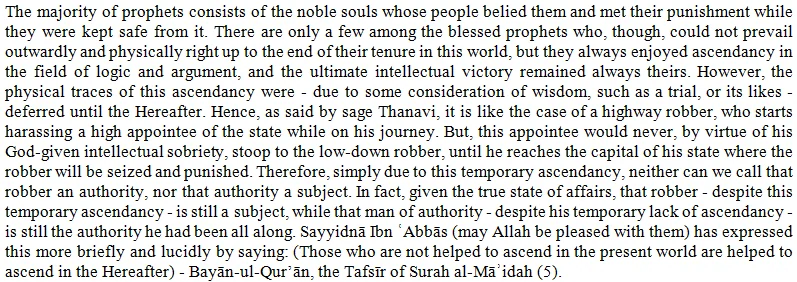
Hence, while the Prophets and believers may be killed in this world, their call ultimately prevails, and history bears witness to how those who killed the Prophets were later subjected to severe punishment and lasting disgrace.25

Again, the fact that Allāh promised to grant victory to His Messengers and their followers in this worldly life does not necessarily imply that in every era each Prophet and his followers must attain political dominance; rather, such dominance takes many forms. The Prophets of Allāh and their followers established moral and spiritual superiority even in regions where they did not achieve political control. Moreover, the nations that rejected their message and chose paths contrary to their teachings were ultimately doomed to destruction. Whatever erroneous philosophies and misguided ideologies people devised, and whatever corrupt practices they enforced, all eventually perished after enjoying temporary sway. Yet the truths preached by the Prophets of Allāh over thousands of years have remained unchanged—as unshakable in the past as they are today. No one has ever been able to disprove them in any way.26 If the atheists do not desist from collectively waging war against Islam, then we too must stand united and fight them collectively—presenting a unified front against them, just as they present a unified front against us: {And together fight the polytheists as they fight against you together. And know that Allāh is with those mindful ˹of Him˺} (Qurʾān 9:36). That is, just as the disbelievers unite in their refusal to fear Allāh, we as Muslims should unite in our reverence and fear of Him. If they come together for corrupt and worldly objectives, then we should come together for righteous and eternal purposes. If they are united for the sake of the world, we should be united for the sake of the Hereafter. Allāh emphasizes that if the believers “support” Him—that is, if they commit their lives and wealth to the cause of elevating His Word—He will, in turn, support them and grant them victory: {O you who believe! If you support ˹the cause of˺ Allāh, He will support you and make your foothold firm} (Qurʾān 47:7). In several places, the Qurʾān describes human participation in the effort to call people to Allāh’s religion and to establish its supremacy over disbelief as “helping Allāh” or “standing up for Him.” This theme appears in Sūrat aṣ-Ṣaff (61:14), Āl ʿImrān (3:52), al-Ḥajj (22:40), Muḥammad (47:7), al-Ḥadīd (57:25), and al-Ḥashr (59:8).27 This calls for some explanation.28

It is Allāh who causes all events to occur, yet He does so through a chain of causes and effects—and the same principle applies to the matter of religion.29
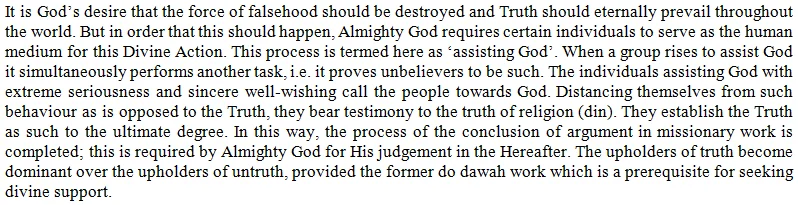
There will always remain among the Muslims a group who defend the religion of Allāh until the Hour is established. These are the ones described by the Prophet (PBUH) in the following ḥadīth: “A group of people from my ummah (nation) will always remain triumphant upon the truth and continue to prevail over their opponents. Those who forsake them will not harm them in the least. They will remain in this state until the Command of Allāh is carried out (i.e., until the Hour is established).”30 Throughout history, the disbelievers have ignored the call of the preachers of truth, forgetting that the effort to spread Allāh’s Word will ultimately succeed—regardless of their opposition. Allāh has promised His Messengers that they and their followers will ultimately prevail, both in this world and in the Hereafter: {and, verily, Our Word has gone forth of old for Our servants, the Messengers, that they verily would be made triumphant, and that Our hosts they verily would be the victors} (Qurʾān 37:171–173). However, it should always be borne in mind that no group attains supremacy or ascendancy—whether in this world or the Hereafter—merely by identifying with a religion in name. True success is only achieved when one becomes a devoted member of the “army of Allāh.”31

Calling to Allāh, responding to the people of falsehood, and exposing the shubuhāt (specious arguments and doubts) of the slanderers are al-ġanīmah al-bāridah (lit. “the cold spoils,” i.e., spoils gained without effort)—easy rewards. The idea is that this form of peaceful jihād does not involve the same hardship as military jihād. It is our duty toward the Prophet (PBUH) to support and honor him: {So that you ˹believers˺ may have faith in Allāh and His Messenger, support and honour him} (Qurʾān 48:9). We support and honor the Prophet (PBUH) by defending his religion and safeguarding his message from every slanderer.32 Therefore, be among the callers to Allāh. Verily, the believers are commanded to be the helpers of Allāh, as were the disciples of Jesus (PBUH): {Believers, be Allāh’s helpers,’ as Jesus, son of Mary, said to the disciples, “Who will be my helpers in the cause of Allāh?’ The disciples said, “We shall be Allāh’s helpers”} (Qurʾān 61:14). “Be Allāh’s helpers” here refers to calling people to Him. Since this is a task beloved to Allāh and carried out by His servants, it is therefore described as “helping Allāh.”33
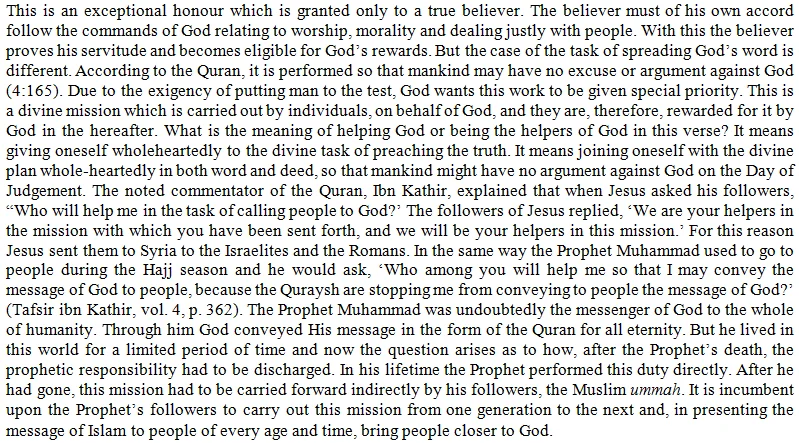
This matter is further clarified by a ḥadīth (Prophetic saying) cited by Ibn Hishām in his biography of the Prophet Muḥammad (PBUH).34
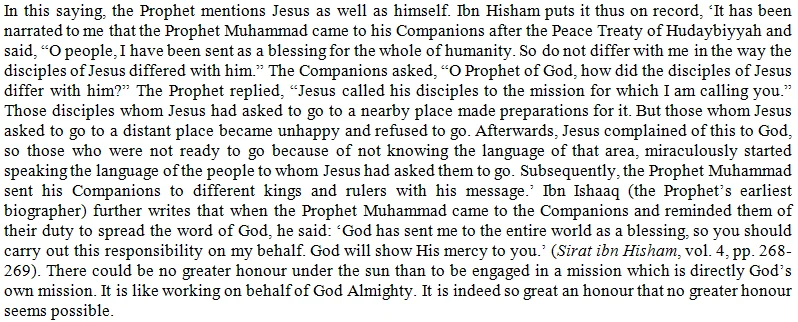
Indeed, there is no higher calling and no greater honor than engaging in daʿwah—inviting people to Allāh. It is important to understand, however, that while working for the reformation of people and the establishment of Allāh’s religion is described as “helping Allāh,” this should never be understood—Allāh forbid—as implying that Allāh is in need of assistance. Rather, it means that such individuals are participating in a cause that Allāh wills to accomplish through His Prophets and His revealed Books, though He is fully capable of achieving it through His power and might. Therefore, be among Allāh’s helpers by calling people to His religion—whether through speech, writing, or any other form of peaceful daʿwah.
Notes and References
- 1
Ibn Qayyim al-Jawziyyah, Miftāḥ Dār as-Saʿādah, (Jaddah, Saudi Arabia: al Majmaʿ al-Fiqhī al-Islāmī, 2012), vol. 1, p. 271.
- 2
Muḥammad ibn Ḥazm, al-Iḥkām fī Uṣūl al-ʾAḥkām, (Cairo, Egypt: Maṭbaʿat al-Īmān, 1960), vol. 1, p. 24.
- 3
Aḥmad ibn Ḥajar al-ʿAsqalānī, Fatḥ al-Bārī Sharḥ Ṣaḥīḥ al-Bukhārī, (Bayrūt, Lebanon: Dār al-Maʿrifah, 1959), vol. 6, p. 4.
- 4
Muslim ibn al-Ḥajjāj, Ṣaḥīḥ Muslim, (Bayrūt, Lebanon: Dār al-Kutub ʿIlmiyyah, 2020), book: 33, ḥadīth: 165, available at: https://sunnah.com/muslim:1878a.
- 5
Muḥammad al-Bukhārī, Ṣaḥīḥ al-Bukhārī, (Cairo, Egypt: Dār as-Salām. 1999), book: 56, ḥadīth: 2785, available at: https://sunnah.com/bukhari:2785.
- 6
The ʾAnṣār (lit. the Helpers): the native inhabitants of al-Madīnah who welcomed Prophet Muḥammad (PBUH) and his followers—the Muhājirūn (li. the Emigrants)—into their homes and supported them after they migrated from Makkah to escape persecution by the Quraysh.
- 7
Abū Dāwūd as-Sijistānī, Sunan Abī Dāwūd, (Cairo, Egypt: Maktabat al-Maʿārif, 1998), book: 15, ḥadīth: 36, available at: https://sunnah.com/abudawud:2512.
- 8
Muslim ibn al-Ḥajjāj, Ṣaḥīḥ Muslim, (Bayrūt, Lebanon: Dār al-Kutub ʿIlmiyyah, 2020), book: 33, ḥadīth: 198, available at: https://sunnah.com/muslim/33/198-199.
- 9
Muḥammad al-Bukhārī, Ṣaḥīḥ al-Bukhārī, (Cairo, Egypt: Dār as-Salām. 1999), book: 56, ḥadīth: 154, available at: https://sunnah.com/bukhari:2942.
- 10
Sayyid abū al-Aʿlá al-Mawdūdī, Towards Understanding the Qurʾān (English version of Tafhīm al-Qurʾān), trans. and edit. Zafar Isḥāq ʾAnṣārī, (Markfield, U.K.: The Islamic foundation, 1988), Chapter Fuṣṣilat (Qurʾān 41:33), footnote 36, available at: https://www.islamicstudies.info/tafheem.php?sura=41&verse=33&to=44.
- 11
ʿAbd ar-Raḥmān ibn Nāṣir as-Saʿdī, Tafsīr as-Saʿdī, (Bayrūt, Lebanon: Muʾassassat ar-Risālah, 2000), interpretation of verse (Qurʾān 3:66).
- 12
Abū Isḥāq Ibrāhīm ibn Mūsá ash-Shāṭibī, Kitāb al-Iʿtiṣām, (Bayrūt, Lebanon: Dār al-Kutub al-ʿIlmiyyah, 2012), vol. 1, p. 494.
- 13
ʿĀiḍ ibn Saʿd ad-Dawsarī, “Ash-Shubuhāt al-ʿAqdiyyah: Ḥaqīqatuhā wa-Anwāʿuhā wa-Maṣādiruhā wa-Maʾālātuhā wa-Kayfa Nataʿāmalu Maʿahā,” Atharah, 12 Nov. 2021, https://atharah.net/doctrinal-suspicions-their-reality-types-sources-consequences-and-how-to-deal-with-them/.
- 14
Abū al-Qāsim Hibat Allāh ibn al-Ḥassan al-Lālakāʾī, Sharḥ Uṣūl Iʿtiqād Ahl as-Sunnah wa-l-Jamāʿah, (ar-Riyāḍ, Saudi Arabia: Dār Ṭaybah, 2003), vol. 1, p. 29.
- 15
ʿUbayd Allāh ibn Muḥammad ibn Baṭṭah, al-Ibānah ʿan Sharīʿat al-Firqah an-Nājiyah wa-Mujānabat al-Firaq al-Maḏmūmah, (ar-Riyāḍ, Saudi Arabia: Dār ar-Rāyah, 1988), Bāb at-Taḥḏīr min Ṣuḥbat Qawmin Yumarriḍūna al-Qulūba wa-Yufsidūna al-Īmān, (Chapter: Warning Against the Company of People Who Sicken the Hearts and Corrupt One’s Faith), p. 437, no. 369.
- 16
Ibid., p. 443, no. 390.
- 17
Ibid., p. 438, no. 371.
- 18
Ibid., p. 444, no. 395.
- 19
Ibid., p. 459, no. 436.
- 20
Shams ad-Dīn abū ʿAbd Allāh Muḥammad ibn Mufliḥ al-Maqdisī,
al-Ādāb ash-Sharʿiyyah wa-l-Manāhij al-Marʿiyyah, ed. Bashshār ʿAwwād Maʿrūf and Muḥammad al-Zuhayrī, (Bayrut, Lebanon: Muʾassasat ar-Risālah, 1997), vol. 1, p. 263. - 21
ʿUbayd Allāh ibn Muḥammad ibn Baṭṭah, ash-Sharḥ wa-l-Ibānah ʿalá Uṣūl as-Sunnah wa-d-Diyānah wa-Mujānabati al-Mukhālifīn wa-Mubāyanati ʾAhl al-ʾAhwāʾ al-Māriqīn (Al-Ibānah aṣ-Ṣuġrá), (ar-Riyāḍ, Saudi Arabia: Dār ar-Rāyah, 2005), p. 132; Shams ad-Dīn aḏ-Ḏahabī, Siyar Aʿlām an-Nubalāʾ, (Bayrūt, Lebanon: Muʾassassat ar-Risālah, 1996), vol. 4, p. 59.
- 22
Shams ad-Dīn aḏ-Ḏahabī, Siyar Aʿlām an-Nubalāʾ, (Bayrūt, Lebanon: Muʾassassat ar-Risālah, 1996), vol.19, p. 447.
- 23
Muḥammad ibn Ṣāliḥ ʿUthaymīn, Sharḥ Thalāthat al-Uṣūl, (ar-Riyāḍ, Saudi Arabia: Dār ath-Thurayyā, 2004).
- 24
Muḥammad Shafīʿ ibn Muḥammad Yāsīn ʿUsmānī Deobandī, Maʿārif-ul-Qurʾān: A Comprehensive Commentary of the Holy Qurʾān, trans. Muḥammad Hasan Askari and Muhammad Shamīm, (Karachi, Pakistan: Maktaba-e-Darul-ʿUloom, 2010), Chapter aṣ-Ṣāffat (Qurʾān 37:173), pp. 490–491, available at: https://islamicstudies.info/quran/maarif/maarif.php?sura=37&verse=167.
- 25
Ibid., Chapter Ġāfir (Qurʾān 40:51), pp. 609–610, available at: https://islamicstudies.info/quran/maarif/maarif.php?sura=40&verse=51.
- 26
Sayyid abū al-Aʿlá al-Mawdūdī, Towards Understanding the Qurʾān (English version of Tafhīm al-Qurʾān), trans. and edit. Zafar Isḥāq ʾAnṣārī, (Markfield, U.K.: The Islamic foundation, 1988), Chapter aṣ-Ṣāffāt (Qurʾān 37:173), footnote 93, available at: https://www.islamicstudies.info/tafheem.php?sura=37&verse=167&to=182.
- 27
{O believers! Stand up for Allāh, as Jesus, son of Mary, asked the disciples, “Who will stand up with me for Allāh?” The disciples replied, “We will stand up for Allāh”} (Qurʾān 61:14); {When Jesus sensed disbelief from his people, he asked, “Who will stand up with me for Allāh?” The disciples replied, “We will stand up for Allāh. We believe in Allāh, so bear witness that we have submitted”} (Qurʾān 3:52); {Allāh will certainly help those who stand up for Him} (Qurʾān 22:40); {O you who believe! If you support ˹the cause of˺ Allāh, He will support you and make your foothold firm} (Qurʾān 47:7); {And We sent down iron with its great might, benefits for humanity, and means for Allāh to prove who ˹is willing to˺ stand up for Him and His messengers without seeing Him. Surely Allāh is All-Powerful, Almighty} (Qurʾān 57:25). {˹Some of the gains will be˺ for poor emigrants who were driven out of their homes and wealth, seeking Allāh’s bounty and pleasure, and standing up for Allāh and His Messenger. They are the ones true in faith} (Qurʾān 59:8).
- 28
Sayyid abū al-Aʿlá al-Mawdūdī, Towards Understanding the Qurʾān (English version of Tafhīm al-Qurʾān), trans. and edit. Zafar Isḥāq ʾAnṣārī, (Markfield, U.K.: The Islamic foundation, 1988), Chapter ʾĀli ʿImrān (Qurʾān 3:52), footnote 50, available at: https://www.islamicstudies.info/tafheem.php?sura=3&verse=52&to=53.
- 29
Maulana Wahiduddin Khan, Tazkirul Quran, (Noida, India: Goodword Books, 2012), Chapter Muḥammad (Qurʾān 47:7), p. 1512, footnote a, available at: https://archive.org/details/CPS-TQE/page/1512/mode/2up?view=theater.
- 30
Muslim ibn al-Ḥajjāj, Ṣaḥīḥ Muslim, (Bayrūt, Lebanon: Dār al-Kutub ʿIlmiyyah, 2020), book: 33, ḥadīth: 245, available at: https://sunnah.com/muslim:1920.
- 31
Muḥammad Shafīʿ ibn Muḥammad Yāsīn ʿUsmānī Deobandī, Maʿārif-ul-Qurʾān: A Comprehensive Commentary of the Holy Qurʾān, trans. Muḥammad Hasan Askari and Muhammad Shamīm, (Karachi, Pakistan: Maktaba-e-Darul-ʿUloom, 2010), Chapter aṣ-Ṣāffāt (Qurʾān 37:173), p. 491, available at: https://islamicstudies.info/quran/maarif/maarif.php?sura=37&verse=167.
- 32
Aḥmad ibn ʿAbd al-Ḥalīm ibn Taymiyyah, aṣ-Ṣārim al-Maslūl, (Bayrūt, Lebanon: Dār al-Kutub al-ʿIlmiyyah, 1998), vol. 1, p. 217.
- 33
Maulana Wahiduddin Khan, Tazkirul Quran, (Noida, India: Goodword Books, 2012), Chapter aṣ-Ṣaff (Qurʾān 61:14), p. 1626, footnote a, available at: https://archive.org/details/CPS-TQE/page/1626/mode/2up?view=theater.
- 34
Ibid., p. 1627, footnote a.