How does al-hawá (whims and desires) amplify shubuhāt (specious arguments, doubts, or misconceptions)?
Think of someone who is so attached to the worldly life that all his thoughts, concerns, plans, ambitions, happiness, sadness, hopes, and fears are entirely anchored in it. In the eyes of such a person, the Hereafter becomes insignificant, and he gradually begins to grow suspicious of Islam itself. For example, he may start to question the legislation of jihād, failing to see the point of sacrificing one’s life and giving up worldly pleasures for the sake of a reward in the Hereafter—which, to him, seems trivial. However, if this person returns to his Lord, reshapes his expectations of life, loosens his attachment to it, and sees it for what it truly is—a platform for the Hereafter that is of use only insofar as it serves that sole purpose—his perspective on jihād will completely shift. Changing one’s view of life is like changing the window through which he looks at the world. Islam teaches us that this life is not permanent or everlasting, for it will come to an end for each of us individually and for all of humanity collectively. At times, Allāh uses the image of rain in the Qurʾān to depict the fleeting nature and ultimate worthlessness of this world.1

Allāh says: {And give them a parable of this worldly life. ˹It is˺ like the plants of the earth, thriving when sustained by the rain We send down from the sky. Then they ˹soon˺ turn into chaff scattered by the wind} (Qurʾān 18:45). The pleasures of this worldly life are thus insignificant when compared to those of the Hereafter, which are everlasting. If the person described earlier—who was skeptical about jihād—adopts Islam’s balanced perspective on life, he will come to see that sacrificing one’s life in the path of Allāh is far from foolish. In fact, dying as a martyr is among the highest honors in Islam, and the rewards granted to the martyr in the Hereafter are so sublime—so far beyond the reward for nearly any other righteous deed—that he would long to return to this world ten times, so that each time he could fight in the cause of Allāh and be martyred again and again.2 The above person’s shubuhāt (specious arguments and doubts) about jihād will vanish. He will even begin to ask Allāh to grant him the honor of dying as a martyr in His cause, and he will no longer feel skeptical when he reads in Islamic literature that martyrdom is the cherished aspiration of many righteous men and women in Islam—those who seek the highest ranks in Paradise.
As discussed earlier, the Muslim should never give precedence to his own reason over divine revelation. He must accept that certain matters lie beyond the full grasp of human intellect, and attempting to “rationalize” such matters may lead to distortion and misguidance. Islam encourages the use of intellect, but only within its proper scope, always reminding us that Allāh alone is Absolute, while every other faculty—including human reason—is limited. Therefore, anyone who experiences doubts about Islam but recognizes the finite capacity of human understanding, aligns his thinking and desires with the law of Allāh, and adopts the correct attitude toward this life—namely, that the Hereafter is the true life and this world is merely a means to prepare for it—will come to see the truth clearly and recognize the absurdity of the so-called “rational” arguments he once used to oppose Divine Legislation. Foolish people often resist hearing or accepting the truth because it conflicts with their desires and interests. Yet the truth remains the truth—it does not bend to their whims or wishes. Allāh says that had He followed the desires of people, the heavens, the earth, and all that is within them would have been corrupted due to the inconsistency and corruption of their desires: {Had the truth followed their desires, the heavens, the earth, and all those in them would have certainly been corrupted} (Qurʾān 23:71). Only a foolish person clings to their personal whims, wishes, and prejudices, treating them as reality, and refuses to listen to or consider any argument—no matter how rational—simply because it conflicts with their desires.3
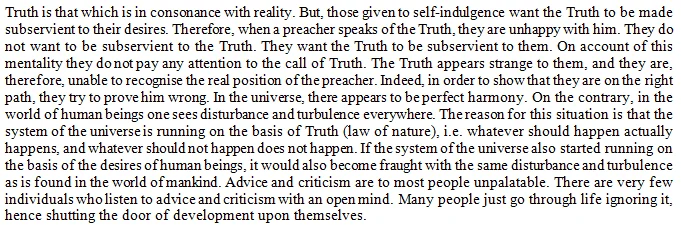
It cannot be denied that humans are fallible due to their physical, biological, mental, and emotional nature—and to complicate matters further, they differ from one another in countless ways. As a result, people often develop drastically divergent, even diametrically opposed, perspectives and perceptions. The claim that perception is reality is both blatantly unrealistic and objectively flawed, for one of the greatest weaknesses of human intelligence is its proneness to error. Perception takes place entirely in the mind, where cognitive distortions can make nearly any belief feel true, leading to false perceptions ranging from mild illusions (misinterpretations of actual experiences) to delusions (false, fixed beliefs). Reality, however, cannot be shaped at will; it exists independently of the mind. Human beings who rely solely on intellect as a source of knowledge often fall into contradictory thoughts and beliefs, and their emotions may conflict with their principles. More often than not, they remain unaware of their own inconsistencies and contradictions, though they are riddled with them. Furthermore, the uniqueness of each person’s experience—the things they perceive, and the judgments they make based on those perceptions—is deeply influenced by cognitive biases. Each person tends to assume that their perception of reality is an accurate reflection of what truly exists, failing to recognize that they construct their own “realities” through filters shaped by expectations (i.e., prior beliefs), preconceived notions, personal interests, desires, and fears. In essence, this results in a biased and partial reading of reality. Although these perceptions may feel profoundly real, they are not necessarily factual. Ibn Qutaybah critiqued the Muʿtazilah—a rationalist school whose creed is founded on the notion that Allāh and everything in existence can be comprehended through the intellect, which Allāh created in Man.4 They held that knowledge of Allāh’s existence, attributes, and actions could be attained through reason alone, independent of revelation. Unlike the people of Ḥadīth (Prophetic traditions), the Muʿtazilah believed that one could know Allāh without Scripture and even without Prophets, and that reason should be given primacy over revelation. If reason and revelation appeared to contradict one another, they insisted that the contradiction be resolved in favor of reason. Ibn Qutaybah criticized this position, saying: “With what they claim—of their knowledge of qiyās (the process of deriving legal rulings from the Qurʾān or Sunnah through analogical reasoning) and their development of the tools of naẓar (rational investigation)—they should not have differed [in their opinions], just as mathematicians, land surveyors, and engineers do not disagree, for their instruments consistently yield the same number and the same shape (i.e., the same quantitative and structural results). Thus, what is the matter with them? They differ among themselves more than any other group. There are not two of their leaders who agree on a single religious matter. There is not one among them who does not have a maḏhab (religious doctrine) shaped by his own opinion, to which he has attracted followers.”5 In a similar vein, after extensively studying various disciplines—both religious and philosophical—al-Ġazālī authored his renowned work Tahāfut al-Falāsifah (The Incoherence of the Philosophers) to expose the inadequacy of philosophy when set against Faith.6 Although he was himself an Ashʿarite and a practitioner of ʿilm al-kalām (often referred to as “Islamic scholastic theology” or “speculative theology”), his intention in this book was to demonstrate the error of treating logic as an absolute authority. He firmly established that in matters of divinity and metaphysics, Faith must take precedence over philosophy and logic. He [may Allāh have mercy on him] wrote: “Let it be known that to plunge into narrating the differences among the philosophers would involve too long a tale. For their floundering about is lengthy, their disputes many, their views spread far apart, their ways divergent and discordant.” 7 It is a fact that anyone can challenge another’s “reasoning and rationality,” and anyone can claim that their reasoning is superior to that of others. This reveals that reasoning, in itself, is ultimately a subjective process. The commonly accepted sources of knowledge—namely, sense perception and rational truths—cannot be relied upon to provide absolute certainty. Sense perception is vulnerable to doubt, as what is presented to us through our senses may be no more substantial than dreams, illusions, or hallucinations. Even mathematical and logical truths are not immune to skepticism, as they too can sometimes be misleading. For knowledge to be certain, it must be infallible—that is, entirely free from error or deception—and only divinity can guarantee such a sound epistemological foundation. In other words, ultimate reasoning and truth can be attained only through divine revelation. Prophethood is Allāh’s greatest mercy, and the Message He revealed to His Messenger (PBUH) is the highest source of knowledge—surpassing all the knowledge accumulated by those who rely solely on reason and demonstrative evidence while rejecting the theological knowledge derived from revelation. Allāh warns those who seek to obstruct the believers from following His path, making it clear that harassing those who have accepted the truth and drawing them into needless disputes is among the most oppressive and reprehensible actions. Those who persist in such behavior risk incurring His wrath and facing severe punishment in the Hereafter: {As for those who dispute about Allāh after He is ˹already˺ acknowledged ˹by many˺, their argument is futile in the sight of their Lord. Upon them is wrath, and they will suffer a severe punishment} (Qurʾān 42:16). The proofs in support of Islam have been fully presented to mankind, and it is the sensible and fair-minded who recognize their truth and embrace Islam. As for those who exalt independent human reason while rejecting divine revelation, their argumentation amounts to nothing but falsehood and misguidance. In this worldly life of trial, people have ample opportunity to invent pretexts and justifications for whatever aligns with their interests. This allows those who reject the Truth—despite its clarity—to feel falsely assured in their stance, to the extent that they claim the “real Truth” is what they have arrived at through independent reasoning and rationality. Yet on the Day of Judgment, the entire structure of false beliefs they have built will be demolished, and they will themselves testify to the falsity of their claims: {See how they will lie about themselves and how those ˹gods˺ they fabricated will fail them!} (Qurʾān 6:24). That is, they will disavow the very things to which they had once clung with pride in the worldly life.8
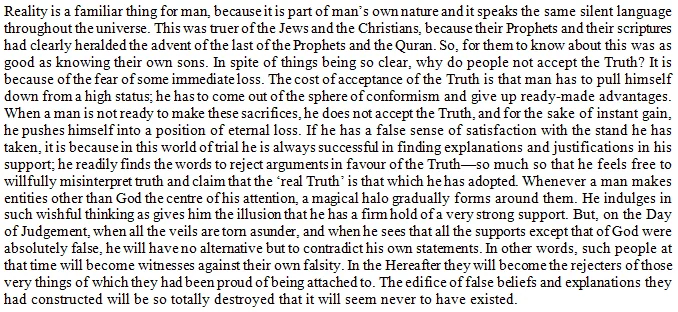
Those who are devoted to their own self-interests and desires represent the worst kind of irreligious people. They cannot bear to be governed by Allāh’s commandments, and they go so far as to craft self-serving interpretations of the Divine religion in order to mold it to their desires. The Truth is accepted only by those who possess firm faith in Allāh and do not evaluate matters through the lens of their own whims. Such individuals make the moral choice to rise above their desires by submitting to the laws of their Lord, recognizing that no one can judge better than Allāh. {Who could be a better judge than Allāh for people of sure faith?} (Qurʾān 5:50). Islam is the path of true knowledge, for it is Allāh Himself who has shown this way, and His knowledge encompasses all things. Therefore, any path that deviates from Islam is a path of ignorance, for those who follow it disregard the knowledge that Allāh has revealed and instead rely on opinions and customs invented by people—none of which have any foundation in His religion. They derive their norms from partial knowledge, mixed with superstitious fancies, conjectures, imagination, and desires—an ignorance born of mere opinion and lust. Those who understand Allāh’s Law are certain that no one is more just in judgment than Allāh, for His knowledge is perfect and His mercy toward His creation surpasses even that of a mother for her child. Indeed, how could the Creator not know what is best for His creation? Allāh says: {How could He not know His Own creation? For He ˹alone˺ is the Most Subtle, All-Aware} (Qurʾān 67:14). Allāh will render the deeds of those who reject what He has revealed for their guidance void and worthless, for they have preferred the whims, superstitions, customs, and moral corruption born of their ignorance over His divine guidance: {That is because they detest what Allāh has revealed, so He has rendered their deeds void} (Qurʾān 47:9). Allah has commanded the Prophet (PBUH) and all Muslims to remain steadfast and upright in every circumstance and in every matter: {So be steadfast as you are commanded…} (Qurʾān 11:112). This command applies to matters of belief, acts of worship, personal and collective transactions, moral conduct, social interactions, and economic pursuits, covering all sources of income and channels of expenditure. This act of standing firm must be in accordance with Allah’s command, not driven by personal desires; one must adhere to the straight path laid out by Allah and remain within the boundaries He has set. Straying from this command leads to misguidance in thought and practice. When people fail to remain firm in Islamic beliefs, they begin to introduce innovations into the religion, eventually falling into the extremes of disbelief (kufr) and associating partners with Allah (shirk). Giving in to personal whims and transgressing the limits set by Allah and His Messenger—whether in belief, worship, transactions, or moral conduct—is the root of all corruption in both worldly and religious life. The Prophet (PBUH) stated that true faith is not complete until one's desires are aligned with the teachings of Islam: “None of you [truly] believes until his desires are subservient to that which I have brought.”9 True believers are those who, when called to Allah and His Messenger, respond by saying, “We hear and we obey.” Allah says: {The only response of the ˹true˺ believers, when they are called to Allāh and His Messenger so he may judge between them, is to say, “We hear and obey.” It is they who will ˹truly˺ succeed} (Qurʾān 24:51). These words should not be uttered merely with the tongue, but must come from the heart—that is, we should accept what Allah and His Messenger legislate with full contentment and willingness.
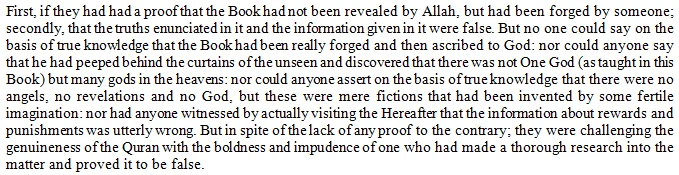
Once again, we should not, without any sound basis of true knowledge, reject the truth revealed by Allah or declare it false merely because we do not grasp the wisdom behind certain divine legislations. This is the case with many who, out of ignorance and foolishness, deny what lies beyond the limits of their understanding, boldly and arrogantly challenging the authenticity of Islam despite having no grounds or evidence for their claims: {In fact, they ˹hastily˺ rejected the Book without comprehending it and before the fulfilment of its warnings} (Qurʾān 10:39). Those who, out of wickedness, pride, stubbornness, and ignorance, accused the Qurʾān of being fabricated during the time of the Prophet (PBUH) could only have done so on two possible grounds—but neither of these existed.10
Notes and References
- 1
Ali Ihsan Hammuda, “How to Understand the Dunya,” Islam21C.com, 09 Dec. 2020, https://www.islam21c.com/theology/how-to-understand-the-dunya/.
- 2
Muḥammad ibn ʿAbd Allāh al-Khaṭīb at-Tibrīzī, Mishkāt al-Maṣābīḥ, (Bayrūt, Lebanon: al-Maktab al-Islāmī. 1979), book: 19, ḥadīth:17, available at: https://sunnah.com/mishkat:3803.
Anas [may Allāh be pleased with him] narrated that Allāh’s Messenger (PBUH) said, “No one who enters Paradise will want to return to the life of this world and have anything in the earth except the martyr. He will wish to return to the world and be killed ten times because of the honour he sees.”
- 3
Maulana Wahiduddin Khan, Tazkirul Quran, (Noida, India: Goodword Books, 2012), Chapter al-Muʾminūn (Qurʾān 23:68–71), p. 1059, footnote a, available at: https://archive.org/details/CPS-TQE/page/1058/mode/2up?view=theater.
- 4
The Muʿtazilah constituted the earliest “school” of Islamic rationalist theology, known as kalām (speculative theology), and flourished in Iraq nearly two centuries after the Prophet’s migration (Hijrah) to Madīnah. The Muʿtazilites were staunch rationalists who held that spiritual truths are accessible to human beings through their intellect and reason, and that theoretical reason must serve as the ultimate arbiter of whatever is revealed. In other words, they upheld the primacy of human reason and developed a form of rationalism that was, in part, influenced by Greek philosophical thought.
- 5
ʿAbd Allāh ibn Qutaybah, Taʾwīl Mukhtalif al‑Ḥadīth, (Bayrūt, Lebanon: al-Maktab al-Islāmī, 1999), p. 14.
- 6
“Al-Ghazali,” Stanford Encyclopedia of Philosophy, 14 Aug. 2007, https://plato.stanford.edu/entries/al-ghazali/.
Al-Ghazâlî (c.1056–1111) was one of the most prominent and influential philosophers, theologians, jurists, and mystics of Sunni Islam. He understood the importance of philosophy and developed a complex response that rejected and condemned some of its teachings, while it also allowed him to accept and apply others. His critique of twenty positions of philosophy in his The Incoherence of the Philosophers (Tahāfut al-Falāsifah) is a significant landmark in the history of philosophy. His approach to resolving apparent contradictions between reason and revelation was accepted by almost all later Muslim theologians and had, via the works of Averroes (Ibn Rushd, 1126–98) and Jewish authors, a significant influence on Latin medieval thinking.
- 7
Abū Ḥāmid al-Ġazālī, The Incoherence of the Philosophers, trans. Michael E. Marmura, (Provo, U.S.: Brigham Young University Press, 2000), p. 4, available at: https://ia801204.us.archive.org/35/items/imamghazali_201510/Al%20Ghazali%20Incoherence%20of%20the%20Philosophers.pdf.
- 8
Maulana Wahiduddin Khan, Tazkirul Quran, (Noida, India: Goodword Books, 2012), Chapter al-ʾAnʿām (Qurʾān 6:20–24), p. 342–343, available at: https://archive.org/details/CPS-TQE/page/342/mode/2up?view=theater
- 9
Abū Zakariyyā Yaḥyá ibn Sharaf an-Nawawī, al-ʾArbaʿūn an-Nawawiyyah, (Cairo, Egypt: Dār as-Salām, 2007), ḥadīth: 41, available at: https://sunnah.com/nawawi40:41.
- 10
Sayyid abū al-Aʿlá al-Mawdūdī, Towards Understanding the Qurʾān (English version of Tafhīm al-Qurʾān), trans. and edit. Zafar Isḥāq ʾAnṣārī, (Markfield, U.K.: The Islamic foundation, 1988), Chapter Yūnus (Qurʾān 10:39), footnote 49, available at: https://www.islamicstudies.info/tafheem.php?sura=10&verse=37&to=40.