How should I deal with someone who raises shubuhāt (specious arguments and doubts) about Islam?
Before responding to any shubhah (specious argument or doubt) raised about Islam, it is essential to first determine whether the person raising it is a Muslim or an atheist, as the approach to addressing shubuhāt fundamentally differs depending on the individual’s worldview—namely, atheism versus theism or Islam. When a shubhah is raised by an atheist, one should not hastily respond; rather, the focus should be on dismantling and uprooting their atheism from its core. As William Lane Craig aptly notes, New Atheism is a pop-cultural phenomenon lacking intellectual depth and largely unaware of the philosophical revolution that has occurred within academic circles.1 It is striking how naturalistic atheistic philosophers and scientists have repeatedly failed both to refute the various arguments for God’s existence and to offer any compelling case for atheistic naturalism (commonly equated with materialism). Notably, the atheist’s rejection of belief in Allāh is typically accompanied by a broader denial of any supernatural or transcendental reality. In most cases, atheists are materialists, holding that matter is the fundamental substance in nature and that all phenomena, including consciousness and mental states, result solely from material interactions—in other words, that nothing exists but matter in motion. Given this commitment to materialism, demonstrating its falsehood necessarily entails the falsehood of atheism itself. Materialism asserts that everything is physical and that all things can, in principle, be fully described and explained by physics. Therefore, if there exist aspects of reality that cannot be exhaustively explained by physics, materialism collapses—and with it, atheism, since the coherence of the atheistic naturalistic worldview rests on the unification of explanatory principles (i.e., explaining all aspects of reality through a single, consistent framework, usually based on physical laws).
The American Heritage Dictionary defines “materialism” as “the doctrine that physical matter is the only reality and that everything, including thought, feeling, mind, and will, can be explained in terms of matter and physical phenomena.”2 The late renowned agnostic astronomer Carl Sagan opened his widely acclaimed book Cosmos with the statement: “The Cosmos is all that is or ever was or ever will be.”3 According to the atheistic naturalistic worldview, human beings and the rest of nature operate according to the same laws. Sagan stated: “yes, only certain laws and constants of nature are consistent with our kind of life. But essentially the same laws and constants are required to make a rock.”4 The materialistic belief that everything in the universe consists solely of matter and energy carries far-reaching logical consequences. Upon deeper examination, it becomes clear that some of the most essential aspects of what it means to be human are called into question. One such aspect is human free will, which must be denied if materialism is accepted. That is, if matter and energy are all that exist, then the idea of a human will that governs conscious decision-making must be rejected. Modern figures in the atheistic community openly acknowledge that, within their worldview, all facts—including those about the human mind, will, and the course of history—are either causally dependent on or reducible to physical processes. In other words, atheists embrace determinism: the belief that free will is an illusion because everything, including thought and behavior, is the product of matter and prior events governed by physical laws. There is no independent “self” outside of matter controlling our actions; instead, our behavior is shaped by internal or external forces over which we have no real control. What follows is a compilation of statements by some of the world’s leading atheists on the subject of free will—all of whom deny its existence. We begin with the most well-known living atheist, Professor Richard Dawkins. In a public discussion some time ago with world-renowned physicist Lawrence Krauss, Dawkins was asked by an audience member whether there is a scientific basis for free will. He responded: “It’s a question that I dread actually because I don’t have a very well thought out view about it… I have a materialist view of the world. I think that things are determined in a rational way by antecedent events and that commits me to the view that when I think I have free will, when I think I am exercising free choice I am deluding myself. My brain states are determined by physical events, and yet that seems to go against the very powerful subjective impression that we all have that we do have free will.”5 Krauss added, “I also have to agree that everything I know about the world tells me that there’s no such thing as free will.”6 Professor William Provine, a prominent historian of science, also admitted during a debate at Stanford University with a theist that he does not believe in free will. He stated: “Free will is not hard to give up, because it’s a horribly destructive idea to our society. Free will is what we use as an excuse to treat people like pieces of crap when they do something wrong in our society. We say to the person, ‘you did something wrong out of your free will, and therefore we have the justification for revenge all over your behind. We put people in prison, turning them into lousier individuals than they ever were’. This horrible system is based upon this idea of free will.”7 Provine’s statement is clearly incoherent, as he claims that belief in free will leads to immoral practices such as harsh retributive punishment—yet, if free will does not exist, then those who enforce such punishments are not acting freely either, and thus cannot be morally condemned for their actions. Nobel Prize winner and co-discoverer of the structure of the double helix, Francis Crick, delivered perhaps the most sweeping rejection of free will among them all. He wrote: “You, your joys and your sorrows, your memories and your ambitions, your sense of personal identity and free will, are in fact no more than the behavior of a vast assembly of nerve cells and their associated molecules. Who you are is nothing but a pack of neurons.”8 Sam Harris, one of the “Four Horsemen of Modern Atheism,” penned a short book titled Free Will dedicated entirely to its denial. He wrote:
“Free will is an illusion. Our wills are simply not of our own making. Thoughts and intentions emerge from background causes of which we are unaware and over which we exert no conscious control. We do not have the freedom we think we have.’’9
“And I cannot determine my wants, or decide which will be effective, in advance. My mental life is simply given to me by the cosmos.’’10
“People feel (or presume) an authorship of their thoughts and actions that is illusory.”11
“What I will do next, and why, remains, at bottom, a mystery—one that is fully determined by the prior state of the universe and the laws of nature (including the contributions of chance).”12 As Harris begins to summarize his views toward the end of his book, he states: “You will do whatever it is you do, and it is meaningless to assert that you could have done otherwise.”13 Harris, like everyone quoted above, insists that free will is non-existent because their commitment to materialism leaves them no alternative. This is evident from Harris’s statement: “In improving ourselves and society, we are working directly with the forces of nature, for there is nothing but nature itself to work with.”14 And on the second-to-last page, he wrote: “Am I free to change my mind? Of course not. It can only change me.”15 There are striking ironies in the position held by Harris and many of today’s leading atheists, who deny both their own free will and that of their readers. The question naturally arises: why would they write books and articles attempting to persuade others to adopt their view—that there is no such thing as free will, that there is no God, and that religion is man-made—if readers cannot choose to change their minds? What purpose does it serve to convince someone who believes in God and in free will if that belief is merely the result of mechanical cause-and-effect processes occurring in the brain? If a person lacks the ability to choose their beliefs, then trying to “demonstrate” the superiority of the “no-God and no free will” position becomes meaningless. According to atheists who deny free will, belief itself is simply the product of the physics of the cosmos playing out in the brain. If that is so, how mere words on a page could possibly alter those physical processes would indeed be a mystery worth uncovering. Without question, the very act of writing to persuade others that free will does not exist stands in stark contradiction to the undeniable reality that human beings possess free will.
If determinism is true, how can atheists claim to have suspicions about the existence of Allāh, the prophethood of Muḥammad (PBUH), or the validity of Islam? The Cambridge Dictionary defines “suspicion” as “a feeling or belief that someone has committed a crime or done something wrong.”16 If the world, as claimed by the new age atheists, is purely deterministic and human free will is nothing more than physical processing—molecules moving to the rhythm of the laws of physics—then it becomes nonsensical to suggest that any religious text is wrong or ought to have been different. Determinism implies that in any given situation where a person makes a decision or takes an action, it was impossible for them to have chosen or acted differently. In other words, people could never have decided or behaved otherwise than they actually did. Consequently, all the allegations directed at Prophet Muḥammad (PBUH) by opponents of Islam—such as the claim that he was an impostor motivated by ambition or desire who knowingly propagated false teachings—collapse under the atheistic materialist worldview, since free will does not exist within the deterministic framework of the physical universe. If the Prophet’s brain was entirely deterministic, then everything he said and did was simply the result of atomic motion, not conscious choice. He (PBUH) did not choose to convey the Qurʾān and Sunnah; rather, these were outcomes forced upon him by the inescapable nature of the cosmos. Thus, why would atheists question the truthfulness of someone who, by their own logic, had no control over his speech or actions and was merely following an unalterable chain of cause and effect in his brain? After all, within the atheistic materialist paradigm, Prophet Muḥammad (PBUH) could not have done otherwise. In essence, deterministic physical laws dictate that everything—including human actions—results from the natural movement of atoms. Therefore, all suspicions raised by atheists about Islam are meaningless, and their efforts to persuade are futile, since humans, under this view, are survival machines incapable of making genuine choices. Why attempt to persuade anyone, if belief itself is not chosen but simply the product of genes and physical processes? Those who believe in Allāh and His Messenger (PBUH) do so because they are genetically programmed to, just as those who reject faith are likewise products of their biology. If, as Sam Harris asserts, people do not change their minds but rather their minds change them, then trying to convince Muslims is pointless—they do not truly have “minds,” and their brains will believe only what their genes dictate. Ironically, atheists must assume the very existence of free will in order to argue about it or to question belief in Allāh and Islam. One of the most damaging lines of reasoning against the idea put forth by atheists who deny free will is the very way they attempt to convince their readers of its truth (i.e., that free will does not exist).17
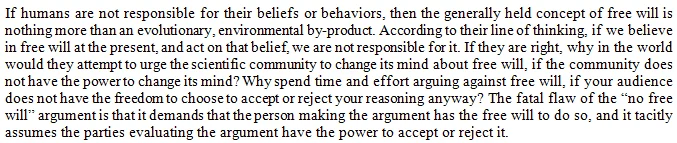
The New Atheists fail to grasp the full ramifications of their conclusions. If their strictly materialistic and deterministic worldview is true, then even the use of rationality becomes impossible.18

In June 2015, evolutionary biologist Jerry Coyne delivered a lecture at the Imagine No Religion convention in Vancouver, Canada, titled “You Don’t Have Free Will.” Addressing his primarily atheistic audience, he stated, “Now many of you probably don’t accept that. You don’t believe that you are robots made out of meat, which is what I’m going to try to convince you of today.”19 Coyne adopts this position because, if atheism is true and nothing supernatural exists, then—as he put it—“Our behavior is absolutely determined by the laws of physics.”20 Coyne takes serious issue with his fellow atheists who claim to be naturalists and determinists yet attempt to argue that humans still possess some form of free will. He rightly points out that atheistic naturalism cannot allow for any genuine notion of free will. According to Coyne, those atheists who try to reconcile the two are merely engaging in “semantic tricks,” attempting to assure people “that we are still okay even though we are meat robots.”21 Coyne went on to say, “As Anthony Cashmore said, ‘We have no more free will than a bowl of sugar.’”22 He then added, “And I firmly believe that. We are bowls of sugar, just very complicated ones.”23 Christian apologist Kyle Butt observes:24

The fact that atheists express frustration or annoyance at the religious beliefs of theists points to the existence of something more in human beings than just molecules in motion. It suggests that, deep down, even atheists recognize that human behavior is not entirely determined by the laws of physics. Instead, human beings are decision-makers capable of making genuine, nondeterministic choices. This acknowledgment undermines the deterministic worldview, as it implies that we live in a probabilistic, indeterministic universe and that man is mukhayyar (possessing free will) and mukallaf (divinely accountable). We humans have the capacity to choose freely and bear moral responsibility for our actions. Once again, the very act of atheists raising suspicions about Islam demonstrates that they implicitly accept that Man has free will—the capacity to choose between alternative courses of action without coercion. In other words, atheists concede that events in this world, including human actions and decisions, are not determined with absolute necessity. Simply put, we, as human beings, make real choices—we freely decide to act or refrain from acting. Therefore, materialism and atheism cannot be true, because our decisions arise from something beyond matter. They cannot be reduced to a naturalistic chain of chemical reactions governed by cause and effect. There is a conscious “self” within us that freely accepts or rejects, and this reality invalidates the materialist understanding of the universe. This is one of the most glaring contradictions in the no-free-will position, and it is clearly illustrated in Sam Harris’s aforementioned statement, where he says: “Am I free to change my mind? Of course not. It can only change me.”25 Kyle Butt observes:26

“Sam Harris” is not merely a label for the collection of physical molecules that constitute his body; rather, there must be something beyond the material—a mind, soul, or spirit of non-physical nature—that governs his bodily movements and is present when he makes personal decisions. As becomes clear, none of the world’s leading atheists believe in free will in the traditional sense—that is, the kind that genuinely renders us morally responsible for our actions. Yet, in public discourse and debates, most atheists behave as if moral accountability is real: they express outrage over what they perceive as immoral behavior and passionately call for justice. But atheists cannot have it both ways—they cannot deny the existence of free will while speaking and acting as though it exists. Furthermore, if their worldview is correct and free will truly does not exist, then they themselves have no choice in what they believe or do. In short, atheism logically entails the denial of free will, and one must either choose atheism or affirm human free will—but not both, while remaining logically consistent. This alone should be enough to convince any rational atheist that the material world is not all there is, that something supernatural exists (i.e., Allāh), and that there is something beyond matter within human beings that can make free choices (i.e., free will). Indeed, this should be sufficient to uproot atheism from the heart of any reasonable atheist.
In regard to morality, crime, and punishment, the necessary implication of denying human free will is that humans are not morally responsible for any of their actions—no more than a rock or a lizard is. Causal determinism holds that it is physically impossible for an offender not to offend in exactly the way and at exactly the time he does. Therefore, from a deterministic perspective, the concepts of guilt, retributive justice, punishment, and moral responsibility lose all meaning. Indeed, the denial of moral responsibility is one of the most fallacious and destructive implications of the false idea of atheism.27

Everyone, including atheists, seeks to hold criminals accountable for their actions—a notion rooted in the belief that human beings possess free will and are capable of choosing between right and wrong. Free will is not merely an illusion; it underpins the moral framework upon which criminal justice systems around the world are built. Deep down, atheists acknowledge that they make choices, yet their commitment to atheistic naturalism forces them to explain those choices as nothing more than the by-products of chemistry and physics—specifically, the outcome of quantum processes in the brain. In doing so, they attempt to persuade us that free will is an illusion, because this is the only way to remain consistent with their atheistic worldview. Consider the logical sequence of this belief system: first, if there is no God, then the material world must be all that exists, and nothing supernatural can be admitted. Second, if the physical world is all there is, then everything composed of matter—including human beings—must be governed entirely by physical laws. Third, if nothing beyond the material exists, then there can be nothing within us that transcends matter to freely choose or decide. It follows, then, that free will cannot exist within an atheistic framework. Yet atheists themselves feel the tension between the logical consequences of their worldview and the undeniable human experience of making conscious, personal choices. They know, as we all do, that we experience decision-making, but their atheism demands that this experience must be dismissed. As a result, they are compelled to adopt the idea of free will as an illusion in order to preserve their atheistic commitments. This tension is clearly illustrated by television personality Bill Nye, former host of the children’s show Bill Nye the Science Guy, who found himself in a difficult dilemma when asked about human free will. Nye stated: “But clearly, I know I have made decisions based on things that happened around me that I wouldn’t have made without being informed by history or what I noticed. I know I have. Now if that turns out not to be true, I’d be very surprised.”28 However, he backtracked and claimed that our decisions are, in fact, the result of the quantum physics at work in our brains: “With that said, I am satisfied now, as an engineer and scientist, that our brains are chemical reactions and chemical reactions, at some level, depend on quantum mechanics, on the interaction of subatomic particles based on this extraordinary thing called quantum electrodynamics, you alluded to it. And so at some level there’s randomness in what we think because we’re made of chemicals that have randomness.”29 Then he said: “I mean, I don’t mean to skirt your question.”30 Bill Nye’s video stands as the epitome of atheism’s failure to grapple with the reality of human free will.31

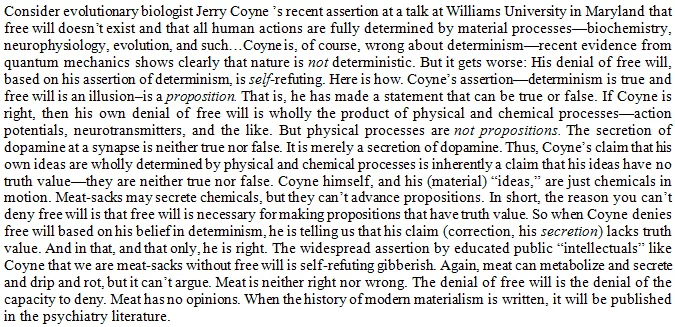
Unquestionably, the denial of free will is the most bizarre of all materialist “cults.” It is, in fact, self-refuting—and evidently so. In his challenge to philosopher Massimo Pigliucci and evolutionary biologist Jerry Coyne, two atheists who reject the notion of free will, Michael R. Egnor—a Professor of Neurosurgery and Pediatrics at the State University of New York and a senior fellow at the Center for Natural and Artificial Intelligence, known for his extensive writings on free will—wrote:32

Egnor wrote elsewhere:33
Anyone who approaches the issue of free will from a truly scientific perspective must begin with what is plainly evident and then seek the explanation that best accounts for the facts. Every one of us knows that we have freely chosen attitudes and behaviors. This is why we feel guilt when we knowingly choose wrongly—because we know we could have chosen differently—and why we feel a sense of triumph when we choose rightly. Surely, you recognize that you could stop reading this book right now, or you could choose to continue. If you do continue, it will not be because your genes or environment forced you to; you are responsible for that decision, and you could just as well choose to do something else. You are not a slave to your genes and environment, and your freedom is not an illusion—it is a reality, a reflection of how things truly are, not merely how they appear. Given that, we must take the existence of our free will as a fact and search for an explanation that best fits it. Clearly, atheism cannot account for the phenomenon of human free will. Atheists who remain consistent with their worldview are compelled to admit that its logical implications deny the existence of genuine choice. Therefore, if human beings do possess free will, and atheism implies that they do not, then atheism must be false. In contrast, the idea that Allāh—a supernatural Creator—has endowed humans with mind, consciousness, and soul aligns perfectly with the existence of free will. Thus, anyone who is trying to follow the evidence where it leads must conclude that the reality of human free will points directly to the existence of a supernatural Creator. Indeed, anyone of sound mind cannot accept the atheistic worldview, which embraces the absurd doctrine of determinism. If atheism were true and humans were merely “meat robots” incapable of acting otherwise, how could they ever be held morally responsible? If our actions are solely driven by selfish genes and dictated by physical properties within the brain, then moral responsibility becomes meaningless. Yet no court of law would accept such empty excuses. For centuries, philosophers and theologians have agreed that civilization depends on the widespread belief in free will and that losing this belief would be catastrophic. Legal systems and moral codes around the world operate on the assumption that we can choose between right and wrong. This, beyond any reasonable doubt, affirms that humans do possess free will. To summarize, atheism cannot account for free will or moral responsibility—and this renders it decisively false. Once again, the very skepticism that atheists direct toward theists’ traditions and beliefs is itself evidence of their inconsistency. More specifically, if indeed atheism is true, then why on earth would atheists criticize Muslims’ belief in Allāh if it is nothing more than another chapter in “the sad tale of Man’s enslavement to religion”—that is, if Muslims had no choice to begin with, and if their bowing before Allāh was inevitable?
Another glaring problem with atheists raising suspicions about Islam has to do with the fact that this, in and of itself, suggests that they assume the existence of objective moral values. That is, atheists’ suspicions about Islam are an implicit acknowledgment of the existence of such values. For example, one of the misconceptions surrounding atheists’ perception of Islam is that it is a religion of terrorism. Such a statement implies that atheists regard terrorism as objectively wrong and evil, and they expect anyone who encounters this accusation to turn away from Islam, since it allegedly promotes terrorism—and all humans recognize terrorism as one of the evil acts committed by bad people in this world. This point is not even debatable. But when atheists claim that terrorism is truly bad, they are presupposing the existence of a standard by which all humans judge it. The question then is: what kind of standard is it? If atheists claim that moral values exist, they must have a standard by which they measure them, and that standard must be objective—external to human beings. That is, it cannot be subjective, based merely on personal opinion, nor can it be determined by consensus.34
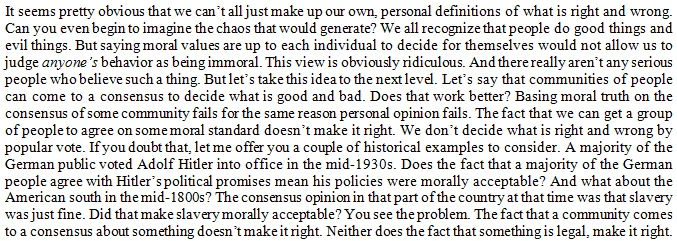
Now, if personal opinion and community consensus are not valid ways to ground moral standards, what is? The only way to account for such a standard is by grounding it in a source beyond all of us—Allāh. All of us, including atheists, live our lives as if this standard exists. We cannot deny it. In doing so, we are merely acknowledging the objective nature of the moral world we inhabit. Yet, although atheists recognize the existence of objective good and evil, they cannot explain what makes something good or bad apart from someone’s or some group’s opinion. Thus, atheists who lecture us on morality are, perhaps unknowingly, affirming Allāh’s existence, since theism alone offers a foundation for objective morality. That is, because naturalistic atheism fails to provide an objective basis for morality, the only alternatives are moral nihilism—the view that nothing is morally right or wrong—or belief that Allāh is the source of morality. Therefore, atheists who deny Allāh’s existence must ultimately resort to radical nihilistic positions, even rejecting the objective evil of acts such as rape. However, experience shows us that this position is unliveable: if someone were to rape an atheist’s daughter, they would instinctively appeal to objective morality and exclaim, “that’s not right” or “that’s not fair,” without considering the worldview implications of such statements. In short, atheists’ moral accusations against Islam rest on the assumption that real evil exists. Yet theism—and Islam in particular—is the only coherent explanation for the existence of evil. Allāh’s character is the source of the ethical answers we seek in the face of moral dilemmas. Hence, whenever atheists condemn humanity on moral grounds, they are implicitly affirming Allāh’s existence. The formal moral argument for Allāh is as follows: If God does not exist, then objective moral values do not exist. But objective moral values do exist. Therefore, God exists. It is no surprise, then, that atheists detest the question, “Where do your morals come from?”—because they cannot answer it without acknowledging the existence of a non-human Moral Law-Giver. Still, for them, denying Allāh’s existence seems more important than consistency, logic, and evidence.
If atheism is true, then objective morality is necessarily an illusion, and all of atheists’ moral beliefs are ultimately unwarranted or unjustified. To remain consistent with their worldview, atheists would have to abandon both the acceptance and the assertion of moral claims, despite the significant personal and societal consequences this would entail. When asked whether objective morality can exist in an atheistic universe—that is, in a reality without God—a long line of atheistic philosophers, both past and present, have responded with a firm “No; morality is illusory.” Joel Marks, Professor Emeritus of Philosophy at the University of New Haven in West Haven, Connecticut, expresses the issue clearly and concisely: “[T]he religious fundamentalists are correct: without God, there is no morality. But they are incorrect, I still believe, about there being a God. Hence, I believe, there is no morality.’’35 The atheistic ethicist Richard Taylor wrote: ‘The very concept of moral obligation is unintelligible apart from the idea of God.’’36 That is, the spectre of nihilism lurks behind every form of ethical naturalism. This is why Alex Rosenberg, Professor of Philosophy at Duke University, openly embraces the label “nihilist” and argues that all honest atheists should do the same. Rosenberg clearly and unequivocally spells out the implications of this stance for morality:37

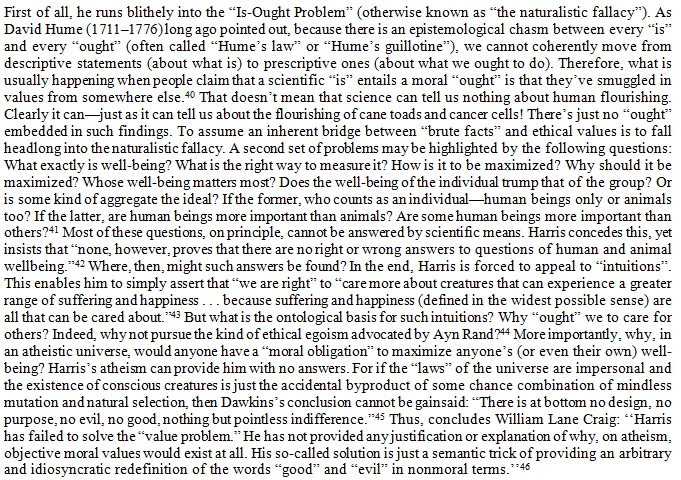
In short, Dostoyevsky was surely right: “without God…everything is permitted.”38 Nonetheless, many evolutionary naturalists are unwilling to abandon morality. Instead, they attempt to ground it in naturalistic evolution, even though evolution and morality are fundamentally incompatible. Science, after all, describes how the natural world is; it does not prescribe how it ought to be. This is precisely where evolutionary morality encounters a widely acknowledged problem—namely, it cannot derive an “ought” from an “is.” In other words, normative principles cannot be drawn from empirical facts, as Nobel Prize–winning biochemist Jacques Monod explains:39

Hence, the problem stems from attempting to deduce a moral duty from a scientific description. While Darwinian evolution may be capable of describing past behavior, it lacks the resources to prescribe future behavior, as Greg Koukl puts it: “One question can never be answered by any evolutionary assessment of ethics: Why ought I be moral tomorrow?”40 Any response assumes an objective standard beyond the natural world. Moreover, evolution is arbitrary, and human beings could have evolved differently. Therefore, the same is true of evolutionary morality: naturalistic morality could have developed in opposite directions, meaning that behaviors currently praised as virtuous might have been considered immoral, and those regarded as vices might have been seen as moral.41 Philosopher Michael Ruse and biologist E. O. Wilson describe how things could have evolved differently.42

Furthermore, evolution does not provide a stable foundation for morality in the future, for evolution is a process of change, and thus morality must also change.43 Apologist Frank Turek asks: “If evolution is the source of morality, then what’s to stop morals from evolving (changing) to the point that one day rape, theft, and murder are considered moral.’’44This reveals the absurdity of trying to ground morality in naturalistic evolution.45

Accordingly, evolutionary naturalism does not explain the existence of morality, but rather explains morality away. That is, it explains why we think morality exists when it actually does not. In other words, the evolutionary approach is not really an explanation of morality, but a denial of it. That is, it only explains the illusion of morality.46

Michael Ruse and Edward O. Wilson, who understand this, state:47

Ruse and Wilson do not believe this is a problem for their view:48

Essentially, objective morality is an illusion, and our moral intuitions are utterly groundless. Given an atheistic evolutionary framework, the philosopher of science, Michael Ruse, believes such a conclusion is unavoidable:49

In short, naturalistic evolution acts as a con artist tricking people into thinking that morality is real. Thus, the act of rape itself is not morally wrong. Rather, our genes have tricked us into thinking rape is wrong. However, the vast majority of secularists do not accept this conclusion, and as already indicated even some of atheism’s most outspoken proponents are determined to account for their moral intuitions in some objective way. As Timothy Keller suggests, this is an odd state of affairs and places humanity at a unique point in history:50

Unquestionably, evolutionary naturalism undermines all moral beliefs. In fact, Charles Darwin was rightly skeptical about the possibility of rationality under naturalistic evolution—and, of course, this would include moral convictions—as he wrote:51

Therefore, on an evolutionary view, there is no compelling reason to trust our moral convictions, since if we hold these beliefs simply because they promote survival, it follows that we would have adopted them regardless of whether they are actually true.52 That is, we could never truly know whether our moral beliefs correspond to objective moral facts, leaving us with moral skepticism in light of the origins of our moral convictions. In short, the reality of human moral experience has led many atheistic philosophers to attempt a naturalistic explanation of what they call “the universally experienced phenomenon of the ought.” Yet this endeavor is ultimately self-defeating, as it can only be pursued by adopting a position that is either intellectually incoherent or by redefining ‘good’ and ‘evil’ in terms that are no longer genuinely moral. For instance, Sam Harris defines “good” as that which promotes the flourishing of conscious creatures and “evil” as that which does not.53 Accordingly, he argues that “questions about values” are essentially “questions about the well-being of conscious creatures,”54 and since human well-being is entirely dependent on brain states, it can, in his view, be measured through neuroscience.55 In such a way, Harris believes science can provide objective answers to our moral questions. Obviously, the problems with Harris’s proposal are essentially the same as those that afflict all forms of ethical naturalism.56
Hence, atheists face a difficult choice: either maintain atheism and embrace amorality, or uphold morality and embrace theism. In all honesty, given that each of the problems discussed above presents a serious challenge to naturalism, it would be more reasonable to reject naturalism than to deny morality.
Contrary to the atheistic worldview, theism—specifically Islam—makes sense of transcendent morality and avoids the problems we have discussed. In essence, moral experience is meaningless without an objective moral order, and an objective moral order is meaningless without Allāh. Thus, atheists will never escape the net of ethical relativism unless they abandon atheism and accept that only theism can adequately account for such moral intuitions and root them in an objective and absolute moral reality. Ludwig Wittgenstein saw this clearly: “Ethics, if it is anything, is supernatural.”57 Indeed, every attempt to uphold both morality and atheism amounts to an exercise in intellectual incoherence. Thus, atheists are left with two choices: either maintain atheism and embrace amorality, or uphold morality and embrace theism—but not just any form of theism. Objective morality requires the existence of a God who is necessary, powerful, and good, and the only God who truly fulfills these criteria is Allāh, the one and only true God. Once again, the very possibility of objective moral truth presupposes the existence of teleology in the natural order—that is, ends toward which things are naturally directed. Teleologists maintain that an intelligent goal-giver assigns purposes to natural beings to fulfill. Although teleology should, in principle, be excluded from an atheistic framework, many atheists still attempt to ground morality in teleology while denying that teleology requires a theological foundation. They claim that the teleological features of their ethical systems do not need divine agency to be coherent. However, no interpretation of teleology that aligns with modern naturalism and scientism—the framework to which most contemporary atheists are committed—can provide the kind of teleology necessary for objective morality. The Qurʾān is categorical in affirming that the Moral Law emanates from Allāh. It says: {…And by the soul and ˹the One˺ Who fashioned it, then with ˹the knowledge of˺ right and wrong inspired it! Successful indeed is the one who purifies their soul, and doomed is the one who corrupts it!} (Qurʾān 91:7–10). The fiṭrah (divinely endowed innate monotheistic disposition)—the default “factory setting” with which all humans are delivered, if you will—is what accounts for the “moral conscience” that people often refer to in everyday life. That is, the moral law is deeply embedded in human nature, functioning like an internal compass that consistently points toward good deeds that draw us nearer to Allāh. C. S. Lewis wrote:58

Lewis also wrote:59

Thus, it is reasonable to conclude that Allāh is the author of the Moral Law and that He is the one who allows its radiant light to penetrate the depths of our being and nature. Undoubtedly, atheists’ attempts to ground morality in naturalistic evolution are riddled with serious flaws, which, taken together, present an insurmountable case against evolution as a foundation for morality. Consequently, the atheist admission that, if atheism is true, then objective morality is merely an illusion—coupled with their inability to ground objective morality in evolutionary naturalism—exposes the naïveté, folly, and delusion inherent in atheism. In a word, absolute morality necessitates the existence of Allāh. Put differently, if there is no God, there can be no morality—for morality is, at its core, a pursuit of God.60
We need Islam because, although the ethical impulse—the natural love for what is good—exists within all human beings, it is revelation that guides and perfects it. Undeniably, disagreement and confusion about the purpose and nature of good character are widespread, and misguided “ethical” beliefs have fueled some of the most horrific evils in human history. Secular modernity, which claims to offer ethics without revelation, has attempted to “smuggle” in religious values, yet it has failed to provide individuals with true meaning or to offer a reliable safeguard against exploitation. Hence, the Islamic alternative is urgently needed.61
Again, atheists raise suspicions about Islam because, although they lack a sound foundation for defining good and evil, they are still capable of recognizing what is moral. That is, the failure to acknowledge Allāh does not erase the Allāh-given moral sense (fiṭrah); it merely distorts and misguides it in countless ways. Clearly, raising a suspicion stems from the assumption that certain aspects of religion in general, and Islam in particular, are immoral. Thus, atheists’ persistent efforts to convince others that there are grounds for suspicion regarding Islam actually serve as evidence that they believe the following:
1.The universe is indeterministic and humans possess free will—one of the components of the Divine Assignment—the responsibility Allāh has given to human beings through free will and moral accountability.
2.The human soul has been endowed with an intuitive awareness of good and evil—Allāh has created the human being with a soul capable of distinguishing between right and wrong—so that anyone who encounters the alleged suspicions about Islam might be convinced of their validity.
In short, atheists raise suspicions about Islam only because atheism is false. The more passionately they insist that Islam is morally questionable—and the more eager they are to engage Muslims in debate to defend that view—the more they unwittingly and forcefully affirm the existence of absolute moral values and moral teleology, as well as the reality that all humans possess free will and are divinely assigned, accountable beings—not the products of a deterministic nature. The world around you is morally innocent. Does the wall behind you know the difference between good and evil? Do atoms, stones, mountains, animals, planets, or galaxies have moral agency—the ability to make ethical decisions based on right and wrong? Unlike humans, animals and inanimate objects lack moral agency, which means they are always innocent. Only humans and jinn are moral agents—that is, they possess the capacity to discern right from wrong. In other words, they are conscious beings endowed with rationality, intentionality, and free will, all of which are necessary for moral agency. They have a real choice between right and wrong and will be held accountable by Allāh on the Day of Judgment for their actions. Hence, as a human being, you are the only creature who cannot be morally innocent. Your only choice is to be either good or evil. If someone were to say to you, “I am a morally innocent animal,” you would certainly reject that claim. You would classify them based on their behavior by judging it against the moral standard—the norms which we have about the types of actions which we believe to be morally acceptable and morally unacceptable—installed in your innate disposition. Man cannot be a morally innocent animal, even if he longs for it with all his heart. His only choice is to be righteous or immoral.62
Another glaring flaw in New Atheism is its inability to account for rationality. Allāh has endowed human beings with the faculties of reason and intellect—the very source of their dignity and moral distinction—so that they may discern between good and evil through their use. These faculties also enable humans to question, evaluate, and form judgments. However, by embracing materialism, the atheist undermines the very foundation of knowledge, along with that of science and technology. In other words, if the materialistic atheistic worldview were true—if nature is all that exists and there is no transcendent God who governs and sustains creation—then proving anything at all would be impossible. Reasoning depends on the use of universal truth statements, known as the laws of logic, such as the law of identity, the law of non-contradiction, and the law of the excluded middle.63 Rational arguments are grounded in these universal truth statements. Without them, there would be no basis for rationality, and truth could not be known—particularly if such laws varied according to individuals’ circumstances, location, time, or personal preferences. In other words, truth would then become relative, dependent on situations and subjective opinions. If that were the case, someone could assert something like “red eats more than Saturday,” and claim it to be true merely because they say so. But this is clearly irrational—and you and I both know it. For instance, the statement “the chair that I am sitting on right now is made of wood and it is not the case that the chair that I am sitting on right now is made of wood” is necessarily false according to the law of non-contradiction. Any rational person would accept this law. The real question is: why is this law true? Why should there be a law of non-contradiction—or any laws of reasoning at all? As a Muslim who believes in Allāh, I can answer this question. For me, there is an absolute standard for reasoning: we are to model our thoughts after Allāh’s. That is, the laws of logic reflect the way Allāh thinks. Therefore, the law of non-contradiction, for example, is not merely someone’s subjective opinion on how we should think—it arises from Allāh’s self-consistent nature. And because Allāh upholds the universe in a coherent and orderly manner, it follows necessarily that the structure of reality will not be contradictory. Atheists, however, have no way to account for these universal truth statements.
a. If they claim that the laws of logic are based on human minds, this cannot hold, because human minds differ, contradict one another, and even contradict themselves. Logical absolutes, being universally true, cannot originate from human minds, which are limited, fallible, and not universally consistent.
b. If they argue that logical absolutes are merely descriptions of how the universe behaves, they face a serious difficulty: how, by observation, could they determine the truth of the third law of logic—the law of the excluded middle, which states that every proposition is either true or false? Clearly, this cannot be empirically verified through observation.
c. If they claim that the laws of logic are human conventions, this too fails, because conventions, by definition, are agreed-upon norms—like driving on the right side of the road. If the laws of logic were merely conventional, then different cultures could adopt different logical systems (as some drive on the left). In such a world, it might be perfectly acceptable to contradict oneself, and truth could be considered self-contradictory in some societies. This would render rational discourse meaningless, as each person could choose their own arbitrary standard for reasoning, making genuine debate impossible.
d. If they assert that logic is a product of human language, this is inadequate, because languages are subjective, culturally shaped, and variable, whereas logic is objective and universal.
e. If they suggest that logic is a property of the universe, like motion or gravity, this too is problematic. Unlike physical properties such as weight, mass, or temperature, the laws of logic cannot be measured empirically. Therefore, they do not function like physical phenomena.
Sometimes, atheists offer a more pragmatic response: “We use the laws of logic because they work.” However, this misses the point. While we all agree that the laws of logic work—and they do because they are true—the real question is: why do they exist at all? How can atheists account for absolute standards of reasoning such as the laws of logic? How can immaterial entities like the laws of logic exist if the universe is purely material? If they claim that logical absolutes are the result of chemical processes in the brain, this falls apart, since it would imply that logic could vary with brain chemistry. That is, if the laws of logic were material—merely electrochemical connections in the brain—they could not be universal, because they would differ from person to person depending on individual neurological structures. Alvin Plantinga’s evolutionary argument against naturalism is particularly relevant here. In Warrant and Proper Function, Plantinga argues that it is irrational to affirm both the Neo-Darwinian account of human evolution and the doctrine of philosophical naturalism. According to him, the naturalistic evolutionary processes—namely, random mutation and natural selection—are not aimed at producing creatures with mostly true beliefs, especially concerning abstract reasoning or metaphysical truths. If unguided evolution is our only origin, then we should doubt the reliability of all our beliefs, including the belief in evolutionary naturalism itself. In this way, Plantinga concludes that the combination of naturalism and evolution is self-defeating, as it gives us little reason to trust that our cognitive faculties are reliable.64 Plantinga asserted that several thinkers, including C. S. Lewis, deem that evolutionary naturalism leads to a deep and pervasive skepticism and to the conclusion that our unreliable cognitive or belief-producing faculties cannot be trusted to produce more true beliefs than false beliefs.65 He also noted that Charles Darwin himself had concerns along these lines, citing his 3 July 1881 letter to William Graham, in which Darwin expressed worry that his theory of evolution might commit its adherents to a form of global skepticism: “But then with me the horrid doubt always arises whether the convictions of man’s mind, which has been developed from the mind of the lower animals, are of any value or at all trustworthy. Would any one trust in the convictions of a monkey’s mind, if there are any convictions in such a mind?’’66 Plantinga has referred to this persistent epistemic concern as “Darwin’s Doubt,” presenting it as Darwin’s own unease that evolutionary naturalism is self-defeating. In essence, if both evolution and naturalism are true, then the probability that humans possess reliable cognitive faculties is low. As a result, naturalists cannot reasonably maintain confidence in their status as reliable cognitive agents. That is, once the trustworthiness of their cognitive faculties is seriously undermined, they are logically compelled to reject any belief founded on that trust—including, specifically, their belief in naturalism itself. Thus, if naturalists are to remain rational, they must abandon naturalism. In this way, belief in both evolution and naturalism generates an undefeated defeater for the belief that human cognitive faculties are dependable. Former atheist C. S. Lewis wrote: “Supposing there was no intelligence behind the universe, no creative mind. In that case, nobody designed my brain for the purpose of thinking. It is merely that when the atoms inside my skull happen, for physical or chemical reasons, to arrange themselves in a certain way, this gives me, as a by-product, the sensation I call thought. But, if so, how can I trust my own thinking to be true? It’s like upsetting a milk jug and hoping that the way it splashes itself will give you a map of London. But if I can’t trust my own thinking, of course I can’t trust the arguments leading to atheism, and therefore have no reason to be an atheist, or anything else. Unless I believe in God, I cannot believe in thought: so I can never use thought to disbelieve in God.’’67 Likewise, William Lane Craig states that naturalism cannot even be rationally affirmed: “for if naturalism was true, the probability that our cognitive faculties would be reliable is pretty low. For those faculties have been shaped by a process of natural selection which does not select for truth but merely for survival. There are many ways in which an organism could survive without its beliefs’ being true. Hence, if naturalism were true, we could not have any confidence that our beliefs are true, including the belief in naturalism itself! Thus, naturalism seems to have a built-in defeater that renders it incapable of being rationally affirmed.’’68 Hence, all atheists’ attempts to account for rationality fail, because atheism is deficient as a worldview and lacks the substance to account for universal truth statements—also known as logical absolutes. Interestingly, even if atheists were, as a last resort, to abandon a strictly materialistic view and concede that immaterial, universal laws exist, this would represent a major concession. After all, if someone admits the existence of immaterial, universal, and unchanging entities, they must consider the possibility that Allāh exists. Yet even such a concession would not rescue their position, for they would still be required to justify the existence of the laws of logic. Why do they exist? And what connects the material world to the immaterial world of logic? In other words, why does the physical universe conform to immaterial laws? Incontestably, atheists cannot answer these questions, which renders their worldview arbitrary, unjustified, and irrational. The laws of logic are Allāh’s standard for thinking: since Allāh is an unchanging, sovereign, immaterial Being, the laws of logic are likewise abstract, universal, and invariant. They are not made of matter, yet they apply everywhere and at all times. Simply put, the laws of logic are grounded in Allāh’s unchanging nature and are essential to logical reasoning. Without Allāh, rational reasoning would be impossible. Materialistic atheists cannot lay claim to the laws of logic, because they believe everything that exists is physical—but the laws of logic are not physical. Hence, atheists are inconsistent, for they rely on laws that cannot exist within their own worldview. That is, they are borrowing from the theistic worldview in order to argue against it. Consequently, their arguments cannot be rational, because they depend on principles—the laws of logic—that their worldview cannot account for. Ironically, in arguing that Allāh does not exist, atheists must use the laws of logic—laws that only make sense if Allāh does exist. In other words, for their argument to be logically coherent, it would have to be false. Atheists might respond, “Well, we can reason just fine, and we don’t believe in God,” but this is not a rational rebuttal. Logical reasoning depends on the existence of God, not merely belief in Him. Naturally, atheists are able to reason, because Allāh created their minds and granted them access to the laws of logic. They, too, are made in the image of Allāh and thus have access to His rational order. The point is not that atheists cannot reason, but that they cannot explain their ability to reason within their own worldview. Simply put, reasoning is possible because Allāh exists. The laws of logic require the existence of God, for only the transcendent God of truth can ground knowledge. It makes perfect sense to have immaterial, universal, and unchanging laws of logic if Allāh is immaterial, sovereign, and beyond time. We can know and use logic only because Allāh has revealed Himself to us. In other words, it is only logical that our minds are capable of studying and understanding the universe—because Allāh created both the universe and our minds. Now the question arises: if the brain is merely the product of mindless evolutionary processes that provided survival advantages in the past, why should we trust its conclusions? If, as atheists claim, both the universe and the human mind are the results of time and chance, why should we expect the mind to be capable of making sense of the universe? How, then, could science and technology even be possible?
In summary, unlike naturalists and atheists, those who believe in Allāh can confidently account for rationality and trust their cognitive faculties. As previously discussed, if Allāh created us in His image, then it follows that He would will for us to share in His capacity for knowledge. In other words, we are able to reason because Allāh has gifted us with our minds—the very apparatus necessary for sound judgment. That is, the human brain is not a product of blind evolution by natural selection. Once again, the atheist cannot be certain that the aspects of Islam he perceives as suspicious are legitimate unless his mind is capable of rational, sound thinking—something that is only possible if it has been created by Allāh. Therefore, when atheists argue that there are moral or rational suspicions concerning Islam, they are, in fact, affirming that human beings are not mere evolutionary accidents but the intentional creation of Allāh. In doing so, they implicitly acknowledge that humans were created with purpose—to fulfill a divinely ordained role in Allāh’s world—and possess unique qualities that reflect aspects of His nature, setting them apart from all other beings. Because they are created in Allāh’s image, they share in His rational nature and cannot be reduced to mere material attributes. This is why they possess the ability to think, reason, and reflect—even on abstract and metaphysical matters. Ultimately, every creation of Allāh submits to His physical laws in full. The only distinction between believers and unbelievers is that the former submit with willing hearts, while the latter do so involuntarily—for it is absolutely beyond their power to resist His will: {To Allāh ˹alone˺ bow down ˹in submission˺ all those in the heavens and the earth—willingly or unwillingly—as do their shadows, morning and evening} (Qurʾān 13:15). Literally, “bow down” or “prostrate” means to submit in complete humility, and in this context, it signifies that all beings—whether by choice or by nature—are ultimately subject to His Will. In a nutshell, atheism, as a worldview, is intellectually bankrupt and riddled with philosophical problems. It is, in fact, one of the easiest worldviews to refute. Ironically, atheists consider their worldview to be rational and scientific, often viewing themselves as champions of “rationality” in contrast to the so-called “superstitions” of religion. Yet, upon closer examination, atheism appears anything but rational. As demonstrated, it is self-refuting, for the atheist must presuppose the very principles they deny in order to argue for anything at all. In short, atheists embody a walking bundle of contradictions. First, they reason and engage in science, yet they deny the very God who makes reasoning and science possible. Second, they can act morally, yet their worldview offers no foundation for objective morality. Third—and perhaps most astonishingly—many prominent atheists deny the existence of free will, even though most everyday atheists still believe in it, recognizing that without free will, moral accountability becomes meaningless. As Richard Dawkins himself admits: “most people who say they are atheists believe in free will. Let’s call them ‘naïve atheists’, meaning they haven’t properly thought through where atheism really leads….”69If we take atheists at their word, we are forced to accept conclusions that strike the average person as both impossible and irrational—yet such is the logical trajectory of atheism. Essentially, we would have to abandon the way we engage in moral debates and dismantle all criminal justice systems, which rest on the belief in free will and moral accountability. In other words, we would need to stop talking about morality altogether and cease pretending that people are responsible for their actions, for if we discard belief in Allāh and, along with it, belief in free will, we must also abandon belief in moral responsibility. In contrast, the theistic worldview—particularly Islam—is internally consistent: it provides a rational foundation for both reason and morality and affirms belief in free will. Returning to our original question about how to deal with shubuhāt (specious arguments and doubts) about Islam when raised by atheists, the approach becomes clear: before addressing their objections, first dismantle their atheism using the reasoning outlined above. Make it evident that the doubts they raise only make sense if three conditions are true: 1) humans possess free will, 2) objective moral values exist, and 3) human beings are capable of rational thought. Atheism, however, fails to account for any of these essential foundations. Therefore, all shubuhāt raised by atheists against Islam are ultimately meaningless. In short, you should ask any atheist who presents such specious arguments: “Which worldview seems more rational—one that offers a coherent explanation for free will, objective morality, and rationality, or one that denies these realities and cannot account for them?” If he is sincerely searching for truth, he will come to see that religion—namely Islam—is far more rational and consistent with our human experience than atheism. Islam, in fact, provides a way out of the ethical dead ends faced by naturalists. It offers a firm basis for affirming the reality of objective moral values without denying reason, human dignity, or free will. Unlike naturalistic atheists, we Muslims do not face the “is-ought” dilemma, nor do we question whether our senses or moral intuitions are reliable, or whether our minds are fundamentally deceptive. Islam provides the metaphysical grounding that atheism lacks—grounding that atheists often unknowingly borrow from the theistic framework. Finally, after dismantling the atheist’s creed in this manner and laying bare the emptiness of his worldview, you may then proceed to respond quietly to his shubuhāt—if any remain at all.
Notes and References
- 1
William Lane Craig, “Does God Exist?” Reasonable Faith, accessed 21 June 2025, https://www.reasonablefaith.org/writings/popular-writings/existence-natureof-god/does-god-exist1; “Does God Exist? William Lane Craig vs. Christopher Hitchens - Full Debate [HD],” YouTube, uploaded by Biola University, 28 Sep. 2014, https://www.youtube.com/watch?v=0tYm41hb48o.
“As is evident from the authors it interacts with – or rather, doesn’t interact with – the New Atheism is, in fact, a pop-cultural phenomenon lacking in intellectual muscle and blissfully ignorant of the revolution that has taken place in Anglo-American philosophy.”
- 2
The American Heritage® Dictionary of the English Language, (New York, U.S.: HarperCollins Publishers, 2022), available at: https://www.ahdictionary.com/word/search.html?q=materialism.
- 3
Carl Sagan, Cosmos, (New York, U.S.: Random House, 1980).
- 4
---., Pale Blue Dot: A Vision of the Human Future in Space, (New York, U.S.: Random House, 1994), p. 38.
- 5
“FREE WILL - Lawrence Krauss and Richard Dawkins,” YouTube, uploaded by ShirleyFilms, 14 Feb. 2012, https://youtu.be/anBxaOcZnGk, [0:35 to 1:2].
- 6
Ibid., [1:35 to 1:41].
- 7
“Darwinism: Science or Naturalistic Philosophy? A Debate between William B. Provine and Phillip E. Johnson at Stanford University, April 30, 1994,” Origins Research, vol. 16, no. 1, fall/winter 1994, available at: http://www.arn.org/orpages/or161.htm and http://www.arn.org/docs/orpages/or161/161main.htm.
- 8
Francis Crick, The Astonishing Hypothesis: The Scientific Search for Soul, (New York, U.S.: Scribner, 1994), p. 3.
- 9
Sam Harris, Free Will, (New York, U.S.: Free Press, 2012), p. 5, (italics in original).
- 10
Ibid., p. 19.
- 11
Ibid., p. 24.
- 12
Ibid., p. 40.
- 13
Ibid., p. 44.
- 14
Ibid., p. 63.
- 15
Ibid., p. 65.
- 16
“Suspicion,” The Cambridge Dictionary, accessed 19 Jan. 2023, https://dictionary.cambridge.org/dictionary/english/suspicion#google_vignette.
- 17
Kyle Butt, “Atheism & Free Will,” Apologetics Press, 2 Oct. 2016, https://apologeticspress.org/atheism-and-free-will-5339/.
- 18
Guest Author, “It Can’t Be Helped: Atheism and the Problem of Determinism,” Ancient Faith Ministries, 15 April. 2013, https://blogs.ancientfaith.com/orthodoxyandheterodoxy/2013/04/15/it-cant-be-helped-atheism-and-the-problem-of-determinism/.
- 19
“INR5: Jerry Coyne “You Don’t Have Free Will,’” YouTube, uploaded by BillJ Castelman, 8 Jul. 2015, https://www.youtube.com/watch?v=Ca7i-D4ddaw, [1:29 to1:35].
- 20
Ibid., [2:49 to 2:53].
- 21
Ibid., [7:54 to 8:01].
- 22
Ibid., [16:14 to 16:16].
- 23
Ibid., [16:17 to 16:21].
- 24
Kyle Butt, “Atheism & Free Will,” Apologetics Press, 2 Oct. 2016, https://apologeticspress.org/atheism-and-free-will-5339/.
- 25
Sam Harris, Free Will, (New York, U.S.: Free Press, 2012), p. 5, (italics in original).
- 26
Kyle Butt, “Atheism & Free Will,” Apologetics Press, 2 Oct. 2016, https://apologeticspress.org/atheism-and-free-will-5339/.
- 27
Ibid.
- 28
“‘Hey Bill Nye, Do Humans Have Free Will?’ #TuesdaysWithBill,” YouTube, uploaded by Big Think, 19 Jan. 2016, https://youtu.be/ITdMa2bCaVc?feature=shared, [1:01 to 1:18].
- 29
Ibid., [1:49 to 2:17].
- 30
Ibid., [2:39 to 2:41].
- 31
Kyle Butt, “Atheism & Free Will,” Apologetics Press, 2 Oct. 2016, https://apologeticspress.org/atheism-and-free-will-5339/.
- 32
Michael R. Egnor, “My Challenge to Two Atheists who Deny Free Will,” Mind Matters News, 10 Feb. 2022, https://mindmatters.ai/2022/02/my-challenge-to-two-atheists-who-deny-free-will/.
- 33
---., “Why You Can’t Actually Deny Free Will,” Mind Matters News, 29 Jan. 2020, https://mindmatters.ai/2020/01/meat-has-no-opinions/.
- 34
Bob Perry, “The Reality of Objective Good,” True Horizon, accessed 15 Jan. 2023, https://truehorizon.org/the-reality-of-objective-good/.
- 35
Joel Marx, “An Amoral Manifesto, (Part I),” Philosophy Now, Sept/Oct 2014, https://philosophynow.org/issues/80/An_Amoral_Manifesto_Part_I.
- 36
Richard Taylor, Ethics, Faith, and Reason, (Englewood Cliffs, U.S.: Prentice Hall, 1985), p. 84.
- 37
Alex Rosenberg, The Atheist’s Guide to Reality: Enjoying Life Without Illusions, (New York, U.S.: Norton, 2011), pp. 97–98.
- 38
Fyodor Dostoyevsky, The Brothers Karamazov, trans. Richard Pevear and Larissa Volokhonsky, (San Francisco, U.S.: North Point Press, 1990), p. 589.
- 39
Jacques Monod, Chance and Necessity, (London, U.K.: Collins, 1971), p. 110.
- 40
Francis J. Beckwith and Gregory Koukl, Relativism: Feet Firmly Planted in Mid-Air, (Grand Rapids, U.S.: Baker Books, 1998), p. 162.
- 41
Paul Copan, “My Genes Made Me Do It: Is Ethics Based on Biological Evolution?” Journey Online, accessed 21 Jan. 2023,https://ministry.journeyonline.org/my-genes-made-me-do-it-is-ethics-based-on-biological-evolution/.
- 42
Michael Ruse and Edward O. Wilson, “The Evolution of Ethics,” as cited in James E. Huchingson, Religion and the Natural Sciences: The Range of Engagement, (Orlando, U.S.: Harcourt Brace, 1993), p. 311.
- 43
Frank Turek, Stealing from God: Why Atheists Need God to Make Their Case, (Carol Stream, U.S.: NavPress, 2014), p. 102.
- 44
Frank Turek, “Evolution Cannot Explain Morality,” Cross Examined Blog, 1 Jul. 2008, https://www.crossexamined.org/evolution-cannot-explain-morality.
- 45
Tim Barnett, “Four Problems with Evolutionary Morality,” Stand to Reason, 9 Jan. 2017, https://www.str.org/w/four-problems-with-evolutionary-morality.
- 46
Ibid.
- 47
Michael Ruse and Edward O. Wilson, “The Evolution of Ethics”, as cited in James E. Huchingson, Religion and the Natural Sciences: The Range of Engagement, (Orlando, U.S.: Harcourt Brace, 1993), p. 310.
- 48
Ibid., p. 311.
- 49
Michael Ruse, “Evolutionary Theory and Christian Ethics: Are they in Harmony?” in The Darwinian Paradigm: Essays on its History, Philosophy and Religious Implications, (London, U.K.: Routledge, 1989), pp. 262, 268–9.
- 50
Timothy J. Keller, The Reason for God: Belief in an Age of Skepticism, (London, U.K.: Hodder & Stoughton, 2008), p. 145.
- 51
Charles Darwin, The Life and Letters of Charles Darwin, ed. Francis Darwin (Boston, U.S.: Elibron, 2005), vol. 1, p. 285.
- 52
Mark D. Linville, “The Moral Poverty of Evolutionary Naturalism,” as cited in Paul Copan and William Lane Craig, Contending with Christianity’s Critics: Answering New Atheists and Other Objections, (Nashville, U.S.: B&H Publishing, 2009), p. 62.
- 53
Sam Harris, The Moral Landscape: How Science Can Determine Human Values, (New York, U.S.: Free Press, 2011), p. 12.
- 54
Ibid., p. 1.
- 55
Ibid., p. 2.
- 56
Robert S. Smith, “The Amorality of Atheism,” Themelios, vol. 40, issue 3, accessed 21 Jan. 2023, https://www.thegospelcoalition.org/themelios/article/the-amorality-of-atheism/.
- 57
Ludwig Wittgenstein, “I: A Lecture on Ethics,” The Philosophical Review, vol. 74, no. 1, 1965, pp. 3–12, available at: JSTOR, DOI: https://doi.org/10.2307/2183526.
- 58
“The Poison of Subjectivism” in C. S. Lewis, Christian Reflection, (Grand Rapids, U.S.: Eerdmans, 1967), p. 77.
- 59
C. S. Lewis, Mere Christianity, (London, U.K.: Geoffrey Bles, 1952), available at: https://archive.org/details/MereChristianityCSL/mode/2up?q=truer, p. 18.
- 60
Ovamir Anjum, “Being a “Good Person” is Not Enough: Why Ethics Need Islam,” Yaqeen Institute, 27 Jan. 2022, https://yaqeeninstitute.org/read/paper/being-a-good-person-is-not-enough-why-ethics-need-islam.
- 61
Ibid.
- 62
Alija Ali Izetbegovic, Islam between East and West, (Chicago, U.S.: American Trust Publications, 1985).
- 63
The law of identity states that each thing is identical to itself. The law of non-contradiction asserts that a statement cannot be both true and false at the same time and in the same context. The law of the excluded middle holds that for any given proposition, either it is true or its negation is true—that is, if one of two contradictory statements is false, the other must be true.
- 64
Alvin Plantinga, Warrant and Proper Function, (New York, U.S.: Oxford University Press, 1993).
- 65
---., “Evolution vs. Naturalism,” Books & Culture, July/August 2008, https://www.booksandculture.com/articles/2008/julaug/11.37.html.
- 66
Charles Darwin, The Life and Letters of Charles Darwin, ed. Francis Darwin (Boston, U.S.: Elibron Classics, 2005), vol. 1, p. 282.
- 67
C. S. Lewis, The Case for Christianity, (Nashville, U.S.: B & H Publishing Group, 2000), p. 32.
- 68
Kairos Focus, “Noted Philosopher William Lane Craig Responds to the American Humanist Association “Kids Without God” Web Site,” Uncommon Descent, 14 Dec. 2012, https://uncommondescent.com/philosophy/noted-philosopher-william-lane-craig-responds-to-the-american-humanist-association-kids-without-god-web-site/.
- 69
David Quinn, “Atheism’s Irrational Denial of Free Will Is Plain to See,” The Irish Catholic, 3 Sep. 2020, http://www.irishcatholic.com/atheisms-irrational-denial-of-free-will-is-plain-to-see/.