Does Allāh guide whom He wills and misguide whom He wills? Does divine foreknowledge negate human free will? Are we compelled in our actions, or do our choices genuinely matter?
The so-called dilemma of “free will and determinism” has preoccupied human beings—particularly philosophers of mind and ethics—for millennia. Some atheists claim that determinism is a foundational principle of Islam, often citing the verse: {˹It is˺ certainly Allāh ˹Who˺ leaves to stray whoever He wills, and guides whoever He wills}(Qurʾān 35:8). However, this verse is among the most misunderstood in the Qurʾān. Advocates of determinism argue that human beings lack free will in matters of guidance because, according to them, it is solely Allāh who causes some to go astray and others to be rightly guided—thus rendering divine punishment unjust. In reality, however, the capacity to discern between truth and falsehood is an innate gift Allāh has granted to every human being. Those who use this faculty sincerely are guided, while those who neglect or corrupt it are left to wander. When a person accepts the Truth (i.e., divine guidance or revealed truth), their intellect sets them on a course toward it, making them a seeker on a journey of guidance. In contrast, those who willfully reject the truth often go further, trying to rationalize their rejection and portray their misdeeds as virtues. The verse in question refers specifically to individuals of a deeply perverse mentality—not those who err out of ignorance, but those who knowingly and stubbornly deny the Truth, despite recognizing it inwardly. Their conscience becomes deadened. They are never inclined to listen to the Truth, nor are they receptive to any advice or admonition. Therefore, Allāh withholds guidance from such people and abandons them to the very path they insist on pursuing.1
The fatalists often ask: If Allāh forgives whomever He wills and punishes whomever He wills, does that not make Him unjust? In support of this objection, they cite the verse: {Whether you reveal what is in your hearts or conceal it, Allāh will call you to account for it. He forgives whoever He wills, and punishes whoever He wills. And Allāh is Most Capable of everything} (Qurʾān 2:284). This verse makes it clear that the Lord to whom humanity is accountable is All-Knowing—nothing is hidden from Him, not even the innermost thoughts and intentions buried deep within the heart. Importantly, the fact that Allāh possesses absolute sovereignty and full authority to either punish or pardon does not render Him unjust. On the contrary, He is Just by definition, and injustice is incompatible with His essence. Thus, the phrase “He forgives whoever He wills and punishes whoever He wills” simply reflects a distinction between those who merit His mercy and those who do not. Consider the analogy of a sovereign state declaring, ‘None can defy my authority, for I reward whomever I will and punish whomever I will. Yet I am just—I only punish the guilty and reward the deserving.’ These statements are not contradictory in the least. And to Allāh belongs the loftiest similitude. Despite this, fatalists persist in claiming that divine sovereignty and human responsibility are irreconcilable. They argue that since Allāh has decreed all things from eternity, human beings are powerless, and striving toward any goal is futile—what is written will inevitably occur. According to their view, if Allāh determines everything, then all human choices are predestined; and conversely, if humans have real freedom, then Allāh cannot be truly sovereign. They regard divine sovereignty and human freedom as mutually exclusive. From a purely rational perspective, this indeed appears to be a paradox. However, the truth is that divine decree and human free will need not be contradictory. It must first be understood that Allāh exists beyond the confines of time and space, and so too does His decree. Because human intellect is limited to reasoning within the bounds of time and space, we are simply not equipped to fully grasp this reality. For this reason, Allāh conveyed the concept of Providence using at-taṣwīr al-fannī (literary imagery), which, in Qurʾānic science, refers to the expression of abstract or mental meanings through vivid sensory and visualized images.2 Thus, we are given the imagery of the Pen, the Preserved Tablet, and the angelic records of deeds to illustrate this profound reality. 3

Divine decree and providence may seem to conflict with human free will because our limited conception of time and space hinders our ability to fully grasp realities that lie beyond them.4
In simple terms, Allāh has decreed all things on the Preserved Tablet, which, in an absolute sense, does not change. However, the fulfillment of those decrees can vary depending on the actions human beings choose to take.5

That is, the human will—granted by God and ultimately subordinate to His will—plays a role in shaping the destiny that Allāh brings into being for each individual. In the end, every person faces two divinely decreed possible outcomes in the afterlife: Paradise or Hellfire, though only one will be realized. Inarguably, the principle of cause and effect governs the world and all phenomena. Everything in existence derives its necessity, form, temporal and spatial attributes, and other characteristics from its corresponding causes. Among these causes is the human will itself. Therefore, divine decree and providence imply fatalism only if one denies the role of human will in human actions, or assumes that divine decree supplants human power, potential, and choice. In truth, divine decree and providence simply mean that the entire system of cause and effect originates from Allāh’s knowledge and will. Human free will is one of the operative causes within this system. Accordingly, belief in divine decree does not contradict human responsibility. As will be elaborated, Allāh’s eternal knowledge, decisive will, and absolute power are not in conflict with human freedom. On the contrary, the faculty of will bestowed on humanity enables individuals to pursue the path of perfection and ultimate happiness.
Islam resolves the age-old dilemma that has perplexed theologians and philosophers by adopting a balanced path between the two historical extremes—absolute free will and absolute fatalism or determinism. On one end, some argue that human beings possess total autonomy and that Allāh exercises no control over their choices; on the other, some claim that humans have no control at all and that their apparent decisions are merely prewritten by Allāh. In contrast, Islam affirms both the absolute sovereignty of Allāh and the moral responsibility of human beings. Undoubtedly, Allāh is sovereign over the universe: He possesses foreknowledge of all things and decrees them into existence with infinite power from eternity. Yet, He has also endowed human beings with will, for without free will, the very foundation of revealed religion would be rendered meaningless. If all human actions were predetermined and devoid of choice, the mission of the Prophets—who were sent to guide humanity in using its free will rightly—would be pointless. Therefore, Allāh entrusted humans with free will so that the great trial of life, culminating in the Day of Judgment, would be just and meaningful. Thus, human will is genuine, for individuals are not coerced into their actions and will be rewarded or punished in the Hereafter according to how they used this God-given faculty. The Qurʾān makes clear that Man is, above all, a free moral agent, and it presents divine decree in a manner that never negates the reality of human freedom and choice. According to the Qurʾān, human history began with Adam (PBUH), the first human being on Earth, to whom Allāh taught all the names: {He taught Adam the names of all things} (Qurʾān 2:31), and whom He has chosen: {Indeed, Allāh chose Adam...} (Qurʾān 3:33). Nonetheless, Adam was free to disobey Allāh: {…So Adam disobeyed his Lord, and ˹so˺ lost his way} (Qurʾān 20:121). After that, Adam was again free to turn in repentance to Allāh: {Then Adam was inspired with words ˹of prayer˺ by his Lord, so He accepted his repentance} (Qurʾān 2:37). Numerous Qurʾānic verses emphasize the reality of human free will. Allāh says: {This is ˹the reward˺ for what your hands have done. And Allāh is never unjust to ˹His˺ creation”} (Qurʾān 3:182). This verse affirms that the chastisement will be a direct consequence of what their own hands will have done. Had Allāh simply said it was due to their actions, they might claim on that Day that they were not free in those actions. However, the verse makes it clear that it will be the result of deeds they will have committed by their own free will and choice, without any compulsion. Indubitably, Allāh created human beings with free will: {And say, “The truth is from your Lord, so whoever wills - let him believe; and whoever wills - let him disbelieve.’’} (Qurʾān 18:29). Allāh has made clear to Man the path of good and the path of evil, and Man possesses full authority to choose between them: {We already showed them the Way, whether they ˹choose to˺ be grateful or ungrateful} (Qurʾān 76:3). Allāh holds no enmity toward His servants such that He would destroy them without just cause while they were engaged in righteous deeds: {And your Lord ˹O Prophet˺ would never destroy a society unjustly while its people were acting rightly} (Qurʾān 11:117). Allāh has declared that He does not change the condition of a people until they change what is within themselves. He said: {This is because Allāh would never discontinue His favour to a people until they discontinue their faith} (Qurʾān 8:53). And He said: {Indeed, Allāh would never change a people’s state ˹of favour˺ until they change their own state ˹of faith˺} (Qurʾān13:11). It should be understood that there is no contradiction between these verses and others that emphasize the universality of divine will and attribute all things to it, such as this one: {Say, ˹O Prophet,˺ “O Allāh! Lord over all authorities! You give authority to whoever You please and remove it from who You please; You honour whoever You please and disgrace who You please—all good is in Your Hands. Surely You ˹alone˺ are Most Capable of everything} (Qurʾān 3:26). Another verse likewise states: {surely this is a reminder. So let whoever wills take the ˹Right˺ Way to their Lord. But you cannot will ˹to do so˺ unless Allāh wills. Indeed, Allāh is All-Knowing, All-Wise} (Qurʾān 76:29–30). Those who believe in determinism infer from such verses that only Allāh’s will operates, independent of anything human beings may or may not do. Accordingly, they claim that if a group of people is honoured or disgraced, it is solely due to Allāh’s will. That is, Allāh could send the righteous to Hell and the sinful to Paradise simply because He wills it, since—according to this view—nothing in the universe is bound by any cause except His will. However, this interpretation is flawed, as it undermines both divine justice and wisdom.
The Qurʾān makes it clear that nothing occurs in this world except by the will and permission of Allāh. At the same time, it underscores His perfect wisdom and justice, as well as human responsibility. In simple terms, Allāh is All-Knowing and All-Wise; He knows who is deserving of guidance and who is deserving of misguidance. Accordingly, He facilitates the path of guidance for the former and withholds it from the latter. The following verses dispel any confusion people may have concerning the matter of destiny: {surely this is a reminder. So let whoever wills take the ˹Right˺ Way to their Lord. But you cannot will ˹to do so˺ unless Allāh wills. Indeed, Allāh is All-Knowing, All-Wise} (Qurʾān 76:29–30). Three key points are made in these verses: first, that whoever wills may choose the path that leads to their Lord; second, that a person's willingness alone is not sufficient unless Allāh also wills it; and third, that Allāh is All-Knowing and All-Wise. Anyone who reflects deeply on these three points will clearly understand the relationship between human free will and the Divine Will. The first verse makes it evident that the freedom granted to human beings in this world is limited to their ability to choose from among the various paths available to them:6

But after a person has exercised this freedom of choice, whether they can actually carry out what they intend to do depends on Allāh’s Will, permission, and grace.7

After this, the third verse clears away any misunderstanding that Allāh’s Will might be arbitrary.8

Therefore, Allāh’s universal Will does not negate human freedom: {Surely this ˹ Qurʾān ˺ is only a reminder to the whole world—to whoever of you wills to take the Straight Way. But you cannot will ˹to do so˺, except by the Will of Allāh, the Lord of all worlds} (Qurʾān 81:27–29). That is, although the Qurʾān is an admonition for all of humankind, not everyone can benefit from it; rather, only those who genuinely desire to pursue piety and righteousness will do so. Hence, the foremost condition for a person to gain any benefit from the truth is that they be one who cherishes it and sincerely seeks it. The moral responsibility of humankind is clearly expressed in both the Qurʾān and the Sunnah. Allāh states that every individual is accountable for whatever they do: {No one will reap except what they sow} (Qurʾān 6:164). In a similar vein, the Prophet (PBUH) said that each person has a place in Paradise and a place in the Hellfire, and that wherever one ultimately ends up, they will be shown what could have been had they taken a different path: “None will enter Paradise but will be shown the place they would have occupied in the Fire had they rejected faith, so that they may be more thankful; and none will enter the Fire but will be shown the place they would have occupied in Paradise had they believed, so that it may be a cause of sorrow for them.”9 Justin Parrott, currently Research Librarian for Middle East Studies at New York University in Abu Dhabi (NYUAD), Research Fellow at Yaqeen Institute, and Instructor at Mishkah University, observes:10
Let us carefully read and reflect on the meaning of the verse often cited by proponents of determinism to support their claim that the Qurʾān portrays Allāh as “a misleader who causes people to be deceived and misled from the path of guidance and salvation.” Allāh says: {˹It is˺ certainly Allāh ˹Who˺ leaves to stray whoever He wills and guides whoever He wills. So do not grieve yourself to death over them ˹O Prophet˺. Surely Allāh is All-Knowing of what they do}. (Qurʾān 35:8). At first glance, this verse may appear to suggest that guidance and misguidance are imposed and depend solely on the Will of Allāh. However, the end of the verse clarifies the reality, revealing that the true source of a person’s guidance or misguidance lies in their own actions. Allāh misguides those who deserve misguidance and guides those who genuinely seek guidance.11 However, it is important to note that guidance and misguidance are not initiated by Allāh; rather, they are given in response to an individual’s good or bad deeds. At the time of creation, Allāh grants everyone an equal share of initial guidance and salvation, as every human being is born upon the fiṭrah—the original, innate disposition of Islamic monotheism. Allāh continues to guide those who preserve the guidance embedded in their fiṭrah and live in full alignment with it. These are the individuals who consistently obey Allāh and return to Him in repentance when they occasionally sin or fall into disobedience. In contrast, Allāh misguides those who have willfully chosen a life of sin and misguidance, and who feel no remorse for it. Allāh says: {He leaves many to stray, and guides many. And He leaves none to stray except the rebellious} (Qurʾān 2:26). That is, Allāh misguides only the rebellious wrongdoers who are truly misguided as a result of the actions they willingly chose to commit. Had Allāh willed, He could have subjected all human beings to His commands, just as He has done with the rest of the universe. In other words, if He had willed that there be no disbelievers or sinners, He could have withheld human free will and created all people as inherently believing and obedient servants: {Had Allāh willed, He could have easily made you one community ˹of believers˺, but He leaves to stray whoever He wills and guides whoever He wills} (Qurʾān 16:93). However, Allāh has granted human beings the freedom to accept or reject His Word because the purpose for which He placed them in this world—namely, to test, train, and purify them—would not have been fulfilled otherwise. Allāh concludes the aforementioned verse by saying: {And you will certainly be questioned about what you used to do} (Qurʾān 16:93). This sentence responds to a question that may arise for some: “If guidance and misguidance belong to Allāh, does that not mean human beings no longer possess free will?” The answer is that human free will remains intact, and the fact that guidance and misguidance belong to Allāh does not negate this, because Allāh does not initially guide or misguide anyone. His guidance and misguidance are the result of, and dependent on, people’s own actions. As previously explained, Allāh initially grants His servants the gift of guidance, but when they corrupt their own souls through evil deeds and by following their base desires, that favor is withdrawn—leading them astray. In other words, no one is doomed from the outset, as proponents of fatalism claim. Allāh guides those who sincerely seek guidance and misguides only those who, by their own will, have laid the path for their own misguidance. Put simply, Allāh supports every person in the path they have freely chosen, whether that path is right or wrong. Nonetheless, fatalists argue that there are many Qurʾānic verses which state that Allāh guides whomever He wills and misguides whomever He wills. They cite the following verses:
{Had Allāh willed, He could have easily made you one community ˹of believers˺, but He leaves to stray whoever He wills and guides whoever He wills.1 And you will certainly be questioned about what you used to do} (Qurʾān 16:93).
{Whoever Allāh guides is truly guided. But whoever He leaves to stray, you will never find for them a guiding mentor} (Qurʾān 18:17).
{Whoever Allāh allows to stray, none can guide, leaving them to wander blindly in their defiance} (Qurʾān 7:186).
{Whoever Allāh leaves to stray will be left with no guide. And whoever Allāh guides, none can lead astray} (Qurʾān 39:36–37).
It must be understood that certain verses of the Qurʾān should not be interpreted in isolation or used to draw definitive conclusions on their own. Rather, they must be understood in light of other verses. Since some parts of the Qurʾān explain and interpret others, one must place different verses side by side in order to grasp their true meanings. Indeed, the same God Who has said that He guides and misguides whomever He wills has also said:
{And Allāh leaves the wrongdoers to stray} (Qurʾān 14:27).
{This is how Allāh leaves every transgressor and doubter to stray} (Qurʾān 40:34).
{Surely Allāh does not guide the rebellious people} (Qurʾān 63:6).
{Allāh certainly does not guide whoever persists in lying and disbelief} (Qurʾān 39:3).
{This is how Allāh leaves the disbelievers to stray} (Qurʾān 40:74).
Therefore, although it is correct to say that Allāh misguides whomever He wills, one must pay attention to the kind of people who are subject to this misguidance. As is clear from the above verses, Allāh misguides the wrongdoers, the transgressors, the doubters, the rebellious, those who persist in lying, and the disbelievers. These groups are already in a state of misguidance without the need for anyone else to lead them astray. Hence, the first step toward misguidance lies in the hands of the person themselves and has nothing to do with Allāh—and the same applies to guidance as well.
Commonly asked questions by fatalists include: Why would Allāh create life, Heaven, and Hell if He already knows the outcome? If everything that will happen in a person’s life is written before their birth, then where is free will? How can Allāh be The Utterly Just if He condemns part of His creation to Hell and grants others Paradise? The answer is simple: the fact that our choices are written prior to birth only affirms that Allāh is the Knower of all things. Indeed, His foreknowledge is infallible and complete. After all, could Allāh truly be Allāh if He did not know everything, including the future? Thus, Allāh has known from eternity all that will happen, and nothing occurs except in accordance with His knowledge and will. However, this does not mean that the choices people make are not freely made. Rather, it means that Allāh is fully aware of what people will choose to do. Fatalists argue that the infallible foreknowledge of a human act renders the act necessary and therefore unfree. According to them, if a being knows the entire future without error, then human acts cannot be truly free. What they fail to realize, however, is that predestination is not a written-down, unchangeable script of a person’s life that implies they have no control over their will. Instead, it refers to Allāh’s eternal knowledge of the past, present, and future, which has already been recorded, along with the reality that everything occurs by His Will. In essence, the conscious exercise of human will falls within the scope of Allāh’s predestination, and His Absolute Foreknowledge does not negate human freedom of choice. The logic is simple: (1) Allāh knows everything—past and future—and time itself is irrelevant to Him, as He exists beyond time and space; (2) we possess full free will; and (3) Allāh knows all our choices before we make them—even if we change our minds, He already knows that too. The following analogies illustrate how divine knowledge and human free will can coexist. Suppose a teacher knows, with complete certainty based on years of experience, that their lazy students will fail while the hardworking ones will succeed by the end of the year. When the lazy students do in fact fail, can they accuse the teacher and say, “Your foreknowledge and prediction caused us to fail”? Or imagine a machine has been invented that can accurately predict events hours before they occur, and it states that a particular person will commit a specific crime at a certain time and place. Does the machine’s knowledge compel the person to commit the crime or free them from responsibility? And to Allāh belongs the loftiest similitude. Allāh is Omniscient and knows in advance what people’s freely chosen actions will be, yet His Knowledge never compels anyone to act. In other words, our freedom of will and choice is itself part of Allāh’s Eternal Knowledge—we choose freely, and Allāh knew from eternity what we would choose. Another frequently asked question by fatalists is: Why did Allāh create atheists if He already knew they would disbelieve? In response, we ask: Why should Allāh refrain from creating atheists simply because He knew from eternity that they would disbelieve? If an atheist willingly chooses disbelief and seeks misguidance, then what objection can there be to Allāh creating them and holding them accountable? It is entirely just that those who knowingly choose misguidance face the consequences they deserve—especially considering that, by His Grace and Mercy, Allāh never withholds sending down His Admonition, even to those who are heedless and turn away from it. Allāh has clearly stated that His Mercy does not demand He abandon efforts to reform individuals or groups simply because they are disbelievers, deeply irreligious, sinful, or rebellious—despite their proven unworthiness: {Should We then turn the ˹ Qurʾānic˺ Reminder away from you ˹simply˺ because you have been a transgressing people?} (Qurʾān 43:5). Indeed, Allāh sent His Admonition so that those who desire guidance may be guided by it, and so that proof may be established against those who do not wish to be guided. Atheists were not doomed from the outset, and it is entirely just that they face the fate they ultimately meet after rejecting the bounty of Allāh and persisting in falsehood even after the Truth has been made clear to them: {We did not wrong them, rather they wronged themselves} (Qurʾān 11:101). Allāh does not wrong human beings, for He has given them everything needed to distinguish between right and wrong, truth and falsehood. Rather, it is they who wrong themselves by refusing to make proper use of the faculties granted to them. Their conscience has become dead as a result of pursuing nothing but their base desires, rendering them incapable of discerning between right and wrong: {Indeed, Allāh does not wrong people in the least, but it is people who wrong themselves} (Qurʾān 10:44). We need not be concerned that Allāh would ever commit injustice towards us; rather, we should be concerned only with our own neglect of the duty we owe to Him. Each person can rest assured that they will receive the due reward or punishment for their choice of faith or unbelief, and for all that they do in this world—either through Allāh’s Justice or through His Grace.
The Qurʾān states that Allāh guides whomever He pleases, but at the same time makes clear the conditions for receiving His guidance—that is, there are specific criteria a person must meet in order to be guided by Allāh: {As for those who struggle in Our cause, We will surely guide them along Our Way} (Qurʾān 29:69). That is, Allāh guides only those who are qualified for guidance—the pious and righteous deserve to be guided and will never be led astray, while the hostile and stubborn deserve misguidance and will never be guided. The Qurʾān makes it clear that showing the way is the responsibility of the Creator, while following it is the responsibility of the created: {And Allāh invites ˹all˺ to the Home of Peace and guides whoever He wills to the Straight Path} (Qurʾān 10:25). Therefore, if one chooses not to remain on the path introduced to them by Allāh, they are the ones to blame. Indeed, those who have no inclination toward their Lord, who reject His Way and disbelieve in His signs, His Messengers, and the Day of Judgment, are the very ones referred to in this verse: {Surely those who do not believe in Allāh’s revelations will never be guided by Allāh, and they will suffer a painful punishment} (Qurʾān 16:104). Anyone who reflects on these verses can clearly conclude the following:
1.Allāh has granted every human being free will and the freedom to choose.
2.He guides to Paradise those who deserve it, and leads to the Hellfire those who deserve punishment.
3.No one can prevent Him from doing so.
It is up to each individual to choose, through their actions and beliefs, whether they will belong to the first group or the second. The fact that we have the freedom to choose between good and evil is a truth that every person can sense inwardly. As mentioned earlier, if a person becomes a transgressor, they will not be guided, for Allāh does not guide the transgressors; and if one chooses to be pious, Allāh will grant them the ability to distinguish between right and wrong: {O believers! If you are mindful of Allāh, He will grant you a standard ˹to distinguish between right and wrong˺, absolve you of your sins, and forgive you} (Qurʾān 8:29). It is Allāh alone who has the power to grant guidance, and He knows best who is receptive to it and who truly desires it: {You surely cannot guide whoever you like ˹O Prophet˺, but it is Allāh Who guides whoever He wills, and He knows best who are ˹fit to be˺ guided} (Qurʾān 28:56). Allāh bestows the favor of guidance upon whomever He wills, based on the sincerity and inclination of the heart. That is, He guides only those whom He knows to be sincere in their pursuit of guidance and willing to accept it. If someone lacks this sincere inclination and willfully deprives themselves of it, how can they expect to be granted such a blessing? Allāh facilitates guidance for those who seek it—He leads them to it, keeps them firm upon it, and increases them in it. In other words, He grants them the grace to cultivate the piety they are inclined to nurture. Thus, while the rightly guided continue to benefit from divine revelation, those whose hearts are averse to its message will derive no understanding from it, even if they hear it: {There are some of them who listen to you ˹O Prophet˺, but when they depart from you, they say ˹mockingly˺ to those ˹believers˺ gifted with knowledge, “What did he just say?” These are the ones whose hearts Allāh has sealed and who ˹only˺ follow their desires. As for those who are ˹rightly˺ guided, He increases them in guidance and blesses them with righteousness} (Qurʾān 47:16–17). Indeed, Allāh grants guidance and the ability to perform righteous deeds to those who have faith: {Surely those who believe and do good, their Lord will guide them ˹to Paradise˺ through their faith, rivers will flow under their feet in the Gardens of Bliss} (Qurʾān 10:9). However, the kind of faith that yields such results is not a mere verbal declaration, but a faith that animates one’s conduct and character and possesses the power to reform one’s morals and deeds:12

It is not Allāh’s way to compel those who are determined to pursue the crooked paths of sin and disobedience to follow the straight path of guidance: {So when they ˹persistently˺ deviated, Allāh caused their hearts to deviate. For Allāh does not guide the evil-doers to the Right Way} (Qurʾān 61:5). It thus becomes clear that the deviation of a person or a nation is not initiated by Allāh, but rather by the individual or nation itself.13

However, it is also true that a person who chooses a particular path for themselves cannot practically follow it unless Allāh facilitates the means, provides the resources, and creates the necessary conditions for its pursuit.14
Allāh appoints a devil as an intimate companion for whoever willfully turns away from His revelation—the source of true guidance—so that it may mislead them at every step: {And whoever turns a blind eye to the Reminder of the Most Compassionate, We place at the disposal of each a devilish one as their close associate} (Qurʾān 43:36). This devil will accompany the person constantly in this world, preventing them from virtuous deeds and diverting them toward evil. However, it is not Allāh who initiates their misguidance; rather, it is the result of what their own hands have earned. When the Jews claimed that their hearts were wrapped (i.e., sealed against reception), Allāh reminded them that it was their own sins that led to their being cursed and cast far from guidance. He also informed them that it was due to their disbelief that He sealed their hearts: {˹They were condemned˺ for breaking their covenant, rejecting Allāh’s signs, killing the prophets unjustly, and for saying, “Our hearts are unreceptive!”—it is Allāh Who has sealed their hearts for their disbelief, so they do not believe except for a few} (Qurʾān 4:155). The Jews’ statement, “Our hearts are unreceptive!” is similar to what the Makkan idolaters at the time of the Prophet (PBUH) said: {They say, “Our hearts are veiled against what you are calling us to, there is deafness in our ears, and there is a barrier between us and you} (Qurʾān 41:5). They claimed that their hearts were veiled against that to which the Prophet (PBUH) was inviting them, as though offering the excuse that their hearts could not comprehend his words because they were wrapped in coverings. However, Allāh made it clear that their hearts were sealed as a consequence of their disbelief: {They say, “Our hearts are unreceptive!” In fact, Allāh has condemned them for their disbelief} (Qurʾān 2:88).
People who willfully choose to go astray are like those who fall into drug addiction. A drug addict begins with seemingly “harmless experimenting,” indulging by choice, often with friends, but gradually slips beyond mere “recreational fun” into the grip of addiction that becomes incredibly hard to escape. Similarly, someone who chooses disbelief deliberately exposes themselves to its avenues. Basically, a person who eventually turns apostate begins their journey into disbelief by giving shubuhāt (specious arguments and doubts) an attentive ear—that is, by exposing themselves to materials that promote disbelief: reading books, engaging in forums, and watching videos that sow doubts in the heart. Bit by bit, they allow their heart—so delicate and vulnerable—to absorb every doubt and allegation like a sponge. Eventually, they drink in these doubts until they begin to affirm them. This journey leads them down into the depths of nihilism, aimlessness, and despair, sometimes even to the point of suicidal ideation or attempts, as the emptiness of life without purpose becomes unbearable. Their heart cries out that the creed they have adopted is hollow and unsound, but they no longer possess the strength of will needed to seek the truth or follow it. In short, those who are entirely disinterested in guidance and instead pursue evil become increasingly perverse in temperament. Their actions grow more crooked over time until their capacity to recognize or accept what is good becomes entirely eroded. That is why, as previously mentioned, when people embrace perversity, Allāh causes their hearts to become perverse—and thus, they earn the punishment they deserve: {˹They will be told,˺ “This is ˹the reward˺ for what your hands have done. And Allāh is never unjust to ˹His˺ creation”} (Qurʾān 22:10). When those who rejected the message of Prophet Muḥammad (PBUH) asked, “Why has no sign been sent down upon him from his Lord?”—implying that one ought to have been—Allāh responded by making it clear that misguidance or guidance is not contingent on the presence or absence of miracles. In other words, their deviation was not due to a lack of signs, but rather due to their complete lack of desire to seek guidance. Allāh does not compel anyone to follow the right path if they deliberately choose to turn away from it; instead, He allows them to stray along the paths they have willfully chosen for themselves. This is the manner in which Allāh allows people to go astray: {The disbelievers say, “If only a sign could be sent down to him from his Lord.” Say, ˹O Prophet,˺ “Indeed, Allāh leaves to stray whoever He wills, and guides to Himself whoever turns to Him} (Qurʾān 13:27). That is, misguided people fail to find the right path because they have no desire for it—hence, they remain blind to the countless signs scattered all around them, and no sign can benefit them. Conversely, those who sincerely seek the path to Allāh recognizethese signs and are guided by them. However, Allāh guides to Himself those who turn to Him in repentance and sincerely seek His help: {… and guides to Himself whoever turns to Him} (Qurʾān 13:27). Abū Ḏarr reported that the Messenger of Allāh (PBUH) said: “Allāh, the Exalted and Glorious, said: ‘O My servants, all of you are astray except those whom I have guided. So seek guidance from Me, and I shall guide you.’”15 Abū Hurayrah narrated that the Prophet (PBUH) said: “Allāh says: If My servant comes near to Me by a span, I draw near to him by a cubit; and if he comes near to Me by a cubit, I draw near to him by the length of two outstretched arms. And if he comes to Me walking, I come to him running.”16 Once again, it is those who sincerely seek guidance whom Allāh guides to the straight path, while those who have no desire for it are left to wander the wrong paths they have chosen for themselves. Thus, the human being is not entirely powerless or without agency in this world. Rather, by Allāh’s permission, each person plays a decisive role in shaping their own fate. Salvation, therefore, does not hinge on forces beyond one’s control, but on one’s own deliberate choice and sincere effort—and that, too, is in accordance with Allāh’s Will. As Allāh says: {As for the one who is charitable, mindful ˹of Allāh˺ and ˹firmly˺ believes in the finest reward, We will facilitate for them the Way of Ease. And as for the one who is stingy, indifferent ˹to Allāh˺, and ˹staunchly˺ denies the finest reward, We will facilitate for them the path of hardship} (Qurʾān 92:5–10). Allāh does not commit even an atom’s weight of injustice—for, Glory be to Him, He is the only true Judge: Utterly Just and Infinitely Gracious to His slaves, from Whose knowledge nothing whatsoever escapes: {Indeed, Allāh never wrongs ˹anyone˺—even by an atom’s weight. And if it is a good deed, He will multiply it many times over and will give a great reward out of His grace} (Qurʾān 4:40).
What is striking is that Allāh has revealed in the Qurʾān that people will use His Will as a justification for their misdeeds, making it a pretext for rejecting true guidance. In other words, the excuse rooted in the notion of absolute determinism has always been put forward by criminals and wrongdoers. During the time of the Prophet (PBUH), the Makkan idolaters claimed that their acts of associating partners with Allāh and arbitrarily prohibiting certain pure things were done only because Allāh had willed them to do so: {The polytheists will argue, “Had it been Allāh’s Will, neither we nor our forefathers would have associated others with Him ˹in worship˺ or made anything unlawful”} (Qurʾān 6:148). The polytheists claimed that they would not have been able to do what they did had Allāh not so willed. Therefore, they argued that all their actions were justified, since they occurred in accordance with Allāh’s Will. In other words, because Allāh had full knowledge of their polytheism and of the unlawful things they prohibited, and since He had the power to guide them to faith and prevent their disbelief—but did not do so—this, they claimed, meant that Allāh Himself had willed, decreed, and approved of their actions. Hence, they believed they bore no blame, for they were compelled and had no real ability to act otherwise. However, Allāh firmly refutes this fatalistic excuse. He states that the misguided among former nations had also denied the Truth and gone astray based on the same baseless notion of fatalism. Had this excuse held any truth, Allāh would not have made those who used it suffer the consequences of their rejection of guidance: {Likewise, those before them rejected the truth until they tasted Our punishment} (Qurʾān 6:148). The unbelievers’ plea—that their misguidance was simply because Allāh had not willed to guide them to the Truth—is rooted in conjecture and fantasy, not in sound knowledge: {Ask ˹them, O Prophet˺, “Do you have any knowledge that you can produce for us? Surely you follow nothing but ˹false˺ assumptions and you do nothing but lie.” Say, “Allāh has the most conclusive argument. Had it been His Will, He would have easily imposed guidance upon all of you”} (Qurʾān 6:148–149). Indeed, the fatalists invoke Allāh’s will without understanding the relationship between it and human actions.17
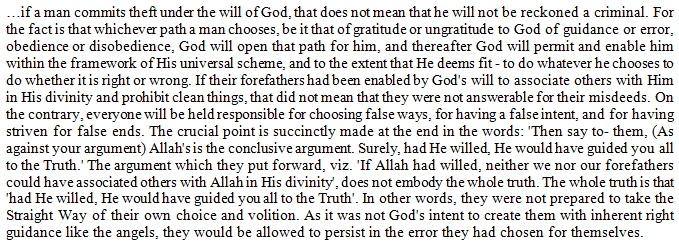
In a nutshell, those who seek to absolve themselves of accountability before Allāh argue that if everything is subject to Allāh’s Will and Foreknowledge, then human free will cannot exist. However, their claim—that we are like feathers, and our destiny is the wind that carries us helplessly toward a predetermined destination—is groundless. Allāh has granted Man the intellect to discern between good and evil, and He has left the ultimate choice to him as to which path to follow. In other words, Allāh has willed that we possess the freedom to choose between good and bad and to act accordingly. His Foreknowledge of our choices does not nullify this freedom. More than that, Allāh has not only endowed us with reason, but also provided us with His Guidance through His chosen Prophets and Revelations to help us make the right decisions. Thus, Allāh’s Will is absolute and all-encompassing, yet within it, there is room for Man’s free and responsible agency, enabling him to consciously shape his own destiny. That is, while everything unfolds by Allāh’s Will, our free will remains fully operative. Allāh says: {a warning to humankind, to whichever of you chooses to take the lead or lag behind} (Qurʾān 74:36–37). Islam places responsibility on the individual for their actions and urges them to live an ethically upright life in order to preserve the initial favor of guidance Allāh has bestowed upon them. Allāh is the All-Knowing, the All-Wise, and the Utterly Just. His eternal knowledge encompasses all things, and His power extends over all things. However, His Power and Foreknowledge do not nullify human freedom, nor does human freedom negate His Power and Knowledge. In other words, even though we possess free will, we remain entirely within Allāh’s Control and Knowledge. Thus, the Islamic perspective on divine decree and human free will is balanced, profound, and nuanced:Allāh grants human beings the freedom to choose their path, and they will bear the consequences of the choices they make. He provides the means of guidance for those who sincerely seek guidance and allows those who desire deviation to go astray. In short, we are neither compelled in our actions nor completely autonomous—and Allāh is, contrary to the false claims of the deists, neither indifferent nor ‘retired’ (i.e., detached and uninvolved in the affairs of His creation). Rather, He is Ever-Seeing, Ever-Active, and fully engaged in the affairs of His slaves.
Notes and References
- 1
Sayyid abū al-Aʿlá al-Mawdūdī, Towards Understanding the Qurʾān (English version of Tafhīm al-Qurʾān), trans. and edit. Zafar Isḥāq ʾAnṣārī, (Markfield, U.K.: The Islamic foundation, 1988), Chapter Fāṭir (Qurʾān 35:8), footnotes 17, available at: https://www.islamicstudies.info/tafheem.php?sura=35&verse=8&to=9.
- 2
Muṣṭafá Dīb al-Buġāʾ and Muḥyī ad-Dīn Mistū, al-Wāḍiḥ fī ʿUlūm al-Qurʾān (Damascus, Syria: Dār al-Kalim aṭ-Ṭayyib, 1998), vol. 1, p. 170.
- 3
Justin Parrott, “Reconciling the Divine Decree and Free Will in Islam,” Yaqeen Institute, 31 Jul. 2017, https://yaqeeninstitute.org/read/paper/reconciling-the-divine-decree-and-free-will-in-islam.
- 4
Ibid.
- 5
Ibid.
- 6
Sayyid abū al-Aʿlá al-Mawdūdī, Towards Understanding the Qurʾān (English version of Tafhīm al-Qurʾān), trans. and edit. Zafar Isḥāq ʾAnṣārī, (Markfield, U.K.: The Islamic foundation, 1988), Chapter al-Insān, (Qurʾān 76:30), footnotes 33, available at: https://www.islamicstudies.info/tafheem.php?sura=76&verse=23&to=31.
- 7
Ibid.
- 8
Ibid.
- 9
Muḥammad al-Bukhārī, Ṣaḥīḥ al-Bukhārī, (Cairo, Egypt: Dār as-Salām. 1999), book: 81, ḥadīth: 157, available at: https://sunnah.com/bukhari:6569.
- 10
Justin Parrott, “Reconciling the Divine Decree and Free Will in Islam,” Yaqeen Institute, 31 Jul. 2017, https://yaqeeninstitute.org/read/paper/reconciling-the-divine-decree-and-free-will-in-islam.
- 11
ʿAbd al-Majīd az-Zindānī, Tawḥīd al-Khāliq, (Bayrūt, Lebanon: Dār al-Khayr, 1999).
- 12
Sayyid abū al-Aʿlá al-Mawdūdī, Towards Understanding the Qurʾān (English version of Tafhīm al-Qurʾān), trans. and edit. Zafar Isḥāq ʾAnṣārī, (Markfield, U.K.: The Islamic foundation, 1988), Chapter Yūnus (Qurʾān 10:9), footnotes 13, available at: https://www.islamicstudies.info/tafheem.php?sura=10&verse=6&to=10.
- 13
Ibid., Chapter aṣ-Ṣaf (Qurʾān 61:5), footnotes 5, available at: https://www.islamicstudies.info/tafheem.php?sura=61&verse=1&to=9.
- 14
Ibid.
- 15
Muslim ibn al-Ḥajjāj, Ṣaḥīḥ Muslim, (Bayrūt, Lebanon: Dār al-Kutub ʿIlmiyyah, 2020), book: 45, ḥadīth: 70, available at: https://sunnah.com/muslim:2577a.
- 16
Agreed upon ḥadīth, Muḥammad al-Bukhārī, Ṣaḥīḥ al-Bukhārī, (Cairo, Egypt: Dār as-Salām. 1999), book: 97, ḥadīth: 34, available at: https://sunnah.com/bukhari:7405; Muslim ibn al-Ḥajjāj, Ṣaḥīḥ Muslim, (Bayrūt, Lebanon: Dār al-Kutub ʿIlmiyyah, 2020), book: 48, ḥadīth: 1, available at: https://sunnah.com/muslim:2675a.
- 17
Sayyid abū al-Aʿlá al-Mawdūdī, Towards Understanding the Qurʾān (English version of Tafhīm al-Qurʾān), trans. and edit. Zafar Isḥāq ʾAnṣārī, (Markfield, U.K.: The Islamic foundation, 1988), Chapter al-ʾAnʿām (Qurʾān 6:149), footnotes 125, available at: https://www.islamicstudies.info/tafheem.php?sura=6&verse=148&to=150.