What would the world be like without God? In other words, what are the implications of atheism?
The most fundamental belief of naturalism—commonly referred to as materialism—from which all other beliefs derive, is that everything can be explained in terms of natural causes. According to naturalists, or materialists, nature—meaning the material universe studied by modern science, or simply matter—is all that truly exists. It has always existed, and there is nothing beyond or prior to it. By definition, naturalism excludes any Supernatural Agent or activity and is therefore effectively synonymous with atheism. The existential and logical consequences of denying God and embracing the naturalistic worldview—which insists that reality is nothing more than matter in motion—are bleak and deeply troubling. Indeed, atheism coupled with philosophical naturalism is a formula for existential ruin. Simply put, without God there is no ultimate value, no ultimate purpose, no objective source of morality, no final justice, no lasting hope, and no eternal, meaningful happiness. If nature is all that exists, and everything is the product of time, chance, and the laws of nature, then Man lives a meaningless life and dies a meaningless death. One of the primary problems of naturalism is its inability to ascribe genuine meaning, value, or purpose to human life. Within naturalism, nothing possesses inherent value, and even the very concept of “value” is ultimately meaningless, since everything in the universe is reduced to nothing more than physical matter and impersonal processes. As such, there is no real distinction between humans, stones, and animals, for all are merely different configurations of lifeless matter produced by random, unconscious physical causes. Any perceived difference is illusory, for nothing has been intentionally designed or created. In this framework, if someone smashed a chocolate bunny with a hammer and then did the same to themselves, there would be no meaningful difference: both the shards of chocolate and fragments of the human skull would, in the end, nothing more than rearrangements of the same inert matter—cold, lifeless, and devoid of purpose.1 That is, like all other organisms, human beings are not the result of any special act of creation; rather, they arise through natural processes from inanimate matter. Some may respond by saying, “But we are human! We think, we feel, we are alive! We experience pain and have a sense of identity!” Yet according to naturalism, even this response is reducible to mere matter—in particular, neurochemical events occurring in the brain. In other words, such sentimental appeals are unwarranted if one adopts an atheistic or naturalistic worldview, because every human experience—whether action, speech, emotion, or even the very sense of meaning—is ultimately the product of cold, impersonal physical processes. Naturalists or atheists, therefore, cannot place any real trust in their thoughts, as those thoughts are simply the outcome of chemical and physical reactions in the brain. In essence, naturalism holds that there is nothing inherently more significant about the workings of the human mind than, say, the digestive system of a jellyfish.2

Under naturalism, there is no basis for believing that human beings are inherently special or possess any objective moral worth.3

Darwinism, which lies at the core of naturalism, has completely dismantled the idea that humans occupy any special category. It argues that humans are not mentally or morally superior to animals, because we are inextricably part of nature, share a common source, and are merely another species among many. In other words, there is no transcendent place for humans above animals and the rest of nature. Some counter that what sets us apart is the mind—consciousness, sentience, intellect, memory, moral awareness, aspirations, desires and affections—those qualities that make human life meaningful are attributed to what the mind knows and understands. Yet from a naturalistic point of view, there is no reason to expect the mind to present us with a true picture of the world. The mind is simply matter in motion, without genuine self-awareness, giving us the illusion of conscious understanding. There is no basis for assuming our minds are reliable or capable of producing anything meaningful, truthful or rational. Even Charles Darwin, one of the most influential naturalists ever, voiced his “horrid doubt” that human minds, having developed from those of lower animals, could yield trustworthy convictions—wondering whether the beliefs of a monkey’s mind should be trusted at all.4

This thought deeply troubled Darwin, and even today’s honest physicalists share Darwin’s “horrid doubt.”5 If reality is limited to matter and forces operating without direction or purpose, then entirely random collections of particles cannot give rise to mental processes that are reliable or rational. The reductive, deterministic view of the mind means we cannot know whether our thoughts are real, for how can we trust—using Darwin’s terminology—that the descendant of the “monkey mind” leads to conscious experience, rational thought, or convictions about truth? We should not assume that impersonal matter has any concern for our knowing anything. Thoughts may be no more than by-products of the brain, meant to be defecated out as waste material. Within naturalism, we are nothing more than matter, and our consciousness is a by-product of that matter shifting into different but ultimately meaningless formations. If we consider our thoughts rational or meaningful, that is merely an illusion, since true knowledge or real significance is neither possible nor meaningful. Think of a box of sand: shaking it a million times yields no outcome that is any more meaningful than any other. From the naturalistic standpoint, reality is genuinely this empty and purposeless. However, from the Islamic perspective, Man’s ultimate value is justified because Allāh created him with profound purpose and preferred him above many of His creation. Thus, the special superiority that Man enjoys over all other beings on earth is a blessing and favor bestowed by Allāh: {Indeed, We have dignified the children of Adam...and privileged them far above many of Our creatures} (Qurʾān 17:70). Allāh has placed within us an innate disposition—referred to as the fiṭrah in Islamic thought—that enables us to acknowledge our worth and recognize fundamental moral and ethical truths. The order of the universe is one imbued with wisdom and intelligent purpose, and it is in keeping with that wisdom that Man—a being endowed with moral consciousness, freedom of choice, reason, and discretion—should be held accountable for his actions. Anyone who reflects on this will develop a firm conviction in the reality of the afterlife and will begin to seek Allāh’s protection from His punishment: {“Our Lord! You have not created ˹all of˺ this without purpose. Glory be to You! Protect us from the torment of the Fire} (Qurʾān 3:191). Islam honors those who believe in Allāh as their Lord and live in obedience to His law, distinguishing them from those who adopt an attitude of disobedience and rebellion. These two groups do not share the same way of thinking or conduct in this life, nor will they be treated equally by Allāh in the Hereafter: {Is the one who is a believer equal ˹before Allāh˺ to the one who is rebellious? They are not equal!} (Qurʾān 32:18). In stark contrast to Islam, which grants us ultimate value, atheism offers us no true sense of worth or significance.6
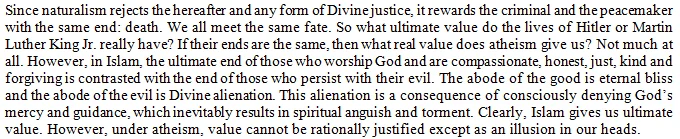
This is a strong argument, yet some atheists still object, asking, “Why does God give us ultimate value?” They argue that even if we were to accept that God grants us ultimate value, it would still be subjective, as it would depend on His perspective.7

Seyyed Hossein Nasr, Professor of Islamic Studies at George Washington University, aptly summarizes the concept of human rights and dignity—which ultimately relate to value—in the absence of God:8
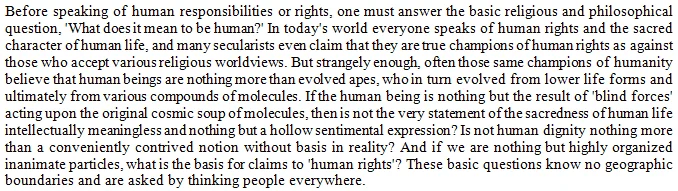
Hamza Tzortzis—writer, philosopher, public speaker, researcher on Islam, and Muslim apologist—uses an apt analogy to illustrate why, from an Islamic perspective, unlike the atheistic worldview, the world has value.9

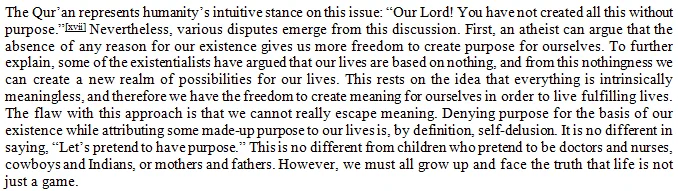
Without God, however, there is no ultimate purpose. That is, from the perspective of naturalism, we have no reason to exist and no profound meaning to our lives. We merely spring from prior blind, random, and non-rational physical processes, and we are riding on a sinking ship. There is nothing we need to be concerned about; we should simply carry on living without worrying about why we are here. Albert Camus, the French novelist, essayist, and playwright who won the 1957 Nobel Prize in Literature, described this attitude, stating: “You will never live if you are looking for the meaning of life.”10 That is, according to Camus, the important thing is for one to live a life that works for him, regardless of any truth behind their existence. The famous atheist Richard Dawkins proposes that our purpose is to propagate our DNA, as our bodies have developed to do precisely that.11 This view reduces our existence to a random accident resulting from a lengthy biological process—human beings are seen as nothing more than by-products, incidental entities that emerged through the random collision of particles and the arbitrary rearrangement of molecules. In contrast to atheistic naturalism, which offers no ultimate purpose for our existence, Islam presents a view of life’s purpose that is both intuitive and empowering, elevating our existence from mere products of matter and time to conscious beings who choose to form a relationship with the One who created us. Like many philosophers, Ludwig Wittgenstein—an influential thinker and towering figure in twentieth-century philosophy—did not provide an answer to the question, “What is the purpose of life?” However, he did suggest that life is not merely a game: “I do not know why we are here, but I’m pretty sure that it is not in order to enjoy ourselves.”12 Someone might ask: is it reasonable to believe that we have a purpose? Hamza Tzortzis offers a powerful illustration to help answer this question.13
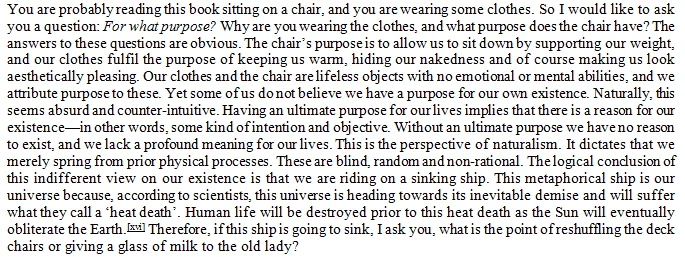
Tzortzis further states:14
The second problem with naturalism’s exclusion of God is that it necessitates moral relativism. Philosophers agree that without God, there is no universal moral standard of conduct. That is, there is no absolute right or wrong, because nothing exists except physical objects situated in time and space. The physical contents of time and space, including animals and inanimate objects, are unmoral—that is, they have no moral perception and are incapable of considering moral concerns. For example, the wall behind you cannot understand or practice moral principles. If humans—including Hitler, robbers, and murderers—are simply doing what they believe is right, and their thoughts are dictated by their own DNA, which itself is the result of purposeless, directionless chemical and physical processes, then there is no reason to be concerned about moral issues, as morality becomes just another meaningless, random product of human evolution.15

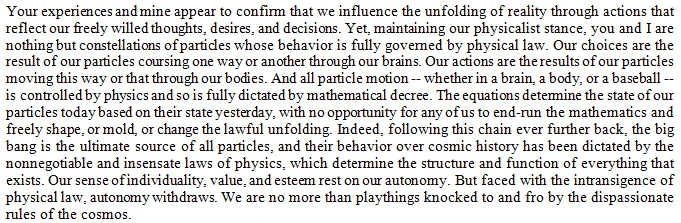
Naturalism—the view that nothing exists beyond physical matter and the laws that govern it—necessitates the rejection of free will, as it allows for no external causality and nothing beyond matter and physical forces. That is, if naturalism is true, then humans do not possess free will. The universe is a closed system of matter operating according to physical laws, and the human being is nothing more than an organic robot programmed by nature and environmental forces to think, speak, and act in precisely the way that he does. Every human desire and thought is merely a product of molecules arranged in specific combinations, as dictated by nature through physical laws, and this will always remain the case. Put another way, biological determinism is an inescapable consequence of biological reductionism. That is, if every choice we make can be reduced to the chemical processes of the brain, then free will is an illusion. This is what Dawkins meant when he said: “DNA neither cares nor knows. DNA just is. And we dance to its music.”16 Brian Greene—theoretical physicist, mathematician, and string theorist—defends the idea that the random action of forces and particles fully determines our brain activities and the outcomes they produce. Greene is categorical about these processes and the determinism they entail:17
If God does not exist, there remains no foundation for objective moral values and duties. That is, without God, there is no real moral standard by which to judge certain actions as good or evil, right or wrong. Interestingly, some of the most influential atheists of our time have admitted that the existence of objective values makes the existence of God more probable than it would be otherwise. For instance, philosopher John Leslie Mackie—best known for his work on ethics and for his 1977 defense of atheism in his seminal essay titled “Evil and Omnipotence,” in which he attempted to show that belief in a good God is irrational—acknowledged that if objective moral truths existed, they would require a supernatural explanation. This is why atheists deny the existence of objective moral values, explaining the human moral sense as another meaningless, random, natural product of biological and social evolution. They offer a biological and sociological account of the development of human morality, suggesting that it is neither objective nor absolute. That is, they argue that morality is merely an aid to survival and reproduction, and any deeper meaning is illusory. Michael Ruse, the philosopher of science who specializes in the philosophy of biology and the relationship between science and religion, reports:18

According to the naturalistic view, there is nothing inherently wrong with any immoral act beyond its social consequences. If there is no absolute right and wrong, then atheists cannot object to what the Nazis did to non-Aryan people, who were considered inferior races. Likewise, they cannot object if someone were to enter their homes, rob them of all their valuables, and murder their families. The naturalistic worldview fails to provide a sound foundation for objective moral values and duties. Indeed, if God does not exist, we are trapped in a morally valueless world in which nothing is truly forbidden. As William Lane Craig puts it, if there is no God, any basis for regarding the herd morality evolved by Homo sapiens as objectively true seems to have been removed. Take God out of the picture, and all we seem to be left with is an apelike creature on a tiny speck of dust, beset with delusions of moral grandeur.19
The third problem with denying God is that it leaves no room for ultimate hope or justice. Since naturalistic atheism rejects the Divine and the supernatural, it also denies the existence of an afterlife. Without an afterlife, there can be no hope of pleasure following a life of pain, and the expectation of something positive after this life is ultimately lost.20

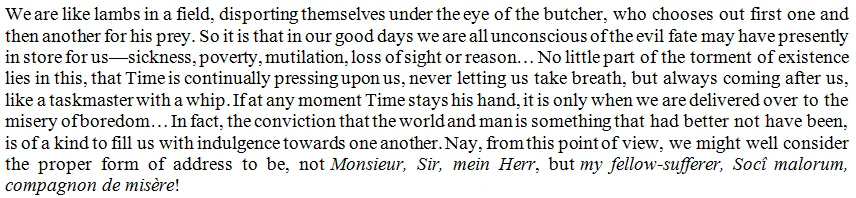
Arthur Schopenhauer, widely regarded as the philosopher of pessimism, powerfully captured the despair and grim fate that lie ahead for us:21
Unlike atheists, believers cannot fall into despair, for they are always sustained by hope—hope that is rooted in Allah’s mercy, which will manifest both in this life and in the Hereafter: {And do not lose hope in the mercy of Allāh, for no one loses hope in Allāh’s mercy except those with no faith”} (Qurʾān 12:87). Under atheism, ultimate justice remains an unachievable goal—a mirage in the desert of life.22

Islam, however, offers everyone hope for pure, Divine, ultimate justice. On the Day of Judgement, no one will be treated unfairly, and everyone will be held to account. Allāh says: {on that Day people will proceed in separate groups1 to be shown ˹the consequences of˺ their deeds. So whoever does an atom’s weight of good will see it. And whoever does an atom’s weight of evil will see it} (Qurʾān 99:6–8). And He says: {For Allāh created the heavens and the earth for a purpose, so that every soul may be paid back for what it has committed. And none will be wronged} (Qurʾān 45:22). Life, from the perspective of philosophical naturalism, is like a mother giving her child a toy only to take it back without any reason.23

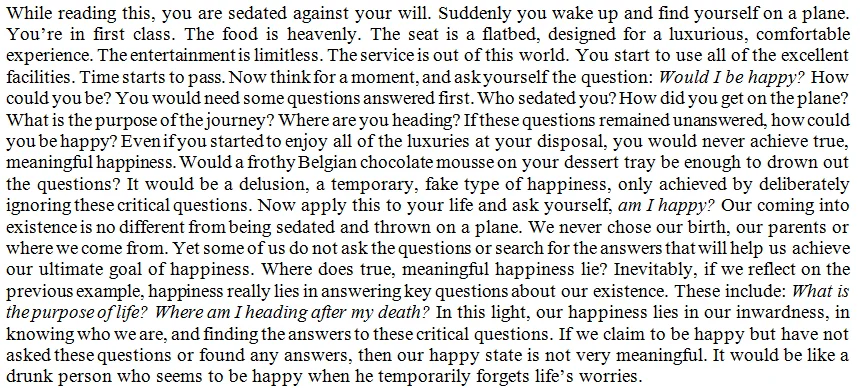
Finally, without God, there is no eternal and meaningful happiness. In essence, we cannot attain true and meaningful happiness unless we discover who we truly are and find answers to life’s fundamental questions—namely, “What is the purpose of life?” and “Where are we heading after death?” If someone has neither asked these questions nor found any answers, yet claims to be happy, then that happiness is not truly meaningful, for such a person would be like someone intoxicated—appearing happy only because they have temporarily forgotten the burdens of life.24

To shed light on this question, Tzortzis invites us to consider the following scenario:25
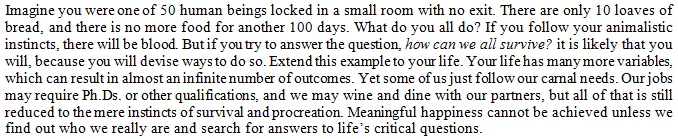
Unlike animals, human beings cannot find contentment simply by complying with their instincts. In other words, surrendering to our hormones and basic physical needs will not resolve life’s fundamental questions or lead to true happiness. To illustrate this, Tzortzis invites us to reflect on another striking and thought-provoking example:26
Naturalism can never produce a truly meaningful or lasting state of happiness, for it fails to provide real answers to the fundamental questions that every human being seeks to resolve. Why are we here? According to naturalism, there is no reason. Where are we going after death? Nowhere—only death awaits. In contrast, Islam offers clear, profound answers to these existential questions. Why are we here? To worship Allāh. Where are we going after death? We are presented with a choice: to embrace Allāh’s eternal and boundless mercy, or to turn away from it. By embracing His mercy through adherence to His Message—and by loving, obeying, and worshipping Him—we pave the way to eternal happiness in paradise.27
In a nutshell, without God, there are no profound answers to our existence, and thus, true meaningful happiness can never be attained. Some atheists may claim to be happy, but theirs is a drunken type of happiness—and they will not sober up unless they begin to reflect deeply on the reality of their own existence. Even if they try to seek answers and eventually settle with uncertainty or skepticism, they still fall short of achieving ultimate happiness. Indeed, the state of those who know their purpose and destination is not the same as those who do not, even if both claim to be happy. Allāh says: {That ˹eternal˺ Home in the Hereafter We reserve ˹only˺ for those who seek neither tyranny nor corruption on the earth. The ultimate outcome belongs ˹only˺ to the righteous} (Qurʾān 28:83).
The above are the logical implications of naturalism—also referred to as atheism, scientific materialism, or secular humanism. While naturalists or atheists may be emotionally justified in believing that their lives possess ultimate value, hope, purpose, and happiness, such belief lacks a solid intellectual foundation. Even Richard Dawkins acknowledges the logical consequences of naturalism, arguing that under its framework, everything is ultimately meaningless and based on blind, pitiless indifference:28

Without Allāh, there is no true value, no capacity for knowledge, no sense of personal freedom and moral responsibility, and no foundation for the concept of “ought.” In His absence, Man drifts into a sea of meaninglessness and nihilism. This is the logical endpoint for the atheist who fully embraces the implications of naturalism with intellectual integrity. Yet, many atheists do not descend into nihilism—not because naturalism offers a way out, but because they subconsciously evade its consequences through self-deception and inconsistency. They avoid confronting the despair that comes with nihilism because it is emotionally unbearable and practically unlivable. In doing so, they often borrow values, truths, and moral frameworks from theism—frameworks that naturalism itself cannot justify. Theists, and especially Muslims, believe in a rational and personal Creator, which provides a coherent foundation for the universe’s order and intelligibility. They also hold that all creatures reflect signs of their Creator—most significantly human beings, who are uniquely endowed with intellect, moral awareness, consciousness, and free will. Moreover, the theistic worldview, with its belief in a purposeful unfolding of history, allows for genuine meaning and direction in life. In essence, Allāh alone provides a rational foundation for objective morality and the very attributes that make us human: reason, consciousness, and free will. Without Him, the struggle to create meaning in a purposeless universe—and us along with it—coming into existence for no reason and edging toward a slow, inevitable death by entropy (a metaphor for the gradual breakdown of all order in the universe, including human mortality, i.e., both the universe and human life as accidental occurrences destined for extinction)—is a sorrowful and ultimately futile endeavor. Unfortunately, although Allāh has endowed human beings with the faculties of observation, hearing, and reasoning, some fail to use them correctly to recognize their Lord and pursue guidance. As a result of this failure, they will ultimately end up in Hell: {Indeed, We have destined many jinn and humans for Hell. They have hearts they do not understand with, eyes they do not see with, and ears they do not hear with. They are like cattle. In fact, they are even less guided! Such ˹people˺ are ˹entirely˺ heedless} (Qurʾān 7:179). Such people are heedless of the true purpose of human life—to attain eternal comfort and peace in the Hereafter by seeking guidance in this worldly life—and they squander their unique faculties in pursuit of mere material things, like animals.29
In short, without Allāh, human beings are reduced to nothing more than evolved apes—supposedly emerging from lower life forms, which arose from molecules, ultimately originating from highly organized inanimate particles. As a result, human dignity becomes a conveniently contrived notion without any real foundation, and claims about the sanctity of human life are rendered intellectually meaningless—mere hollow sentiments.
Notes and References
- 1
Hamza Andreas Tzortzis, “Life Without God: The Implications of Atheism,” Hamza Andreas Tzortzis accessed 17 March 2023, https://www.hamzatzortzis.com/life-without-god-the-implications-of-atheism/#_edn1.
- 2
Dennis Oh, “Does Naturalism Lead to Nihilism?” Singapore Inter-Worldviews Dialogue, 1 Nov. 2008, https://groups.google.com/g/singaporeworldviews/c/e5oYPN2jvGI?pli=1.
- 3
William Lane Craig, “‘Navigating Sam Harris’ The Moral Landscape,” Reasonable Faith, accessed 17 March, 2013, https://www.reasonablefaith.org/writings/popular-writings/existence-nature-of-god/navigating-sam-harris-the-moral-landscape.
- 4
Charles Darwin, The Life and Letters of Charles Darwin, ed. Francis Darwin, (Boston, U.S.: Elibron Classics, 2005), vol. 1, p. 282.
- 5
Gerald R. Baron, “Darwin’s Horrid Doubt: Why Monkey Brains Troubled the Great Man of Science,” Science and Philosophy, 8 Sep. 2020, https://medium.com/science-and-philosophy/darwins-horrid-doubt-why-monkey-brains-troubled-the-great-man-of-science-e77c954e9019.
- 6
Hamza Andreas Tzortzis, “Life Without God: The Implications of Atheism,” Hamza Andreas Tzortzis,accessed 17 March 2023, https://www.hamzatzortzis.com/life-without-god-the-implications-of-atheism/#_edn1.
- 7
Ibid.
- 8
Seyyed Hossein Nasr, The Heart of Islam: Enduring Values for Humanity, (New York, U.S.: HarperSanFrancisco, 2004), p. 275.
- 9
Hamza Andreas Tzortzis, “Life Without God: The Implications of Atheism,” Hamza Andreas Tzortzis, accessed 17 March 2023, https://www.hamzatzortzis.com/life-without-god-the-implications-of-atheism/#_edn1.
- 10
As cited in Stephen M. Pollan and Mark Levine, It’s All in Your Head: Thinking Your Way to Happiness, (New York, U.S.: HarperCollins, 2006), p. 4.
- 11
Richard Dawkins, The Selfish Gene, (Oxford, U.K.: Oxford University Press, 2006).
- 12
“In Our Time’s Greatest Philosopher Vote–Ludwig Wittgenstein (1889-1951),” BBC Radio 4, accessed 18 March 2023, https://www.bbc.co.uk/radio4/history/inourtime/greatest_philosopher_ludwig_wittgenstein.shtml.
- 13
Hamza Andreas Tzortzis, “Life Without God: The Implications of Atheism,” Hamza Andreas Tzortzis, accessed 17 March 2023, https://www.hamzatzortzis.com/life-without-god-the-implications-of-atheism/#_edn1.
- 14
Ibid.
- 15
Dennis Oh, “Does Naturalism Lead to Nihilism?” Singapore Inter-Worldviews Dialogue, 1 Nov. 2008, https://groups.google.com/g/singaporeworldviews/c/e5oYPN2jvGI.
- 16
Richard Dawkins, River Out of Eden: A Darwinian View of Life, (London, U.K.: Phoenix, 2001), p. 133.
- 17
Brian Greene, Until the End of Time: Mind, Matter, and Our Search for Meaning in an Evolving Universe, (New York, U.S.: Random House, 2020), p. 18.
- 18
Michael Ruse, “Evolutionary Theory and Christian Ethics: Are they in Harmony?” in The Darwinian Paradigm: Essays on its History, Philosophy and Religious Implications, (London, U.K.: Routledge, 1989), pp. 262, 268, 289.
- 19
William Lane Craig, “Navigating Sam Harris’ The Moral Landscape,” Reasonable Faith, accessed 17 March, 2013, https://www.reasonablefaith.org/writings/popular-writings/existence-nature-of-god/navigating-sam-harris-the-moral-landscape.
- 20
Hamza Andreas Tzortzis, “Life Without God: The Implications of Atheism,” Hamza Andreas Tzortzis, accessed 17 March 2023, https://www.hamzatzortzis.com/life-without-god-the-implications-of-atheism/#_edn1.
- 21
Arthur Schopenhauer, Studies in Pessimism: On the Sufferings of the World, (New York, U.S.: Cosimo Classics, 2007).
- 22
Hamza Andreas Tzortzis, “Life Without God: The Implications of Atheism,” Hamza Andreas Tzortzis, accessed 17 March 2023, https://www.hamzatzortzis.com/life-without-god-the-implications-of-atheism/#_edn1.
- 23
Ibid.
- 24
Ibid.
- 25
Ibid.
- 26
Ibid.
- 27
Ibid.
- 28
Richard Dawkins, River Out of Eden: A Darwinian View of Life, (London, U.K.: Phoenix, 2001), p. 155.
- 29
Muḥammad Shafīʿ ibn Muḥammad Yāsīn ʿUsmānī Deobandī, Maʿārif-ul-Qurʾān: A Comprehensive Commentary of the Holy Qurʾān, trans. Muḥammad Hasan Askari and Muhammad Shamīm, (Karachi, Pakistan: Maktaba-e-Darul-ʿUloom, 2010), Chapter al-ʾAʿrāf (Qurʾān 7:179), pp. 100–101, available at:https://islamicstudies.info/quran/maarif/maarif.php?sura=7&verse=178.