Does the Qurʾān contain a scientific miracle pertaining to human embryonic development?
Human beings have long been fascinated by the question of how life develops before birth. For many centuries, however, understandings of human prenatal development were largely shaped by speculation and mystical beliefs. During the Prophetic era, that is, in the 7th century C.E., embryology—like most branches of medicine—was still in its infancy. The most advanced knowledge in the field at the time came from Greek physicians and philosophers, particularly Aristotle, Hippocrates, and Galen, whose ideas about the origin of semen and the development of the embryo were ultimately incorrect. Before exploring what the Qurʾān conveys regarding human embryonic development, it is useful to shed some light on the Greco-Roman theories of reproduction that prevailed during the Prophet (PBUH)’s mission. Notably, in the fourth century B.C., Aristotle authored On the Generation of Animals, widely regarded as the first work on embryology.
In this book, Aristotle argued that the mother serves merely as a passive receptacle for the male’s sperm. He maintained that only the male produces semen, which he considered the active element in reproduction, while the female provides the passive component necessary for fertilization. His theory closely resembled the popular biblical notion that the male implants the seed in the female, much like a farmer plants seeds in the soil, implying that the seed already contains its essential characteristics and only requires a suitable environment to develop. In other words, Aristotle believed that the mother contributes, at most, constructive matter—namely, menstrual blood—while the father supplies the generative substance, the semen. He further proposed that the fetus forms in the uterus from a coagulum of this menstrual blood, comparing the process to cheese-making: just as rennet transforms milk into cheese, male semen transforms female menstrual blood into an embryo. However, modern science shows this idea to be entirely incorrect, as it is now well established that the female body requires the thick uterine lining to support pregnancy, which is why menstruation ceases during gestation. Galen, in turn, proposed a theory in which the embryo exists fully formed within the man’s sperm. In his view, the embryo is a complete miniature creature contained in a single drop of semen, which then develops in the womb like a small tree, when nourished by the female’s semen.1 In other words, Galen believed that male semen contains preformed miniature adults that gradually unfold during development—the fetus grows by simple enlargement of this fully differentiated miniature.
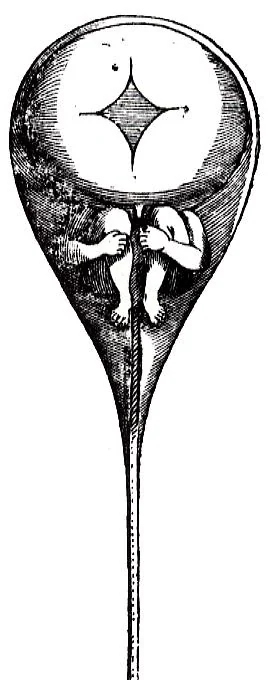
Generally speaking, ancient philosophers and scientists did not recognize that both the man’s sperm and the woman’s ovum contribute to the creation of the embryo. Instead, there was an almost unanimous belief among them that females play a lesser role in reproduction compared with males. In fact, from the time of Aristotle until the late 18th century C.E., it was widely held across Europe that the human embryo arises solely from the man’s ejaculate, with the woman’s womb serving merely as an incubator. In short, Greeks and Europeans believed either that the fetus is formed from menstrual blood curdled by male semen, as Aristotle proposed, or that it exists fully formed in miniature within the sperm and is nourished by female semen, as Galen taught. Unquestionably, they failed to understand that the embryo is created from the combination of a man’s sperm and a woman’s ovum.

In contrast, the Qurʾānic account of embryonic development aligns with modern scientific observations, as it accurately describes both the sequence and the details of human development in the womb. It describes how the fetus arises from a mixture of elements, how the early embryo attaches to the uterine wall, how it subsequently forms into a differentially formed lump—meaning a lump in which different parts begin to take shape—before developing bony structures clothed with flesh, and ultimately how the soul enters the physical body. The accuracy and depth of this Qurʾānic description were unparalleled by any understanding available at the time of Prophet Muḥammad (PBUH). The following is a concise summary of the Qurʾānic description of human embryonic development, highlighting its remarkable precision and alignment with modern scientific understanding. First, the Qurʾān depicts in precise terms the creation of humans from a nuṭfah amshāj (mingled fluid-drop). That is, it describes the zygote as a cell formed by the union of two gametes—the male gamete (sperm) and the female gamete (ovum). The phrase nuṭfah amshāj underscores the Qurʾān’s miraculous nature: while nuṭfah in Arabic denotes a single small drop of fluid, the addition of amshāj indicates that it is a mixture of components. This fits perfectly with scientific findings, since the zygote is both shaped like a drop and composed of a combination of male and female chromosomes. Allāh says: {˹For˺ indeed, We ˹alone˺ created humans from a drop of mixed fluids} (Qurʾān 76:2). Commentators since the time of Ibn ʿAbbās have explained that nuṭfah amshāj refers to the intermingled fluids of the male and the female, resembling a single drop of water, which then undergoes successive stages of development. In addition, the Qurʾānic term sulālah is also remarkable. Allāh says: {Who has perfected everything He created. And He originated the creation of humankind from clay. Then He made his descendants from an extract of a humble fluid} (Qurʾān 32:7–8). The term sulālah, rendered as “an extract” in English, corresponds to male semen, which contains sperm among its components. Linguistically, sulālah denotes the essential or best part of something, and by either implication it signifies “part of a whole.” This indicates that creation originates from only a portion of the man’s fluid—which contains many components—rather than its entirety, as Aristotle and other ancient thinkers mistakenly assumed.
Notes and References
- 1
Galen, On Semen, ed. Philipp De Lacy, (Berlin, Germany: Akademie Verlag, 1995).