What are the stages of human prenatal development as described in the Qurʾān?
The miracle of human creation is among several scientific miracles contained in the Qurʾān. Indeed, more than fourteen centuries ago, at a time when erroneous doctrines still prevailed, the Qurʾān conveyed, in simple language and with remarkable accuracy, truths of fundamental importance regarding the creation of Man and his prenatal development—truths that scientists would take centuries to uncover. Here is a brief overview of the stages of human prenatal development as described in the Qurʾān. Human creation begins with the formation of a zygote, described in the Qurʾān by the phrase nuṭfah amshāj (i.e., mingled fluid-drop: the intermingled fluids of the male and the female, resembling a single drop of water), as explained earlier. Allāh says: {We then placed him as a nuṭfah (sperm-drop) in a secure place} (Qurʾān 23:13). The Qurʾān then describes the ʿalaqah stage: {Then We developed the nuṭfah (sperm-drop) into a ʿalaqah (clinging clot)} (Qurʾān 23:14). The Arabic word ʿalaqah has two meanings: blood clot and leech. The Qurʾānic description of this stage is strikingly accurate, as the embryo at this point closely resembles a blood clot in appearance and a leech in function. The embryo’s external form resembles a blood clot due to the relatively large presence of blood. At this stage, the blood within the embryo does not circulate until the end of the third week, effectively making it like a clot of blood. Moreover, the embryo obtains nourishment from the mother’s blood, much like leeches, which are sanguivorous, feeding on the blood of their hosts (i.e., blood-sucking parasites).

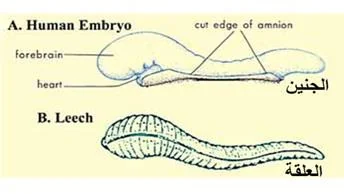
Thus, the two meanings of the word ʿalaqah correspond accurately to the Qurʾānic description of the embryo at the ʿalaqah stage. The Qurʾān does not mention any of the reproductive myths related to menstrual blood or the preformed fetus that were prevalent in its era. The next stage described in the Qurʾān is the muḍġah stage. Allāh says: {Then We developed the ʿalaqah (clinging clot) into a muḍġah (lump of flesh)} (Qurʾān 23:14). The Arabic word muḍġah literally means “chewed substance.” If one were to take a piece of gum and chew it, then compare it with an embryo at the muḍġah stage, one would observe that the embryo acquires the appearance of a chewed substance, due to the somites along its back, which resemble teethmarks.

Hence, the terminology used in the Qurʾān to describe prenatal development is marked by descriptiveness, accuracy, clarity, and a remarkable integration between external appearance and underlying internal processes. This demonstrates the miraculous nature of the Qurʾān, which could only be revealed by the Omniscient. Again, the information contained in the Qurʾān is so detailed that it would have been impossible for anyone living in the 7th century C.E. to know it, since its discovery became possible only through modern scientific technology. This provides indisputable evidence that the Qurʾān is the Word of Allāh, Who knows the creation of Man down to the minutest details.