Are there any ḥadīths (Prophetic traditions) that might be regarded as containing scientific miracles?
Yes, there are several ḥadīths of Prophet Muḥammad (PBUH) that contain insights remarkably consistent with modern scientific knowledge. The following are some examples of such ḥadīths:
Ḥadīth 1: Prophet Muḥammad (PBUH) said, “And Allāh created Adam (peace be upon him) after the ʿaṣr (late afternoon) on Friday, as the last of creation and in the last hour of the hours of Friday between the ʿaṣr and the night.”1 Indisputably, human beings were the last species to emerge on Earth, with Homo sapiens appearing approximately 200,000 years ago.
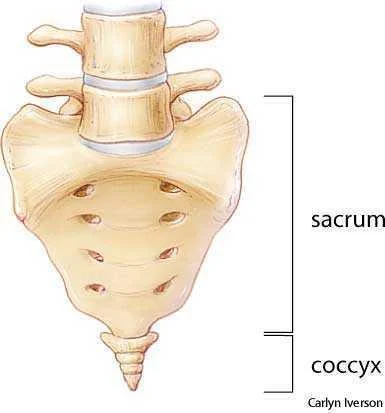
Ḥadīth 2: Prophet Muḥammad (PBUH) stated that ʿajb aḏ-ḏanab (the coccyx, also known as the tailbone) does not decompose in the earth, and on the Day of Judgment, Allāh will resurrect every human being from his or her tailbone: “The earth would consume all of the son of Adam except ʿajb aḏ-ḏanab. From it he was created, and from it he will be recreated [on the Day of Resurrection].”2 This ḥadīth makes three unambiguous statements: 1) Man is created from the tailbone, 2) the tailbone does not completely decompose in the earth, and 3) on the Day of Judgment, resurrection will occur from the tailbone. It is well known that the tailbone, anatomically referred to as the coccyx, is the final segment of the vertebral column.
The first stage of embryonic development is fertilization—the union of a sperm and an egg—resulting in the formation of a fertilized egg, or zygote, which initiates development. The zygote begins to divide: one cell becomes two, two become four, and so on. Cell division continues, and during the second week, the bilaminar embryonic disc is formed, consisting of two layers: the epiblast (outer layer) and the hypoblast (inner layer). The epiblast gives rise to the embryo proper (the portion of the inner cell mass that develops into the fetus itself—the baby’s body), while the hypoblast mainly contributes to extraembryonic structures such as the yolk sac. Around the embryonic disc, the outer layer of early embryonic cells forms the trophoblast, which helps the embryo attach to the uterine wall and receive nutrients from the mother. Around the fifteenth day, a structure called the primitive streak becomes visible as a groove along the midline of the epiblast. The cranial end of the streak contains the primitive node, which in turn houses the primitive pit.

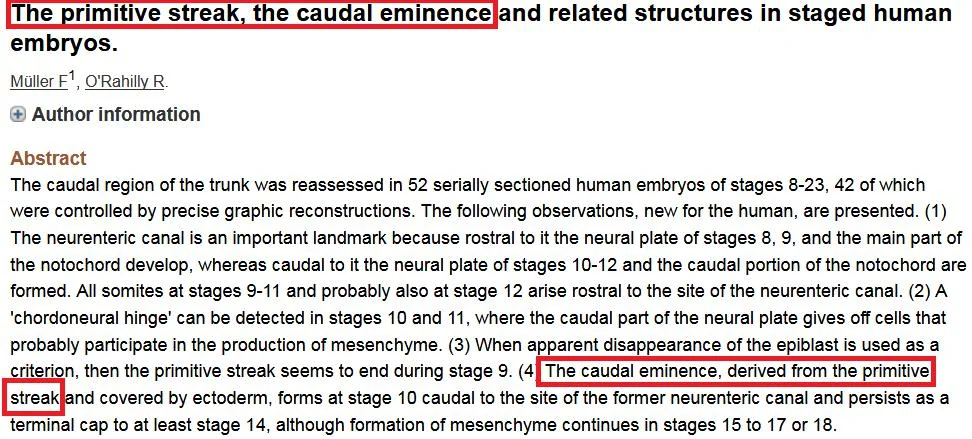
The primitive streak and the primitive node act as organizers of gastrulation—a crucial early process in which embryonic cells move and specialize to form the body’s basic layers—directing the migration and differentiation of epiblast cells. During the third week, epiblast cells move through the primitive streak and the primitive node, forming the three germ layers: ectoderm, mesoderm, and endoderm, which give rise to all organs and tissues of the fetus.3 This process also establishes the body axes (i.e., the basic directional orientations of the body)—anterior–posterior, dorsal–ventral, and left–right—observed in the mature adult. The primitive streak, including its cranial part known as the primitive node, then gradually regresses toward the caudal (tail) end of the embryo, forming the caudal eminence (or tail bud), which contributes to the sacrococcygeal region, where the coccyx (tailbone) ultimately develops.4
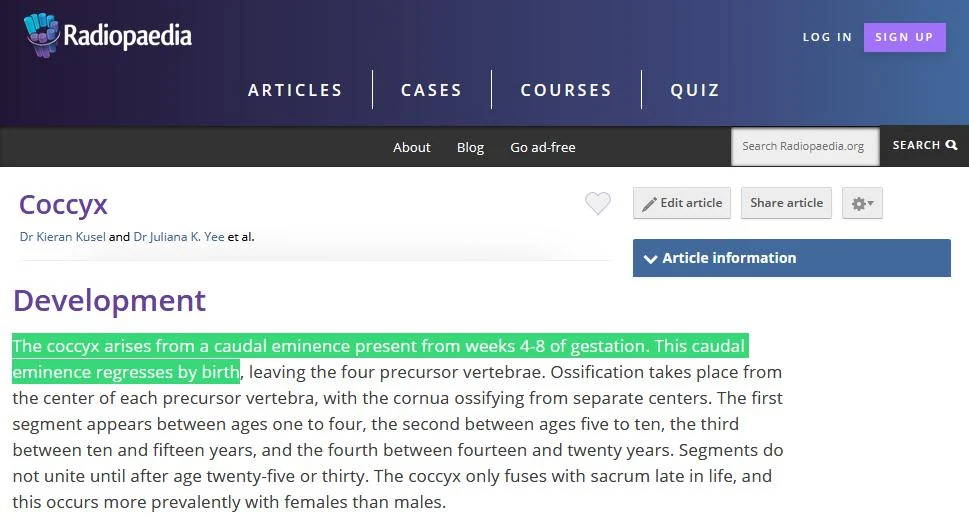
The caudal eminence subsequently regresses, contributing to the formation of the coccyx (tailbone), which is a small, triangular bone resembling a shortened tail, located at the bottom of the spine.5
To sum up the above in simple terms, the primitive streak and the primitive node are the organizers of early embryonic development, controlling gastrulation and the formation of the three germ layers. As development proceeds, they regress toward the caudal (tail) end of the embryo. That caudal region later becomes the sacrococcygeal area, which gives rise to the coccyx (tailbone). Hence, scientifically, it makes sense why the tailbone is emphasized in the Prophetic tradition: the tailbone represents the part of the body that is closest to where human development originates at the primitive streak, the “starting point” for the formation of the whole body. In other words, the tailbone symbolically and developmentally corresponds to the earliest organizing center of the human body, which aligns with the Prophetic statement that resurrection will occur from this part. This also explains why scientists restrict experiments on embryos after the primitive streak appears: it is a critical structure that lays the foundation for the entire human body. Accordingly, many countries follow the 14-day rule, which prohibits culturing or experimenting on human embryos beyond the appearance of the primitive streak (approximately day 14). This guideline is widely recognized and respected in bioethics.6 Thus, the Prophetic statement that resurrection will occur from the tailbone is consistent with the embryological significance of this region. It is also worth noting that certain rare anomalies of embryonic development, such as teratomas, highlight the remarkable role of the primitive streak and the primitive node in early human development. These structures, located in the region that later becomes the coccyx (tailbone), act as organizers of the embryo and contain pluripotent “mother cells”—cells capable of forming many different tissues of the body. In rare cases, if some of these pluripotent cells persist abnormally or undergo mutations, a teratoma may develop—a tumor that can contain a variety of tissues and even partially formed organs. This shows that the region of the embryo that later develops into the tailbone harbors the original cells capable of generating many different tissues during early development. In other words, the tailbone serves as the adult landmark of where the embryonic organizer cells of the human body once existed.7 Moreover, as explained above, cellular differentiation—the process by which unspecialized embryonic cells become specialized and form different tissues of the body—begins during gastrulation under the influence of the primitive streak and the primitive node. These structures act as key organizers that guide the early patterning (arrangement of tissues and body structure) of the embryo. The embryonic region where these organizers arise later develops into the coccyx (tailbone) in the adult body. One of the scientists who demonstrated the organizing role of such embryonic structures (the primitive streak and the primitive node) was the German embryologist Hans Spemann. Through a series of classic experiments on amphibian embryos, Spemann showed that a small region of early embryonic tissue—functionally equivalent to the primitive streak and the primitive node in humans—could direct the development of surrounding cells. In one well-known experiment, tissue from the dorsal lip of the blastopore—an organizer region in amphibian embryos—was transplanted from one embryo into another embryo of the same developmental stage. Remarkably, the transplanted tissue induced nearby cells to reorganize and form a secondary embryonic axis (the body’s head-to-tail and back-to-belly orientation), resulting in the partial development of a second embryo. Spemann’s experiments demonstrated that a small region of early embryonic tissue functions as an organizer, with cells capable of directing the formation and patterning of the developing body. Spemann therefore called this region the “primary organizer.” The illustration below shows how transplanting this organizer region can lead to the formation of a second embryonic axis.8
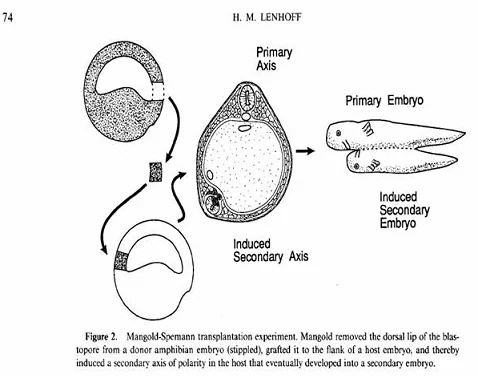
The findings of Spemann’s experiments highlighted the critical role of early embryonic organizer cells in guiding the formation of the human body. Importantly, these organizers arise in the region that later develops into the coccyx (tailbone), showing that this small, adult structure corresponds to the site of the earliest organizing center of human development. This connection helps explain why the aforementioned Prophetic tradition identifies the tailbone as the point from which human resurrection will occur, linking the adult tailbone to the very origin of human body formation. Furthermore, Spemann’s additional experiments highlighted the remarkable resilience of early embryonic organizer cells in the region he called the primary organizer, which later develops into the coccyx (tailbone). In 1931, Spemann ground tissue from the primary organizer and transplanted it into another embryo, yet the experiment still resulted in the formation of a secondary embryonic axis, demonstrating that the organizer’s function persisted despite being physically disrupted (i.e., ground). In 1933, Spemann and his colleagues repeated the experiment after boiling the tissue, and again the transplanted organizer induced the formation of a second embryonic axis. These findings demonstrated that the organizer cells are highly robust and resistant to damage, underscoring their critical role in embryonic development. In recognition of his groundbreaking discovery of the organizer effect, Spemann was awarded the Nobel Prize in Physiology or Medicine in 1935.9 In 2003 (Ramaḍān 1424), Dr. ʿUthmān al-Djīlānī and Shaykh ʿAbd al-Majīd az-Zandānī conducted experiments on tailbones in Shaykh az-Zandānī’s house in Ṣanʿāʾ, Yemen. They exposed one vertebra from each of five tailbones to a gas flame for ten minutes, until the bones glowed red and then turned black.10 The burned pieces were then placed in sterile containers and sent to al-ʿAwlaqī Laboratory in Ṣanʿāʾ for analysis. Dr. Ṣāliḥ al-ʿAwlaqī, professor of histology and pathology at the University of Ṣanʿāʾ, examined the samples and found that, while the bone marrow and surrounding soft tissues (including fat) were destroyed by the heat, the bone cells themselves remained intact.11 In conclusion, the Prophet (PBUH)’s tradition about the tailbone is a scientific miracle, as it aligns with modern embryology and experimental findings. The tailbone region corresponds to the site of the earliest embryonic organizer cells, which guide the formation and differentiation of all parts and organs of the human body. Experiments have shown that even extreme treatments—grinding, boiling, or burning—do not destroy these organizer cells, referred to by Spemann as the primary organizer, which later develops into the tailbone, highlighting their extraordinary resilience. This confirms that the Prophet (PBUH)’s statement that the tailbone does not completely decompose in the earth was accurate even before modern scientific experiments and observations. As a specialist doctor, I find it difficult to explain the knowledge that the Prophet (PBUH) possessed regarding the tailbone over 1400 years ago, except as a miracle.
Ḥadīth 3: Prophet Muḥammad (PBUH) said: “Verily, every human being among the Children of Adam is created with 360 joints. Whoever glorifies Allāh by saying ‘Allāhu Akbar’ (Allāh is the Greatest), praises Allāh by saying ‘al-ḥamdu li-Allāh’ (Praise be to Allāh), declares the oneness of Allāh by saying ‘lā ilāha illā Allāh’ (There is no deity but Allāh), exalts Allāh by saying ‘subḥāna Allāh’ (Glory be to Allāh), or seeks Allāh’s forgiveness by saying ‘astaġfiru Allāh’ (I seek Allāh’s forgiveness), removes a stone, a thorn, or a bone from the path of people, commands what is good, or forbids what is evil by the number of those 360 joints, he will walk on that day having delivered himself from the Hellfire.”12 In line with this Prophetic tradition, the exact number of joints was debated for decades, until modern medical references established the total as 360.

It is remarkable that Prophet Muḥammad (PBUH) mentioned the precise number of body joints at a time when knowledge of human anatomy was virtually nonexistent. Indeed, the total number of joints is 360, and these refer to the movable joints that allow the vertebral column—and therefore the entire body—to move freely.

The fact that the human body has 360 joints is now well established.13

Notes and References
- 1
Muslim ibn al-Ḥajjāj, Ṣaḥīḥ Muslim, (Bayrūt, Lebanon: Dār al-Kutub al-ʿIlmiyyah, 2020), ḥadīth: 2789, available at: https://sunnah.com/muslim:2789.
- 2
Ibid, ḥadīth: 2955b, available at: https://sunnah.com/muslim:2955b.
- 3
During gastrulation, cells of the epiblast layer break away and migrate inward through the primitive streak and the primitive node. These migrating cells form the three germ layers: endoderm (epiblast cells that displace the hypoblast), mesoderm (epiblast cells that settle between the epiblast and the newly formed endoderm), and ectoderm (epiblast cells that remain in place). Each germ layer then gives rise to specific tissues and organs: the endoderm forms the epithelial lining of the digestive and respiratory tracts, the bladder, and glands including the thyroid and auditory canal; the mesoderm forms muscles (smooth, skeletal, and cardiac), bones, connective tissues, the heart and circulatory system, the reproductive and urinary systems, the lymphatic system, and organs such as the spleen; the ectoderm forms the skin and central nervous system.
- 4
Frederich Müller and Ronan O'Rahilly, “The Primitive Streak, the Caudal Eminence and Related Structures in Staged Human Embryos,” Cells, Tissues, Organs, vol. 177, issue 1 2004, pp. 2-20. DOI: https://doi.org/10.1159/000078423.
- 5
Kieran Kusel et al., “Coccyx,” Radiopaedia, 2016, https://radiopaedia.org/articles/coccyx.
- 6
The 14-day rule, first proposed in the United Kingdom’s Warnock Report (1984) and later codified in the Human Fertilisation and Embryology (HFE) Acts of 1990 and 2008, limits the in-vitro culture of human embryos to no more than 14 days after fertilization. In the United States, a similar rule has been followed since 1979. It is one of the most widely accepted regulations in reproductive medicine worldwide. The 14-day boundary was chosen because the primitive streak, a visible structure of cells that marks the beginning of gastrulation (the process by which cells internalize to form the three germ layers—endoderm, mesoderm, and ectoderm—and establish the body’s form and axes), appears on approximately day 15 of human development. The original HFE Act prohibited research on embryos after the appearance of the primitive streak, which occurs no later than 14 days after fertilization. In 2008, the law was updated to specify that no human embryo may be cultured beyond 14 days from the start of the process of creating the embryo, and the rule applies to all live human embryos regardless of how they were created, as well as to all live human gametes.
- 7
Keith L. Moor, The Developing Human, Clinically Oriented Embryology, as cited in Adel ben Mohamed Zaghdoud, “Believe It or Not...German Scientist Confirms a Miracle of Islam,” Way to Allah, http://www.way-to-allah.com/en/miracles/TheTailboneMiracle.html.
A surgeon can find some complete organs, which can be any organ, when opening the tumor… teeth, hair, even hand or feet with nails.
- 8
Ibid.
- 9
Ibid.
- 10
They chose one vertebra from each tailbone for testing to preserve the rest of the specimen and to have a standardized sample for analysis. This allowed them to examine the effect of extreme heat on a single vertebra while keeping the rest of the tailbone intact for potential reference.
- 11
Keith L. Moor, The Developing Human, Clinically Oriented Embryology, as cited in Adel ben Mohamed Zaghdoud, “Believe It or Not...German Scientist Confirms a Miracle of Islam,” Way to Allah, http://www.way-to-allah.com/en/miracles/TheTailboneMiracle.html.
- 12
Muslim ibn al-Ḥajjāj, Ṣaḥīḥ Muslim, (Bayrūt, Lebanon: Dār al-Kutub al-ʿIlmiyyah, 2020), ḥadīth: 1007a, https://sunnah.com/muslim:1007a.
- 13
“3 Facts to Ace Your Anatomy and Physiology Test: Joints,” Parallel Coaching, 28 June 2015, https://parallelcoaching.co.uk/3-facts-to-ace-your-anatomy-and-physiology-test-joints.