What is the law of attraction?
The proponents of the Law of Attraction (LOA) believe that the universe operates through vibration. According to their so-called “law of vibration,” everything in existence is composed of energy vibrating at a specific frequency. Hence, human beings, like everything else, are also forms of vibrational energy and supposedly attract circumstances based on the vibrational alignment of their thoughts and feelings. They claim that vibrational alignment means that the energy a person emits vibrates at the same frequency as the reality they desire to experience. In other words, vibrational alignment supposedly enables a person to attract what they desire because energies with similar frequencies are drawn to one another through the LOA. The proponents of the LOA frequently say: “Just ask the universe for what you want, keep your vibration high, and the universe is bound to respond.” If asking the universe for one’s desires is not major polytheism—namely, openly associating others with Allāh or attributing His divine qualities to created things—then what is major polytheism? Allāh says: {so do not knowingly set up equals to Allāh ˹in worship˺} (Qurʾān 2:22). Indeed, setting up the universe as an equal or rival to Allāh and asking it for things is the essence of kufr (disbelief) and irrationality. Even if the proponents of the LOA claim that vibrational alignment is a form of al-akhḏ bi-l-ʾasbāb—having recourse to the means that Allāh has ordained for attaining benefit and preventing harm—and that everything occurs only by Allāh’s will, this would still constitute minor polytheism, namely polytheism of causes. This is because the LOA is not among the legitimate means that the Law-giver (Allāh) has established as causes for achieving outcomes. Polytheism of causes is the belief that something can bring benefit or ward off harm when Allāh has not made it a cause for doing so. The legitimate means that Muslims may employ to attain desired outcomes are of two types. The first consists of religious means prescribed by the Law-giver, such as the Qurʾān and supplication. The second consists of material means whose effectiveness has been established through empirical science, namely the laws of the universe that Allāh has subjected for the service of His servants. Hence, attributing power to something when Allāh has not made it a cause—neither according to the Sharīʿah nor according to the laws of the universe—constitutes minor polytheism. Allāh did not state that the co-called vibrational alignment can bring benefit or ward off harm. Although the proponents of the LOA claim that it is grounded in science, this is merely pseudoscience based on erroneous and unfounded assumptions. Dr. Michael Shermer—the founding publisher of Skeptic, host of The Michael Shermer Show (formerly Science Salon Podcast), and a Presidential Fellow at Chapman University—has criticized and debunked the Law of Attraction as false and dangerous. Shermer said regarding the “risible twaddle” presented in The Secret:1

Here is a simple example to illustrate the difference between having recourse to legitimate means and falling into minor or major polytheism. Suppose someone suffers from some kind of pain, and:
A.He performs ruqyah on himself by reciting Qurʾānic verses: this is a legitimate means of healing.
B.He takes pain-relief medication: there is nothing wrong with this, for Allāh has commanded us to seek treatment and has made medication a legitimate means of healing.
C.He wears a talisman as a means of healing: this is polytheism because the person is seeking healing through something that Allāh has not made a legitimate means of healing. If the person says that the talisman is merely a secondary cause and that healing comes from Allāh, then they have fallen into minor polytheism known as polytheism of causes. However, if the person believes that the talisman itself possesses the power to heal, then they have fallen into major polytheism.
Similarly, the belief that one can attract benefit and ward off harm through “vibrational alignment” revolves around minor and major polytheism. Unfortunately, the proponents of the LOA and energy healing in our countries give this pagan practice two “tinges” to make it appealing to laypeople: an Islamic tinge and a scientific one. As for the Islamic tinge, they claim that the LOA is simply a matter of having good expectations of Allāh, Who said in the ḥadīth qudsī: “I am as My servant expects of Me.” However, this is a deceptive misrepresentation, because the LOA practitioners place their positive expectations not in Allāh, but in the supposed power of cosmic energy, which they claim is “present everywhere and flows through our bodies” and is “our purifier and healer.” Is this truly a matter of having good expectations of Allāh, or rather of having good expectations of the superstitious LOA? They also frequently quote the verse: {Allāh would never change a people’s state until they change their own state} (Qurʾān 13:11). This verse means that Allāh does not remove blessings from a people unless they themselves change from obedience and righteousness to disobedience and corruption. In other words, improving one’s condition is achieved through righteous deeds and by turning away from disbelief, not through “vibrational alignment,” as the proponents of the LOA claim. They also cite a ḥadīth (tradition) in which the Prophet (PBUH) allegedly said: “Hope for the best and you shall find it.” In reality, however, this ḥadīth is fabricated. Certainly, optimism is better than pessimism because optimism motivates a person to act and to make use of legitimate means. And yes, our thoughts and emotions influence how we experience the world. But it is pure deception to claim that one can attract benefit or ward off harm merely through optimism. The proponents of the LOA also appeal to the ḥadīth: “Actions are by intentions.” Yet what does this ḥadīth have to do with “vibrational alignment”? This ḥadīth simply teaches that the value and reward of deeds depend upon one’s intentions, and that each person will be rewarded according to what they intended. Indeed, Imām aḏ-Ḏahabī [may Allāh have mercy on him] spoke the truth when he said: “Whoever seeks to combine the knowledge of the Prophets with the knowledge of charlatans will depart from both of them.”2 As for the scientific tinge, the proponents of the LOA promote it as being based on physics. They often use scientific-sounding jargon to obscure the issue and get the uneducated excited. However, the LOA has no basis in established science. The so-called notions of “energy” and “vibrational alignment” that the LOA allegedly relies on have nothing to do with the known laws of physics, and no scientific theory supports the philosophy from which it originates. Nonetheless, the LOA proponents argue that all matter exists in a constant state of vibration and that the human brain translates these vibrations into reality. They claim that every thought has a specific frequency or wavelength of energy. They further claim that energy encoded with thoughts and desires leaves the brain, travels through the surrounding space, and causes the universe to manifest what one is thinking about. However, no such “thought energy” exists in physics, nor is there any mechanism by which thoughts can be encoded with positive or negative properties in the manner described by the LOA proponents. Thoughts are just tiny electrical firings between neurons, and the energy involved is far too small to leave the body. Hence, the idea that thoughts can pass beyond the brain, influence the external world, and generate events is scientifically unfounded.
It is true that every object tends to vibrate at a particular frequency known as its natural frequency, which is determined primarily by factors such as mass and elasticity, and can therefore change when these properties change. However, molecules in solids are not free to move in any direction; rather, they vibrate about their fixed equilibrium positions. In addition, at absolute zero (the lowest possible temperature), particles cease all thermal (heat-related) motion and vibration. Moreover, since gravity is an extremely weak force unless very large masses are involved, the gravitational force exerted by the human body is negligible and incapable of attracting external objects. Furthermore, the human body is generally electrically neutral and therefore does not ordinarily attract or repel objects through electrical charge. Nevertheless, the proponents of the LOA frequently speak about “vibrational frequencies” and claim that thoughts themselves vibrate. According to them, individual thoughts vibrate at particular frequencies and radiate these frequencies into the world, thereby attracting thoughts and physical entities vibrating at similar frequencies. They invoke quantum physics to support the bogus claim that positive thoughts vibrate at high frequencies whereas negative thoughts vibrate at lower ones. They even claim that quantum physics teaches that the universe cannot be explained without including the power of the human mind, and that human thoughts directly influence external reality. However, physicists do not recognize any so-called “law of vibration” as the “third of the Seven Universal Laws”3 because these alleged laws are entirely invented. They are merely New Age pseudoscience embraced by people with little understanding of physics who nevertheless wish to appear intellectually sophisticated and spiritually enlightened. Likewise, the claim that low-frequency vibrations correspond to negative thoughts while high-frequency vibrations correspond to positive thoughts is completely fabricated. In short, the LOA proponents speak about principles of physics that they do not truly understand, presenting their own inventions as established science. In truth, they often learn just enough scientific terminology to impress the gullible.
The LOA proponents refer to Cleve Backster’s work and use it as support for their so-called law.4 They claim that Backster’s findings resemble their belief that human thoughts and conscious intentions can influence the material world and produce physical effects. In this view, thoughts are said to be projected into the universe as energy, and the universe responds in kind—positive thoughts attract positive outcomes, while negative thoughts attract negative outcomes. Backster’s plant studies began in the 1960s. He reported that a polygraph instrument attached to a plant leaf registered changes in electrical resistance when the plant was harmed or even threatened with harm. In February 1966, Backster attached polygraph electrodes to a Dracaena cane plant to measure the time taken for water to reach the leaves. Using the same equipment to measure galvanic skin response (a change in electrical activity in the skin linked to emotional arousal, such as stress, fear, excitement, or surprise), he observed readings which he interpreted as resembling those of a human subject. This led him to conduct further experiments. He reported that the readings spiked dramatically when he imagined burning the leaf, which he interpreted as evidence of the plant displaying a stress response to his intention to harm it.5 He later conducted a similar experiment in which he observed a plant’s response to the death of a brine shrimp in another room. The results, he claimed, convinced him that plants demonstrated a form of telepathic awareness. He argued that plants could perceive human intentions. As he continued his experimental work, he further reported that human thoughts and emotions appeared to cause measurable reactions in plants that could be recorded using a polygraph instrument. He termed this alleged sensitivity of plants to human thoughts “primary perception” and published his findings in the International Journal of Parapsychology in 1968.6 After 1973, Backster conducted further experiments on yogurt bacteria, eggs, and human sperm, and claimed that his results showed that “primary perception” could be measured in all living organisms.7 Backster’s theory has been rejected by the scientific community because it does not adhere to the scientific method.8 Controlled experiments designed to replicate his findings have failed.9 An attempt to replicate his plant and shrimp experiments was made by a group of three scientists at Cornell University. The authors stated:10

Hence, mainstream science has largely ignored Backster’s plant and shrimp findings due to failed replication attempts at Cornell University. The panel of biologists at the 141st annual meeting of the American Association for the Advancement of Science found Backster’s claims unsupportable.11 Contrary to what the LOA proponents promote, human thoughts and conscious intentions cannot alter physical reality, and the claim that people attract whatever their thoughts are focused on is sheer nonsense. Benjamin Radford—the managing editor of Skeptical Inquirer, whose “Bad Science” column regularly appears in Live Science—wrote:12
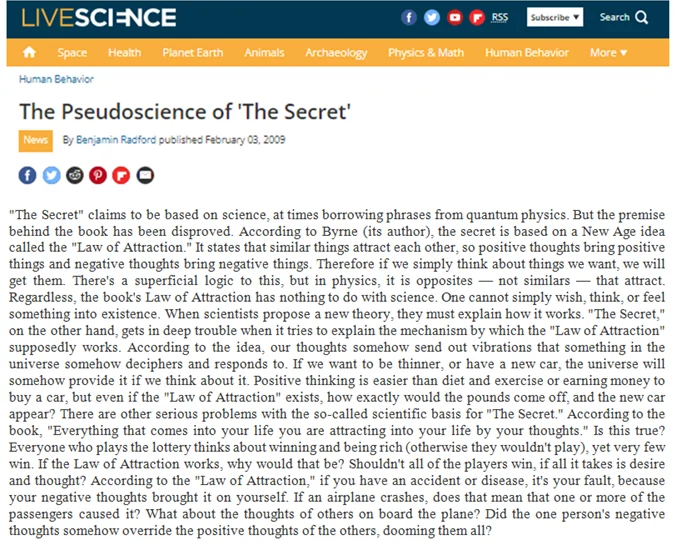
It should be noted that the so-called law of vibration upon which the LOA is based has its roots in Buddhism. Buddha is famously reported to have said: “Sabbo pajjalito loko, sabbo loko pakampito,” meaning that the entire universe is nothing but combustion and vibration.13 Unfortunately, charlatans dress up this wishful thinking as science in order to market it to gullible people who desperately desire a better life and are willing to pay money to be told that they can attain it merely by “raising their vibration.” It should also be noted that the LOA is dangerous because it promotes toxic positivity and is fundamentally rooted in victim-blaming. Its proponents often go to extremes, claiming that people remain poor only because their negative thoughts block wealth from coming to them, and that people become ill because they persistently think about becoming ill. In other words, according to this ideology, if a person is poor or ill, it is entirely their own fault.
This leads us to a crucial question: we are told that the Prophets were severely tested. If nothing can enter one’s experience unless they summon it through persistent thoughts, does it follow that the trials faced by the Prophets were the result of their own habitual negative thinking? Were they operating at a low frequency? Did they not know how to manifest their desired outcomes by raising their vibration to align with what they supposedly wanted in life?14 Funnily enough, Jerry Hicks, the husband of Esther Hicks—the most prominent LOA figure—died of cancer in 2011. Indeed, the LOA proponents are either adhering to a religion that offers superior guidance to that of the Prophets, or they are opening the doors to misguidance and blasphemy. Oddly enough, they refer to their wishful thinking as a “law,” even though it cannot be empirically verified or falsified. Moreover, as noted earlier, the LOA proponents adopt scientific-sounding language in order to make their New Age claims appear factual to gullible people who fall under their influence. Furthermore, the blasphemous LOA magnifies the worldly life, placing earthly desires and material possessions as the ultimate goal and aspiration. Those who adopt and practice this materialistic philosophy begin with a single drop of desire, which the LOA turns into an ocean of desires in which they end up practically drowning. The LOA thereby promotes selfishness, egocentricity, greed, and materialism. It also venerates human beings, attributing to them a quasi-sacred status, as well as unlimited potential and creative energy. In fact, its core message is that they are “incarnations of God” and “their own gods.” Hence, they are able to create their own reality and control their own destiny. God, if He even exists in this view, is nothing but a universal energy force that humans manipulate through their thoughts and feelings. The LOA proponents thus reject the idea of a sovereign, omnipotent, and omniscient God Who is in control of everything. In their pantheistic view, God has neither will nor qayyūmiyyah (Allah’s attribute of absolute self-sufficiency and self-subsistence, and His sustaining and maintaining of the entire universe)—far be it from Him, and Exalted is He and High above what they say by great sublimity. Undoubtedly, the LOA constitutes a serious deviation and involves ascribing partners to Allāh in His Lordship: {Yet they worship besides Allāh those ˹idols˺ who do not afford them any provision from the heavens and the earth, nor do they have the power to} (Qurʾān 16:73).
Notes and References
- 1
Michael Shermer, “The (Other) Secret: The Inverse Square Law Trumps the Law of Attraction,” Scientific American, 1 June 2007, https://www.scientificamerican.com/article/the-other-secret/.
- 2
Shams ad-Dīn aḏ-Ḏahabī, Mīzān al-Iʿtidāl, (Bayrūt, Lebanon: Dār al-Maʿrifah, 1963), vol. 5, p. 173.
- 3
In the New Age thought, the Law of Vibration is regarded as the third of the Seven Universal Laws. It states that nothing rests; rather, everything moves and vibrates. According to this belief, everything in the universe is composed of energy vibrating at different frequencies, from the smallest subatomic particle to the largest celestial body. Since everything is believed to be in constant motion, human thoughts and emotions are likewise considered forms of energetic vibration. This principle serves as the foundation of the Law of Attraction—the belief that similar frequencies attract one another.
- 4
Cleve Backster was a former CIA interrogation specialist and polygraph expert known for his work in lie detection. He later became widely known for his controversial experiments on plant responses, which he interpreted as evidence of a form of “primary perception” in living organisms.
- 5
Mark Pilkington, “Primary Perception,” The Guardian, 10 June 2004, https://www.theguardian.com/education/2004/jun/10/research.highereducation4.
- 6
Cleve Backster, “Evidence of a Primary Perception in Plant Life,” International Journal of Parapsychology, vol. 10, no. 4, June 1968, pp. 329–348, available at: https://www.researchgate.net/publication/333566924_Evidence_of_a_Primary_Perception_In_Plant_Life.
- 7
Mark Pilkington, “Primary Perception,” The Guardian, 10 June 2004, https://www.theguardian.com/education/2004/jun/10/research.highereducation4.
- 8
Ibid.
- 9
Ursula Schwebs, “Do Plants Have Feelings?” Harpers, June 1973 issue, pp. 75–76, available at: https://harpers.org/archive/1973/06/do-plants-have-feelings/.
- 10
Kenneth Horowitz et al., “Plant Primary Perception: Electrophysiological Unresponsiveness to Brine Shrimp Killing,” Science, vol. 189, issue 4201, 8 Aug. 1975, pp. 478–480. DOI: https://doi.org/10.1126/science.189.4201.478.
- 11
“Cleve Backster,” Wikipedia: The Free Encyclopedia, last edited 19 August 2023, https://en.wikipedia.org/wiki/Cleve_Backster.
- 12
Benjamin Radford, “The Pseudoscience of ‘The Secret,’” Live Science, 03 Feb. 2009, https://www.livescience.com/5303-pseudoscience-secret.html.
- 13
Ajahn Sucitto, Turning the Wheel of Truth: Commentary on the Buddha’s First Teaching, (Boulder, U.S.: Shambhala Publications, 2010).
- 14
“Qānūn al-Jaḏb fī Mīzān ash-Sharīʿah (The Law of Attraction in the Balance of the Sharīʿah),” Shaykh Muḥammad Ṣāliḥ al-Munajjid’s Official Website, 5 May 2015, https://almunajjid.com/courses/lessons/494.