What is feminism, and is it incompatible with the Sharīʿah?
Feminism is a philosophy that encourages women to rebel against patriarchy, which, according to feminists, oppresses and shackles them and is the root cause of gender inequality. In other words, feminists resist what they perceive as male dominance, believing that men, as a group, subjugate and exploit women. They assert that feminism is committed to ensuring that women can fully enjoy their rights on an equal footing with men. However, the feminist movement of the 1960s and 1970s produced destructive repercussions that continue to affect women today. In September 2020, Amy Mastrine—an American radical feminist who once advocated that patriarchy is an exploitative system oppressing women and that it must be dismantled to achieve women’s liberation—wrote that “patriarchy protects women better than modern feminism.”1

When she was a radical feminist, Mastrine would tell anyone who would listen that patriarchy must be destroyed. It was with this mindset that she decided to move from the small town where she was living to San Francisco, a city known for its strong feminist presence.2

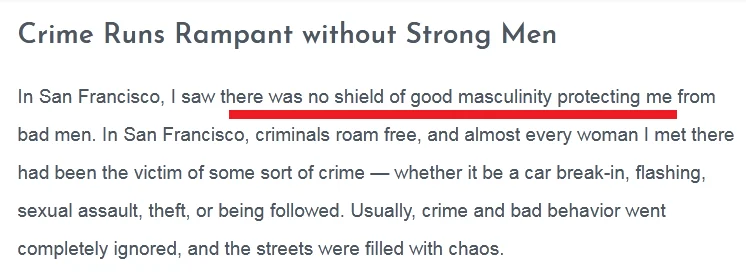
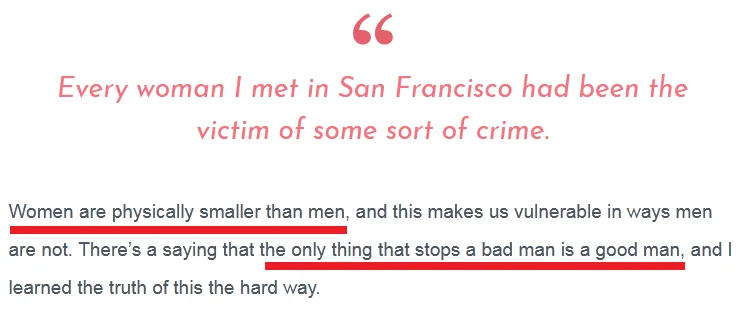
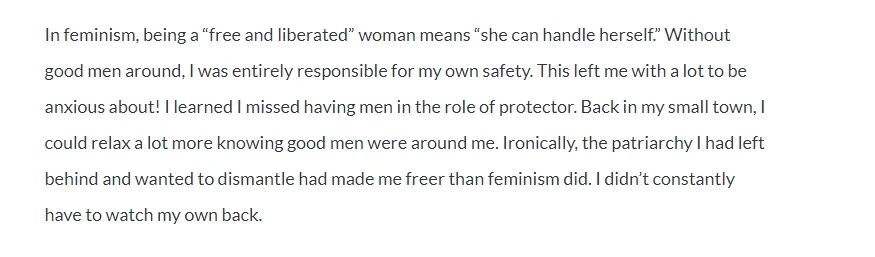
Mastrine quickly realized that, contrary to her seemingly progressive beliefs, the patriarchy she had left behind does not oppress women but rather protects them. In San Francisco, she observed, there was no shield of good masculinity to protect women from harmful men, which allowed criminals to roam freely in this feminist city. Indeed, San Francisco is among the most crime-ridden cities in the United States—the crime capital of the country. Mastrine noted that women, being physically smaller than men, are vulnerable in ways men are not. She revealed that nearly every woman she encountered in San Francisco had fallen victim to some form of crime, as unscrupulous men could take advantage of women in the absence of strong, virtuous men who would intervene or hold wrongdoers accountable.3
Mastrine admitted that she learned the hard way the truth of the saying: “The only thing that stops a bad man is a good man.”4
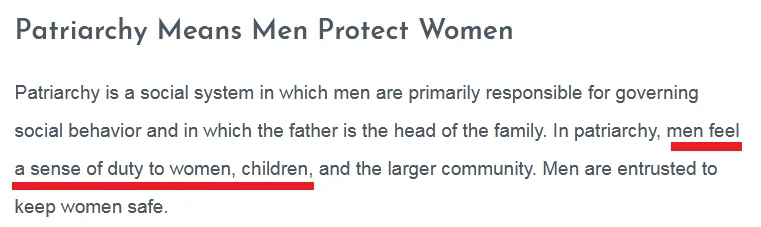
Mastrine stated that, within patriarchy, men feel a sense of duty toward women, children, and the broader community.5
Mastrine concluded by saying that the patriarchy she had left behind—and once sought to dismantle—had made her freer than feminism ever did, as she did not have to constantly watch her own back.6
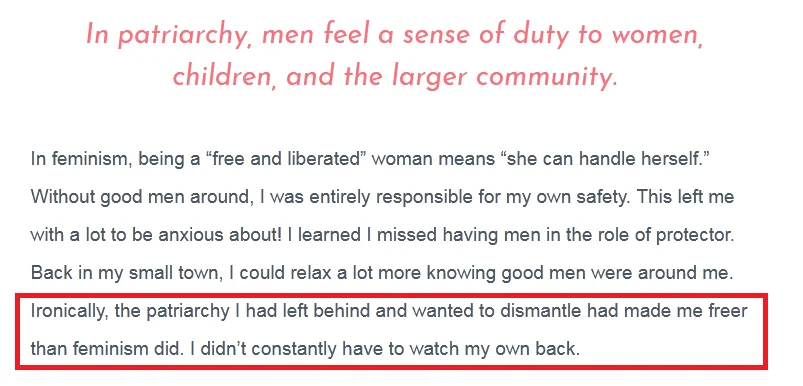
Hence, it took moving 3,000 miles away from home for Mastrine to realize that patriarchy is not inherently harmful. Given the choice, she asserted, she would prefer to live in a patriarchal society rather than a feminist one.7
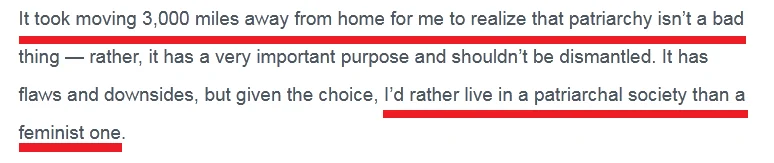
Mastrine explained:
Let us shed light on the true intentions of the proponents of the feminist movement, which are rooted in a disdain for traditional values and roles, and have caused harm to both women and societies at large. Strange as it may seem, feminism has proven to be the arch-enemy of women. This harsh reality has been recognized by women who have lost their religious and intellectual anchors to the toxic influence of feminism. These women experienced a profound inner struggle—their minds telling them one thing while their hearts said another—women whose fiṭrah (innate disposition) and maternal instincts clashed with the demands of the modern feminist world. Crushed by feelings of hopelessness, depression, and confusion, and driven by a sense of repentance, these women came to recognize the dark side of feminism and found their way back home. The following are some of the most disturbing truths about feminism that most people remain unaware of:
Fact #1: The suffix -ism is typically used to denote ideologies. Accordingly, feminism is a full-fledged ideology, comparable to communism, Nazism, and Darwinism. Contrary to popular belief, feminism is not primarily concerned with championing women’s rights. Rather, feminists advocate a totalitarian worldview—a reimagining of society according to their own perspective. They seek to reshape the world’s economy, politics, culture, and art through the lens of the feminist ideology. They aim to interpret everything according to this framework and to construct a world in which men have little or no influence—one where women’s actions are beyond criticism and where men are marginalized. In other words, they aspire to establish a social structure that is female-centered, female-identified, female-dominated, and that devalues qualities narrowly associated with masculinity. Thus, the first fact about feminism is that it constitutes a full-fledged ideology.
Fact #2: Feminism was never concerned with upholding the concept of femininity. In fact, it has little to do with femaleness or feminine qualities. On the contrary, feminists oppose femininity, and often act as the fiercest critics and enemies of naturally feminine women. Achieving what men achieve is the central ambition of classical feminists, who, living with a sense of their own inferiority, structure their lives around the belief that men are superior to women and that women must rise to men’s level. Paradoxically, while feminist activists claim to strive to improve conditions for women, they often display both physiological and psychological traits associated with heightened masculinization. That is, feminist activists are masculinized relative to women in general, and their sense of inferiority drives them to reject the notion of femininity. These feminists—masculinized women—tend to diminish, judge, and even resent feminine women who embrace the belief that men and women have distinct designs and roles, and who prioritize marriage and children over career ambitions. In reality, feminists glorify hyper-masculinity while devaluing traditionally feminine qualities such as care, nurturance, and valuing relationships. Feminists perpetuate the notion that females are weak and victimized. In doing so, they disempower and insult women by insisting that, to succeed, they must achieve everything men can. They encourage women to focus solely on careers, viewing housekeeping and childrearing as insignificant work. Consequently, they look down on women who embrace traditional femininity, homemaking and allowing their husbands to take the lead. Instead, feminists advocate that women should assume authority in their relationships. Ironically, they disparage conventional expressions of femininity, adopting the attitude that anything traditionally associated with women is inferior—a phenomenon sometimes termed femmephobia. They regard “girl stuff” as less valuable and worthwhile. In a word, feminists reject traditional femininity and seek to eradicate the idea that women should embrace their natural female traits. They encourage women to go against their innate instincts by believing they must do everything men do. As a result, feminist women often lose touch with their feminine side and adopt masculine traits and behaviors. Although they claim to oppose male supremacy, in reality, they aim to eliminate femininity and make women just like men, thereby distorting the female psyche, personality, and innate disposition. They ignore the fact that providing emotional care for their children is a woman’s natural instinct, which is why returning to work too soon is heart-wrenching and profoundly distressing for mothers. Feminists insist on denying the God-given roles of men and women, urging women to reverse their priorities—placing career above marriage and children. For them, career success is more meaningful and fulfilling than family life. Accordingly, they promote structuring women’s lives around work, as men do, suppressing maternal desire in favor of productivity in the marketplace. They argue that women should not limit their ambitions by pursuing gender-compliant goals. They even go so far as to liken being a wife and mother to being in a “comfortable concentration camp.” In fact, feminists often claim that, since men and women are supposed to be treated as equals, women need not exert any effort to maintain their appearance, while men are frequently careless about theirs. They argue that society should not burden women or coerce them into using beauty products, wearing makeup, or dressing attractively. What feminists fail to recognize is that caring about one’s appearance is neither bad nor despicable, contrary to their belief. Oddly enough, they maintain that beauty is a social construct and a tool of patriarchy, designed to oppress women by forcing them to chase unattainable standards while men face no such expectations. Consequently, some feminists put minimal effort into dressing up, with some refusing to wear any makeup or even brush their hair. Even more striking, some openly refuse to remove body hair, proudly proclaiming “hairy and proud!” Naturally, these feminists criticize women who hold different views on beauty. In short, modern feminists encourage women to reject traditionally feminine comportment, urging them instead to compete with men and adopt masculine traits—to essentially become like men. The feminist philosophy rests on the assumptions that men are stronger, superior, and enjoy privileges, whereas women are disadvantaged. Accordingly, feminists promote the idea that women should think like men and pursue careers in male-dominated fields and industries.

Feminists aim for women to achieve everything that men can in order to prove that women are self-sufficient and equally capable. As a result, their lives are filled with hostility toward men and a constant race to compete with them. Paradoxically, feminists advocate for women to become the very men they have historically despised or claimed to despise. They encourage women to act against the purpose for which they were created. Consequently, women who embrace feminist doctrines will never experience the happiness and fulfillment they would attain by aligning with their natural essence and femininity. Undeniably, feminists promote a perception that leaves women unhappy. That is, women who accept feminist premises—that motherhood is a modern form of slavery, that pursuing a career is more valuable than raising a family, and that all men oppress women—suffer profound misery. Indeed, millions of women who followed feminist advice ultimately regretted it. Suzanne Venker—an American non-fiction author and radio host, and the author of several anti-feminist books—states that women have been deceived for years, which explains why they are so unhappy. In a compelling article, Venker outlines what she identifies as four feminist lies that are making women miserable: “women don’t need men,” “men and women are the same, or gender is a social construct,” “the biological clock isn’t real,” and “a career is more meaningful than marriage and children.”8

Venker explains that the purpose of feminism is to “yank the feminine out of women” and give them a false sense of equality: “Just because men and women are equal in worth or value doesn’t mean they’re interchangeable or the same. Feminism taught women to reject marriage and motherhood, go out into the workforce, and compete with men. That has been extremely destructive.’’9 Venker asserts that entering the workforce goes against what is naturally feminine. In other words, feminists have robbed women of what they naturally desire: to be a wife, a mother, and homebound. Venker comments: “But that’s only half the pie. Feminism didn’t teach women to have it all; it taught them to have half of it all, the half of the pie that used to belong to men as if men had it so great and they had better lives.’’10 Hence, the second fact about feminism is that feminists are misogynists who lead women to despise their bodies, their God-given nurturing nature, and even the very idea of marriage and family.
Fact #3: Feminism has ingrained paranoia in women. Feminists firmly believe that men throughout history have consciously conspired to oppress women. In their view, all sectors of a male-dominated society—education, politics, the media, advertising, music, scholarship, psychology, medicine, movies, fashion, the toy industry, and so on—are colluding against women everywhere. Feminist women feel as if every man is conspiring against them, including their fathers and brothers. It is no exaggeration to say that feminism instills fear in women simply for walking down the street. This is how paranoia becomes part of many women’s personality. This constitutes delusional disorder, previously called paranoid disorder—a serious mental illness classified as a psychotic disorder, marked by persistent distrust and suspicion of others without adequate reason. Paranoid individuals are constantly on guard, believing that others are always trying to demean, harm, or threaten them. According to feminists, patriarchy is a social system in which positions of dominance and privilege are primarily held by men. Women who internalize the feminist ideology therefore adopt unfounded beliefs such as: “Men do this and that to reinforce their superiority over women, ensuring that positions of dominance and privilege remain in their hands,” or, “This man is trying to convince me that he loves me in order to control me!” In other words, feminists engage in conspiratorial thinking, characterized by the conviction that all injustice suffered by women is the result of a deliberate conspiracy by men with malicious intent. Such thinking aligns with psychiatric definitions of paranoid delusions. Hence, feminists aim to make women paranoid, stripping them of confidence and fostering distrust of everyone around them, particularly men. They portray all men as brutes, liars, and cheaters by virtue of their social or biological nature, while depicting women as always honest, innocent, and oppressed. Feminists stereotype men as predators and women as victims to incite the latter to revolt against the patriarchal society which “subjugates and controls women” and against the family which is “a source of inequality and a vehicle for male oppression of women, as it preserves, supports, and embeds patriarchy.” Feminists have drawn the battle lines “between the victims of the patriarchal system and the patriarchs”—pitting daughters against fathers. Now, let us list the symptoms of paranoia, which every feminist exhibits:11
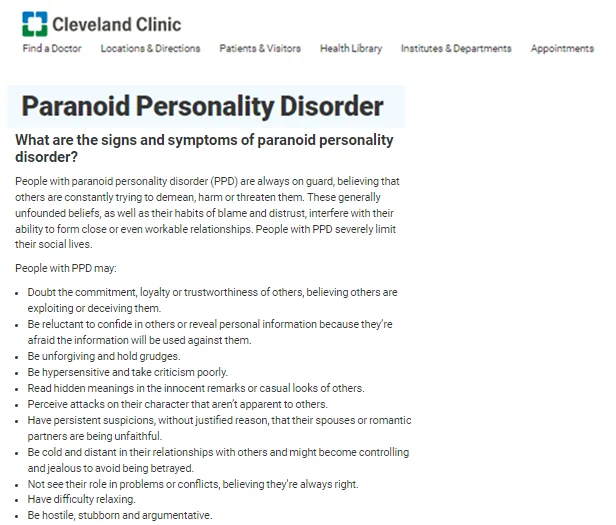
Hence, the third fact about feminism is that it contributes to women’s declining mental health by immersing them in paranoia and conspiratorial thinking. Over time, women influenced by the feminist discourse become lonely, socially isolated, man-hating, and aggressive, living their lives mistrusting men and their motives.
Fact #4: People tend to think that feminism is about equity for all, but nothing could be further from the truth. Feminists claim that their movement is about equal rights and opportunities for men and women, yet in reality, they are fighting against men and attempting to put them down. Consequently, feminism widens the divide between the sexes and embitters relations between them.

Feminism is a full-scale revolution and a cleansing fire aimed at completely dismantling and replacing the system that, according to feminists, oppresses women. That is, feminists do not merely seek to end patriarchy—they aim to control the world and transform it into a matriarchy. The truth is that feminism is an exclusionary philosophy, much like all totalitarian ideologies that emerged under the umbrella of secularism. For example, communism is an exclusionary philosophy that seeks to eliminate the bourgeoisie (the capitalist class) to empower the proletariat (the working class). Similarly, the Nazis exterminated what they considered inferior races (non-Aryans), whom they believed had no place in Nazi Germany. Modern feminism, likewise, is a male-exclusionary philosophy: it is focused on putting men down because feminists believe that men must step down for women to ascend. This is why feminists attack the very foundations of the male worldview and continually seek to pull men down. Unfortunately, modern feminists claim to fight for the betterment of women, yet their movement harms men, women, children, families, and communities. Rather than inspiring women to become happy individuals who contribute positively to future generations, feminists incite them to fight endlessly against the allegedly oppressive patriarchy that has supposedly harmed them since time immemorial—to seek revenge for the mistreatment of past ages. Consequently, they instill a toxic attitude in young women, teaching them to hate men. Modern feminism has, in fact, fostered egoism and entitlement in women—the very traits feminists claim to abhor in men. As noted earlier, feminists belittle and demonize men, portraying them as “violent misogynists,” while encouraging women to see themselves as perpetual victims. They undermine the strong male role model in the lives of adolescent girls, misleading them into believing that the plight of women is rooted in the patriarchal authority embodied by their fathers. They incite girls to struggle to free themselves from the clutches of patriarchy, which, in their words, “granted fathers nearly total ownership over wives and children.” In short, feminists hate fatherhood and teach women to hate their fathers. In doing so, they turn girls into misandrists—man-haters. Hatred of men, contempt for them, and prejudice against them drive women to rebel against societal values and norms. Teaching girls that men—including waliyys (guardians: fathers, brothers, male relatives, and husbands), as well as male teachers, religious scholars, and callers to Allāh—are worthless is extremely serious in the sight of Allāh, as it damages their psyche, corrupts their morals, disrupts their familial and social relationships, and may even lead them to kufr (blasphemy). Hence, the fourth fact about feminism is that it was never about equality. Rather, it is an exclusionary philosophy, as feminists seek a world and a social structure in which men are suppressed by women.
Fact #5: Feminism entails atheism—apostasy from the religion of Allāh (Islam). This consequence of feminism is by far the most dangerous. Atheist feminists argue that religion is a primary source of female oppression and inequality. Thus, atheism and feminism go hand in hand. That is, atheism is one of the inevitable consequences of feminism. A woman must ultimately choose her reference point and source of authority regarding what is lawful and unlawful: feminism or divine revelation. There is no middle ground. If she chooses feminism, she effectively makes it her religion. If she chooses divine revelation, then she cannot adhere to feminism, for the Qurʾān was revealed by Allāh as the ultimate law and the sole reference point for what is lawful and unlawful—commanding believers to accept what it permits as lawful and what it forbids as unlawful. Hence, women cannot be feminists unless they adopt feminism as their governing authority—one that shapes their perceptions, values, and conduct. In other words, to be a feminist is to prioritize female dominance and woman-centered values. In this sense, the modern feminist movement has taken on the characteristics of a religion. The Qurʾān states that the Jews and Christians took their rabbis and monks as lords besides Allāh—that is, they had effectively transferred to them the right of worship, a right that belongs to none but Allāh: {they have taken their rabbis and monks as well as the Messiah, son of Mary, as lords besides Allāh, even though they were commanded to worship none but One God. There is no god ˹worthy of worship˺ except Him. Glorified is He above what they associate ˹with Him˺!} (Qurʾān 9:31). One might argue that the Jews and the Christians did not literally worship their rabbis and monks; yet in reality they did so by accepting as unlawful whatever those religious authorities declared unlawful and as lawful whatever they declared lawful, which is effectively to take them as lords. This verse makes clear that those who set the boundaries of the lawful and the unlawful without the authority of Allāh’s Book arrogate to themselves a rank akin to divinity, and those who accept their authority to legislate take them as lords. For this reason, Allāh states that the Jews and the Christians were commanded to worship none but Him: whatever He has made lawful is lawful, whatever He has made unlawful is unlawful, and whatever He has legislated is the law that must be followed and upheld. According to the unanimous consensus of Qurʾānic commentators, this is the meaning of verse 9:31. In a similar manner, just as the Jews and Christians obeyed their rabbis and monks in what they permitted or forbade, feminists accept as permissible whatever their philosophy deems permissible and as impermissible whatever it deems impermissible. Thus, the contemporary feminist movement bears a striking resemblance to religious fundamentalism, particularly in its adherents’ absolute conviction in their own correctness. Once again, women must choose their source of authority: the divine texts or feminism. True Muslims, however, are only those who take the sharʿī (Islamic legal) texts as their source of authority. Allāh says: {But no! By your Lord, they will never be ˹true˺ believers until they accept you ˹O Prophet˺ as the judge in their disputes, and find no resistance within themselves against your decision and submit wholeheartedly} (Qurʾān 4:65). Allah also says: {It is not for a believing man or woman—when Allāh and His Messenger decree a matter—to have any other choice in that matter} (Qurʾān 33:36). It is evident that feminists do not submit to the Law of Allāh in every command and prohibition, for feminism is founded essentially upon what its adherents themselves deem appropriate. It must be emphasized that there is no such thing as “Islamic feminism,” just as there is no such thing as “Islamic Marxism” or “Islamic atheism.” Once again, Islam is a religion, and feminism is a separate religion altogether for the following reasons. First, feminists permit what Allāh has prohibited. For example, they permit tabarruj (the unlawful display of a woman’s beauty), homosexuality, and other acts whose prohibition is considered necessarily known in Islam. Moreover, they oppose what Allāh has legislated, such as by calling for the abolition of the system of wilāyah (male guardianship over women). Furthermore, they prohibit much of what Allāh has made lawful, including polygamy and similar matters. Therefore, a woman cannot be a feminist unless she permits some of what Allāh has prohibited and rejects some of what He has revealed, which amounts to major disbelief and apostasy from the religion of Islam. Allāh says: {That is because they detest what Allāh has revealed, so He has rendered their deeds void} (Qurʾān 47:9). Thus, the fifth fact about feminism is that it goes hand in hand with atheism.
Fact #6: Feminists measure success by male-typical indicators such as sheer earnings and positions of power. They disregard the reality that human beings were created to be tested, then to die and be held accountable for all that they did in their worldly life. For this reason, Allāh sent Messengers, revealed Books, and established clear proofs against humankind. The true criterion of human success is piety and righteous deeds, not the accumulation of material wealth or advancement up the corporate ladder. Real success lies in submission to the sharʿī (Islamic legal) rulings and in surrender to Allāh, which entails complete obedience to all that He commands and prohibits. This is the purpose for which human beings were created, yet it has never been the aim of feminism. Rather, worldly achievement constitutes feminists’ ultimate objective in life. Nevertheless, the genuine measure of success does not consist in worldly gain. An intelligent person recognizes the fleeting nature of worldly accomplishments and plans for the long term, for what benefit is there in gaining the world while losing one’s religion and afterlife? Indeed, the believer should treat striving for worldly success as one of many means toward attaining eternal success. In other words, every ambition and desire must be driven by the aim of pleasing Allāh, and one must not allow oneself to be so consumed by the transient that one forfeits everlasting success. Undoubtedly, true success in this world requires adherence to the Divine Law and remaining within its bounds. The Qurʾān has concisely yet comprehensively described the qualities of those who administer the affairs of the Islamic State: they are those who act righteously and employ their power and authority to promote good and eliminate evil: {˹They are˺ those who, if established in the land by Us, would perform prayer, pay alms-tax, encourage what is good, and forbid what is evil. And with Allāh rests the outcome of all affairs} (Qurʾān 22:41). This is the true aim of the Islamic State and the duty of every Muslim. Islam teaches that the Hereafter is more real than the ground beneath our feet, and that genuine success or failure is determined by one’s standing in the Hereafter, for which Allāh alone is the Judge. Consequently, nothing in this world holds real value unless it benefits a person on the Day of Judgment. When the time of Reckoning arrives, what will matter is not our job title, the size of our house, the car we drove, or the clothes we wore, but how we utilized our possessions—did we use them to serve Allāh and His creation, or to incur His displeasure? For instance, did we manage our finances with integrity and fulfill our work honestly, or did we betray those we were responsible for? Did we wear good clothing to please Allāh, or as an expression of arrogance? The problem with the feminist worldview is that its objectives are purely materialistic, devoid of any spirituality or moral refinement. In other words, feminists harbor materialism in their hearts and are preoccupied solely with worldly matters. Therefore, the sixth fact about feminism is that it constitutes a materialistic and pragmatic doctrine, entirely lacking spiritual values and higher goals.
Fact #7: Feminists have aligned themselves with Satan on the grounds that religion is inherently and irredeemably oppressive to women. Within Satanic feminism, Satan is “a feminist liberator of womankind, an ally in the struggle against a tyrannical patriarchy supported by God and His male preachers.” Feminism—a blasphemous movement—encourages girls and women to engage in the very acts that the God of patriarchy has forbidden them to commit and to interpret any resulting backlash as evidence that their efforts are succeeding. According to feminists, if women seek genuine change, they must defy, disobey, and disrupt at every opportunity; they must do what they are told not to do, desire what they are told not to desire, and be women and girls in ways they are told not to be. It is therefore unsurprising that many sins have come to be regarded as acceptable within feminist thought. To begin with, the connection between queer advocacy and feminism is longstanding: the rights of the LGBTQI—those who identify as lesbian, gay, bisexual, transgender, queer, or intersex—are integral to feminist values because feminists attribute both the mistreatment of women and that of LGBTQI individuals to the same root cause, namely heteropatriarchy. In feminist theory, heteropatriarchy—derived etymologically from “heterosexual” and “patriarchy”—denotes a hierarchical social order dominated by heterosexual males and characterized by bias against women and individuals of diverse sexual orientations and gender identities. Feminists maintain that discrimination against women and LGBTQI individuals stems from this shared sexist social principle, arguing that male-dominated societies devalue women and the LGBTQI community alike. Consequently, feminists and LGBTQI activists are natural allies pursuing what is termed “gender justice” in opposition to patriarchy, both asserting bodily autonomy and the freedom to desire whomever one chooses, and both seeking to loosen what they describe as the hold of traditional gender norms upon society. As an anti-male movement, feminism encourages women to direct their efforts, attention, relationships, and activities toward other women rather than men—that is, to adopt lesbianism. In other words, lesbianism is the inevitable logical consequence of feminism, a natural outcome of urging women to rebel against men and exclude them from their lives. Radical and lesbian feminists go so far as to assert that “women can choose their sexual orientation, and that a true feminist might reject heterosexuality in order to fully embrace a female-centric life and repudiate the burdens of patriarchy on an intimate level.” They also indirectly encourage men to adopt homosexuality so that they would no longer depend on women for sexual fulfillment. The central point is that feminists consider homosexuality morally unobjectionable, which, from an Islamic perspective, constitutes apostasy and disbelief. Moreover, some feminists go beyond mere support for LGBTQI civil rights, viewing such efforts as operating within what they regard as an inherently flawed system. Instead, they advocate a more radical agenda: dismantling the concepts and structures that render queerness a marker of difference altogether, which entails opposing not only compulsory heteronormativity but also compulsory monogamy. According to these feminists, monogamy is associated with possession—both possessing and being possessed by one’s partner—and a sexual order in which polyamory becomes the norm would represent the profound sexual revolution indeed. They argue that grounding sexuality and gender in an absolute right to engage in consensual sexual relations wherever and with whomever one chooses challenges not only heterosexuality and monogamy but patriarchy itself. In addition to endorsing homosexuality, feminists also promote abortion on demand, encouraging women to terminate their fetuses. As is widely recognized, “my body, my choice” is a feminist slogan employed in numerous countries as a rallying cry in protests and demonstrations to draw attention to various feminist causes, particularly bodily autonomy and abortion.

Indeed, feminism has transformed women into cold-blooded killers by telling them that their babies are merely a “blob of tissue”—a blatant falsehood from the depths of evil. It grants mothers the choice to kill their unborn babies on the premise that a fetus in the womb does not constitute human life. Indeed, abortion is unequivocally cold-blooded murder. This feminist holocaust rests upon a simple atheistic and predatory logic: that the strong may eliminate the weak—the law of the jungle. In other words, strong women have the right and choice to kill “weak” and “unwanted” fetuses that lack the ability to defend their own right to life. Furthermore, the feminist movement has been at the forefront of sexual liberation, advocating for women’s sexual freedom and agency while opposing marriage and motherhood. Feminists have long agreed that motherhood represents a hindrance to emancipation, arguing that the subjugation of the self to the needs of others is the antithesis of liberation—the final great oppression and the last barrier to equality with men. According to them, the way to overcome this is to weaken or diminish the natural ties of maternity. Consequently, feminists celebrate abortion, discourage women from getting pregnant, and advocate that women spend less time with their children and more with colleagues. The way feminists describe childbearing is intended to provoke revulsion. To use their words, no woman in her right mind would want whiny little children clinging to her like a dead weight around her neck; infants who scream, require constant diaper changes, or wake in the middle of the night crying; or toddlers whose defining trait is throwing tantrums and acting like little brats. Feminists argue that motherhood shackles women for life, causing them to lose their freedom, identity, and sense of self. In their portrayal, having children is akin to a life sentence—or even a death sentence. Additionally, feminists maintain that surrogacy—an instrument of exploitation—is one of the reproductive choices that women should have the freedom to make. They also assert that artificial wombs would serve as a tool of feminist liberation, freeing women from the constraints imposed by pregnancy. According to feminists, artificial wombs would eliminate “the heavily gendered process of reproduction, which is oppressive to women because of the unequal division of reproductive labor.” In other words, if fetuses were to develop in artificial wombs, women would finally be liberated to pursue their interests and ambitions beyond the demands of reproductive responsibilities. I swear by Allāh, nothing that feminists promote is truly in women’s best interest, neither in this worldly life nor in the Hereafter. Everything they advocate destroys women’s nature and gravely harms their wellbeing, particularly through commodification—the process of turning women’s bodies into mere commodities to be bought, sold, and used for men’s benefit. Beneath the rhetoric of equality and sexual liberation lies the stark reality of sexual exploitation, with millions of women objectified within the pervasive sex industry of capitalist societies. Indeed, the lofty claims of creating equal opportunities, improving women’s lives, and promoting sexual liberation serve merely as a pretext to grant men unrestricted access to women. There is no denying that women are sexually exploited, commodified by the media, and manipulated by capitalist structures. They are led to believe that their strength derives from their sexuality, and that to appear strong, this sexuality must be publicly displayed. Yet, allowing women’s sexuality to be consumed publicly by men will never foster their true growth or empowerment.
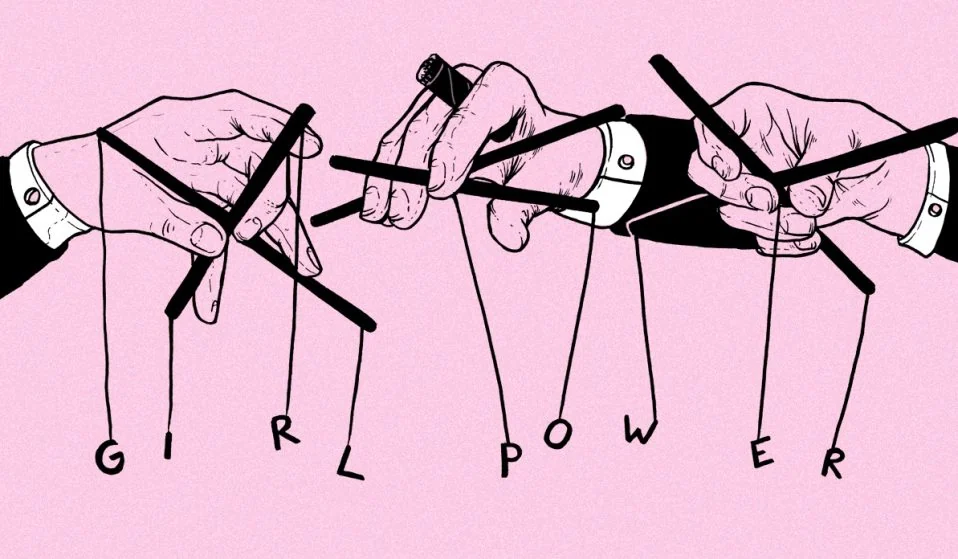
Unquestionably, liberal feminism has failed women, as it amounts to nothing more than comforting rhetoric and prescriptions that ultimately harm women rather than men. Hence, the seventh fact about feminism is that it is a blasphemous movement that encourages women to avoid marriage on the grounds that it constitutes slavery, to terminate their fetuses on the premise that children are shackles, and to adopt a “sex-positive” stance—defined as nonjudgmental acceptance of diverse sexualities and gender expressions so long as there is consent. In short, feminism justifies three fundamental evils:
1)Murder: the killing of fetuses (induced abortion).
2)Immoralities: illicit sexual relations (premarital sex, extramarital sex, and homosexuality).
3)Atheism/Blasphemy: feminism leads women to reject religion by permitting what Allāh has forbidden and by resenting and rebelling against what He has allowed.
This constitutes the triangle of Satan.

What more could Satan desire from the son of Adam than murder, immoralities, and atheism/blasphemy?
So-called Muslim feminists want the toxic poison of feminism to permeate the minds of Muslim girls and women like dye seeping into fabric, staining it. Muslim girls and women, however, should recognize that these feminists have waged a vendetta against Allāh, embraced Satan’s religion, and are propagating it under the guise of advocating for the rights of oppressed women. Indeed, Satan is standing aside and laughing as feminists preach his teachings. Undoubtedly, Islam and feminism are incompatible and incapable of coexisting within the heart of a Muslim woman. It must be understood that in matters of religion—particularly in issues of ʿaqīdah (creed)—there is absolutely no room for compromise. A woman must choose: either submission to the Law of Allāh and contentment with His revelation, or apostasy and rebellion against His religion; either faith or disbelief; either Paradise or Hell. Islam, as a religion, calls for complete submission to the Law of Allāh, whereas feminists seek to establish female dominance. Therefore, O woman, choose between the two religions; choose between the two creeds. Feminism has transformed quiet homes into arenas of conflict between men and women, as feminists promote an exaggerated sense of victimhood among young women by disseminating demonstrably false statistics to advance the notion that all women experience gender oppression in the same way. They take the cases of women who have suffered from gender inequality, domination, or violence and use them to indict all men collectively, while conveniently ignoring the fact that there have always been men who have stood alongside women and have never committed acts of violence against them. In other words, they employ a discourse of blame that targets men in general—both those who perpetrate violence and those who oppose it—for the suffering of women. We must all recognize the danger posed by the feminist movement, which undermines all that is good. Feminists claim that all religions are inherently sexist and oppressive toward women. However, Islam establishes that men and women are not identical, yet they are created equal. It has honored and liberated women by granting them rights equal to those of men. Furthermore, Islam confines sexual relations to the bounds of marriage between a man and a woman, even when this goes against men’s desires. The Qurʾān regards marriage as a sacred bond and a solemn, binding contract, for which the Sharīʿah prescribes rules and arrangements to ensure its stability and permanence: {and they have taken a firm covenant from you} (Qurʾān 4:21). Islam enjoins husbands to treat their wives honourably: {And live with them honourably} (Qurʾān 4:19). It should be noted that marriage, as a lifelong commitment in which men are responsible for the full maintenance of their wives, goes against men’s desires, as many of them tend to prefer casual flings over enduring, committed relationships. The purpose of Islam, however, is to ensure that women are not treated as mere passing fancies by men who use and discard them, leaving them to suffer emotionally, mentally, physically, and financially. Moreover, Islam elevates and glorifies the position of mothers. Indeed, the Prophet (PBUH) bestowed a special honor upon mothers when he said that Paradise lies beneath their feet. We previously mentioned a Prophetic tradition which demonstrates the extent to which Islam reveres mothers and motherhood. On the authority of Muʿāwiyah ibn Jāhimah as-Sulamī, he said: “I came to the Messenger of Allah (PBUH) and said, “O Messenger of Allah, I intended to participate in jihād (i.e., fighting in the cause of Allah) with you, seeking thereby the Face (i.e., pleasure) of Allāh and the [reward of the] Hereafter.” He said, “Woe to you! Is your mother still alive?” I said, “Yes.” He said, “Return to her and be dutiful to her.” Then I approached him from the other side and said, “O Messenger of Allah, I intended to participate in jihād with you, seeking thereby the Face of Allah and the Hereafter.” He said, “Woe to you! Is your mother still alive?” I said, “Yes, O Messenger of Allah.” He said, “Return to her and be dutiful to her.” Then I approached him from the front and said, “O Messenger of Allah, I intended to participate in jihād with you, seeking thereby the Face of Allah and the Hereafter.” He said, “Woe to you! Is your mother still alive?” I said, “Yes, O Messenger of Allah.” He said, “Woe to you! Stick to her feet (i.e., serve her, obey her, and show her dutiful care), for there lies Paradise.”12We learn from another tradition that the position of a mother is highly glorified, even taking precedence over that of a father. On the authority of abū Hurayrah [may Allah be pleased with him], he said: A man came to the Messenger of Allah (PBUH) and asked, “O Messenger of Allah, who is most entitled to my good companionship?” He said, “Your mother.” He said, “Then who?” He said, “Your mother.” He said, “Then who?” He said, “Your mother.” He said, “Then who?” He said, “Then your father.”13 Numerous Prophetic traditions demonstrate beyond a shadow of a doubt that women hold a high status in Islam. ʿĀʾishah reported that the Prophet (PBUH) said: “Verily, the most perfect of the believers in faith are those who possess the best character and are most kind to their families.”14 Abū Hurayrah reported that the Prophet (PBUH) said: “The most perfect of the believers in faith are those with the best character, and the best of you are the best to their wives in character.”15 In fact, the man is commanded to protect his wife even to the point of sacrificing his life if necessary: “…whoever fights to protect his family is a martyr.”16
Muslim women have no need to campaign or advocate for their rights; rather, they need only understand their faith fully so they grasp the rights that Islam has granted them. They should be aware of the so-called empowering feminist movement that claims Islam oppresses Muslim women and that they require “liberation.” Western feminists purport to protect, uplift, and champion Muslim women, yet their true aim is to subjugate them. In fact, given the high honor accorded to women in Islam, Western imperialists today target Muslim women to destabilize the fundamental structures of Islamic societies, pressuring them to conform to Western notions of “civilized” dress and gender roles. Essentially, they demonize and dehumanize the Muslim man, portraying him as barbaric, while constructing the narrative of the helpless Muslim woman in need of saving. Muslim women should recognize the flip side of feminism. They must understand that modern feminists are, in fact, contradictory, hypocritical, and even sexist: on one hand, they denigrate men, while on the other, they fetishize high-end male career paths, which require women to behave more like men, suppressing their own innate preferences and inclinations. Moreover, feminists criticize traditionally masculine traits in men but celebrate similar traits in women as “empowering.” It is crucial to grasp that feminism is not about equality but female superiority disguised as equality. That is, feminists do not seek a social order in which all individuals enjoy equal rights regardless of gender; rather, they aim to establish one in which men are suppressed and women dominate. In other words, the aim of the feminist movement is to dismantle patriarchy and invert the power structure, placing men at the bottom and women at the top. As discussed above, feminists do not intend for women to merely participate in existing societal structures but to create their own systems of religion, governance, and economy. At its core, feminism is anti-patriarchy and anti-men—a movement grounded in a man-hating philosophy. Consequently, feminists demonize men, seeking to alienate and subjugate them, while instilling a victim complex in young women by telling them they must “work harder for the same results as a man” and that they are “unsafe and threatened by every man.” Thus, despite claims of empowering women, feminism ultimately ruins them and sabotages their happiness. The latest statistics indicate that as women have gained greater freedom, education, and power, they have become less happy than they were prior to the second and third waves of feminism.
Finally, if feminism were truly about women exercising the right to choose and expressing their individual freedom, highly educated women who choose to dedicate themselves to their homes and families would not be labeled the ultimate traitors by feminists. That is, if feminism genuinely valued all women, it would recognize and honor the contributions of those of them who choose to be full-time homemakers, rather than pursuing a bitter, lonely existence filled with regrets and cats. In short, post-modern feminism in Western societies has not led to the liberation of women but rather to the destruction of both women and men: women seeking total power are losing touch with their true nature, while men are increasingly emasculated and marginalized. In a word, the contemporary West is rotting under the onslaught of feminism.
Notes and References
- 1
Amy Mastrine, “Patriarchy Protects Women Better than Modern Feminism,” Evie Magazine, 7 Sep. 2020, https://www.eviemagazine.com/post/patriarchy-protects-women-better-than-modern-feminism.
- 2
Ibid.
- 3
Ibid.
- 4
Ibid.
- 5
Ibid.
- 6
Ibid.
- 7
Ibid.
- 8
Suzanne Venker, “4 Feminist Lies that are Making Women Miserable,” The Federalist, 12 Nov. 2019, https://thefederalist.com/2019/11/12/4-feminist-lies-that-are-making-women-miserable/?fbclid=IwAR24YrDRUpfb85RG88TOgl_U5YsG58zcWrA8F-kDF7qmSATSBNg3NCkmDUg.
- 9
Kat Stoeffel, “Suzanne Venker Prescribes a Detox from Feminism,” The Cut, 28 Nov. 2012, www.thecut.com/2012/11/suzanne-venker-prescribes-a-detox-from-feminism.html.
- 10
Ibid.
- 11
“Paranoid Personality Disorder,” Cleveland Clinic, last reviewed by a Cleveland Clinic medical professional on 28 Apr. 2022, https://my.clevelandclinic.org/health/diseases/9784-paranoid-personality-disorder.
- 12
Abū ʿAbd Allāh ibn Mājah, Sunan Ibn Mājah, (Cairo, Egypt: Dār at-Taʾṣīl. 2014), book: 24, ḥadīth: 29, available at: https://sunnah.com/ibnmajah:2781.
- 13
Agreed upon ḥadīth, Muḥammad al-Bukhārī, Ṣaḥīḥ al-Bukhārī, (Cairo, Egypt: Dār as-Salām. 1999), book: 78, ḥadīth: 2, available at: https://sunnah.com/bukhari:5971; Muslim ibn al-Ḥajjāj, Ṣaḥīḥ Muslim, (Bayrūt, Lebanon: Dār al-Kutub ʿIlmiyyah, 2020), book: 45, ḥadīth: 2, available at: https://sunnah.com/muslim:2548b.
- 14
Muḥammad at-Tirmiḏī, Jāmiʿ at-Tirmiḏī, (Cairo, Egypt: Dār at-Taʾṣīl, 2016), book: 40, ḥadīth: 7, available at: https://sunnah.com/tirmidhi:2612.
- 15
Ibid., book: 12, ḥadīth: 17, available at: https://sunnah.com/tirmidhi:1162.
- 16
Abū ʿAbd ar-Raḥmān an-Nasāʾī, Sunan an-Nasāʾī, (Aleppo, Syria: Maktab al-Maṭbūʿāt al-Islāmiyyah, 1986), book: 37, ḥadīth: 129, available at: https://sunnah.com/nasai:4094.