Was Ḥadīth written only 200 years after the death of the Prophet (PBUH)? Was the first book of Ḥadīth that of al-Bukhārī, who was born more than 200 years after the Prophet (PBUH)’s passing? Was Ḥadīth transmission exclusively oral during the first two centuries after the Hijrah?
Orientalists, modernist Muslims and Qurʾānists claim that Ḥadīthwas not recorded initially and was transmitted solely orally for the first two centuries after the Hijrah. They assert that al-Bukhārī (d. 256 H) was the first to collect, write down, and systematically compile ḥadīth, portraying it as mere folklore transmitted orally in a haphazard manner for two centuries—ample time, they argue, for potential distortion and forgery. This misconception has become widespread among those who have carried out only superficial research on the subject. However, it is nothing more than a vain attempt to undermine Muslims’ belief in Islam. Aware that no Muslim would doubt the Qurʾān, the enemies of Islam launched a campaign against the Sunnah, assuming it would be an easier target. Yet their efforts influence only those with little knowledge of Islam or those inclined to accept any statement made by Western scholars. Imagine, for instance, if one of those who advance this fallacious claim—that Ḥadīthwas never written in the days of the Prophet (PBUH) and his Companions—had approached al-Bukhārī’s study circle, which was attended by twenty thousand leading scholars of Ḥadīth, and asked, “How could you compile the ḥadīths of the Prophet (PBUH) two centuries after his death?” Such an event would surely have become one of the most famous stories of folly in history. The mutaqaddimūn (early scholars) addressed every possible shubhah (specious argument about Islam) to clarify the truth to people. Yet I am unaware of any early scholar who felt the need to discuss this particular shubhah that Ḥadīth was not recorded until 200 years after the Prophet (PBUH)’s death, because it is not a serious shubhah, but rather evidence of its proponents’ extreme ignorance of Islam.
The enemies of Islam claim that there were no Ḥadīth collections in early Islam and that such collections did not emerge until 250 to 300 years after the Prophet (PBUH)’s passing. In reality, the compilation of Ḥadīth in book form was already practiced during the Prophet (PBUH)’s lifetime. The Companions did not rely solely on memory; they also recorded Ḥadīth in books known as ṣaḥīfas (sing. ṣaḥīfah, meaning “scroll”), which were later preserved by their families and by the following generation of Muslims (the Successors). The following are some examples of Companions who wrote Ḥadīth during the lifetime of the Prophet (PBUH):
ʿAmr ibn Ḥazm: The Prophet (PBUH) appointed him as governor of the province of Yemen in 10 A.H., following the conquest of Najrān by Muslims. At that time, the Prophet (PBUH) dictated a detailed kitāb (letter)—Kitāb aṣ-Ṣadaqāt wa-ad-Diyāt wa-l-Farāʾiḍ wa-as-Sunan—to ʾUbayy ibn Kaʿb and entrusted it to ʿAmr ibn Ḥazm.1 It is considered one of the earliest records of the Prophetic Sunnah that addressed the rules of zakāh (obligatory alms), diyāt (blood compensations), farāʾiḍ (legal obligations), and sunan (general rulings).2 It was in accordance with this book that ʿAmr ibn Ḥazm carried out his duties as governor of Yemen. The document remained in the possession of his grandson, Abū Bakr. Imām az-Zuhrī learned and copied it from the latter, and taught it to his own disciples. Certain extracts of this book are preserved in Ḥadīth works. It was narrated from Abū Bakr ibn Muḥammad ibn ʿAmr ibn Ḥazm, from his father, from his grandfather, that the Messenger of Allāh (PBUH) wrote a letter to the people of Yemen addressing the rulings on ṣadaqāt, diyāt, farāʾiḍ, and sunan. He (PBUH) entrusted this letter to ʿAmr ibn Ḥazm, and it was then read to the people of Yemen.3
ʿAbd Allāh ibn ʿAmr ibn al-ʿĀṣ: he collected, with the permission of the Prophet (PBUH), around one thousand of his narrations in a book he named aṣ-Ṣaḥīfah aṣ-Ṣādiqah (The Truthful Script). This work remained within his family and was later used by his grandson, ʿAmr ibn Shuʿayb. Aḥmad ibn Ḥanbal incorporated the entirety of this work into his voluminous book, The Musnad, thereby preserving the content of the missing aṣ-Ṣaḥīfah aṣ-Ṣādiqah, which had originally been written during the Prophet (PBUH)’s lifetime. Parts of it were also narrated by al-Bukhārī and Muslim in their authentic collections. The Companion Abū Hurayrah himself affirmed that ʿAbd Allāh ibn ʿAmr ibn al-ʿĀṣ kept a book of narrations.4 Nabia Abbott stated that the sources unanimously emphasize that ʿAbd Allāh ibn ʿAmr ibn al-ʿĀṣ recorded Ḥadīth and Sunnah from the very beginning.5
Anas ibn Mālik: He was ten years old when the Prophet (PBUH) migrated to al-Madīnah and served him throughout his life in the city. A long list of his students transmitted ḥadīths from him or compiled their own collections based on his teachings. Living until the end of the first century of the Hijrah, his circle of students became very extensive. He also advised his sons to write down the ḥadīths of the Prophet (PBUH) and to learn them.6 He used to say, “We do not value the knowledge of those who have not recorded it in writing.”7 Here, “knowledge” refers specifically to the ḥadīths of the Prophet (PBUH). Abū Hurayrah said, “When Anas ibn Mālik imparted the ḥadīths, many people gathered, and he brought books out of a box and gave them to his students, saying, ‘I heard these ḥadīths from the Prophet (PBUH); I then wrote them down and read them to him from time to time so that if there was any mistake, he corrected it himself.’”8 This demonstrates that Anas had not only recorded a substantial number of ḥadīths across several scripts but had also presented them to the Prophet (PBUH), who verified their authenticity.
ʿAlī ibn abī Ṭālib: he possessed a written collection of ḥadīths that he had compiled during the days of the Prophet (PBUH). He used to say that he has not recorded anything from the Prophet (PBUH) except the Holy Qurʾān and what is contained in this script of ḥadīths.”9
Jābir ibn ʿAbd Allāh: it is well established that he compiled ḥadīths in two ṣaḥīfahs (scripts). One of these contained a detailed account of the final pilgrimage performed by the Prophet (PBUH). The complete text of this ṣaḥīfah is preserved in Ṣaḥīḥ Muslim. The second ṣaḥīfah contained other ḥadīths on various subjects. Qatādah, the well-known student of Jābir, used to say, “I memorize the ṣaḥīfah of Jābir better than I memorize Chapter al-Baqarah.” 10 References to this ṣaḥīfah are also found in the Muṣannaf of ʿAbd ar-Razzāq, where several of its ḥadīths are transmitted.
Saʿd ibn ʿUbādah: he compiled a small written collection containing ḥadīths of the Prophet (PBUH) during his lifetime.
These examples are sufficient to shed light on the issue under discussion. As previously mentioned, the most authentic tradition permitting the writing of Ḥadīth is the one reported by Abū Hurayrah, in which the Messenger (PBUH) said, “Write for abū Shāh.”11 What he (PBUH) ordered to be written for abū Shāh al-Yamānī was a sermon he delivered on the day of the conquest of Makkah. There is concrete evidence that Abū Hurayrah preserved ḥadīths in written form. Ḥasan ibn ʿAmr, one of his students, reported that Abū Hurayrah once took him to his home and showed him many scripts containing ḥadīths of the Prophet (PBUH).12 This demonstrates that Abū Hurayrah possessed many scripts of Ḥadīth. It is also established that a number of his students prepared several scripts of his narrations. Abū Hurayrah alone instructed more than eight hundred students, who transmitted Ḥadīth from him, some orally and others in writing. These are only a few examples of the efforts undertaken by the Companions of the Prophet (PBUH) to compile Ḥadīth. For an exhaustive survey of such efforts, detailed works such as Muḥammad Muṣṭafá al-ʾAʿẓamī’s Studies in Early Ḥadīth Literature may be consulted. Al-ʾAʿẓamī listed fifty Companions who, at one time or another, preserved Ḥadīth in writing:13
1)Abū Ayyūb al-ʾAnṣārī, 2) Abū Bakr aṣ-Ṣiddīq, 3) Nufayʿ abū Bakrah ath-Thaqafī (or Nufayʿ ibn Masrūh), 4) Abū Hind ad-Darī, 5) Abū Harayrah, 6) Abū Mūsá ʿAbd Allāh ibn Qays al-Ashʿarī, 7) Abū Rāfiʿ, 8) Abū Saʿīd al-Khudrī, 9) Abū Shāh al-Yamanī, 10) Abū ʾUmāmah (or Suday ibn ʿAjlān), 11) ʿAbd Allāh ibn ʿAbbās, 12) ʿAbd Allāh ibn abī ʾAwfá, 13) ʿAbd Allāh ibn ʿAmr ibn al-ʿĀṣ, 14) ʿAbd Allāh ibn Masʿūd, 15) ʿAbd Allāh ibn ʿUmar ibn al-Khaṭṭāb, 16) ʿAbd Allāh ibn az-Zubayr, 17) ʿĀʾishah Umm al-Muʾminīn, 18) ʿAlī ibn abī Ṭālib, 19) ʿAmr ibn Ḥazm, 20) Anas ibn Mālik, 21) Asmāʾ bint ʿUmays, 22) Al-Barāʾ ibn ʿĀzib, 23) Aḍ-Ḍaḥḥāk ibn Sufyān al-Kilābī, 24) Aḍ-Ḍaḥḥāk ibn Qays ibn Khālid, 25) Fāṭimah bint Muḥammad (PBUH), 26) Fāṭimah bint Qays, 27) al-Ḥassan ibn ʿAlī, 28) ʿItbān ibn Mālik, 29) Jābir ibn ʿAbd Allāh ibn ʿAmr, 30) Jābir ibn Samurah, 31) Jarīr ibn ʿAbd Allāh al-Bajallī, 32) Muʿāḏ ibn Jabal, 33) Muʿāwiyah ibn abī Sufyān, 34) Al-Muġīrah ibn Shuʿbah, 35) Muḥammad ibn Maslamah al-ʾAnṣārī, 36) an-Nuʿmān ibn Bashīr, 37) Rāfiʿ ibn Khadīj, 38) Saʿd ibn ʿUbādah, 39) Sahl ibn Saʿd as-Sāʿidī, 40) Salmān al-Fārisī, 41) Samurah ibn Jundub, 42) Subayʿah al-ʾAslamiyyah, 43) Shaddād ibn ʾAws ibn Thābit, 44) Shamʿūn al-ʾAzdī al-ʾAnṣārī, 45) ʾUbayy ibn Kaʿb, 46) ʿUmar ibn al-Khaṭṭāb, 47) Ussayd ibn Ḥuḍayr, 48) Wāthilah ibn al-ʾAsqaʿ, 49) Zayd ibn ʾArqam, 50) Zayd ibn Thābit.
These Companions maintained their own scripts, known as kutub and ṣaḥuf, in which they recorded the Ḥadīth of the Prophet (PBUH) during his lifetime. Consequently, these concrete examples refute the erroneous assumption that Ḥadīth was never written during the days of the Prophet (PBUH) and his Companions.
It is important to note that the theory of the late recording of Ḥadīth arose from several misconceptions, particularly the misinterpretation of certain terms and statements found in Ḥadīth literature:14
1.Misinterpretation of the words kitābah, tadwīn, and taṣnīf, which were understood solely in the sense of “recording.”
2.Misinterpretation of the terms ḥaddathanā, akhbaranā, and ʿan, which were generally believed to refer exclusively to oral transmission.
3.The claim that the Arabs possessed extraordinary memory powers and therefore had no need to write anything down.
4.Ḥadīths purportedly discouraging the recording of Ḥadīth.
Point four has been addressed in the previous section, but the first two points require further discussion. Proponents of the theory that Ḥadīth was recorded very late have interpreted the terms ḥaddathanā, akhbaranā, ʿan, and their derivatives exclusively in the sense of oral transmission. However, this assumption is only partially correct, as these terms were also employed to indicate written transmission.15 Similarly, the verbs dawwana (lit. “he compiled or collected”) and ṣannafa (lit. “he classified”) have been misinterpreted to mean “he wrote.” Consequently, Imām Mālik’s statement, “awwal man dawwana al-ʿilm ibn Shihāb az-Zuhrī,”16 has been wrongly translated as “the first who wrote al-ʿilm (i.e., Ḥadīth) was ibn Shihāb az-Zuhrī.” It is on the basis of this translation that the theory emerged that the writing of Ḥadīth began as late as az-Zuhrī’s period—at the end of the first or the beginning of the second century after the Hijrah. However, the term dawwana does not indicate writing for the first time; rather, it refers to the collection and compilation of materials that were already written. Therefore, the statement should be accurately rendered as “the first who compiled the [written] collections of Ḥadīth was ibn Shihāb az-Zuhrī.”17 Literally, tadwīn denotes the taqyīd (binding and securing) of disheveled ṣuḥuf (loose written scripts) into a single volume to prevent their loss. The author of Tāj al-ʿArūs min Jawāhir al-Qāmūs defined dawwana as “he collected,” while al-Fayrūzābādī interpreted its derivative dīwān as mujtamaʿ aṣ-ṣuḥuf (a collection of loose scripts). Hence, tadwīn does not merely mean writing; it refers to the collection and compilation of already written texts. In other words, the verb dawwana does not indicate writing for the first time but rather gathering preexisting materials. The term taṣnīf is broader in meaning than tadwīn, implying the classification of collected records into various sections. The expression ṣannafahu literally means “he categorized it into various kinds and distinguished some parts from others.” Thus, taṣnīf involves arranging the already collected material into sections and chapters.18 In the context of Ḥadīthcollection, it refers to organizing the material according to subject matter. As explained in the previous chapter, a Ḥadīthwork arranged by subject is known as muṣannaf (arranged), in contrast to musnad collections, where traditions are organized under the names of transmitters regardless of subject.19 In sum, there is a clear distinction between the terms kitābah, tadwīn, and taṣnīf, each representing a phase in the preservation of Ḥadīth. Kitābah (writing) refers to recording on a ṣaḥīfah (script, pl. ṣuḥuf); tadwīn (collection) refers to bringing all the scattered ṣuḥuf together into a single volume; and taṣnīf (classification/categorization/organization) means arranging the compiled material into categories, chapters, or topics according to importance or subject. Therefore, the most accurate translation of tadwīn is “compilation”—putting scripts together in one work. Essentially, there are three phases in the compilation of Ḥadīth. The phase of kitābah was carried out in two stages: first, during the lifetime of the Prophet (PBUH), encompassing what was written by his direct orders as well as what was written with his permission; and second, during the era of the Companions.20 The phase of tadwīn was carried out approximately between 58 and 120 A.H., encompassing the reigns of Marwān ibn al-Ḥakam (d. 65), ʿAbd al-ʿAzīz ibn Marwān (d. 85), and ʿUmar ibn ʿAbd al-ʿAzīz (d. 101).21 Taṣnīf was carried out during the 2nd and 3rd centuries of the Hijrah and continues to this day. An example of a type of Ḥadīth collection from this period is al-jawāmiʿ (sing. jāmiʿ), which comprises ḥadīths covering various categories, including: 1) Prophetic biography, 2) Etiquettes, 3) Exegesis, 4) ʿAqīdah, 5) Tribulations/Trials, 6) Signs of the Day of Judgment, 7) Rulings, and 8) Qualities of the Prophet (PBUH) and the Companions. In brief, the tadwīn (compilation) of Ḥadīth does not imply that Ḥadīth was never written down before az-Zuhrī’s time, just as the tadwīn of the Qurʾān does not mean that it was not recorded until the era of Abū Bakr. Rather, both tadwīn and taṣnīf involve working on pre-existing materials. Indeed, it is well established that the codification of any body of knowledge occurs only after the knowledge itself exists; in other words, compilation is a subsequent phase following the existence of the knowledge.22
The following illustrations clearly depict the three phases of Ḥadīth compilation:
The phase of kitābah:

The phase of tadwīn:

The phase of taṣnīf which began with aṣ-Ṣiḥāḥ as-Sittah (the Six Canonical Authentic Ḥadīth Collections):
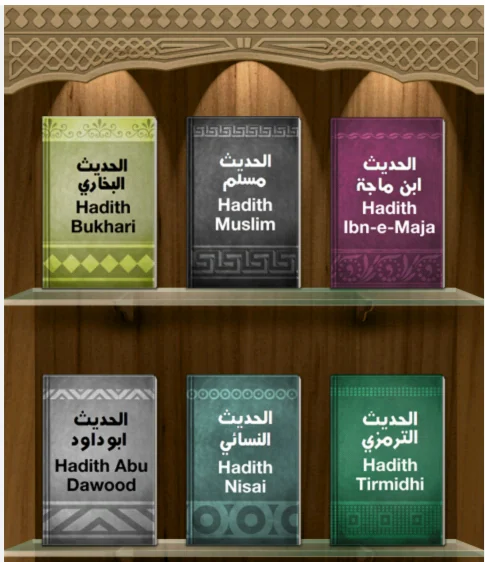
After aṣ-Ṣiḥāḥ as-Sittah, Muslim scholars continued to produce many other extensive Ḥadīth compilations demonstrating that the Six are foundational, but they were never meant to be the end of Ḥadīth scholarship.

The modern method of taṣnīf has made the Ḥadīth of the Prophet (PBUH) readily accessible at our fingertips.

The Successors—the generation following the Companions—followed in the footsteps of the Companions who had been their direct teachers. They initiated the practice of seeking out those Companions who had memorized Ḥadīthfrom the Prophet (PBUH) in order to record it in writing. For example, fourteen Successors wrote Ḥadīthfrom Jābir ibn ʿAbd Allāh, and nine from ibn ʿAbbās. The latter left behind a camel-load of kutub (scripts) of Ḥadīth, which remained in the possession of his student Kurayb ibn abī Muslim. Mūsá ibn ʿUqbah said: Kurayb left with us a camel-load of ibn ʿAbbās’s kutub, and when ʿAlī ibn ʿAbd Allāh ibn ʿAbbās needed any kitāb from among them, he wrote to Kurayb, “Send to me such and such kutub.” He would then transcribe the kitāb and send him one of the two copies.23 In addition to listing and discussing some fifty Companions of the Prophet (PBUH) who had recorded Ḥadīth, al-ʾAʿẓamī also compiled a list of forty-nine individuals from the first-century Successors, discussing each personality individually, who had recorded Ḥadīth.24 He then listed eighty-seven scholars of the late first and early second centuries who had recorded Ḥadīth.25 He further listed 251 scholars from the early second century who collected and recorded Ḥadīth.26 Hence, al-ʾAʿẓamī compiled a list of 437 individuals (50 + 49 + 87 + 251) who had recorded Ḥadīth, all of whom lived and died before the year 250 A.H. Many of them predated ʿUmar ibn ʿAbd al-ʿAzīz, who is often credited as the first person to request the collection of Ḥadīth. As elaborated earlier, his story has been misunderstood; it does not imply that no one collected Ḥadīth before him. Some well-known Ḥadīth records among the Successors include those of Saʿīd ibn Jubayr and Mujāhid ibn Jabr—both students of the prominent Companion ibn ʿAbbās—and of abū az-Zubayr Muḥammad ibn Muslim ibn Tadrus al-Makkī—a student of Jābir ibn ʿAbd Allāh. Al-ʾAʿẓamī has demonstrated beyond doubt that in the first two centuries of Islam—long before al-Bukhārī—there were literally thousands of Ḥadīth compilations in circulation:27

People often ask the question: if so many early writings and collections of Ḥadīth existed, as al-ʾAʿẓamī demonstrated in his Ph.D. thesis, why do none of them remain extant today? The answer is quite simple. To begin with, most of these early compilations did not survive in their original form because the written materials were often of poor quality. Moreover, these were personal manuscripts rather than published books and were therefore not preserved in the same manner as later works. The principal reason they were not preserved is that they were absorbed into later compilations, rendering their independent preservation unnecessary. Al-ʾAʿẓamī wrote in his discussion of what became of these earliest works:28

The strongest evidence that the works of the first and second centuries were absorbed into those of the third and fourth centuries is provided by one of the earliest compilations still extant today: the ṣaḥīfah (script) of the Successor Hammām ibn Munabbih. This is a written collection of Ḥadīth that the Companion Abū Hurayrah dictated to his student Hammām, who was among the most prominent Successors to record Ḥadīth. The ṣaḥīfah, one of the earliest surviving Ḥadīth collections, is believed to have been composed around the mid-first century A.H./seventh century C.E., since Abū Hurayrah died around 58 A.H.—less than half a century after the Prophet (PBUH)’s death—and the collection must have been dictated to Hammām before that date. The original manuscript has been lost, but the text survives through secondary copies, with two known manuscripts: one in a library in Damascus and the other in Berlin. The Musnad of Aḥmad ibn Ḥanbal incorporates Hammām’s ṣaḥīfah almost in its entirety (except for two ḥadīths) and in nearly the same order. The ḥadīths in Aḥmad’s Musnad are arranged according to the Companion who narrated them, making it straightforward to locate all ḥadīths from Hammām on the authority of Abū Hurayrah. Furthermore, other works in which ḥadīths are organized by jurisprudential topics also incorporated a substantial portion of this ṣaḥīfah.29

It is also noteworthy that all of the following works, which contain many—if not all—of the ḥadīths from this ṣaḥīfah, have now been published:30

Muḥammad Ḥamīd Allāh, a modern scholar who was the first to discover and publish Hammām’s ṣaḥīfah in the twentieth century, commented:31

Ḥamīd Allāh concluded:32

The above demonstrates that Imāms Aḥmad, al-Bukhārī, Muslim, Maʿmar, and ʿAbd ar-Razzāq had access to Hammām’s ṣaḥīfah during their lifetimes. This also provides evidence that there was no necessity to preserve the earliest works independently, as they were absorbed into later compilations. Other examples of early works incorporated into subsequent collections include the writings of ibn Jurayj, ath-Thawrī, and ibn ʿUyaynah, which were integrated into the Muṣannaf of ʿAbd ar-Razzāq.
It is evident from the available evidence that the writing of Ḥadīth has been a continuous practice since the time of the Prophet (PBUH). Contrary to popular belief, the compilation of Ḥadīth began before the reign of ʿUmar ibn ʿAbd al-ʿAzīz. In fact, the first to contemplate the compilation of Ḥadīth was ʿUmar ibn al-Khaṭṭāb. As reported on the authority of Maʿmar ibn Rāshid, during his caliphate, ʿUmar consulted the Companions regarding the compilation of Ḥadīth, and all of them supported the idea. Nevertheless, he continued to hesitate and prayed to Allāh for an entire month, seeking guidance on the best course of action. Ultimately, he decided not to undertake the task, stating that former peoples had neglected the Divine Books and focused solely on the conduct of the Prophets, and that he did not wish to risk creating confusion between the Qurʾān and the Prophet’s Ḥadīth.33 Hence, the only reason ʿUmar ibn al-Khaṭṭāb did not wish to compile the Sunnah was his concern that people might focus on the Ḥadīth of the Prophet (PBUH) and neglect the Book of Allāh, especially since most Muslims at the time were newly converted to Islam. However, he never forbade the writing of Ḥadīth. Rather, ʿUmar preferred not to hasten the compilation of the Sunnah until the Qurʾān had firmly taken root in the hearts of Muslims, particularly as the Sunnah was preserved in the memories of the Companions and also recorded in individual writings, given that the practice of writing the Sunnah had begun during the lifetime of the Prophet (PBUH) himself. Therefore, there was no temporal gap that could have led to the loss or distortion of Ḥadīth. By contrast, had the Sunnah been compiled into a single volume and distributed throughout the early Islamic world, there was a genuine fear that the Qurʾān and the Sunnah might become conflated. For this reason, ʿUmar—exercising his individual reasoning—chose to postpone the compilation of the Sunnah. ʿAbd al-ʿAzīz ibn Marwān (d. 85 A.H.), the son of Marwān ibn al-Ḥakam, sent a letter to Kathīr ibn Murrah (d. between 80–90 A.H.) in which he wrote: “Gather and send whatever ḥadīths you have heard from the Companions, except the ḥadīths of Abū Hurayrah, because they are already in our possession.” Kathīr ibn Murrah studied under ʿUmar ibn al-Khaṭṭāb and was acquainted with seventy Companions who participated in the Battle of Badr. He also studied under Muʿāḏ ibn Jabal, Tamīm ad-Dārī, ʿUbādah ibn aṣ-Ṣāmit, ʿAwf ibn Mālik, abū ad-Dardāʾ, Abū Hurayrah, ʿUqbah ibn ʿĀmir, and numerous other senior Companions. Consequently, the project of compiling the Sunnah began during the time of Kathīr ibn Murrah under the directive of the esteemed Successor ʿAbd al-ʿAzīz ibn Marwān, who governed Egypt for twenty years (65–85 A.H.), and a reasonable estimate places his request to Kathīr around the year 75 A.H. This suggests the possibility of an earlier initiative to compile Ḥadīth. Even if, for the sake of argument, we assume that Kathīr never carried out the instruction, there is evidence that the compilation of Ḥadīth began at an even earlier time. As previously noted, ʿAbd al-ʿAzīz advised Kathīr not to collect the ḥadīths of Abū Hurayrah because they were already in his possession, likely obtained from his father, Marwān ibn al-Ḥakam (d. 65 A.H.), who shared the governorship of al-Madīnah with Abū Hurayrah. This is further supported by the following incident, which demonstrates that Marwān did, in fact, record Abū Hurayrah’s ḥadīths, as recounted by abū az-Zuʿayzaʿah, Marwān’s scribe:34

Therefore, the date of the compilation of Ḥadīth can be placed sometime before the death of Abū Hurayrah in 58 A.H., which is nearly half a century—by even the most cautious estimate—earlier than the date commonly assumed for the compilation of Ḥadīth.35 Kathīr ibn Murrah did not complete the task; thus, ʿUmar ibn ʿAbd al-ʿAzīz, the son of ʿAbd al-ʿAzīz and grandson of Marwān—seeking to follow the legacy of his father and grandfather—desired that the task be completed. Consequently, the official compilation of Ḥadīth took place under ʿUmar ibn ʿAbd al-ʿAzīz (61–101 A.H.) after he became caliph in 99 A.H., at a time when many of the Companions and the sons of the Companions were still alive. He shared the same ambition that Abū Bakr had when he decided to compile the Qurʾān, namely, to standardize Ḥadīth while learned individuals were still living, particularly those who had been writing it down. As mentioned earlier, he wrote to Abū Bakr ibn Ḥazm (d. 100 A.H.) saying: “Look for whatever there is of the Ḥadīth of the Messenger of Allah (PBUH) and write it down, for I fear the disappearance of knowledge and the passing away of scholars. Accept nothing except the ḥadīths of the Prophet (PBUH). Disseminate knowledge and sit to teach those who do not know, for knowledge only disappears when it is kept hidden.”36 He also wrote to the people of al-Madīnah: “Seek out the knowledge of Ḥadīth and have it recorded, for I fear the loss of religious knowledge and the passing of the scholars.”37 Ibn Shihāb az-Zuhrī said: “ʿUmar ibn ʿAbd al-ʿAzīz ordered us to collect the Sunnah, so we wrote it book by book, and he sent a copy to every land over which he had authority.”38 Many Orientalists and Qurʾānists claim that the compilation of Ḥadīth began at this point. However, as Dr. Imtiaz Ahmed noted:39

Likewise, al-Meṭīrī observed:40

Inarguably, Muslims maintained both an oral and a written tradition of the Sunnah even before ʿUmar ibn ʿAbd al-ʿAzīz’s order to compile it. As noted earlier, the Prophet (PBUH) permitted ʿAbd Allāh ibn ʿAmr ibn al-ʿĀṣ to write Ḥadīth.41 Remarkably, Yaḥyá ibn Ayyūb narrated on the authority of abū Qabīl that he said: “We were with ʿAbd Allāh ibn ʿAmr ibn al-ʿĀṣ, and he was asked: ‘Which of the two cities will be conquered first—Constantinople or Rome?’ ʿAbd Allāh then called for a chest with rings, took out a script from it, and said: ‘While we were gathered around the Messenger of Allāh (peace be upon him) writing [his ḥadīths], the Messenger of Allāh was asked: “Which of the two cities will be conquered first—Constantinople or Rome?” The Messenger of Allāh said: “The city of Heraclius will be conquered first,” that is, Constantinople.’”42 The phrase “we were gathered around the Messenger of Allāh (PBUH) writing” clearly indicates that the Sunnah was being recorded in writing during the lifetime of the Prophet (PBUH).
Some have said, “It would have been remarkable if the Sunnah of the Prophet (PBUH) had been compiled immediately after his death, for then those Qurʾānists who are prejudiced against the Sunnah would have had no pretext to delegitimize it.” However, as scholars of Ḥadīth have rightly noted, it is not a necessary condition for preservation that something be recorded in writing. In other words, the fact that something was not written down does not imply that it was not accurately and faithfully preserved. Moreover, writing alone is not sufficient to guarantee preservation, since errors can occur in the recording process. Accordingly, the scholars did not require a ḥadīth to be written in order for it to be accepted, although they acknowledged the value of a physical record and often, depending on the individual involved, preferred the written account over the verbal one. Essentially, being written down is not a prerequisite for authenticity or authoritativeness. In fact, oral transmission was long considered more solid and reliable than writing among the Arabs of the time. During the pre-Islamic period, people preserved their history and genealogy entirely through memory, relying on such extraordinary memorization skills that once they heard something, they could retain it for life. The memorization of lengthy poems, comprising thousands of verses and transmitted over centuries without the slightest error, attests to these skills. Had writing been required for authoritativeness, the Prophet (PBUH) would, for example, have commanded the Companions to record every detail of prayer, including its times, method, all its aḏkār (remembrances), and so forth. Similarly, the authoritativeness of the Qurʾān is not grounded in the fact that it was written down; rather, the Qurʾān is, by its very nature, primarily an oral communication. From the earliest days of Islam to the present, the sounds of the Qurʾān have been transmitted orally through a long, uninterrupted chain of reciters extending back to the Prophet (PBUH). Not only were the words of the Qurʾān memorized, but its precise pronunciation was also preserved, eventually developing into a formal discipline known as ʿilm at-tajwīd. This discipline carefully explains how each letter is to be articulated, as well as how words are to be pronounced both independently and in relation to surrounding letters and words. As a result, individuals from diverse linguistic backgrounds are able today to recite the Qurʾān as though they were native Arabs living at the time of the Prophet (PBUH). In Qurʾān memorization schools, students learn the Qurʾān together with its tajwīd directly from a teacher, who in turn acquired this knowledge from his own teacher, forming an unbroken chain that traces back to the Prophet (PBUH). Once a student attains mastery and his recitation is verified as free from error, he is granted an ijāzah, a formal authorization certifying that he has mastered the rules of recitation and can recite the Qurʾān as it was recited by the Prophet (PBUH). Moreover, no muṣḥaf (Qurʾānic codex) is printed anywhere in the Islamic world without first being reviewed by the people of asānīd, namely those who belong to and transmit the uninterrupted oral chains of the Qurʾān that have persisted in every generation since the Prophetic era, preserving both its text and the finest details of its pronunciation. As a matter of fact, early Muslim-era scholars were wary of books and held that learning through listening was superior to learning through reading. They cautioned against taking the Qurʾān from someone who had memorized it solely from the muṣḥaf (codex), without receiving it through oral transmission from qualified Qurʾān masters. They would say, “Do not take the Qurʾān from a muṣḥafī.” By the mercy of Allāh upon the Muslim nation, it was this oral tradition of recitation and preservation that was relied upon in teaching and transmitting the Qurʾān, as ibn al-Jazarī stated in an-Nashr: “Reliance in the transmission of the Qurʾān is upon preservation within the breasts and hearts (i.e., memorization by heart), not upon the preservation of muṣḥafs and books. This is the noblest quality bestowed upon this ummah (Muslim nation) by Allāh, Exalted is He.”43 Hence, the authoritativeness of the Qurʾān does not arise from its preservation through compilation and codification, but rather from its preservation through oral transmission. As stated earlier, the Qurʾān is primarily an oral text rather than a written one. This explains why when it was codified during the reign of the caliph ʿUthmān ibn ʿAffān, there existed only six single-volume copies of the Qurʾān across the entire Islamic caliphate—one retained in al-Madīnah and the others dispatched to the major centers of the caliphate, namely Makkah, Egypt, Iraq, the Levant, and Yemen. The reason for this is that the Qurʾān had been revealed and memorized as an oral tradition before being compiled in book form. Likewise, Ḥadīth is primarily an oral tradition. It was transmitted orally from the Prophet (PBUH) to each ṭabaqah (lit. “layer,” referring to a generation of narrators from the same era, whose lifespans overlapped or who studied under the same teachers). In short, the Qurʾān recited by Muslims today has been passed down orally through successive generations of reciters via uninterrupted chains tracing back to the Prophet (PBUH), and this oral transmission will continue until the Hour is established. The same applies to Ḥadīth. Although it was written down during the Prophet (PBUH)’s lifetime, the primary mode of its preservation was memorization and oral transmission through continuous, authentic chains of trustworthy narrators reaching back to the Prophet (PBUH).
In essence, in the first centuries of Islam, knowledge was predominantly transmitted orally. The sanad (chain of transmission)—the authoritative foundation of Islamic religious knowledge—is inherently oral, as indicated by the term as-samāʿ (audition), which refers to the transmission from teacher to student. A shaykh would relate a text, either from memory or from a written source, to one or more students, who would listen and take notes. The student would then read aloud or recite from memory what he had learned back to the shaykh, who would listen, correct errors if necessary, and thereby validate the text, granting the student permission to transmit it further. In addition to the reader or reciter, others would also be present at the sessions as listeners, and their names were recorded at the end of the manuscript in an ijāzat as-samāʿ (audition note or certificate). The key point is that scholars of the early centuries regarded knowledge preserved in memory as more secure than that preserved in writing. Oral recitation of knowledge was therefore esteemed above manuscript writing. As al-ʾĀmidī explained, “Riwāyat as-samāʿ (oral transmission) is more adequate (reliable) because it is not prone to distortion and error.”44 Consequently, as a general rule, an orally transmitted text was considered more authoritative than one copied in a manuscript, provided it was heard from an individual respected for his moral integrity, sound memory, and erudition.
Someone may ask: Why does codification not, in itself, establish the authoritativeness of a text? Early scholars of Ḥadīth preferred oral transmission to written records—that is, they preferred that a narration be preserved in memory rather than merely recorded in writing. This preference stemmed from the recognition that recording alone does not guarantee accuracy, owing to the fallibility of copyists. They may forget or err, and scribal errors—even something as minor as a misspelling or the alteration of a single letter—can drastically change the meaning of a text. For this reason, memorized reports were often regarded as more reliable than written ones. A person who commits a narration to memory typically attains a deeper mastery and understanding of it than one who simply writes it down, especially within a society that made limited use of writing and instead cultivated memory and oral transmission to an extent largely unknown today. The seventh-century Arabs of the Arabian Peninsula, particularly those inhabiting desert regions, were naturally endowed with strong retentive memories. They were capable of memorizing lengthy material with remarkable speed and precision. Thus, they preserved the celebrated Muʿallaqāt—a group of seven long pre-Islamic poems regarded as the finest literary works of the era—and maintained records of historical events and genealogies entirely through memory. Indeed, written documents were trusted only when accompanied by a sanad (chain of transmission) and a seal identifying the author. This culture placed great emphasis on oral memorization and narration, a skill refined through centuries of practice. Their exceptional memories were further aided by a simple way of life, a calm environment with few distractions, keen intelligence, and a profound mastery of the Arabic language. Similarly, the early Muslims lived simply and were largely unencumbered beyond meeting their basic needs. As a result, they possessed ample time and mental clarity, which they devoted to memorizing the Qurʾān and the Sunnah using minds that were focused, disciplined, and highly retentive. Ibn ʿAbbās—who memorized the poem of ʿUmar ibn abī Rabīʿah (which was composed of 65 verses) after hearing it once—committed the Prophet (PBUH)’s words to memory with the capacity and accuracy of a recording instrument. Likewise, az-Zuhrī and ash-Shaʿbī were renowned for the strength of their memory. Az-Zuhrī said, “I did not entrust anything to my heart that I later forgot.”45 Therefore, memorizing the Qurʾān and the Sunnah was not a difficult task for the early Muslims. There is no denying that someone who recites a text from memory inspires a strong sense of confidence in its reliability. Consider a muftī (an Islamic legal authority who issues a fatwá—a formal legal opinion—in response to a private inquiry). Someone seeking a fatwá tends to place greater trust in a muftī who cites evidence from the Qurʾān and the Sunnah from memory, rather than one who merely quotes it from books. In other words, people generally have confidence that a ḥāfiẓ (a title of respect for a Muslim who has memorized the Qurʾān and Ḥadīth) possesses a thorough understanding of the sharʿi (Islamic legal) texts. It is therefore unsurprising that orality was regarded as the primary touchstone of authenticity in the first centuries of Islam. Consequently, copyists were required to demonstrate that their manuscripts had been produced through an oral process in the presence of learned scholars. The formal evidence of this practice was known as ijāzat as-samāʿ (an audition note or certificate).
Memorizing the Sunnah gave rise to a remarkable capacity in the field of jurisprudence, evident in the Salaf (the first three generations of Muslims—the Companions, the Successors, and the Successors of the Successors) of this nation and in all those who dedicated themselves to preserving the Qurʾān and the Sunnah through memorization across the generations. In other words, the extraordinary jurisprudential heritage that early scholars derived from the Qurʾān and the Sunnah is the direct fruit of memorization combined with profound understanding. It was common for these early scholars to explain sharʿī (Islamic legal) rulings in detail and with remarkable precision, as if a vast library were open before them, allowing them to consult any work at will. The legendary memory of these scholars was widely renowned. For instance, Ibn al-Qayyim composed Zād al-Maʿād (Provisions for the Hereafter)—a classical work of thousands of pages—from memory while traveling on the pilgrimage journey from Damascus to Makkah. It is truly astonishing that he could produce this five-volume book, encompassing thousands of incidents and the names of the Companions associated with them, as well as ḥadīths (Prophetic traditions), Qurʾānic verses, and jurisprudential insights. Remarkably, he achieved this while enduring the hardships of travel and without access to written resources. Equally remarkable is Imām as-Sarakhsī’s achievement: while imprisoned in a well during a conflict with the ruler of Ūzjand, he dictated his commentary on al-Kāfī of al-Ḥākim ash-Shahīd to his students, who gathered at the mouth of the well, fearing that his knowledge would be lost if he passed away. Entirely from memory, he produced this monumental work, al-Mabṣūṭ, which consists of fifteen volumes. Similarly, al-Qurṭubī composed his fifteen-volume commentary on Ṣaḥīḥ Muslim entirely from memory while on board a ship. Indeed, one who relies solely on writing cannot achieve the depth of mastery in Islamic jurisprudence attained by these great scholars. Had the Sunnah been codified immediately after the death of the Prophet (PBUH), as was done with the Qurʾān, the Muslim nation would have gained no real advantage; rather, it would have forfeited the opportunity to develop the extraordinary jurisprudential faculties that memorization fostered.
Indisputably, rote learning strengthens memory and verbal recall. By contrast, reliance on the written word can be intellectually limiting, as it encourages people to depend on external texts rather than exercise their minds to internalize and recall information. Simply put, those who rely on writing do not need to fully comprehend or remember what they read; instead, when asked a question, they may merely open a book and recite the answer like a parrot. Moreover, unlike verbal transmission, written records are susceptible to misinterpretation, since texts require readers to decipher their meaning. Interpretation can vary depending on who reads texts, particularly because the connotations and context of words influence understanding. Over time, language evolves, further increasing the risk of misreading texts composed centuries or millennia earlier. What is more, readers may lack the knowledge or critical tools to question what they read and therefore tend to accept it at face value. Exclusive reliance on writing also introduces the risk of scribal errors or deliberate alterations, which can drastically alter a text’s meaning. For this reason, memorization served as a crucial safeguard for the Sunnah, protecting it from both mistakes and interpolation. By the mercy of Allāh, the Muslim nation preserved the Sunnah of its Prophet (PBUH) through memorization, just as it preserved the Qurʾān through memorization. Glory be to Allāh, even Greek philosophers recognized that the invention of writing could lead people to rely less on their memory and become forgetful. Socrates, for instance, believed that writing was not an effective means of transmitting knowledge; to him, face-to-face communication was the only reliable way for one person to convey knowledge to another. Plato, quoting Socrates—who reportedly refused to write anything down—famously observed:46

To conclude, it is beyond doubt that Ḥadīth works were written down long before the time of Imām al-Bukhārī. In light of the above evidence, it is safe to assert that many Companions compiled Ḥadīth during the lifetime of the Prophet (PBUH), and that probably most, if not all, of the Prophet’s ḥadīths were recorded by the Companions themselves. Hence, al-Bukhārī was not the first to write down Ḥadīth, but he was the first to systematically develop the science of Ḥadīth. Indeed, the Sunnah will remain preserved, by Allāh’s preservation of the Qurʾān, until the Hour is established, for it serves as the clarification of the Qurʾān and the second source of Islamic legislation, a point on which all Muslims unanimously agree. As ash-Shawkānī [may Allāh have mercy on him] observed, “The proof of the authoritativeness of the pure Sunnah and its independence in legislating rulings is a religious necessity, and no one disagrees with this except someone who has no share in the religion of Islam.”47
Notes and References
- 1
Contents of the book:
•Ṣadaqāt (Zakāh): Detailed instructions on zakāh for camels, livestock, and the proportions of zakāh.
•Diyāt: Specification of blood compensations for the soul and various body parts such as wounds and teeth, including rulings like a man being killed in place of a woman.
•Farāʾiḍ: Rulings related to the pillars of Islam, such as prayers and divorce before property acquisition, and major sins like associating partners with Allah and taking a life.
•Sunan: General rulings and etiquette, such as prohibitions on praying in a single torn garment, and warnings against magic.
- 2
Muḥammad Ḥamīd Allāh, Majmūʿat al-Wathāʾiq as-Siyāsiyyah li-al-ʿAhd an-Nabawī wa-l-Khilāfah ar-Rāshidah, (Bayrūt, Lebanon: Dār an-Nafāʾis, 1987), no. 105.
- 3
Aḥmad ibn Ḥajar al-ʿAsqalānī, at-Talkhīs al-Ḥabīr, (Bayrūt, Lebanon: Dār al-Kutub al-ʿIlmiyyah, 1989), vol. 4, p. 58.
- 4
Muḥammad al-Bukhārī, Ṣaḥīḥ al-Bukhārī, (Cairo, Egypt: Dār as-Salām. 1999), book: 3, ḥadīth: 55, available at: https://sunnah.com/bukhari:113
“Among the Companions of the Prophet (PBUH), there is none who narrated more from him than I did except for ʿAbd Allāh ibn ʿAmr, for he used to write while I did not.”
- 5
Nadia Abbott, Studies in Arabic Literary Papyri, Volume 2: Quranic Commentary and Tradition, (Chicago, U.S.: University of Chicago Press, 1967), p. 37.
- 6
Al-Khaṭīb al-Baġdādī, Taqyīd al-ʿIlm, (Damascus, Syria: al-Maʿhad al-Faransī li-d-Dirāssāt al-ʿArabiyyah, 1949), p. 96.
- 7
Ibid.
- 8
Aslam ibn Sahl ar-Razzāz al-Wāsiṭī, Tārīkh Wāsiṭ, (Bayrūt, Lebanon: Dār ʿĀlam al-Kutub, 1986), p. 38.
- 9
Muḥammad al-Bukhārī, Ṣaḥīḥ al-Bukhārī, (Cairo, Egypt: Dār as-Salām. 1999), book: 3, ḥadīth: 53, available at: https://sunnah.com/bukhari:111.
Abū Juḥayfah said: I said to ʿAlī, “Do you have any written book?” He said, “No—except the Book of Allah, or an understanding granted to a Muslim man, or what is contained in this script.”
- 10
---., at-Tārīkh al-Kabīr, (Bayrūt, Lebanon: Dār al-Kutub al-ʿIlmiyyah, 1987), vol. 7, p. 186.
- 11
---., Ṣaḥīḥ al-Bukhārī, (Cairo, Egypt: Dār as-Salām. 1999), book: 45, ḥadīth: 9, available at: https://sunnah.com/bukhari:2434.
- 12
Aḥmad ibn Ḥajar al-ʿAsqalānī, Fatḥ al-Bārī Sharḥ Ṣaḥīḥ al-Bukhārī, (Bayrūt, Lebanon: Dār al-Maʿrifah, 1959).
- 13
Muḥammad Muṣṭafá al-ʾAʿẓamī, Studies in Early Ḥadīth Literature, (Indianapolis, U.S.: American Trust Publications, 1978), part I, chap III: Writings of and from the Companions, pp 34–59, available at: https://archive.org/details/StudiesInEarlyHadithLiteratureByShaykhMuhammadMustafaAlAzami_201512/page/n37/mode/2up.
- 14
Ibid., p. 19.
- 15
Imtiaz Ahmed, Significance of Sunna and Ḥadīth and their Early Documentation,(Edinburgh, U.K.: The University of Edinburgh, 1974), pp. 228–229, available at: https://archive.org/details/ImtiazAhmedSignificanceOfSunnaAndHadithAndTheirEarlyDocumentation/page/n1/mode/2up.
- 16
Yūsuf ibn ʿAbd Allāh ibn Muḥammad ibn ʿAbd al-Barr, Jāmiʿ Bayān al-ʿIlm wa-Faḍlihi, (ad-Dammām, Saudi Arabia: Dār Ibn al-Jawzī, 1994), vol. 1, p 76.
- 17
Imtiaz Ahmed, Significance of Sunna and Ḥadīth and their Early Documentation,(Edinburgh, U.K.: The University of Edinburgh, 1974), p. 239, available at: https://archive.org/details/ImtiazAhmedSignificanceOfSunnaAndHadithAndTheirEarlyDocumentation/page/n1/mode/2up.
- 18
Ibid., p. 241.
- 19
Ibid., p. 242.
- 20
Ḥākim ʿBīsān al-Meṭīrī, Tarīkh Tadwīn as-Sunnah wa-Shubuhāt al-Mustashriqīn, (Kuwait, Kuwait: The Academic Publication Council of Kuwait University – the Authorship, Arabization & Publication Committee, 2002), pp. 35–50.
- 21
Ibid., pp. 50–83.
- 22
Ibid., p. 30.
- 23
Jamāl al-Dīn abū al-Ḥajjāj Yūsuf al-Mizzī, Tahḏīb al-Kamāl, (Bayrūt, Lebanon: Muʾassassat ar-Risālah, 1998), vol. 24, p. 172.
- 24
Muḥammad Muṣṭafá al-ʾAʿẓamī, Studies in Early Ḥadīth Literature, (Indianapolis, U.S.: American Trust Publications, 1978), part I, chapter III: Writings of and from the Companions, pp. 60–74, available at: https://archive.org/details/StudiesInEarlyHadithLiteratureByShaykhMuhammadMustafaAlAzami_201512/page/n37/mode/2up.
- 25
Ibid., pp. 74–106.
- 26
Ibid., pp. 106–182.
- 27
Muḥammad Muṣṭafá al-ʾAʿẓamī, Studies in Ḥadīth Methodology and Literature, (Indianapolis, U.S.: American Trust Publications, 1978), p. 64, available at: https://ia800602.us.archive.org/15/items/StudiesInHadithMethodologyAndLiteratureByShaykhMuhammadMustafa/StudiesInHadithMethodologyAndLiteratureByShaykhMuhammadMustafaAl-azami.pdf.
- 28
Ibid., p. 75.
- 29
Jamaal al-Din M. Zarabozo, The Authority and Importance of the Sunnah, (Colorado, U.S.: Al-Basheer Publications & Translations, 2000), p. 185, available at: https://archive.org/details/the-authority-and-importance-of-the-sunnah/page/185/mode/2up.
- 30
Ibid., p. 186.
- 31
Ibid.
- 32
Ibid., p. 187.
- 33
Muḥammad Ḥamīd Allāh, Introduction to Islam, (Lahore, Pakistan: Sh. Muhammad Ashraf Publisher, n.d.), p. 33.
- 34
ʿImād ad-Dīn abū al-Fidāʾ Ismāʿīl ibn ʿUmar ibn Kathīr, al-Bidāyah wa-n-Nihāyah, (Bayrūt, Lebanon: Dār al-Kutub al-ʿIlmiyyah, 2001), v. 8.
- 35
Muḥammad ʿAjjāj al-Khaṭīb, as-Sunnah Qabl at-Tadwīn, (Cairo, Egypt: Maktabat Wahbah, 1988), p. 374.
- 36
Aḥmad ibn Ḥajar al-ʿAsqalānī, Fatḥ al-Bārī Sharḥ al-Bukhārī, (Bayrūt, Lebanon: Dār al-Maʿrifah, 1959), vol. 1, p. 234; Muḥammad al-Bukhārī, Ṣaḥīḥ al-Bukhārī, book: 3, chapter 34: How the (religious) knowledge will be taken away, https://sunnah.com/bukhari/3.
- 37
ʿAbd Allāh ibn ʿAbd ar-Raḥmān ad-Dārimī, Sunan ad-Dārimī, (ar-Riyāḍ, Saudi Arabia: Dar al-Muġnī, 2000), v. 1, p. 104; Al-Khaṭīb al-Baġdādī, Taqyīd al-ʿIlm, (Damascus, Syria: al-Maʿhad al-Faransī li-d-Dirāssāt al-ʿArabiyyah, 1949), p 106.
- 38
Yūsuf ibn ʿAbd Allāh ibn Muḥammad ibn ʿAbd al-Barr, Jāmiʿ Bayān al-ʿIlm wa-Faḍlihi, (ad-Dammām, Saudi Arabia: Dār Ibn al-Jawzī, 1994), v. 1, p. 76.
- 39
Imtiaz Ahmed, Significance of Sunna and Ḥadīth and their Early Documentation (Edinburgh, U.K.: The University of Edinburgh, 1974), p. 308, available here: https://archive.org/details/ImtiazAhmedSignificanceOfSunnaAndHadithAndTheirEarlyDocumentation/page/n1/mode/2up.
- 40
Ḥākim ʿBīsān al-Meṭīrī, Tārīkh Tadwīn as-Sunnah wa-Shubuhāt al-Mustashriqīn, (Kuwait, Kuwait: The Academic Publication Council of Kuwait University–the Authorship, Arabization & Publication Committee, 2002), p. 30.
- 41
Abū Dāwūd as-Sijistānī, Sunan Abī Dāwūd, (Cairo, Egypt: Maktabat al-Maʿārif, 1998), book: 26, ḥadīth: 6, available at: https://sunnah.com/abudawud:3646.
It is narrated from ʿAbd Allāh ibn ʿAmr that he said: “I used to write down everything I heard from the Messenger of Allah (PBUH) intending to preserve it. Quraysh forbade me, saying: “Do you write down everything you hear while the Messenger of Allah is only a human being; he speaks in anger and in pleasure.” Hence, I refrained from writing. Later, I mentioned this to the Messenger of Allah (PBUH), and he pointed with his finger to his mouth and said: “Write, for by the One in Whose Hand is my soul, nothing comes from it except the truth.””
- 42
Aḥmad ibn Ḥanbal, al-Musnad, (Cairo, Egypt: Dār al-Ḥadīth, 1990), vol. 2, p. 176; ʿImād ad-Dīn abū al-Fidāʾ Ismāʿīl ibn ʿUmar ibn Kathīr, al-Bidāyah wa-n-Nihāyah, (Bayrūt, Lebanon: Dār al-Kutub al-ʿIlmiyyah, 2001), p. 71.
- 43
Abū al-Khayr ibn al-Jazarī, an-Nashr fī al-Qirāʾāt al-ʿAshr, (Bayrūt, Lebanon: Dār al-Kutub al-ʿIlmiyyah, 2006), vol. 1, p. 6
- 44
ʿAlī ibn abī ʿAlī al-ʾĀmidī, al-Iḥkām fī Uṣūl al-Aḥkām, (Bayrūt, Lebanon: Dār al-Kutub al-ʿIlmiyyah, 2011), p. 994.
- 45
Aḥmad ibn Ḥajar al-ʿAsqalānī, Tahḏīb at-Tahḏīb, (Hyderabad, India: Maṭbaʿat Dāʾirat al-Maʿārif an-Niẓāmīyyah, 1907), vol. 9, p. 397.
- 46
Plato, Phaedrus, trans. Reginald Hackforth, (Cambridge, U.K.: Cambridge University Press, 1952), 274b-277a.
- 47
Ash-Shawkānī Muḥammad, Irshād al-Fuḥūl, (Bayrūt, Lebanon: Dār al-Kitāb al-ʿArabī, 1999), p. 69.