Is a woman’s share of inheritance truly half that of a man’s in Islam?
The critics of Islam claim that the Islamic law of inheritance discriminates against women, as it allots them half the share of men. They draw this allegation from the following verse: {Allāh commands you regarding your children: the share of the male will be twice that of the female} (Qurʾān 4:11). To begin with, it should be borne in mind that the verse granting women a definite share in inheritance was revealed to the Prophet (PBUH) at a time when women worldwide, and especially among the Arabs, were deprived of status and worth. In the pre-Islamic Age of Ignorance, the possessions of the deceased typically went solely to their sons or eldest son, while daughters were entirely excluded from inheritance unless a father specified an amount in his will or the sons, out of pity, provided for their female siblings. By legislating women’s inheritance in such circumstances, Islam honored women and recognized their status as inheritors alongside men. Moreover, critics often overlook the fact that the portion of the verse they cite, which they claim shows discrimination against women, specifically addresses the inheritance of the children of a deceased parent. Nowhere does the Qurʾān present this as a general rule or principle applicable in all situations, a point that becomes clear when the entire verse is read in context.1 Furthermore, while it is true that Islam differentiates between men and women in matters of inheritance, this distinction reflects a realistic understanding of the financial responsibilities that men bear. In Islam, men are obliged to provide a dowry to their wives. Incidentally, the husband cannot reclaim the dowry unless the wife willingly returns it, regardless of whether he divorces her at her insistence or on his own; it can be recovered only in the case of khulʿ (marital separation initiated by the woman). In addition to the dowry, men are responsible for all living expenses of their wives and children, as well as those of other family members if necessary. In contrast, women are not required to cover such expenses; all wealth a woman acquires—whether through work, dowry, gifts, inheritance, or any other lawful means—belongs entirely to her, and she may retain or accumulate it as she wishes. Thus, Islam safeguards women’s wealth and, in this respect, accords them preference over men:2

It should be noted that women are partners in all the possessions of their husbands, including any inheritances the husband receives, which are indirectly shared with them. However, a woman’s own inheritances are entirely and unquestionably hers. It is for this reason that Islam structured inheritance laws so that, in some cases, women receive half the share of men, thereby providing support to men in fulfilling their financial responsibilities. If critics examined the matter fairly, they would see that Islam does not discriminate against women in matters of inheritance. As noted, Islam not only treats women equitably but, in terms of wealth, actually favors them by ensuring that they retain their wealth without obligation to spend it, except for paying the zakāt (annual obligatory charity). Conversely, while men may receive a greater share of inheritance in certain cases, they are commanded—once Islamically legally competent and financially responsible—to provide for their wives, children, and, if necessary, extended family.
The difference in inheritance shares between women and men should not be evaluated in isolation; rather, it must be understood in the context of other Islamic laws and commandments. Dār al-Iftāʾ al-Maṣriyyah (the official body for issuing religious rulings in Egypt) explains that the difference is not determined solely by the heir’s gender, but depends on three primary conditions. The first of these is the degree of kinship to the deceased:3

The second condition is the generation of the heir:4

The third condition is financial responsibility. It is only in this category that inheritance shares differ by gender, yet this disparity does not result in any injustice to women:5
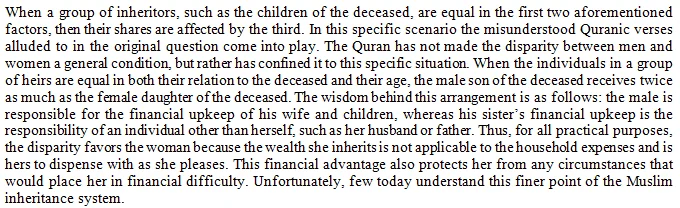
Hence, in certain cases, in light of the financial responsibilities borne by men—which include paying a dowry, providing ongoing financial maintenance for wives and children without any expectation of reciprocation, and supporting extended family members when required—Islam assigns a woman’s share of inheritance as half that of a man. However, when such financial responsibilities do not exist for the male heir, as in the case of inheritance between uterine brothers and sisters (that is, siblings who share the same mother but not the same father), Islam grants male and female heirs an equal share, since they are connected solely through maternal kinship and the male does not bear any financial burden or responsibility in this regard:6

Hence, male heirs are not expected to spend on their uterine sisters, and therefore a larger share of inheritance—which normally reflects financial responsibility—is not justified in such a case.7 Indeed, those who propagate shubuhāt (doubts or specious arguments) about the status of women in Islam by isolating a single case of inheritance from the broader context of the Islamic family and social system, and who refuse to examine the overall Islamic financial structure, are like someone who singles out a mole on a beautiful face in an attempt to prove that the face is flawed. Such individuals magnify this small blemish, turning it into a large blemish, and then cast it into the spotlight, implanting the notion in people’s minds that the entire face is unattractive.8 As previously noted, the critics present the notion that men inherit twice the share of women as a universal principle applicable in all cases. However, the Qurʾān itself does not assert that the 2:1 ratio applies to every instance of inheritance. This ratio specifically pertains to the inheritance of male and female children, and not to all male and female relatives. This distinction is clear even in the very verse cited by the critics to claim that Islam oppresses women, which states that when parents inherit from a deceased child, each receives a sixth: {…Each parent is entitled to one-sixth if you leave offspring} (Qurʾān 4:11). If the 2:1 ratio were meant to apply in all cases, why then does the father of the deceased receive a share equal to that of the mother in this instance? Clearly, the Qurʾān did not establish a principle only to contradict it immediately afterward. Another example in which a woman receives the same share as a man occurs, as noted earlier, when the deceased has no direct ascendants or descendants but leaves behind siblings; in such a case, the sister and brother each receive one-sixth: {And if a man or a woman leaves neither parents nor children but only a brother or a sister ˹from their mother’s side˺, they will each inherit one-sixth} (Qurʾān 4:12). Unfortunately, few today understand the following important facts concerning the Islamic law of inheritance:9
1.There are only four cases in which a male inherits twice the share of a female.
2.There are eleven cases in which a female inherits an equal share to that of a male.
3.There are fourteen cases in which a woman inherits more than a male.
4.There are five cases in which a woman inherits a share while the man inherits nothing.
These are the four cases in which a woman is entitled to half the share of a man:10

These are the eleven cases in which women are entitled to a share equal to that of men:11
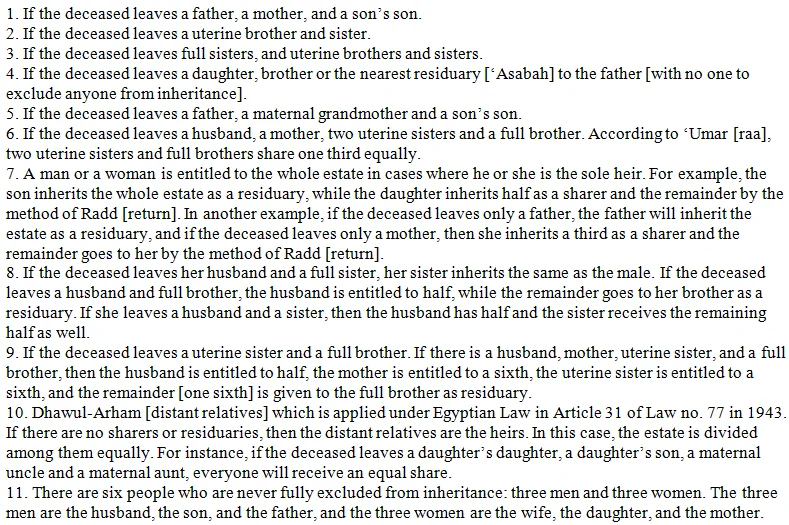
These are the fourteen cases in which women inherit more than men:12


These are the five cases in which women inherit while men do not:13

Hence, there are only four cases in which a woman inherits half the share of a man, whereas in thirty cases, a woman inherits the same as or more than a man, or receives a share while he does not.
In summary, when we consider the regulations and principles of the Islamic family and social system, it becomes clear why there are a few cases in which a woman’s share of inheritance is half that of a man. To reiterate, a woman’s expenses are covered by her father before marriage. The man is responsible for providing her dowry at the time of marriage and for all her expenses thereafter. If her husband dies, she receives her rightful share of his estate. She may inherit from her parents, husband, and children, yet she is not obliged to share this inheritance with anyone. Additionally, any income she earns through employment, business, or other means is part of her personal wealth, and she is not required to spend it on her family. Overall, a woman bears no financial responsibilities under the Islamic family and social system, except for the payment of the zakāt (annual obligatory charity); instead, she benefits from the financial responsibilities placed on men. In contrast, men are obliged to provide for and maintain their family, sharing their income and inheritance with their wife, children, and, if necessary, extended relatives. Without a doubt, Allāh’s justice is absolute, and His Law contains no injustice toward humans or any other creatures. A careful examination of the inheritance law set forth in the Qurʾān demonstrates beyond any doubt that the claim that Islam oppresses women by granting them half the inheritance share of men is unfounded. Indeed, if we were to fully understand and faithfully implement our Sharīʿah—the comprehensive code of life—we would have become the true stewards of the world, for it is the guidance of the One Who is All-Wise and All-Aware, prescribed to ensure the well-being of all humanity: {How could He not know His Own creation? For He ˹alone˺ is the Most Subtle, All-Aware} (Qurʾān 67:14).
Notes and References
- 1
{Allāh commands you regarding your children: the share of the male will be twice that of the female. If you leave only two ˹or more˺ females, their share is two-thirds of the estate. But if there is only one female, her share will be one-half. Each parent is entitled to one-sixth if you leave offspring. But if you are childless and your parents are the only heirs, then your mother will receive one-third. But if you leave siblings, then your mother will receive one-sixth—after the fulfillment of bequests and debts. ˹Be fair to˺ your parents and children, as you do not ˹fully˺ know who is more beneficial to you. ˹This is˺ an obligation from Allāh. Surely Allāh is All-Knowing, All-Wise} (Qurʾān 4:11).
- 2
“Do Women Take Unequal Shares of Inheritance in Islam?” Egypt’s Dar Al-Ifta, accessed 6 Sep. 2023, https://www.dar-alifta.org/en/article/details/120/do-women-take-unequal-shares-of-inheritance-in-islam.
- 3
Ibid.
- 4
Ibid.
- 5
Ibid.
- 6
Ibid.
- 7
That is, men do not generally bear financial obligations toward all their sisters, and inheritance rules take into account whether a male heir is expected to cover the living expenses of female heirs. In the case of uterine siblings, unlike full siblings (who share the same mother and father), no such expectation exists, and therefore men and women inherit equally.
- 8
ʿAbd al-ʿAzīz aṭ-Ṭarīfī, al-ʿAqliyyah al-Lībirāliyyah fī Raṣf al-ʿAql wa-Waṣf an-Naql, (ar-Riyāḍ, Saudi Arabia: Dār al-Minhāj, 2011), paraphrased.
- 9
“Do Women Take Unequal Shares of Inheritance in Islam?” Egypt’s Dar Al-Ifta, accessed 6 Sep. 2023, https://www.dar-alifta.org/en/article/details/120/do-women-take-unequal-shares-of-inheritance-in-islam.
- 10
Ibid.
- 11
Ibid.
- 12
Ibid.
- 13
Ibid.