Why did Prophet Muḥammad (PBUH) state that prayer is interrupted by a woman, a donkey, and a dog?
Critics deliberately misrepresent the following Prophetic tradition in an attempt to argue that the Prophet (PBUH) regarded women as no better than dogs and donkeys. Abū Hurayrah reported that the Messenger of Allah (PBUH) said: “Prayer is interrupted by [the passing of] a woman, a donkey, and a dog, and that is prevented by something like the rear part of a saddle.”1 Critics allege that this comparison is derogatory toward women. However, this allegation rests on baseless and specious arguments that reflect a clear ignorance of Arabic style and usage. It is undeniable that all things in existence share certain general characteristics; for this reason, no one regards the philosophers’ definition of human beings as “rational animals” as an insult to humanity. Contrary to the misguided notion that the aforementioned Prophetic tradition concerns the negative traits of donkeys and dogs, or that Islam places women on the same level as these animals, the tradition mentions women, dogs, and donkeys together only because they share a particular effect related to prayer. In essence, all three may serve as sources of distraction that divert the attention of the person praying—dogs and donkeys due to their coarse and loud sounds, and women due to their beauty. The meaning, therefore, is simply that the passing of a woman, a donkey, or a dog in front of someone engaged in prayer may distract him. Al-Qurṭubī explained: “This is because a woman may be a source of fitnah (temptation), a donkey may bray, and a dog may cause fear; and when a person reflects upon such matters, he may become distracted to the extent that his prayer is interrupted and compromised. Since these factors can lead to the disruption of prayer, they are described as interrupting it.”2 Jurists point out that passing in front of someone who is praying is forbidden in all cases and applies equally to men and women, as it constitutes a distraction that diverts the worshipper’s attention. Accordingly, the above tradition does not demean women; it merely states the reality that if a woman passes in front of a man during prayer, his focus may be diverted, thereby affecting the quality and sincerity of his worship. To illustrate, if someone were to say, “Humans, dogs, and donkeys are all living beings,” this would not imply that humans are the same as dogs and donkeys; it would simply mean that all share basic characteristics such as eating, drinking, living and dying. Consider, for example, the road signs reading “Slow Down—Kind and Pets at Play.”
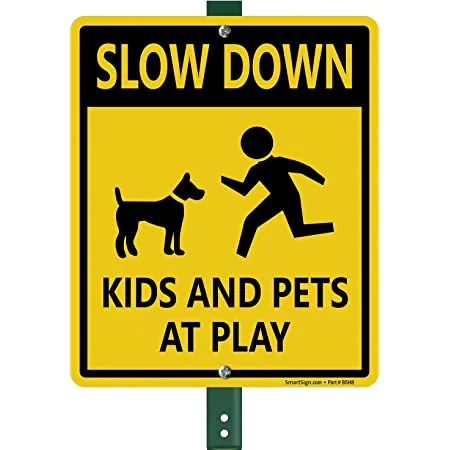
Do such signs degrade children by placing them alongside animals? No sensible person would think so. They exist solely to alert motorists to slow down, as there may be children playing near the road or animals on the lane or track. In the same way, the Prophet (PBUH) did not liken women to donkeys and dogs in order to demean them by placing them on the level of animals. Moreover, he (PBUH) instructed the person praying to place a sutrah—an obstruction that serves as a barrier between the worshipper and others, such as a wall, a pillar, a cane, or anything serving a similar function—to prevent anyone from passing in front of him. He (PBUH) said: “When any one of you prays, let him place something in front of his face. If he cannot find anything, let him set up a stick. If he cannot find one, let him draw a line. Then whatever passes in front of him will not harm him.”3
Notes and References
- 1
Muslim ibn al-Ḥajjāj, Ṣaḥīḥ Muslim, (Bayrūt, Lebanon: Dār al-Kutub ʿIlmiyyah, 2020), book: 4, ḥadīth: 301, available at: https://sunnah.com/muslim:511.
- 2
Abū ʿAbd Allāh al-Qurṭubī, al-Mufhim limā ʾAshkala min Talkhīs Ṣaḥīḥ Muslim, (Bayrūt, Lebanon: Dār Ibn Kathīr, 1997), vol. 2, p. 109.
- 3
Abū ʿAbd Allāh ibn Mājah, Sunan Ibn Mājah, (Cairo, Egypt: Dār at-Taʾṣīl. 2014), book: 5, ḥadīth: 141, available at: https://sunnah.com/ibnmajah:943.