Did Craig Venter create life?
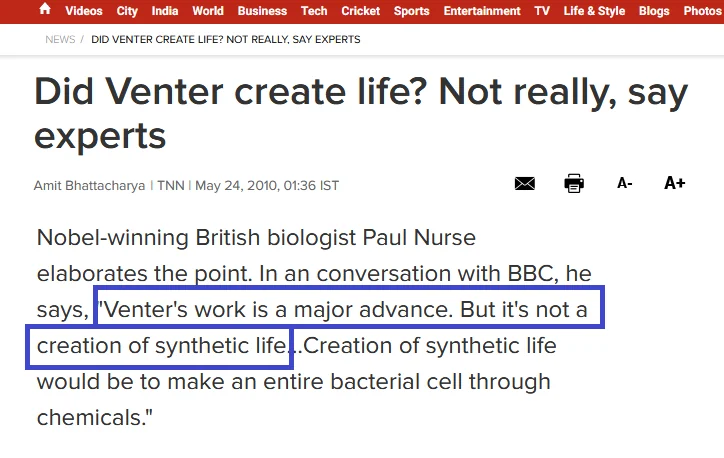
To begin with, scientists know for certain that life is impossible without the genetic code—remove DNA, and life ceases almost instantly. Accordingly, the principle they aimed to demonstrate in recent years is that genomes can be designed using computer software, chemically synthesized in a laboratory, and transplanted into a recipient cell to produce a new self-replicating organism controlled solely by the synthetic genome. Venter’s experiment served as a proof of this principle.1 Venter’s team assembled the complete DNA of a bacterium using genetic sequences created on a computer, then inserted it into another bacterium and initiated synthesis—or, in Venter’s words, “booted up” the cell. They thus announced the creation of the first cell entirely controlled by a synthetic chromosome—one they had designed on a computer based on an existing chromosome. According to Venter, the genome was built from four bottles of chemicals, comprising over a million base pairs. Once assembled and transplanted into a recipient cell, the synthetic chromosome was read by the cell’s machinery, which began producing new proteins and ultimately transformed the cell into a new species encoded by the synthetic genome. In other words, it was the first living, self-replicating cell on the planet whose DNA was chemically synthesized and computer-designed. In short, while it is true that Venter and his team created a new, living cell, they did not create life from scratch. As we shall see, Venter himself acknowledged that the cell is living and self-replicating, but stated that advancing life forms akin to human beings still lies firmly within the realm of science fiction. In the end, what Venter’s team achieved was the synthesis and modification of DNA from one type of bacterium, which they then inserted into another bacterial species after extracting its original DNA. Thus, the life form they created was not fundamentally new; it was a re-creation of an existing bacterial form, equipped with a prosthetic genome synthesized in the lab and placed into the cytoplasm of a slightly different species.2 In a word, what Venter did was just a project on a living cell. Commenting on the Venter Institute’s work on synthesized DNA, Nobel Prize-winning biologist Sir Paul Nurse told the BBC, “Venter’s work is a major advance. But it’s not a creation of synthetic life.”3
Jim Collins, a bioengineer at Boston University, said: “my worry is that some people are going to draw the conclusion that they have created a new life form. What they have created is an organism with a synthesized natural genome. But it doesn’t represent the creation of life from scratch or the creation of a new life form.”4

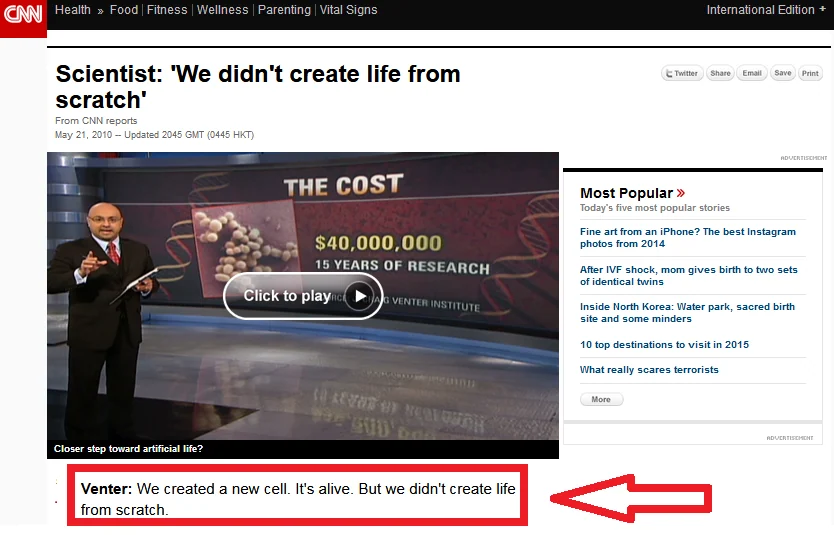
Similarly, Craig Venter himself said: “we created a new cell. It’s alive. But we didn’t create life from scratch.”5
In sum, some atheists are overstating Venter’s recent achievement, claiming that what was once an intractable puzzle with significant religious implications has now been solved. However, Venter has neither created life nor demystified it. Ironically, he re-created life from life. As many have pointed out, scientists are still nowhere near creating a living organism from non-living materials. In other words, they have not demonstrated how life began—how inanimate matter became animate. Indeed, many scientists acknowledge that the origin of life has proven to be far more challenging than they had anticipated. Without a doubt, life is sacred, unique, ineffable, and beyond full human comprehension. One of the great ironies of modern science is that, as scientists gain greater control over life, it remains as fundamentally mysterious as ever. Surely, if atheists reflected honestly on all of this, they would find no rest in the face of such truths.
Notes and References
- 1
Daniel G. Gibson et al., “Creation of a Bacterial Cell Controlled by a Chemically Synthesized Genome,” Science, vol. 329, issue 5987, pp. 52–56, 20 May 2010. DOI: https://doi.org/10.1126/science.1190719.
- 2
Science News Staff, “Synthetic Biology Breakthrough: Your Questions Answered. Experts Respond to Reader Queries about the Creation of Artificial Life,” Science, 21 May 2010, https://www.science.org/content/article/synthetic-biology-breakthrough-your-questions-answered.
- 3
Amitt Bhattacharya, “Did Venter Create Life? Not Really, Say Experts,” Times of India, 24 May 24, 2010, https://timesofindia.indiatimes.com/science/did-venter-create-life-not-really-say-experts/articleshow/5966474.cms; Brian J. Ford, “Inventing Life or Reality?” The Microscope, vol. 58, issue 2, pp. 71–79, 2010, available at: https://www.brianjford.com/a-CriticalFocus1-Reconstitution.pdf.
The best commentary to put it all in context came the next day from British biologist Sir Paul Nurse, who won a Nobel Prize in 2001 and became the ninth president of Rockefeller University, New York, in 2003. I know Nurse as a dynamic, thoughtful and immensely insightful cell biologist. He set the reports into perspective. “I don’t think it is a major breakthrough,” he told the BBC. “It is not the creation of synthetic life.” Even so, the commentator added the possibility of creating cells that could “eat waste oil.”
- 4
Nicholas Wade, “Researchers Say They Created a Synthetic Cell,” The New York Times, 20 May 2010, https://www.nytimes.com/2019/05/15/science/synthetic-genome-bacteria.html.
- 5
“Scientist: ‘We Didn’t Create Life from Scratch,” CNN REPORTS, 21 May 2010, http://www.cnn.com/2010/HEALTH/05/21/venter.qa/.