Did the principle of causality apply at the moment the universe emerged?
Most Muslim scholars regard the attributes al-Ḥayy (the Ever-Living) and al-Qayyūm (the Self-Sustaining and the Sustainer of all that exists) as Ism Allāh al-Aʿẓam (the Greatest Name of Allāh).1 These two Names are frequently paired to express Allāh’s everlasting life and complete self-sufficiency. As Muslims, we affirm Allāh’s qayyūmiyyah (the divine attribute of being al-Qayyūm) and believe that all creation—including the heavens and the earth—depends entirely on Him. Everything else is transient and bound for non-existence, whereas His existence is eternal. In other words, Allāh is wholly independent of anything else for His existence, while He is the very foundation upon which all else depends. Indeed, a closer look into our universe reveals that it could neither come into existence nor continue to exist without Allāh. Indeed, Allāh possesses absolute dominion over all levels of existence, from the grand cosmic order to the minutest quantum events. Even the probabilistic framework of the wave function cannot yield a single instance of reality without His will—for even the most fundamental and uncertain aspects of physical reality are entirely sustained by Him. This is the essence of His qayyūmiyyah. In quantum mechanics, the wave function is a mathematical construct that describes the wave-like behavior of particles. The value of a particle’s wave function at a given point in space and time is tied to the probability of the particle being found at that location and moment. In other words, the wave function does not specify where a particle is or how fast it is moving; rather, at the subatomic level, scientists concede that they can only speak in terms of probabilities regarding a particle’s position and momentum. A particle, in this context, is not a localized object in the usual sense but a spread of probabilities over space and time.
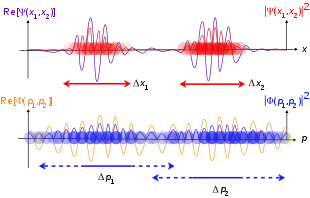
Undoubtedly, even the wave function would not exhibit a single instance of reality without the will and sustaining power of Allāh, Who creates, maintains, continuously preserves and perfectly governs all things without pause or partner.
Quantum mechanics is the branch of science that explores the behavior of matter and light at atomic and subatomic scales. Since its development in the early twentieth century, it has achieved remarkable success and continues to provide an exceptionally accurate framework for understanding the physical world. It offers a profound approximation of a deeper theoretical model—one that reconciles both deterministic and probabilistic dimensions of reality.

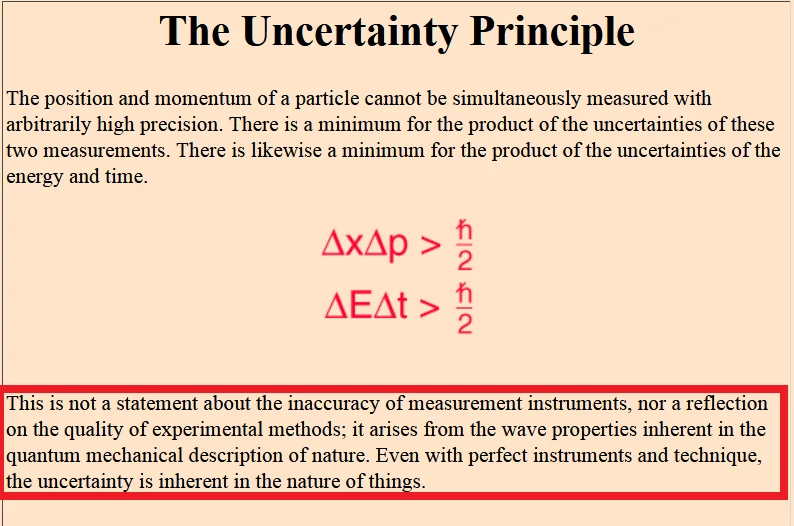
The Uncertainty Principle is a foundational concept in quantum mechanics, establishing that it is impossible to measure certain pairs of quantum variables—such as a particle’s position and momentum—simultaneously with absolute precision. The more accurately one of these variables is known, the less precisely the other can be determined. This limitation is not due to flaws in measurement tools, experimental technique, or observer error. Rather, it reflects the intrinsic nature of subatomic reality, where particles also exhibit wave-like behavior. Although counterintuitive, especially when compared to the predictability of classical physics, this principle is a universal law—an essential feature of the quantum world that no informed physicist would deny.
Therefore, based on the foregoing, the universe is inherently deficient and lacks self-governance, for it has no self-awareness and cannot predict what will occur in the next instant. In literal terms, it is impossible to know with certainty what will happen even a moment from now—a fact confirmed by the universal laws of quantum mechanics. Indeed, the collapse of the heavens and the fracturing of celestial bodies is a constant quantum possibility. Allāh says: {Indeed, Allāh ˹alone˺ keeps the heavens and the earth from falling apart. If they were to fall apart, none but Him could hold them up} (Qurʾān 35:41). That is, this vast and boundless universe is sustained solely by Allāh, while all created beings are utterly helpless and in constant dependence on Him every moment. Atheists, however, argue that God had nothing to do with the emergence of the universe and that it has no need for Him. In his final book, The Grand Design, co-authored with physicist Leonard Mlodinow, Stephen Hawking explored the concept of the multiverse—the idea that the universe does not have a single, unique history, but rather that there exists a multitude of possible histories, each equally real and governed by its own physical laws. In one of his bold statements, marked by unconventional humor, Hawking wrote: “There might be one history in which the Moon is made of Roquefort cheese. But we have observed that the Moon is not made of cheese, which is bad news for mice.”2
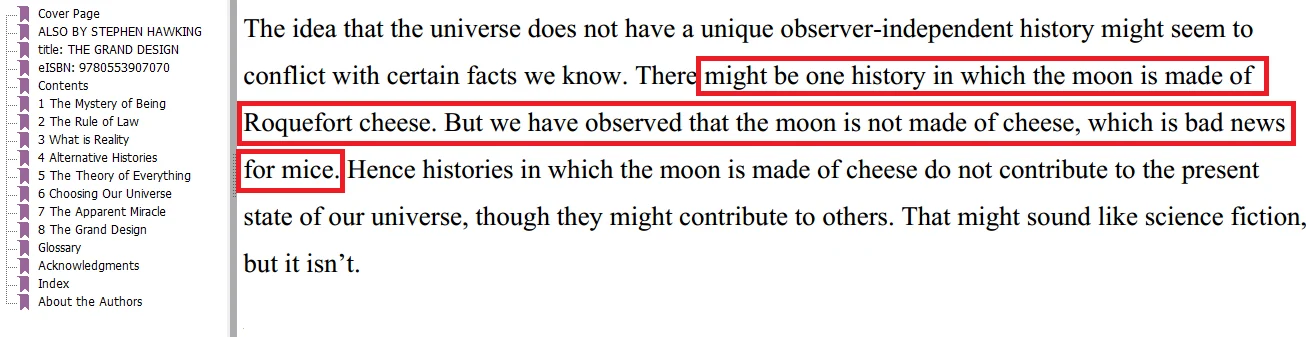
Hawking further added, “That might sound like science fiction, but it isn’t,”3 emphasizing that the multiverse theory, despite its seemingly fantastical implications, is presented as a serious scientific proposition.

In short, anyone with a basic understanding of quantum mechanics would acknowledge that, in theory, anything could occur in the universe at any given moment. What is most remarkable, however, is that the universe remains finely tuned, stable, and orderly—through the divine sustainment of Allāh. In other words, Allāh is the Sustainer of the entire universe, and every particle within it depends on Him from the moment of its existence. Without this divine sustainment, the universe would collapse into chaos instantaneously. Allāh says: {Had there been other gods besides Allāh in the heavens or the earth, both ˹realms˺ would have surely been corrupted} (Qurʾān 21:22). The entire system of the universe operates in accordance with a universal law—one so precise that the universe could not function for even a moment without proper balance and coordination among its countless elements. This law compels these elements to cooperate with one another in perfect proportion and harmony. Clearly, the existence of such an intricate system serves as compelling evidence that there must be One All-Powerful Manager and Administrator who governs and oversees the entire universe. In essence, quantum mechanics and the wave function both indicate that the universe is continuously sustained by and reliant upon Allāh. Indeed, the principle of causation has been fundamental since the very moment the universe came into being, and for anyone who reflects and contemplates, divine sustainment stands as an undeniable truth.