Did chemical evolution not win the 2018 Nobel Prize in Chemistry?
The Royal Swedish Academy of Sciences announced that the 2018 Nobel Prize in Chemistry has been awarded to three scientists who “have taken control of evolution and used the same principles to develop proteins that solve mankind’s chemical problems.” The academy has decided to divide the prize with one half given to Frances H. Arnold, professor of chemical engineering at Caltech, “for the directed evolution of enzymes,” and the other half jointly to two other protein engineers, George P. Smith, an emeritus professor of biological sciences at the University of Missouri, and Sir Gregory P. Winter, a biochemist at the Medical Research Council (MRC) Laboratory of Molecular Biology in England, “for the phage display of peptides and antibodies.”1 According to Sara Snogerup Linse—a Swedish professor of biochemistry at Lund University and a member of the Nobel Committee for Chemistry—what these scientists have done is to “really speed up the evolution. Nature has had billions of years but now you want the process to be possible in maybe a few weeks or a year or something in the laboratory.”2 These chemists have supposedly applied Darwinian principles in test tubes—that is, they used their molecular understanding of the so-called evolutionary process to recreate it in the laboratory, accelerating evolution by many thousands of times.3
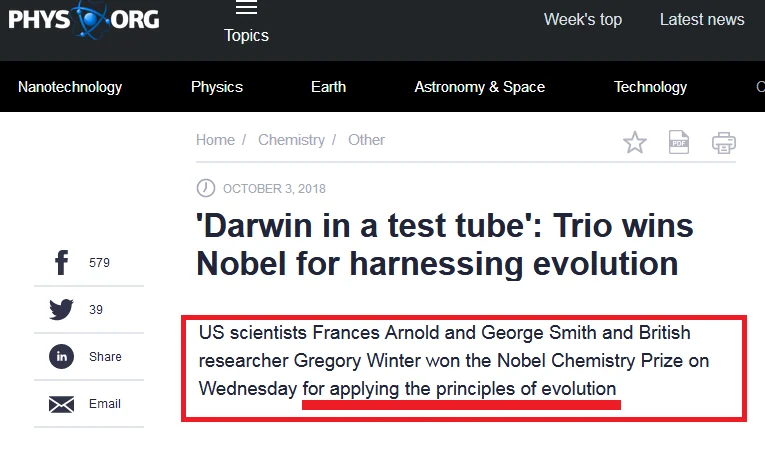
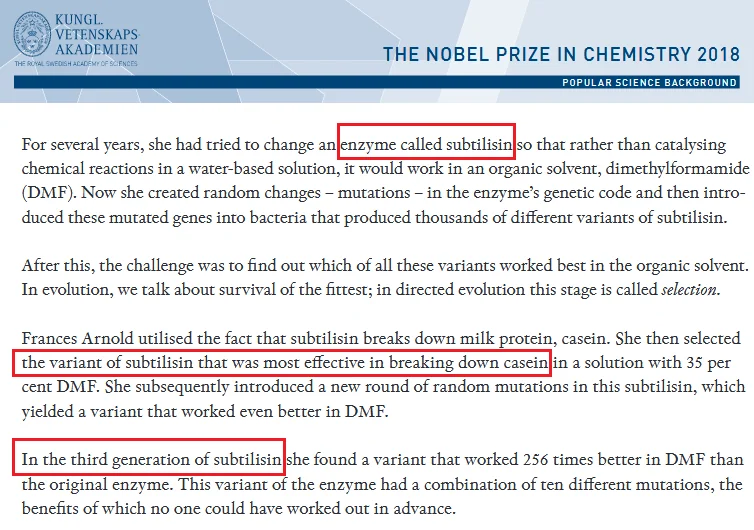
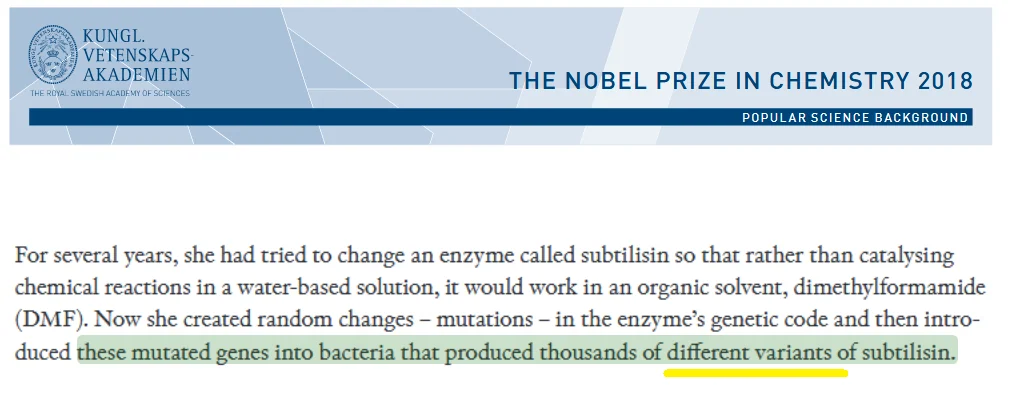
The irony is that not a single microbial species evolved into another, nor did any entirely new functional protein or enzyme emerge. The only observed outcome was that a variant in the third generation of an enzyme called subtilisin became slightly more effective at breaking down the milk protein casein. In other words, despite this minor variation, subtilisin remained the same enzyme throughout the first, second, and third generations—within the same microbial species and family.4
In short, the observed variants were merely changes within the same enzyme type.5
More importantly, it turned out that the modified enzyme resulting from repeated mutations was the most effective only in terms of our practical use, such as in biofuels. However, it became poor and weak for the organism itself, with a shorter lifespan compared to the natural enzyme that had not undergone mutation. Dr. Douglas Axe, Maxwell Professor of Molecular Biology at Biola University and founding Director of the Biologic Institute, pointed out that even with the best efforts of protein engineers, modified enzymes remain poor and weak compared to natural enzymes.6
Ann Gauger—a senior research scientist at Biologic Institute whose work uses molecular genetics and genomic engineering to study the origin, organization, and operation of metabolic pathways—and Douglas Axe—the director of Biologic Institute and author of Undeniable: How Biology Confirms Our Intuition That Life Is Designed—and Matti Leisola—professor of bioprocess technology at Aalto University—have commented on the news of the aforementioned three scientists being awarded the 2018 Nobel Prize in Chemistry. Gauger observed regarding Frances H. Arnold’s contribution:7

Gauger noted that “directed evolution” is an oxymoron:8

Gauger observed another problem: since multiple mutations may be required together, Philip A. Romero and Frances H. Arnold acknowledged in a 2009 review that “some functions… simply cannot be reached through a series of small uphill steps and instead require longer jumps that include mutations that would be neutral or even deleterious when made individually.”9 You can wait an exceedingly long time for four or five specific mutations to arise that together produce the desired function. In a global bacterial population such as E. coli, the waiting time for just four mutations can reach 10¹⁵ years10—yet the universe itself is only 10¹⁴ years old. Like Dr. Douglas Axe, Gauger emphasized that modified enzymes are poor and weak compared to natural ones: “We are forcing enzymes to perform in ways they were not designed to perform.”11 Lastly, Gauger praised Dr. Arnold’s contribution but emphasized that this is not evolution—rather, it is intelligently designed engineering:12

When the New York Times reported that the Nobel Prize in Chemistry was awarded to 3 scientists for using evolution in design of molecules,13 Axe noted that it is not every day that we see the words “evolution” and “design” in the same headline.14 He also noted that, in his experience, it is not every day a Nobel Prize goes to two people one knows. Axe said of Frances Arnold:15
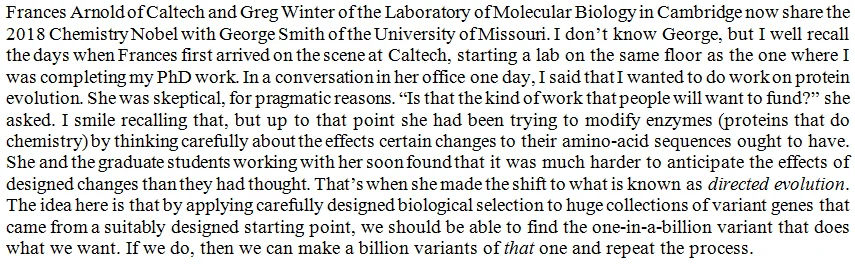
Axe remarked on Sir Gregory P. Winter:16

Axe observed that both Arnold and Winter pushed their respective technologies to the limits, and that highly significant accomplishments emerged from each of their research groups. It is therefore fitting that they were chosen for the highest of scientific honors, as both conducted work worthy of a Nobel Prize.17 He further observed that it is also fitting for words like ‘design’ and ‘directed’ to be associated with their work, as the truth is that through diligent effort and careful thought, they achieved what unguided processes could never accomplish on their own.18 Axe asserted that it is equally true that even these outstanding scientists have not discovered a way to invent proteins from scratch that rival the thousands observed in living cells. In fact, Arnold herself once acknowledged with admirable candor:19

Axe summed the problem with such efforts, saying:20

Dr. Leisola stated that she greeted with enthusiasm the announcement that part of the 2018 Nobel Prize in Chemistry went to an enzyme bioengineer (Frances H. Arnold) because she is an enzyme bioengineer too. According to Dr. Leisola, Arnold’s accomplishments in the field are impressive, as is the work of her co-winners, whose work also involves bioengineering—the three are deserving recipients indeed.21 However, Leisola observed that there is one point of confusion in the descriptions of the 2018’s prize winners, namely the talk of “directed evolution.” The Nobel Prize organization itself has encouraged such talk.22 The New York Times used similar language.23 Leisola stated that the conflation of artificial and natural selection is a problem:24

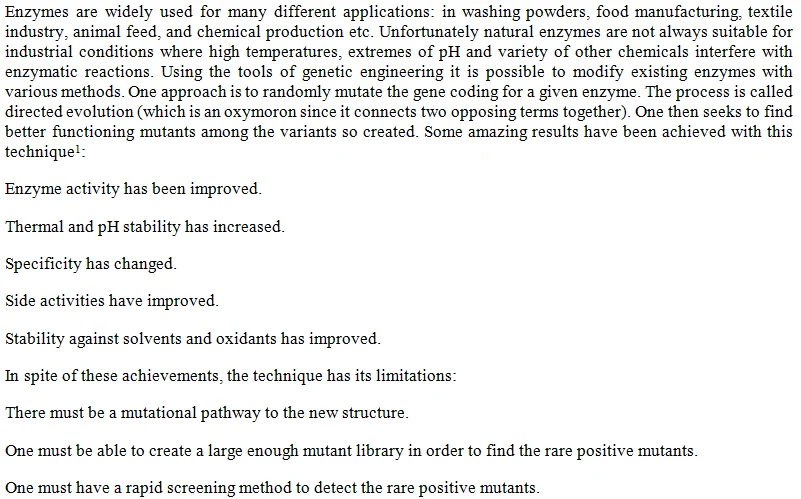
Leisola shared an excerpt from her essay in the recent anthology Theistic Evolution: A Scientific, Philosophical, and Theological Critique,describing the random and designed aspects of the so-called “directed evolution” approach to bioengineering:25
Leisola cited biochemist Michael Behe’s book The Edge of Evolution in which he draws upon research on E. coli, malaria, and HIV mutations. From this Behe calculated the upper limit for a random mutational process in nature at two to three simultaneous mutations in one protein. This is in harmony with Barry Hall’s results with lactase mutations.26 Leisola asserted that bioengineers, including the 2018 Nobel laureates in Chemistry, are demonstrating a way beyond this limit—intelligent design:27

Chapter 10 of Leisola’s recently co-authored book Heretic: One Scientist’s Journey from Darwin to Design delves more into the promising field of enzyme engineering, and how it demonstrates the limits of natural evolutionary processes and the reach of intelligent design.28 To conclude, it is logical and fair to say that evolution could never happen at all. Jerry Fodor and Massimo Piattelli-Palmarini, two Darwinist atheists and co-authors of the book What Darwin Got Wrong, started the book with the statement: “This is not a book about God; nor about intelligent design; nor about creationism. Neither of us is into any of those. We thought we’d best make that clear from the outset, because our main contention in what follows will be that there is something wrong–quite possibly fatally wrong–with the theory of natural selection; and we are aware that, even among those who are not quite sure what it is, allegiance to Darwinism has become a litmus for deciding who does, and who does not, hold a ‘properly scientific’ world view. ‘You must choose between faith in God and faith in Darwin; and if you want to be a secular humanist, you’d better choose the latter’. So we’re told.”29
Notes and References
- 1
“They Harnessed the Power of Evolution,” The Nobel Prize, 3 Oct. 2018, https://www.nobelprize.org/prizes/chemistry/2018/press-release/.
- 2
“What They Have Done Is They Have Sped up Evolution. Interview: The 2018 Nobel Prize in Chemistry,” YouTube, uploaded by Nobel Prize, 3 Oct. 2018, https://www.youtube.com/watch?v=6ecpiWFOCvU, [2:07–2:20].
- 3
“Darwin in a Test Tube: Trio Wins Nobel for Harnessing Evolution,” Phys.org, 3 Oct. 2018, https://phys.org/news/2018-10-trio-nobel-chemistry-prize-evolution.html.
- 4
“Nobel Prize 2018--Popular Science Background,” Kungl Vetenskaps Akademien (The Royal Swedish Academy of Sciences), 2 Oct. 2028, https://www.kva.se/en/news/nobelpriset-i-fysik-2018-2/; https://www.kva.se/app/uploads/2018/10/popkeen18.pdf.
- 5
Ibid.
- 6
Douglas Axe, “Nobel Prize in Chemistry for Intelligent Design?” Evolution News & Science Today, 3 Oct. 2018, https://evolutionnews.org/2018/10/nobel-prize-in-chemistry-for-intelligent-design/.
- 7
Ann Gauger, “It’s Not “Evolution” — A Nobel Prize for Engineering Enzymes,” Evolution News & Science Today, 4 Oct. 2018, https://evolutionnews.org/2018/10/its-not-evolution-a-nobel-prize-award-for-engineering-enzymes/.
- 8
Ibid.
- 9
Philip A. Romero and Frances H. Arnold, “Exploring Protein Fitness Landscapes by Directed Evolution,” Nature Reviews: Molecular Cell Biology, vol. 10, 1 Dec. 2009, pp. 866–875. DOI: https://doi.org/10.1038/nrm2805 as cited in ibid.
- 10
Mariclair A. Reeves et al., “Enzyme families—Shared Evolutionary History or Shared Design? A Study of the GABA-Aminotransferase Family,” BIO-Complexity, 2014, vol. 2014, issue 4, pp. 1−16. DOI: https://doi.org/10.5048/BIO-C.2014.4 as cited in Ann Gauger, “It’s Not “Evolution” — A Nobel Prize for Engineering Enzymes,” Evolution News & Science Today, 4 Oct. 2018, https://evolutionnews.org/2018/10/its-not-evolution-a-nobel-prize-award-for-engineering-enzymes/.
- 11
Ann Gauger, “It’s Not “Evolution” — A Nobel Prize for Engineering Enzymes,” Evolution News & Science Today, 4 Oct. 2018, https://evolutionnews.org/2018/10/its-not-evolution-a-nobel-prize-award-for-engineering-enzymes/.
- 12
Ibid.
- 13
Kenneth Chang, “Use of Evolution to Design Molecules Nets Nobel Prize in Chemistry for 3 Scientists,” The New York Times, 3 Oct. 2018, https://www.nytimes.com/2018/10/03/science/chemistry-nobel-prize.html.
- 14
Douglas Axe, “Nobel Prize in Chemistry for Intelligent Design?” Evolution News & Science Today, 3 Oct. 2018, https://evolutionnews.org/2018/10/nobel-prize-in-chemistry-for-intelligent-design/.
- 15
Ibid., (emphasis in original).
- 16
Ibid.
- 17
Ibid.
- 18
Ibid.
- 19
Eric M. Brustad and Frances H Arnold, “Optimizing Non-Natural Protein Function with Directed Evolution,” Current Opinion in Chemical Biology, vol. 15, issue 2, Apr. 2011, pp. 201–10. DOI: https://doi.org/10.1016/j.cbpa.2010.11.020 as cited in ibid.
- 20
Douglas Axe, “Nobel Prize in Chemistry for Intelligent Design?” Evolution News & Science Today, 3 Oct. 2018, https://evolutionnews.org/2018/10/nobel-prize-in-chemistry-for-intelligent-design/.
- 21
Matti Leisola, “How the 2018 Nobel Laureates in Chemistry Harnessed Intelligent Design,” Evolution News & Science Today, 4 Oct. 2018, https://evolutionnews.org/2018/10/how-the-2018-nobel-laureates-in-chemistry-harnessed-intelligent-design/.
- 22
“They Harnessed the Power of Evolution,” The Nobel Prize, 3 Oct. 2018, https://www.nobelprize.org/prizes/chemistry/2018/press-release/.
The 2018 Nobel Laureates in Chemistry have taken control of evolution and used it for purposes that bring the greatest benefit to humankind. Enzymes produced through directed evolution are used to manufacture everything from biofuels to pharmaceuticals.
- 23
Kenneth Chang, “Use of Evolution to Design Molecules Nets Nobel Prize in Chemistry for 3 Scientists,” 3 Oct. 2018, The New York Times, https://www.nytimes.com/2018/10/03/science/chemistry-nobel-prize.html.
At first, Dr. Arnold attempted “rational design,” employing logic and knowledge of how proteins function to try to build new enzymes—proteins that act as catalysts for chemical reactions. But enzymes are large, complicated molecules—some consisting of thousands of amino acids—and it is hard to figure out how a shift in one twist of the molecule affects how it works. In desperation, she said, she turned to evolution. “I copied nature’s inventions, this wonderful process of evolution, to breed molecules like you breed cats and dogs,” she said. For this “directed evolution” research, she inserted the gene that produced the enzyme she wanted to study into fast-reproducing bacteria. With mutations of the gene, she could then examine how well variations of the enzyme worked. She chose the one that worked best and repeated the process — just like evolution chooses the survival of the fittest over succeeding generations.
- 24
Matti Leisola, “How the 2018 Nobel Laureates in Chemistry Harnessed Intelligent Design,” Evolution News & Science Today, 4 Oct. 2018, https://evolutionnews.org/2018/10/how-the-2018-nobel-laureates-in-chemistry-harnessed-intelligent-design/.
- 25
Matti Leisola and Ossi Turunen, “Protein Engineering: Opportunities and Challenges,” Applied Microbiology and Biotechnology, vol. 75, Jul. 2007, pp. 1225–1232. DOI: https://doi.org/10.1007/s00253-007-0964-2 in James P. Moreland et al., Theistic Evolution: A Scientific, Philosophical, and Theological Critique, (Wheaton, U.S.: Crossway, 2017).
- 26
Barry Hall, “The EBG System of E. Coli: Origin and Evolution of a Novel Beta-Galactosidase for the Metabolism of Lactose,” Genetica, vol. 118, 2003, pp. 143–156.
- 27
Matti Leisola, “How the 2018 Nobel Laureates in Chemistry Harnessed Intelligent Design,” Evolution News & Science Today, 4 Oct. 2018, https://evolutionnews.org/2018/10/how-the-2018-nobel-laureates-in-chemistry-harnessed-intelligent-design/.
- 28
Matti Leisola and Jonathan Witt, Heretic: One Scientist's Journey from Darwin to Design, (Seattle, U.S.: Discovery Institute Press, 2018).
- 29
Jerry Fodor and Massimo Piattelli-Palmarini, What Darwin Got Wrong, (London, U.K.: Profile Books, 2011), p. xv.