What about Richard Dawkins’ project to explain the accidental appearance of the genetic code?
The remarkable engineering design evident throughout the living world is embodied in an unimaginably vast quantity of information, stored and transmitted in coded form. Richard Dawkins—one of the most vocal and influential Neo-Darwinists and arguably the chief apostle of evolution—openly promotes atheism as the logical outcome of evolutionary theory. He recognizes that the fundamental challenge is to explain how all this information could have arisen through natural processes, without the involvement of a guiding intelligence. However, experts in information science have made it unequivocally clear that random processes cannot generate genuine information. In an attempt to address this dilemma, Dawkins employed a playful strategy. He utilized Richard Hardison’s computer program to demonstrate that evolution can allegedly achieve remarkable outcomes. In the 1980s, Hardison—a college professor at Glendale College—developed a program capable of generating random phrases while preserving the positions of letters that happened to fall correctly into place. Dawkins’ version of the program begins with a random sequence of 28 letters or spaces. This sequence is then repeatedly copied, simulating reproduction, with random copying errors introduced to represent mutations. The program evaluates all the ‘daughter’ sentences and selects the one that most closely resembles the target phrase: “Methinks it is like a weasel.” This process is said to represent natural selection. Unsurprisingly, within a few generations (43 and 64 in the examples shown below), the target sentence is achieved. This experiment is presented as evidence that real information can emerge through the natural processes of mutation and selection, unaided by intelligence.1
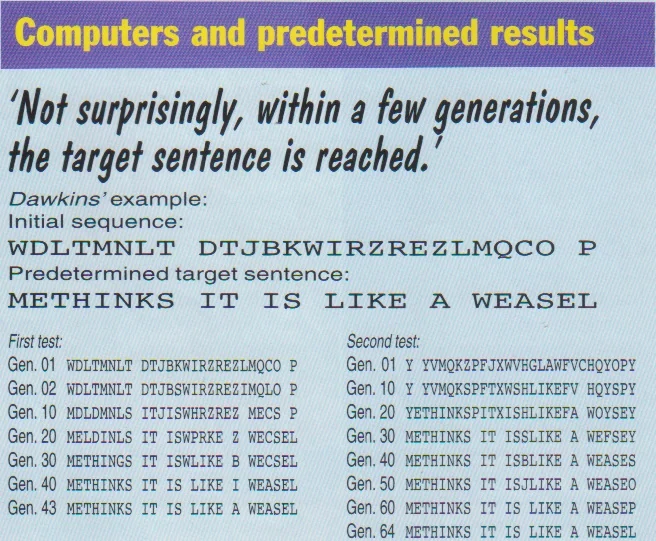
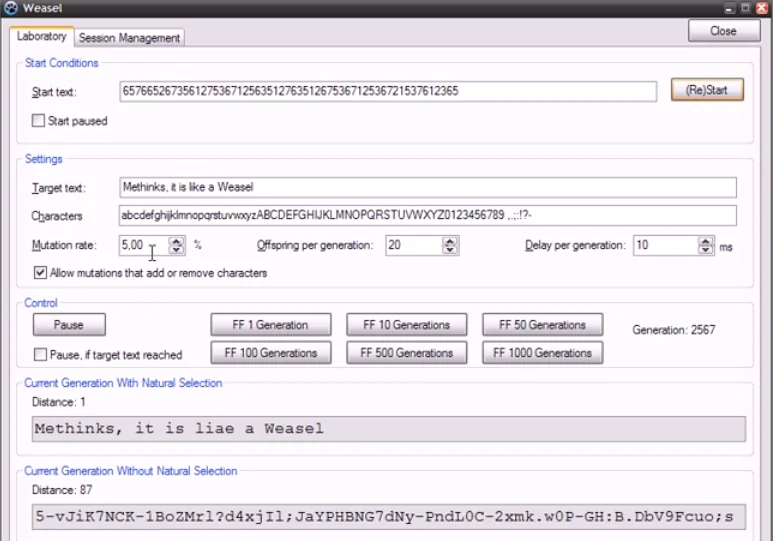
Obviously, Dawkins’s computer simulation of evolution has significant limitations. Scientists point out that this type of computer game can be played by anyone and will always reach its goal because the outcome is predetermined—the target is specified in advance, and even the number of letters is fixed. It is therefore clear that no new information is actually generated in Dawkins’s example. On the contrary, the information—the sentence “Methinks it is like a weasel”—is already known from the outset. Dawkins purports to show how mutations and natural selection generate new information, but by providing the information at the start, the simulation merely reproduces it rather than creating it. Thus, he has not demonstrated what he claims to prove. Moreover, as the simulation moves from random gibberish toward the predetermined sentence, it passes through entirely dysfunctional intermediates. This is problematic, as Darwinian natural selection tends to eliminate dysfunctional offspring. Additionally, the program is designed to aim for a specific distant goal—yet evolution, as Darwinists themselves assert, does not work toward predetermined ends. It is not mindful but mindless, not seeing but blind.2 Dawkins conceded all this in his book The Blind Watchmaker:3

Notwithstanding, Dawkins dismisses these shortcomings by claiming that the simple program was intended merely for illustrative purposes, and suggests that more sophisticated simulations would soon be developed to more accurately mimic natural selection while still demonstrating the remarkable creativity of the evolutionary process. Yet, three decades later, no such program has emerged. Various attempts at more advanced simulations have been introduced, but as critics have pointed out, these models either grossly underestimate the difficulty of avoiding dysfunctional intermediates, rely on unrealistically vast probabilistic resources, or covertly embed a distant goal for the program to pursue. While these more refined simulations may better obscure the underlying flaws than the original weasel program, the fundamental problems remain.4
It is worth asking: Why does the computer program—which clearly implies capacity, knowledge, design, will, expertise, and fine-tuning—seem perfectly acceptable to Dawkins in his experiment, while he objects to attributing those very qualities to a Creator who designed the finely tuned conditions of the early universe? Without a doubt, it is irrational to deny the existence of physical laws that appear specifically designed for the emergence of life. Oddly enough, while everything in the early universe reflects a meticulously orchestrated plan, Dawkins insists it all arose from mere random quirks. In short, in his experiment, Dawkins set a predetermined target, which the computer strives to achieve by comparing outcomes and preserving the correct letters while discarding the rest. This entire process implies deliberate and purposeful intelligent design—precisely the kind of design believers refer to in the context of creation.5
Notes and References
- 1
Werner Gitt and Carl Wieland, “Weasel Words: Refuting a Common Ploy to Persuade People that Evolution Has Been ‘Proven by Computer’,” Creation, vol. 20, issue 4, pp. 20–21, Sep. 1998, available at: https://creation.com/weasel-words-critique-of-dawkins; “Methinks It Is Like a Weasel,” YouTube, uploaded by NineBerry NeunBeere, 5 Feb. 2010, https://www.youtube.com/watch?v=AXxCsHGIxww.
- 2
Jonathan Witt, “Richard Dawkins’s Weasel Program Is Bad in Ways You Never Dreamed,” Evolution News, 23 Sep. 2016, https://evolutionnews.org/2016/09/dawkinss_weasel/.
- 3
As quoted in ibid.
- 4
Ibid.
- 5
Farḥāt Karīm, You Are Not an Atheist...Why? (Cairo, Egypt: Nahḍat Miṣr Publishing Group, 2014).