Does the recurrent laryngeal nerve refute intelligent design? Is it evidence that humans evolved from fish?
Evolutionists argue that the human body exhibits poor design, which they interpret as evidence against intelligent design and in favor of a body assembled through the blind, unguided process of evolution. Jerry A. Coyne, an evolutionary biologist and geneticist, stated: “Imperfect design is the mark of evolution; in fact, it is precisely what we expect from evolution.”1 He further stated: “[N]ew parts do not evolve from old ones, and we have to work well with the parts that have already evolved. Because of this, we should expect compromises: some features that work pretty well, but some not as well as they might, or some features—like the kiwi wing—that do not work at all, but are evolutionary leftovers.”2 That is, according to Coyne, evolution predicts that some features will function well, others less effectively, and some not at all. He coupled this argument with the questionable claim that intelligent design necessarily entails perfect design. On that basis, he positioned evolution as uniquely capable of explaining examples of so-called imperfect design. Similarly, Kelly C. Smith, a philosopher of science with training in evolutionary biology, stated: “if a design in nature is clearly inferior to what a human engineer could produce, then we are entitled [to reject intelligent design].”3 One of the examples of poor design most frequently cited by evolutionists is the recurrent laryngeal nerve (RLN), which controls the muscles of the larynx (voice box) in mammals. Both Coyne and Smith regard the RLN as an instance of imperfect or suboptimal design. Likewise, Donald Prothero—an American geologist and paleontologist—argues that examples of “poor or at least very puzzling design can be accumulated endlessly,” thereby supporting the theory of evolution. According to Prothero, one of the clearest examples is the recurrent laryngeal nerve, which connects the brain to the larynx and enables speech. He stated: “In mammals, this nerve avoids the direct route between the brain and throat and instead descends into the chest, loops around the aorta near the heart, then returns to the larynx. That makes it seven times longer than it needs to be.”4 Similarly, Coyne described the extended route taken by the RLN to reach the larynx as “[o]ne of nature’s worst designs.”5 Likewise, Smith described it as “a very poor design for its intended purpose.”6 Analogously, Dawkins asserted in a National Geographic video: “obviously a ridiculous detour! No engineer would ever make a mistake like that.”7
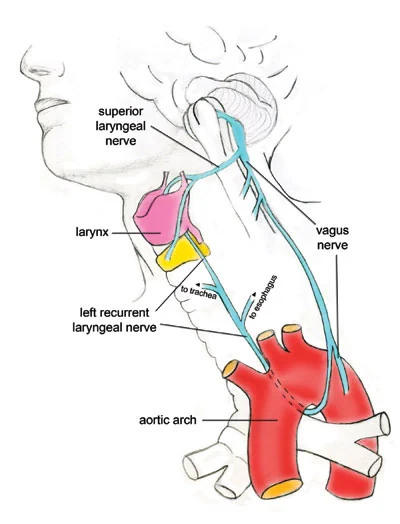
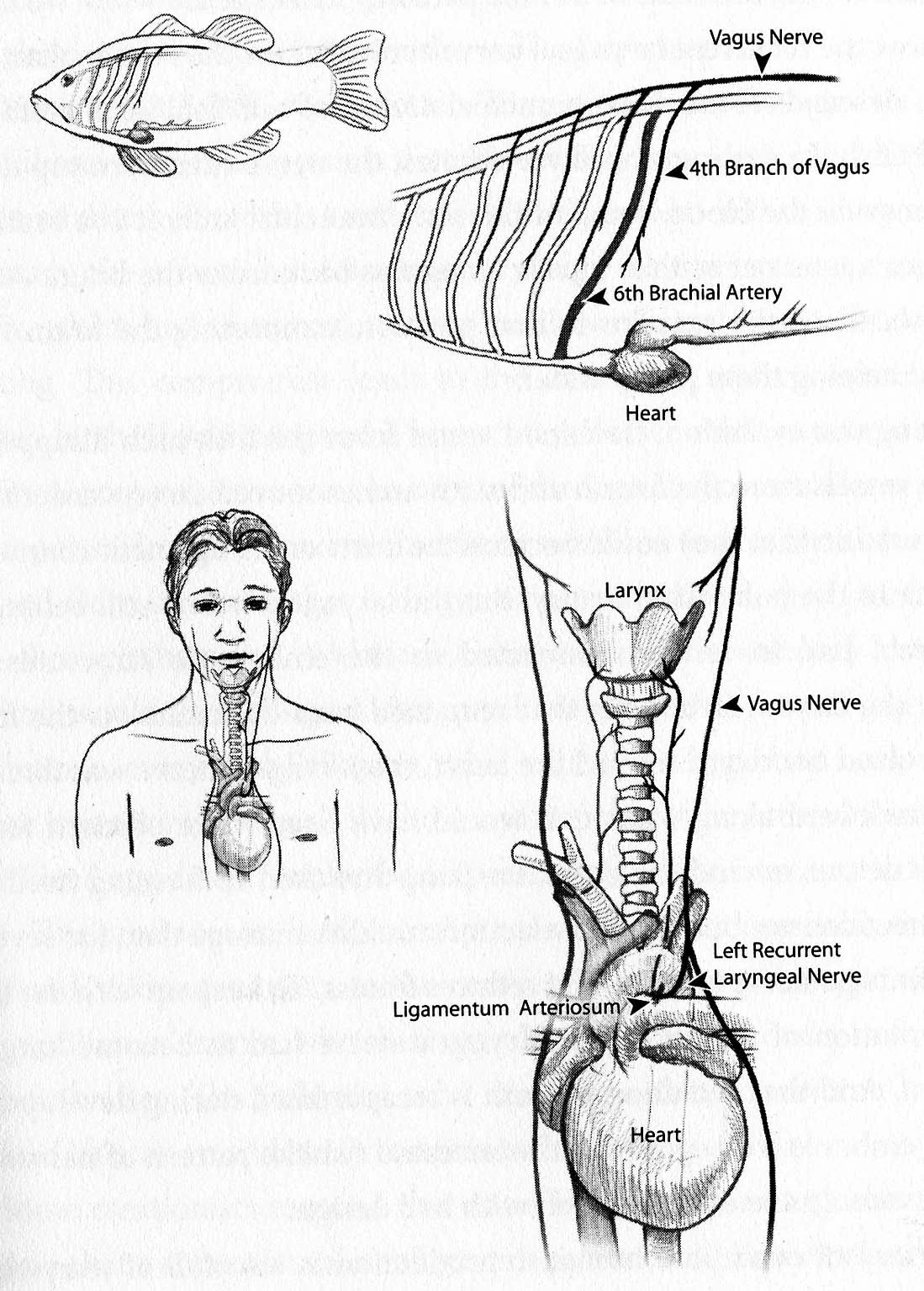
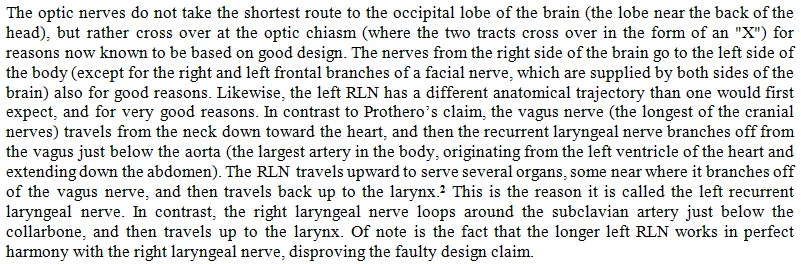
Evolutionists’ argument regarding the recurrent laryngeal nerve (RLN) is as follows: the RLN innervates the larynx, but instead of running directly from the brain to the voice box—as one might expect—the nerve takes a detour. It descends past the larynx, branches off from the vagus nerve near the heart, loops around the aorta, and then travels back up the neck to reach the larynx from below. This circuitous path, they claim, is readily explained if one understands that the human body evolved from a fish body and is therefore constrained by that ancestral blueprint. In other words, our alleged fish ancestry dictates that the RLN must follow this roundabout route from the brain to the larynx. Prothero asserted: “Not only is this design wasteful, but…the bizarre pathway of this nerve makes perfect sense in evolutionary terms. In fish and early mammal embryos, the precursor of the recurrent laryngeal nerve [is] attached to the sixth gill arch, deep in the neck and body region.”8
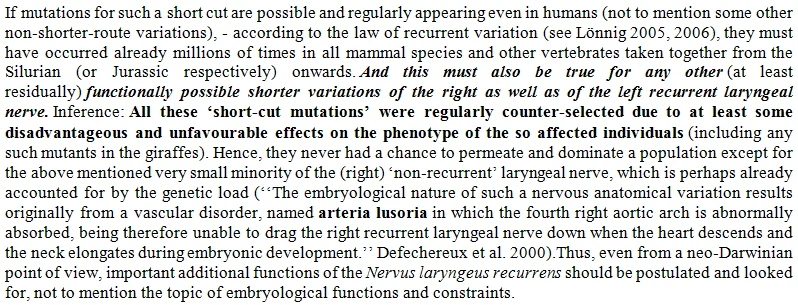
Wolf-Ekkehard Lönnig, a pro–intelligent design biologist at the Max Planck Institute for Plant Breeding Research in Germany, explained that observed variation within humans suggests that such so-called evolutionary constraints do not, in fact, exist:9

Lönnig thus made the following observations:10
Luskin observed:11

Dr. Jerry Bergman—who has taught biology, genetics, chemistry, biochemistry, anthropology, geology, and microbiology at both the undergraduate and graduate levels for over 40 years—noted that although the recurrent laryngeal nerve does not take the most direct path to the larynx, this is also true of many other nerves in the body.12
Evolutionists acknowledge that if a rational function or reasonable purpose can be identified for a particular design, then the objection of “imperfect” or “inferior” design collapses. In contrast, the concept of imperfect design does not undermine evolution, since evolutionary theory allows for both highly functional and poorly functional features. While this argument may lack internal coherence,13 one effective way to counter it is to identify a logical function for the recurrent laryngeal nerve’s (RLN) pathway in normally developed humans. Indeed, hints of important functions for the RLN can be found in Henry Gray’s Anatomy of the Human Body—widely regarded as one of the most iconic anatomical texts ever published—which notes, with respect to the normal human structure:14

Hence, the recurrent laryngeal nerve innervates far more than just the larynx. Lönnig cited a passage from a more recent edition of Gray’s Anatomy (1980) that affirmed the same point:15

Lönnig further stated:16

Thus, the RLN’s sole purpose—or, as intelligent design critic Smith phrased it, its “intended function”—is not merely to innervate the larynx. It also provides innervation to the heart and even the esophagus, and for those organs, it follows a direct—or, as Coyne might say, “rational”—route from the brain. All of this aligns with what Smith referred to as evidence of a “global” function, which he acknowledges makes “an instance of local imperfection” (i.e., the RLN’s circuitous route to the larynx) more acceptable within an argument for design.17 Hence, what exactly are evolutionists like Smith complaining about?18 The bottom line is that there are significant challenges to the claim that common ancestry between mammals and fish is the best explanation for the path of the recurrent laryngeal nerve. As we shall further see, the nerve’s route provides it with unique and specific functions.
In fact, there are several reasons underlying the design of the recurrent laryngeal nerve (RLN). The most compelling explanation is that its design results from developmental constraints. Professor Erich Blechschmidt, a renowned embryologist, argued that the RLN’s seemingly poor design in adults is not a vestige of evolutionary history but rather the “necessary consequences of developmental dynamics.”19 That is, there are embryological factors that account for the design of the recurrent laryngeal nerve. As Bergman explained, unlike human-made devices—such as radios or computers—which do not need to function until fully assembled, living organisms must operate effectively at every stage of development, from a single-cell zygote to a fully formed adult. In other words, the embryo must function as a complete and integrated system, adapted to its specific environment, every moment throughout its development. Given this reality, adult anatomy can only be properly understood in light of embryological development. To illustrate this point, Blechschmidt offered the analogy of a river’s course: “It cannot be explained on the basis of a knowledge of its sources, its tributaries, or the specific locations of the harbors at its mouth. It is only the total topographical circumstances that determine the river’s course.”20 Bergman observed:21

Bergman highlighted developmental variations that demonstrate that the claim that the recurrent laryngeal nerve must loop upward from the ligamentum arteriosum (arterial ligament) for no reason is unfounded:22

Moreover, the laryngeal branch divides into multiple branches before entering the larynx at various levels, and these numerous branches of the recurrent laryngeal nerve serve several other organs, providing them with both motor and sensory innervation:23
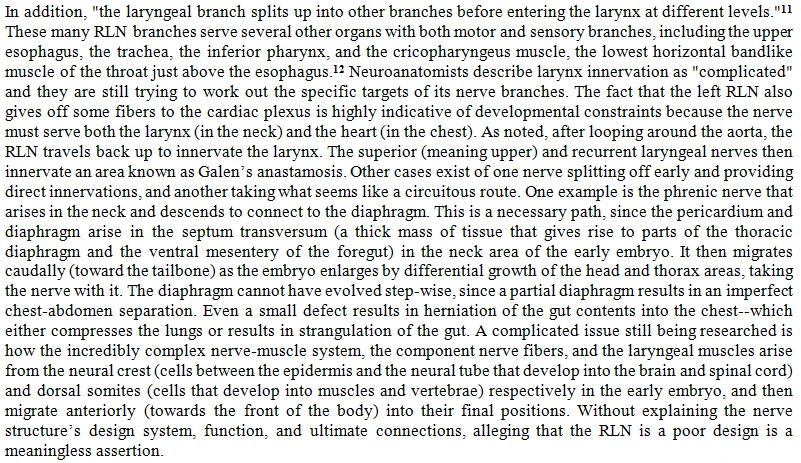
For all the above reasons, the conclusions drawn by evolutionists regarding the recurrent laryngeal nerve (RLN) are incorrect and poorly considered. Bergman commented on the so-called redundant pathway design:24

Lönnig also suggested that embryological considerations may underlie the design of the RLN:25

Another pro–intelligent design scholar privately commented to Luskin on this matter as follows:26

Lönnig therefore concluded:27
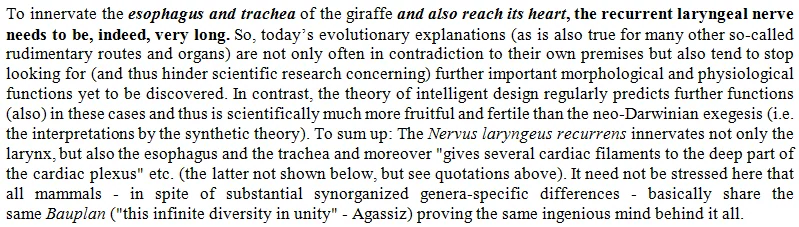
Lönnig then proceeded to present a meticulous and incisive critique of Dawkins and other evolutionists who invoke the alleged poor design of the recurrent laryngeal nerve as evidence against intelligent design.28
Furthermore, Luskin has demonstrated that the precise form of direct innervation of the larynx from the brain, as demanded by critics of intelligent design, does indeed exist. As noted earlier, Coyne, Smith, and Dawkins have all argued that the purportedly circuitous innervation of the larynx by the RLN constitutes an “imperfect design” refuting intelligent design. However, they seldom disclose that nerves directly innervate the larynx from the brain via the superior laryngeal nerve (SLN), bypassing the longer route of the RLN—precisely as they assert should exist. Thus, the larynx is innervated both from above and from below, by the SLN and the RLN respectively. This dual innervation is clearly illustrated in this diagram from the third edition of Elsevier’s Atlas of Ultrasound-Guided Regional Anesthesia.29

Luskin noted that damage to the superior laryngeal nerve can impair swallowing, yelling, singing, or proper control of voice pitch. Thus, the design favored by Coyne, Dawkins, and Smith indeed exists in our bodies, since the larynx receives direct innervation from above via the superior laryngeal nerve. As Luskin explained, the distinct medical conditions arising when the laryngeal nerves (the SLN and the RLN) are damaged suggest that the two nerves perform different functions: the SLN, innervating from above, contributes to higher-pitched sounds, whereas the RLN, innervating from below, contributes to lower-pitched sounds. Luskin observed:30

Luskin summarized the main points of his posts as follows:31

Finally, Luskin examined medical considerations regarding the intelligent design of the recurrent laryngeal nerve. He noted that Michael Egnor, a neurosurgeon and advocate of intelligent design, has proposed that the RLN may serve a medical function by alerting the organism to illness and prompting recovery from infections or diseases originating in the thoracic region. Dr. Egnor provided Luskin with insightful observations on the functional implications of the RLN’s pathway design from his perspective as a physician and medical professor:32
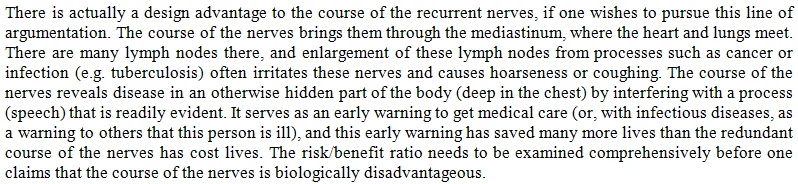
As Luskin observed, although one cannot access the designer’s mind and there is a lot scientists still do not understand about human biological development, it is equally evident that the recurrent laryngeal nerve’s pathway enables a variety of functions. As demonstrated, there is solid positive evidence for multiple important roles of the RLN. Egnor offered an elegant explanation showing that it is evolutionists who base their arguments on ignorance of developmental biology rather than on established facts:33

In summary, the recurrent laryngeal nerve serves multiple functions, not merely a single one. Its role extends well beyond innervating the larynx, and indeed the larynx receives direct innervation exactly as evolutionists predict. Again, all of this fulfils what Smith termed evidence of a “global” function, which, as he acknowledges, makes “an instance of local imperfection” (namely, the RLN’s circuitous route) more acceptable within a design argument.34 Thus, the argument against the intelligent design of the recurrent laryngeal nerve collapses. As Luskin observed: “If anything is clear here, it is that we don’t know enough to presume that the RLN is “[o]ne of nature’s worst designs” (Coyne’s words), but that we do know enough to see that it is definitely not “a very poor design for its intended purpose” (Smith’s words).”35 In conclusion, as Bergman noted, arguing that the RLN is poorly designed implies that God should have employed alternative embryonic developmental trajectories for all involved structures to avoid the nerve’s looping around the aorta. Those who assert that the RLN is a “poor design” presume the existence of a superior design—but such a claim cannot stand unless one can propose a complete alternative pathway from fertilized ovum to fetus, encompassing all molecular gradients, triggers, cascades, and anatomical modifications, that demonstrably constitutes an improved design. In the absence of this information, proponents of the “poor design” argument invoke evolution to fill gaps in our knowledge. Moreover, any hypothetical alternative developmental pathway would introduce its own constraints, likewise giving the false impression of suboptimal design. Thus, the recurrent laryngeal nerve is not poorly designed but rather constitutes clear evidence of intelligent design:36

Notes and References
- 1
Jerry A. Coyne, Why Evolution Is True, (London, England: Penguin Books, 2010), p. 81 as cited in Casey Luskin, Wolf-Ekkehard Lönnig: Under Neo-Darwinism, the Recurrent Laryngeal Nerve Must Have a Rational Design, Evolution News, 13 Oct. 2010, https://evolutionnews.org/2010/10/wolf-ekkehard_lonnig_under_neo/.
- 2
Ibid.
- 3
Kelly C. Smith, “Appealing to Ignorance Behind the Cloak of Ambiguity,” pp. 705–35 in Robert T. Pennock, Intelligent Design Creationism and Its Critics: Philosophical, Theological, and Scientific Perspectives, (Cambridge, U.S.: MIT Press, 2001), quote in p. 724 as cited in Casey Luskin, Wolf-Ekkehard Lönnig: Under Neo-Darwinism, the Recurrent Laryngeal Nerve Must Have a Rational Design, Evolution News, 13 Oct. 2010, https://evolutionnews.org/2010/10/wolf-ekkehard_lonnig_under_neo/.
- 4
Donald Prothero, Evolution: What the Fossils Say and Why It Matters, (New York, U.S.: Columbia University Press, 2008), pp. 37–38.
- 5
Jerry A. Coyne, Why Evolution is True, (London, U.K.: Penguin Books, 2010), p. 82 as cited in Casey Luskin, Wolf-Ekkehard Lönnig: Under Neo-Darwinism, the Recurrent Laryngeal Nerve Must Have a Rational Design, Evolution News, 13 Oct. 2010, https://evolutionnews.org/2010/10/wolf-ekkehard_lonnig_under_neo/.
- 6
Robert T. Pennock, Intelligent Design Creationism and Its Critics: Philosophical, Theological, and Scientific Perspectives, (Cambridge, U.S.: MIT Press, 2001) in Kelly C. Smith, “Appealing to Ignorance Behind the Cloak of Ambiguity,” pp. 705–35, quote in p. 725 as cited in Casey Luskin, Wolf-Ekkehard Lönnig: Under Neo-Darwinism, the Recurrent Laryngeal Nerve Must Have a Rational Design, Evolution News, 13 Oct. 2010, https://evolutionnews.org/2010/10/wolf-ekkehard_lonnig_under_neo/.
- 7
“Richard Dawkins Demonstrates Laryngeal Nerve of the Giraffe,” YouTube, uploaded by MysOxen, 14 Jun. 2010, https://www.youtube.com/watch?v=cO1a1Ek-HD0 as cited in Casey Luskin, Wolf-Ekkehard Lönnig: Under Neo-Darwinism, the Recurrent Laryngeal Nerve Must Have a Rational Design, Evolution News, 13 Oct. 2010, https://evolutionnews.org/2010/10/wolf-ekkehard_lonnig_under_neo/.
- 8
Donald Prothero, Evolution: What the Fossils Say and Why It Matters, (New York, U.S.: Columbia University Press, 2008), pp. 37–38.
- 9
Wolf-Ekkehard Lönnig, “The Laryngeal Nerve of the Giraffe: Does it Prove Evolution?” Dr. Wolf-Ekkehard Lönnig, last updated 19 Oct. 2010, http://www.weloennig.de/LaryngealNerve.pdf as cited in Casey Luskin, “Wolf-Ekkehard Lönnig: Under Neo-Darwinism, the Recurrent Laryngeal Nerve Must Have a Rational Design,” Evolution News, 13 Oct. 2010, https://evolutionnews.org/2010/10/wolf-ekkehard_lonnig_under_neo/.
- 10
Ibid.
- 11
Casey Luskin, “Wolf-Ekkehard Lönnig: Under Neo-Darwinism, the Recurrent Laryngeal Nerve Must Have a Rational Design,” Evolution News, 13 Oct. 2010, https://evolutionnews.org/2010/10/wolf-ekkehard_lonnig_under_neo/.
- 12
Jerry Bergman, “Recurrent Laryngeal Nerve Is Not Evidence of Poor Design,” The Institute for Creation Research (ICR), 01 Aug. 2010, https://www.icr.org/article/recurrent-laryngeal-nerve-not-evidence/.
2 T. W. Sadler, Langman’s Medical Embryology, 11th edition, (Philadelphia, U.S.: Williams & Wilkins, 2010).
- 13
Casey Luskin, “The Recurrent Laryngeal Nerve Does Not Refute Intelligent Design,” Evolution News, 14 Oct. 2010, https://evolutionnews.org/2010/10/the_recurrent_laryngeal_nerve/.
Let’s assume, for the sake of argument, that common ancestry between mammals and fish is the best explanation for the nerve’s path. Would that refute intelligent design? Evolutionary biologist Jerry Coyne assumes that intelligent design (ID) is incompatible with common ancestry, which it isn’t. As one pro-ID biologist wrote me on this topic, “this is only a problem for design if one assumes design means designed from scratch for each taxon, and if one believes that the designer would necessarily use the shortest distance between two points (in other words, that the designer thinks like we do), and that there are no other design considerations at play.” But if we set aside the question of whether evolutionary history explains the RLN’s path, it’s also never been clear to me why “imperfect design” should refute design. I’ve complained before [in another article titled: “The Human Eye is so Poorly Designed That Engineers Mimic It”] about the breakdowns and flaws I’ve had with computers, but obviously computers are designed. In fact, every piece of technology that has ever had a flaw shows that imperfect designs are still designed! “Imperfect design”–a term used by Coyne–is still design.
- 14
Henry Gray, Anatomy of the Human Body, (Washington, U.S.: Lea & Febiger, 1918), available at: “Henry Gray (1825–1861). Anatomy of the Human Body. 1918--5j. The Vagus Nerve,” Bartleby, https://www.bartleby.com/lit-hub/anatomy-of-the-human-body/5j-the-vagus-nerve/ as cited in Casey Luskin, “The Recurrent Laryngeal Nerve Does Not Refute Intelligent Design,” Evolution News, 14 Oct. 2010, https://evolutionnews.org/2010/10/the_recurrent_laryngeal_nerve/.
- 15
Wolf-Ekkehard Lönnig, “The Laryngeal Nerve of the Giraffe: Does it Prove Evolution?” Dr. Wolf-Ekkehard Lönnig, last updated 19 Oct. 2010, http://www.weloennig.de/LaryngealNerve.pdf as cited in Casey Luskin, “The Recurrent Laryngeal Nerve Does Not Refute Intelligent Design,” Evolution News, 14 Oct. 2010, https://evolutionnews.org/2010/10/the_recurrent_laryngeal_nerve/.
- 16
Ibid.
- 17
Kelly C. Smith, “Appealing to Ignorance Behind the Cloak of Ambiguity,” pp. 705–35, in Robert T. Pennock, Intelligent Design Creationism and Its Critics: Philosophical, Theological, and Scientific Perspectives, (Cambridge, U.S.: MIT Press, 2001), quote in p. 725.
- 18
Casey Luskin, “The Recurrent Laryngeal Nerve Does Not Refute Intelligent Design,” Evolution News, 14 Oct. 2010, https://evolutionnews.org/2010/10/the_recurrent_laryngeal_nerve/.
- 19
E. Blechschmidt, The Ontogenetic Basis of Human Anatomy: A Biodynamic Approach to Development from Conception to Birth, trans. B. Freeman, (New York, U.S.: North Atlantic Books, 2004), p. 188 as cited in Jerry Bergman, “Recurrent Laryngeal Nerve Is Not Evidence of Poor Design,” The Institute for Creation Research (ICR), 01 Aug. 2010, https://www.icr.org/article/recurrent-laryngeal-nerve-not-evidence/.
- 20
E. Blechschmidt, The Ontogenetic Basis of Human Anatomy: A Biodynamic Approach to Development from Conception to Birth, trans. B. Freeman, (New York, U.S.: North Atlantic Books, 2004), p. 108 as cited in Jerry Bergman, “Recurrent Laryngeal Nerve Is Not Evidence of Poor Design,” The Institute for Creation Research (ICR), 01 Aug. 2010, https://www.icr.org/article/recurrent-laryngeal-nerve-not-evidence/.
- 21
Jerry Bergman, “Recurrent Laryngeal Nerve Is Not Evidence of Poor Design,” The Institute for Creation Research (ICR), 01 Aug. 2010, https://www.icr.org/article/recurrent-laryngeal-nerve-not-evidence/.
5 G. Sturniolo et al., “The Recurrent Laryngeal Nerve Related to Thyroid Surgery,” The American Journal of Surgery, vol. 177, 1999, pp. 487–488.
6 J. L. Steinberg t al., “Anatomy of the Recurrent Laryngeal Nerve: A Redescription,” The Journal of Laryngology and Otology, vol. 100, 1986, p. 919.
- 22
Ibid.
7 T. W. Sadler, Langman’s Medical Embryology, 6th edition, (Philadelphia, U.S.: Williams & Wilkins, 1990), p. 211.
8 G. C. Schoenwolf et al., Larsen's Human Embryology, (Philadelphia, U.S.: Churchill Livingstone, 2009), p. 407.
9 T. W. Sadler, Langman’s Medical Embryology, 6th edition, (Philadelphia, U.S.: Williams & Wilkins, 1990), p. 211.
10 E. Blechschmidt, The Ontogenetic Basis of Human Anatomy: A Biodynamic Approach to Development from Conception to Birth, trans. B. Freeman, (New York, U.S.: North Atlantic Books,) 2004, p. 9.
- 23
Ibid.
11 G. Sturniolo et al., “The Recurrent Laryngeal Nerve Related to Thyroid Surgery,” The American Journal of Surgery, vol. 177, 1999, p. 487.
12 Ibid.
- 24
Ibid.
14 I. Sanders and L. Mu, “Anatomy of the Human Internal Superior Laryngeal Nerve,” The Anatomical Record, vol. 252, 1998, pp. 646–656.
15 W. G. Armstrong and J. W. Hinton, “Multiple Divisions of the Recurrent Laryngeal Nerve,” AMA Archives of Surgery, vol. 62, issue 4, 1951, p. 539.
- 25
Wolf-Ekkehard Lönnig, “The Laryngeal Nerve of the Giraffe: Does it Prove Evolution?” Dr. Wolf-Ekkehard Lönnig, last updated 19 Oct. 2010, http://www.weloennig.de/LaryngealNerve.pdf as cited in Casey Luskin, “The Recurrent Laryngeal Nerve Does Not Refute Intelligent Design,” Evolution News, 14 Oct. 2010, https://evolutionnews.org/2010/10/the_recurrent_laryngeal_nerve/.
- 26
Casey Luskin, “The Recurrent Laryngeal Nerve Does Not Refute Intelligent Design,” Evolution News, 14 Oct. 2010, https://evolutionnews.org/2010/10/the_recurrent_laryngeal_nerve/.
- 27
Ibid.
- 28
Ibid.
- 29
Andrew T. Gray, Atlas of Ultrasound-Guided Regional Anesthesia, (Philadelphia, U.S.: Elsevier Inc., 2019) as cited in Casey Luskin, “Direct Innervation of the Larynx Demanded by Intelligent Design Critics Does Exist,” Evolution News, 15 Oct. 2010, https://evolutionnews.org/2010/10/direct_innervation_of_the_lary/.
- 30
Ibid.
- 31
Casey Luskin, “Medical Considerations for the Intelligent Design of the Recurrent Laryngeal Nerve,” Evolution News, 16 Oct. 2010, https://evolutionnews.org/2010/10/medical_considerations_for_the/.
- 32
Ibid.
- 33
Ibid.
- 34
Kelly C. Smith, “Appealing to Ignorance Behind the Cloak of Ambiguity,” pp. 705–35 in Robert T. Pennock, Intelligent Design Creationism and Its Critics: Philosophical, Theological, and Scientific Perspectives, (Cambridge, U.S.: MIT Press, 2001), quote in p. 725.
- 35
Casey Luskin, “Medical Considerations for the Intelligent Design of the Recurrent Laryngeal Nerve,” Evolution News, 16 Oct. 2010, https://evolutionnews.org/2010/10/medical_considerations_for_the/.
- 36
Jerry Bergman, “Recurrent Laryngeal Nerve Is Not Evidence of Poor Design,” The Institute for Creation Research (ICR), 01 Aug. 2010, https://www.icr.org/article/recurrent-laryngeal-nerve-not-evidence/.