How much time, according to probability theory, would it take to fix two beneficial mutations in one generation?
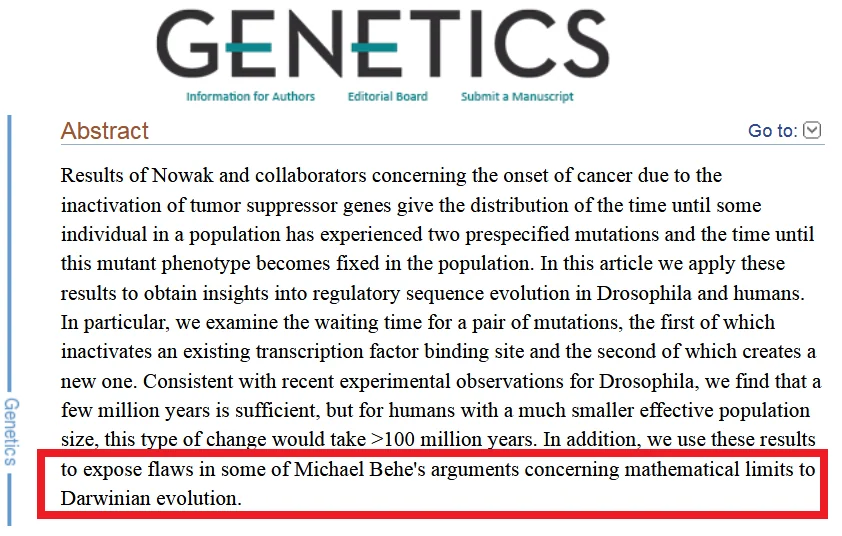
Probability theory is an advanced branch of mathematics that deals with the odds and statistics of events. It provides a mathematical framework that enables scientists to analyze chance events in a logically sound manner. A gene is said to have achieved fixation when its frequency reaches 100% in a population—at which point all individuals are homozygous for that allele until a new mutation arises. The fixation probability—the likelihood that the frequency of a particular allele will eventually reach unity—is one of the cornerstones of population genetics. According to a study published in Genetics, scientists examined the waiting time for a pair of mutations: the first inactivates an existing transcription factor binding site, and the second creates a new one. They found that while a few million years may suffice for such a change in Drosophila (commonly known as the fruit fly), the same type of change in humans would require more than 100 million years.1
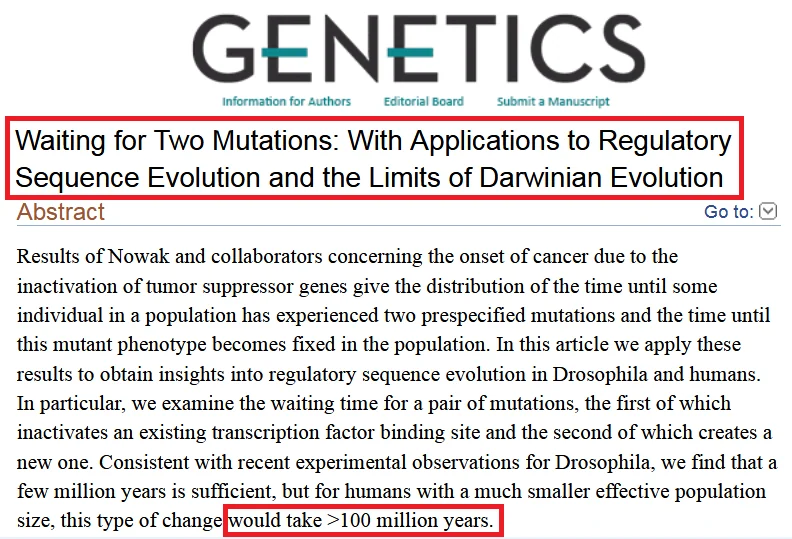
Ironically, this study was conducted in response to critics and skeptics of evolution—specifically, to purportedly “expose flaws in some of Michael Behe’s arguments concerning mathematical limits to Darwinian evolution.”2
Essentially, scientific evidence makes it clear that evolution is biologically impossible, as the fixation of just two beneficial mutations in humans would require over a hundred million years. Given that there are more than sixty million genetic differences between humans and the alleged common ancestor, Australopithecus africanus (“southern ape of Africa”), the time required for even a single new species to emerge would far exceed the age of the universe. Lynn Margulis, an American evolutionary biologist, and Dorion Sagan, an American science writer known for co-authoring numerous works on the origin of life, thermodynamics, evolution, and purpose, acknowledged that no direct evidence has ever been found for the emergence of a new species—neither on the remote Galapagos Islands, nor in fruit fly laboratories, nor in sediment layers.3 The compelling and definitive evidence for evolution remains absent; what scientists have observed are merely variations within the same species. A case in point is the peppered moths of 19th-century England during the Industrial Revolution, which do not constitute proof of evolution. As we shall demonstrate, genetic evidence indicates that the changes in the coloration of peppered moths support creation—these color changes appear to be engineered. The classic account of the British peppered moth (Biston betularia) stands as one of the most iconic examples often cited in support of evolutionary theory. The story centers on a supposed evolutionary process termed “industrial melanism” (melanin being the pigment responsible for dark coloration, as in humans). According to Darwinists, this phenomenon illustrates the Darwinian model of evolution: a species exhibits phenotypic variation (light and dark forms), upon which natural selection can act. In this scenario, it is claimed that birds prey selectively on more conspicuous moths, and as the background environment changes, the moth population correspondingly evolves.
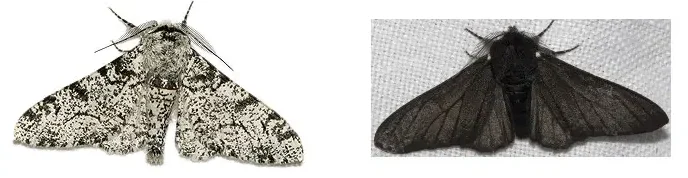
To begin with, peppered moths exist in two forms: the “typica” form, which is ash-grey with black, pepper-like speckling, and the darker form, known as “carbonaria.” The illustration depicts the light-colored variant on the left and the dark-colored variant on the right.
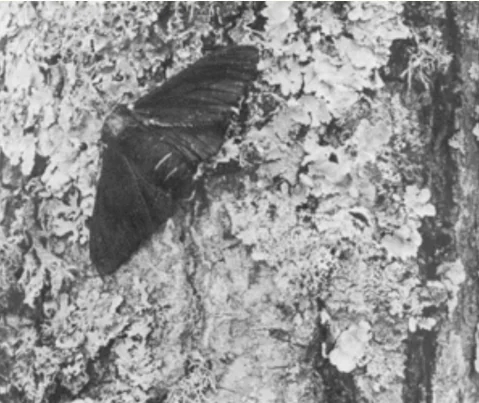
The textbook narrative about peppered moths is as follows: the lighter-colored moths could camouflage themselves against lichen-covered tree trunks, while the darker ones were more easily spotted and eaten by birds due to their higher visibility. In this image, both the light and dark forms of the peppered moth are shown on a lichen-covered tree trunk in an unpolluted area of England. The light form is difficult to discern, whereas the dark form is highly conspicuous.
Pollution from the Industrial Revolution in England between 1850 and 1920 killed off the lichens on the tree trunks, exposing the darker-coloured bark. It is claimed that once this happened, the darker-coloured moths had the advantage of camouflage, and thus they survived more readily, while the lighter-coloured ones were more likely to be eaten by the birds. This figure shows the same two forms as in the previous figure, but photographed against the trunk of an oak tree blackened by the polluted air of Birmingham, England. In this case the dark form is hard to see, while the light form is conspicuous.

It is said that, as tree trunks darkened due to industrial pollution, the white-colored moths resting on them became easy prey for birds. Then, by chance, a random mutation occurred that caused some moths to turn black. As a result, natural selection began to favor the darker moths while selecting against the lighter ones. Consequently, the black moths came to dominate the population until the period of heavy coal burning came to an end. After 1950, the implementation of pollution controls improved air quality, allowing lichen to regrow on the trees. This led to a resurgence of the lighter moths. Moths were collected using traps, enabling researchers to monitor changes in their numbers. H. B. D. Kettlewell, a British geneticist at Oxford University, conducted the majority of the classic experiments on peppered moths between 1952 and 1972.4 Kettlewell stated: “Had Darwin observed industrial melanism he would have seen evolution occurring not in thousands of years but in thousands of days-well within his lifetime. He would have witnessed the consummation and confirmation of his life’s work.”5
The above evolutionary account is fraught with problems, as Carl Wieland—one of the pioneers of the modern creation movement in Australia—documented in 1999.6 Wieland asserted that the case demonstrates nothing more than a shift in gene frequencies—by natural selection—within a single created kind. As he explained, it offers nothing that could, even over millions of years, contribute the kind of complex design information required for amoeba-to-man evolution. The first flaw in this evolutionary narrative involves factual distortions concerning whether peppered moths actually spend significant time on tree trunks, where they would be vulnerable to predation by birds.7 Simply put, biologists observed that peppered moths do not rest on tree trunks during the day. Rather, like most moths, they typically hide beneath twigs in the upper canopy of trees.

Oddly enough, it took evolutionists 50 years to realize that no one had ever actually observed peppered moths resting on tree trunks! After all, why would moths of any color choose to spend their resting hours exposed in the open? Kettlewell and others attracted the moths into forest traps either using light or by releasing female pheromones—and in both cases, the moths only flew in at night. Cyril Clarke, a British physician, geneticist, and lepidopterist who extensively studied the peppered moth, wrote:8

All the famous photos of light and dark moths resting on lichen-covered tree trunks were staged—dead moths were either pinned or glued onto logs or trunks.

The moths filmed being eaten by birds were either dead specimens or laboratory-bred individuals that Kettlewell had placed onto tree trunks during the daytime. Wieland noted that these moths were so lethargic that Kettlewell once had to warm them on his car bonnet (hood).9 That is, Kettlewell released laboratory-bred moths onto tree trunks while they were in a state such that they may not have naturally rested on the tree trunks. The paper also described how dead moths were glued to the bark of trees.10 Imagine the backlash if creationists had done something similar to support creation! Theodore Sargent—Professor Emeritus of Biology at the University of Massachusetts Amherst—assisted in gluing moths onto trees for a NOVA television documentary intended to illustrate “evolution in action.” Sargent acknowledged that the setup was entirely artificial and admitted that textbooks and films have included “a lot of fraudulent photographs.”11 He believes that Dr. Kettlewell’s experiments produced a wholly artificial scenario—moths placed in unnatural positions and birds that quickly learned they were being offered a free meal in the woods.
The second problem with the narrative is that the population of light-colored moths began to increase after pollution had declined in the 1950s—yet this occurred before the light-colored lichen had returned to the tree trunks.12 Other studies have demonstrated a very weak correlation between lichen coverage and the corresponding moth populations. In one experiment, researchers glued dead moths to tree trunks in an unpolluted forest; as expected, birds consumed more of the dark-colored (less camouflaged) moths. However, the researchers’ traps captured four times as many dark moths as light ones—the exact opposite of what textbooks had predicted.13 The bottom line is that the shift in the frequency of the two forms of peppered moths—even if the traditional account involving tree trunks were entirely accurate—cannot be regarded as evidence of evolution in action. The biological reality of the matter can be summarized in three points: Prior to the Industrial Revolution, genetic information existed for both dark and light-colored moths; during the peak of industrial pollution, genetic information still existed for both forms; and today, that same genetic information remains. The only change has been in the relative proportions of the two. In other words, the genetic information was already present in the moth populations from the outset. Thus, the change in the ratio of light to dark moths reflects natural selection alone—not evolution—and this form of natural selection does not amount to the kind of evolution that progresses from simple organisms to human beings.14
Hence, all that is actually occurring is a fluctuation in the frequency of existing gene variants over time. No new gene variants are being generated—yet such innovation is essential for evolution to take place. The decline of darker-colored moths after 1950, as air quality improved, undermines the claim that peppered moths are evolving into a new species, let alone into a fundamentally different type of insect, even given vast stretches of time. The moths have always remained moths, merely shifting in form in response to environmental changes. In fact, the way evolutionists extrapolated from a mere shift in gene frequencies—which, at best, is what industrial melanism would demonstrate—to a sweeping “proof of evolution” is deeply troubling. For most people, the term “evolution” implies the grand narrative that matter has ultimately transformed into human beings. As Marc Ambler noted, to argue that because evolution requires a change in gene frequencies, the demonstration of such a change proves evolution, is a textbook example of the logical fallacy of affirming the consequent.15 Even Pièrre-Paul Grassé—a prominent evolutionist and longtime holder of the Chair of Evolution at the Sorbonne University in Paris—emphasized that while mutations and selection can indeed occur in organisms such as bacteria, resulting in changes in gene frequencies, this merely represents a shift to the left or to the right, without any meaningful long-term outcome.16 Likewise, the moths shifted toward darker forms in response to pollution, and as the air gradually cleared over the decades, the population generally reverted to a state in which the lighter forms once again predominated. There has been absolutely no net evolutionary change—no generation of novel traits as required by the theory of evolution.17 Once again, the central point is that the genetic information for both light-colored and dark-colored moths already existed within the moth population in England prior to the Industrial Revolution—that is, the variation did not arise from a mutation.
Another issue with the evolutionary account lies in its overt personification of nature—treating it as if it possesses agency to “select” for or against different-colored moths, which is scientifically inappropriate. Moreover, recent research raises questions about whether the so-called “mutation” responsible for black coloration was merely a fortunate accident or something more complex. A 2011 article in the journal Science asserted that a “recent mutation” is responsible for the dark coloration in peppered moths:18

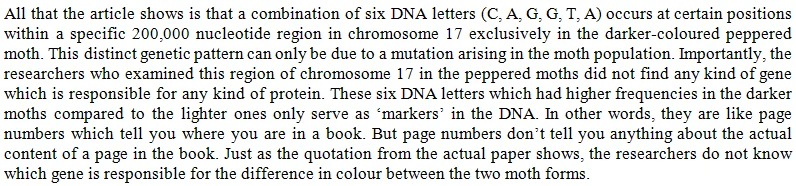
Now, with the added element of mutation alongside natural selection, evolutionists are presenting the peppered moths as a legitimate example of evolution. In doing so, they are adopting a new approach—shifting the focus from observable traits and ecological factors to the genetic background of the peppered moths. This shift is significant for them, as they seek to preserve one of the most iconic examples used to promote their theory. However, the 2011 paper in question does not prove evolution. In fact, it opens with the following telling statement:19

Dr. Matthew Cserhati—who holds a PhD in biology, has a strong interest in molecular biology, and has been an active creationist for 18 years—explained:20
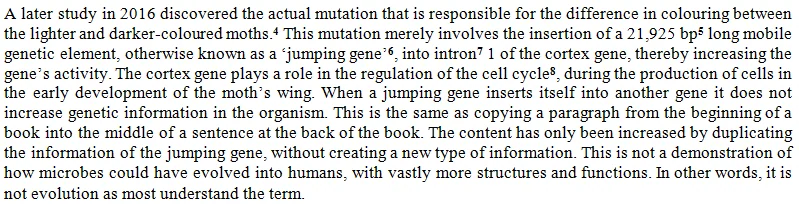
But the story does not end there. In 2016, a genetic research team led by Ilik J. Saccheri—Professor of Ecological Genetics at the University of Liverpool, England, specializing in evolution, ecology, and behaviour—discovered that the black coloration was caused by the insertion of a “transposable element” in the DNA.21

Cserhati commented on this study, stating:22
In fact, mobile genetic elements—also known as transposons—are quite common:23

In summary, the following points can be made regarding the genetic analysis of industrial melanism in the peppered moth:24
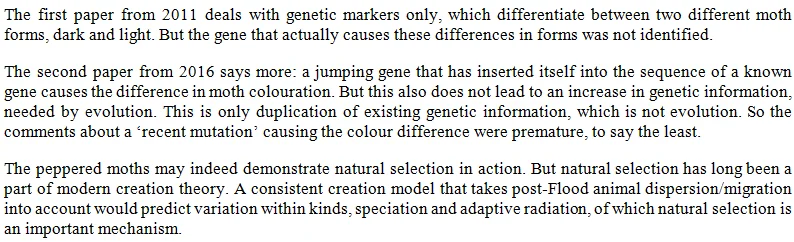
Cserhati concluded:25

Saccheri’s team expanded their research in 2019, revealing that peppered moths were not the only moth species to respond to pollution with an increase in the frequency of the black form.26

Another observation casts doubt on whether the response to pollution was the result of an accidental mutation—namely, the fact that these three moth species were not the only ones to exhibit such a response. A press release by the University of Liverpool, featuring commentary from Saccheri, highlighted the widespread nature of the dark coloration response to pollution, stating:27

Randy Guliuzza—a leading theorist in biological design—summarized the findings that might lead a scientist not only to question whether black coloration results from an accidental mutation, but also to consider the possibility of a regulated mechanism: genetic hotspots for wing coloration, coloration master switches, transposable elements consistently located within the same gene regulatory region, and a rapid, widespread response observed across dozens of species. Guliuzza, who serves as president of the Institute for Creation Research (ICR), is actively advancing ICR’s scientific research and spearheading the critical effort to develop a theory of biological design as a more scientifically grounded alternative to selectionism for explaining biological functions.28 As Guliuzza explained, the theory serves as a working hypothesis for how the biological phenomena of growth, metabolism, reproduction, and adaptation operate. He further noted that a central premise of this theory is that biological functions are best understood through the lens of engineering principles. From this framework emerged a design-based, organism-centered model to explain the type of adaptation observed in these studies, known as Continuous Environmental Tracking (CET). The latter proposes that organisms employ the same fundamental system components found in human-engineered tracking systems—such as sensors and logic mechanisms—to generate appropriate responses to environmental changes. Guliuzza maintained that, based on current evidence, the rapid and predictable responses seen across so many moth species could be interpreted as support for a regulated CET response.29 Jerry A. Coyne—Emeritus Professor in the Department of Ecology and Evolution at the University of Chicago and a prominent defender of evolution against proponents of intelligent design—proposed abandoning the peppered moths as a well-established example of natural selection in action. In a 1998 review of geneticist M. E. N. Majerus’s Melanism: Evolution in Action—a book in which Majerus acknowledged that many of the famous photographs of peppered moths resting on tree trunks were staged—published in Nature, Coyne asserted that the peppered moth story, once “the prize horse in our stable of examples” of natural selection, must now be discarded. He remarked that the revelations surrounding the narrative gave him the same feeling he experienced upon learning that Santa Claus was not real and that it had been his father who placed the presents. He wrote: “My own reaction resembles the dismay attending my discovery, at the age of six, that it was my father—and not Santa—who brought the presents on Christmas Eve.”30 Funnily enough, seemingly frustrated that creationists were making effective use of his remarks, Coyne quickly backpedaled—asserting that the peppered moths still represent a valid example of evolution.31 It has been alleged that creationists took Coyne’s quotation out of context—a classic tactic often employed by politicians. In reality, however, Coyne’s remarks went well beyond merely “pointing out some cautions,” as is evident from his statements in both the aforementioned article and book review. Even Leonard Harrison Matthews—a biologist of such stature that he was invited to write the foreword to the 1971 edition of Darwin’s Origin of Species—acknowledged that the observations on the peppered moth demonstrated natural selection, but not “evolution in action.”32 Clearly, Matthews—like many other evolutionists at the time—was content to regard the peppered moths as an example of selection in action, which, notably, poses no difficulty for creationists either. It is therefore worth highlighting what he stated in that foreword:33

It should be understood that while selection is a significant component of evolutionary theory, it is not synonymous with evolution itself. Nevertheless, many evolutionists—including Kettlewell—write as though the two are interchangeable, thereby creating confusion for the general public.34 It is important to distinguish between natural selection as an observable and logically sound process, and the broader concept of “goo-to-you” evolution.35 The evolutionary narrative requires the creative addition of new genetic information, whereas natural selection merely acts as a filter—eliminating existing information rather than generating anything new.36 In other words, natural selection operates through the loss of genetic information, not its creation. Needless to say, new information must have an origin. Evolutionists turn to mutations as the proposed source, but this is precisely where significant challenges arise—and where the core issue lies with the alleged mechanism of evolution.37 Journalist Judith Hooper—author of Of Moths and Men: Intrigue, Tragedy and the Peppered Moth, a book chronicling the moth saga—highlighted the serious doubts surrounding aspects of Kettlewell’s findings—results that others have been unable to replicate. Pointing out that his field notes had conveniently disappeared, she remarked, “The unspoken possibility of fraud hangs in the air.”38 Unfortunately, hundreds of millions of students have once again been indoctrinated with a so-called “proof” of evolution—one riddled with errors, fraud, and half-truths.39 Generations of evolutionists have been raised on the peppered moth story—hailed as the ultimate triumph of Darwinism, evolution captured in action—despite its overwhelming stench of incompetence, naïveté, and outright fraud. In reality, however, it stands as yet another typical myth from the fairy tale book of evolution.
Evolutionists frequently present examples of natural selection as proof of evolution—highlighting changes in size, color, skin patterns, and shape as though they constitute evolution’s honor roll. This bait-and-switch tactic has been exposed so often that it is remarkable evolutionists still rely on it—or that people continue to be misled by it. The very term natural selection should alert readers that something is missing. Quite simply, in everyday usage, “selection” implies choosing from what already exists. Marc Ambler offered a helpful analogy: selecting cards from a pack.40 This illustration applies equally to “selection” in the biological context. Allāh, the All-Wise Creator, knew the various environments His creatures would encounter and need to adapt to in order to survive. Accordingly, He embedded within the genetic information of each “kind” of creature He created a rich array of variation in their biological makeup. This includes traits that interact with the environment—such as the overall size of a plant, animal, or person; the size of individual organs or limbs (such as beaks and noses); leaf dimensions; skin color; hair and feather length, texture, and coloration. All of these features, and many more, were programmed into the DNA of His creatures so that, as populations of different kinds dispersed into new environments, the expression of these preexisting variations enabled individuals to survive and thrive. Those possessing favorable traits passed them on to their offspring. When the expression of certain variations becomes distinct and consistent within a specific habitat, we may classify these populations as separate “species.” Yet, as previously stated, throughout this process of selection, no new genetic information is ever introduced. It may be conserved or lost—but never created. In essence, the astonishing phenomenon of variation reflects the providence of the All-Wise, All-Knowing, and Supremely Ingenious Creator. Whether variation is selected naturally by environmental pressures or artificially by breeders seeking specific traits, it remains exactly that: selection from already existing genetic information—nothing genuinely new is produced. Genetic engineering—also known as genetic modification or manipulation—involves laboratory techniques used to alter an organism’s DNA. While such methods have resulted in, for example, high-yield beef cattle and protein-rich corn, cattle remain cattle and corn remains corn. That is, although genetic changes may occur through mutations or genetic drift, there is no evidence that one species can ever transform into another. The probability of such a transition occurring—even over billions of years—is effectively zero. Unquestionably, when scientists operate within the realm of operational science—dealing with phenomena that are observable, testable, and repeatable—they have never witnessed a species turning into another. In fact, in many living organisms, the extent of biological variation appears to have been exhausted to its limit—yet no new species has emerged.41 Evolutionists are not presenting the most critical part of the evolutionary narrative: mutations must supply the raw material upon which natural selection can act. As Scott F. Gilbert—an American evolutionary developmental biologist and historian of biology—John M. Opitz—a German-American medical geneticist and professor at the University of Utah School of Medicine—and Rudolf A. Raff—a pioneering experimental biologist in the emerging field of evolutionary developmental biology—wrote: “The Modern Synthesis is a remarkable achievement. However, starting in the 1970s, many biologists began questioning its adequacy in explaining evolution. Genetics might be adequate for explaining microevolution, but microevolutionary changes in gene frequency were not seen as able to turn a reptile into a mammal or to convert a fish into an amphibian. Microevolution looks at adaptations that concern only the survival of the fittest, not the arrival of the fittest. As Goodwin (1995) points out, “the origin of species—Darwin’s problem—remains unsolved.”42 What evolution truly requires is an inventive step—the emergence of a novel organ or body part—facilitated by new information in the DNA that did not previously exist. The reality, however, is that despite the vast resources devoted to evolutionary research in universities and scientific institutions, natural selection has never been shown to produce this kind of inventive step. Today, evolutionists point to mutations as the mechanism that introduces such novelty, from which natural selection purportedly selects. Hence, they should focus on mutations—not natural selection—when attempting to defend their theory. Yet when creationists challenge evolutionists to provide examples of novel genetic information or entirely new organs arising by mutation, they are often presented with cases like wingless beetles on islands or the flightless cormorant of the Galápagos. The flaw in these examples is readily apparent: although such traits may offer a specific advantage in an unusual environment, they do not involve the addition of new information to the DNA or the creation of new body parts. Rather, they represent a loss or degradation of existing genetic information. As Marc Ambler aptly observed, evolution is in desperate need of Natural Invention, Natural Novelty, and Natural Creation, because Natural Selection alone simply does not pass muster as exhibit A for evolution. Rather, it is a wonderful tribute to God’s design and His providence.43
The peppered moth icon of evolution has been exposed for what it truly is—at best, a highly trivial example of natural selection, and certainly not the definitive proof of Darwin’s theory. Nevertheless, many evolutionists remain staunch defenders of the textbook narrative surrounding the peppered moth, despite its falsehoods—or, to put it more mildly, its abundance of half-truths. They rush to defend it, flaws and all, as though their very “religion” depended on it. Regrettably, this reflects their uncritical acceptance of evolution, which carries the real danger of leading them to see what they believe. As a result, we are presented with oversimplified portrayals—such as the textbook version of peppered moth “evolution”—that reduce science to dogma. In their effort to demonstrate natural selection at work, evolutionists tacitly weave the theory into the description of the phenomena, and what they put in, they conveniently get back out. Rudolf Steiner identified this as a fundamental danger within science:44

Unfortunately, although Steiner wrote these words in 1886,45 they remain as relevant today as ever. For decades, the peppered moth has served as a standard classroom and textbook example of evolution. This so-called “living proof” of natural selection has been—and continues to be—taught to millions of students. Evolutionists have propped up the moth narrative not only with inadequate methodologies, but also with staged photographs, all in an effort to indoctrinate students and leave them believing they have witnessed a process that generates biological novelty. Indeed, the idea of natural selection has become so deeply embedded in the thinking of modern evolutionists that it functions like a pair of spectacles they no longer remove—thus turning science into dogma. In short, evolutionary theory has long been, and continues to be, a hope maintained in defiance of empirical and observational evidence. In fact, even referring to it as a “theory” in the absence of firmly established evidence is problematic. The Nobel Prize–winning scientist Ernst Chain, whose professional life included sustained engagement with the validity of Darwin’s theory of evolution, ultimately concluded that it is a “very feeble attempt” to explain the origin of species—resting on assumptions so flimsy, “mainly of morphological and anatomical nature,” that “it can hardly be called a theory.”46
Notes and References
- 1
Rick Durrett and Deena Schmidt, “Waiting for Two Mutations: with Applications to Regulatory Sequence Evolution and the Limits of Darwinian Evolution,” Genetics, vol. 180, issue 3, 1 Nov. 2008, pp. 1501–9. DOI: https://doi.org/10.1534/genetics.107.082610.
- 2
Ibid.
- 3
Margulis Lynn & Sagan Dorion, Acquiring Genomes: A Theory of the Origins of Species, (New York, U.S.: Basic Books, 2008), p. 32 as cited in William Dembski and Jonathan Wells, The Design of Life: Discovering Signs of Intelligence in Biological Systems, (Dallas, U.S.: Richardson, Foundation for Thought and Ethics, 2008).
- 4
H. B. D. Kettlewell, “Selection Experiments on Industrial Melanism in the Lepidoptera,” Heredity, vol. 9, 1 Dec. 1955, pp. 323–342. DOI: https://doi.org/10.1038/hdy.1955.36.
- 5
H. B. D. Kettlewell, “Darwin’s Missing Evidence,” Scientific American, 1 Mar. 1959, https://www.scientificamerican.com/article/darwins-missing-evidence-1959-03/ in Leo F. Laporte, Evolution and the Fossil Record, Readings from Scientific American, (San Francisco, U.S.: W. H. Freeman and Company, 1978), p. 33.
- 6
Carl Wieland, “Goodbye, Peppered Moths: A Classic Evolutionary Story Comes Unstuck,” Creation, vol. 21, issue 3, June 1999, https://creation.com/goodbye-peppered-moths.
- 7
Kauri Mikkola, “On the Selective Forces Acting in the Industrial Melanism of Biston and Oligia Moths (Lepidoptera: Geometridae and Noctuidae),” Biological Journal of the Linnean Society, vol. 21, issue 4, Apr. 1984, pp. 409–421. DOI: https://doi.org/10.1111/j.1095-8312.1984.tb01602.x; Judith Hooper, Of Moths and Men: An Evolutionary Tale: The Untold Story of Science and the Peppered Moth, (New York, U.S.: W. W. Norton and Co., 2002), p. 377.
- 8
C. A. Clarke et al., “Evolution in Reverse: Clean Air and the Peppered Moth,” Biological Journal of the Linnean Society, vol. 26, issue 2, Oct. 1985, pp. 189–199, https://doi.org/10.1111/j.1095-8312.1985.tb01555.x, quote on p. 197.
- 9
Calgary Herald, 21 Mar. 1999, p. D3 as cited in Carl Wieland, “Goodbye, Peppered Moths: A Classic Evolutionary Story Comes Unstuck,” Creation, vol. 21, issue 3, June 1999, https://creation.com/goodbye-peppered-moths.
- 10
D. R. Lees and E. R. Creed, “Industrial Melanism in Biston Betularia: The Role of Selective Predation,” Journal of Animal Ecology, vol. 44, 1975, pp. 67–83 as cited in Carl Wieland, “Goodbye, Peppered Moths: A Classic Evolutionary Story Comes Unstuck,” Creation, vol. 21, issue 3, June 1999, https://creation.com/goodbye-peppered-moths.
- 11
J. A. Coyne, “Not Black and White,” Nature, vol. 396, issue 6706, 1998, pp. 35–36; The Washington Times, 17 Jan. 1999, p. D8 as cited in Carl Wieland, “Goodbye, Peppered Moths: A Classic Evolutionary Story Comes Unstuck,” Creation, vol. 21, issue 3, June 1999, https://creation.com/goodbye-peppered-moths.
- 12
Matthew Cserhati, “More of the Moth Myth! Genetic Evidence Show that Peppered Moths Support Creation,” Creation.com, 2 June 2020, https://creation.com/more-of-the-moth-myth.
- 13
D. R. Lees and E. R. Creed, “Industrial Melanism in Biston Betularia: The Role of Selective Predation,” Journal of Animal Ecology, vol. 44, 1975, pp. 67–83 as cited in Carl Wieland, “Goodbye, Peppered Moths: A Classic Evolutionary Story Comes Unstuck,” Creation, vol. 21, issue 3, June 1999, https://creation.com/goodbye-peppered-moths.
- 14
Marc Ambler, “Natural Selection ≠ Evolution,” Creation, vol. 34, issue 2, Apr. 2012, pp. 38–39, https://creation.com/natural-selection-evolution.
This is an important ‘equation’ that all people should be aware of, namely ‘Natural Selection does not equal (≠) Evolution’. Christians [and all believers in God] should know it so they do not get conned, and evolutionists should know it as a reminder that they still have lots of work to do to be able to claim that they have a mechanism for evolution.
- 15
Ibid.: For me to be a good driver requires that I have good eyesight. I can demonstrate that I have good eyesight. Therefore, I am a good driver. That should be amply clear from such articles on this site as Muddy Waters, The Evolution train's a-comin', and Beetle Bloopers. A biblical creation model would also predict changing gene frequencies with time, but within the limits of the original kind plus the addition of (mostly information-losing) mutations.
- 16
Carl Wieland, “More about Moths,” Creation.com, https://creation.com/more-about-moths.
- 17
Ibid.
- 18
Arjen E. van't Hof et al., “Industrial Melanism in British Peppered Moths has a Singular and Recent Mutational Origin,” Science, vol. 332, issue 6032, 11 Apr. 2011, pp. 958–60. DOI: https://doi.org/10.1126/science.1203043.
- 19
Ibid., (emphasis added).
- 20
Matthew Cserhati, “More of the Moth Myth! Genetic Evidence Show that Peppered Moths Support Creation,” Creation.com, 2 June 2020, https://creation.com/more-of-the-moth-myth.
- 21
Arjen E. van't Hof et al., ‘The Industrial Melanism Mutation in British Peppered Moths is a Transposable Element,” Nature, vol. 534, issue, 7605, 1 June 2016, pp.102–5. DOI: https://doi.org/10.1038/nature17951.
- 22
Matthew Cserhati, “More of the Moth Myth! Genetic Evidence Show that Peppered Moths Support Creation,” Creation.com, 2 June 2020, https://creation.com/more-of-the-moth-myth.
4 Arjen E. van't Hof et al., “The Industrial Melanism Mutation in British Peppered Moths is a Transposable Element,” Nature, vol. 534, issue, 7605, 1 June 2016, pp.102–5. DOI: https://doi.org/10.1038/nature17951.
5 Bp = base pair, a single DNA letter. 6 Also known as a ‘transposon’. 7 The sequence of a gene is made up of alternating sections of DNA called exons and introns. Exons are those parts of the genes which are cut out and which make up the messenger RNA (mRNA). Introns are those parts of the genes which are not translated into protein. Despite this fact, introns can take part in the regulation of the gene they are located in. 8 The cell cycle is a process whereby the cell duplicates its internal components, such as its cell organelles and its DNA to produce two daughter cells.
- 23
Ibid.
9 Ana Barahona, “Barbara McClintock and the Transposition Concept,” Archives internationales d'histoire des sciences, vol. 46, issue 137, Dec. 1997, pp. 309–29.
- 24
Matthew Cserhati, “More of the Moth Myth! Genetic Evidence Show that Peppered Moths Support Creation,” Creation.com, 2 June 2020, https://creation.com/more-of-the-moth-myth.
- 25
Ibid.
- 26
Randy Guliuzza, “Peppered Moth Color Changes Are Engineered,” Institute for Creation Research, 25 Feb. 2020, https://www.icr.org/article/peppered-moth-changes-engineered.
- 27
“‘Industrial Melanism’ Linked to Same Gene in Three Moth Species,” University of Liverpool, 16 Oct. 2019, https://news.liverpool.ac.uk/2019/10/16/industrial-melanism-linked-to-same-gene-in-three-moth-species/ as cited in ibid.
- 28
Randy Guliuzza, “Engineered Adaptability: Adaptive Changes Are Purposeful, Not Random,” Acts & Facts, vol. 47, issue 6, 31 May 2018, pp. 17–19, https://www.icr.org/article/adaptive-changes-purposeful-not-random.
- 29
Randy Guliuzza, “Peppered Moth Color Changes Are Engineered,” Institute for Creation Research, 25 Feb. 2020, https://www.icr.org/article/peppered-moth-changes-engineered.
- 30
Jerry A. Coyne, “Not Black and White [Review of Melanism: Evolution in Action by M. E. N. Majerus],” Nature, vol. 396, issue 6706, 5 Nov. 1998, pp. 35–36.
- 31
Carl Wieland, “The Moth Files: An Update on the Peppered Moth Fiasco,” Creation, vol. 25, issue 1, Dec. 2002, pp. 14–15, https://creation.com/the-moth-files.
- 32
As cited in Carl Wieland, “Goodbye, Peppered Moths: A Classic Evolutionary Story Comes Unstuck,” Creation, vol. 21, issue 3, June 1999, https://creation.com/goodbye-peppered-moths.
- 33
Carl Wieland, “More about Moths,” Creation.com, https://creation.com/more-about-moths.
- 34
Carl Wieland, “Muddy Waters: Clarifying the Confusion about Natural Selection,” Creation, vol. 23, issue 3, June 2001, pp. 26–29, https://creation.com/muddy-waters.
- 35
“From goo to you, by way of the zoo” is a humorous simplification of the evolutionary narrative, describing the supposed progression from simple life forms, to marine organisms, to early mammals, to primates, and ultimately to humans.
- 36
Carl Wieland, “The Moth Files: An Update on the Peppered Moth Fiasco,” Creation, vol. 25, issue 1, Dec. 2002, pp. 14–15, https://creation.com/the-moth-files.
- 37
Carl Wieland, “Beetle Bloopers,” Creation, vol. 19, issue 3, pp. 30, Dec. 1997, https://creation.com/beetle-bloopers.
- 38
Peter D. Smith, “Darwinism in a Flutter,” The Guardian, 11 May 2002, p. 1011, https://www.theguardian.com/books/2002/may/11/scienceandnature.highereducation; Nicholas Wade, “Staple of Evolutionary Teaching May Not Be Textbook Case,” The New York Times, 18 June 2002, https://www.nytimes.com/2002/06/18/science/staple-of-evolutionary-teaching-may-not-be-textbook-case.html.
- 39
Theodore D. Sargent et al., “The “Classical” Explanation of Industrial Melanism: Assessing the Evidence,” in M. K. Hecht et al., Evolutionary Biology, vol. 30, pp. 299–322, (New York, U.S.: Plenum Press, 1998): Unfettered by evolutionary ‘just so’ stories, researchers can now look for the real causes of these population shifts. Might the dark form actually have a function, like absorbing more warmth? Could it reflect conditions in the caterpillar stage? In a different nocturnal moth species, Sargent has found that the plants eaten by the larvae may induce or repress the expression of such ‘melanism’ in adult moths.
- 40
Marc Ambler, “Natural Selection ≠ Evolution,” Creation, vol. 34, issue 2, Apr. 2012, pp. 38–39, https://creation.com/natural-selection-evolution: Think of being asked to select cards from a pack. You could select cards from a pack every second for the rest of your life and all you would only ever produce is different groups of the same cards. You would not have created anything new—only re-arranged cards, or removed cards or added cards from another pack. If an illusionist asks you to select a card from a pack, and surprises you with something new, you know it is an illusion, a sleight of hand. We need to learn to see the evolutionists’ sleight of hand when they claim to have pulled something ‘new’ out of the pack. Selection is always from a pre-existing series or range; it creates nothing new.
- 41
William Dembski and Jonathan Wells, The Design of Life: Discovering Signs of Intelligence in Biological Systems, (Dallas, U.S.: Richardson, Foundation for Thought and Ethics, 2008).
- 42
Scott F. Gilbert et al., “Resynthesizing Evolutionary and Developmental Biology,” Developmental Biology, vol. 173, issue 2, 1 Feb. 1996, p. 357–372.
- 43
Marc Ambler, “Natural Selection ≠ Evolution,” Creation, vol. 34, issue 2, Apr. 2012, pp. 38–39, https://creation.com/natural-selection-evolution.
- 44
Rudolf Steiner, The Science of Knowing, trans. William Lindeman, (Spring Valley, U.S.: Mercury Press, 1988), p. 31, as cited in Craig Holdrege, “Science as Process or Dogma? The Case of the Peppered Moth,” Elemente der Naturwissenschaft, vol. 70, 1999, pp. 39–51. DOI: https://doi.org/10.18756/edn.70.39 reprinted with permission in The Nature Institute, https://www.natureinstitute.org/article/craig-holdrege/science-as-process-or-dogma-the-case-of-the-peppered-moth.
- 45
The first edition of his book The Science of Knowing was originally published in German in October 1886.
- 46
Ronald William Clark, The Life of Ernst Chain: Penicillin and Beyond, (New York, U.S.: St. Martin’s Press, 1986), p. 147.