Is it not possible that our universe is simply the one, among many parallel universes, that happens to support life by chance? Why not?
In recent years, atheist scientists have advanced the multiverse theory in an effort to explain away the fine-tuning of the universe. According to this theory, our universe is not the only one; rather, countless universes exist parallel to each other. Each of these universes is said to possess different properties and distinct values for the fundamental constants of physics, with only a few being suitable for life. Proponents argue that if the number of universes is vast enough, it becomes less surprising that one of them—namely, ours—would happen to have the precise conditions necessary for life. However, some cosmologists question whether the multiverse theory even falls within the domain of science. They argue that invoking it as an explanation undermines the very foundation of scientific reasoning, since the existence and properties of these other universes are virtually impossible to verify or falsify. John Polkinghorne, a prominent theoretical physicist, remarked on the multiverse: “Let us recognize these speculations for what they are. They are not physics, but in the strictest sense, metaphysics. There is no purely scientific reason to believe in an ensemble of universes. By construction these other worlds are unknowable by us. A possible explanation of equal intellectual respectability — and to my mind greater economy and elegance — would be that this one world is the way it is, because it is the creation of the will of a Creator who purposes that it should be so.”1 Moreover, the prominent British nuclear physicist Russell Stannard stated: “Please write down the equation. I can write down Schrödinger’s equation of quantum mechanics, I can write down Newton’s law of gravitation. You write down the equation which is M-theory. They can’t. Because they haven’t got one.”2

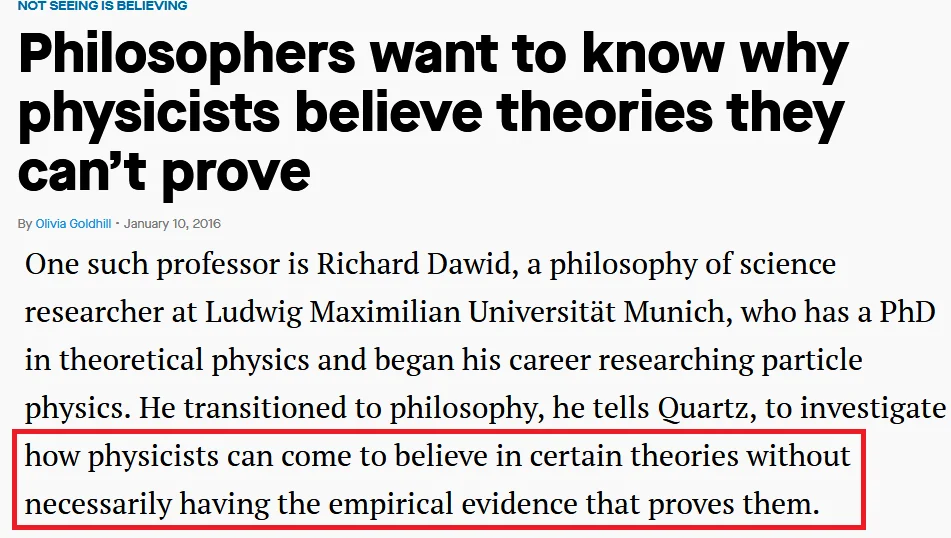
The multiverse theory enjoys no observational support whatsoever, and there is absolutely no empirical evidence for it. It is indeed absurd that some atheist scientists believe in and promote theories they cannot prove. Professor Richard Dawid, a researcher in the philosophy of science and a theoretical physicist, asked Quartz to investigate how physicists can come to believe in certain theories without necessarily having the empirical evidence to support them.3
Interestingly, even if multiple universes existed, they would still remain causally isolated—that is to say, each universe would be an independent event with no connection to the others. In other words, each universe would have its own distinct laws, and the emergence of some of these universes would not explain the existence of the others. Moreover, the multiple universes, like our own, would not be eternal. In a compelling interview, Robert Lawrence Kuhn hosted Alan Guth—a world-renowned theoretical physicist best known for pioneering the theory of cosmic inflation, one of the most developed models of the multiverse. Guth elaborated on the concept of eternal inflation and its implications for the origin of the universe. He acknowledged that, despite the potential for multiple “bubble” universes to arise through inflation, there likely remains an ultimate beginning to the entire inflationary process. When Kuhn asked, “There had to be some original, the mother of all beginnings?” Guth replied, “Yes! That’s right! Those issues are still unclear. I won’t say that these things are shown beyond doubt. But with reasonable assumptions one can show that even in the context of inflation, with many bubbles forming, there would still be somewhere an ultimate beginning.”4 Furthermore, some scientists argue that even if multiverse models were correct and well-established on a scientific level, they would not eliminate the issue of fine-tuning. Simply put, while the multiverse may explain certain properties in our universe that previously appeared fine-tuned, the fine-tuning is not removed—it is merely pushed back to the origin of the multiverse itself. In other words, even if multiverse theories are validated, they cannot replace God, for the multiverse itself would still be part of His creation. Thus, such theories would only serve to further our understanding of the beauty, splendor, complexity, and vastness of Allāh’s creation. Certainly, the atheistic many-worlds theory cannot resolve the problem of design—it simply shifts it one level higher. In short, as some intelligent design advocates have noted: whether we speak of a universe or a multiverse, God is the Creator. Science merely investigates the physical world that God has created and continues to sustain, deepening our awe and reverence for Him. Ultimately, the multiverse theory is barely science—it is little more than speculative wishful thinking.
I will set forth an analogy to illustrate the futility and absurdity of pretending that the multiverse assumption resolves the question of the universe’s origin. Imagine a scenario in which we are discussing a little boy. I ask you, “Where did this adorable child come from?” and you respond, “He has many siblings, and some of them might be unattractive!” Would such an answer be remotely adequate to my question? Similarly, if I ask, “Where did this magnificent universe come from?” and you reply, “There are multiple universes,” the response is equally ludicrous. In both scenarios, the question is rational, while the answer is nonsensical. Once again, the multiverse assumption—or rather, evasion—does not divert attention away from God or negate the implications of fine-tuning. The reality of fine-tuning remains undeniable, even if atheist scientists attempt to drown our universe in a sea of billions of others. In fact, every additional parallel universe only magnifies the argument for divine design, for each would equally be a product of Allāh’s perfect wisdom and creative power. Christian de Duve, the Nobel Prize-winning biochemist, rightly asserted that the multiverse argument does not undermine the argument from design: “Even if the theory turns out to be correct, the deduction drawn from it by Rees and Weinberg strikes me as what is called in French noyer le poisson (‘drowning the fish’). Whether you use all the water in the oceans to drown the animal, it will still be there, affirming its presence. However, many universes one postulates, ours can never be rendered insignificant by the magnitude of this number... What appears to me as supremely significant is that a combination capable of giving rise to life and mind should exist at all.”5 It is noteworthy that, from the standpoint of both reason and revelation, there is no objection to the existence of multiple universes. Allāh says: {All praise is for Allāh—Lord of all worlds} (Qurʾān 1:2). However, in all the experiments scientists have conducted, all the observations they have recorded, and all the measurements they have made, there has never been a single instance requiring the existence of something beyond our own isolated universe to be explained. Therefore, even if the multiverse theory were correct, it is likely that these parallel universes would be entirely disconnected and causally unrelated. In other words, each universe would possess its own constants and operate independently, leaving no room for chance to explain fine-tuning. All things considered, based on the current scientific evidence, parallel universes remain, at least for now, little more than a science fiction fantasy.
Notes and References
- 1
John Polkinghorne, One World: The Interaction of Science and Theology (London, U.K.: SPCK, 1986).
- 2
Caspar L. Smith, “Russel Stannard: We can't Know Everything,” The Guardian, 12 Sep. 2010, https://www.theguardian.com/technology/2010/sep/12/russell-stannard-my-bright-idea.
- 3
Godhill Olivia, “Philosophers Want to Know Why Physicists Believe Theories They Can’t Prove,” Quartz, 10 Jan. 2016, https://qz.com/590406/philosophers-want-to-know-why-physicists-believe-theories-they-cant-prove.
- 4
“Alan Guth - Did Our Universe Have a Beginning?” YouTube, uploaded by Closer to Truth as cited in Sāmī ʿĀmirī, Barāhīn Wujūd Allāh, (ad-Dammām, Saudi Arabia: Markaz Takwīn li-d-Dirāssāt wa-l-Abḥāth, 2018), p. 414, also available at: https://www.youtube.com/watch?v=NUI9Dq4WTxg, [30:30–30:51].
- 5
Christian de Duve, Life Evolving: Molecules, Mind, and Meaning, (New York, U.S.: Oxford University Press, 2002), p. 299.