Pro-Darwin scientists hold that the complex eye evolved from simple precursors, claiming that complex structures arise step by step through a gradual evolutionary process. Is this true?
Evolutionary scientists claim that the human eye—the very emblem of intelligent design—is actually evidence for evolution, arguing that it is flawed and therefore not the product of intentional design but of unguided processes. According to this view, the eye developed gradually, one small improvement at a time, eventually culminating in the fully functioning and highly adapted organ we recognize today. Richard Dawkins, for instance, criticized the structure of the eye by asserting that its photocells face away from the light and that their wires exit on the side nearest the light—an arrangement he deemed an offense to tidy-mindedness.1 George C. Williams—an American evolutionary biologist—claimed that the vertebrate eye is badly and foolishly designed, arguing that it would not have a blind spot2 if it were truly the product of intelligent design.3 Jerry A. Coyne—an American biologist and skeptic known for his work on speciation and his commentary on intelligent design—asserted that the human eye is certainly not the sort of structure an engineer would design from scratch. Coyne attributed its so-called “poor design” to unguided evolution, which, he argued, produces fitter forms that nonetheless often contain flaws that violate reasonable principles of intelligent design.4 Douglas J. Futuyma—also an American evolutionary biologist—went so far as to claim that no intelligent engineer would be expected to design the functionally nonsensical arrangement of cells in the human retina.5 Kenneth A. Mason and his colleagues argued that a prime example of imperfect design is found in the eyes of vertebrate animals, where the photoreceptors face backward toward the wall of the eye. They noted that the eyes of cephalopods, by contrast, are more optimally designed.6 Similarly, molecular biologist Nathan Lents asserted that the backward placement of the retina’s photoreceptor cells—with the wiring facing the light and the photoreceptors turned inward—is not an optimal design for several reasons. He further remarked that, unlike vertebrates, cephalopods were fortunate in that their eyes are more optimally designed; during the evolution of the cephalopod eye, the retina developed in a more logical manner, with the photoreceptors facing outward toward the light.7 Now, is the human eye truly evidence against intelligent design? As we shall see, extensive research on the choriocapillaris and the retinal pigment epithelium (RPE), as well as studies demonstrating the superiority of vertebrate eyes over those of cephalopods, was already available before Dawkins published The Blind Watchmaker. Yet critics of intelligent design often overlook the scientific literature. They simply assume the truth of evolution and presume to know how an eye ought to be designed. On that basis, they declare the human eye poorly designed, cite it as evidence for evolution, and ignore all contrary findings. In reality, the intricate combination of nerves, sensory cells, muscles, and lens tissue in the human eye points unmistakably to purposeful design. After all, how could evolution—working one gene at a time—begin with a sightless organism and eventually produce an organ of such complexity? A retina would be useless without a lens, and a lens would be useless without a retina; the eye demands an integrated system that could only have been designed from the ground up.
To begin with, the light-sensing cells in the vertebrate retina require an abundant supply of nutrients and consume vast amounts of energy. In mammals, these cells have the highest metabolic rate of any tissue in the body.8 About three-quarters of the eye’s blood supply flows through a dense network of capillaries known as the choriocapillaris, located behind the retina.9 Oxygen and nutrients are delivered from the choriocapillaris to the light-sensing cells by an intermediate layer known as the retinal pigment epithelium.10 In addition to transporting oxygen and nutrients to the light-sensing cells, the retinal pigment epithelium performs two other essential functions. First, its dark pigment absorbs scattered light, thereby enhancing the optical quality of the eye. Second, it removes toxic byproducts generated during the process of light detection. The light-sensing cells contain stacks of discs, and in 1967, American geneticist Richard Young experimentally demonstrated that a photoreceptor cell continually renews itself by shedding discs at the end nearest the retinal pigment epithelium and replacing them with newly synthesized discs at the opposite end.11 The retinal pigment epithelium then engulfs the shed discs and neutralizes the associated toxins.12 Jonathan Wells—an American biologist—explains:13

Moreover, advocates of intelligent design argue that the blind spot is not a serious flaw, since the blind spot in the left eye does not align with that of the right eye. In other words, in individuals with normal binocular vision, the field of vision of one eye compensates for the blind spot of the other, and vice versa. Furthermore, the claim that cephalopod eyes are superior to vertebrate eyes is unfounded:14

To conclude, sound empirical science seeks explanations that align with the evidence. However, evolutionists remain committed to promoting materialistic narratives of unguided evolution—even when those narratives do not fit the facts. As Jonathan Wells aptly observed, the evolutionary stories advanced by atheists are empirically dead, yet they persist like zombies. Wells recently explored this phenomenon in his book titled Zombie Science.15
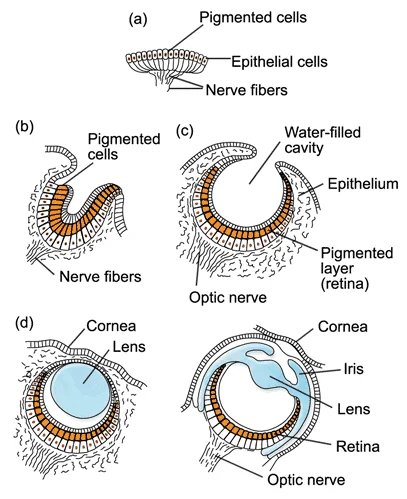
We know for certain that the miraculous nature of the human eye extends down to its light-sensitive cells. Why are photoreceptor cells sensitive to light? How is photosensitivity converted into electrical signals? And how are those electrical signals transformed into conscious awareness and vision of the world before us? It is sheer nonsense to attempt to explain away the miracle of the human eye by merely assuming the existence of other, less developed eyes. Yet this proposition is far from new; atheists repeatedly present irrational assumptions in an effort to escape the reality of intelligent design. This reveals that we are dealing with a theory built entirely on conjecture rather than scientifically verified facts. These are the so-called stages in the evolutionary development of the eye: (a) a pigment spot, (b) a simple pigment cup, (c) the basic optic cup found in abalone, and (d) the complex lensed eye of the marine snail and the octopus.16
Let me pose a humorous question—and try to imagine the typical evolutionary response: Did nature create a tray of fresh kunāfah—that syrupy cheese pie so beloved across the Middle East?

According to the logic of evolutionists, the answer would be a resounding yes. They would likely assert that this is quite a simple matter. One can easily imagine their narrative. The standard evolutionary reply might go something like this: “At some point in the distant past, meteorite impacts ground wild wheat into flour, which then mixed with rainwater to form phyllo (a very thin unleavened dough used for making pastries). Volcanic rocks served as natural ovens for baking. The sweetness came from abundant cane sugar, melted by geothermal springs. Cheese formed when cows, after nursing their young, produced milk that fermented in just the right conditions. Hence, over millions of years, random processes acting on flour particles, cheese curds, sugar crystals, and strands of shredded phyllo—combined with just the right environmental conditions—led to the spontaneous emergence of kunāfah. Add to that a few lightning strikes, some selective pressures favoring sweet, gooey textures, and eventually, natural selection favored the arrangement that now graces dessert tables across the region.” Ludicrous, isn’t it? It sounds so absurd that you probably feel bored or amused just reading it—and rightly so, for only the most gullible would believe such nonsense. This kunāfah parody may sound like exaggeration, but not by much, since many of the claims made by atheists are just as far-fetched. They argue that things far more complex than kunāfah—within the human body and throughout the universe—came into existence through similarly blind processes. The bottom line is this: the mere presence of raw materials—wheat, sugar, milk, cheese—does not lead to the spontaneous creation of a tray of kunāfah. Knowledge, skill, and intent are essential—in other words, the know-how to make kunāfah from start to finish. This example illustrates why contemplating the wonders of creation should evoke immense gratitude and awe toward Allāh. Hence, the claim that the human eye is the product of over a billion years of stepwise evolution, rather than intelligent design, is unfounded. What evolutionists often do is mentally dismantle the complex parts of biological systems like the eye and then attempt to reassemble them from scattered elements in nature—as if solving a puzzle—while ignoring the necessity of an intelligent designer.

We are willing to concede that human imagination is fertile and that some may possess a gift for crafting compelling stories. However, at the molecular level within the cell, every detail matters—indeed, a single-letter defect in the genetic code can corrupt the entire system. The bottom line is that the human eye is an organ of extraordinary complexity, both in structure and function. Like a top-of-the-line modern camera, it features a self-adjusting aperture, an automatic focusing system, and an internal surface designed to minimize stray light scattering. In fact, its sensitivity range—providing clear vision in both sunlight and moonlight—far surpasses that of any photographic film. Its neural circuitry enables the eye to enhance contrast automatically, while its color-analysis system adjusts instantly to various lighting conditions—incandescent, fluorescent, or natural sunlight—that would require a photographer to change filters or film. With a resolution of 576 megapixels and the purest natural lens in the world, the human eye stands unrivaled. One of its most vital components, the retina, comprises photoreceptor cells connected to a complex network of neurons and nerve fibers that transmit visual information to the brain via the optic nerve. The anatomy of these individual photoreceptors is astonishing; for example, a typical rod cell is about 100 µm long and occupies no more than half a square millimeter. In short, the human eye must be the product of deliberate and intelligent divine design, for its perfection defies explanation by the random workings of evolution alone.17 The eye functions as a dual system: the foveal system delivers 3 to 4 high-quality images per second through the line of sight, while the peripheral system processes up to 90 blurred images per second.18

Darwin persuaded much of the world that the modern eye evolved gradually from a simpler structure, yet he left unaddressed the question of the eye’s ultimate origin. In other words, he made no attempt to explain where his starting point—the simple light-sensitive spot—came from. To be fair, he had a valid reason for avoiding the question: it lay entirely beyond the reach of nineteenth-century science. At the time, the mechanisms of vision—such as what occurs when a photon of light first strikes the retina—were simply unknown. To Darwin, therefore, vision remained a black box. Today, however, thanks to the painstaking cumulative work of numerous biochemists, we are beginning to uncover answers to the mystery of sight. Michael Behe offers a concise overview of the biochemistry of vision:19

Behe observes:20
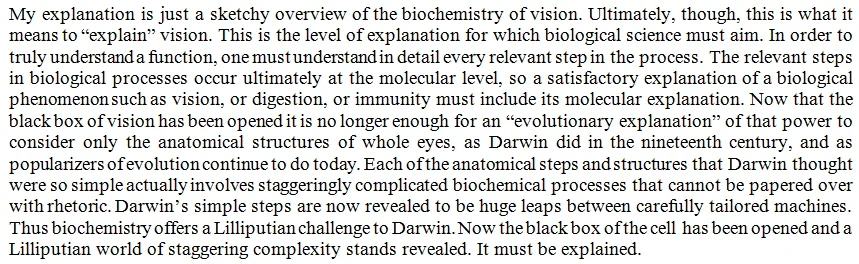
It is truly astonishing how photoreceptors convert light into electrical signals, which travel from the retina through the optic nerve to the brain—where, as if equipped with a pre-integrated dictionary, these signals are translated into the images we see. Indeed, this is a miracle that continues to dazzle me every time I reflect on it. The brain resides in a dark, enclosed space—the skull—and receives only electrical impulses. How, then, does it interpret these nerve signals as vision? How does it distinguish between ten million different shades of color?21 How does it adjust to all distances and change focus automatically? Needless to say, this entire miraculous process takes place instantly the moment we open our eyes. The gene coding for rhodopsin—a protein essential for vision, particularly in dim light—and the enzymes that break it down after each visual cycle22 are encoded in our DNA, as are the genes responsible for the retina, lenses, eyelashes, eyebrows, skull bones, the brain, and every human organ. Ironically, all the atoms in the universe are not enough to code for a single rhodopsin protein by chance—let alone to create the retina, the brain, the extraordinary process by which the brain interprets nerve impulses as vision, or the human being himself. Citing Chandra Wickramasinghe—a Sri Lankan-born British mathematician, astronomer, and astrobiologist—and Fred Hoyle, a British mathematician and astronomer—Richard Dawkins posed the question of how chance alone could give rise to the complex structure of a functioning enzyme. A typical enzyme, Dawkins noted, corresponds to a mathematical probability of 1 in 20²⁰⁰—a figure vastly greater than the total number of fundamental particles in the entire universe.23 Allāh says: {This is Allāh’s creation. Now show Me what those ˹gods˺ other than Him have created. In fact, the wrongdoers are clearly astray} (Qurʾān 31:11).
Notes and References
- 1
Richard Dawkins, The Blind Watchmaker, (New York, U.S.: W. W. Norton & Company, 1986), p. 93.
“Any engineer would naturally assume that the photocells would point towards the light, with their wires leading backwards towards the brain. He would laugh at any suggestion that the photocells might point away from the light, with their wires departing on the side nearest the light. Yet this is exactly what happens in all vertebrate retinas. Each photocell is, in effect, wired in backwards, with its wire sticking out on the side nearest the light. The wire has to travel over the surface of the retina, to a point where it dives through a hole in the retina (the so-called “blind spot”) to join the optic nerve.”
“Vertebrate eyes work reasonably well, but it is the principle of the thing that would offend any tidy-minded engineer!”
- 2
Everyone has a spot in their retina where the optic nerve connects. In this area, there are no light-sensitive cells so this part of your retina cannot see. Scientists call this the blind spot. Most of the time one does not notice their blind spot because the spot in one eye does not match the spot in the other eye.
- 3
George C. Williams, Natural Selection: Domains, Levels, and Challenges, (New York, U.S.: Oxford University Press, 1992), p. 73.
“There would be no blind spot if the vertebrate eye were really intelligently designed. In fact, it is stupidly designed,” while “the retina of a squid is right side up.”
- 4
Jerry A. Coyne, “The Faith that Dare not Speak its Name: The Case Against Intelligent Design,” The New Republic, Aug. 22 & 29, 2005, pp. 21–33.
- 5
Douglas J. Futuyma, Evolution, (Sunderland, U.S.: Sinauer Associates, 2005), p. 49.
- 6
Kenneth A. Mason et al., Raven and Johnson’s Biology, (New York, U.S.: McGraw-Hill, 2014), pp. 428–429.
- 7
Nathan H. Lents, “The Poor Design of the Human Eye,” Human Evolution Blog, 12 Jan. 2015, https://thehumanevolutionblog.com/2015/01/12/the-poor-design-of-the-human-eye/.
“The photoreceptor cells of the retina appear to be placed backward, with the wiring facing the light and the photoreceptor facing inward…. This is not an optimal design for obvious reasons. The photons of light must travel around the bulk of the photoreceptor cell in order to hit the receiver tucked in the back. It’s as if you were speaking into the wrong end of a microphone. There are no working hypotheses about why the vertebrate retina is wired in backwards. It seems to have been a random development that then ‘stuck’ because a correction of that magnitude would be very difficult to pull off with random mutations…. During the evolution of the cephalopod eye, the retina took shape in a more logical way, with the photoreceptors facing outward toward the light. Vertebrates were not so lucky.”
- 8
Sidney Futterman, “Metabolism and Photochemistry in the Retina,” pp. 406–419 in Robert A. Moses, Adler’s Physiology of the Eye, (St. Louis: C. V. Mosby, 1975), p. 406, as cited in Jonathan Wells, “Is the Human Eye Really Evidence Against Intelligent Design?” Evolution News, 4 Oct 2024, https://evolutionnews.org/2024/10/is-the-human-eye-really-evidence-against-intelligent-design-3/.
- 9
Albert Alm and Anders Bill, “Ocular and Optic Nerve Blood Flow at Normal and Increased Intraocular Pressures in Monkeys (Macaca Irus): A Study with Radioactively Labeled Microspheres Including Flow Determinations in Brain and Some Other Tissues,” Experimental Eye Research, vol. 15, 1973, pp. 15–29; Paul Henkind et al., “Ocular Circulation,” pp. 98–155 in Raymond E. Records, Physiology of the Human Eye and the Visual System, (Hagerstown, U.S.: Harper & Row, 1979), pp. 139–140 as cited in Jonathan Wells, “Is the Human Eye Really Evidence Against Intelligent Design?” Evolution News, 4 Oct 2024, https://evolutionnews.org/2024/10/is-the-human-eye-really-evidence-against-intelligent-design-3/.
- 10
Roy H. Steinberg, “Interactions between the Retinal Pigment Epithelium and the Neural Retina,” Documenta Ophthalmologica, vol. 60, 1985, as cited in Jonathan Wells, “Is the Human Eye Really Evidence Against Intelligent Design?” Evolution News, 4 Oct 2024, https://evolutionnews.org/2024/10/is-the-human-eye-really-evidence-against-intelligent-design-3/.
- 11
Richard W. Young, “The Renewal of Photoreceptor Cell Outer Segments,” Journal of Cell Biology, vol. 3, 1967, pp. 61–72 as cited in Jonathan Wells, “Is the Human Eye Really Evidence Against Intelligent Design?” Evolution News, 4 Oct 2024, https://evolutionnews.org/2024/10/is-the-human-eye-really-evidence-against-intelligent-design-3/.
- 12
Richard W. Young and Dean Bok, “Participation of the Retinal Pigment Epithelium in the Rod Outer Segment Renewal Process,” Journal of Cell Biology, vol. 42, 1969 as cited in Jonathan Wells, “Is the Human Eye Really Evidence Against Intelligent Design?” Evolution News, 4 Oct 2024, https://evolutionnews.org/2024/10/is-the-human-eye-really-evidence-against-intelligent-design-3/.
- 13
Jonathan Wells, “Is the Human Eye Really Evidence Against Intelligent Design?” Evolution News, 4 Oct 2024, https://evolutionnews.org/2024/10/is-the-human-eye-really-evidence-against-intelligent-design-3/.
- 14
Ibid.
Alberto Wirth et al., “The Advantages of an Inverted Retina,” Developments in Ophthalmology, vol. 9, 1984, pp. 20–28.
- 15
Jonathan Wells, Zombie Science, (Seattle, U.S.: Discovery Institute Press, 2017).
- 16
Wikipedia Contributors, “Irreducible Complexity,” Wikipedia: The Free Encyclopedia, last edited 29 Aug. 2024, https://en.wikipedia.org/wiki/Irreducible_complexity.
- 17
Ask and Do Not Be Afraid | Episode 18 | Can the Eye Be the Product of Coincidence? | Part 1 | With Dr. Muhāb as-Saʿīd,” YouTube, uploaded by Markaz Rawāsikh, 16 Aug. 2022, https://www.youtube.com/watch?v=EVU4uE894Lc.
- 18
Wikipedia Contributors, “Peripheral Vision,” Wikipedia: The Free Encyclopedia, last edited 17 June 2024, https://en.wikipedia.org/wiki/Peripheral_vision.
- 19
Michael Behe, “Evidence for Intelligent Design from Biochemistry--From a speech delivered at Discovery Institute’s God & Culture Conference,” Intelligent Design, 10 Aug. 1996, https://www.discovery.org/a/51/.
- 20
Ibid.
- 21
Reena Mukamal, “How Humans See in Color,” American Academy of Ophthalmology, 8 Jun. 2017, https://www.aao.org/eye-health/tips-prevention/how-humans-see-in-color.
The visible spectrum for humans falls between ultraviolet light and red light. Scientists estimate that humans can distinguish up to 10 million colors. Scientists believe that we can see around 1,000 levels of light-dark, 100 levels of red-green and 100 levels of yellow-blue. Multiply these numbers together, and you get 10,000,000 colors.
- 22
The breakdown of rhodopsin triggers a transduction process involving a rapid cascade of intermediates. Once the all trans-retinal detaches from the opsin it is transported to the epithelium by a protein carrier. Within the epithelial cells, retinal is converted to its 11-cis isomer in an ATP requiring process. Retinal then heads back to the photoreceptor cells outer segments to begin the process again.
- 23
Richard Dawkins, Climbing mount improbable, (New York, U.S.: World Scientific Publishing Company, 1996) p. 75.
“Hoyle says no, and he is right. There is a fixed number of amino acids available, twenty. A typical enzyme is a chain of several hundred links drawn from the twenty. An elementary calculation shows that the probability that any particular sequence of, say 100, amino acids will spontaneously form is one in 20 × 20 × 20 ... 100 times, or 1 in 20100. This is an inconceivably large number, far greater than the number of fundamental particles in the entire universe. Sir Fred, bending over backwards (unnecessarily, as we shall see) to be fair to those whom he sees as his Darwinian opponents, generously shortens the odds to 1 in 1020. A more modest number to be sure, but still a horrifyingly low probability. His co-author and fellow astrophysicist, Professor Chandra Wickramasinghe, has quoted him as saying that the spontaneous formation by ‘chance’ of a working enzyme is like a hurricane blowing through a junkyard and spontaneously having the luck to put together a Boeing 747.”