How did life on earth begin?
The frontiers of knowledge have advanced, and scientists have resolved one creation question after another. Yet one of the most fundamental questions—the origin of life—remains a profound mystery. Professor Stuart Kauffman said: “Anyone who tells you that he or she knows how life started on Earth some 3.4 billion years ago is a fool or a knave. Nobody knows.”1 Professor Stuart Kauffman is an American theoretical biologist and complex systems researcher specializing in the study of the origin of life on Earth.2
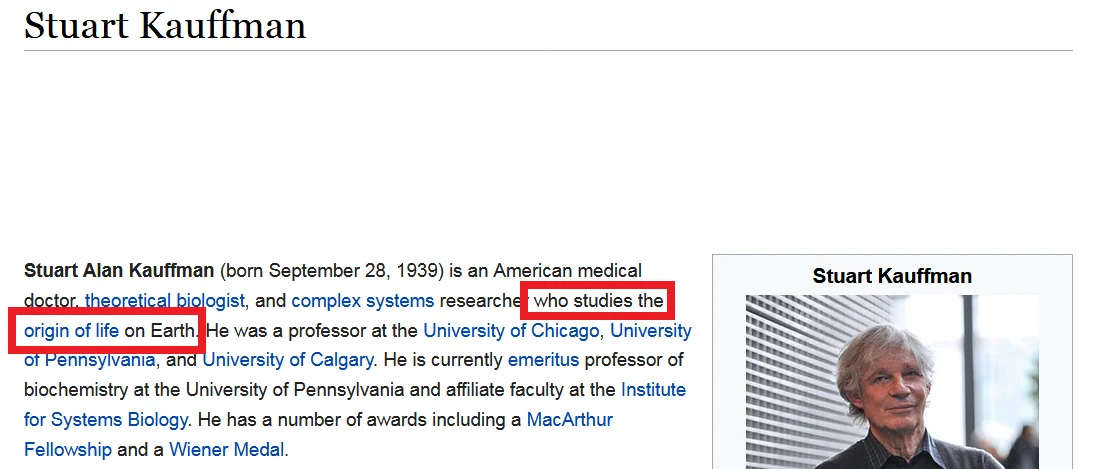
Likewise, Scientific American published an article titled: “Pssst! Don’t tell the creationists but, scientists don’t have a clue how life began.”3
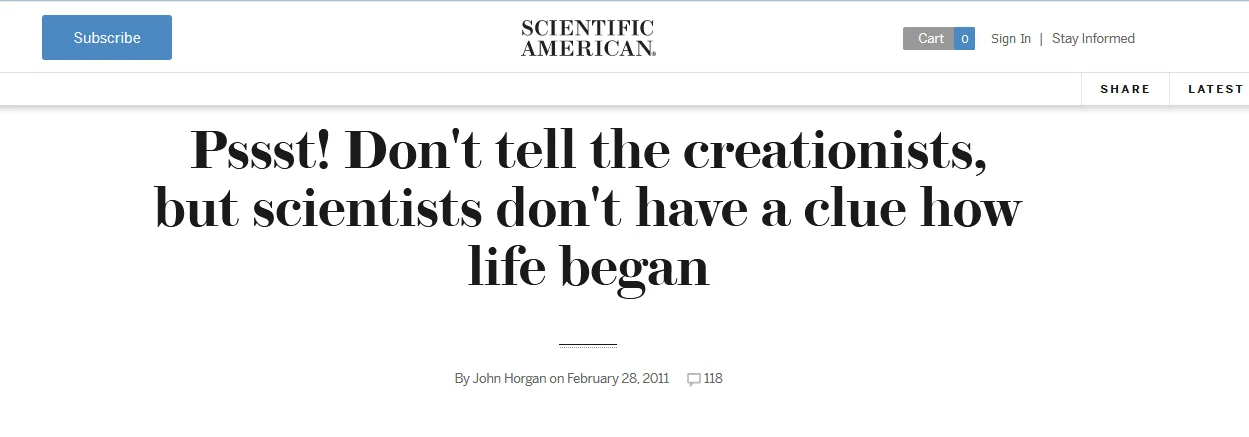
The author of this article highlighted the fact that scientists are struggling to reach a consensus on when, where, and—most importantly—how life first emerged on Earth. He noted that geologists, chemists, astronomers, and biologists remain as perplexed as ever by the mystery of life, and that creationists are no doubt delighted that origin-of-life research has come to such an impasse.
We all know that Darwin argued that all life on Earth arose through undirected natural processes—namely, time, chance, and natural selection. Since his time, biologists have relied on such processes to explain the origin of living organisms. Today, however, this approach is facing unprecedented challenges, as some contemporary scientists are advancing a compelling alternative: the theory of intelligent design. Undeniably, the mystery of life’s origin cannot be explained from a purely materialistic perspective. Yet atheists often accuse believers of invoking “gaps in knowledge” as evidence for intelligent design. In other words, they claim that whenever science lacks an explanation, believers insert God as the cause. This, however, is a serious misconception. In reality, the scientific case for intelligent design is grounded in recent discoveries in biochemistry, genetics, and molecular biology. Our intuition naturally points us toward a designer when we consider the intricate workings of the living cell—its nucleus, the DNA molecule, protein structures, and the bacterial flagellar motor—because design implies a designer, and intelligent design necessitates an intelligent designer: the Creator God. The appearance of design in the genetic information encoded in DNA is undeniably overwhelming. Therefore, some intelligence beyond humanity must account for the origin and complexity of this information—otherwise, how could it give rise with such precision to flesh, blood, organs, hormones, and their functions?
A common objection to belief in God is the claim that God cannot be directly seen or perceived. Atheists often ask: Why should we believe in what we cannot see? The answer is simple: God—Exalted is He—is the supreme, unique, and transcendent Being who exists beyond the cosmic veil, in the realm of the Unseen. While we cannot perceive Him directly, we can reasonably infer His existence through the signs of His design manifest in the world. It goes without saying that scientific atheism is fundamentally flawed, for no one can logically assert that the inability to see something proves its non-existence. In reality, there are many things we cannot see yet still believe in, because their existence is inferred from their signs or effects. By its very nature, science cannot “prove” or “disprove” the existence of God through direct empirical methods, such as laboratory experiments. Science is limited to the physical, measurable world, while God transcends both the physical realm and the constraints of measurement. In short, by asserting that God does not exist, atheists are not only displaying intellectual dishonesty but also contradicting the very principles of the discipline they claim to uphold—science—particularly given the inherent difficulty in proving a negative.
Indeed, theism cannot be dismissed as wishful thinking or superstition, for the overwhelming evidence in nature and the compelling rational argument it supports cannot be denied. No objective scientist who examines the evidence could fail to infer that the early conditions of the universe were deliberately designed with specific outcomes in mind—namely, the emergence of life. The universe, in other words, was designed for the very purpose of life. It would be irrational to claim that life was merely the result of a sequence of accidents in the early Earth environment, especially when even the most brilliant scientists, equipped with advanced knowledge, prestigious universities, and state-of-the-art laboratories, have failed to produce even the simplest form of life. Undeniably, materialist accounts of origins face a twofold challenge: biological evolution and chemical evolution. The latter refers to the formidable problem of generating life from nonlife within the hostile conditions of early Earth. To describe this problem as overwhelming, given the resources of matter and energy alone, is a gross understatement—it does not even begin to address the magnitude of the difficulty. This is the central message of a powerful documentary by Illustra Media, Origin: Design, Chance and the First Life on Earth, which, through stunning computer animation and the latest scientific research, explores a question that has puzzled scientists for centuries: How did life on Earth begin?4
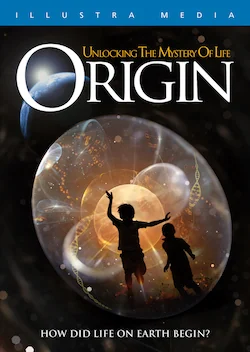
In this documentary, Ann Gauger—senior fellow at the Discovery Institute’s Center for Science and Culture and senior research scientist at the Biologic Institute in Seattle—alongside philosopher of biology and Darwinian evolution dissenter Paul Nelson, and Timothy G. Standish, research scientist at the Geoscience Research Institute, confront the enigma of chemical evolution and challenge the paradigm of scientific materialism and the belief that life is merely the product of blind, undirected processes. Nelson asserted: “What we never observe, ever, is non-living chemicals forming a cell.”5 Unquestionably, the true superstition is the unfounded dogma that the universe is a purposeless accident. Interestingly, even some scientists whose early writings were not particularly sympathetic to theism—such as Frank Tipler—and long-time atheist philosophers who spent years arguing against it—such as Antony Flew—eventually concluded, upon examining the growing evidence of fine-tuning, that God must have crafted the abundantly complex universe, as such fine-tuning is highly improbable under prevailing atheistic hypotheses. Allāh says: {They will ˹then˺ cry, “We do ˹now˺ believe in it ˹all˺.” But how could they ˹possibly˺ attain faith from a place so far-off ˹from the world˺ (52), while they had already rejected it before, guessing blindly from a place ˹equally˺ far-away ˹from the Hereafter˺? (53)} (Qurʾān 34:52–53). But even if everything we have just mentioned fails to convince the New Atheists that there is more to the universe than meets the eye, we have yet to see any compelling scientific evidence that God and a cosmic purpose do not exist.
Notes and References
- 1
Stuart Kauffman, At Home in the Universe: The Search for the Laws of Self Organization and Complexity, (New York, U.S.: Oxford University Press, 1995), p. 31.
- 2
Wikipedia Contributors, “Stuart Kauffman,” Wikipedia: The Free Encyclopedia, last edited 9 Oct. 2024, https://en.wikipedia.org/wiki/Stuart_Kauffman.
- 3
John Horgan, “Pssst! Don't Tell the Creationists, but Scientists Don’t Have a Clue How Life Began.” Scientific American, 28 Feb. 2011, https://www.scientificamerican.com/blog/cross-check/pssst-dont-tell-the-creationists-but-scientists-dont-have-a-clue-how-life-began/.
- 4
“ORIGIN: Design, Chance, and the First Life on Earth,” prod. & dir. by Lad Allen, ed. Jerry Harned, written by W. Peter Allen, associate producers Paul Nelson, Timothy Standish, David F. Coppedge, Illustra Media, 2016, http://www.originthefilm.com/about.php, available at: “ORIGIN: Design, Chance, and the First Life on Earth—Part 1,” YouTube, uploaded by Markaz Barāhīn, 22 Jan. 2018,https://www.youtube.com/watch?v=zskbSuG4lco.
- 5
Ibid., [4:13–4:19].