Is the “RNA world” theory—which posits ribonucleic acid as the first biomolecule—correct?
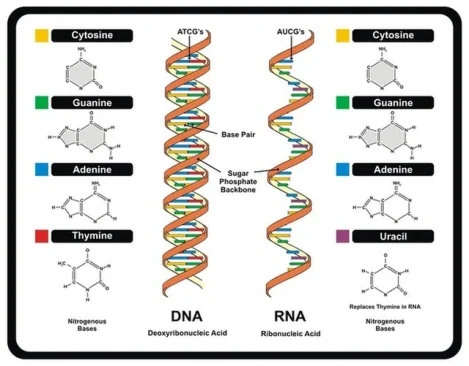
DNA and RNA are both types of nucleic acids—large molecules found in all living cells. These nucleic acids serve as the cell’s information carriers, storing the genetic material of an organism and passing it on to offspring during reproduction. DNA, or deoxyribonucleic acid, is the primary information molecule; it stores all the genetic instructions needed by the cell and directs the synthesis of other molecules, such as proteins. RNA, or ribonucleic acid, functions to carry out the instructions encoded in DNA.
Today, there are nearly as many theories about the origin of life as there are theorists. One of the most popular is the RNA World theory, which proposes that ribonucleic acid was the first biomolecule. This is because, while DNA cannot replicate without the assistance of enzymes, RNA can function as its own enzyme—capable of snipping itself in two and splicing itself back together. According to proponents of the RNA World hypothesis, around four billion years ago, RNA was the primary living substance due to its unique ability to serve both as genetic material and as a catalyst. The central reasoning behind this hypothesis is that RNA’s capacity for self-replication could have enabled it to transmit genetic information across generations independently. However, based on what scientists currently know about living organisms, it is not possible to conclude that a self-replicating RNA molecule served as the original catalytic mechanism underlying life. In fact, recent research has cast serious doubt on the RNA World hypothesis. NASA itself stated in a 1996 report that the concept faces “significant difficulties,” particularly due to the chemical fragility of RNA and its limited range of catalytic functions.1 Biochemist Harold S. Bernhardt expressed similar concerns. In a 2012 biology paper, he referred to the RNA World hypothesis as “the worst theory of the early evolution of life.”2 He stated in his paper that the complexity of the RNA molecule makes it unlikely to have arisen prebiotically, that RNA is inherently unstable, and that it possesses only limited catalytic properties. The bottom line is that RNA and its components are difficult to synthesize even under controlled laboratory conditions—let alone under plausible prebiotic scenarios. Furthermore, once synthesized, RNA can replicate itself only with considerable intervention from a chemist. Some scientists speculate that a simpler—and possibly quite different—molecule may have preceded RNA and paved the way for it, but no strong candidate has yet emerged. Let us now return to the documentary by Illustra Media, Origin: Design, Chance and the First Life on Earth. Paul Nelson asserted:3

Each chemical building block must then be assembled and organized into the intricate network of molecular machines that govern every aspect of life.4Timothy G. Standishstated:5

Ann Gaugerexplained:6

Standish observed:7

With chance completely out of luck, the search for a viable materialistic explanation has branched in several directions. Theories include clay surfaces etched with cracks, where organic molecules might have been attracted and aligned into chains of nucleic and amino acids; hydrothermal vents on the seafloor, spewing chemical building blocks from underwater cauldrons heated to hundreds of degrees; and primordial oceans filled with RNA—a versatile molecule thought to store and replicate genetic information without the assistance of DNA or proteins. While such proposals have sparked considerable interest, each one faces the same insurmountable obstacle that undermined the chance hypothesis: the transformation of lifeless components into the complex biomolecules of life. This fundamental problem is especially evident in the RNA World hypothesis.8 Gauger noted:9

Since the introduction of the RNA World theory, acceptance of the idea has grown—despite its numerous limitations, including the inherent fragility of the molecule itself.10 Standish stated:11

Gauger said:12

Today, RNA molecules are manufactured under controlled laboratory conditions. For many biochemists, these synthetic strands of nucleic acids serve as at least partial confirmation that chemical evolution may have once sparked life on primordial Earth.13 Gauger explained:14

Reflecting on the origin of life and the implications of synthetic RNA, chemist Robert Shapiro noted:15

Gauger said:16

The probability of chemical evolution is further weakened by the composition of the primordial soup. If a primordial soup truly existed, then chemically it would have been an absolute mess.17 Paul Nelson said:18

Standish noted:19

Faced with insurmountable challenges on Earth, some scientists have expanded the boundaries of their search. In 1976, Nobel Prize–winning biologist Francis Crick proposed a radical alternative for the origin of life. He suggested that our planet was seeded with microscopic organisms transported from another part of the universe by an alien civilization—a theory known as Panspermia. Five years later, physicist Fred Hoyle presented a modified version of Panspermia, theorizing that strands of DNA were manufactured by an intelligence in a distant galaxy and then set adrift like dandelion seeds on a windy day, with some of this genetic material eventually reaching Earth. Another variation of the theory, popularized by the discovery of the Mars rock—a meteorite found in Antarctica—contends that microbes evolved elsewhere in the galaxy and hitchhiked to Earth, embedded in comets and asteroids.20 Standish observed:21

Nelson said:22

The shortcomings of Panspermia have led some researchers to embrace a theory that reaches far beyond conventional astronomy: the Multiverse. According to this hypothesis, our universe is not the only one—instead, billions or even trillions of universes were generated by some unknown natural process. As the number of opportunities increased exponentially, impossible odds became statistically probable. Eventually, it is claimed, the right combination of raw materials, environmental conditions, natural laws, and a large dose of luck came together to produce the molecules and biological machinery required for the first living cell. In other words, within a vast theoretical ocean of universes, someone had to win the cosmic lottery—and it happened to be us.23 Nelson stated:24

Standish asked:25

Nelson observed:26

Gauger noted:27

Standish concluded:28

Hence, as elaborated above, RNA cannot serve as a viable starting point for the origin of life.
Notes and References
- 1
Susha Cheriyedath, “What is the RNA World Hypothesis?” News Medical Life Science, last updated 24 Jul. 2023, https://www.news-medical.net/life-sciences/What-is-the-RNA-World-Hypothesis.aspx.
- 2
H. S. Bernhardt, “The RNA World Hypothesis: The Worst Theory of the Early Evolution of Life (Except for All the Others),” Biology Direct, vol. 7, issue 23, Jul. 2012. DOI: https://doi.org/10.1186/1745-6150-7-23.
- 3
“ORIGIN: Design, Chance, and the First Life on Earth,” produced and directed by Lad Allen, edited by Jerry Harned, written by W. Peter Allen, associate producers Paul Nelson, Timothy Standish, David F. Coppedge, Illustra Media, 2016, http://www.originthefilm.com/about.php, available at: “ORIGIN: Design, Chance, and the First Life on Earth—Part 1,” YouTube, uploaded by Markaz Barāhīn, 22 Jan. 2018,https://www.youtube.com/watch?v=zskbSuG4lco, [28:08–28:52].
- 4
Ibid., [28:54–29:03].
- 5
Ibid., [29:05–29:48].
- 6
Ibid., [29:48–30:31].
- 7
Ibid., [30:31–30:55].
- 8
Ibid., [30:57–32:06].
- 9
Ibid., [32:08–32:21].
- 10
Ibid., [32:38–32:48].
- 11
Ibid., [32:49–33:17].
- 12
Ibid., [33:17–33:27].
- 13
Ibid., [33:28–33-46].
- 14
Ibid., [33:48–34:28].
- 15
Ibid., [34:30–34:58].
- 16
Ibid., [35:02–35:16].
- 17
Ibid., [35:19–35:34].
- 18
Ibid., [35:34–35:49].
- 19
Ibid., [35:49–36:24].
- 20
Ibid., [36:29–37:44].
- 21
Ibid., [37:46–38:12].
- 22
Ibid., [34:14–38:49].
- 23
Ibid., [38:52–39:54].
- 24
Ibid., [39:58–40:45].
- 25
Ibid., [40:45–41:04].
- 26
Ibid., [41:08–42:37].
- 27
Ibid., [42:42–43:29].
- 28
Ibid., [43:31–44:31].