Is natural selection a scientific theory or a metaphysical proposition?
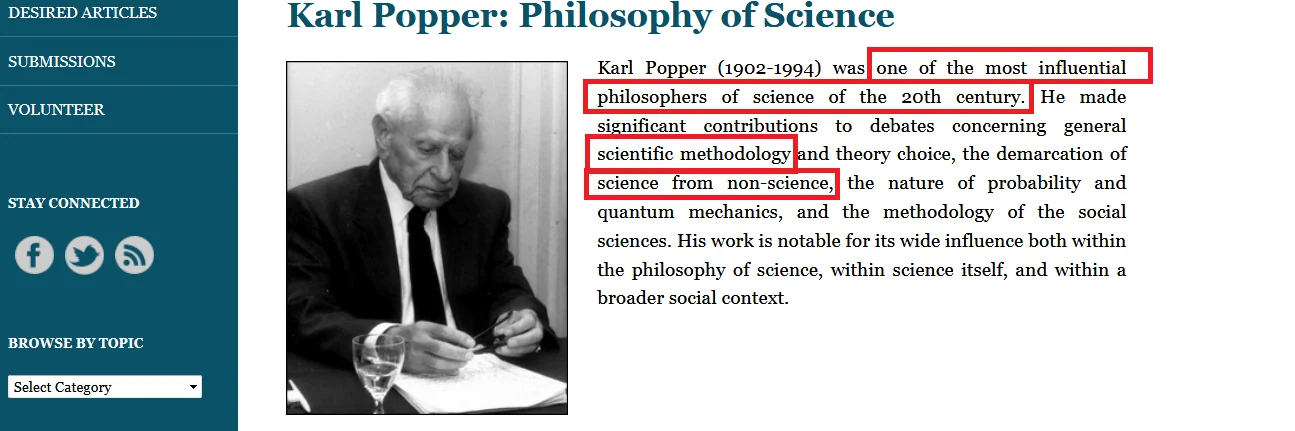
Karl Popper was one of the most influential philosophers of science of the twentieth century who described himself as an agnostic.1
Early in his career, Popper noted that Darwinian evolution is structured in such a way that it resists empirical falsification. He specifically described evolution by natural selection as “almost a tautology” and “not a testable scientific theory but a metaphysical research program.”2 His first thorough treatment of the tautology issue and evolution theory appeared in section 37 of his 1974 autobiography, titled “Darwinism as a Metaphysical Research Program,” which was published in the Paul Arthur Schilpp volume on him. There, Popper stated that the theory of evolution “is not a testable scientific theory, but a metaphysical research program—a possible framework for testable scientific theories.” He clarified what he meant by a metaphysical research program in footnote 242:3

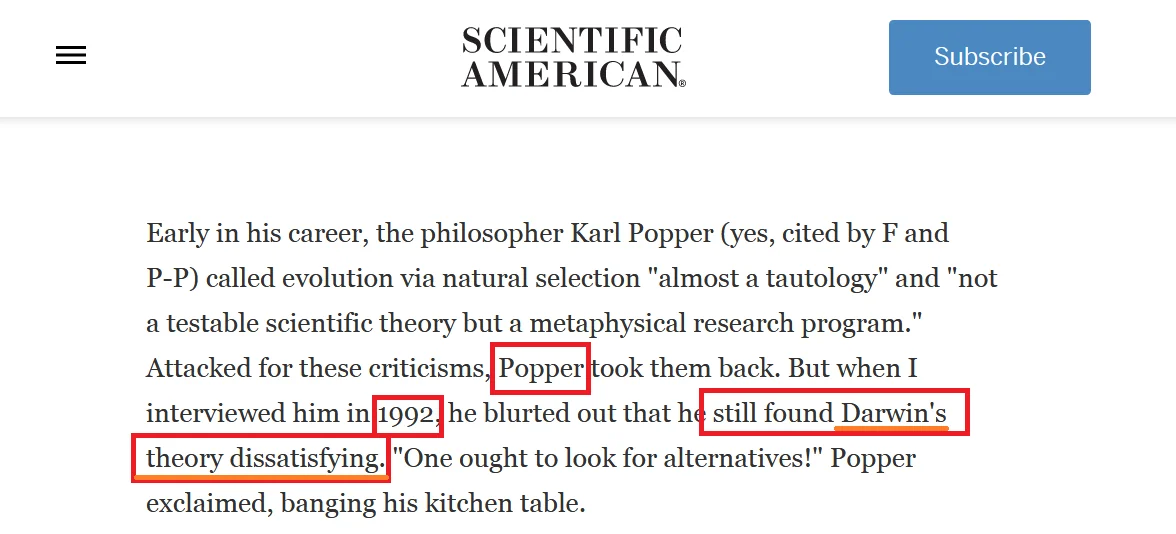
Popper was criticized by Darwinists for these remarks, and as a result, he retracted his criticisms of Darwinism in 1978. However, when John Horgan—an American science journalist who has written for Scientific American since 1986—interviewed him in 1992, two years before his death, Horgan noted that Popper “blurted out that he still found Darwin’s theory dissatisfying. ‘One ought to look for alternatives!’ Popper exclaimed, banging his kitchen table.”4
Popper argued that the theory of evolution contains no testable laws and is therefore a metaphysical research program—metaphysical because it is non-falsifiable. He maintained that there are no empirical laws of evolution, full stop. In section 27 of The Poverty of Historicism, titled “Is There a Law of Evolution? Laws and Trends,” he asserted that there are no general laws governing the evolution of societies, the evolution of organisms, or the evolution of the universe as a whole. He made this claim despite acknowledging that many laws are employed in explaining phenomena in the social sciences, evolutionary biology, and cosmology.5 He pointed out that the principle of natural selection is a tautology, and that the explanatory power of a tautology is zero. He took particular issue with the evolutionary concept of “survival of the fittest,” regarding it as a tautology—that is, it assumes the very point that is supposed to be demonstrated through testing the theory. Popper addressed this problem of tautology in his 1965 Arthur Compton Memorial Lecture:6

Popper raised the same issue in his 1969 Emory University Lectures:7

The tautology issue surfaced again in Chapter 2 of his Objective Knowledge, but this time he went a step further in his treatment of the subject:8

In short, Popper—the ardent empiricist and architect of the principle of falsifiability, the idea that a scientific theory must be testable—questioned evolution by means of natural selection and concluded that it is a metaphysical research program. It should be noted that although he stated in his well-known 1977 lecture at Darwin College, Cambridge—later published in Dialectica in 1978—that he had changed his mind regarding the absence of testable laws in evolutionary theory, he did not, in fact, alter his position. What appeared to be a change of heart—his subsequent retraction—was, in reality, a restatement of his original view in disguise. He did not change his mind about the substance of his initial claim.9 As earlier stated, John Horgan wrote an important article titled: “Dubitable Darwin? Why some Smart, Nonreligious People Doubt the Theory of Evolution.”10

In this article, Horgan observed: “The philosopher Daniel Dennett once called the theory of evolution by natural selection “the single best idea anyone has ever had.” I’m inclined to agree. But Darwinism sticks in the craw of some really smart people. I don’t mean intelligent-designers (aka idiots) and other religious ignorami but knowledgeable scientists and scholars.”11 In Evolutionary Epistemology, Rationality, and the Sociology of Knowledge—a 1987 volume edited by Gerard Radnitzky and W.W. Bartley—Karl Popper contributes essays outlining his approach to evolutionary epistemology and offering a critical engagement with aspects of Darwinian theory. This work, Popper’s final major publication before his death, explores the growth of knowledge through a process of conjectures and refutations, drawing analogies to biological evolution. Popper critiques key elements of evolutionary theory and reflects on the views of some of its most influential proponents, thoughtfully exposing the philosophical assumptions and limitations that often underlie evolutionary explanations. The editors of this landmark volume have rendered a great service to the philosophy of knowledge, providing scholars with a comprehensive and up-to-date presentation of the core ideas of evolutionary epistemology.12
In a nutshell, evolution by means of natural selection is a tautology. Simply put, a tautology is a statement that repeats the same idea in different words without adding clarity or force—akin to the old proverb: “after great effort, he explained that water is water.” Indeed, an analysis of the core tenets of evolution—particularly natural selection—reveals a lack of predictive power and operational precision, which are essential features of a scientific theory. For this reason, some scientists and philosophers of science argue that it is, at its core, a tautology. While tautologies can serve as useful logical tools, they cannot substitute for genuine scientific theories. In essence, the theory of evolution is often presented not as a result of empirical observation and experimentation, but as a metaphysical framework. For instance, Darwinists commonly assert that a living organism has been naturally selected simply because it is alive—without providing independent scientific evidence to support the claim. One might rightly ask: could there be another explanation for this organism’s survival? Karl Popper addressed this very issue in a lecture of great significance delivered at Darwin College, Cambridge, on 8 November 1977.13 He asserted that even some prominent Darwinists have acknowledged that the theory of natural selection amounts to a tautology:14

One such Darwinist was C. H. Waddington—a British embryologist, geneticist, and philosopher of science—who openly stated that “natural selection turns out to be a tautology,” a view he defended in multiple places:15

Popper noted that similar passages can nonetheless be found in the works of leading Darwinists such as Ronald Fisher and G. B. S. Haldane—two of the founding fathers of Neo-Darwinism—as well as George Gaylord Simpson, the prominent American paleontologist who spent over three decades with the National Museum of Natural History in the United States, among others.16
Unfortunately, belief in evolution continues to be passionately defended by the scientific establishment, despite the absence of observable scientific evidence for macroevolution—that is, the transformation of one distinct kind of organism into another. The well-known Long-Term Evolution Experiment at Michigan State University, led by evolutionary biologist Richard Lenski, initially generated excitement when his team believed they had observed the emergence of a new species of E. coli in their laboratory flasks. However, the findings have inadvertently demonstrated that evolution on any significant scale does not occur in the present, did not occur in the past, and is unlikely ever to occur. Since the late 1980s, Lenski—a committed proponent of Darwinian evolution—has been running this long-term experiment to observe E. coli populations over tens of thousands of generations, hoping to witness the development of new functions.17 Some scientists are strong proponents of this experiment precisely because, as they put it, it does not rely on a theoretical model. That is, it is neither a computer simulation nor a speculative framework. Rather, what Lenski did was allow evolution to proceed on its own—and then document what actually occurred.18 By 2014, Lenski and his researchers had grown 60,000 generations of bacteria.19 This is equivalent to approximately one million years in the lifespan of—as evolutionists put it—a large animal like us, human beings; and during that time, trillions upon trillions of bacteria have been born and died in Lenski’s flasks.20 Although often cited as supporting Darwin’s theory, Lenski’s experiment is perhaps most revealing in what it has failed to produce!21 The experiment was expected to demonstrate significant evolutionary changes—such as the emergence of new species or the development of entirely new complex functions. But what stands out most is that such major changes did not occur, despite decades of continuous observation and the passing of trillions upon trillions of bacterial generations.Not a single new protein with a novel fold and a distinct function has emerged.22 Biochemist Michael Behe reviewed Lenski’s experiment and noted that one flask of E. coli evolved the ability to metabolize citrate in the presence of oxygen. However, this adaptation was accompanied by multiple mutations that broke genes, degraded genetic information, and ultimately increased the bacteria’s death rates.23 All of this supports Behe’s thesis in his latest masterpiece, Darwin Devolves, namely that “evolution is good at creating niche advantages by breaking things; it is not good at the very thing the grand narrative of modern evolutionary theory purports that it does: building fundamentally novel forms.”24
However, some people claim that “Darwin’s finches” provide compelling evidence for Darwinism. Between 1831 and 1836, Charles Darwin traveled around the world, observing animals across various continents and islands. On the Galápagos Islands, he noted several species of finches with distinct beak shapes. These island finches closely resembled a species found on the South American mainland, and among the Galápagos finches, he observed a graded series of beak sizes and shapes, with only subtle differences between the most similar species. Darwin speculated that the island species might have all descended from a single ancestral species originating from the mainland. In 1860, he wrote: “The curious fact is the perfect gradation in the size of the beaks in the different species of Geospiza, from one as large as that of a hawfinch to that of a chaffinch, and… even to that of a warbler… Seeing this gradation and diversity of structure in one small, intimately related group of birds, one might really fancy that from an original paucity of birds in this archipelago, one species has been taken and modified for different ends.”25 When Darwin observed variation in beak shape among finch species, he postulated that the beak of an ancestral species had gradually adapted to enable the finches to exploit different food sources. This illustration depicts the beak shapes of four species of ground finch.

Darwin called this mechanism of change natural selection, which he argued was the inevitable result of three principles operating in nature. First, the characteristics of organisms are inherited—that is, passed from parents to offspring. Second, more offspring are produced than can survive; the reproductive capacity of all organisms exceeds the resources available to sustain them, creating competition for those limited resources. Third, offspring vary in their characteristics, and many of these variations are heritable. From these principles, Darwin reasoned that offspring with inherited traits that give them an advantage in competing for resources are more likely to survive and reproduce than those with less favorable traits. As a result, these advantageous traits will become more common in the next generation. Over time, this leads to changes in populations across generations—a process Darwin called “descent with modification,” or evolution.
Now, do the differences in beak shape and size among Darwin’s finches illustrate ongoing evolutionary change? To begin with, finches are found across the world and exist in many varieties. Thirteen species of dark-colored finches inhabit the Galápagos Islands, located about 600 miles west of Ecuador in the Pacific Ocean. Each island hosts more than one species, and many of these species are capable of interbreeding. Darwin—who helped popularize the idea that animals can change from one species to another—collected nine of the thirteen finch species during his visit to the Galápagos Islands in 1835. While textbooks often claim that these finches helped convince him of bird evolution, this is inaccurate. According to molecular biologist Jonathan Wells in his book Icons of Evolution, Darwin did not mention them in his voyage diary or in his seminal work On the Origin of Species.26 In fact, the use of the Galapagos finches to represent Darwinian change came nearly a century later, through a landmark 1947 book titled Darwin’s Finches.27 In 1973, Peter and Rosemary Grant—a husband and wife research team—went to the Galapagos Islands to investigate how finches might exhibit Darwinian changes. They meticulously tracked all the finches on one small island, recording weather patterns and the birds’ diets. When a drought struck in 1977, the only readily available food was tough nuts. Finches with slightly smaller beaks perished, while those with larger beaks capable of cracking the nuts survived. Evolutionists then proposed that, at this rate of beak thickening, further droughts could lead to even larger beaks, potentially illustrating the same mechanisms believed to drive Darwinian change between species. However, record rainfall in 1982 and 1983 reversed this trend. The renewed abundance of soft seeds enabled finches with smaller beaks to thrive again. Thus, for every apparent step forward in evolution, finches seemed to take a step backward. In the end, no net evolutionary change occurs in “Darwin’s finches.”28 Peter Grant wrote in 1991 that the beak trait in his finch population “is oscillating back and forth.”29 This means that rather than evolving progressively in one direction, the beak size fluctuates with changing environmental conditions—expanding during droughts and shrinking during times of abundant rainfall. This undermines the idea of linear, directional evolution and instead supports the conclusion that natural selection can produce reversible changes, not necessarily cumulative or progressive ones. Summarizing these finds in the college textbook Evolution, author Mark Ridley wrote that “beaks evolving up in some years, down in other years, and staying constant in yet other years—probably results in some kind of ‘stabilizing’ selection over a long period of time.”30 But transforming one kind of animal into another requires radical change—not stability over a long period of time. Moreover, the subtle beak variations observed in finches do not represent the kind of information-adding evolution needed to transform a fish into a reptile or a reptile into a bird. In truth, the Galapagos finches simply display their God-given ability to adapt and endure challenging conditions, all while remaining within their created kind. Hence, the next time someone claims that the Galapagos finches prove evolution, you might ask: “How do minor fluctuations in the size of already existing beaks explain how bird beaks originated in the first place?”31 To conclude, the birds known as “Darwin’s finches” do not demonstrate Darwinian change between kinds. It remains evident that each creature was created to reproduce according to its kind—not to transform into a fundamentally different one.
Interestingly, Joseph Hooker—a British botanist, explorer, and one of Darwin’s closest friends—wrote to Darwin in 1862, asserting that it was neither crossing nor natural selection, but rather variation alone, that had produced such a wide divergence among human individuals.32


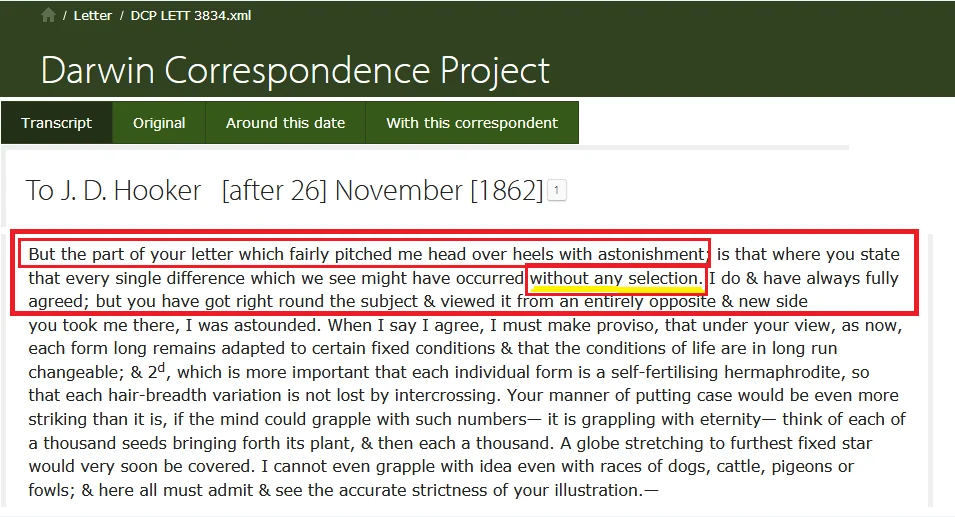
Notably, in his letter, Hooker described what would later come to be known—nearly a century afterward—as the gene pool. A gene pool refers to the total genetic diversity within a population or species; the larger the gene pool, the greater the diversity, and the higher the likelihood that the population will survive environmental stresses. In other words, the broader the genetic variation, the better equipped the population is to withstand ecological challenges. Darwin himself admitted that the part of Hooker’s letter suggesting that every single difference we observe might have occurred without any selection left him “fairly pitched head over heels with astonishment.”33
Indeed, advocates of the theory of evolution who continue to insist on its validity resemble a group of prospectors tirelessly searching for a treasure of gold—digging through tons of sedimentary layers—mudrock, sandstone, and more—while ignoring an inscription nearby that reads, “The treasure is here!” They overlook the sign simply because they began with the assumption that the treasure must lie underground. Likewise, the perfected craftsmanship of divine creation stands plainly before the eyes of evolutionists, yet they remain willfully blind to it because they begin with the a priori belief that the origin of life and genetic diversity must have a purely scientific and materialistic explanation. Thus, they persist in their objections, even though the signs of intricate, purposeful creation are evident all around them and despite mounting evidence that the theory of evolution by natural selection fails to account for these realities. Tragically, this insistence not only misleads the scientific enterprise but also results in significant harm—diverting valuable academic resources and research funding away from more fruitful and promising avenues of inquiry.
Notes and References
- 1
Brendan Shea, “Karl Popper: Philosophy of Science,” Internet Encyclopedia of Philosophy, https://iep.utm.edu/pop-sci/.
- 2
Karl Popper, “Darwinism as a Metaphysical Research Programme,” in Michael Ruse, Philosophy after Darwin: Classic and Contemporary Readings, (Princeton, U.S.: Princeton University Press, 2010), pp. 167–175. DOI: https://doi.org/10.1515/9781400831296-023.
“I have come to the conclusion that Darwinism is not a testable scientific theory, but a meta-physical research programme—a possible frame-work for testable scientific theories.”
- 3
Karl Popper, “Intellectual Autobiography,” in Paul Arthur Schillp, The Philosophy of Karl Popper, pp. 3–181, (La Salle, U.S.: Open Court, 1974), p. 175.
- 4
John Horgan, “Dubitable Darwin? Why Some Smart, Nonreligious People Doubt the Theory of Evolution,” Scientific American, 6 Jul. 2010, https://www.scientificamerican.com/blog/cross-check/dubitable-darwin-why-some-smart-nonreligious-people-doubt-the-theory-of-evolution/.
- 5
Karl Popper, The Poverty of Historicism, (London, U.K.: Routledge & Kegan Paul, 1957), p. 117.
The crucial point is this: although we may assume that any actual succession of phenomena proceeds according to the laws of nature, it is important to realize that practically no sequence of, say, three or more causally connected concrete events proceeds according to any single law of nature. If the wind shakes a tree and Newton’s apple falls to the ground, nobody will deny that these events can be described in terms of causal laws. But there is no single law, such as that of gravity, nor even a single definite set of laws, to describe the actual or concrete succession of causally connected events. … The idea that any concrete sequence or succession of events (apart from such examples as the movement of a pendulum or a solar system) can be described or explained by any one law, or by any one definite set of laws, is simply mistaken. There are neither laws of succession nor laws of evolution.
- 6
Karl Popper, Objective Knowledge: An Evolutionary Approach, (Oxford, U.K.: Clarendon Press, 1972), pp. 241–42.
- 7
Karl Popper, Knowledge and the Body-Mind Problem: In Defence of Interaction, ed. Mark Amadeus Notturno, (London, England: Routledge, 1994), p. 54.
- 8
Karl Popper, Objective Knowledge: An Evolutionary Approach, (Oxford, U.K.: Clarendon Press, 1972), p. 69.
- 9
David L. Hull, “The Use and Abuse of Sir Karl Popper,” Biology and Philosophy, vol. 14, issue 4, 1999, pp. 481–504 as cited in Mehmet Elgin and Elliott Sober, “Popper’s Shifting Appraisal of Evolutionary Theory, 3. A Change of Heart or the Old View in Disguise?” HOPOS, vol. 7, number 1, 2017. DOI: https://doi.org/10.1086/691119.
Karl Popper argued in 1974 that evolutionary theory contains no testable laws and is therefore a metaphysical research program. Four years later, he said that he had changed his mind. Here we seek to understand Popper’s initial position and his subsequent retraction. We argue, contrary to Popper’s own assessment, that he did not change his mind at all about the substance of his original claim.
- 10
John Horgan, “Dubitable Darwin? Why Some Smart, Nonreligious People Doubt the Theory of Evolution,” Scientific American, 6 Jul. 2010, https://www.scientificamerican.com/blog/cross-check/dubitable-darwin-why-some-smart-nonreligious-people-doubt-the-theory-of-evolution/.
- 11
Ibid.
- 12
Karl Popper, Evolutionary Epistemology, Rationality, and the Sociology of Knowledge, ed. Gerard Radnitzky and William W. Bartley, (Chicago, U.S.: Open Court Publishing Company, 1987).
- 13
---., “Natural Selection and the Emergence of Mind Delivered at Darwin College, Cambridge 8 November 1977,” The Information Philosopher, https://www.informationphilosopher.com/solutions/philosophers/popper/natural_selection_and_the_emergence_of_mind.html.
“It is a great honor to have been invited to give the first Darwin Lecture at Darwin College, in Cambridge, which of all universities is most closely connected with Charles Darwin and the Darwin family. When I received the invitation, I was worried whether or not I should accept it. I am not a scientist; nor am I a historian. There are Darwin scholars devoted to studying his life and his times; but I have done nothing of the kind. For these reasons, I suppose I ought to have declined the invitation. Yet it was an extremely kind and pressing invitation; and those who invited me were obviously well aware of the fact that I was neither a biologist nor a Darwin scholar, but simply an amateur. In the end I did accept, choosing as my topic a theme which, I believe, is closely linked to two of Darwin's central interests: natural selection; and the evolution of mind.”
- 14
Ibid.
- 15
C. H. Waddington, “Evolutionary Adaptation,” in S. Tax, Evolution after Darwin: volume I— The Evolution of Life, (Chicago, U.S.: Chicago University Press, 1960), pp. 381–402; see p. 385 as cited in ibid.
- 16
Karl Popper, “Natural Selection and the Emergence of Mind Delivered at Darwin College, Cambridge 8 November 1977,” The Information Philosopher, https://www.informationphilosopher.com/solutions/philosophers/popper/natural_selection_and_the_emergence_of_mind.html.
- 17
“Planet of the Apes | Ad-Daḥīḥ: Are Chimpanzees Closer to Humans?” YouTube, uploaded by Dr. Haitham Talaat, 30 Aug. 2024, https://www.youtube.com/watch?v=IPIUpPG_9c8, [8:16–8:36].
- 18
Ibid., [8:37–8:51].
- 19
Ibid., [8:52–8:58].
- 20
Ibid., [8:58–9:11].
- 21
Ibid., [9:12–9:21].
- 22
Ibid., [9:21–9:25].
- 23
Michael Behe, “Citrate Death Spiral,” Evolution News, 17 Jun. 2020, https://evolutionnews.org/2020/06/citrate-death-spiral/.
- 24
Michael Behe, Darwin Devolves, (San Francisco, U.S.: HarperOne, 2019).
- 25
As quoted in Nigel Williams, “Darwin’s Enduring Finches,” Current Biology, vol. 20, issue 4, 23 Feb. 2010, pp. R130–R131. DOI: https://doi.org/10.1016/j.cub.2010.02.006.
- 26
Jonathan Wells, Icons of Evolution, (Washington, U.S.: Regnery Publishing, 2002), p. 160.
- 27
David Lack, Darwin’s Finches, (New York, U.S.: Cambridge University Press, 1947).
- 28
Kenneth Miller and Joseph S. Levine, Biology, (Boston, U.S.: Pearson, 2010), p. 472 as cited in Brian Thomas, “Do Darwin’s Finches Prove Evolution?” Acts & Facts, vol. 43, issue 11, 31 Oct. 2014, available at: Institute for Creation Research,https://www.icr.org/article/do-darwins-finches-prove-evolution.
The Texas public high school biology textbook co-authored by atheist Ken Miller says that scientists watched the “average beak size in this finch population increase dramatically.” Why did he not also say that finch beak sizes shrink, showing no net evolution?
- 29
Peter R. Grant, “Natural Selection and Darwin’s Finches,” Scientific American, vol. 265, issue 4, Oct. 1991, pp. 82–87, https://www.scientificamerican.com/article/natural-selection-and-darwins-finch/ as cited in Brian Thomas, “Do Darwin’s Finches Prove Evolution?” Acts & Facts, vol. 43, issue 11, 31 Oct. 2014, available at: Institute for Creation Research,https://www.icr.org/article/do-darwins-finches-prove-evolution.
- 30
Mark Ridley, Evolution, Malden, MA: Blackwell, 2004), p. 225 as cited in Brian Thomas, “Do Darwin’s Finches Prove Evolution?” Acts & Facts, vol. 43, issue 11, 31 Oct. 2014, available at: Institute for Creation Research,https://www.icr.org/article/do-darwins-finches-prove-evolution.
- 31
Brian Thomas, “Do Darwin’s Finches Prove Evolution?” Acts & Facts, vol. 43, issue 11, 31 Oct. 2014, available at: Institute for Creation Research,https://www.icr.org/article/do-darwins-finches-prove-evolution.
- 32
“Darwin Correspondence Project--From J. D. Hooker 26 November 1862,” University of Cambridge, https://www.darwinproject.ac.uk/letter/?docId=letters/DCP-LETT-3831.xml.
- 33
“Darwin Correspondence Project--To J. D. Hooker [after 26] November [1862],” University of Cambridge, https://www.darwinproject.ac.uk/letter/DCP-LETT-3834.xml.