Do atheists have the right to appeal to the future—that is, to claim that the final “theory of everything” is within reach?
Essentially, conjectures are permissible only within the realm of what is known as contingent existence—that is, what is rationally possible. It is a well-established fact that a self-generated universe (spontaneous creation) is rationally impossible, as evidenced by humanity’s inability to produce even the simplest form of life despite remarkable scientific advancements and the concerted efforts of researchers. If it were truly possible, humans would be able to create life at will and with minimal effort. Indeed, those who deny the existence of God and cosmic purpose while clinging to the hope that science will one day explain away the life-permitting fine-tuning of the universe are among the most irrational and misguided. In reality, scientists have attempted to create life—even a form millions of times simpler than the smallest bacterium—yet they have failed nonetheless.1 Allāh, Exalted is He, said: {O humanity! A lesson is set forth, so listen to it ˹carefully˺: those ˹idols˺ you invoke besides Allāh can never create ˹so much as˺ a fly, even if they ˹all˺ were to come together for that. And if a fly were to snatch anything away from them, they cannot ˹even˺ retrieve it from the fly. How powerless are those who invoke and those invoked!} (Qurʾān 22:73). He also said in the authentic qudsī ḥadīth: “Who is more unjust than one who tries to create something like My creation? Let them create even the smallest ant, or a grain of wheat, or a grain of barley.”2 Researchers have failed to meet this challenge despite all their resources, scientific and technological expertise, and determined efforts. In short, it is hardly rational or logical to assume that a barren land could produce Man—or even bacteria—as Allāh says: {What is the matter with you? How do you judge?} (Qurʾān 37:154).
In fact, what should prompt atheists to seriously reconsider their position is the enormous funding being dedicated to cracking the code of life—the complete letter-by-letter sequence of genetic information that defines human existence: the human genome. High-stakes scientific prizes are pushing researchers to look inward, all the way down to the A’s, T’s, C’s, and G’s of the genetic code. Without a doubt, the origin of life remains the most difficult question in science, and no one currently knows how the first cell came into being. These ambitious prizes aim to answer a more basic and pressing question: Where did the information in DNA come from? Scientists are now in a fiercely competitive race to win one of the largest scientific prizes ever offered. Perry Marshall, together with a private equity investment group, Natural Code LLC, has launched a technology prize to solve one fundamental challenge: How do you get from chemicals to code, and how do you obtain a code without a designer? The Evolution 2.0 contest, announced at Arizona State University and open until 2026, offers $5,000,000 to anyone who can solve the mystery of how the genetic code originated.3

This is Perry Marshall alongside physicist Paul Davies at the prize announcement.
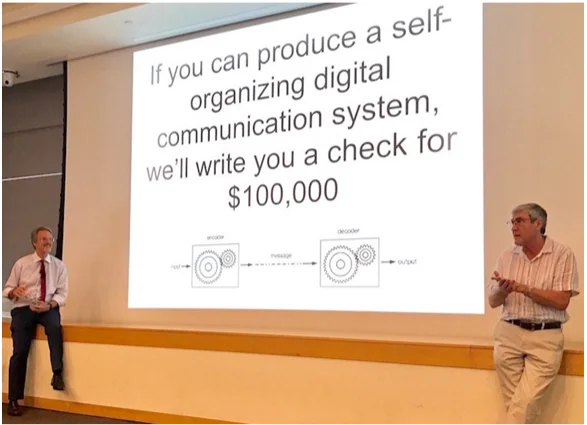
As a matter of fact, this prize—aimed at unraveling the mystery of the origin of the genetic code—was doubled to ten million dollars, as Perry Marshall announced at the Royal Society in Great Britain on 31 May 2019.4

The Evolution 2.0 Prize is the largest single award ever offered in science—ten times the size of the Nobel Prize. It will be granted to the individual or team that solves one of the greatest mysteries in history: how the genetic code within cells originated, and how cells intentionally self-organize, communicate, and adapt with purpose. To win, the applicant must produce a physical encoder, message, and decoder that self-organize independently. However, the organizers openly acknowledge that this contest will not be easy, given that its ultimate aim is to uncover the origin of life. It is a well-established fact that all known codes are the product of design, and since no scientist has yet been able to explain how the DNA code came into existence, it too must have been designed. In truth, the chances of solving the question of life’s origin through purely materialistic means are virtually nonexistent.
Indeed, scientists have failed to meet the divine challenge—“Let them create even the smallest ant, or a grain of wheat, or a grain of barley.” They have been unable to create even the simplest form of life. It is well known that DNA forms the foundation of all life, and many scientists recognize it as an exceptionally elegant code. Cells possess genetic engineering capabilities, as each one reproduces itself based on digital instructions encoded in DNA. In essence, DNA exhibits the same features as modern digital technology: layers of digital encoding and decoding, data storage, error detection, error correction and repair, along with an adaptive capacity that defies imagination. It is worth asking: How do cells “know” how to repair themselves, heal, adapt to new conditions, and make purposeful choices? No human-designed software does that, and even with millions of chances and billions of years, software will simply crash. In conclusion, the supposed conflict between religion and science is a false dichotomy, for true faith is not the result of abandoning reason, as some mistakenly believe. On the contrary, non-theistic explanations face severe challenges—they are at odds with the findings of modern science and irreconcilable with reason.
Notes and References
- 1
Haitham Talaat, “The 10 Million $ Challenge for Atheists to Solve the Mystery of the Origin of Life. Refuting the ‘God of the Gaps’ Argument,” YouTube, uploaded by Dr. Haitham Talaat, 29 Oct. 29, 2019, Https://www.youtube.com/watch?v=PmNGZgHH6Jg, [7:49–8:02].
- 2
Muḥammad al-Bukhārī, Ṣaḥīḥ al-Bukhārī, (Cairo, Egypt: Dār as-Salām. 1999), ḥadīth: 7559, available at: https://sunnah.com/bukhari:7559.
- 3
“$5 Million Tech Prize Seeks Answer to Origin of Life,” Frontline Genomics, 1 Mar. 2018, https://www.evo2.org/frontlinegenomics/.
- 4
“Origin of Life: $10 Million Prize at the Royal Society,” YouTube, uploaded by voicesfromoxfordUK, 16 Jul. 2019, https://www.youtube.com/watch?v=rJSCBeLD05M, [12:48–13:04]: “Well, good morning. Thank you. It is an honor to be here at the Royal Society. Well, so we’re here raising, doubling, the prize amount and it is the first significant activity I have had here in Europe discussing this.”