Are particles constantly emerging from the quantum vacuum? Does this imply that matter can arise from nothingness?
The hypothesis that particles emerge from the quantum vacuum was among the most widely circulated—and misleading—claims promoted by atheists in the early twentieth century. They asserted that things arise from “nothing,” but what they failed to clarify is that “nothing,” in the language of physics, is not truly nothing in the philosophical sense. In reality, physicists acknowledge that this “nothing” is not absolute nonexistence, as it operates within the framework of time, space, matter, and energy. Simply put, what is referred to as the quantum vacuum actually contains a minute amount of energy, however infinitesimal. In other words, it is still “something.” Even at its lowest energy state, there are fluctuations within the quantum vacuum of the universe, and as a result, quantum particles appear to momentarily pop into and out of existence throughout it. Quite simply, there appears to be “nothing,” then particles emerge, interact or collide, and vanish—leaving behind what seems like nothing once more. Scientists explain that even if everything were removed from the universe, quantum fluctuations embedded in spacetime would still remain. Given that physicists agree the universe emerged at neither a specific place nor time, the logical question arises: what relevance does this vacuum phenomenon have to the origin of the universe? Interestingly, the particles that emerge from these zero-point fields are known as virtual particles. That is to say, they are not actual particles in the conventional sense. Rather, they are disturbances in quantum fields, never found in isolation, and typically generated by the presence of other particles—often from other fields. In short, they do not constitute real matter and vanish almost immediately after appearing.1
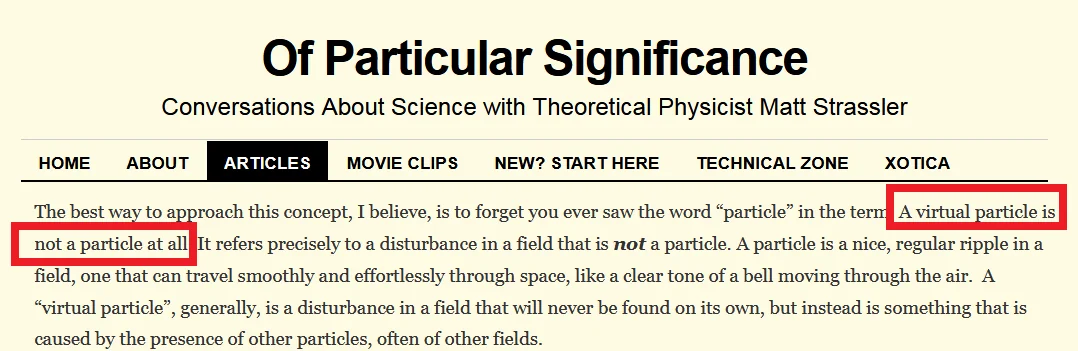
However, it is worth noting that virtual particles can, under the right conditions, transform into real matter through interactions with existing matter and energy. Thus, from the perspective of quantum mechanics, certain conditions must be met for virtual particles to emerge:
1.Space
2.Time
3.A minimal amount of energy (zero-point energy)
Nonetheless, such particles vanish almost immediately after their emergence. Therefore, atheists’ claim that a universe can arise from “nothing” is a misrepresentation, as what they refer to as “nothing” is not, in fact, truly nothing—hence the scientific term quantum vacuum. Such assertions are baseless and reflect a vain attempt to justify delusions, driven by a desperate need to uphold atheistic belief. For in truth, New Atheism amounts to little more than superstition. Ironically, many prominent atheists are convinced that traditional religious belief is dangerously irrational, and that its decline would give rise to a more intelligent, scientifically literate, and civilized society. Yet, the reality is that the New Atheist movement, by discouraging religion, is not fostering a generation of enlightened individuals, but rather promoting new forms of mass superstition. Moreover, contrary to the atheistic narrative of an ongoing war between science and religion—one in which religion is purportedly losing—many distinguished scientists maintain that science has played no role in turning people away from faith. In fact, the so-called “scientific worldview” championed by atheists ultimately undermines its own rational foundations. In truth, religion stands as one of the greatest triumphs of the human intellect, whereas atheists cling to desperate assumptions that expose nothing but their own inner turmoil.
Notes and References
- 1
Matt Strassler, “Virtual Particles: What Are They?” Of Particular Significance, https://profmattstrassler.com/articles-and-posts/particle-physics-basics/virtual-particles-what-are-they/.