Why did Prophethood cease among the Israelites and pass to the Islamic nation?
The Children of Israel were among the best of nations, and many Prophets, imāms (religious leaders), and righteous people arose from among them. Allāh says: {And We certainly delivered the Children of Israel from the humiliating torment (30) of Pharaoh. He was truly a tyrant, a transgressor. (31) And indeed, We chose the Israelites knowingly above the others (32)} (Qurʾān 44:30–32). In other words, Allāh selected the Children of Israel from among their contemporary nations to be the standard-bearers of His message of monotheism, for they were, in His knowledge, the most suitable people for this purpose. However, due to their close association with pagans and the attachment of many of them to the worldly life, corruption and idolatry began to appear among them, and their women started to display their beauty and adornments to men. Consequently, Prophet Isaiah warned the Jews and foretold the destruction of the Temple in Jerusalem as a result of their sins and wickedness. In the first chapter of the Book of Isaiah, the Lord declares that the Children of Israel had gone astray and that sin and immorality had spread among them: “1 1The vision concerning Judah and Jerusalem that Isaiah son of Amoz saw during the reigns of Uzziah, Jotham, Ahaz and Hezekiah, kings of Judah. 2 Hear me, you heavens! Listen, earth! For the Lord has spoken: “I reared children and brought them up, but they have rebelled against me. 3The ox knows its master, the donkey its owner’s manger, but Israel does not know, my people do not understand.” 4Woe to the sinful nation, a people whose guilt is great, a brood of evildoers, children given to corruption! They have forsaken the Lord; they have spurned the Holy One of Israel and turned their backs on him. 5 Why should you be beaten anymore? Why do you persist in rebellion? Your whole head is injured, your whole heart afflicted. 6From the sole of your foot to the top of your head there is no soundness—only wounds and welts and open sores, not cleansed or bandaged or soothed with olive oil. 7Your country is desolate, your cities burned with fire; your fields are being stripped by foreigners right before you, laid waste as when overthrown by strangers. 8Daughter Zion is left like a shelter in a vineyard, like a hut in a cucumber field, like a city under siege. 9Unless the Lord Almighty had left us some survivors, we would have become like Sodom, we would have been like Gomorrah.” (Isaiah1:1-9).
The verse, “The ox knows its master, the donkey its owner’s manger, but Israel does not know; my people do not understand,” illustrates that while the ox recognizes its owner and the donkey knows who cares for it, the leaders and people of Judah (the Israelites) failed to recognize their true Master. In other words, the Jews did not know their Creator and Sustainer, and they rejected and disobeyed Allāh. The verse, “Your country is desolate, your cities burned with fire; your fields are being stripped by foreigners right before you, laid waste as when overthrown by strangers,” serves as a severe warning to the Israelites due to their tyranny and moral decline. Their Prophet cautions that the kingdom of Judah will be attacked and plundered by their enemies because of their persistent unfaithfulness to the Lord. Isaiah then continues with the revelation of the Lord, saying: “1 15 When you spread out your hands in prayer, I will hide my eyes from you; even if you offer many prayers, I will not listen. Your hands are full of blood; 16 wash and make yourselves clean. Take your evil deeds out of my sight! Stop doing wrong, 17 learn to do right! Seek justice, encourage the oppressed. Defend the cause of the fatherless; plead the case of the widow.” (Isaiah1:15-17).
This verse, “When you spread out your hands in prayer, I will hide my eyes from you; even if you offer many prayers, I will not listen. Your hands are full of blood,” indicates that corruption had spread throughout Zion, and that the leaders and people of Judah had transgressed across the land. Their wrongdoing was evident in their mistreatment of one another. They feigned devotion to Allāh through religious ceremonies—empty, hollow, and ineffective prayers—but the Lord valued more how they treated others, particularly the weak. The verses, “Wash and make yourselves clean. Take your evil deeds out of my sight! Stop doing wrong, learn to do right! Seek justice, encourage the oppressed. Defend the cause of the fatherless; plead the case of the widow,” represent Allāh’s call to the Jews to repent from their sins and to advocate for the vulnerable—the oppressed, fatherless, and widows. Verse 16 of the third chapter of the Book of Isaiah is particularly striking: “The Lord says: ‘The women of Zion are haughty, walking along with outstretched necks, flirting with their eyes, tripping along with mincing steps, with ornaments jingling on their ankles.’” (Isaiah 3:16).

This verse illustrates that moral decay had deeply penetrated the hearts of the people of Zion (the Israelites), particularly among the women, who had become vain, self-centered, and indifferent to the commandment to guard their chastity and modesty. They walked with necks outstretched, haughty and intent on proudly displaying their jewelry. Their flirtatious glances and seductive eyes sought to attract men, while their mincing steps feigned humility even as they drew attention to the jingling of their ankle ornaments. Isaiah emphasized that these wealthy women were so self-absorbed and prideful that they could not practice true humility or devotion to God. Their disregard for justice and righteousness was reflected even in the way they dressed. In short, all their actions were designed to command attention, and when the women of a nation turn so completely away from Allāh, the downfall of that nation inevitably follows. Consequently, the destruction of Jerusalem drew near. Verse 9 of chapter 30 of the Book of Isaiah states: “These are rebellious people, deceitful children, children unwilling to listen to the Lord’s instruction.” (Isaiah 30:9). This indicates that the Jews were rebellious against Allāh and His commands, falsely claiming to be the children of God, and unwilling to accept the Law of the Lord. Consequently, their destruction came because they refused to heed Allāh’s Word, instead delighting in flattery and being led astray. This prophecy foretells that the Jews would be defeated and that Jerusalem would be ruined. Indeed, Zion was destroyed, and although the Jews attempted to rebuild the Temple of Jerusalem, it never regained its former glory. When Jesus (PBUH) appeared many centuries after the Temple’s destruction, the Jews expected the Savior to restore the glory of Jerusalem and Zion. Ironically, he further warned them of the complete destruction of Jerusalem, declaring that not one stone of the Temple would remain upon another: “13 1As he (Jesus) was leaving the temple, one of his disciples said to him, “Look, Teacher! What massive stones! What magnificent buildings!” 2“Do you see all these great buildings?” replied Jesus. “Not one stone here will be left on another; everyone will be thrown down.”” (Mark 13:1-2).
Indeed, the last Temple was destroyed, and Jerusalem was completely ruined after Jesus (PBUH) was raised unto Allāh. This well-known destruction occurred in 70 A.D. at the hands of the Romans.

The Jews continue to hold annual mourning rituals to commemorate this destruction after which the Temple was never rebuilt. Undoubtedly, the irreversible destruction of the Jewish Temple and the fact that its original location is no longer known among the Jews serve as practical and rational evidence clearly indicating that the Jewish Law was revoked.
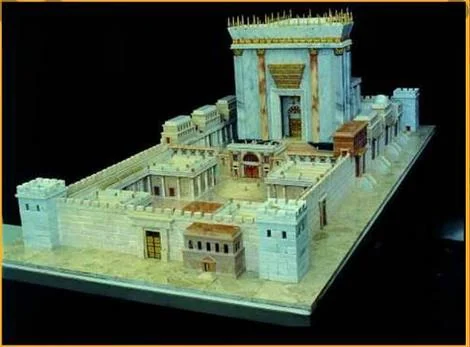
The destruction of the Jewish Temple—the symbol of Jewish worship and the source of Jewish religious authority—serves as a sign of the abrogation of the Jewish Law, meaning its nullification and replacement by a new Law. Consequently, the divine Message was withdrawn from the Jews and entrusted to another nation that would uphold the covenant of Allāh, which the Jews had forsaken. Notably, immediately following the prophecy concerning the Temple’s destruction, Isaiah foretold the emergence of a New Jerusalem and a new Zion. The term “Zion” refers to the safe and well-fortified house of the Lord. Isaiah heralded a new Zion, distinct from the old, corrupt Zion where disbelief and idolatry prevailed and where women displayed their beauty to tempt men. In truth, Isaiah prophesied the establishment of a House of the Lord in the land of the Arabs.