How can we be certain that Prophet Jacob (PBUH)’s prophecy truly pertains to Islam?
The answer to this question lies in the meaning of the term “Shiloh” in the verse in chapter 49 of the Book of Genesis: “The sceptre shall not depart from Judah, nor a lawgiver from between his feet, until Shiloh come; and unto him shall the gathering of the people be” (Genesis 49:10). This term is considered one of the most difficult in the Torah. Some Torah scholars and rabbis conclude that “Shiloh” literally means “he to whom it belongs,” that is, “the one to whom the dominion and the Book will belong.” However, a large number of Torah scholars contend that “Shiloh” derives from the same root as “Shalom,” meaning peace, as in Shalom Aleichem (Hebrew: שָׁלוֹם עֲלֵיכֶם), which means “peace be upon you.”
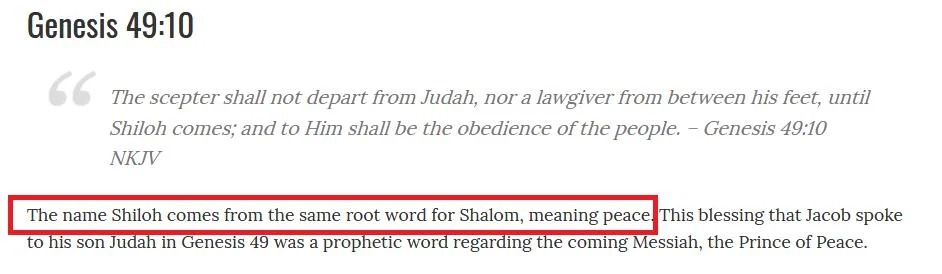
Hence, “Shiloh” is related to “Shalom,” which shares the same root as “Islam,” and thus “…until Shiloh come” simply means “until Islam comes.”1 Every Muslim knows and believes that Islam was clearly mentioned in Prophet Jacob (PBUH)’s final words to his sons on his deathbed. Unquestionably, he (PBUH) instructed his sons to submit in devotion to Allāh alone. Allāh says: {Or did you witness when death came to Jacob? He asked his children, “Who will you worship after my passing?” They replied, “We will ˹continue to˺ worship your God, the God of your forefathers—Abraham, Ishmael, and Isaac—the One God. And to Him we ˹all˺ submit”} (Qurʾān 2:133). Whether “Shiloh” relates to the root word for peace, as we have just explained, or has another linguistic denotation, which we will shortly discuss, Jacob (PBUH)—as every believer in the Qurʾān knows—reminded his sons to submit to Allāh alone, the core message of Islam. Moreover, many linguists contend that, in its context within the Torah, “Shiloh” means the “peace-giver,” the “rest-bringer,” or “the one who relieves the Israelites of their burdens and the shackles that bound them.” Indeed, this is the interpretation that numerous websites specializing in Bible studies regard as correct.2
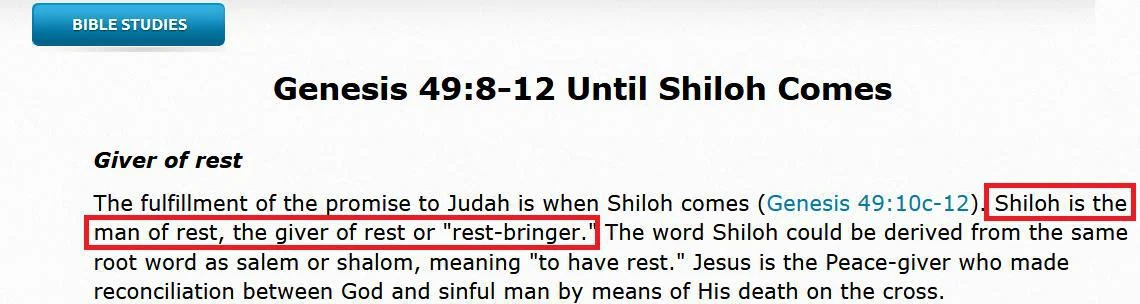
Therefore, Jacob (PBUH) foretold the one who would remove the difficult commandments that had been revealed as obligations to the Israelites.3

The shackles that bound the Israelites refer to rulings concerning food and purity, as well as other religious rulings. These strict rulings were imposed upon them as a punishment for their transgressions. For example, certain things were made unlawful for them because of their wrongdoing. Allāh says: {To the Jews, We have forbidden what We related to you before. We did not wrong them, but it was they who wronged themselves} (Qurʾān 16:118). Jacob (PBUH) told his sons that the one who would relieve them of their burdens would come. Allāh says: {“˹They are˺ the ones who follow the Messenger, the unlettered Prophet, whose description they find in their Torah and the Gospel. He commands them to do good and forbids them from evil, permits for them what is lawful and forbids to them what is impure, and relieves them of their burdens and the shackles that bound them”} (Qurʾān 7:157). The shackles that bound the Israelites refer to rulings concerning food and purity, as well as other religious rulings. These strict rulings were imposed upon them as a punishment for their transgressions. For example, certain things were made unlawful for them because of their wrongdoing. Allāh says: {To the Jews, We have forbidden what We related to you before. We did not wrong them, but it was they who wronged themselves} (Qurʾān 16:118). Jacob (PBUH) told his sons that the one who would relieve them of their burdens would come. Allāh says: {“˹They are˺ the ones who follow the Messenger, the unlettered Prophet, whose description they find in their Torah and the Gospel. He commands them to do good and forbids them from evil, permits for them what is lawful and forbids to them what is impure, and relieves them of their burdens and the shackles that bound them”} (Qurʾān 7:157). The Prophet (PBUH) removed the difficult commandments that had been imposed as obligations upon the Israelites. One of the strict rulings regarding purity in Judaism that was made easier in Islam concerns menstruation:
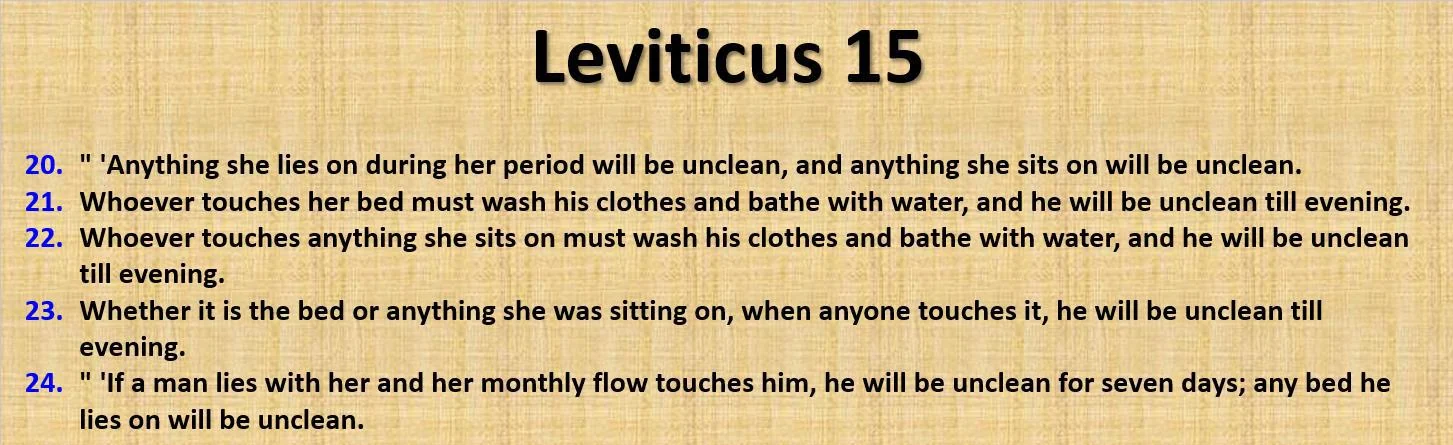
As earlier noted, strict rulings were imposed upon the Jews in the Torah as a punishment for their transgressions, due to their hardness of heart. Consequently, Prophet Muḥammad (PBUH) came to relieve them of these rulings. Allāh urged the Jews and others to honor him (PBUH) and to support him against the disbelievers who opposed him: {˹Only˺ those who believe in him, honor and support him, and follow the light sent down to him will be successful} (Qurʾān 7:157). In other words, it was foretold that he (PBUH) would be a fighter for the cause of Allāh and that “the obedience of the nations would be his.”
These verses are worth reflecting on: {Or did you witness when death came to Jacob? He asked his children, “Who will you worship after my passing?” They replied, “We will ˹continue to˺ worship your God, the God of your forefathers—Abraham, Ishmael, and Isaac—the One God. And to Him we ˹all˺ submit.” (133) That was a community that had already gone before. For them is what they earned and for you is what you have earned. And you will not be accountable for what they have done (134)} (Qurʾān 2:133–134). The statement, “That was a community that had already gone before,” is of great significance. The Israelites, particularly the tribe of Judah, passed away like other communities, and the Prophethood, the Law, and the dominion were taken from them and entrusted to another nation. What people commonly call “actions” or “deeds” is described by the Qurʾān as “earning”—“For them is what they earned, and for you is what you have earned”—because every human act carries an ultimate effect, whether good or bad, and will be met with Allāh’s approval or disapproval. This ultimate effect constitutes one’s earning. The Qurʾān emphasizes this concept by consistently framing people’s actions as their “earning.” The statement, “For them is what they earned, and for you is what you have earned,” signifies that the Israelites received the outcome of their deeds, whether good or evil, and that the Muslims will receive the outcome of their own. Allāh thus informs us that no one will be held accountable for another’s actions; everyone will be rewarded according to their own actions. Consequently, we should focus on our own actions rather than being distracted by the actions of those before us, for nothing benefits us except our own good actions. The verse further underscores that although the Jews are the Prophets’ offspring by blood, they, in fact, have no true connection with them. They have no right to claim affiliation with the Prophets, for they had strayed far from their path, and Allāh will judge each individual by their own deeds, not those of their forefathers. Likewise, Muslims, having inherited the Book, will be held accountable for their deeds and for the mission entrusted to them—the propagation of Allāh’s Word.
Notes and References
- 1
Henry. M. Morris, The Genesis Record: A Scientific and Devotional Commentary on the Book of Beginnings, (Grand Rapids, U.S.: Baker Books House: 1976), p. 655: The form of the word is related to the word for peace ‘Shalom.’
- 2
“Genesis 49:8-12 Until Shiloh Comes,” Abide in Christ, http://www.abideinchrist.com/messages/gen49v8.html.
- 3
Wayne Jackson, “Who Is the Mysterious Shiloh?” Christian Courier, 10 March 2021, https://www.christiancourier.com/articles/1101-who-is-the-mysterious-shiloh.