How did Isaiah prophesy the establishment of a House of God in Arabia?
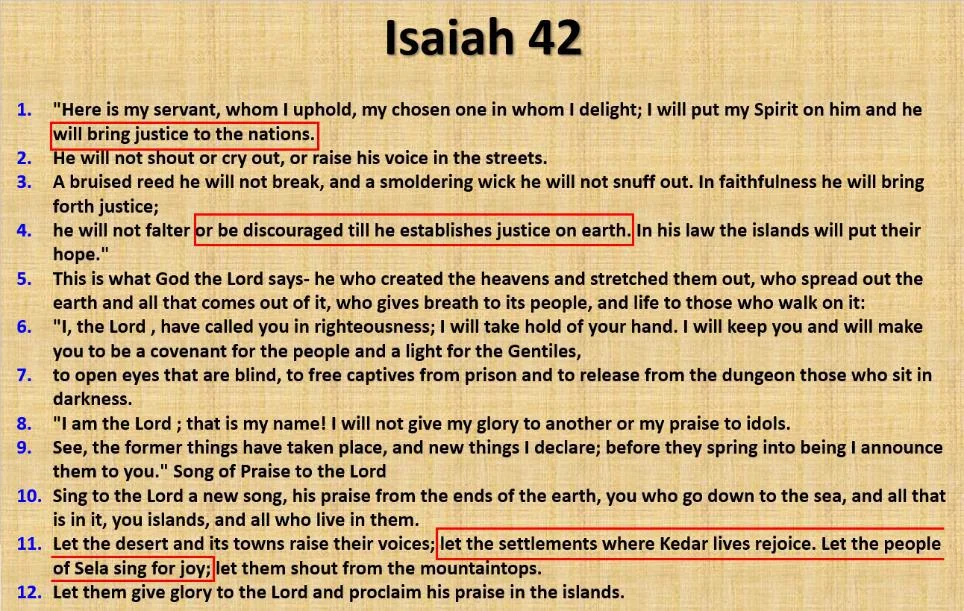
The prophecies concern a House of the Lord in the land of the Arabs, where the sheep and camels of Makkah are sacrificed during the ḥajj (pilgrimage) season. The light of this House will shine among the Children of Ishmael so that Allāh will dispel the darkness that has covered the world, and fruits of all kinds will be brought to it. This House will remain glorious forever, serving as a source of joy for all generations. These prophecies are recorded in the present-day Torah, which the Jews read, and any fair-minded person who examines them will undoubtedly recognize that they refer to al-Masjid al-Ḥarām (the Sanctified House of Allāh in Makkah). These prophecies are well-known to all who study the Torah, yet the Jewish rabbis conceal the truth, and the Jewish masses remain ignorant of the Scriptures, as Allāh says: {And among them are the illiterate who know nothing about the Scripture except lies, and ˹so˺ they ˹wishfully˺ speculate} (Qurʾān 2:78). Let us now examine these remarkable prophecies. As explained earlier, in chapter 42 of the Book of Isaiah, Prophet Isaiah foretold the destruction of the Jewish Temple as a consequence of widespread corruption among the Children of Israel. He then heralded the coming of the Prophet who would deliver the Truth to all nations, raising the sound of Allāh’s glorification and the call to prayer in the lands of Kedar and Sela—namely, Makkah and al-Madīnah.
In chapter 60 of the Book of Isaiah, Prophet Isaiah foretold the emergence of a new House of Allāh, which would be established among the homes of Kedar: “60 1Arise, shine, for your light has come, and the glory of the Lord rises upon you. 2See, darkness covers the earth and thick darkness is over the peoples, but the Lord rises upon you and his glory appears over you. 3Nations will come to your light, and kings to the brightness of your dawn. 4Lift up your eyes and look about you: All assemble and come to you; your sons come from afar, and your daughters are carried on the hip. 5Then you will look and be radiant, your heart will throb and swell with joy; the wealth on the seas will be brought to you, to you the riches of the nations will come. 6Herds of camels will cover your land, young camels of Midian and Ephah. And all from Sheba will come, bearing gold and incense and proclaiming the praise of the Lord. 7All Kedar’s flocks will be gathered to you, the rams of Nebaioth will serve you; they will be accepted as offerings on my altar, and I will adorn my glorious temple. 8Who are these that fly along like clouds, like doves to their nests?” (Isaiah 60:1-8).
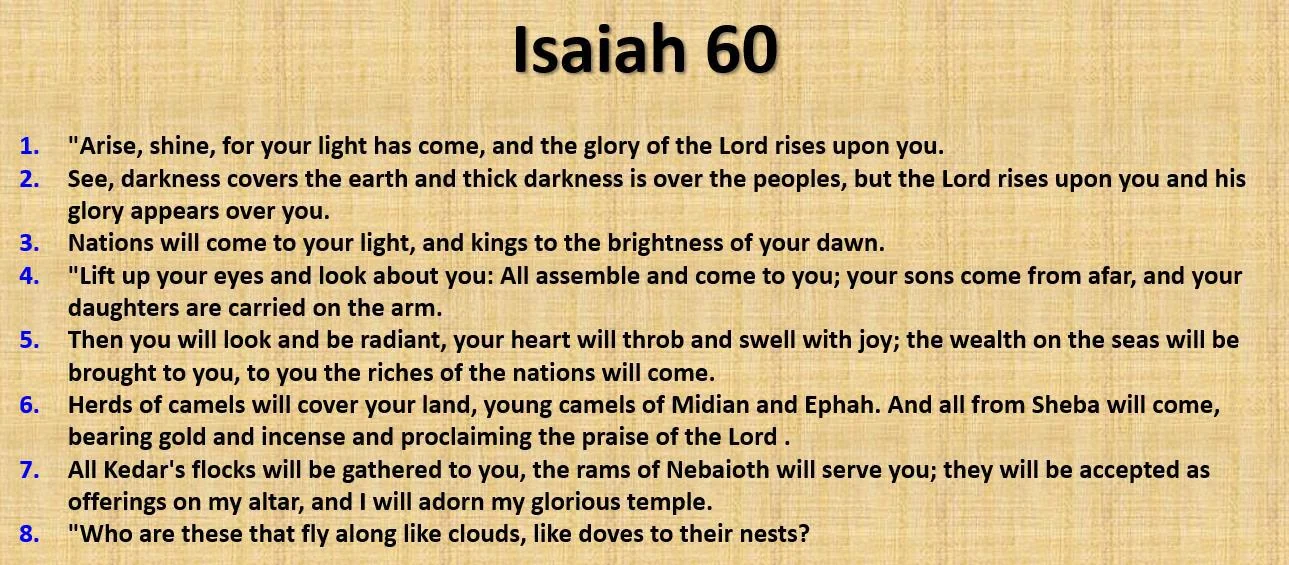
In the first two verses, “Arise, shine, for your light has come, and the glory of the Lord rises upon you. See, darkness covers the earth and thick darkness is over the peoples, but the Lord rises upon you and His glory appears over you,” Isaiah foretold the coming of the light of the New Jerusalem, contrasting it with the darkened city—Jerusalem or Zion—and thus with the nation of Israel. In this verse, darkness symbolizes evil and disbelief, and the coming Prophet is portrayed as the light of the world. The next three verses, “Nations will come to your light, and kings to the brightness of your dawn. Lift up your eyes and look about you: All assemble and come to you; your sons come from afar, and your daughters are carried on the hip. Then you will look and be radiant, your heart will throb and swell with joy; the wealth on the seas will be brought to you, to you the riches of the nations will come,” describe the New House of God. The Qurʾān provides a corresponding description of this prophesied New House of the Lord, as Allāh says: {Have We not established for them a safe haven ˹in Makkah˺ to which fruits of all kinds are brought as a provision from Us?} (Qurʾān 28:57). The verse, “Herds of camels will cover your land, young camels of Midian and Ephah. And all from Sheba will come, bearing gold and incense and proclaiming the praise of the Lord,” indicates that caravans of camels are characteristic of the land in which the House of the Lord will be established. It also alludes to the two well-known seasonal trade journeys undertaken by Quraysh: in the summer they traveled north to the Levant—toward Syria and Palestine—where the climate was cooler, and in the winter they traveled south to Sheba in Yemen, where the weather was warmer. Similarly, Allāh states: {˹At least˺ for ˹the favour of˺ making Quraysh habitually secure—secure in their trading caravan ˹to Yemen˺ in the winter and ˹the Levant˺ in the summer} (Qurʾān 106:1–2). Finally, the remarkable statement, “All Kedar’s flocks will be gathered to you, the rams of Nebaioth will serve you; they will be accepted as offerings on my altar, and I will adorn my glorious temple,” can apply only to the Sanctified House of Allāh in Makkah. Kedar, as mentioned earlier, was the second son of Ishmael, and Nebaioth his firstborn.
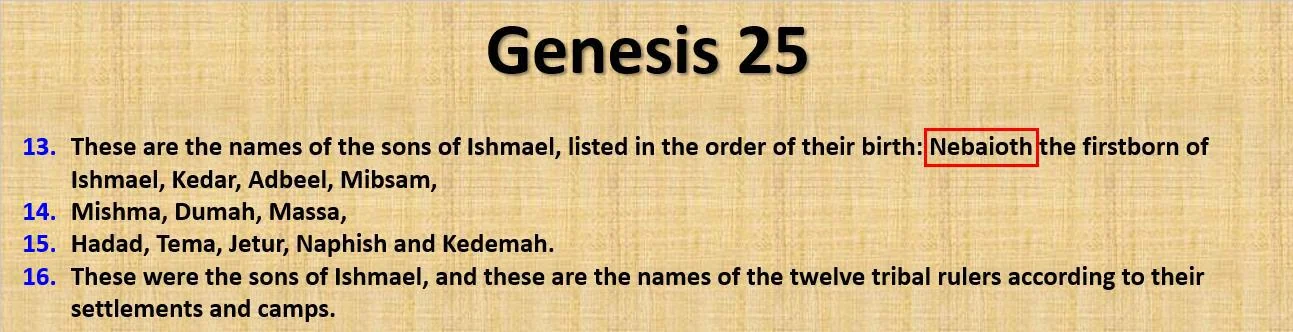
Kedar lived and grew up in Makkah and is the forefather of ʿAdnān, who in turn is the forefather of Prophet Muḥammad (PBUH). Therefore, the people of Makkah, including the tribe of Quraysh, are the descendants of Kedar. Throughout Arab history, animals have consistently been brought as offerings to the Makkan Sanctuary. They were not offered on the altars of Christian churches, nor on the altar of the Temple in Jerusalem. Likewise, the rams of Nebaioth, the eldest son of Ishmael, were brought for sacrifice to the Sanctified House of Allāh in Makkah. Let us now consider additional verses from chapter 60 of the Book of Isaiah: “60 7 All Kedar’s flocks will be gathered to you, the rams of Nebaioth will serve you; they will be accepted as offerings on my altar, and I will adorn my glorious temple. 8 Who are these that fly along like clouds, like doves to their nests?” 9 Surely the islands look to me; in the lead are the ships of Tarshish, bringing your children from afar, with their silver and gold, to the honor of the Lord your God, the Holy One of Israel, for he has endowed you with splendor. 10 Foreigners will rebuild your walls, and their kings will serve you. Though in anger I struck you, in favor I will show you compassion. 11 Your gates will always stand open, they will never be shut, day or night, so that people may bring you the wealth of the nations—their kings led in triumphal procession. 12 For the nation or kingdom that will not serve you will perish; it will be utterly ruined.” (Isaiah 60:7-12).
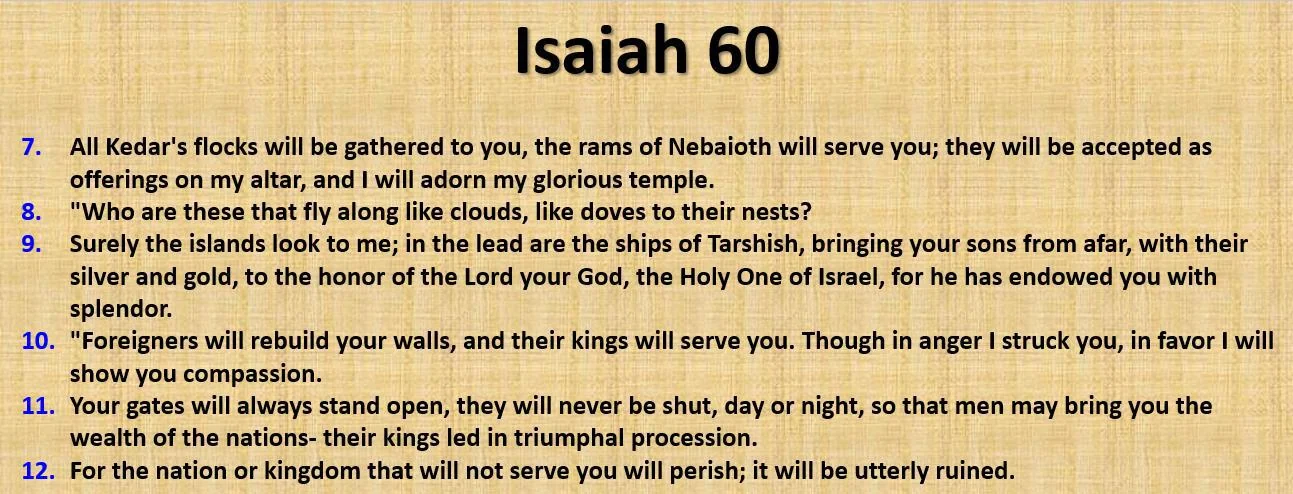
Isaiah’s prophecy concerning the House of the Lord in the land of the Arabs clearly refers to the Sanctified House of Allāh in Makkah. The verse, “All Kedar’s flocks will be gathered to you, the rams of Nebaioth will serve you; they will be accepted as offerings on my altar, and I will adorn my glorious temple,” explicitly alludes to the animals sacrificed during the pilgrimage and to the adornment of the Kaʿbah. These verses, “Who are these that fly along like clouds, like doves to their nests? Surely the islands look to me; in the lead are the ships of Tarshish, bringing your children from afar, with their silver and gold, to the honor of the Lord your God, the Holy One of Israel, for he has endowed you with splendor,” provide an astonishingly accurate description of the planes that now come to Makkah during the pilgrimage, appearing like clouds as they approach the Sacred House. Today, Muslims arrive by planes and ships from across the world, bringing wealth with them and offering sacrificial animals. Undoubtedly, this mode of pilgrimage occurs exclusively at the Sacred House of Allāh in Makkah and nowhere else. These verses deserve close attention, as this description applies to no other place in the world except the Holy Mosque in Makkah: “Foreigners will rebuild your walls, and their kings will serve you. Though in anger I struck you, in favor I will show you compassion. Your gates will always stand open, they will never be shut, day or night, so that people may bring you the wealth of the nations—their kings led in triumphal procession. For the nation or kingdom that will not serve you will perish; it will be utterly ruined.” Historically, many nations and peoples have contributed to building the walls of the Sanctified House in Makkah. Today, the Saudi kings serve as the guardians of the Makkan Sanctuary and are honored to be called the Custodians of the Two Holy Mosques. The statement, “Though in anger I struck you, in favor I will show you compassion,” refers to the profound transformation of the Makkan Sanctuary after the coming of Prophet Muḥammad (PBUH), who purified it from idols, making it, by Allāh’s grace and mercy, the pilgrimage site for all nations. The verse, “Your gates will always stand open, they will never be shut, day or night,” is remarkably accurate, for indeed, the doors of the Makkan Sanctuary remain open around the clock. Similarly, the verse, “So that people may bring you the wealth of the nations—their kings led in triumphal procession,” is fully demonstrated in history, as the treasures of Khosrow and Caesar were brought to the Makkan Sanctuary, and the kingdoms of the earth were conquered by the Muslim nation. Finally, the verse, “For the nation or kingdom that will not serve you will perish; it will be utterly ruined,” is significant: anyone who approaches the Sanctuary with evil intent will indeed face divine punishment and destruction, as Allāh says: {Indeed, those who persist in disbelief and hinder ˹others˺ from the Way of Allāh and from the Sacred Mosque—which We have appointed for all people, residents and visitors alike—along with whoever intends to deviate by doing wrong in it, We will cause them to taste a painful punishment} (Qurʾān 22:25).
Is there any other place on earth to which these prophecies apply with such remarkable accuracy, aside from the Holy Mosque in Makkah? The Jewish Temple was completely destroyed in 70 A.D., and its original location remains unknown to this day. Animals have never been slaughtered as offerings on the altars of Christian churches. By contrast, the sacrificial animals of the lands of the Arabs—the lands of Kedar and Nebaioth—have never been offered to any house of worship except the Sanctified House in Makkah. These prophecies are thus crystal clear, applicable only to the blessed Bakkah (an ancient name for Makkah), from which the light of the divine Message shone, illuminating the earth and dispelling all darkness of disbelief.