Was the Prophet (PBUH) mentioned by the name “Muḥammad” in the Torah?
Prophet Haggai (PBUH) was sent to the Children of Israel many years after the death of Jacob (PBUH). He proclaimed one of the most significant prophecies of the Old Testament, recorded in chapter 2 of the Book of Haggai:
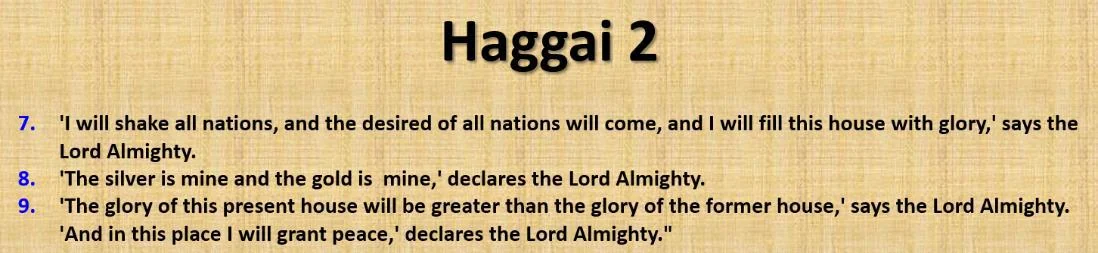
“‘I will shake all nations, and the desired of all nations will come, and I will fill this house with glory,’ says the Lord Almighty” (Haggai 2:7). This verse heralded the advent of a Prophet, and the shaking of the nations is a metaphor for fighting for the sake of Allāh by the heralded Prophet. He is described as the desired of all nations. The question then arises: who is he? To determine the answer, we must examine the original Hebrew text:
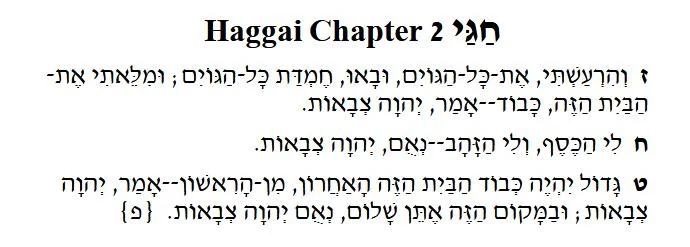
This is the word “desired” in Hebrew:

We will now look up this Hebrew word in a reliable online Hebrew-to-English dictionary and see its translation:1

The English translation of the Hebrew word meaning “the desired” is “Hemdat.” The “Hemdat” of all nations will come. “Hemdat” is derived from the triconsonantal Semitic root Ḥ-M-D, which is also the root of the Arabic names “Muḥammad,” “Aḥmad,” and “Maḥmūd.” Interestingly, the above-mentioned online dictionary did not provide a synonymous English meaning of this Hebrew word; rather, it listed the Hebrew proper noun “Hemdat.” The “Hemdat” of all nations will come—that is, the one whom all nations shall praise will come. This corresponds exactly to the meaning of the Arabic names Muḥammad, Aḥmad, and Maḥmūd. Muḥammad is the primary transliteration of the Arabic name derived from the verb ḥamada (i.e., to praise), which, similar to the Hebrew noun “Hemdat,” stems from the triconsonantal Semitic root Ḥ-M-D. It comes from what grammarians call the passive participle—a form that indicates someone is the recipient of the action—and thus it literally means “the one who is praised.” The word Muḥammad can therefore be translated as “the praised one,” “the commendable one,” or “the laudable one.” Hence, Muḥammad (i.e., the praised one) of all nations will come. Glory be to Allāh, the Hebrew word “Hemdat” thus shares the same root and meaning as the Arabic name of the final Prophet Muḥammad (PBUH), and their pronunciation is closely related.
The verses in the Book of Haggai that heralded Prophet Muḥammad (PBUH) by name remain in the possession of the Jews and Christians to this day. Allāh says: {Those We have given the Scripture recognize this ˹Prophet˺ as they recognize their own children. Yet a group of them knowingly conceals the truth} (Qurʾān 2:146). As noted earlier, the expression “to recognize something as one recognizes one’s own children” is an Arabic idiom referring to knowledge that is certain and beyond doubt. Jewish and Christian scholars were aware that Muḥammad (PBUH) was the Prophet heralded in their Scriptures. The Hebrew verse rendered “and the desired of all nations will come” (Haggai 2:7) specifies a particular individual with a particular name, as elaborated above. Undoubtedly, this prophecy cannot apply to anyone other than Prophet Muḥammad (PBUH), for his name alone is identical in root and meaning to the Hebrew proper noun “Hemdat” in the original text, and no other Prophet shares this name. Moreover, he was the Prophet who fought for the cause of Allāh and whose religion ultimately triumphed. We will now examine the phrase “all nations” in the verse “the desired of all nations will come” in the original Hebrew text of the second chapter of the Book of Haggai:
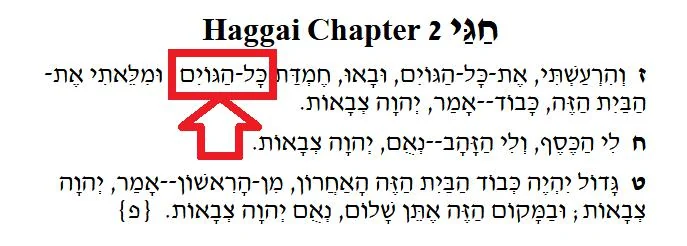
The accurate translation of this word, according to a reliable Hebrew-to-English dictionary, is “all gentiles,” meaning all non-Jewish people.2
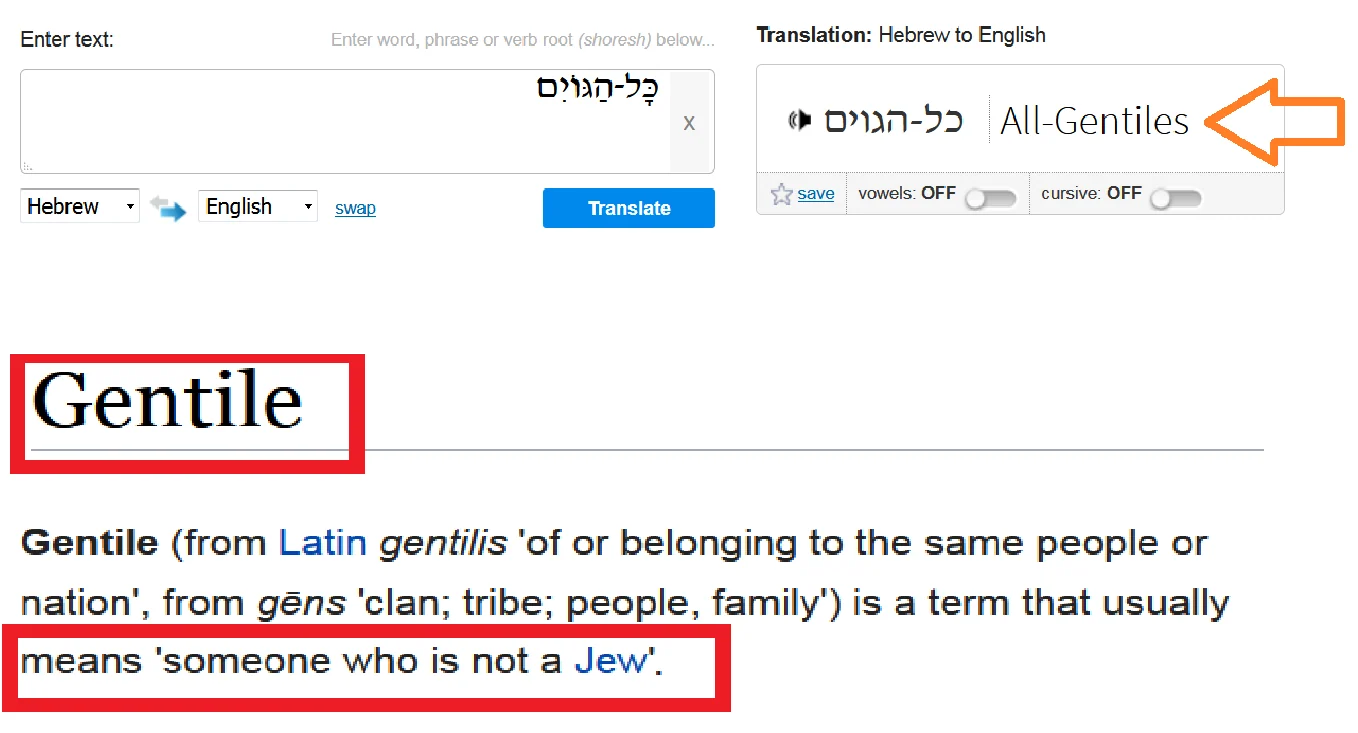
The Torah thus indicated that Hemdat—that is, Muḥammad—will come from among the gentiles. The term “gentile” carries connotations of disdain and contempt, as it was historically used to refer to all those who were not Jewish.
Many Jews harbored prejudice toward the “gentiles” (non-Jews) and falsely claimed that they would not be held accountable for any wrongdoing against them. In other words, they asserted that there was no sin on their part for any crime they commit against non-Jews (Arabs), falsely claiming that Allāh had permitted such actions. They propagated these lies knowingly, as Allāh says: {This is because they say, “We are not accountable for ˹exploiting˺ the Gentiles.” And ˹so˺ they attribute lies to Allāh knowingly} (Qurʾān 3:75). In reality, the Prophet heralded in the Book of Haggai 2, described as “the desired of all nations,” or more accurately, “the one who will be praised by all nations,” comes from among the gentiles. Allāh says: {˹They are˺ the ones who follow the Messenger, the unlettered Prophet, whose description they find in their Torah and the Gospel} (Qurʾān 7:157). The term “unlettered” here is a translation of the Arabic word ummiyy, which refers to someone who cannot read and write. In the Jewish context of that period, the term ummiyyīn was used to refer to non-Jews, particularly the Arabs, whom they regarded as unlettered gentiles. Thus, the Qurʾān’s use of “the unlettered Prophet” not only indicates the Prophet (PBUH)’s illiteracy but also reflects that he came from among the non-Jewish peoples, fulfilling the prophecy of the Haggai verse. The name and description of the Prophet sent from among the gentiles are explicitly mentioned in the Scriptures of the People of the Book (i.e., the Jews and the Christians). Allāh says: {He is the One Who raised for the gentiles a Messenger from among themselves—reciting to them His revelations, purifying them, and teaching them the Book and wisdom, for indeed they had previously been clearly astray} (Qurʾān 62:2). Here the term “gentiles,” a rendering of the Arabic ummiyyīn, is used with a particular historical nuance: the verse means that Allāh has raised a Messenger among the Arabs (gentiles), whom the Jews contemptuously considered inferior. In fact, the Jewish usage of the Hebrew word goyim (gentiles) originally referred to non-Jewish nations, and over time it acquired a more specific meaning in which all non-Jewish peoples were regarded as uncivilized, irreligious, unclean, and contemptible. In a nutshell, Muḥammad (PBUH) is the gentile Prophet whom all nations will praise (Haggai 2); the Shiloh from outside the tribe of Judah, foretold by Jacob (PBUH) on his deathbed (Genesis 49); and the Prophet heralded by Jesus (PBUH), whose nation will inherit the “vineyard” (that is, successorship on earth), which will be taken away from the Children of Israel on account of their corruptness (Mark 12).
Notes and References
- 1
“Hemdat,” Do it in Hebrew (English-Hebrew online translation dictionary), https://www.doitinhebrew.com/Translate/default.aspx?kb=US+US&l1=en&l2=iw.
- 2
“All gentiles,” Do it in Hebrew (English-Hebrew online translation dictionary), https://doitinhebrew.com/Translate/default.aspx?kb=IL%20Hebrew%20Phonetic; Wikipedia Contributors, “Gentile,” Wikipedia: The Free Encyclopedia, last edited 4 March 2021, https://en.wikipedia.org/wiki/Gentile.