If the prophecies concerning Prophet Muḥammad (PBUH) in the Scriptures of the People of the Book are so clear, why did they not accept Islam?
The religious scholars who studied the Torah thoroughly admit that Muḥammad (PBUH) is the unlettered Prophet prophesied therein.1 However, out of blind obstinacy and bigotry, they claim that he was sent exclusively to the unlettered Arabs; yet Muḥammad (PBUH) is indeed Allāh’s Messenger to all mankind. Allāh says: {So if they argue with you ˹O Prophet˺, say, “I have submitted myself to Allāh, and so have my followers.” And ask those who were given the Scripture and the illiterate ˹people˺,1 “Have you submitted yourselves ˹to Allāh˺?” If they submit, they will be ˹rightly˺ guided. But if they turn away, then your duty is only to deliver ˹the message˺. And Allāh is All-Seeing of ˹His˺ servants} (Qurʾān 3:20). Therefore, despite their claims, Prophet Muḥammad (PBUH) is the Messenger of Allāh to all humanity, including both Arabs and non-Arabs. Allāh says: {Say, ˹O Prophet,˺ “O humanity! I am Allāh’s Messenger to you all} (Qurʾān 7:158). The legitimate question is: If the Jewish religious scholars acknowledge that Muḥammad (PBUH) is the Prophet of the unlettered, why then do they not follow him? A true Prophet can never lie. Therefore, when the Prophet (PBUH) told them that they must believe in him, lest they become disbelievers, he was conveying nothing but the truth revealed to him. Undoubtedly, they would have followed him were it not for their stubbornness and arrogance. Allāh says: {O you who were given the Book! Believe in what We have revealed—confirming your own Scriptures—before We wipe out ˹your˺ faces, turning them backwards, or We condemn the defiant as We did to the Sabbath-breakers. And Allāh’s command is always executed!} (Qurʾān 4:47). The Jews and Christians should have faith in what Allāh revealed to Muḥammad (PBUH), which confirmed what they had received in their Scriptures. As previously explained, their Prophets warned them that the Message would be taken away from them and given to another nation, as Jacob (PBUH) foretold to his sons on his deathbed. Similarly, Jesus (PBUH) heralded that the kingdom of Allāh would be inherited by another nation. The Prophethood ceased among the Israelites after their attempt to crucify Jesus (PBUH). Moreover, the Jewish Temple was destroyed, and its original location remains unknown to this day, serving as a sign that the Jewish Law has been revoked. In short, all these are indications that the Prophethood, the Message, the Law, and the dominion have been inherited by another nation. Unfortunately, the People of the Book continue to turn a blind eye to all these proofs, and on the Day of Judgement, they will have only themselves to blame. Allāh says: {Blessed is the One Who sent down the Decisive Authority to His servant, so that he may be a warner to the whole world} (Qurʾān 25:1). Indeed, Allāh bestowed the Qurʾān on His servant and Messenger, Muḥammad (PBUH), to admonish all mankind—not the gentiles alone, as the People of the Book claimed.
Let us now return to chapter 2 of the Book of Haggai:
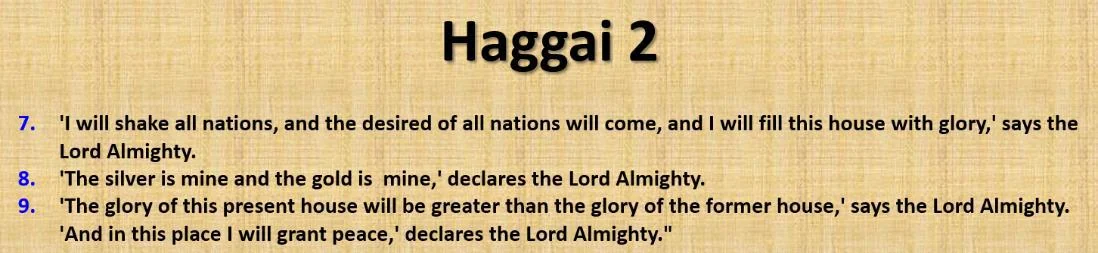
“‘I will shake all nations, and the desired of all nations will come, and I will fill this house with glory,’ says the Lord Almighty” (Haggai 2:7). Which “house” does this verse refer to? This question will be addressed in a subsequent section, where we will examine its significance in detail. “‘The silver is mine and the gold is mine,’ declares the Lord Almighty” (Haggai 2:8). Prophet Muḥammad (PBUH) was granted the treasures of gold and silver. Thawbān reported that Allāh’s Messenger (PBUH) said: “Verily, Allāh drew the ends of the world near me until I saw its east and west, and He bestowed upon me two treasures, the red and the white.”2
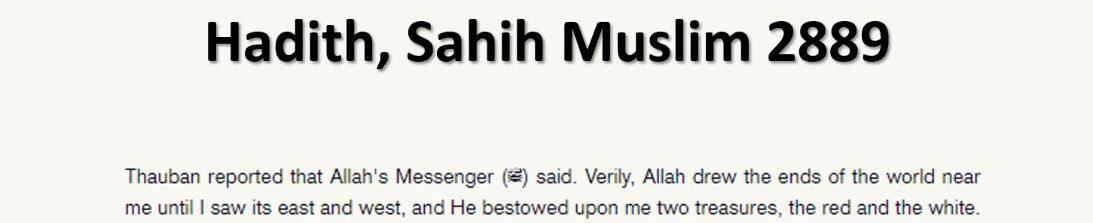
The red treasure represents gold, and the white treasure represents silver. The treasures of Caesar and Khosrow, the kings of the Levant and Iraq respectively, were historically known as the treasures of silver and gold, because silver was used by the former, while gold was used by the latter. Jābir ibn Samurah [may Allāh be pleased with him] reported that the Messenger of Allāh (PBUH) said: “When Khosrow perishes, there will be no Khosrow after him; and when Caesar perishes, there will be no Caesar after him. By Him in Whose Hand my soul is, their treasures will surely be spent in the cause of Allāh.”3 Indeed, the prophecy of Prophet Haggai (PBUH)—“‘The silver is mine and the gold is mine,’ declares the Lord Almighty” (Haggai 2:8)—and that of Prophet Muḥammad (PBUH)—“He bestowed upon me two treasures, the red and the white”—were fulfilled, for the Levant and Iraq were conquered, and the treasures of Caesar and Khosrow were spent in the cause of Allāh. Praise be to Allāh for the grace of success He bestowed upon His religion of truth, which all the Prophets called for.
It is interesting to contemplate the Prophetic tradition that describes Islam in its early days, showing how the Prophet (PBUH) succeeded in his mission and how Islam ultimately prevailed. The tradition narrates the story of ʿAmr ibn ʿAbasah’s conversion to Islam.ʿAmr ibn ʿAbasah as-Sulamī (PBUH) said: “During the Jāhiliyyah (the pre-Islamic period of ignorance), I used to think that people were misguided and that they were upon nothing (i.e., upon no right path) while they worshipped idols. Then I heard of a man in Makkah who was telling news [of a divine message], so I mounted my camel and went to him. It was the Messenger of Allāh (PBUH), who was in hiding because his own people were hostile toward him. I approached gently until I entered upon him in Makkah. I asked him, ‘What are you?’ He replied, ‘I am a Prophet.’ I asked, ‘What is a Prophet?’ He said, ‘Allāh has sent me.’ I asked, ‘With what has He sent you?’ He replied, ‘He sent me with [a message of] maintaining kinship ties, breaking the idols, and upholding the oneness of Allāh without associating anything with Him.’ I asked, ‘Who is with you upon this?’ He replied, ‘A free man and a slave.’ At that time, only Abū Bakr and Bilāl [may Allāh be pleased with both] were with him. I said, ‘I shall follow you.’ He replied, ‘You cannot do that today. Do you not see my situation and that of the people? However, return to your family, and when you hear that I have succeeded in my mission, come to me.’ He said: So I went back to my family, and the Messenger of Allāh (PBUH) had arrived in al-Madīnah while I was still with my people. I began inquiring about the news and asking the people when he had arrived in al-Madīnah, until a group from my people reached al-Madīnah. I asked them, ‘What has this man who came to al-Madīnah done?’ They said, ‘People are hastening to him, and his own people wanted to kill him, but they could not.’ I then went to al-Madīnah, entered upon him, and said, ‘O Messenger of Allāh, do you recognize me?’ He replied, ‘Yes, you are the one who met me in Makkah.’”4 At their first meeting, at the beginning of Prophet Muḥammad (PBUH)’s mission, he said to ʿAmr ibn ʿAbasah, “Do you not see my situation and that of the people?”—for he was in hiding, and the Quraysh were hostile toward him. Surprisingly, a few years later, ʿAmr was informed that people were hastening to him (PBUH), meaning that people were embracing Islam in large numbers.
Now let us return to chapter 2 of the Book of Haggai: “‘The glory of this present house will be greater than the glory of the former house,’ says the Lord Almighty. ‘And in this place I will grant peace,’ declares the Lord Almighty” (Haggai 2:9). This verse refers to “a new House of the Lord,” which, as noted earlier, is located in the land of the Arabs. The Qurʾān likewise describes the Sanctified House of Allāh in Makkah with the attributes of peace, safety, and sanctuary. Allāh states: {Surely the first House ˹of worship˺ established for humanity is the one at Bakkah—a blessed sanctuary and a guide for ˹all˺ people. In it are clear signs and the standing-place of Abraham. Whoever enters it should be safe. Pilgrimage to this House is an obligation by Allāh upon whoever is able among the people. And whoever disbelieves, then surely Allāh is not in need of ˹any of His˺ creation} (Qurʾān 3:96–97). He also reminds us: {And ˹remember˺ when We made the Sacred House a centre and a sanctuary for the people} (Qurʾān 2:125). Furthermore, He asks: {Have they not seen how We have made ˹Makkah˺ a safe haven, whereas people ˹all˺ around them are snatched away? How can they then believe in falsehood and deny Allāh’s favours?} (Qurʾān 29:67). Collectively, these verses underscore the unique sanctity, divine protection, and peace of the Sanctified House in Makkah, thereby distinguishing it from all other houses of worship. Is the Haggai prophecy applicable to any house other than the Sanctified House of Allāh in Makkah? Clearly, it applies neither to the Jewish Temple, which has been permanently destroyed, nor to churches, which have never been described in Scripture as sanctuaries endowed with divinely assured peace and inviolable security.
Notes and References
- 1
“Jewish Rabbi Confirms that Mohammad PUH is a Great Prophet,” YouTube, uploaded by Keedar al-Maghribi, 22 Nov. 2014, https://www.youtube.com/watch?v=4y6NsYLxj3g.
- 2
Muslim ibn al-Ḥajjāj, Ṣaḥīḥ Muslim, (Bayrūt, Lebanon: Dār al-Kutub al-ʿIlmiyyah, 2020), ḥadīth: 2889a, available at: https://sunnah.com/muslim:2889a.
- 3
Agreed upon ḥadīth, Muḥammad al-Bukhārī, Ṣaḥīḥ al-Bukhārī, (Cairo, Egypt: Dār as-Salām. 1999), ḥadīth: 3121, available at: https://sunnah.com/bukhari:3121; Muslim ibn al-Ḥajjāj, Ṣaḥīḥ Muslim, (Bayrūt, Lebanon: Dār al-Kutub al-ʿIlmiyyah, 2020), ḥadīth: 2919, available at: https://sunnah.com/muslim:2919a.
- 4
Abū Bakr Aḥmad ibn Ḥusayn al-Bayhaqī, as-Sunan al-Kubrá, (Bayrūt, Lebanon: Dār al-Kutub al-ʿIlmiyyah, 2003), vol. 2, p. 454.