What are some examples of the prophecies concerning Prophet Muḥammad (PBUH) found in the apocryphal books?
The Apocalypse of Abraham: Together with the Testament of Abraham is an English translation of two ancient religious texts preserved in Slavonic and likely derived from earlier Greek originals. The volume includes a scholarly introduction and commentary by noted scholars G. H. Box and Dr. Moses Gaster, providing valuable insight for theologians, students, and general readers alike.
The Apocalypse of Abraham contains a prophecy concerning the time of Prophet Muḥammad (PBUH)’s mission. Prophet Abraham (PBUH) supplicated Allāh to raise from among his offspring—specifically from the descendants of Ishmael—a Messenger who would recite His revealed verses to them, teach them the Book and wisdom, and purify them from associating partners with Him and from all forms of wrongdoing. He (PBUH) said: {Our Lord! Raise from among them a Messenger who will recite to them Your revelations, teach them the Book and wisdom, and purify them. Indeed, You alone are the Almighty, All-Wise} (Qurʾān 2:129). This supplication indicates that the advent of Prophet Muḥammad (PBUH) was, in fact, Allāh’s response to Abraham (PBUH)’s supplication. The Prophet foretold in the Book of Abraham is described as one who would restore people from paganism to the pure Abrahamic monotheism. Allāh informed Abraham (PBUH) that this Prophet would arise twelve centuries after the destruction of the Temple. The Temple was destroyed in the sixth century B.C., and Prophet Muḥammad (PBUH) was sent in the sixth century C.E.—approximately twelve centuries later. This prophecy is preserved in the biblical Apocrypha to this day: “...be born from you. In the last days, in this twelfth period of the age of my fulfillment, I will set up this man from your tribe, the one whom you have seen from my people. All will imitate him, you consider” (Apocalypse of Abraham 29:9–10).

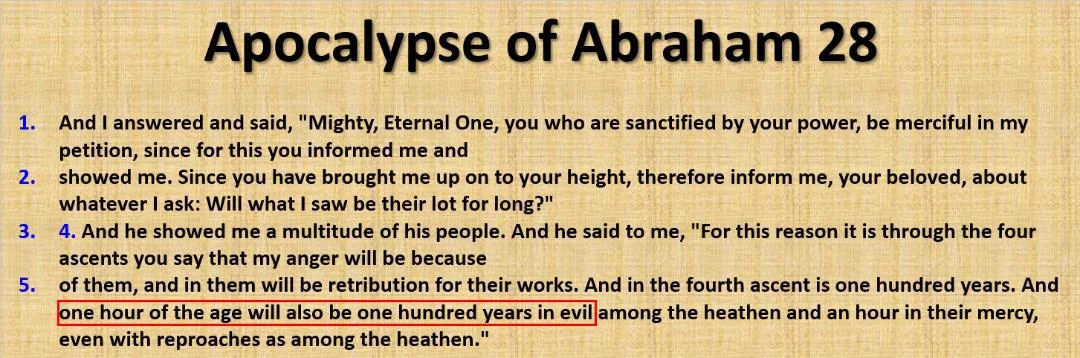
According to this apocryphal text, a “period of the age” or “one hour of the age” is understood to represent one hundred years. The text states: “…And in the fourth ascent is one hundred years. And one hour of the age will also be one hundred years in evil among the heathen and an hour in their mercy, even with reproaches as among the heathen, even with reproaches as among the heathen” (Apocalypse of Abraham 28:5).
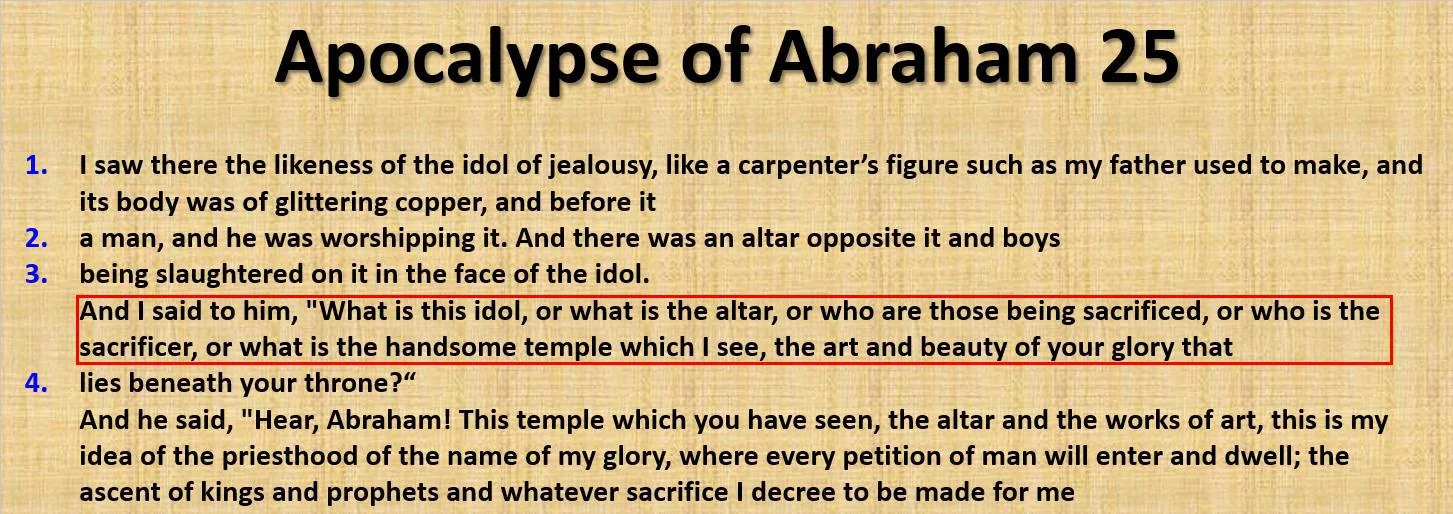
The statement, “In the last days, in this twelfth period of the age of my fulfillment, I will set up this man from your tribe…,” indicates that Allāh will raise a Prophet who will restore pure monotheism twelve centuries after the destruction of the Temple. The prophecy in this text begins with a vision in which Abraham (PBUH) sees some of his descendants worshipping idols inside a magnificent and beautiful temple—identified as the Temple of Solomon, which was built centuries after the time of this vision: “25 1I saw there the likeness of the idol of jealousy, like a carpenter’s figure such as my father used to make, and its body was of glittering copper, and before it a man, and he was worshiping it. 2And there was an altar opposite it and boys being slaughtered on it in the face of the idol. 3And I said to him, “What is this idol, or what is the altar, or who are those being sacrificed, or who is the sacrificer, or what is the handsome temple which I see, the art and beauty of your glory that lies beneath your throne?” (Apocalypse of Abraham 25:1-3).
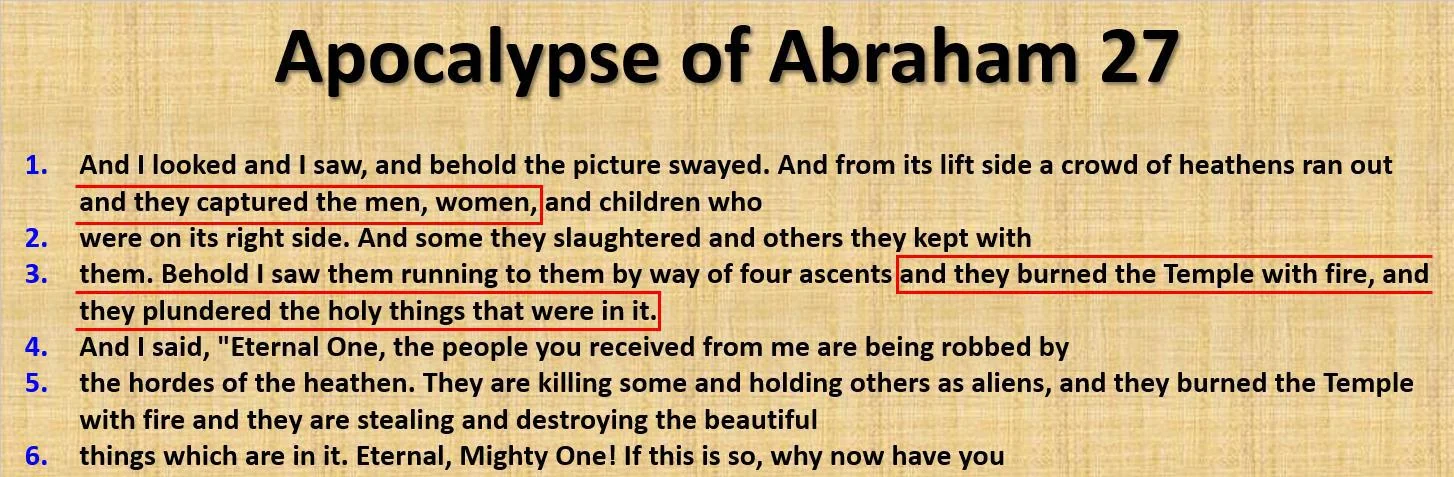
Allāh informed Abraham (PBUH) that, as a consequence of the idolatry committed within the Temple, those who defiled it through their disbelief would be exiled, and the Temple itself would be destroyed and its contents plundered: “27 1And I looked and I saw, and behold the picture swayed. And from its left side a crowd of heathens run out and they captured the men, women and children who were on its right side. 2And some they slaughtered and others they kept with them. 3Behold, I saw them running to them by way of four ascents. And they burned the Temple with fire, and they plundered the holy things that were in it” (Apocalypse of Abraham 27:1-3).

This prophecy was fulfilled when the Jews were exiled at the hands of Nebuchadnezzar II in the sixth century B.C.E.: “But because our fathers angered the God of heaven, he handed them over to Nebuchadnezzar the Chaldean, king of Babylon, who destroyed this temple and deported the people to Babylon” (Ezra 5:12).
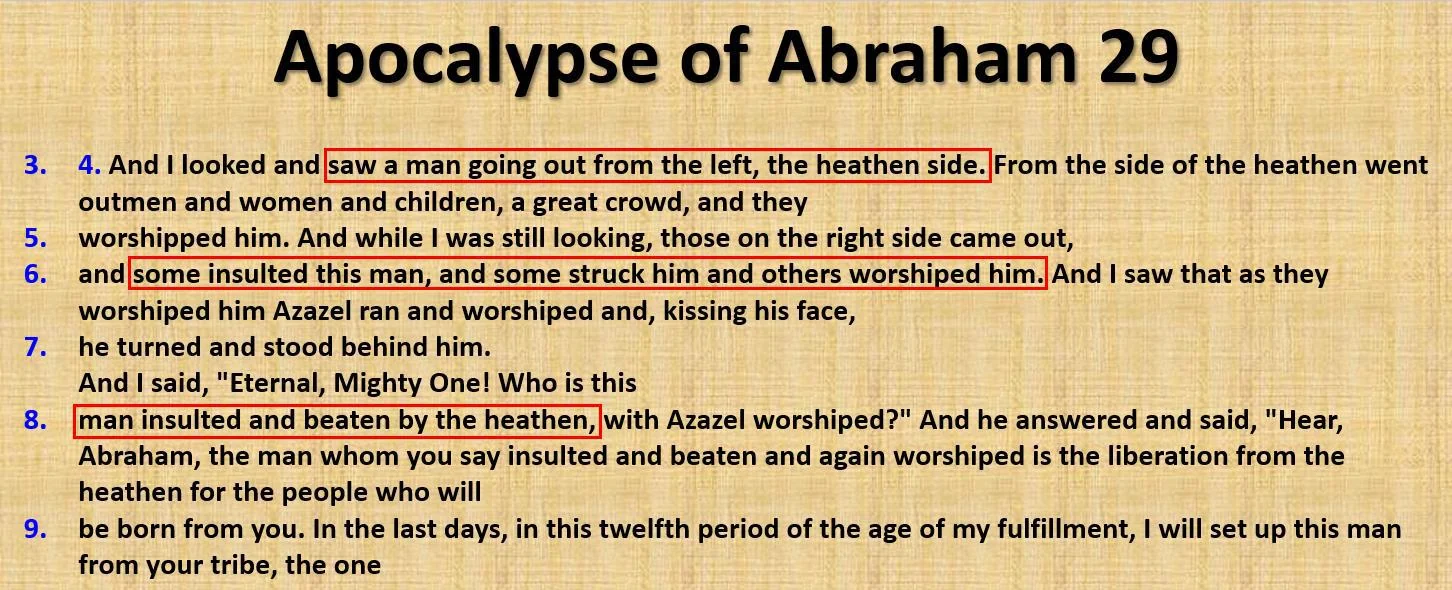
Indeed, the Jews of the ancient kingdom of Judah were exiled to Babylon as a consequence of their sins, and the contents of the Temple were plundered. Allāh revealed to Abraham (PBUH) that, twelve centuries after the destruction of this Temple, a great Prophet would arise among his descendants in the heart of the pagan lands. According to this prophecy, he would initially face opposition and harassment from these pagans, but ultimately he would be victorious and would be followed, obeyed, and honored by many: “29 4And I looked and saw a man going out from the left, the heathen side. From the side of the heathen went out men and women and children, a great crowd, and they worshiped him. 5And while I was still looking, those on the right side came out, and some insulted this man, and some struck him, and others worshiped him. 6And I saw that as they worshiped him, Azazel ran and worshiped, and kissing his face he turned and stood behind him” (Apocalypse of Abraham 29:4-7).
Allāh informed Abraham (PBUH) that, twelve centuries after the destruction of the Temple, this Prophet would arise to restore pure monotheism: “29 8And I said, “Eternal, Mighty One! Who is this man insulted and beaten by the heathen, with Azazel worshiped?” 9And he answered and said, “Hear, Abraham, the man whom you say insulted and beaten and again worshiped is the liberation from the heathen for the people who will be born from you. In the last days, in this twelfth period of the age of my fulfillment, I will set up this man from your tribe, the one whom you have seen from my people” (Apocalypse of Abraham 29:8-9).

History testifies that these prophetic statements were fulfilled: Prophet Muḥammad (PBUH)’s mission began twelve centuries after the destruction of the Jewish Temple. He (PBUH) was the only Prophet to emerge from the heart of the pagan lands. At the outset of his mission, he faced opposition from the pagans but ultimately triumphed over them and successfully spread monotheism. It should be noted that the Jewish Temple was destroyed twice. The first destruction, by Nebuchadnezzar II in the sixth century B.C.E., was due to the Jews’ idolatry. The second destruction, by the Romans in 70 C.E., was not due to idolatry and was so complete that no trace of the Temple remains to this day. The prophecy of Abraham (PBUH) refers specifically to the first destruction. As mentioned earlier, the same timing for the advent of Prophet Muḥammad (PBUH) is also indicated in the prophecy of Prophet Daniel (PBUH).