Does the Torah mention the descendants of Kedar and the mission of Prophet Muḥammad (PBUH) in the lands of Kedar?
Amazingly, the Torah mentions the descendants of Kedar and foretells the coming of a great figure who will emerge from the lands of Kedar, fight the pagans, and uphold the message of monotheism. The Torah proclaims that this person will not die until his Law is completed and the glorification of Allāh—a reference to the call to prayer—is heard in the mountains of Kedar, that is, the mountains of Makkah and the mountains of Selah in Yathrib (al-Madīnah). Without a doubt, one of the most famous prophecies concerning Prophet Muḥammad is found in chapter 42 of the Book of Isaiah: “42 1Here is my servant, whom I uphold, my chosen one in whom I delight; I will put my Spirit on him, and he will bring justice to the nations. 2He will not shout or cry out, or raise his voice in the streets. 3A bruised reed he will not break, and a smouldering wick he will not snuff out. In faithfulness he will bring forth justice; 4he will not falter or be discouraged till he establishes justice on earth. In his teaching the islands will put their hope.” 5 This is what God the Lord says—the Creator of the heavens, who stretches them out, who spreads out the earth with all that springs from it, who gives breath to its people, and life to those who walk on it: 6“I, the Lord, have called you in righteousness; I will take hold of your hand. I will keep you and will make you to be a covenant for the people and a light for the Gentiles, 7 to open eyes that are blind, to free captives from prison and to release from the dungeon those who sit in darkness. 8“I am the Lord; that is my name! I will not yield my glory to another or my praise to idols. 9See, the former things have taken place, and new things I declare; before they spring into being I announce them to you.” 10Sing to the Lord a new song, his praise from the ends of the earth, you who go down to the sea, and all that is in it, you islands, and all who live in them. 11Let the wilderness and its towns raise their voices; let the settlements where Kedar lives rejoice. Let the people of Sela sing for joy; let them shout from the mountaintops. 12Let them give glory to the Lord and proclaim his praise in the islands.” (Isaiah 42:1-12).
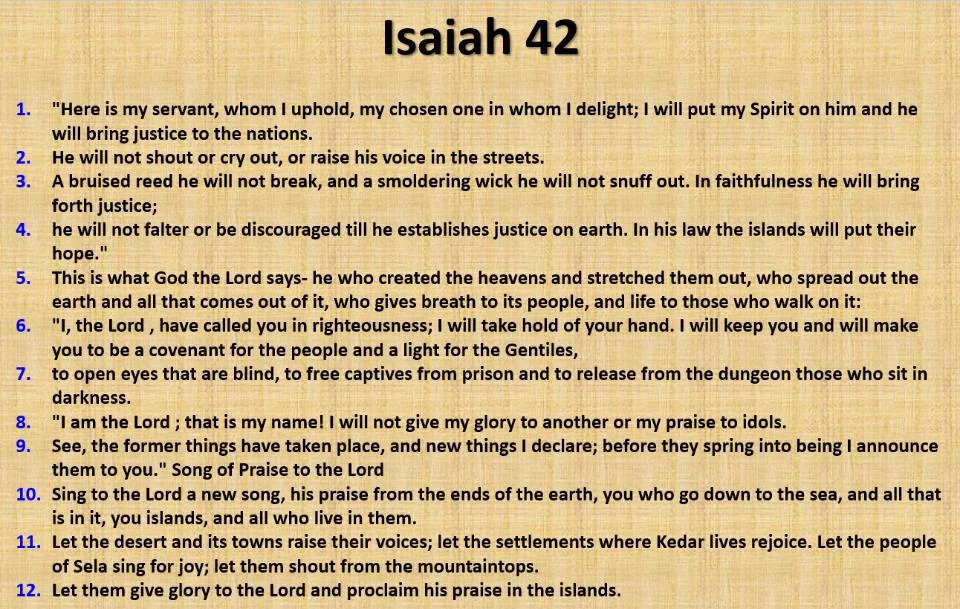
“Here is my servant, whom I uphold” means that the servant of God who will be supported by Him will come. The phrase “my chosen one in whom I delight” refutes the Christian claim that this prophecy refers to the Messiah (PBUH), for how could Jesus be chosen if, according to their belief, he was always the eternal Son of God? “I will put my Spirit on him, and he will bring justice to the nations” indicates that his message and Law will be sent to all mankind, whereas the other Prophets were sent to their own people. Jesus Christ, for instance, was sent only to the children of Israel; he said, “I was sent only to the lost sheep of Israel” (Matthew 15:24), in response to the Canaanite woman who asked him to heal her demon-possessed daughter.

Christians may claim that the call of Jesus (PBUH) later became universal—after the alleged crucifixion—but the text here refers to the chosen one whose message was meant for all nations from the outset. Prophet Muḥammad (PBUH) is the only one who fits this description perfectly. He (PBUH) said: “Every Prophet used to be sent to his nation exclusively but I have been sent to all of mankind.”1

Indeed, Prophet Muḥammad (PBUH) was sent to all mankind. Allāh says: {Say, ˹O Prophet,˺ “O humanity! I am Allāh’s Messenger to you all”} (Qurʾān 7:158). Let us continue with Isaiah 42: “He will not shout or cry out, or raise his voice in the streets.” Analogously, Jābir said: “He [Prophet Muḥammad] would observe silence for long periods of time.”2 Prophet Muḥammad (PBUH) was known for his quietness, and he was never heard shouting in the streets. However, chapter 5 of the Book of Hebrews reports that Jesus (PBUH) offered prayers and supplications with loud cries and tears: “During the days of Jesus’ life on earth, he offered up prayers and petitions with loud cries and tears to the one who could save him from death, and he was heard because of his reverent submission” (Hebrews 5:7).

Pay attention to the statement, “he was heard because of his reverent submission.” That is, Allāh, Exalted is He, answered Jesus (PBUH)’s prayers. The question arises: was he crucified even though Allāh answered his prayers? At any rate, this is not the topic of our present discussion, but it is worth raising. In truth, the description “he will not shout or cry out or raise his voice in the streets” does not apply to Jesus (PBUH), who is known for often reprimanding the Pharisees and for yelling at the corrupters. The Bible narrates an incident in which Jesus (PBUH)’s anger was evident: he made a whip from some ropes, chased the corrupt merchants out of the Temple, and said, “Get these things out of here. How dare you turn my Father’s house into a market!” (John 5:17).

Back to Isaiah 42: “A bruised reed he will not break, and a smouldering wick he will not snuff out” refers to the fact that Prophet Muḥammad (PBUH) never deviated from the path of guidance and did not act, even in the smallest matter, according to his own desires. As Allāh says: {By the stars when they fade away! Your fellow man [Muḥammad] is neither misguided nor astray. Nor does he speak of his own whims} (Qurʾān 53:1–3). “In faithfulness he will bring forth justice; he will not falter or be discouraged till he establishes justice on earth” means that the Prophet (PBUH) would never be defeated or disheartened. In other words, he (PBUH) delivered what was revealed to him from his Lord and fulfilled his task of Messengership. Indeed, he (PBUH) did not die until he perfected the Law, as Allāh revealed: {Today I have perfected your religion for you, completed My favour upon you, and chosen Islam as your religion} (Qurʾān 5:3). The statement “he will not falter or be discouraged” indicates that, thanks to Allāh’s protection, no one from among the disbelievers could harm the Prophet (PBUH) or prevail against him. Allāh says: {Allāh will ˹certainly˺ protect you from the evil of men} (Qurʾān 5:67). The phrase “In his teaching the islands will put their hope” signifies that the people of the islands, such as those of the Arabian Peninsula, would await his Law. The word “life” in the verse, “This is what God the Lord says—the Creator of the heavens, who stretches them out, who spreads out the earth with all that springs from it, who gives breath to its people, and life to those who walk on it,” refers to the divine revelation. Similarly, Allāh says: {And so We have revealed unto you ˹O Prophet˺ a life-giving message} (Qurʾān 42:52). The verse, “I, the Lord, have called you in righteousness; I will take hold of your hand,” conveys a meaning similar to the Qurʾānic verse: {Allāh will ˹certainly˺ protect you from the evil of men} (Qurʾān 5:67). “I will give you as a covenant for the people, a light for the nations” refers to the light of revelation, akin to the Qurʾānic verse: {O humanity! There has come to you conclusive evidence from your Lord. And We have sent down to you a brilliant light} (Qurʾān 4:174). The statement “a light for the nations” indicates that the Law of this Prophet is a guidance for all mankind. Indeed, Prophet Muḥammad (PBUH) was not appointed solely for his homeland or his era but for all humanity until the Day of Resurrection, as repeatedly stated in the Qurʾān: {We have sent you ˹O Prophet˺ only as a deliverer of good news and a warner to all of humanity} (Qurʾān 34:28). Does this prophecy apply to anyone other than Prophet Muḥammad (PBUH)? The verse “…to open eyes that are blind, to free captives from prison and to release from the dungeon those who sit in darkness” means that Allāh will open blind eyes and deaf ears and save people from Hell through him (PBUH), as He says: {And you were at the brink of a fiery pit and He saved you from it} (Qurʾān 3:103). Indeed, the People of the Book, since the time of the Prophet (PBUH), were fully aware that this chapter in the Book of Isaiah clearly refers to Prophet Muḥammad (PBUH). That is why ʿAbd Allāh ibn ʿAmr ibn al-ʿĀṣ—when asked about the description of Prophet Muḥammad (PBUH) in the Torah—said: “Yes. By Allāh, he is described in the Torah with some of the qualities attributed to him in the Qurʾān as follows: ‘O Prophet! We have sent you as a witness [for Allāh’s true religion] and a giver of glad tidings [to the faithful believers], and a warner [to the unbelievers] and guardian of the illiterates. You are My slave and My Messenger (i.e., Apostle). I have named you “al-Mutawakkil” (i.e., the one who relies upon Allāh). You are neither discourteous, harsh nor a noisemaker in the markets and you do not do evil to those who do evil to you, but you deal with them with forgiveness and kindness. Allāh will not let him (the Prophet) die till he makes straight the crooked people by making them say: “None has the right to be worshipped but Allāh,” with which will be opened blind eyes and deaf ears and enveloped hearts.”3
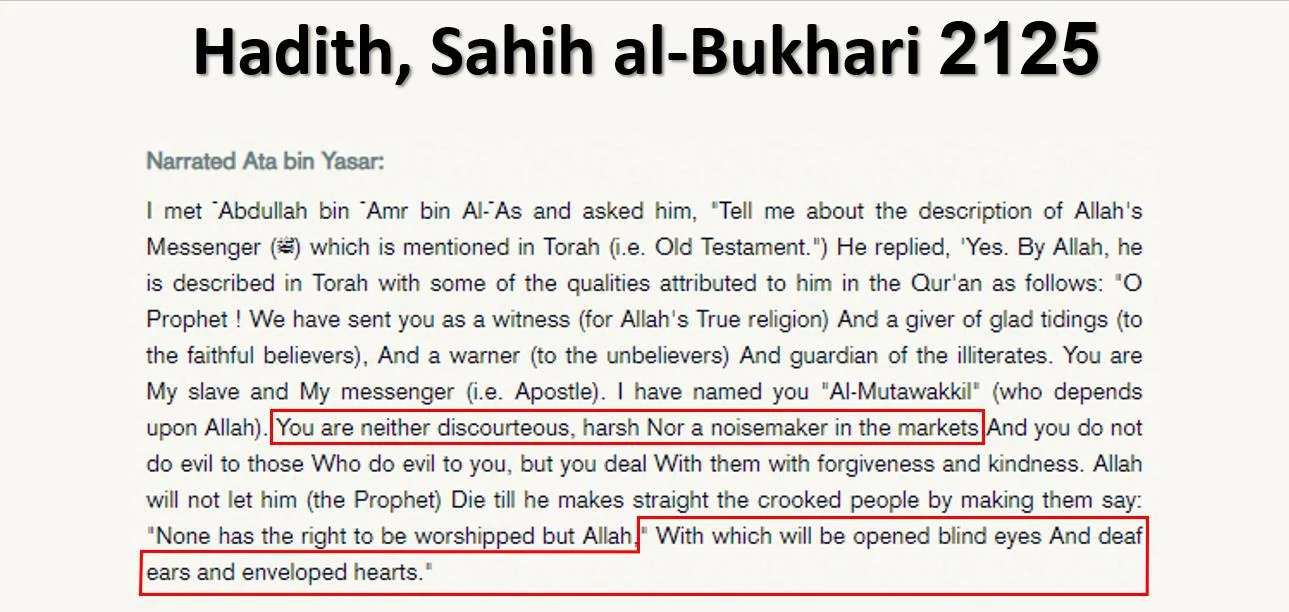
Indeed, Prophet Muḥammad (PBUH) is described in the Torah—particularly in the Book of Isaiah—and in the Qurʾān with the same attributes, expressed in remarkably similar terms:

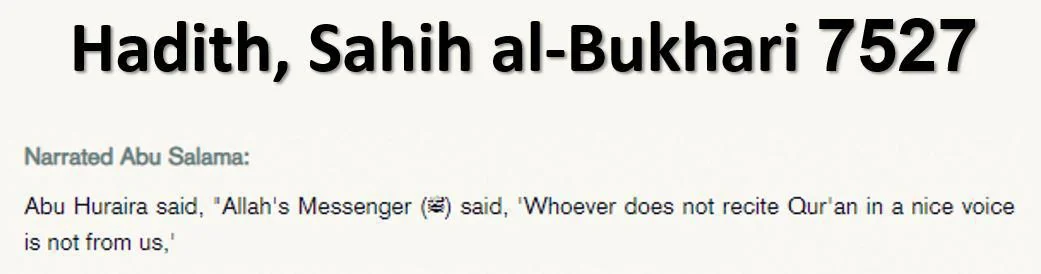
Let us continue with Isaiah 42: “I am the Lord; that is my name! I will not yield my glory to another or my praise to idols.” It is evident that Jesus (PBUH) was sent to the Children of Israel, whereas Prophet Muḥammad (peace be upon him) was sent to a people immersed in idolatry, calling them to {shun the impurity of idolatry} (Qurʾān 22:30). The verse, “See, the former things have taken place, and new things I declare; before they spring into being I announce them to you,” indicates that he would proclaim matters of the unseen—something the Prophet (PBUH) did, as previously discussed. Likewise, the statement “Sing to the Lord a new song” may be understood as a reference to the recitation of the Qurʾān according to its prescribed rules—that is, to recite it slowly, carefully, and distinctly, in a measured and melodious tone. The Prophet (PBUH) said: “Whoever does not recite Qurʾān in a nice voice is not from us.”4
The following verses contain remarkable truths: “42 10Sing to the Lord a new song, his praise from the ends of the earth, you who go down to the sea, and all that is in it, you islands, and all who live in them. 11Let the wilderness and its towns raise their voices; let the settlements where Kedar lives rejoice. Let the people of Sela sing for joy; let them shout from the mountaintops. 12Let them give glory to the Lord and proclaim his praise in the islands.” (Isaiah 42:10-12). Obviously, these verses refer to a new glorification of Allāh and to the call to prayer that this forthcoming Prophet would raise and spread widely. We have previously discussed the land inhabited by Kedar, the son of Ishmael and forefather of ʿAdnān. Accordingly, Kedar’s descendants settled in Makkah, and the settlements he inhabited subsequently became the dwellings of Quraysh. Without doubt, no Messenger other than Prophet Muḥammad (PBUH) came to warn the people of Makkah since Kedar lived in it. Allāh says: {so that you may warn a people whose forefathers were not warned, and so are heedless} (Qurʾān 36:6). He also says: {nor did We ever send them a warner before you ˹O Prophet˺} (Qurʾān 34:44). The new glorification—subḥāna Allāh (Glorified is Allāh)—and the call to prayer—Allāhu Akbar, Allāhu Akbar, Allāhu Akbar, Allāhu Akbar (God is Great, God is Great, God is Great, God is Great)—were only proclaimed with the coming of the Prophet of Islam (PBUH), who destroyed the idols and restored the monotheism of Abraham. Therefore, this prophecy applies to none other than Prophet Muḥammad (PBUH). Furthermore, verse 11 mentions “Sela,” which refers to Jabal Sāliʿ (Selah Mountain), a well-known mountain in al-Madīnah located approximately five hundred meters from the Prophet (PBUH)’s Mosque.5
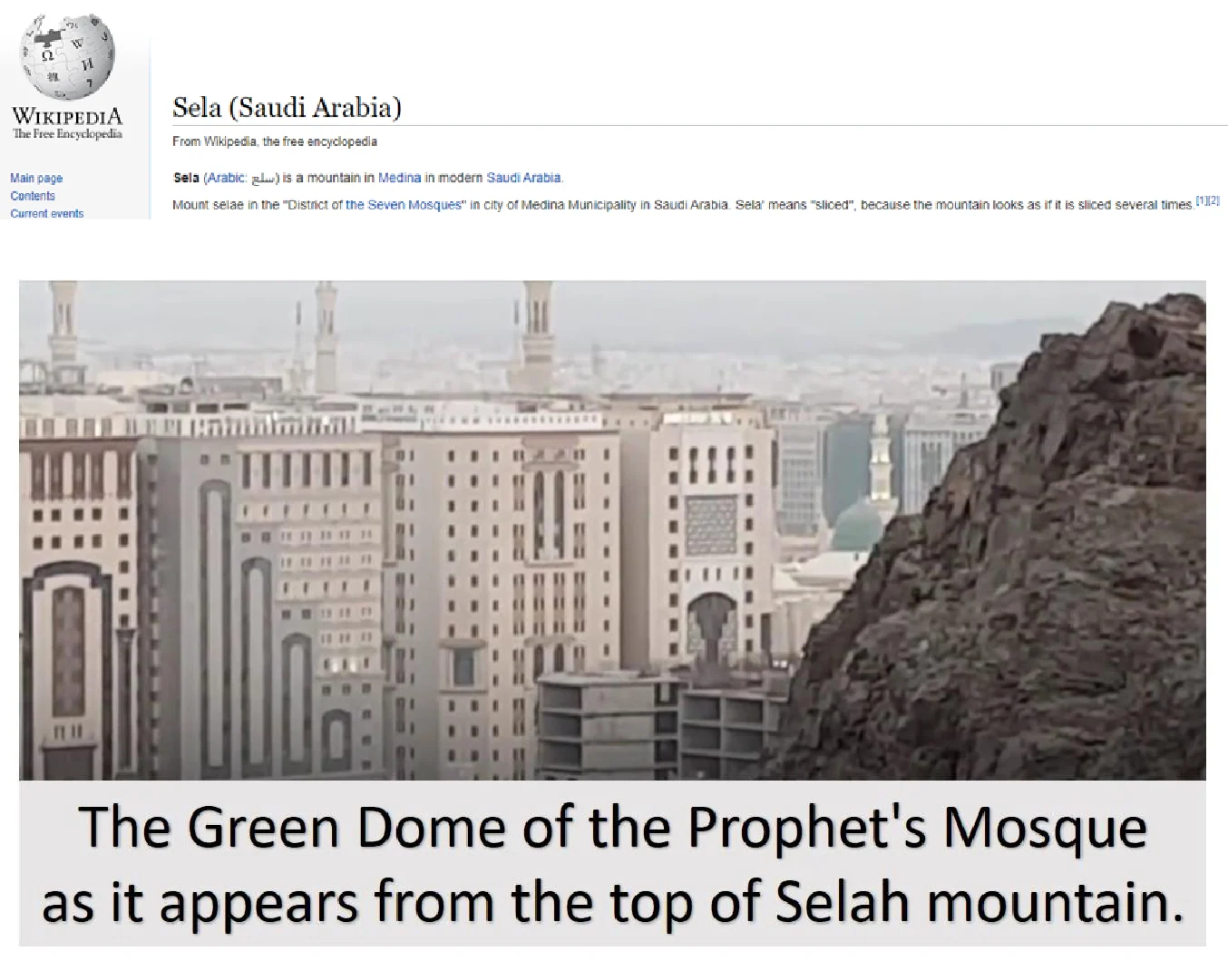
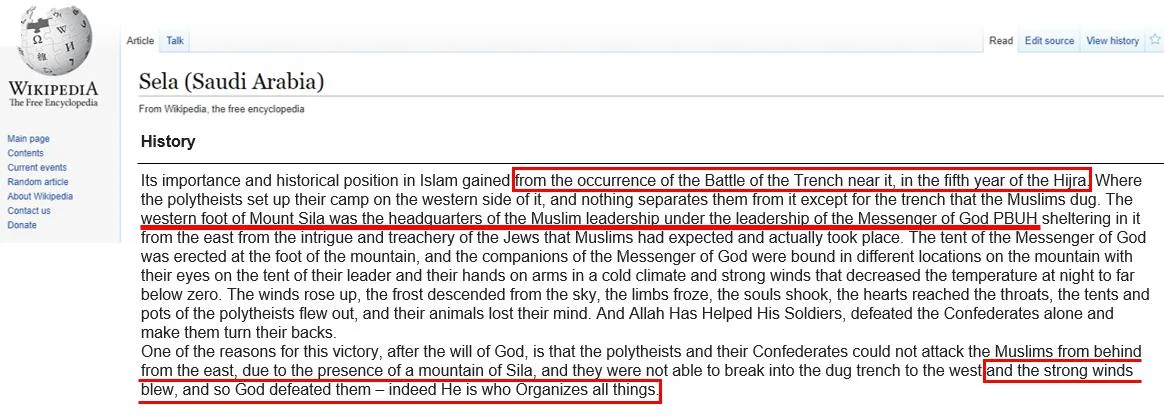
If one stands today upon Mount Sela one can hear the call to prayer from The Prophet (PBUH)’s Mosque and witness the fulfillment of the prophecy delivered by Prophet Isaiah (PBUH) to the Israelites approximately three thousand years ago. The significance of Mount Sela in Islamic history is closely tied to the events of the Battle of the Trench, also known as the Battle of the Confederates, which occurred in the fifth year after the Hijrah. During this battle, various polytheistic Arab tribes, in alliance with certain Jewish tribes, attempted to attack the Muslims in al-Madīnah. The Muslims deliberately positioned their camp along the western side of Mount Sela. The trench lay between them and the confederate forces, forming a protective barrier, while the mountain itself ensured that no enemy could approach them from behind. This location was strategically chosen. The Muslims were aware of the possibility of treachery from the Jewish tribes within al-Madīnah, and by stationing themselves beside Mount Sela, they secured their rear against any sudden betrayal. The mountain thus served as a natural fortification, preventing attacks from the east, while the trench blocked advances from the west. The Messenger of Allāh (PBUH) had a tent erected at the foot of the mountain, and the Companions were deployed in various positions along its slopes for defense. Allāh miraculously unleashed a violent wind against the confederate armies. Allāh says: {O believers! Remember Allāh’s favour upon you when ˹enemy˺ forces came to ˹besiege˺ you ˹in al-Madīnah˺, so We sent against them a ˹bitter˺ wind and forces you could not see} (Qurʾān 33:9). The Muslim camp remained protected, as it was stationed at the western foot of Mount Sela. In contrast, the confederate forces were fully exposed to the biting cold and relentless winds, which sowed fear and confusion among them, undermining their morale. Unable to breach the trench and prevented from attacking from behind due to the mountain’s presence, they eventually withdrew under the cover of night.6
The seven small mosques, which the Companions [may Allāh be pleased with them] built during the digging of the trench to serve as observation posts during the battle, remain at the foot of Mount Sela to this day. Turning to the Book of Isaiah, the verse, “Let the people of Sela sing for joy; let them shout from the mountaintops. Let them give glory to the Lord and proclaim his praise in the islands,” refers to the followers of Prophet Muḥammad (PBUH), who are known for chanting from mountain tops such as Mount ʿArafah, Mount ar-Raḥmah, and the two hills of aṣ-Ṣafā and al-Marwah. Indeed, Muslim pilgrims spend the entire day on Mount ʿArafah, invoking Allāh for forgiveness and chanting as they ascend the plateau, “labbayka Allāhumma labbayk (O Allāh, here I am, answering Your call).” This verse also signals that the Prophet (PBUH)’s followers will spread the message of the Lord to all nations across the earth. Without a doubt, the prophecy in chapter 42 of the Book of Isaiah provides clear evidence that Prophet Muḥammad (PBUH) is mentioned in the Torah.
Notes and References
- 1
Muḥammad al-Bukhārī, Ṣaḥīḥ al-Bukhārī, (Cairo, Egypt: Dār as-Salām. 1999), ḥadīth: 438, available at: https://sunnah.com/bukhari:438.
- 2
Muḥammad Nāṣir ad-Dīn al-ʾAlbānī, Ṣaḥīḥ al- Jāmiʿ aṣ-Ṣaġīr, (Bayrūt, Lebanon: al-Maktab al-Islāmī, 1988), ḥadīth: 4822.
- 3
Muḥammad al-Bukhārī, Ṣaḥīḥ al-Bukhārī, (Cairo, Egypt: Dār as-Salām. 1999), ḥadīth: 2125, available at: https://sunnah.com/bukhari:2125.
- 4
Muḥammad al-Bukhārī, Ṣaḥīḥ al-Bukhārī, (Cairo, Egypt: Dār as-Salām. 1999), ḥadīth: 7527, available at: https://sunnah.com/bukhari:7527.
- 5
Wikipedia Contributors, “Sela (Saudi Arabia),” Wikipedia: The Free Encyclopedia, last edited 20 Feb. 2021, https://en.wikipedia.org/wiki/Sela_(Saudi_Arabia).
- 6
Ibid.