Where did the Jews claim that Ezra is the son of God?
Ezra was highly revered by the Jews, as he was the restorer of their Scriptures, which had been lost during their captivity in Babylon. The Jews had lost much of their knowledge of their national language (Hebrew), their traditions, and their Law, and Ezra rewrote the Old Testament and revived the Law. For this reason, they employed highly exalted language in expressing their veneration for him, which, led some Jewish sects to describe him as “the son of God.” Allāh says: {The Jews say, “ʿUzayr is the son of Allāh”} (Qurʾān 9:30). It should be noted that the Qurʾān does not imply that all Jews were unanimous in declaring Ezra to be the son of God; rather, it indicates that their articles of faith had been so perverted that some among them came to hold this belief. Moreover, Ezra (PBUH) occupied such an elevated position in the eyes of his people that later tradition deified him, portraying him as a God-like figure. In other words, he was apotheosized. The deification of Ezra and his elevation to a divine rank are associated with the Second Book of Esdras, a pseudepigraphal apocalyptic work linked to Ezra, the so-called author of the Book of Ezra. This work held considerable importance in the Roman Catholic Church during the Middle Ages, as evidenced by the numerous surviving manuscripts and its attachment to the Vulgate, the Latin translation of the Bible widely used in the Western Church at that time. Accordingly, the Coptic Orthodox Church Heritage website states: “There is also a Syriac translation and other Abyssinian, Arabic, and Armenian translations, but all of them—with the exception of one or two Arabic manuscripts—are taken from the missing Greek translation. These numerous translations indicate that Esdras II was widespread, and the Greek and Latin Fathers quoted it as a true prophetic book.”

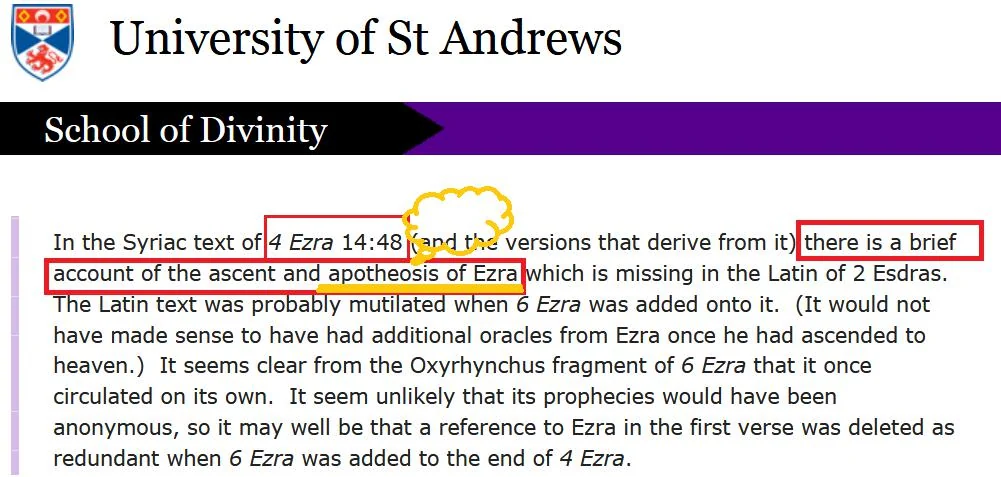
The deification of Ezra is recounted in apocryphal works such as 4 Ezra (sometimes called 2 Esdras), which is highly regarded in certain Biblical traditions. According to the University of St Andrews website, the Syriac text of 4 Ezra 14:48, along with the versions derived from it, contains a brief account of Ezra’s ascent and apotheosis.1
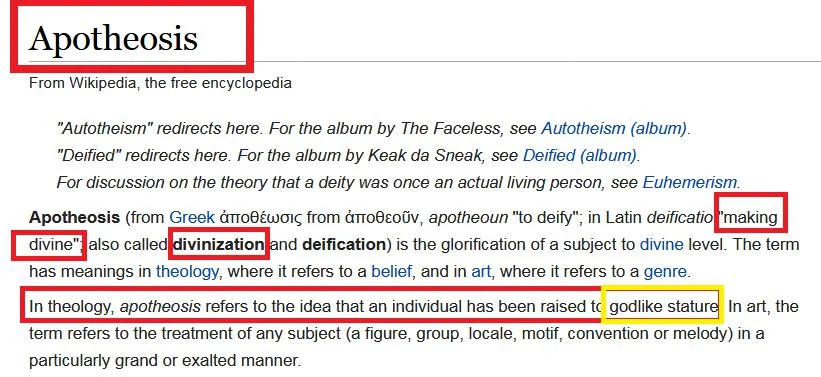
In theology, the term “apotheosis” refers to the deification of an individual—that is, the act of raising someone to a god-like status.2
It is noteworthy that some churches, such as the Ethiopian Orthodox Church, continue to regard 4 Ezra as canonical to this day.3

Finally, it is worth noting that the study of the Scriptures of the People of the Book—including both the canonical and apocryphal texts—by knowledgeable specialists can open a significant avenue for daʿwah (inviting people to Allāh), as it can reveal numerous proofs of the truthfulness of Prophet Muḥammad (PBUH) and help resolve many theological dilemmas in the Torah and the Bible. Unfortunately, sufficient attention has not been given to the study of the prophecies in the Scriptures of previous nations, and this endeavor truly requires dedicated research centers staffed with qualified specialists.
Notes and References
- 1
James R. Davila, “THE BOOK OF 4 EZRA (Handout for a lecture),” The University of St Andrews, 19 Apr. 2002, https://otp.wp.st-andrews.ac.uk/abstracts-lectures/4-ezra/.
- 2
Wikipedia Contributors, “Apotheosis,” Wikipedia: The Free Encyclopedia, last edited 8 March 2021, https://en.wikipedia.org/w/index.php?title=Apotheosis&oldid=1011028191.
- 3
Wikipedia Contributors, “2 Esdras,” Wikipedia: The Free Encyclopedia, last edited 22 Sep. 2024, https://en.wikipedia.org/wiki/2_Esdras.