What did Prophet Daniel (PBUH) see in his dream, and how did he interpret it?
Daniel’s prophecy is the same as the one Jesus (PBUH) delivered to his disciples centuries after Daniel’s death. It is among the most significant prophecies in the Old Testament concerning the coming of Prophet Muḥammad (PBUH) and the emergence of the Islamic nation. ʿAbd al-ʾAḥad Dāwūd (formerly Rev. David Benjamin Keldani), a former priest of Urmia, described it as “the most wonderful and, perhaps, the most manifest prophecy about the divine mission of the greatest man and the Apostle of God.”1 Prophet Daniel (PBUH) saw in his vision, with remarkable accuracy, the great unbelieving kingdoms of the earth and the stone by which Allāh would destroy them. He (PBUH) also saw a nation that would rise in the middle of the seventh century A.D. (around 640 A.D.) and conquer these kingdoms. This timing coincides precisely with the era of the Rightly-Guided Caliphate. It is astounding that Prophet Daniel (PBUH) foretold these events more than a thousand years before they occurred. To understand Daniel (PBUH)’s prophecy, Jerusalem was once a great city, ruled by noble Prophets of Allāh such as David and Solomon, where pure monotheism prevailed. Over time, however, paganism began to spread among the Children of Israel, and they strayed from the teachings of their Prophets. Allāh informed His Prophets that He would remove the favor He had bestowed on the Children of Israel because they failed to uphold their covenant with Him. They had been entrusted with the Truth not only to follow it themselves but also to guide others toward it. The Jewish Prophets warned the Children of Israel that, due to their disobedience, the nations would exile them. Indeed, in the fifth century B.C., the “Babylonian exile” or “Babylonian captivity” took place, during which the Children of Israel were exiled to Babylon under the rule of Nebuchadnezzar.
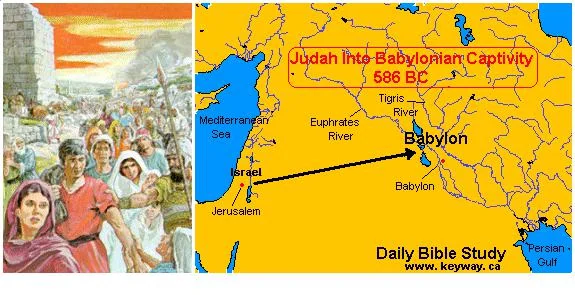
Daniel (PBUH) was a great Prophet during the period of captivity in Babylon. He is mentioned in certain traditions attributed to Prophet Muḥammad (PBUH), although the chains of transmission of these traditions are subject to scholarly debate. It is narrated that Prophet Muḥammad (PBUH) said: “Whoever discovers [the body of] Daniel, give him glad tidings of Paradise.”
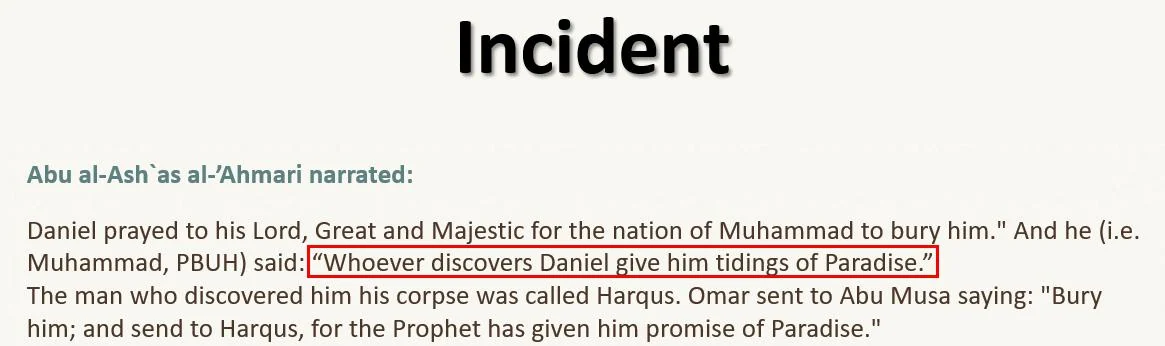
The chain of transmission of this tradition is disputable. Nevertheless, when the city of Shushtar (in ancient Persia) was conquered, the Companions found in the treasury of al-Hurmuzān (the Persian military commander and ruler of the region) a bier upon which lay a deceased man, with a sacred scripture placed by his head. It is reported that the body had not decayed, even though the man had been dead for three hundred years. The Companions learned from the people of Shushtar—who used to carry the bier outside to supplicate for rain during times of drought—that it was the body of Prophet Daniel (PBUH). The Companions [may Allāh be pleased with them] dug thirteen separate graves during the day, then buried him (PBUH) at night and levelled all the graves so that no one would be able to identify the exact site and exhume him.
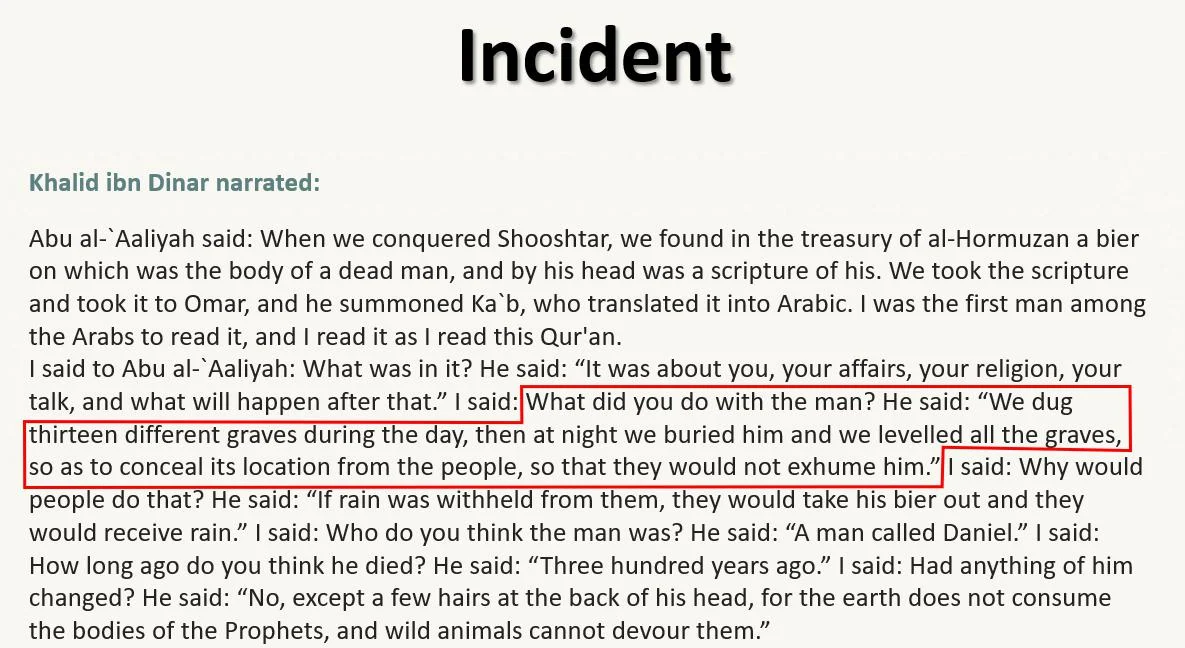
The Companions [may Allāh be pleased with them] sent the scripture that had been placed by Daniel (PBUH)’s head to ʿUmar ibn al-Khaṭṭāb. Remarkably, when it was translated, they learned that it spoke about them (i.e., the Companions of the final Prophet)—their religion, their affairs, their speech, and other future events. Indeed, the scripture found by the head of Daniel (PBUH) is identified as the Book of Daniel, one of the Books of the Torah read by Jews and Christians to this day. Most notably, this Book foretold the era of ʿUmar ibn al-Khaṭṭāb and heralded the conquest of the kingdoms of the earth at the hands of the Islamic nation. It could be that Daniel (PBUH) supplicated to his Lord to be buried by the people of Allāh’s new kingdom upon their conquest of the unbelieving kingdoms.
Let us now recount Daniel (PBUH)’s prophecy as recorded in the Book of Daniel. It begins with a strange dream seen by King Nebuchadnezzar of Babylon—then the great world power, somewhat like the “America” of the ancient world. The dream so troubled the king that he could not sleep, and he demanded its interpretation. Consequently, he summoned the city’s Jewish elders, along with the enchanters, sorcerers, magicians, and Chaldeans who were renowned as astrologers. Nebuchadnezzar expected these men not only to interpret the dream, but to tell him what it was without being informed. When they confessed that they could not do so, the king became enraged and ordered that all the “wise” men of Babylon be put to death. Daniel (PBUH), the Israelite Prophet, whom Allāh had blessed with knowledge, wisdom, and the interpretation of dreams, learned of the matter. He (PBUH) requested time from the king so that he might interpret the dream. During the night, Allāh granted Daniel (PBUH) a vision in which both the king’s dream and its meaning were revealed to him. Daniel (PBUH) praised Allāh and then sought an audience with the king. The meeting between Daniel (PBUH) and the king is narrated in the second chapter of the Book of Daniel:
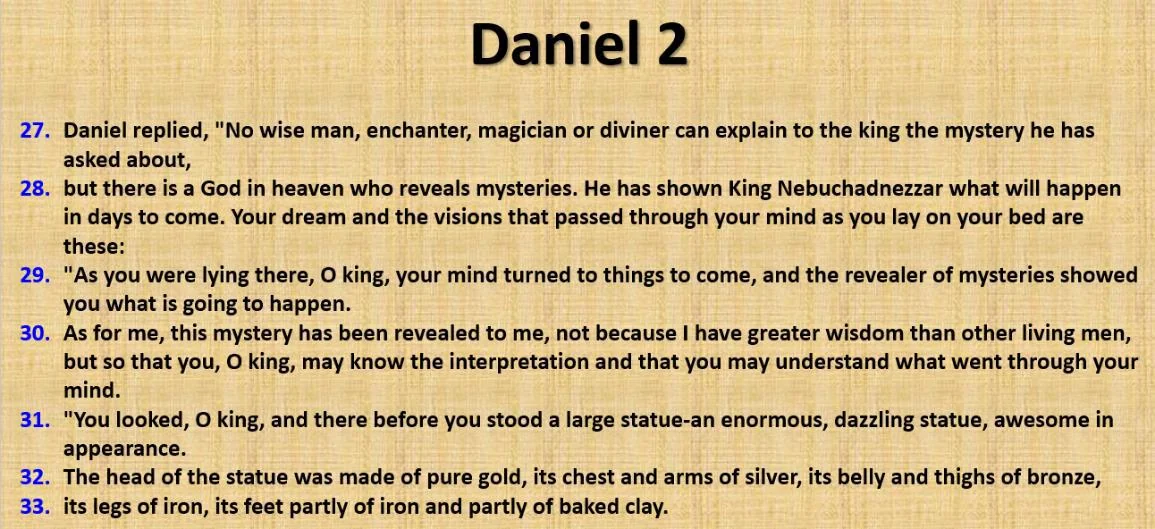
Daniel (PBUH) told the king that no human being on earth could tell him what he saw and that only Allāh could provide him with an answer, since revelation comes from Allāh to Man and is not a human achievement. “26 The king asked Daniel, “Are you able to tell me what I saw in my dream and interpret it?” 27 Daniel replied, “No wise man, enchanter, magician or diviner can explain to the king the mystery he has asked about, 28 but there is a God in heaven who reveals mysteries. He has shown King Nebuchadnezzar what will happen in days to come” (Daniel 2:26-28). Daniel (PBUH), through Allāh, was able to tell the king the dream because the secret was revealed to him in a night vision: “30 As for me, this mystery has been revealed to me, not because I have greater wisdom than other living men, but so that you, O king, may know the interpretation and that you may understand what went through your mind” (Daniel 2:30). Daniel (PBUH) told the king that his dream concerned future events: “28 Your dream and the visions that passed through your mind as you were lying in bed are these: 29 As you were lying there, O king, your mind turned to things to come, and the revealer of mysteries showed you what is going to happen” (Daniel 2:28-29). Daniel (PBUH) described the king’s dream as a vision of a very large and bright statue: its head was made of gold; its chest and arms were made of silver; its belly and thighs were made of bronze; its legs were made of iron; and its feet were part iron and part baked clay: “31 You looked, O king, and there before you stood a large statue—an enormous, dazzling statue, awesome in appearance. 32 The head of the statue was made of pure gold, its chest and arms of silver, its belly and thighs of bronze, 33 its legs of iron, its feet partly of iron and partly of baked clay” (Daniel 2:31-33). The second chapter of the Book of Daniel further reads:

“While you were watching, a rock was cut out, but not by human hands. It struck the statue on its feet of iron and clay and smashed them.” (Daniel 2:34). That is, the stone comes from Allāh. This is Jesus’s prophecy about the “stone which has become the capstone,” which is well known to the Jews.
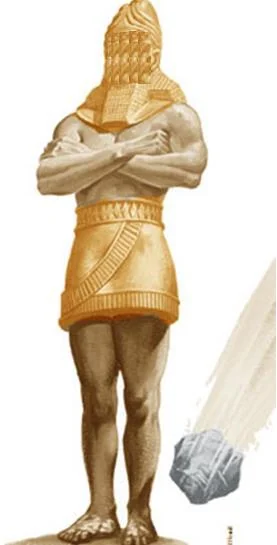
“Then the iron, the clay, the bronze, the silver and the gold were all broken to pieces and became like chaff on a threshing floor in the summer. The wind swept them away without leaving a trace. But the rock that struck the statue became a huge mountain and filled the whole earth” (Daniel 2:35). This verse refers to the Islamic nation, which has risen to prominence through the conquest of the greatest kingdoms of the earth, thereby allowing the message of Islam to spread throughout the world and continue to spread to this day. Daniel then started the interpretation of the dream, which concerns the emergence of four kingdoms that will eventually be destroyed by “the stone.” He (PBUH) said to the king: “36 This was the dream, and now we will interpret it to the king. 37 You, O king, you are the king of kings. The God of heaven has given you dominion and power and might and glory; 38 in your hands he has placed all mankind and the beasts of the field and the birds in the sky. Wherever they live, he has made you ruler over them all. You are that head of gold. 39 After you, another kingdom will arise, inferior to yours. Next, a third kingdom, one of bronze, will rule over the whole earth. 40 Finally, there will be a fourth kingdom, strong as iron—for iron breaks and smashes everything—and as iron breaks things to pieces, so it will crush and break all the others. 41 Just as you saw that the feet and toes were partly of baked clay and partly of iron, so this will be a divided kingdom; yet it will have some of the strength of iron in it, even as you saw iron mixed with clay” (Daniel 2:37-41). According to Daniel’s interpretation, given to him by Allāh, the statue’s head represented Babylon, and the other parts symbolized the successive kingdoms that would replace Babylon. In other words, the statue represented a sequence of empires, each less glorious than the one before, as reflected in the decreasing value of the metals. Thus, the next kingdom to arise will be inferior to Babylon, and the one after that likewise. These earthly kingdoms—the Babylonian, Persian, Greek, and Roman Empires—will ultimately be destroyed by “the stone.” What will occur after the destruction of these four kingdoms? The answer is found in the second chapter of the Book of Daniel, which further reads:

“In the time of those kings, the God of heaven will set up a kingdom that will never be destroyed, nor will it be left to another people. It will crush all those kingdoms and bring them to an end, but it will itself endure forever” (Daniel 2:44). Finally, Allāh will establish a kingdom that will put an end to the other kingdoms and will never be destroyed—the stone that struck the statue’s feet and made it crumble. The law of this last kingdom will remain until the Hour is established. “This is the meaning of the vision of the rock cut out of a mountain, but not by human hands—a rock that broke the iron, the bronze, the clay, the silver and the gold to pieces. The great God has shown the king what will take place in the future. The dream is true and its interpretation is trustworthy” (Daniel 2:45). The stone comes from Allāh, signifying that the nation which will inherit His new kingdom will be supported by Him and assured of victory. “46 Then King Nebuchadnezzar fell prostrate before Daniel and paid him honor and ordered that an offering and incense be presented to him. 47 The king said to Daniel, ‘Surely your God is the God of gods and the Lord of kings and a revealer of mysteries, for you were able to reveal this mystery.’ 48 Then the king placed Daniel in a high position and lavished many gifts on him. He made him ruler over the entire province of Babylon and placed him in charge of all its wise men” (Daniel 2:46-48). It was permissible to prostrate oneself before someone of great importance before the advent of Islam.
Unquestionably, Allāh provided an overview of the world events in the millennia yet to come through Nebuchadnezzar’s dream. As previously noted, the four kingdoms have been identified as the Babylonian, Persian, Greek, and Roman Empires. Indeed, the Islamic nation triumphed over these four empires and spread the message of monotheism throughout the world.
Notes and References
- 1
David Benjamin Keldani, Muḥammad in the Bible, (ad-Dammām, Saudi Arabia: Esbah Publishing House, 2012), p. 73, available at: http://www.minbible.com/Books/English/English_F/Main.html.